The first night Clara Bennett arrived at Whitaker Manor, she discovered that the house was almost as broken as the family living inside it.
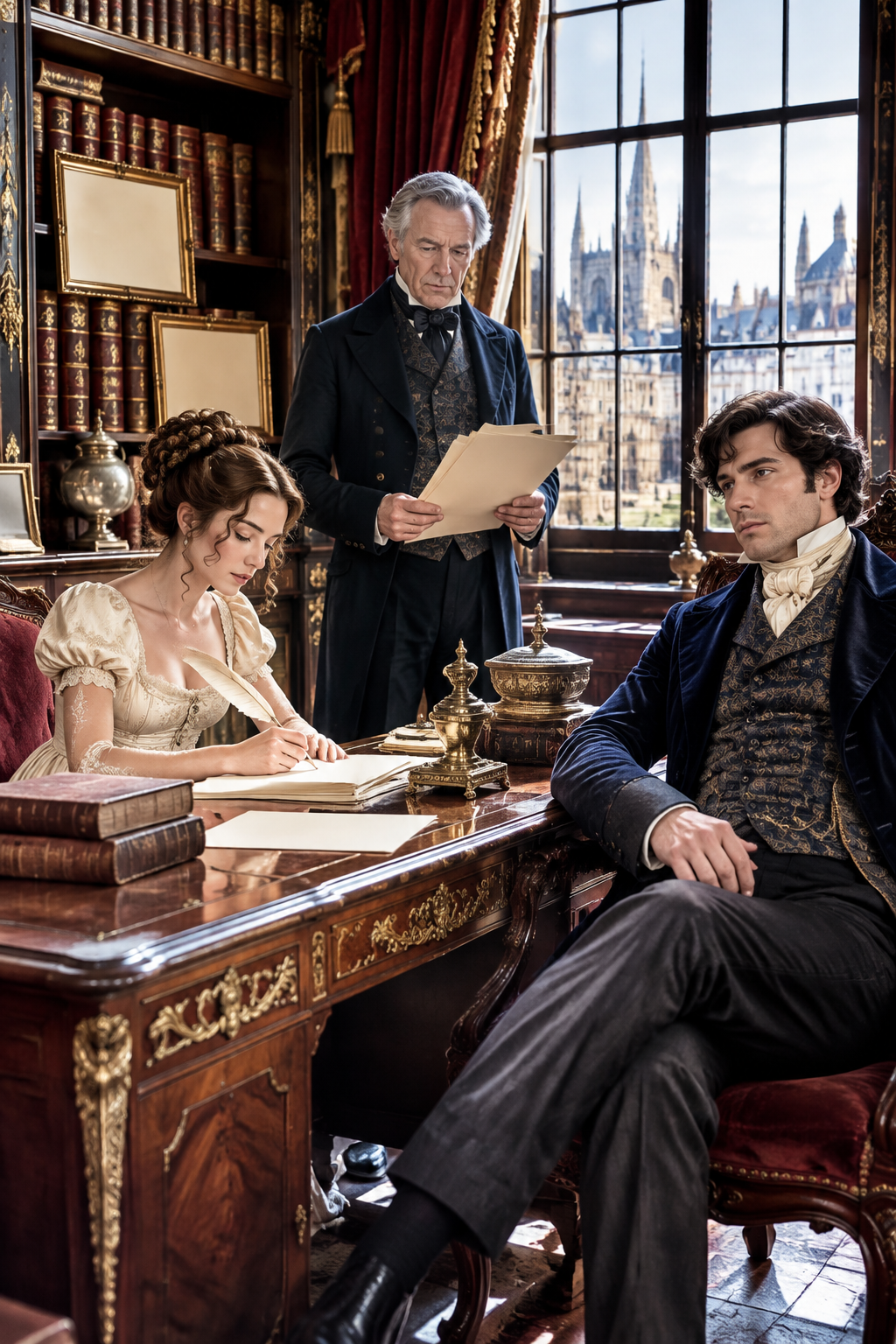
The envelope lay between Clara and Nathaniel.
For several seconds, neither of them spoke.
Clara carefully broke the seal and unfolded the papers inside. The first page contained the names of Nathaniel’s late brother, Thomas, and his wife, Margaret. Beneath them were dates, financial records, and a handwritten statement.
“What is this?” Clara asked.
Nathaniel pulled out a chair but remained standing.
“It’s the truth about Rose and Samuel’s parents.”
Clara looked up.
“They were my brother’s children. Thomas and Margaret died three years ago. Their deaths left the children in my care.”
“I’m sorry,” Clara said softly.
Nathaniel nodded, but his expression remained hard.
“Thomas was a good man. He loved his family. But he trusted the wrong people.”
He pointed to several entries in the documents. Thomas had borrowed money to expand a business, and someone had convinced him to sign over control of several family properties. When the business collapsed, the debts grew beyond anything he could manage.
“Margaret died first,” Nathaniel continued. “Thomas followed her less than a year later. He never recovered from losing her.”
Clara slowly turned another page.
There was something else.
A legal document showed that Thomas had named Nathaniel as guardian of both children. However, the inheritance left for Rose and Samuel was supposed to remain untouched until they reached adulthood.
“Why are you showing me this?” Clara asked.
Nathaniel looked toward the window.
“Because someone has been trying to take what belongs to them.”
Clara’s fingers tightened around the paper.
He explained that the children’s inheritance included a substantial trust, land, and several properties. Nathaniel had been appointed to protect it. But a distant relative named Edward Whitaker had challenged the arrangement.
Edward believed Nathaniel was unfit to manage the estate. He had already contacted lawyers and made accusations about Nathaniel’s handling of the family’s money.
“He’s telling people I’ve been wasting the children’s inheritance,” Nathaniel said. “If he convinces the court, he’ll become their legal guardian and gain control of the trust.”
“Do you have proof that he’s lying?”
Nathaniel hesitated.
“Some. Not enough.”
Clara looked again at the financial records.
Suddenly, the strange expenses she had discovered made more sense.
“These payments,” she said, pointing to several entries. “They aren’t household expenses. They’re transfers to the same account.”
Nathaniel leaned closer.
“Where did you find that?”
“In the old ledgers. There are payments going back almost two years.”
He examined the numbers carefully.
For the first time since Clara had arrived, his guarded expression changed.
“Edward.”
Clara looked at him.
“You think he’s been taking money?”
“I think he may have been using the children’s accounts to make it look as though I’ve been stealing from them.”
The room fell silent.
Clara gathered the papers.
“Then we need to find out exactly where the money went.”
Nathaniel studied her for a long moment.
“You don’t have to involve yourself in this.”
“I became responsible for this household when I signed the agreement. And those children deserve better than another adult who walks away when things become difficult.”
Nathaniel said nothing.
But that evening, he allowed Clara access to every account book, receipt, and legal document in the estate.
It was the first time he had truly trusted her with something important.
Over the following week, Clara worked almost every waking hour.
She compared old ledgers with bank statements, organized receipts, and made a list of every payment she could not explain.
The more she investigated, the more troubling the situation became.
Several payments had been made to a company that no longer existed. Others had been approved using Nathaniel’s signature, but the handwriting looked slightly different.
She also discovered that the money had been moved through several accounts before disappearing.
One afternoon, Clara found a small packet of letters tucked inside an old account book.
They were written by Thomas.
The letters described his growing concerns about Edward. Thomas had suspected that his cousin was using family investments for personal gain. He had even planned to confront him before his sudden decline.
At the bottom of one letter was a sentence that made Clara stop reading.
“If anything happens to me, Nathaniel must know that Edward has access to the children’s trust.”
Clara immediately brought the letter to Nathaniel.
He read it twice.
His jaw tightened.
“Why didn’t Thomas tell me?”
“Perhaps he was afraid,” Clara answered. “Or perhaps he never had the chance.”
Nathaniel sat down slowly.
For years, he had blamed himself for not protecting his brother. Now he was discovering that the danger might have been much closer than he had imagined.
That night, Clara found him sitting alone in the library.
A glass of untouched whiskey rested on the table.
“You’re going to make yourself ill if you keep sitting here without eating,” she said.
“I’ve spent three years trying to keep this family together.”
“And you’ve spent three years refusing to let anyone help you.”
He looked at her sharply.
“You think it’s that simple?”
“No. I think it’s difficult. But being alone doesn’t make it easier.”
Nathaniel looked away.
Clara sat across from him.
She didn’t ask him to talk about his grief. She simply remained there until he finally spoke.
“Thomas was the only person who ever understood me,” he said. “After he died, I thought the safest thing was to keep everyone at a distance. I couldn’t bear losing anyone else.”
Clara’s expression softened.
“Then perhaps you’ve been protecting yourself so fiercely that you’ve forgotten to protect the people still here.”
Nathaniel stared at her.
He had no answer.
The next morning, Clara found Samuel waiting outside her bedroom.
He was holding a broken wooden horse.
“Can you fix this?” he asked.
Clara smiled.
“I can try.”
Samuel looked down.
“It belonged to my father.”
She took the toy carefully.
“Then we’ll do our best.”
He hesitated before asking, “Do you think he would have liked me?”
Clara knelt in front of him.
“I’m sure he would have loved you. And I think he would be proud of how brave you’ve been.”
Samuel’s eyes filled with tears.
For the first time, he allowed someone to hug him without pretending he didn’t need it.
Rose began changing, too.
She started following Clara around the garden and asking questions about flowers, books, and the world beyond Whitaker Manor.
One afternoon, she brought Clara a drawing.
It showed four people standing outside a large house. Samuel was holding a wooden horse. Rose was holding Clara’s hand. Nathaniel stood beside them.
Clara studied the picture.
“Who’s this?” she asked, pointing to the fourth figure.
Rose smiled shyly.
“That’s you. I made you taller because you’re the one who keeps everyone safe.”
Clara felt her throat tighten.
She carefully placed the drawing on the mantelpiece.
Nathaniel noticed it that evening.
He stood looking at it for a long time.
“She hasn’t drawn anything like this since her mother died,” he said.
Clara smiled.
“Children need somewhere to put the things they can’t say.”
He glanced at her.
“And what about adults?”
“They need somewhere to put them, too.”
For a moment, Nathaniel almost smiled.
Then came the letter that changed everything.
It arrived on a rainy Tuesday morning.
The court had scheduled a hearing regarding the children’s inheritance and guardianship. Edward had formally requested that Nathaniel be removed as trustee.
Worse, he had submitted financial documents suggesting that Nathaniel had misused the estate.
The hearing would take place in three weeks.
Nathaniel read the letter twice before placing it on his desk.
“He has made his move,” he said.
Clara immediately began gathering their evidence.
They had the old letters, suspicious transfers, and the mismatched signatures. But they still needed to prove that the money had gone into Edward’s control.
Without that connection, the court might believe the accusations.
Nathaniel contacted his solicitor, Mr. Collins, who promised to investigate the accounts.
Meanwhile, Clara continued managing the household.
She refused to let the court case become the only thing the children experienced.
She organized lessons for Rose, encouraged Samuel to help repair the garden fence, and made sure they had time to play.
But the pressure was beginning to show.
Nathaniel slept little and spent most of his time in the study.
One evening, Clara found him staring at an old photograph of Thomas.
“You can’t save everyone by punishing yourself,” she said.
Nathaniel put the photograph down.
“I should have noticed what Edward was doing.”
“Perhaps. But you can’t change what happened three years ago. You can decide what happens now.”
He looked at her for a long time.
“Why do you care so much?”
Clara thought about Eliza.
Because she knew what it meant to watch someone you loved suffer. Because she understood the fear of losing the only family you had left.
“Because I know what it feels like when the world becomes too heavy to carry alone.”
Nathaniel reached across the desk and gently took her hand.
It was a small gesture.
But Clara didn’t pull away.
Neither did he.
A few days later, Mr. Collins returned with troubling news.
He had traced several transfers to a private company registered under the name of Edward’s business partner. The company had been used to purchase land and luxury goods.
But the most important discovery was still missing.
The original authorization documents.
Without them, Edward could claim the transfers had been approved by Nathaniel.
Mr. Collins believed the documents might be hidden in the old business office on the far side of the estate.
The office had been locked since Thomas’s death.
Nathaniel was reluctant to open it.
“That was my brother’s room,” he told Clara.
“I understand.”
“I haven’t been inside since the funeral.”
Clara gently touched his arm.
“You don’t have to go alone.”
The next morning, they unlocked the door together.
Dust covered the desk. Books filled the shelves. Thomas’s coat still hung behind the door.
Nathaniel stood motionless.
Clara waited.
Finally, he walked to the desk and opened the drawers.
They searched for nearly an hour.
At first, they found only ordinary business papers. Then Clara noticed that one section of the bookshelf sat slightly away from the wall.
Behind it was a narrow wooden compartment.
Inside lay a leather folder.
Nathaniel opened it with trembling hands.
There were letters, bank records, and several signed authorization forms.
The signatures were not his.
They were forgeries.
And there was one more document.
A handwritten statement from Thomas, dated just days before his death.
It named Edward as the person responsible for the suspicious transactions and explained how he had gained access to the family accounts.
Nathaniel closed his eyes.
For the first time, he had something that could expose the truth.
But Edward wasn’t going to surrender without a fight.
At the hearing, the Whitaker family arrived under a storm of whispers.
Edward sat confidently beside his lawyer.
He was a well-dressed man in his early fifties, with a polite smile that never quite reached his eyes.
When he saw Clara beside Nathaniel, he leaned toward his lawyer and whispered something.
Then he smiled at her.
“Your new wife,” he said as they passed. “I hope she understands that marriages built on money rarely last.”
Clara met his gaze.
“Neither do lies built on stolen money.”
Edward’s smile disappeared.
Inside the courtroom, his lawyer presented the accusations.
He described Nathaniel as an irresponsible guardian who had allowed the children’s inheritance to decline.
He suggested that Clara had been brought into the household to conceal the estate’s financial problems.
Then Edward took the stand.
He spoke calmly and confidently.
He claimed that he had only tried to protect the children and that Nathaniel had repeatedly ignored his advice.
When Mr. Collins began questioning him, Edward denied knowing anything about the suspicious transfers.
He said the authorization forms were legitimate.
Nathaniel’s face remained unreadable.
Clara sat beside him, holding the folder tightly.
Then Mr. Collins submitted the original documents.
The court examined the signatures.
A handwriting expert had confirmed that the authorizations were not Nathaniel’s.
Edward shifted in his chair.
The judge asked him to explain.
He claimed that the documents might have been altered.
Then Mr. Collins presented Thomas’s letter.
The courtroom became silent as the statement was read aloud.
Edward’s lawyer objected, but the judge allowed the document to be considered alongside the financial records.
For the first time, Edward looked uncertain.
But the final blow came when Mr. Collins presented the bank records tracing the stolen money to Edward’s business partner.
Edward tried to interrupt.
“This is a misunderstanding,” he insisted. “I was acting in the family’s best interests.”
The judge raised a hand.
“Mr. Whitaker, you will have an opportunity to respond through your legal counsel.”
Nathaniel looked at the man who had nearly destroyed his brother’s family.
“You didn’t just steal money,” he said quietly. “You took away the children’s security. You made me believe I had failed my brother.”
Edward said nothing.
The judge ordered an investigation into the suspected fraud and rejected Edward’s immediate request for guardianship.
Nathaniel remained the children’s guardian and trustee while the investigation continued.
The court also ordered that the trust be independently reviewed and protected from further unauthorized transactions.
Outside the courtroom, Clara finally allowed herself to breathe.
Samuel ran toward Nathaniel and grabbed his hand.
“Does this mean we’re going home?”
Nathaniel knelt and looked at him.
“Yes. We’re going home.”
Rose wrapped her arms around Clara.
“Are we going to stay together?”
Clara hugged her tightly.
“That’s what we’re going to work toward.”
But the hardest part was still waiting.
When they returned to Whitaker Manor, Clara found Nathaniel in the library.
He was holding the original marriage agreement.
The same document that had brought her into his home.
“I’ve been thinking,” he said.
Clara stopped in the doorway.
“About what?”
Nathaniel placed the agreement on the desk.
“When I asked you to marry me, I believed I could arrange every part of my life like a business transaction. I thought I could pay for your sister’s care, provide for the children, and keep my own heart out of it.”
He paused.
“I was wrong.”
Clara looked down at the papers.
“Are you unhappy with our arrangement?”
“No. I’m unhappy that I thought you deserved nothing more than an arrangement.”
He slowly pushed the agreement toward her.
“I want you to be free to leave. Your sister’s treatment will continue to be paid for, whether you stay or go. You owe me nothing.”
Clara’s eyes filled.
“Why are you telling me this now?”
“Because I don’t want you to stay out of gratitude, fear, or obligation.”
For the first time, Nathaniel looked completely vulnerable.
“I care about you, Clara. More than I know how to explain. But I won’t ask you to give me something you don’t want to give.”
Clara looked at the man before her.
She remembered the cold welcome, the lonely children, the endless accounts, and the quiet moments when Nathaniel had slowly begun to let his guard down.
She remembered how he had stood beside her when Eliza’s condition worsened and how he had arranged for the best physician available without asking for anything in return.
And she remembered that he had given her a choice.
She walked toward the desk.
“Do you remember what I told you when I first arrived?”
Nathaniel shook his head.
“I said we would have plenty of work to do.”
A faint smile crossed his face.
“Yes.”
“Well, I don’t think the work is finished.”
She picked up the marriage agreement, tore it carefully in half, and placed the pieces on the desk.
Nathaniel stared at them.
“Clara…”
“I’m not staying because I need your money anymore. And I’m not staying because I promised to manage your estate.”
She reached for his hand.
“I’m staying because this house has become my home. Because Rose and Samuel have become part of my family. And because somewhere along the way, the man who insisted he had no room for love became someone I don’t want to lose.”
Nathaniel’s eyes filled with emotion.
He drew her gently into his arms.
For the first time, their marriage began without conditions.
The months that followed brought more changes than either of them had expected.
Eliza’s treatment continued, and with proper care, her health slowly improved.
She was not completely recovered, but the worst of the danger had passed.
When Clara received the news, she sat beside her sister and cried with relief.
“You saved me,” Eliza whispered.
Clara shook her head.
“We saved each other.”
Eliza eventually came to stay at Whitaker Manor while she regained her strength.
She quickly discovered that Samuel talked far too much, Rose had developed a love for gardening, and Nathaniel was surprisingly terrible at making tea.
The house was no longer silent.
There were lessons in the morning, garden work in the afternoon, and family dinners in the evening.
Nathaniel began spending more time with the children.
He taught Samuel how to ride a horse and helped Rose build a small flower garden near the kitchen.
He still had difficult days.
Sometimes, a memory of Thomas would leave him quiet for hours.
But now he no longer disappeared behind locked doors.
He learned that grief could be shared without becoming a burden.
Clara also discovered that love did not mean abandoning the person she had been before.
Nathaniel respected her judgment, encouraged her ideas, and trusted her to help guide the estate.
Together, they repaired the old buildings, reopened unused farmland, and established a proper accounting system.
Clara also persuaded Nathaniel to turn one of the unused wings into a small schoolroom.
Children from nearby farms were welcome to attend.
She wanted to give them the kind of education and encouragement that could change the direction of their lives.
Samuel became one of her most enthusiastic students, although he still pretended that reading was a terrible inconvenience.
Rose began keeping a garden journal.
And Nathaniel, who had once believed that a household needed only discipline and money, discovered that it needed patience, laughter, and people willing to stay.
One spring afternoon, nearly a year after Clara had first arrived, the family gathered beneath the old oak tree.
Rose was reading a book.
Samuel was trying to teach Eliza’s visiting physician how to throw a ball.
Nathaniel sat beside Clara, holding two cups of tea.
“Do you ever regret coming here?” he asked.
Clara looked toward the house.
The windows were open. The garden was full of flowers. Somewhere inside, Samuel was laughing.
She thought about the woman who had arrived with a suitcase, a sick sister, and nothing but a desperate hope that she could survive another day.
“No,” she said. “I think I found something I didn’t know I was looking for.”
Nathaniel took her hand.
“And what was that?”
“A family.”
He smiled.
Then Rose came running toward them with a folded piece of paper.
“I made something for everyone!”
She opened it carefully.
It was another drawing.
This time, the four figures had become five. Eliza stood beside Clara, Samuel was holding his wooden horse, and Nathaniel stood with one arm around Rose.
At the bottom, in uneven handwriting, Rose had written:
“Home is where people don’t leave when things get hard.”
Clara read the words twice.
Then she looked at Nathaniel.
He had tears in his eyes.
For years, Whitaker Manor had been a place filled with locked doors, old grief, and people afraid to need one another.
Now it was a home.
And Clara finally understood something she wished she had known long before.
A family was not created by a marriage contract, a shared name, or an inheritance.
It was created by the small choices people made every day.
The choice to listen.
The choice to forgive.
The choice to stand beside someone when walking away would be easier.
And most importantly, the choice to stay.
Nathaniel had once offered Clara financial security in exchange for a marriage without love.
But in the end, they had given each other something no contract could guarantee.
They had built a home where nobody had to earn the right to be loved.
And that was worth more than all the land, money, and property the Whitaker family had ever owned.
Two years later, a letter arrived at Whitaker Manor confirming that Edward had finally been convicted of financial fraud. Much of the stolen inheritance had been recovered, and the children’s future was secure.
Nathaniel handed the letter to Clara over breakfast.
“It’s over,” he said.
Clara read it carefully before reaching for his hand.
“Then perhaps it’s time to stop living as though something terrible is about to happen.”
Nathaniel smiled. For the first time in years, he felt he could do exactly that.
Eliza had recovered enough to help Clara teach at the little school. What had begun with six children had grown into a classroom of nearly thirty. Families who could not afford lessons were welcomed just the same.
Samuel, now eleven, dreamed of becoming a doctor. Rose wanted to become a teacher like Clara.
One evening, as the family gathered around the dinner table, Rose suddenly put down her fork.
“Clara, can I ask you something?”
“Of course, sweetheart.”
Rose glanced nervously at Samuel.
“Would you mind if we called you Mama?”
Clara froze.
Samuel quickly spoke up.
“We talked about it yesterday. We still love our real mother. We just thought maybe we could love you that way, too.”
Clara covered her mouth as tears filled her eyes.
Nathaniel quietly reached for her hand beneath the table.
“You never have to stop loving your mother,” Clara told them. “There will always be room for her in this family. And there will always be room in my heart for both of you.”
Rose climbed into Clara’s arms, and Samuel followed.
Nathaniel watched them, remembering the frightened children who had once wandered through his silent house.
He had given them shelter, food, and financial protection. But Clara had taught him that children needed something even more important: the certainty that they were wanted.
Several weeks later, Nathaniel surprised Clara by arranging a small wedding ceremony in the garden.
There were no business agreements, financial negotiations, or promises made out of desperation.
Only family, friends, flowers, and two people who had finally learned to trust each other.
When it was Nathaniel’s turn to speak, he unfolded a small piece of paper.
“The first time I married you, I promised to take care of your needs. Today, I promise to listen to your dreams, respect your choices, and stand beside you through whatever life brings us.”
Clara smiled through her tears.
“And I promise never to let you manage the household accounts without supervision.”
Everyone laughed, including Nathaniel.
After the ceremony, Eliza approached her sister and hugged her tightly.
“Do you ever think about what would have happened if you hadn’t accepted his offer?”
Clara looked toward Nathaniel, who was dancing awkwardly with Rose while Samuel laughed beside them.
“Sometimes,” she admitted. “But I don’t think about it with fear anymore.”
Years passed, and Whitaker Manor became known throughout the surrounding community as a place where people could find help without shame.
Clara never forgot what it felt like to be desperate. Whenever someone arrived at her door asking for assistance, she listened before making judgments.
Nathaniel supported her efforts, understanding that generosity was not measured by how much a person owned, but by how willing they were to share what they had.
On their twentieth wedding anniversary, Clara discovered a familiar envelope resting on her bedside table.
Inside was a copy of their original marriage agreement, along with a handwritten letter from Nathaniel.
She smiled as she began reading.
“Twenty years ago, I believed everything valuable could be protected by a contract. Then you walked into my life and proved me wrong. You gave our children a childhood, our house a heartbeat, and me a reason to look forward to tomorrow. Of all the agreements I have ever made, marrying you was the only one that gave me far more than I deserved.”
Clara found him waiting in the garden beneath their favorite oak tree.
His hair had turned gray, and his steps were slower, but his eyes still held the warmth she had once believed she would never see.
She sat beside him and rested her head against his shoulder.
“Twenty years,” she whispered.
“Not nearly enough,” he replied.
From the house came the laughter of their grown children and grandchildren. Eliza was calling everyone inside for dinner.
Nathaniel stood and offered Clara his hand.
“Shall we go home?”
She smiled and took it.
Together, they walked toward the house that had once held nothing but painful memories.
Clara had entered Whitaker Manor believing she was sacrificing her happiness to save her sister. Nathaniel had married her believing he could protect himself from ever loving again.
Neither had understood what life was preparing for them.
Sometimes, the beginning of a beautiful life does not look beautiful at all. It looks like desperation, uncertainty, and a decision made when every other door seems closed.
But even the hardest beginnings can lead somewhere wonderful when people choose kindness over pride, courage over fear, and love over selfishness.
Clara and Nathaniel had not found happiness because their lives became perfect.
They found it because they learned to face life’s imperfections together.
And the marriage that was never supposed to involve love became the greatest love story their family would ever tell.
THE END.