The most feared rancher in the Wyoming territory stood outside Hannah Cooper’s door and asked her for something no man had ever asked of her before. And he wasn’t going to leave until she heard him out.
Hannah stumbled through the deepening snow toward Grant, her heart pounding so hard that she could barely hear the wind. In his enormous hand lay a small brown mitten. She recognized the uneven stitches immediately. She had repaired that mitten herself just two nights earlier while Jaime slept beside the fireplace.
“Where did you find it?” she whispered.
“Here, caught on the fence.”
Beyond the broken fence, the ground sloped toward a narrow creek that ran beneath the mountains. During summer, it was little more than a shallow stream. But after days of freezing weather, its surface had become a dangerous sheet of ice.
Hannah rushed forward, but Grant caught her arm.
“Don’t. You can’t see where you’re stepping.”
“That’s my nephew out there!”
“And we’re going to find him. But I won’t have two people missing instead of one.”
Something in his voice made her stop fighting. Grant studied the ground, searching for tracks that the falling snow hadn’t completely covered. Near the fence, he discovered another set of prints. They belonged to a small animal.
“The calf,” he muttered.
Hannah suddenly remembered Jaime complaining that morning about a loose board in the animal’s pen. The boy had grown attached to their youngest calf and often talked to it as though it understood every word.
“He must have gone after her,” Hannah said.
Grant nodded grimly. “Get Elsie inside. Put more wood on the fire and bring me a rope and every blanket you can spare.”
“I’m coming with you.”
“Hannah—”
“That boy has already lost his mother. I’m not leaving him alone out there.”
Grant looked at her for a long moment. Then he took off his heavy outer coat and placed it around her shoulders.
“Stay close to me. Whatever happens, don’t wander off.”
They returned to the house, where Elsie stood trembling beside the kitchen table. Hannah knelt and explained that Jaime had probably gone looking for the calf. She promised they would bring him home, though the words nearly broke her heart.
Mrs. Miller, an elderly neighbor who lived down the road, had stopped by earlier that afternoon to deliver eggs and was waiting for the weather to settle before returning home. She immediately offered to stay with Elsie.
“Go find that boy,” the older woman said. “I’ll keep the fire burning.”
Grant gathered supplies, saddled two horses, and tied a lantern to his saddle. By the time they left the homestead, the mountains had disappeared behind a wall of white.
Every few minutes, Hannah shouted Jaime’s name. Each time, the wind carried her voice away.
As they approached the creek, Grant suddenly raised his hand.
A faint sound came from somewhere below them.
It wasn’t a child’s voice.
It was the frightened cry of a calf.
Grant dismounted and moved carefully down the slope. Hannah followed, gripping the branches of nearby trees to keep herself from falling.
They found the calf trapped between two fallen logs near the creek. Its legs were tangled in brush, and its body shook violently.
But Jaime was nowhere in sight.
Hannah noticed something beside the animal. A small piece of blue fabric hung from a broken branch.
Jaime’s shirt was blue.
“Oh, God,” she whispered.
Grant examined the area before pointing toward a section of the creek where the ice had broken.
Hannah felt her knees weaken.
“No. Please, no.”
Grant moved closer to the water and called Jaime’s name.
For several terrible seconds, there was nothing.
Then a weak voice answered.
“Help!”
Hannah screamed his name.
“Down here!” the boy cried.
Grant dropped to his knees near the creek bank. Beneath an overhanging section of earth, almost hidden by snow and tangled roots, Jaime clung desperately to a branch. His lower body was in the freezing water.
The bank had collapsed beneath him when he tried to reach the calf.
“Aunt Hannah!” he cried. “I can’t get out!”
“I’m here, sweetheart! We’re here!”
Grant handed Hannah the lantern and secured a rope around a sturdy tree. Then he lowered himself toward the boy.
The frozen ground cracked beneath his boots.
“Grant, be careful!”
He reached down, but Jaime was just beyond his grasp.
“Listen to me, son,” Grant said calmly. “I need you to hold on a little longer.”
“I’m tired.”
“I know. You’re doing real good. Just keep looking at me.”
Grant shifted his weight and stretched farther. Suddenly, the edge of the bank gave way, sending him sliding into the creek.
Hannah screamed.
Grant caught himself against a thick root. Water rushed around his waist as he grabbed Jaime beneath the arms.
“I’ve got you!”
The boy began sobbing.
With tremendous effort, Grant lifted Jaime toward the bank. Hannah lay flat on the snow and reached down, catching the child’s wrists. Together, they managed to pull him onto solid ground.
Hannah wrapped Jaime in a blanket and held him against her chest.
Then she turned toward Grant.
He was still in the creek.
His face had gone pale, and his movements were becoming slow. The rope had kept him from being carried downstream, but he struggled to find a place to set his feet.
“Grant!”
“Take care of the boy.”
“Don’t you dare tell me that!”
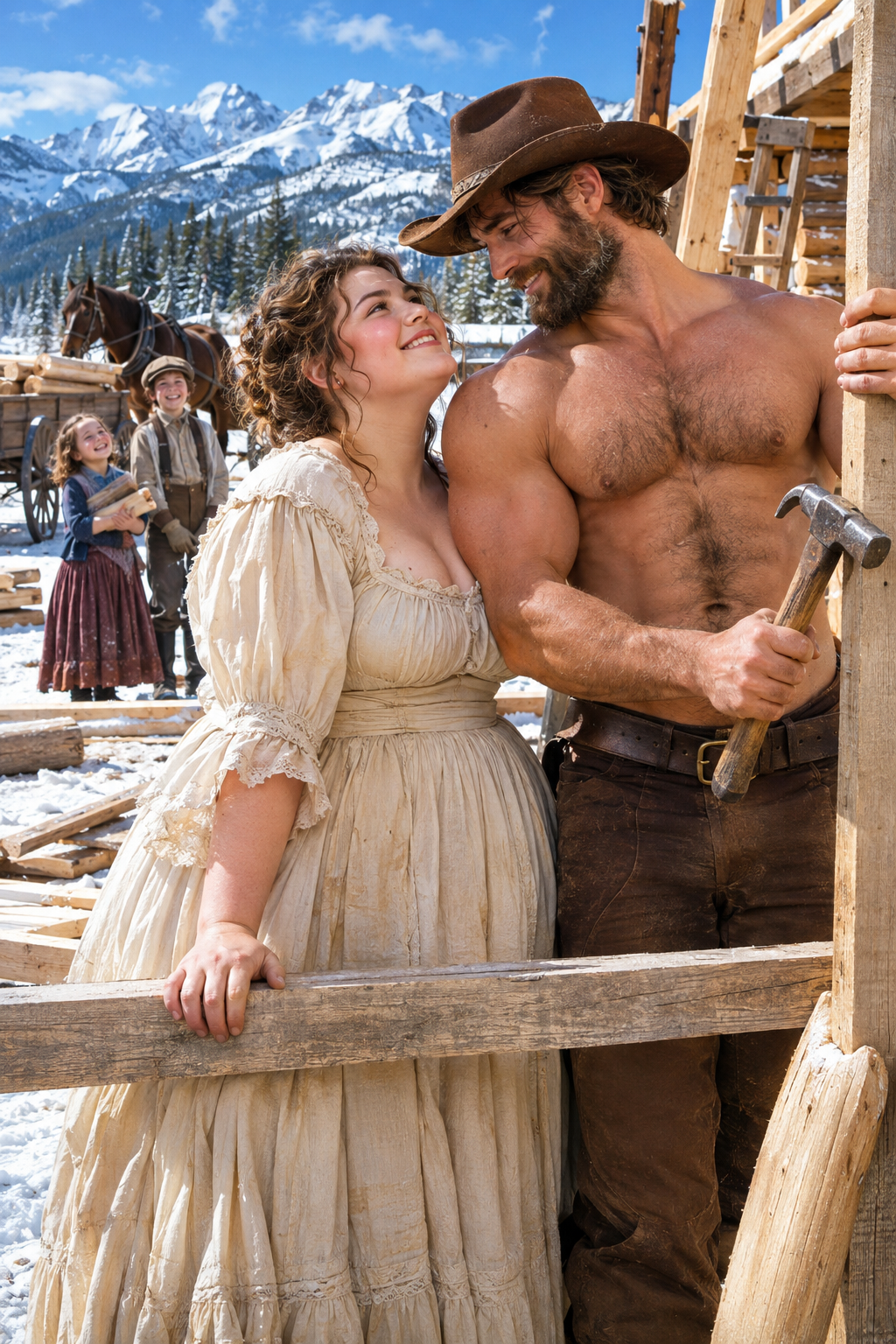
Hannah secured Jaime near the tree before grabbing the rope with both hands. Grant managed to climb partway up the bank, but his injured shoulder struck a rock, and he nearly slipped backward.
Hannah pulled until her palms burned.
Finally, Grant reached the top and collapsed beside her.
For a moment, neither of them spoke. Then Jaime crawled toward him and threw his little arms around his neck.
“I’m sorry,” the boy cried. “I just wanted to save her.”
Grant placed a shaking hand against the back of Jaime’s head.
“Having a good heart isn’t something you need to apologize for. But next time, you ask for help.”
Hannah looked away, wiping tears from her cheeks. Those words seemed meant for more than just the child.
They freed the calf, which was able to walk despite its frightening experience. Grant secured it with a lead rope before helping Hannah and Jaime onto the horses.
The journey home felt endless.
When the little farmhouse finally appeared through the snow, Hannah had never been so grateful to see its crooked chimney and sagging porch.
Elsie burst into tears when she saw her brother. Mrs. Miller hurried everyone inside, removed Jaime’s wet clothing, and wrapped him in dry blankets.
Grant insisted that the boy be attended to first.
Only after Jaime was safely resting beside the fire did Hannah notice blood dripping from Grant’s sleeve.
“You’re hurt.”
“It’s nothing.”
She gave him a look that silenced him immediately.
“Sit down.”
Mrs. Miller examined his shoulder and discovered a deep cut. Fortunately, the injury appeared less serious than Hannah had feared, though Grant was exhausted and dangerously cold.
While Mrs. Miller prepared clean cloths, Hannah brought him dry clothing that had belonged to her sister’s late husband.
Grant accepted the clothes without comment.
Later that evening, the storm continued to batter the farmhouse. Jaime slept beneath several blankets, and Elsie refused to leave his side.
Hannah sat across from Grant at the kitchen table. His injured arm rested in a makeshift sling.
“You could have died today,” she said.
“So could Jaime.”
“You barely know us.”
Grant stared into his coffee.
“That’s not entirely true.”
Hannah remembered the conversation they had been having before the storm. She remembered the receipt, the paid debt, and his strange request for a family.
“What were you going to tell me earlier?”
Grant reached into his coat, which hung drying beside the stove. From an inside pocket, he removed a small leather pouch.
Inside was a folded letter.
The paper was worn, and the handwriting made Hannah’s breath catch.
She knew that handwriting better than her own.
It belonged to her sister, Margaret.
“Where did you get this?”
“She gave it to me before she died.”
Hannah unfolded the letter with trembling fingers.
Dear Grant,
I know what I’m asking is more than any neighbor should have to give. But the doctor says I may not have much time left, and there are things I can no longer pretend will work themselves out.
My sister Hannah is coming. She is stubborn, proud, and far too willing to carry the whole world on her shoulders. She will love my children as her own, but she won’t know how to ask for help.
Please watch over them when you can. Don’t let her mistake kindness for pity.
And Grant, please don’t spend the rest of your life believing that losing your family means you don’t deserve another one.
You have more love in your heart than you allow anyone to see.
Your friend,
Margaret.
Hannah read the letter twice.
By the time she finished, tears were running freely down her face.
“You knew my sister?”
Grant nodded.
“She and her husband were good neighbors. After he passed, I helped when she’d let me. She never wanted much. Usually just someone to talk to.”
Hannah pressed the letter against her chest.
“What did she mean about losing your family?”
Grant remained silent for so long that Hannah wondered whether he would answer.
“Seven years ago, I had a wife and a little boy,” he finally said. “My wife’s name was Rebecca. Our son’s name was Thomas.”
He looked toward Jaime, asleep beside the fireplace.
“Thomas was about his age.”
Hannah’s expression softened.
“What happened?”
“My wife became ill during winter. The doctor couldn’t reach us for several days. By the time he arrived, there wasn’t much he could do. Thomas caught the same illness shortly afterward.”
Grant swallowed hard.
“I buried them three days apart.”
Hannah covered her mouth.
Suddenly, the quiet rancher made sense to her. His lonely house, his distant manner, and the sadness she had occasionally noticed when he watched the children playing.
“After that, I stopped letting people get close,” he continued. “I worked from sunrise until dark. Bought more cattle, more land, more horses. Everyone thought I was building something important.”
He gave a tired smile.
“But every night, I went home to an empty house.”
“Grant…”
“Your sister was one of the few people who never treated me like a man made of stone. She’d bring over bread sometimes. Ask how I was doing. She never pushed when I didn’t want to talk.”
He glanced at the letter.
“When she asked me to watch over you and the children, I promised I would.”
Hannah looked down.
“So everything you’ve done was because of a promise?”
“At first.”
His answer made her lift her head.
“Then I got to know you. I watched you work until your hands cracked. I saw you give the children the last piece of bread and pretend you weren’t hungry. I heard you laughing with Elsie when you thought nobody was around.”
Grant leaned forward.
“Somewhere along the way, Hannah, I stopped coming here because I’d made a promise. I started coming because this was the only place I wanted to be.”
Hannah’s heart tightened.
“When I asked for a family this morning, I said it poorly,” he admitted. “I don’t want to purchase your affection with lumber or money. I want a chance to earn your trust. And if you never feel the same way, I’ll still keep my promise to Margaret.”
For the first time since arriving in Wyoming, Hannah allowed herself to cry without trying to hide it.
She had spent six weeks pretending she wasn’t frightened. Every unpaid bill, every cold night, and every hungry morning had become another burden she refused to share.
“I don’t know how to depend on someone,” she confessed. “People have disappointed me before. I learned that the safest thing was to need nobody.”
Grant nodded.
“I understand.”
“And I can’t marry a man because I’m grateful.”
“I wouldn’t want you to.”
They sat quietly until Hannah reached across the table and placed her hand over his.
“But I think I’d like to know you better.”
Grant smiled.
It was the first genuine smile she had ever seen on his face.
The following morning, however, brought another problem.
A man named Silas Mercer arrived at the homestead shortly after the snow stopped falling. He was a wealthy local businessman who had been trying to acquire Margaret’s property for months.
He stepped onto the porch carrying a leather folder.
“Miss Cooper, I’m afraid your time has run out.”
Hannah frowned.
“Mr. Hail paid the outstanding account yesterday.”
“That was the account at the general store. I’m here about the mortgage.”
He handed her a document.
According to the paperwork, Margaret’s late husband had borrowed money against the homestead. The final payment was overdue, and Mercer intended to take possession of the property.
Hannah felt sick.
She had known about the smaller debts, but Margaret had never mentioned a mortgage.
“You have until the end of the week,” Mercer said. “After that, the house and land belong to me.”
Grant appeared in the doorway.
“Let me see those papers.”
Mercer’s expression changed immediately.
“This is a private matter, Hail.”
“Then you shouldn’t mind proving your claim.”
Grant examined the document. Something about it bothered him, particularly the date beside Margaret’s husband’s signature.
“Where’s the original?”
“At my office.”
“I’d like to see it.”
Mercer snatched the paper back.
“You ranchers seem to think money gives you authority over everything.”
“No,” Grant replied. “But I know when something doesn’t look right.”
After Mercer left, Hannah sank into a chair.
“I can’t keep doing this.”
Grant knelt beside her.
“We’ll figure it out.”
“What if he’s telling the truth?”
“Then we’ll deal with the truth. But first, let’s make sure that’s what he’s telling us.”
Hannah spent the afternoon searching through Margaret’s belongings. She opened drawers, emptied trunks, and examined every envelope she could find.
Just before sunset, Elsie entered the bedroom carrying an old sewing basket.
“Are you looking for Mama’s important papers?”
Hannah turned.
“What papers, sweetheart?”
“Mama put something under the cloth in there. She told me never to throw it away.”
Hannah lifted the lining of the basket.
Beneath it lay several receipts and a document signed by Silas Mercer’s former business partner.
The mortgage had been paid in full nearly two years earlier.
Hannah stared at the evidence in disbelief.
Grant examined the receipts and immediately recognized the name of the witness.
It belonged to a retired banker living in town.
The next morning, they traveled there together.
The banker remembered Margaret’s husband and confirmed that the debt had been settled. He also revealed that Mercer had purchased several old accounts after his business partner retired.
Apparently, Mercer had been attempting to collect money on debts that no longer existed.
Hannah refused to let the matter disappear quietly.
With Grant beside her, she presented the evidence to the local authorities. Two other families soon came forward with similar complaints.
Mercer’s claim against the homestead was dismissed, and an investigation into his business dealings began.
For the first time in months, Hannah could look at her sister’s property without fearing that someone would take it away.
When Grant offered again to repair the house, she accepted.
But she insisted on helping.
Over the following weeks, neighbors arrived with tools, supplies, and food. Grant replaced the damaged roof, repaired the windows, and reinforced the walls.
Hannah cooked meals for the workers and helped wherever she could. Jaime carried small pieces of wood, while Elsie proudly announced that she was responsible for keeping everyone cheerful.
The old homestead slowly became a real home again.
One evening, Hannah found Grant sitting on the porch with Jaime. The boy was asking questions about horses, cattle, and what it meant to be brave.
“Being brave doesn’t mean you’re never scared,” Grant explained. “It means you try to do what’s right even when you are.”
“Like when you saved me?”
Grant smiled.
“Like when your aunt came looking for you.”
Hannah stood inside the doorway, listening.
Something warm settled in her heart.
Winter eventually gave way to spring. Grant visited regularly, sometimes bringing supplies, sometimes arriving with nothing more than a desire to spend the evening with them.
He never mentioned marriage again.
Until one afternoon, Hannah invited him to walk with her toward the creek.
They stopped near the fence where he had found Jaime’s mitten.
“I used to think accepting help meant giving someone power over me,” she said. “But you’ve never made me feel small for needing you.”
Grant looked at her quietly.
“And I’ve realized something else,” she continued. “I don’t want you here because the roof needs fixing or because the children need looking after.”
She took his hand.
“I want you here because I love you.”
Grant stared at her, unable to speak.
Hannah laughed softly.
“For a man who once asked me for an entire family, you suddenly don’t have much to say.”
He reached into his pocket and pulled out a small ring.
“I’ve been carrying this around for three weeks,” he admitted. “I was waiting until you were ready.”
Hannah’s eyes filled with tears.
“Ask me properly this time.”
Grant lowered himself onto one knee.
“Hannah Cooper, will you marry me?”
“Yes.”
He stood and wrapped his arms around her, holding her as though something precious had finally returned to his life.
They married that summer beneath a cottonwood tree near the homestead. Mrs. Miller cried throughout the ceremony. Elsie scattered wildflowers, and Jaime stood proudly beside Grant.
Afterward, Jaime approached him with an unusually serious expression.
“Can I call you Papa?”
Grant’s smile disappeared as tears filled his eyes.
“Only if you want to, son.”
Jaime hugged him.
Elsie immediately joined them, declaring that if Jaime could have a papa, she wanted one too.
Hannah watched the three of them and thought of Margaret. She wished her sister could have been there, but somehow, standing beneath the summer sky, she felt closer to her than she had in months.
Years later, travelers passing through that part of Wyoming often stopped at the Hail family homestead. Nobody who arrived hungry was turned away. Nobody facing a winter without enough firewood was left to manage alone.
Hannah and Grant remembered what loneliness, grief, and desperation felt like, and they made sure their good fortune became a blessing to others.
Margaret’s letter remained tucked inside a wooden box beside their bed. Whenever life became difficult, Hannah would read it again.
She had once believed that strength meant carrying every burden alone. Grant had believed that protecting his heart meant never loving anyone again.
Both had been wrong.
They learned that accepting kindness does not diminish a person’s dignity, that grief does not take away the right to happiness, and that opening your heart after being hurt can be one of the bravest things you ever do.
Grant had arrived during a snowstorm with a wagon full of lumber, hoping for another chance at having a family.
Hannah had opened her door expecting another burden.
Instead, two people who thought they had to face the world alone discovered that the greatest thing they could build together wasn’t a house.
It was a home where nobody ever had to wonder whether they belonged.
Ten years passed, and the little homestead that had once seemed destined to disappear became one of the warmest and most welcoming places in the Wyoming territory.
Grant’s ranch grew, but he never measured his success by the number of cattle he owned or the acres of land he controlled. His greatest pride was watching Jaime grow into a kind, hardworking young man and seeing Elsie become a confident young woman with dreams of her own.
Hannah never forgot the frightened children who had arrived with her that first winter. She remembered the leaking roof, the empty cupboards, and the nights when she had quietly cried because she didn’t know how she would keep everyone safe.
One spring morning, Jaime returned from town with news that made the whole family smile. He had been offered an apprenticeship with a respected rancher, and he wanted to learn enough to one day manage the family land.
Grant shook his hand proudly.
“You don’t have to become me, son. Just become a good man.”
Jaime nodded.
“I hope I can be half the father you’ve been to me.”
Grant turned away for a moment, hiding the tears in his eyes.
That evening, Hannah found him standing beside the old wooden fence where they had once searched desperately for Jaime.
“Thinking about the past?” she asked.
“Sometimes,” he admitted. “I still wish Rebecca and Thomas could have seen this.”
Hannah slipped her hand into his.
“I think they would be happy knowing you found your way back to life.”
Grant looked at her, then toward the farmhouse where Elsie was laughing with her brother.
“I used to think losing everything meant my life was over,” he said. “I never imagined I’d be given another chance.”
Hannah rested her head against his shoulder.
“Sometimes life doesn’t give us back what we’ve lost. Sometimes it gives us something different, something we never knew we needed.”
They stood together as the evening sun settled behind the mountains.
Inside the house, the old letter from Margaret remained safely tucked away. Hannah had added one more line beneath her sister’s words:
You asked me to watch over your children. In the end, you helped me find a family, too.
And every winter, when the first snow covered the Wyoming hills, Grant made sure the fireplace was burning brightly and the doors were open to anyone who needed shelter.
Because the family they had built was never meant to be a family that kept love to itself.
It was meant to be a place where love could grow, where broken hearts could heal, and where no one would ever have to face the cold alone.
And that became the greatest legacy of the Hail family: not the land they owned, but the lives they touched and the love they chose to share.
A few days after that quiet evening by the old fence, Hannah discovered something she had never expected.
While cleaning the small wooden chest that held Margaret’s belongings, she found another envelope hidden beneath the lining. Her sister’s handwriting was unmistakable, but this letter had never been opened.
On the front were four simple words:
For Hannah, when you’re ready.
Her hands trembled as she broke the seal.
Inside was a short letter.
“My dearest Hannah,
If you’re reading this, then I hope you’ve found a place where you can finally breathe. I know you. I know how fiercely you love and how often you hide your own pain because you believe everyone else needs you more.
Please remember something I wish I’d understood sooner: You don’t have to earn love by sacrificing everything. You deserve to be loved simply because you are you.
I chose Grant because I knew he would never ask you to become someone else. He has known loss, just as you have. I hoped that perhaps the two of you could help each other remember that life is still worth living.
But don’t feel obligated to him because of me. Choose him only if your heart is truly happy.
And if you do, please let him love those children without fear. They have already lost enough.
I love you, little sister.
Margaret.”
Hannah pressed the letter to her heart and cried.
For years, she had believed that her sister’s death had left her with nothing but responsibilities. Now she understood that Margaret had left her something far more precious: the chance to begin again.
That evening, she showed Grant the letter.
He read it slowly, then folded it with great care.
“She always knew what people needed to hear,” he whispered.
Hannah smiled through her tears.
“She knew us better than we knew ourselves.”
Grant kissed her forehead.
“Then let’s make sure the children grow up knowing that.”
And they did.
As the years passed, the homestead became a gathering place for neighbors, travelers, and families struggling through difficult seasons. Hannah organized a small community kitchen, while Grant offered work to men who had lost their livelihoods.
Elsie eventually became a teacher. Jaime grew into a respected rancher, carrying with him the lessons Grant had taught him about honesty, courage, and responsibility.
Neither child ever forgot the woman who had crossed a dangerous winter to give them a home, or the man who had chosen to love them as his own.
One afternoon, many years later, Jaime returned with his young daughter. He watched her run across the same porch where he had once stood as a frightened little boy.
“Dad,” he said quietly, “I want her to grow up the way we did. Knowing there’s always someone who will open the door.”
Grant looked at his granddaughter and smiled.
“Then you’ve already learned the most important thing.”
That night, Hannah and Grant sat together by the fireplace. Their hair had turned gray, and their hands showed the marks of decades spent working, building, and caring for others.
Grant reached for her hand.
“Do you ever wonder what would have happened if I hadn’t come that winter?”
Hannah laughed softly.
“I probably would have chased you off my porch.”
He chuckled.
“Probably.”
She leaned against his shoulder.
“But I’m glad you stayed.”
Outside, snow began falling over the Wyoming mountains, just as it had on the day their story began.
Only this time, there was no leaking roof, no unpaid debt, and no frightened child missing in the storm.
There was laughter coming from the bedrooms, a warm fire in the kitchen, and a family that had grown far beyond the four people who first needed one another.
Hannah closed her eyes, listening to the familiar sounds of home.
She finally understood what Margaret had tried to tell her.
A family isn’t simply the people who share your blood. It is the people who stay when life becomes difficult, who help without making you feel weak, and who choose you even when you have nothing to offer in return.
And sometimes, the greatest gift life gives us doesn’t arrive when everything is going right.
Sometimes it arrives in the middle of a storm, standing on our doorstep with a wagon full of lumber, asking only for the chance to build something beautiful together.
Because a house can shelter you from the winter, but love is what makes you feel at home.
Years later, when Grant and Hannah were both growing old, the ranch faced one final winter unlike any they had experienced before.
A terrible blizzard swept across Wyoming, destroying fences, burying barns, and cutting off the roads to neighboring farms. Several families lost their livestock, and others ran dangerously low on food and firewood.
Grant, now slower and weaker than he had once been, stood by the window watching the snow fall.
“We should send the wagons tomorrow,” he said.
Hannah looked at him with concern.
“You’re not going out in that weather.”
“People are counting on us.”
“And people are counting on you to stay alive.”
Before Grant could argue, Jaime entered the room. He was now a grown man with a family of his own.
“I’ll take the wagons, Dad. You taught me how to handle a winter storm.”
Grant looked at his son with pride.
“Then take enough supplies for everyone. Nobody gets left behind.”
The next morning, Jaime and several ranch hands set out with food, blankets, medicine, and firewood. They worked through the storm, helping stranded families and bringing those in danger back to the ranch.
When they returned, a young mother approached Hannah, holding a little girl in her arms.
“We don’t know how to thank you,” she said. “We had nowhere else to go.”
Hannah smiled and wrapped another blanket around the child.
“Then stay until the roads are safe. There’s always room for one more.”
Grant watched from his chair near the fireplace.
For a moment, he saw the faces of Rebecca and Thomas in the firelight. He remembered the years when he had believed his life ended with their deaths. Then he looked around at Hannah, their children, and the grandchildren filling the house.
His eyes grew wet.
He had not forgotten the family he lost. He had simply learned that loving again did not mean loving them any less.
That night, Hannah found him holding the old photograph of Rebecca and Thomas.
She sat beside him.
“Missing them?”
“Every day.”
She rested her hand over his.
“You know, I used to think the heart had only so much room. That if you lost someone, you had to spend the rest of your life protecting whatever was left.”
Grant looked at her.
“And now?”
“Now I know the heart can grow.”
He kissed her hand.
“Margaret would have liked that.”
“She would have loved it.”
They sat together until the fire burned low.
In the spring, Grant’s health began to decline. The years of hard work had finally caught up with him. He could no longer ride across the ranch or repair fences as he once had.
At first, he struggled with the change.
“I spent my whole life fixing things,” he told Hannah one afternoon. “Now I can’t even mend a broken gate.”
Hannah took his hand.
“You’ve already built something that will last longer than any fence.”
She pointed toward the yard, where Jaime was teaching his son to ride, Elsie was laughing with her children, and neighbors were gathering for their weekly meal.
“You built a family. You gave people a place to belong.”
Grant looked outside and smiled.
For the first time, he understood that his greatest work was already finished.
One peaceful evening, as the sun disappeared behind the mountains, Grant asked Hannah to bring him the wooden box containing Margaret’s letters.
He read them again, slowly, touching the familiar handwriting.
Then he placed the letters back inside.
“Promise me something,” he said.
“Anything.”
“Keep this place open. Even when I’m gone. Don’t let it become just another ranch.”
Hannah’s eyes filled with tears.
“I promise.”
Grant passed away peacefully several months later, surrounded by Hannah and the family they had built together.
His funeral brought people from across Wyoming. Ranchers, neighbors, travelers, and families he had helped came to say goodbye.
Jaime stood beside his mother throughout the service. Elsie held her hand.
Hannah mourned deeply, but she did not feel abandoned. Grant had left behind something no storm could destroy.
Years later, when Hannah finally joined him, their children placed Margaret’s letters beside the photograph of Grant and Rebecca.
The homestead remained open, just as Hannah had promised.
A small sign was placed above the front door:
“No One Faces the Winter Alone.”
And every year, when the first snow fell over Wyoming, the Hail family gathered around the fireplace to remember the people who had shaped their lives.
They told stories about Margaret’s kindness, Grant’s quiet courage, Hannah’s stubborn determination, and the little boy who had once risked everything to save a calf.
They laughed, cried, and passed those stories down to the next generation.
Because they understood something that Hannah and Grant had learned through loss, hardship, and love:
Family is not only about who stands beside you when life is easy. It is about who stays when the storm comes, who reaches for your hand when you are afraid, and who makes sure you never have to face the darkness alone.
And that was how a broken homestead became a lasting home—not because its walls were strong, but because the people inside never stopped making room for one another.