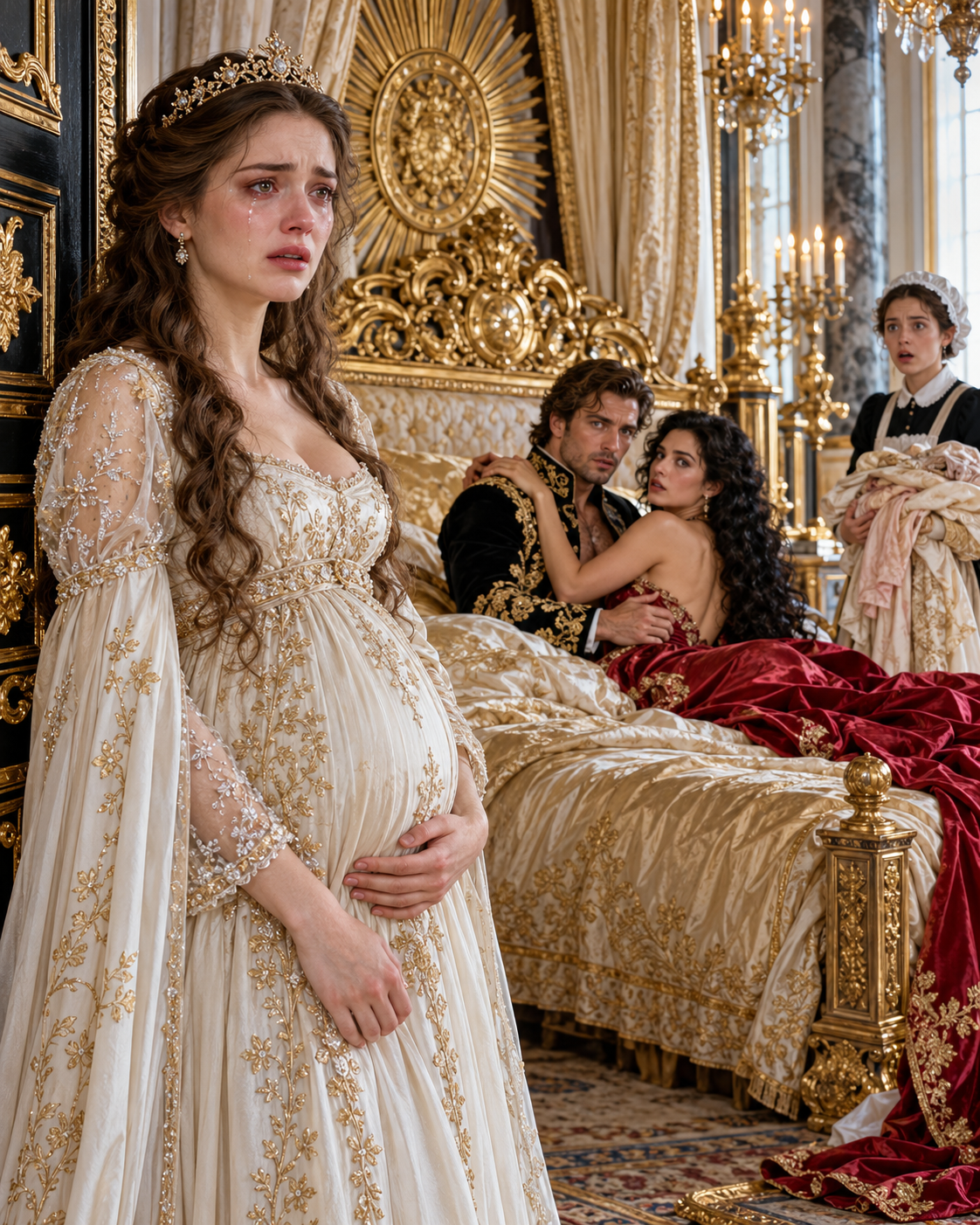
The queen was seven months pregnant when she discovered that her husband had given another woman her bedroom, her title, and the cradle meant for their unborn child.
The second explosion tore through the northern wall before Elowen could reach the door. A violent tremor passed beneath the stone floor, scattering fragments of plaster across the chamber. Allara gripped the edge of the table, her breath catching as another contraction tightened around her abdomen. Beyond the windows, orange flames climbed the watchtowers of Moonveil Valley, illuminating the rain like falling sparks.
Captain Rowan entered with his sword drawn, blood darkening the sleeve of his uniform. He stopped when he saw Allara bent over the table and Elowen kneeling beside her.
“The northern gate has fallen,” he said. “Someone disabled the inner locks before the first attack.”
Elowen looked toward the corridor.
“How many?”
“Nearly two hundred. Morcant soldiers, with mercenaries behind them. They’re wearing our colors over their armor.”
Allara straightened with difficulty. The child moved sharply beneath her ribs, and she pressed a trembling hand against her stomach. Her breathing remained uneven, but her eyes settled on the captain.
“Then they want your men to mistake them for allies.”
Rowan nodded.
“They’ve already taken the lower courtyard.”
Another contraction forced Allara to close her eyes. Elowen caught her arm and guided her toward the bed, but she resisted.
“Where are the people?”
“The southern shelters,” Rowan answered. “We’ve begun evacuating them through the old passages.”
“Then finish that before you defend these rooms.”
Rowan hesitated, looking toward the royal insignia above the fireplace.
“Your Highness, our orders are to protect the last heir of House Vain.”
Allara met his gaze.
“And what kingdom will I inherit if everyone in it dies protecting me?”
For a moment, Rowan said nothing. Then he lowered his sword in acknowledgment and hurried toward the courtyard. Elowen watched him disappear before turning back to Allara, whose face had grown pale.
“You must lie down now.”
Allara took one careful breath.
“Tell me how long.”
Elowen examined her with the practiced calm of a woman who had delivered children during wars and winters. When she looked up, her expression had changed.
“The baby isn’t waiting for morning.”
Far beyond Moonveil Valley, Alpha King Kale Draven stood opposite Lady Saraphene in his private study. Rain ran down the tall windows, and the documents on his desk remained exactly where he had placed them. He had read the physician’s confession three times. Each reading had revealed another detail he wished he could deny.
Saraphene stood beneath the chandelier, wearing Allara’s sapphire bracelet.
Kale’s gaze returned to it.
“Take that off.”
She looked down as though surprised to find it there.
“She abandoned it.”
“She left it in my chambers.”
“And you left her alone in the northern wing.”
The words settled between them. Kale did not answer. Saraphene recognized the hesitation and stepped closer, lowering her voice.
“Allara was never suited to this court. You know how fragile she became after the pregnancy.”
Kale lifted one of the medical reports.
“Because your physician told me so?”
Saraphene’s expression tightened.
“He was trying to protect the heir.”
“He was paid to lie.”
A faint sound came from the doorway. Two royal guards entered, followed by Commander Thorne, the king’s oldest military adviser. Thorne placed a sealed dispatch on the desk.
“We intercepted a Morcant courier at the eastern border, Your Majesty.”
Kale opened the letter. The message was short, written in military shorthand, and addressed to Lord Cassian Morcant.
The surviving Vain daughter has entered the valley. The operation must be completed before the child is born.
Kale read the words again.
Then he looked at Saraphene.
“What child?”
She turned toward the window.
“Saraphene.”
Her silence lasted only a moment, but it was long enough.
Kale moved around the desk.
“What do you know about my wife’s family?”
Saraphene’s composure cracked. She took one step backward, then stopped herself.
“More than you ever bothered to learn.”
Thorne reached for his sword, but Kale raised a hand.
“Explain.”
Saraphene looked at the dispatch in his hand.
“The House of Vain should have disappeared twenty-six years ago. My father spent half his life making certain of it.”
Kale felt the room become strangely quiet.
“Allara’s mother?”
“A queen who refused to surrender her crown.”
“And Allara?”
Saraphene’s lips parted, but she did not answer.
Kale understood before she spoke.
His wife had not been an obscure noblewoman whose family history was lost in a border conflict. She was the surviving daughter of a murdered royal house, and someone had spent years keeping that truth from her.
“Why marry me?” he asked.
Saraphene gave a bitter smile.
“Because your marriage to her gave House Morcant access to the one person we couldn’t find.”
Kale looked toward the bracelet.
For months, he had believed Saraphene’s attentiveness was loyalty. She remembered his council appointments, anticipated his complaints, and always seemed to know when Allara had disappointed him. He had mistaken convenience for honesty, and each small surrender had made the next easier.
“How long have you been planning this?”
“Long enough to know you would never ask the right questions.”
Kale turned to Thorne.
“Arrest her. Seal the Morcant estates. No one leaves the palace without my authorization.”
Saraphene’s face hardened as the guards approached.
“You think arresting me will save her?”
Kale stopped.
“What have you done?”
Saraphene glanced toward the mountains.
“My father isn’t going to bring your queen home.”
The first guard seized her wrist. She struggled only when he removed Allara’s bracelet.
Kale was already reaching for his sword.
Within minutes, the palace courtyard filled with mounted soldiers. Thorne warned that the storm had flooded the western road, but Kale ordered the fastest horses prepared. He had no certainty that Allara would welcome him, nor any right to expect it.
There was only one decision left that might still matter.
He would reach Moonveil before Lord Morcant did.
Inside the valley fortress, Elowen drew the curtains and prepared a basin of warm water. The chamber had become an improvised birthing room, with clean linen spread across the bed and medicinal herbs warming beside the fire. Every few minutes, the distant clash of steel came closer.
Allara lay against the pillows, her hair damp with perspiration. The contractions were stronger now, leaving little time between them.
Elowen supported her shoulders.
“Breathe slowly. Save your strength.”
Allara obeyed, though her fingers tightened around the blanket.
“Who opened the gate?”
“We’ll know soon.”
“No.” Allara shook her head. “Someone knew where I was. Someone knew about the passages.”
Elowen said nothing.
Allara studied her face.
“You’re afraid of someone inside these walls.”
A crash echoed from the corridor. Both women turned toward the door. A moment later, a young maid entered carrying fresh water, her face streaked with soot.
“The eastern staircase is blocked,” she reported. “Captain Rowan sent me through the servants’ passage.”
Elowen took the basin.
“Where is Lord Fenwick?”
The maid hesitated.
“He ordered the remaining guards to withdraw from the inner gate.”
Elowen’s hand tightened around the handle.
Allara noticed.
“Who is Lord Fenwick?”
“The valley’s steward. He has governed the fortress in the absence of the royal family.”
“And he controls the gates?”
Elowen looked toward the door.
“He controls the keys.”
The answer arrived with a sharp knock.
Lord Fenwick entered without waiting for permission, accompanied by two armed men. He was a narrow-faced gentleman with silver hair and a velvet coat that seemed strangely untouched by the fighting outside.
He bowed.
“Your Highness. We need to move you.”
Elowen stepped between him and the bed.
“Captain Rowan ordered this chamber secured.”
“Captain Rowan is no longer in command.”
Allara watched Fenwick’s expression. His breathing was steady. His boots were clean. Even his gloves remained spotless despite the fighting that had spread across the lower fortress.
“Where would you take me?” she asked.
“To a safer room beneath the eastern tower.”
Elowen’s face changed.
“The eastern tower has no protected chamber.”
Fenwick drew a short blade from beneath his coat.
“Then perhaps we should stop pretending.”
The two guards moved forward.
Before either could reach the bed, the young maid hurled the basin of hot water at the nearest soldier. He cried out, dropping his sword. Elowen seized a heavy iron candlestick and struck the second man across the temple.
Fenwick lunged toward Allara.
She rolled away just as his blade cut through the pillow beside her shoulder. Pain tightened across her abdomen, but she managed to pull a small dagger from beneath the blanket.
It was the same dagger her mother had given her on her sixteenth birthday.
She drove it into Fenwick’s forearm.
He stumbled backward, shouting.
The maid slammed the door against his shoulder. Elowen thrust the wooden bolt into place while Fenwick staggered into the corridor, leaving a dark trail across the stone.
For a moment, the three women heard only their own breathing.
Then Allara doubled forward, unable to suppress a cry.
Elowen rushed back to her.
“The baby?”
Allara nodded, gripping the bedframe.
Elowen looked toward the maid.
“Find Captain Rowan. Tell him the steward betrayed us.”
The girl reached for the door, then paused.
“What if he can’t come?”
Elowen glanced toward Allara.
“Then bring anyone willing to stand between this room and the enemy.”
The maid slipped away through a narrow passage concealed behind the wardrobe.
Outside, the fortress bells began to ring in an unfamiliar pattern.
Elowen listened.
Three low strokes. A pause. Three more.
Her expression changed.
Allara noticed immediately.
“What does that mean?”
Elowen moved toward the fireplace and touched a small silver emblem set into the stone.
“It means the old royal guard has been summoned.”
A concealed panel shifted, revealing a narrow staircase descending into darkness.
Allara stared.
“You knew about this?”
“Your mother ordered it built after the first assassination attempt.”
“Then why didn’t you tell me?”
Elowen looked at her, and for the first time, the old woman’s voice trembled.
“Because I hoped you would never need it.”
They descended slowly, with Elowen supporting most of Allara’s weight. Every step sent pain through her lower back. The passage was cold, and the air smelled of wet stone and old iron.
At the bottom stood a circular chamber illuminated by blue crystals embedded in the walls. Ancient banners hung from the ceiling, their silver wolves embroidered beneath a crescent moon.
In the center rested a stone cradle.
Allara stopped.
The cradle was carved with the same markings that appeared on her wrist.
Elowen approached it reverently.
“This is where the heirs of House Vain were presented to the valley. Your mother intended to bring you here, but the attack came before the ceremony.”
Allara pressed her palm against the cradle’s rim.
A soft light traveled beneath the stone.
She pulled her hand away.
The light remained.
Elowen stared.
“The bloodline recognizes you.”
Above them, a tremendous crash shook the ceiling.
Allara clutched her stomach.
“This isn’t the time for ceremonies.”
“No,” Elowen agreed. “It’s time for your child to be born.”
Outside Moonveil’s shattered walls, Lord Cassian Morcant watched his soldiers advance through the courtyard. He wore dark armor beneath a cloak marked with his family’s silver insignia. At his side stood Lord Fenwick, his wounded arm bound tightly against his chest.
“You promised me the queen would be alone,” Cassian said.
“She was.”
“And yet she’s still alive.”
Fenwick lowered his eyes.
“The old woman knew about the passages.”
Cassian looked toward the eastern tower.
“Then collapse them.”
Fenwick hesitated.
“There are families sheltering beneath that tower.”
Cassian turned toward him.
“Your point?”
Fenwick’s face drained.
For decades, he had accepted Morcant money in exchange for information, believing the arrangement would preserve his position. He had never imagined the agreement would end with the slaughter of the people he governed.
Cassian drew his sword.
“Give the order.”
Before Fenwick could respond, an arrow struck the soldier beside him.
A second arrow pierced the banner above Cassian’s head.
From the southern battlements came a low, commanding howl.
Captain Rowan stood amid the smoke, his injured arm wrapped in bloodstained linen. Behind him, the surviving Moonveil guards emerged from concealed defensive positions.
The royal standard rose above the southern tower.
Silver on midnight blue.
The first such banner to fly over the valley in twenty-six years.
Cassian stared at it.
Then he gave the order to burn the fortress.
Fire arrows streaked across the courtyard. The wooden galleries ignited, and flames spread toward the buildings where villagers sheltered. Rowan’s soldiers abandoned their defensive positions to carry children and elderly residents toward the tunnels.
They were outnumbered, exhausted, and running out of arrows.
Then horns sounded from the western ridge.
Cassian turned.
A line of mounted soldiers appeared through the rain, bearing the black-and-gold banners of House Draven.
At their head rode Kale.
He did not slow as he crossed the valley’s outer boundary. His horse surged through the broken gate, and the royal cavalry followed in a disciplined charge.
The first collision scattered Morcant’s front line.
Kale fought his way toward the courtyard, searching every face for signs of Allara. Blood ran down his cheek from a shallow cut, but he barely noticed.
Captain Rowan intercepted him near the burning stables.
“King Draven.”
“Where is the queen?”
Rowan kept his sword raised.
“She is under our protection.”
“She’s my wife.”
Rowan’s expression did not change.
“She was your wife when she arrived here alone, half-frozen and carrying your child.”
Kale absorbed the accusation without defending himself.
“Is she alive?”
“Yes. For now.”
A terrible silence passed between them.
“She’s in labor,” Rowan continued. “And Morcant knows where she’s hiding.”
Kale looked toward the eastern tower.
“Then show me the way.”
Rowan hesitated before lowering his weapon.
“If you betray her again, Your Majesty, these walls will be the last thing you ever see.”
Kale nodded.
“Fair enough.”
They moved together through the burning fortress, fighting past soldiers wearing stolen Moonveil colors. Twice, falling beams blocked their path. Once, Rowan dragged Kale away from a collapsing archway moments before the stones struck the ground.
At the entrance to the underground staircase, they found Fenwick kneeling beside a wounded guard.
The steward looked up, his face gray with fear.
“Cassian is going to destroy the eastern foundations.”
Rowan seized him by the collar.
“Where is the powder?”
Fenwick pointed toward a narrow storage corridor.
“Beneath the old chapel. The charges are already placed.”
Kale looked at Rowan.
“Go to the queen. I’ll stop the explosion.”
Rowan studied him for a moment.
Then he handed Kale a small lantern.
“The passage divides after the second staircase. Take the left corridor.”
Kale ran into the smoke.
Below the fortress, Allara’s cries echoed through the ancient birthing chamber.
Elowen knelt beside her, sleeves rolled above her elbows, speaking in a voice steady enough to be trusted.
“Again, Allara. One more breath.”
Allara’s strength was nearly gone.
Her hair clung to her forehead. Her fingers had become numb from gripping the linen, and each contraction seemed to arrive before she had recovered from the last.
“I can’t.”
Elowen brushed a damp strand of hair from her cheek.
“You can. Look at me.”
Allara opened her eyes.
For one brief moment, she was a frightened girl again, kneeling beside her mother’s bed while a storm battered the windows.
She remembered her mother’s hands, always warm, always patient.
She remembered being told that courage was not the absence of fear.
It was choosing whom to protect while fear remained.
Allara drew another breath.
Then she pushed.
Above them, Kale found the first explosive charge beneath the chapel floor. Three iron barrels had been positioned against a supporting column, their fuses twisted together. A burning cord crept slowly toward the nearest barrel.
He dropped to one knee and cut it with his sword.
The flame disappeared inches from the powder.
Then footsteps sounded behind him.
Cassian Morcant stood in the doorway.
“You’re remarkably devoted for a husband who threw her away.”
Kale rose.
“Move.”
Cassian smiled faintly.
“Did Saraphene tell you why we wanted the child?”
Kale tightened his grip on his sword.
“The child is heir to two royal houses.”
“Three.”
Cassian stepped forward.
“Your own grandmother descended from House Vain. The bloodlines were separated to prevent one ruler from claiming the old lunar throne. Your marriage reunited them.”
Kale’s eyes narrowed.
“And you intended to control that heir.”
“Through Saraphene, yes. Until your wife proved less obedient than expected.”
Kale remembered the countless occasions when Saraphene had urged him to restrict Allara’s movements, dismiss her attendants, and postpone visits to her mother’s homeland.
Each suggestion had seemed reasonable in isolation.
Together, they had formed a cage.
Cassian attacked first.
Their blades met beneath the low stone ceiling. Steel rang against steel, the sound sharp in the confined passage. Cassian fought with brutal precision, driving Kale toward the explosive barrels.
Kale parried a strike aimed at his throat, but Cassian caught his shoulder with the edge of his blade.
Pain shot down his arm.
Cassian advanced.
“She would have given you everything,” he said. “And you couldn’t even give her a room in your palace.”
Kale did not answer.
He stepped aside as Cassian lunged, caught the older man’s wrist, and drove him against the stone column.
Cassian’s sword fell.
Kale held his blade against the man’s throat.
For a moment, he saw all the years of deception, every deliberate injury, and the woman fighting for her life somewhere beneath the fortress.
He wanted to finish it.
Then he heard a distant cry.
A woman’s voice.
Allara.
Kale lowered his sword just enough to strike Cassian unconscious with its hilt.
He bound the man’s wrists with a length of torn rope and dragged him away from the powder.
Cassian would live to answer for what he had done.
Kale would not allow another death to be the first gift he brought his child.
Deep underground, the birthing chamber filled with a sudden silver light.
The crystals along the walls awakened one by one, illuminating the ancient carvings. Elowen looked up in astonishment as the glow moved toward the stone cradle.
Then a newborn’s cry rose above the distant battle.
Allara fell back against the pillows, trembling with exhaustion.
Elowen lifted the child carefully, wrapped the tiny body in clean linen, and placed the baby against Allara’s chest.
“A daughter,” she whispered.
Allara looked down.
The infant’s dark hair lay damp against her forehead. One tiny hand opened and closed against the queen’s skin.
For several seconds, the fortress, the war, and the terrible hours that had brought her here disappeared.
There was only the child’s breathing.
Allara touched her cheek.
“Hello, little one.”
The baby moved closer to her warmth.
Then the silver markings on Allara’s wrist began to glow.
A matching crescent appeared faintly above the infant’s heart.
Elowen covered her mouth.
“The Moonveil heir.”
Allara looked toward the illuminated cradle.
“What does that mean?”
Before Elowen could answer, the stone doors shuddered.
A deep sound traveled through the chamber, almost like the slow beating of an enormous heart.
The ancient throne beneath the fortress had recognized a new sovereign.
Above ground, every wolf in the valley began to howl.
The sound swept across the mountains, rising above the flames and battle cries. Soldiers stopped fighting long enough to look toward the eastern tower.
Even Cassian’s mercenaries hesitated.
The silver royal standard, torn and blackened by smoke, began to shimmer.
Captain Rowan understood first.
He dropped to one knee.
“The heir has been born.”
One by one, the Moonveil soldiers followed.
The surviving villagers emerged from their shelters, looking toward the fortress with tears on their faces.
After twenty-six years, House Vain had returned.
Kale reached the underground chamber moments later.
He stopped at the entrance.
Allara lay against the pillows, pale and exhausted, holding a tiny bundle against her chest. Elowen stood beside the stone cradle, her hands stained from the difficult delivery.
For a long moment, Kale could not speak.
Allara looked at him.
Her expression did not soften.
“You found us.”
Kale lowered his sword.
“Yes.”
“Did you come to take her?”
He looked toward the child.
Then back at Allara.
“No.”
The answer surprised her.
Kale approached slowly, stopping several steps from the bed.
“I came because you were in danger.”
Allara’s fingers tightened around the baby’s blanket.
“I was in danger in your palace.”
Kale lowered his eyes.
“I know.”
“You let them take my rooms. You believed every accusation. You watched me disappear from your life long before I left the kingdom.”
Each word was quiet.
None needed to be louder.
Kale knelt beside the bed, but Allara did not reach for him.
“I thought I was keeping peace in my court,” he said. “I was protecting the people who were destroying you.”
Allara watched him.
“Why did you believe them?”
Kale struggled for an answer that would not become an excuse.
“Because their lies were easier to accept than the truth about how I treated you.”
The baby stirred.
Kale looked at her small face, his breathing uneven.
“May I see her?”
Allara hesitated.
Then she carefully shifted the blanket.
Kale leaned forward.
The infant opened her eyes.
They were pale gray, almost silver beneath the crystal light.
Kale’s face changed.
For the first time since entering the chamber, he looked entirely unguarded.
“She has your eyes.”
Allara glanced down.
“Not yet. They’re still changing.”
A faint, unexpected smile touched her lips before disappearing.
Kale noticed, but he did not mistake it for forgiveness.
“What will you name her?”
Allara looked toward Elowen.
Then toward the stone cradle.
“Selene.”
Kale repeated the name softly.
“Princess Selene.”
Allara met his eyes.
“Queen Selene, one day. If she chooses to accept the crown.”
Before Kale could answer, footsteps echoed along the staircase.
Captain Rowan entered, followed by two guards escorting a bound Cassian Morcant.
The older man’s face was bruised, but his expression remained composed.
He looked at the glowing cradle and went utterly still.
“No.”
Elowen stepped toward him.
“You recognize it.”
Cassian stared at the infant.
“The mark should have disappeared with Seraphina.”
Allara shifted carefully upright.
“You knew my mother.”
Cassian’s gaze moved to her.
“I knew what she intended to do.”
“And what was that?”
He gave a hollow laugh.
“End the old order. Give the valleys the right to choose their rulers. Strip the noble houses of their hereditary claims.”
Elowen nodded.
“Your mother believed a crown should be earned through service, not preserved through fear.”
Allara looked down at Selene.
Cassian had not merely murdered a queen to steal her territory.
He had destroyed a woman whose reforms threatened the system that made his family powerful.
“And you killed her for that,” Allara said.
Cassian’s expression hardened.
“She would have ruined everything our ancestors built.”
“No,” Allara replied. “She would have ended what they stole.”
Cassian turned toward Kale.
“You cannot allow this. The moment that child is crowned, every royal house will be forced to answer to the valley councils.”
Kale looked at Allara.
For years, he had been taught that authority rested in unquestioned obedience.
Now he stood before a woman who had lost everything because men like Cassian believed obedience was more valuable than justice.
He turned back to the prisoner.
“Then perhaps those royal houses have questions to answer.”
Cassian lunged against his restraints, but Rowan forced him to his knees.
Allara watched without satisfaction.
“Take him to the upper cells,” she said. “He will stand trial before representatives of every village he attacked.”
Rowan bowed.
“As you command, Your Majesty.”
The words settled over the chamber.
Allara had not asked anyone to call her queen.
Yet no one questioned the title.
By morning, the fires had been extinguished.
Rain washed soot from the surviving stone walls, and the wounded were carried into the great hall, where healers worked beneath the restored silver banners. The dead were laid beneath white coverings in the eastern courtyard.
Allara remained in the underground chamber until the physicians were satisfied that both she and Selene were stable enough to move.
Kale stayed nearby, but he did not enter without permission.
Instead, he helped carry supplies through the fortress and assisted the guards in clearing the collapsed stairways. His royal cloak disappeared somewhere in the rubble, and his hands became scraped and blistered from the work.
No one praised him.
He did not ask them to.
Three days later, a messenger arrived from the Draven capital.
Saraphene had attempted to escape custody with the help of two palace officials. Both officials had been arrested, and the royal treasury had uncovered payments linking House Morcant to the disappearance of several Vain loyalists over the previous decade.
There was also a confession from the physician.
Allara read it in silence.
The document described how Saraphene had ordered him to exaggerate the danger of her pregnancy, restrict her visitors, and convince Kale that his wife was emotionally unstable.
The physician had obeyed because the Morcants held his family’s debts.
Allara folded the letter.
She felt neither surprise nor relief.
The details confirmed what she already knew: her suffering had been useful to other people.
Kale stood by the window.
“I’ve ordered a public investigation.”
Allara placed the document on the table.
“And the servants who helped her?”
“Those who knowingly participated will answer for it. Those she threatened will be heard.”
She studied him.
A month earlier, he would have dismissed the question as a matter beneath his attention.
Now he waited for her response.
“That is a beginning,” she said.
Kale nodded.
He did not ask whether it was enough.
The trial began six weeks later, after Allara had recovered sufficiently to preside beside the valley council.
The great hall had been rebuilt with plain wooden benches instead of gilded thrones. Farmers sat beside noble representatives. Soldiers stood beside widows whose husbands had died defending the gates.
Cassian Morcant faced the charges without his ceremonial insignia.
Saraphene arrived under guard from the Draven kingdom.
When she saw Allara seated at the council table with Selene sleeping in Elowen’s arms nearby, her expression tightened.
“You’ve made quite a spectacle of yourself,” Saraphene murmured as she passed.
Allara looked at her.
“No. I’ve made certain everyone can see.”
Witness after witness testified.
The physician presented his records. Fenwick described the secret payments and identified the officers who had opened the gates. Surviving servants recounted how Saraphene’s household had forged documents bearing Allara’s stolen seal.
Finally, Elowen revealed the original royal archives.
Among them was a letter from Queen Seraphina Vain, written shortly before her death.
Allara listened as Elowen read her mother’s words aloud.
Seraphina had intended to surrender certain hereditary powers to elected valley councils, preserve protections for children born outside noble bloodlines, and establish laws preventing any ruler from stripping a spouse of shelter or property without lawful cause.
The final passage was addressed to the daughter she feared she might never see grow up.
A crown is not proof that someone deserves to rule. It is a promise that they will answer for the lives placed in their care.
Allara lowered her gaze.
She had spent years believing her mother’s cautious lessons came from fear.
Now she understood that they had come from hope.
Cassian and the conspirators were convicted. The council sentenced the principal leaders to lifelong imprisonment under the laws they had tried to destroy, while lesser participants received penalties proportionate to their actions and the evidence against them.
Saraphene stood rigid as her sentence was read.
Her lands and titles, gained through conspiracy, were forfeited.
When the guards approached, she looked directly at Allara.
“You think you’ve won because he came back for you?”
Allara rose slowly.
“No, Saraphene.”
She glanced toward Selene.
“I survived because I stopped waiting for him to.”
Saraphene had no answer.
After the trial, Kale requested a private audience.
Allara received him in the restored eastern garden, where young silver-leaf trees had been planted beside the old fountain. Selene slept in a cradle beneath the shade, watched over by a nurse.
Kale stood several steps away.
“I’ve signed the decree ending the Morcant family’s privileges in Draven territory,” he said. “I’ve also restored every property taken from the families who helped you escape.”
Allara nodded.
“Good.”
He hesitated.
“There is one more document.”
He handed her a sealed parchment.
She opened it.
It was a formal recognition of her sovereignty over Moonveil Valley, together with an agreement guaranteeing Selene’s inheritance without requiring Allara to return to the Draven court.
Allara read every line.
Then she looked up.
“You’re releasing us?”
Kale’s face tightened.
“I never had the right to hold you.”
For a while, neither spoke.
Beyond the fountain, the leaves moved in a light afternoon breeze.
Allara folded the parchment.
“I loved you,” she said.
Kale closed his eyes briefly.
“I know.”
“No. I don’t think you did.”
He looked at her.
“I loved the man who listened when I spoke. The man who walked beside me without expecting everyone else to move aside. Somewhere along the way, you became a king who heard everything except his own wife.”
Kale swallowed.
“I don’t know how to undo that.”
“You can’t.”
The words were not cruel.
They were simply true.
Allara looked toward the cradle.
“But Selene deserves to know her father. If you want to be part of her life, you can begin there.”
Kale followed her gaze.
“Will you allow me to visit?”
“Yes. Under arrangements we agree upon. And you will come as her father, not as a king demanding an heir.”
He nodded.
“I understand.”
Allara studied him for a moment.
“Understanding is the easy part, Kale.”
He looked down at his empty hands.
“I intend to learn the rest.”
The seasons changed.
Moonveil Valley rebuilt its northern walls, but the new gates bore no noble family’s insignia. Instead, they carried the symbols of the valley’s twelve communities, each represented on the council established under Seraphina’s unfinished reforms.
Allara attended the meetings even when Selene was restless, and she listened to farmers, healers, soldiers, and merchants with the same patience she had once wished to receive.
Not every decision was easy.
Some council members resisted surrendering the privileges their families had inherited. Others feared that a queen willing to share authority would eventually lose control.
Allara allowed them to argue.
Then she asked them to explain how their proposals would affect the people who had no seat at the table.
The discussions often lasted until sunset.
Gradually, the valley changed.
The abandoned northern barracks became a maternity shelter. The royal kitchens opened a public bakery during the harsh winter months. Children whose parents had died in the siege received education funded by the estates confiscated from the conspirators.
And when the first anniversary of the attack approached, Allara ordered that no celebration be held without first honoring those who had died.
Kale visited regularly.
At first, his arrivals unsettled the household. Soldiers straightened instinctively when they saw him, and servants waited for commands he no longer gave.
But he learned to enter the nursery quietly, to hold Selene while her nurse rested, and to accept that a crying child cared very little for royal authority.
He learned that Selene disliked loud footsteps, loved the sound of running water, and laughed whenever Allara pretended to sneeze.
He missed her first word.
He was present for her first steps.
Sometimes he and Allara spoke over supper after Selene had fallen asleep. Their conversations were careful, occasionally uncomfortable, and often interrupted by practical matters.
They did not pretend the past had become harmless.
Kale never asked Allara to forget it.
And Allara never promised that forgiveness would lead them back to the marriage they once had.
There were evenings when she watched him carry Selene through the garden and remembered the young man who had once promised her a home.
Those memories still hurt.
But they no longer decided her future.
Two years after the siege, the people of Moonveil gathered beneath the silver trees for Selene’s formal presentation as heir.
The little princess wore a simple white dress embroidered with crescent moons. She was far more interested in the ribbons tied around the ceremonial platform than in the hundreds of people who had come to see her.
Allara stood beside her, wearing her mother’s restored silver crown.
Elowen approached with the ancient royal charter.
“Your Majesty, the council is ready.”
Allara looked across the gathering.
She saw Rowan standing among the guards, the scar on his arm visible beneath his sleeve. She saw the young maid who had saved her life, now overseeing the valley’s new healing school. She saw families who had lost homes and rebuilt them together.
At the edge of the gathering stood Kale.
He wore no crown.
When Selene noticed him, she waved both arms enthusiastically.
“Papa!”
A ripple of gentle laughter moved through the crowd.
Kale smiled and bowed to his daughter.
Allara took Selene’s small hand and stepped toward the stone cradle that had been brought into the garden.
The silver markings along its rim glowed softly in the afternoon light.
Elowen opened the charter.
“Does the daughter of House Vain accept the duty of safeguarding Moonveil and its people?”
Allara looked down at Selene.
The child was trying to catch a drifting leaf.
For a moment, Allara thought of the night she had fled the Draven palace, carrying nothing but a satchel and a child she feared she might never hold.
She remembered the cold road, the rain, and the terrible uncertainty of walking away from the only home she had known.
Then she looked at the people gathered before her.
“When she is old enough,” Allara said, “Selene will answer that question herself.”
A murmur passed through the crowd.
Allara continued.
“Until then, we will teach her what a crown means. Not that she is greater than those around her, but that she is responsible for what her choices do to them.”
She rested one hand on the cradle.
“No child should inherit a prison simply because it has golden walls. And no ruler should be obeyed merely because others are afraid to disagree.”
Elowen’s eyes shone.
The council members rose.
One by one, the people followed.
There was no thunder, no sudden blaze of ancient magic, no voice descending from the mountains.
Only the sound of hundreds of people standing together.
Selene looked around in delight and began clapping.
The laughter that followed spread across the garden.
That evening, after the guests had departed and the last candles burned low, Allara carried her daughter onto the balcony overlooking Moonveil Valley.
The rebuilt houses glowed beneath the stars. Beyond them, the mountains stood quiet against the darkening sky.
Selene rested her head against her mother’s shoulder.
“Story,” she murmured sleepily.
Allara smiled.
“Which one?”
“Moon.”
Allara settled into the chair beside the balcony doors.
Once, she would have told her daughter about an ancient royal family, a stolen crown, and a queen who escaped a terrible war.
But tonight she chose another story.
She told Selene about a woman who had been afraid to leave a palace, even though staying had made her lonely. She told her about a road through the rain, a valley filled with strangers who offered shelter, and people who had chosen to protect one another when the walls began to fall.
Selene listened with heavy eyelids.
“Was she brave?”
Allara looked toward the mountains.
“She was frightened.”
Selene frowned.
“Then brave?”
“Yes,” Allara whispered. “Very brave.”
“Why?”
Allara kissed her daughter’s forehead.
“Because she kept going.”
A soft knock sounded from the balcony doorway.
Kale stood there, preparing to leave for the Draven capital. His horse waited in the courtyard below.
“She’s asleep?” he asked.
“Almost.”
He approached just close enough to brush a kiss across Selene’s hair.
“Goodnight, little star.”
Selene murmured something unintelligible and curled closer to Allara.
Kale straightened.
For a moment, he seemed ready to say something else.
Then he simply bowed his head.
“Goodnight, Allara.”
“Goodnight, Kale.”
She watched him cross the garden and disappear beneath the archway.
There was no bitterness in the farewell.
There was no promise waiting behind it either.
Some wounds could heal without restoring what had been lost. Some people could change without being owed another chance. And some forms of love were better expressed through respect than possession.
Allara carried Selene inside and placed her gently in the cradle.
The little girl opened her eyes once more.
“Mama?”
“Yes, darling?”
“Home?”
Allara looked around the quiet room.
The windows were open to the evening breeze. Fresh flowers stood beside the bed. Beyond the walls lived people who knew her name, trusted her judgment, and had helped her build a future from the ruins of everything she once believed permanent.
She brushed a dark curl from Selene’s cheek.
“Yes,” she said softly. “We’re home.”
And when the moon rose over Moonveil Valley, its silver light fell across the restored crown resting on Allara’s table.
For years, she had believed that becoming a queen meant being chosen by a king.
Now she understood something her mother had tried to teach her long before she was old enough to understand.
A crown could be given, stolen, inherited, or lost.
But dignity could never truly be granted by another person.
It had to be recognized within oneself.
And sometimes, the first act of courage was not fighting to keep the life that had been promised.
It was walking away from it, carrying only the hope that something better might still be waiting beyond the gates.
THE END.