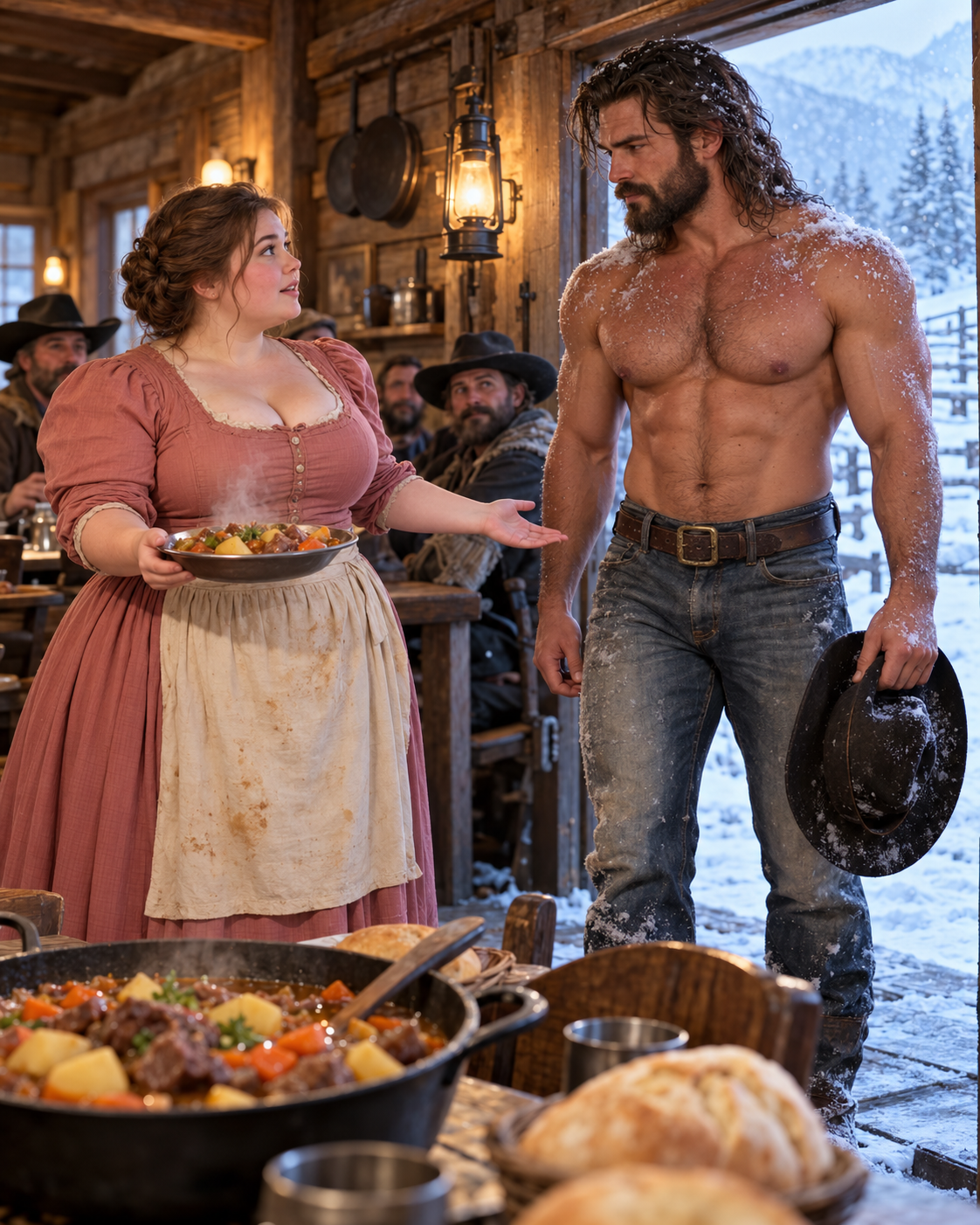
The night I found Caleb Morgan eating alone on a frozen porch, he humiliated me before twelve ranch hands, but his cruelty concealed a terrible secret.
For a moment, neither of us moved.
The letter trembled between my fingers, and Caleb Morgan stood in the doorway with a look I had never seen on his face before.
It wasn’t anger.
It wasn’t grief.
It was fear.
“Ruth,” he whispered, “tell me exactly where you found that.”
I pointed toward the chair where his son used to sit.
“Underneath the seat. It was caught between the wood and the frame.”
Caleb took one unsteady step forward.
“That chair’s been here three years.”
“I know.”
“Nobody’s touched it since Daniel died.”
His eyes dropped to the envelope.
Then he reached for it with both hands, as though he were afraid it might disappear.
I watched him unfold the yellowed paper.
The first sentence stopped him cold.
“Dad, if I don’t come home tonight, please don’t blame the men, because there’s something about that storm I haven’t told you.”
Caleb pressed his lips together.
His eyes moved slowly down the page.
Then he suddenly grabbed the edge of the table.
“Dear God.”
I caught his arm before he fell.
“Caleb, what is it?”
He shook his head.
“No. No, that can’t be right.”
The paper slipped from his fingers.
I picked it up, but before I could read another word, he whispered something that made my stomach tighten.
“Daniel didn’t go looking for those men.”
Outside, the wind rattled the bunkhouse door.
“He went looking for someone else.”
I stared at him.
“Who?”
Caleb looked toward the dark hills beyond the window.
“His mother.”
I knew Daniel’s mother had died years earlier.
At least, that was what everyone at the ranch believed.
Caleb sank into the nearest chair.
“My wife, Evelyn, disappeared seventeen years ago.”
His voice sounded hollow.
“One morning, she packed a suitcase, left a note, and drove away.”
“Where did she go?”
“I never knew.”
He swallowed painfully.
“I told Daniel she died because I couldn’t bear telling a six-year-old boy that his mother had abandoned him.”
I looked at the letter again.
“But Daniel knew?”
Caleb nodded.
“He found her note when he was nineteen.”
For a long moment, only the clock above the stove made a sound.
“He hated me for lying.”
“Did you explain?”
“I tried.”
Caleb covered his face.
“But every explanation sounded like another lie.”
I unfolded the letter completely.
Daniel’s handwriting was hurried, uneven in places.
I began reading aloud.
“Dad, I know you think Mom left because she didn’t love us, but I found something that proves she was trying to come home.”
Caleb stopped breathing for a moment.
I continued.
“I’ve been receiving letters from her for almost a year. She says she wrote to me every birthday, but I never received a single one.”
My eyes lifted from the page.
Caleb looked utterly bewildered.
“I never saw those letters.”
There was more.
“She told me someone has been keeping us apart. I think I finally know who.”
At the bottom, Daniel had written one final paragraph.
“Tonight I’m meeting her near the old north line cabin. She says she has proof. If I’m right, everything we’ve believed about this family is wrong.”
Caleb stared at the words.
Then his expression changed.
“The north line cabin.”
He stood so suddenly his chair scraped across the floor.
“That’s where we found Daniel’s horse.”
I felt the room turn cold around us.
“Was his body there?”
“No.”
Caleb’s voice barely carried.
“We found him nearly two miles away, at the bottom of Miller’s Ravine.”
I looked at the letter again.
“Did anyone search the cabin?”
“Of course.”
“Who?”
He hesitated.
“Frank.”
“Frank who?”
“Frank Whitaker. My ranch foreman.”
I knew Frank.
He was a broad-shouldered man with silver hair and a calm, commanding voice.
He had managed Morgan Creek for nearly twenty years.
And he was the only ranch hand who hadn’t joined us for supper that evening.
“Where is Frank now?” I asked.
Caleb turned toward the window.
“Visiting his sister in Cheyenne.”
Something about the way he said it made me uneasy.
“Caleb, when is he coming back?”
“Tomorrow.”
Neither of us slept much that night.
Before sunrise, Caleb knocked on my kitchen door.
He was wearing his heavy coat and carrying an old leather folder.
“I need to show you something.”
Inside were yellowed bank statements, property surveys, and a photograph of Evelyn Morgan standing beside a younger Frank Whitaker.
“Frank was Evelyn’s cousin,” Caleb explained.
“He came to work here when we first bought the ranch.”
I studied the photograph.
Evelyn was beautiful, with dark curls and the same gray eyes her son had inherited.
But Frank’s hand rested possessively on her shoulder.
“Did they get along?”
Caleb gave a bitter laugh.
“She trusted him with everything.”
He opened the folder.
“Three months before she disappeared, we discovered money missing from the ranch accounts.”
“How much?”
“Nearly eighty thousand dollars.”
I stared at him.
“That’s a fortune.”
“It was enough to ruin us back then.”
“Who handled the accounts?”
Caleb didn’t answer.
He didn’t need to.
I looked down at the statements.
Several withdrawals carried Evelyn’s signature.
But one thing stood out.
The handwriting looked strangely inconsistent.
“Did you ever ask Evelyn about these?”
“She swore she hadn’t taken the money.”
“Did you believe her?”
Caleb’s eyes filled.
“I wanted to.”
Those four words told me more than any confession could have.
“Then she disappeared?”
“Two weeks later.”
I turned over the photograph.
Something had been written on the back in faded blue ink.
“Summer, 1999. Before everything changed.”
But underneath it, almost invisible, was another sentence.
“Frank knows about the land.”
I showed Caleb.
His face went pale.
“What land?”
He stared toward the hills.
Then he whispered, “The north pasture.”
The north pasture covered nearly two thousand acres of rocky, mostly unused land.
According to Caleb, it had never been worth much.
But twenty years earlier, a geological survey had suggested the possibility of valuable mineral deposits beneath part of the property.
“Nothing ever came of it,” Caleb said.
“Frank told me the results were worthless.”
“Did you see the report?”
He shook his head.
“Frank handled it.”
I felt a dreadful suspicion beginning to form.
“Caleb, we need to find out what happened at that cabin.”
He looked at me for a long moment.
Then he reached for his truck keys.
The drive north took almost forty minutes.
Snow covered the dirt road, and the mountains rose like dark walls against the pale morning sky.
Caleb barely spoke.
Occasionally, I noticed his fingers tighten around the steering wheel.
When the cabin finally appeared, I understood why Daniel had chosen it.
It sat in a narrow valley, hidden among tall pines.
The windows were boarded.
The front door hung slightly crooked.
Caleb turned off the engine.
“This is where my son spent his last night alive.”
His voice broke.
I touched his shoulder.
“We don’t have to go inside.”
“Yes,” he whispered.
“We do.”
The cabin smelled of old wood, dust, and damp earth.
A rusted stove stood in one corner.
There were two chairs beside a small table.
Caleb walked slowly across the room.
Then he stopped.
“That’s strange.”
“What?”
“The floor.”
He pointed toward a patch of boards near the fireplace.
“They’re newer than the others.”
I knelt beside them.
Someone had replaced three narrow planks.
The nails were rusty, but the boards themselves showed far less wear.
Caleb fetched a crowbar from the truck.
As he lifted the first plank, a hollow sound echoed beneath us.
Underneath was a shallow compartment.
Inside lay a metal biscuit tin wrapped in oilcloth.
Caleb opened it with trembling hands.
There were photographs.
Letters.
An old cassette tape.
And a small silver necklace with a heart-shaped pendant.
Caleb picked up the necklace.
A sound escaped his throat that I will never forget.
“Evelyn.”
He opened the pendant.
Inside was a tiny photograph of Daniel as a baby.
On the other side were three engraved words.
“Always come home.”
Caleb pressed it against his chest.
I gave him a moment before examining the letters.
Every envelope was addressed to Daniel.
One for his seventh birthday.
Another for his eighth.
Then his ninth.
There were more than a dozen.
All unopened.
All stamped and addressed.
But none appeared to have been mailed.
At the bottom of the tin was a photograph dated the winter Daniel died.
It showed Evelyn standing beside the cabin.
She looked older, thinner, but unmistakably alive.
And next to her stood Frank Whitaker.
In his hands was a rifle.
Caleb stared at the picture.
“Why would she be here with him?”
I turned it over.
A message had been written in shaky handwriting.
“If anything happens to me, Frank knows why.”
Suddenly, a vehicle engine sounded outside.
Caleb extinguished his flashlight.
Through a gap in the boards, I saw a dark pickup approaching.
A man climbed out.
Frank Whitaker.
He wasn’t supposed to return until tomorrow.
I grabbed Caleb’s sleeve.
“Don’t move.”
Frank crossed the porch.
His boots struck the wooden steps.
Then he called, “Caleb?”
My heart slammed against my ribs.
“I saw your truck.”
Caleb stood perfectly still.
Frank tried the door.
It creaked inward.
He stepped into the cabin and stopped when he saw us.
For several seconds, nobody spoke.
Then his eyes dropped to the open tin.
Something dangerous passed across his face.
“Well,” he said quietly.
“Looks like you finally found it.”
Caleb stepped forward.
“What did you do to my family?”
Frank’s expression hardened.
“Careful, old friend.”
“Don’t call me that.”
Frank glanced at the letters.
Then at Evelyn’s necklace.
“You should’ve left the past buried.”
I moved closer to Caleb.
“Where is Evelyn?”
Frank looked at me as though I’d interrupted a private conversation.
“This doesn’t concern you, Mrs. Bennett.”
“It concerns anyone with a conscience.”
He gave a humorless smile.
“You’ve been here a week, and you’re already tearing apart twenty years of peace.”
“Peace?” Caleb shouted.
“My son is dead!”
Frank flinched.
For the first time, I saw genuine pain in his eyes.
“Daniel wasn’t supposed to die.”
The words seemed to freeze in the air.
Caleb staggered backward.
“What?”
Frank looked toward the window.
“I only wanted to stop him.”
“Stop him from what?”
“From ruining everything.”
He lowered his head.
Then, slowly, he told us the truth.
Years earlier, Frank had discovered that a mining company was interested in purchasing mineral rights beneath the north pasture.
The potential payment was enormous.
But Caleb had promised Evelyn that the ranch would remain intact for their children.
Frank knew Caleb would never sign.
So he began forging documents.
He planned to transfer mineral rights through a company he secretly controlled.
Evelyn discovered the scheme.
She confronted him.
He threatened to accuse her of stealing from the ranch accounts.
Then he made sure Caleb saw the forged withdrawals.
“I thought she’d run away,” Frank whispered.
“But she kept fighting.”
He had intercepted Evelyn’s letters to Daniel, hoping time would destroy whatever remained of their family.
Years later, Daniel found one of those letters by accident.
He tracked down his mother.
And on the night of the blizzard, he arranged to meet her at the cabin.
“She came here with the evidence,” Frank admitted.
“Daniel was going to take it to the sheriff.”
Caleb’s voice shook.
“So you followed him.”
Frank nodded.
“We argued outside.”
He stared at the floor.
“I grabbed his coat. He pulled away. The horse spooked.”
I heard Caleb struggling to breathe.
“Daniel rode off into the storm.”
Frank closed his eyes.
“I went after him, but I lost the trail.”
“Why didn’t you tell me?”
“Because I knew what you’d think.”
Caleb stepped toward him.
“You let me bury my boy believing he’d died saving his friends.”
Frank said nothing.
“You let those men carry the blame!”
Tears spilled down Caleb’s cheeks.
“And you stood beside me at his funeral.”
Frank’s face crumpled.
“I loved that boy.”
Caleb’s voice became frighteningly quiet.
“Then you should’ve protected him.”
I knew something was still missing.
“Evelyn,” I said.
“Where is she?”
Frank stared at me.
“After Daniel died, she disappeared again.”
“Did you hurt her?”
“No.”
“Then why did she leave?”
Frank looked at Caleb.
“Because she thought you’d never believe her.”
Caleb sank into a chair.
For a moment, he seemed twenty years older.
I picked up the cassette tape.
“What’s on this?”
Frank’s face changed immediately.
“Put that down.”
I held it tighter.
“Why?”
“Because some things don’t need to be heard.”
Caleb rose.
“Give it to me, Ruth.”
Frank moved toward the door.
But Caleb blocked his path.
“You’re not leaving.”
Frank stopped.
The two men stood facing each other.
Twenty years of friendship had become something unrecognizable.
Finally, Frank lowered his head.
“Then call the sheriff.”
We drove back in silence.
Caleb made the call from the ranch office while I kept the tin beside me.
Frank waited in the bunkhouse under the watchful eyes of Tommy and the other men.
When Sheriff Danielson arrived, Caleb handed over the letters, photographs, and financial records.
Frank gave a statement.
He admitted forging documents, intercepting mail, and concealing evidence related to Daniel’s death.
The sheriff took him into custody.
But before he left, Frank turned toward Caleb.
“There’s one thing you deserve to know.”
Caleb looked at him without speaking.
“Evelyn never stopped loving you.”
Then the sheriff led him away.
That evening, the ranch felt different.
Not lighter.
Not yet.
But something had shifted.
The silence was no longer hiding the truth.
After supper, Tommy approached Caleb.
“Boss, we need to tell you something.”
Caleb looked exhausted.
“What is it?”
Tommy removed his hat.
“The night Daniel died, we weren’t lost.”
Every man at the table went still.
Caleb slowly stood.
“What did you say?”
Tommy’s eyes filled with tears.
“Frank told us to say we were.”
I felt the blood drain from my face.
“He said Daniel had gone after us, and that telling you anything different would only make things worse.”
Another ranch hand nodded.
“We thought he was protecting you.”
Tommy wiped his cheek.
“Daniel once told me he was trying to bring his mother home. I should’ve told you.”
Caleb stared at the men who had worked beside him for years.
Then he sat down.
For a long time, he didn’t speak.
Finally, he whispered, “We all let fear do our thinking.”
Tommy began to cry.
“I’m sorry, boss.”
Caleb looked at Daniel’s empty chair.
“So am I.”
He reached across the table and rested his hand on Tommy’s shoulder.
“My boy wouldn’t want us punishing each other forever.”
That night, for the first time, the men spoke openly about Daniel.
They remembered his terrible jokes.
His habit of singing off-key while repairing fences.
The stray animals he kept bringing home.
Tommy recalled how Daniel once spent three nights nursing a sick calf that everyone else had given up on.
“He named her Queen Elizabeth,” Tommy said.
Caleb surprised us all by laughing.
“That fool boy insisted she deserved royal treatment.”
We laughed with him.
Then Caleb covered his eyes and wept.
Nobody looked away.
Nobody told him to be strong.
We simply stayed.
Later, after the others had gone to bed, I found an old cassette player in the ranch office.
Caleb sat beside me as I placed Daniel’s tape inside.
The machine hissed.
Then a woman’s voice filled the room.
“Caleb, if you’re hearing this, then Daniel found a way to bring you the truth.”
Caleb gripped my hand.
It was Evelyn.
Her voice was older than I expected.
Tired.
But gentle.
“I didn’t leave because I stopped loving you.”
The recording crackled.
“I left because Frank threatened to destroy you with the forged accounts, and I believed disappearing would buy me time to prove what he’d done.”
She paused.
“I thought I could return in a few months.”
I watched Caleb’s tears fall onto his hands.
“But every door I opened seemed to close before I reached it.”
She described years of searching for documents, hiring lawyers she couldn’t afford, and watching her son grow through occasional photographs.
Then her voice broke.
“The worst part wasn’t being away from you. It was knowing Daniel believed I chose to leave him.”
Caleb bowed his head.
“I’m sorry, Evie.”
The tape continued.
“Daniel says you told him he wasn’t ready to take over the ranch.”
There was a faint laugh.
“He has your stubbornness, Caleb, but he has a gentleness you were never taught to show.”
I pressed my lips together.
“He wants to turn part of our land into a place where struggling families can start over.”
Caleb looked toward the window.
“I think that’s a beautiful dream.”
Then came the words that seemed to break whatever remained of his defenses.
“Please don’t let your pride steal another day from the people who love you.”
The tape clicked off.
Caleb sat motionless.
Then he whispered, “I wasted so much time.”
I placed my hand over his.
“Then don’t waste what’s left.”
The next morning, he asked me to help him find Evelyn.
We contacted the attorney whose name appeared on several documents.
He had retired years earlier, but his former assistant remembered Evelyn.
“She was a remarkable woman,” the assistant told us over the telephone.
“She never gave up trying to clear her name.”
“Do you know where she is now?” Caleb asked.
There was a pause.
“Last I heard, she was living near Sheridan.”
Caleb nearly dropped the receiver.
Sheridan was less than three hours away.
For seventeen years, he’d imagined his wife somewhere across the country.
She had been living close enough to reach before sunset.
The assistant gave us the name of a small community center where Evelyn had once volunteered.
We called immediately.
A woman answered.
When I asked about Evelyn Morgan, she became quiet.
“May I ask who’s calling?”
“Her husband.”
Another long silence.
Then she said, “I think you’d better come in person.”
We left before noon.
Caleb insisted on driving.
He barely touched the sandwich I packed.
As the miles passed, I watched him rehearse words under his breath.
“I’m sorry.”
“I should’ve believed you.”
“I never stopped loving you.”
Each time, his voice broke.
By late afternoon, we reached a modest building beside an old church.
A wooden sign read: Second Chance Family Center.
Inside, children were drawing pictures at a long table.
A woman with silver-streaked hair stood near the kitchen, arranging donated groceries.
When she turned, Caleb stopped breathing.
“Evelyn?”
The woman froze.
A grocery bag slipped from her hands.
Apples rolled across the floor.
She stared at him as though she were seeing a ghost.
“Caleb?”
He took one step forward.
Then another.
But Evelyn backed away.
“No.”
Her voice trembled.
“No, you can’t just walk in here.”
Caleb stopped immediately.
“I know.”
Tears streamed down his face.
“I know I have no right.”
Evelyn pressed a hand against her mouth.
For a terrible moment, I thought she might collapse.
Then she whispered, “Where’s Daniel?”
The question struck harder than anything else that day.
Caleb closed his eyes.
“Evelyn…”
She shook her head.
“Please.”
He could barely speak.
“Our boy is gone.”
Her knees buckled.
I reached her just as Caleb did.
She clutched his coat with both hands.
“No. No, he promised he’d come back.”
Caleb held her as they sank to the floor.
“I’m sorry, Evie.”
She buried her face against his chest.
“I waited for him.”
“I know.”
“I waited all night.”
“I know, sweetheart.”
And there, surrounded by scattered apples and the quiet footsteps of strangers, two broken people mourned the same son together for the first time.
I moved away to give them privacy.
Through the window, snow began falling again.
It seemed cruel that the world could look so beautiful while hearts were breaking inside it.
We remained at the center until evening.
Evelyn eventually told us what had happened after Daniel’s death.
She had been injured in a car accident while driving through the storm to search for him.
Her vehicle slid off an icy road.
A passing motorist found her unconscious.
She spent weeks recovering in a hospital under the name she had been using while investigating Frank.
When she finally learned Daniel had died, she tried to contact Caleb.
But grief and fear overwhelmed her.
She believed he still considered her a thief.
And she couldn’t bear facing him with the knowledge that their son had died trying to reunite them.
“I thought staying away would spare you more pain,” she whispered.
Caleb shook his head.
“We were both wrong.”
Evelyn looked at him sadly.
“We can’t bring him back.”
“No.”
Caleb took her hand.
“But maybe we can stop losing each other.”
She began crying again.
He didn’t ask her to return home immediately.
He didn’t demand forgiveness.
He simply asked if he could visit.
And Evelyn, after a long silence, nodded.
Over the following weeks, the truth about Frank’s scheme spread through the county.
Investigators uncovered additional forged property records and accounts connected to the mineral-rights negotiations.
The mining deal had never been completed, but Frank had hidden enough evidence to protect himself for years.
He eventually pleaded guilty to financial crimes and admitted his role in concealing the circumstances surrounding Daniel’s final ride.
The law couldn’t restore what had been taken.
But it finally cleared Evelyn’s name.
Caleb began visiting her every weekend.
Sometimes they talked for hours.
Sometimes they sat quietly over coffee.
There were arguments, too.
Pain doesn’t disappear simply because the truth arrives.
One Sunday, Evelyn told Caleb she wasn’t sure she could ever live in the old house again.
Too many rooms reminded her of Daniel.
Caleb listened.
Then he said, “We don’t have to go backward.”
She looked at him.
“What do you mean?”
“We can build something different.”
That spring, he gathered the ranch hands around the bunkhouse table.
I stood beside the stove, pretending not to listen.
Caleb unfolded a map of Morgan Creek.
“I’ve been thinking about Daniel.”
Tommy smiled sadly.
“We all have, boss.”
Caleb pointed to a section near the southern creek.
“There’s three hundred acres here we hardly use.”
The men leaned closer.
“My son wanted to help families who’d fallen on hard times.”
His voice shook.
“I called him foolish.”
He swallowed.
“But he saw something I couldn’t.”
Caleb looked around the table.
“A ranch isn’t just land and cattle. It’s people.”
Then he told us his plan.
He wanted to establish a small nonprofit program on part of the property, offering temporary housing, agricultural training, and paid work to families rebuilding their lives.
He would call it Daniel’s Place.
For several seconds, nobody spoke.
Then Tommy stood.
“I’ll help build it.”
Another man rose.
“Me too.”
Soon every hand in the room was raised.
Caleb stared at them, overwhelmed.
I brought over a fresh pot of coffee.
“Looks like you’ll need a bigger table.”
He laughed through his tears.
And for the first time since I’d arrived at Morgan Creek, his laughter sounded completely free.
By summer, three little cottages stood beside the creek.
The men had built them themselves.
Evelyn helped organize the program through her connections at Second Chance Family Center.
She visited more often.
Sometimes she stayed overnight.
Eventually, she began leaving a sweater in Caleb’s bedroom.
Then a book.
Then an old photograph.
One evening, I found them sitting on the porch, watching the sunset.
Caleb was holding her hand.
Neither spoke.
They didn’t need to.
I was carrying a tray of lemonade when Evelyn looked up and smiled.
“Ruth, would you mind setting another place at supper?”
I smiled back.
“Not at all.”
That night, thirteen people gathered around the bunkhouse table.
The men squeezed together, laughing and complaining about elbows.
Evelyn sat beside Caleb.
Daniel’s old chair remained at the head of the table.
For months, nobody had dared move it.
But before supper, Caleb stood and rested a hand on its worn wooden back.
“I’ve been keeping this chair empty because I thought filling it meant forgetting my boy.”
He looked at Evelyn.
Then at the men.
“But Daniel spent his whole life trying to make room for people.”
His eyes moved toward the doorway.
Outside stood a young father named Samuel, recently hired through Daniel’s Place.
His wife had died the previous winter.
He was raising a little girl alone.
The child stood beside him, clutching a stuffed rabbit.
She couldn’t have been more than six.
Caleb smiled gently.
“Come here, sweetheart.”
The little girl approached.
“What’s your name?”
“Lily.”
“Well, Lily, we’ve got a special chair for you.”
She looked at the empty seat.
“Is it okay?”
Caleb knelt beside her.
“It belonged to somebody very kind.”
“Where is he?”
Caleb’s eyes filled.
“He’s gone somewhere I can’t follow yet.”
Lily thought about that.
Then she touched his cheek with her small hand.
“My mommy went somewhere like that.”
A tear slipped down Caleb’s face.
“I’m sorry, sweetheart.”
She nodded solemnly.
“Daddy says we can still love people even when we can’t see them.”
Caleb glanced at Samuel.
Then he looked back at Lily.
“Your daddy’s a wise man.”
He lifted her gently into Daniel’s chair.
And when she reached for the bread basket, everyone began passing food as though that chair had never been empty.
I turned toward the stove because I couldn’t trust myself not to cry.
Later, after supper, Caleb found me washing the dishes.
“Ruth?”
“Yes?”
He stood quietly in the doorway.
“I owe you an apology.”
I smiled.
“For what?”
“For that first night.”
I remembered the frozen porch.
The cold beans.
The second cup of coffee.
“You were grieving.”
“That’s not an excuse.”
He looked down.
“I was cruel to you because I was afraid you’d make me feel something.”
I dried my hands.
“And did I?”
He laughed softly.
“More than I thought I could survive.”
Then he reached into his pocket.
He placed a small silver key on the counter.
“What’s this?”
“The old guesthouse.”
I looked at him, confused.
“It hasn’t been used in years.”
“I know.”
“Caleb, I already have a room.”
He shook his head.
“This isn’t for a cook.”
His voice softened.
“It’s for family.”
I stared at the key.
After five years of widowhood, I’d grown accustomed to quiet evenings and empty chairs.
I’d convinced myself that being needed was the closest thing to being loved.
But standing in that kitchen, I realized something.
Sometimes the family you lose leaves a space that another kind of love can enter.
Not to replace anyone.
Not to erase the past.
Just to remind you that your story isn’t finished.
I hugged Caleb.
He held me tightly.
“Thank you for not leaving me on that porch,” he whispered.
I closed my eyes.
“Thank you for finally coming inside.”
Autumn arrived with golden leaves and cool mornings.
Daniel’s Place welcomed its fourth family.
The little cottages filled with laughter, children, and the smell of fresh bread.
Evelyn and Caleb celebrated what would have been their thirty-fifth wedding anniversary.
There was no grand party.
Just a supper in the bunkhouse.
The same old table.
The same mismatched chairs.
And a homemade apple pie.
Before dessert, Evelyn stood and held up a photograph of Daniel.
He was laughing, his hair windblown, his eyes bright.
“I spent seventeen years believing our family was gone,” she said.
Her voice trembled.
“I thought the worst thing that could happen was losing the people I loved.”
She looked at Caleb.
“But I’ve learned something.”
The room grew still.
“Sometimes the greater tragedy is allowing fear, pride, and silence to keep us from the people who are still here.”
Caleb rose and wrapped an arm around her.
Evelyn lifted her glass.
“To Daniel.”
Everyone raised theirs.
“To Daniel.”
Then Lily, sitting in his old chair, asked a question that made us all smile through our tears.
“Do you think Daniel would like us?”
Caleb knelt beside her.
He looked around the room.
At Tommy.
At the men.
At the families who had found shelter on the ranch.
At Evelyn.
Then at me.
His face softened.
“Sweetheart, I think he’d be very proud of us.”
That evening, after everyone had gone home, I stepped onto the porch.
The air was cold.
Not as cold as the night I’d first found Caleb there.
But cold enough to remind me.
Beside the door sat the old dented tin plate.
Caleb had kept it.
I picked it up and ran my thumb along its scratched rim.
There had been a time when that plate represented everything he believed he deserved.
Loneliness.
Punishment.
An endless winter.
Now laughter drifted through the windows behind me.
I heard Evelyn teasing Caleb about his terrible dancing.
I heard Tommy arguing with Samuel over a card game.
And somewhere inside, Lily was singing a song about horses.
I set the plate on a shelf beside the doorway.
Not as a reminder of suffering.
But as proof that even the coldest seasons eventually end.
A moment later, Caleb opened the door.
“Ruth, what are you doing out here?”
I smiled.
“Just enjoying the stars.”
He looked toward the sky.
Then he stepped beside me.
For a while, we stood in comfortable silence.
“Do you ever think about that first night?” he asked.
“Sometimes.”
He nodded slowly.
“I still wonder what would’ve happened if you hadn’t come outside.”
I looked through the window at the crowded table.
Then back at him.
“Maybe somebody else would’ve come.”
Caleb smiled sadly.
“Maybe.”
From inside, Evelyn called his name.
He turned toward the warmth.
But before going in, he looked at me one last time.
“You know what Daniel always said?”
“What?”
Caleb’s voice grew thick with emotion.
“He said there was no such thing as a table too full for one more person.”
I felt tears gather in my eyes.
“Sounds like he was a good boy.”
Caleb looked toward the stars.
“He was.”
Then he opened the door wider.
“Come on, Ruth. There’s room.”
I followed him inside.
And as the door closed behind us, shutting out the wind, I finally understood what Daniel had tried to teach his father all those years ago.
Love isn’t measured by how tightly we hold on to the past.
It’s measured by how bravely we open our hearts to the people standing in front of us.
Forgiveness cannot undo what happened.
Truth cannot return the years we lost.
And grief doesn’t vanish simply because happiness finds its way back.
But a broken family can become a shelter for someone else.
A wounded heart can learn to love again.
And sometimes, changing an entire life begins with something as ordinary as pulling out a chair and saying, “There’s room for you here.”
That night, nobody ate alone at Morgan Creek Ranch.
And as long as I had anything to say about it, nobody ever would again.
THE END.