The moment Gideon Mercer called me too fat to work on his Montana ranch, the entire train platform laughed, unaware I carried proof of his father’s betrayal.
For a moment, I forgot how to breathe.
My mother’s name stared back at me from the yellowed page, written in the same delicate handwriting I remembered from the birthday cards she had sent me as a child.
Eleanor Whitlock.
Beneath it stood the signature of Gideon’s father, Nathaniel Mercer.
And between those two names was an agreement dated October 14, 1861.
Twenty-six years earlier.
Long before I had ever imagined setting foot in Montana.
Gideon reached for the ledger, but the bank manager pulled it back.
“I think we should discuss this somewhere private.”
“No,” I whispered.
Every face at the supper table turned toward me.
“If this concerns my mother, I have a right to know.”
Gideon looked at me with an expression I had never seen before.
Not anger.
Not disappointment.
Fear.
“Your mother?” he asked.
I nodded, my fingers tightening around the letter hidden inside my coat.
“She died when I was eleven.”
He swallowed.
“My father never mentioned her.”
“Perhaps that’s because he had something to hide.”
The words escaped before I could stop them.
The room fell painfully quiet.
Then a voice rose from the back.
“Some things are better left buried, Miss Whitlock.”
I turned.
Standing beside the doorway was Silas Crowley, the wealthiest cattle dealer in the county and a man whose smile had always made me uneasy.
He had attended our celebration without offering a single word of congratulations.
Now he was watching the ledger as though it were a loaded pistol.
Gideon stepped between us.
“What do you know about this, Crowley?”
Silas slowly pulled on his gloves.
“Enough to recognize trouble when I see it.”
Then he walked outside.
I should have followed him.
Instead, I looked down at my mother’s signature and felt twenty-six years of silence beginning to crack.
That night, Gideon and I sat across from each other in the ranch kitchen.
The wind rattled the windows.
The stove had burned low.
Between us lay the old ledger and the letter I had carried across the country.
Gideon hadn’t touched either.
“Why did you really come here?” he finally asked.
His voice was quiet, which somehow hurt worse than shouting.
I stared at my hands.
“Because my father made me a promise before he died.”
“What promise?”
“That if I ever lost everything, there was a place in Montana where I would never have to beg.”
Gideon looked toward the dark window.
“And you believed him?”
“I wanted to.”
I carefully unfolded the letter.
The paper was thin enough to show the writing through its back.
It had been written by Nathaniel Mercer to my father, Thomas Whitlock, in 1862.
Its opening words had haunted me since the day I discovered it beneath my father’s mattress.
“Thomas, I cannot undo what happened, but I swear Eleanor’s share will remain untouched until justice can be done.”
Gideon read those lines twice.
His face hardened.
“What happened?”
“That’s what I came to find out.”
For several moments, neither of us spoke.
Then he turned another page in the ledger.
There, beside the original land purchase, was a figure.
Three thousand dollars.
A fortune in 1861.
Beneath it was a notation identifying the money as Eleanor Whitlock’s contribution.
My mother had paid for half of Mercer Ranch.
The realization struck me so violently that I pressed a hand against my chest.
My mother had spent her final years sewing dresses for wealthy women in Pennsylvania.
She had worked until her fingers swelled.
Some nights, she skipped supper so I could eat.
And all that time, part of a Montana ranch had belonged to her.
Gideon pushed back his chair.
“I don’t understand.”
“Neither do I.”
“Did your father know?”
I nodded.
“He knew enough to keep the letter.”
“Then why didn’t he come?”
I closed my eyes.
“Because he was ashamed.”
My father had been a proud man.
Too proud to accept charity.
Too proud to admit when somebody had cheated him.
And perhaps too proud to tell his daughter that her mother’s sacrifice had been stolen.
Gideon stood.
“If this is true, you own half the ranch.”
I looked at him.
The very ranch he had nearly lost.
The place we had fought together to save.
And suddenly, I understood why he looked terrified.
“You think I’m going to take it from you.”
He said nothing.
That silence hurt more than his cruel words at the train station.
“I came here because I wanted a chance,” I whispered.
“Not because I wanted to ruin you.”
He looked exhausted.
“Then why didn’t you tell me?”
“Because when we first met, you wouldn’t even let me speak.”
He lowered his head.
I stood, gathered the papers, and walked toward the door.
“Mabel.”
I stopped.
“I don’t know what my father did,” he said, “but I won’t ask you to ignore it.”
For the first time that night, I felt the tears threatening.
I wanted him to come closer.
Instead, I went upstairs alone.
The following morning, the first threatening note appeared.
Someone had slipped it beneath the kitchen door.
It contained only eight words.
“Take your money and leave Montana alive.”
Gideon found me reading it.
His face changed immediately.
“Who gave you that?”
“I don’t know.”
He reached for his coat.
“You’re not going anywhere alone.”
I almost argued.
Then I noticed the muddy boot print beneath the doorstep.
It was large, with a broken horseshoe-shaped mark in the heel.
I had seen that mark before.
On Silas Crowley’s boots.
At the supper.
Three days later, the bank manager disappeared.
His office was locked.
His horse was gone.
And the original ledger vanished with him.
The town began whispering.
Some said he had stolen bank funds.
Others claimed he had run away with another man’s wife.
But I remembered his trembling hands when he opened that ledger.
He had looked frightened long before anyone threatened him.
Gideon rode into town to investigate.
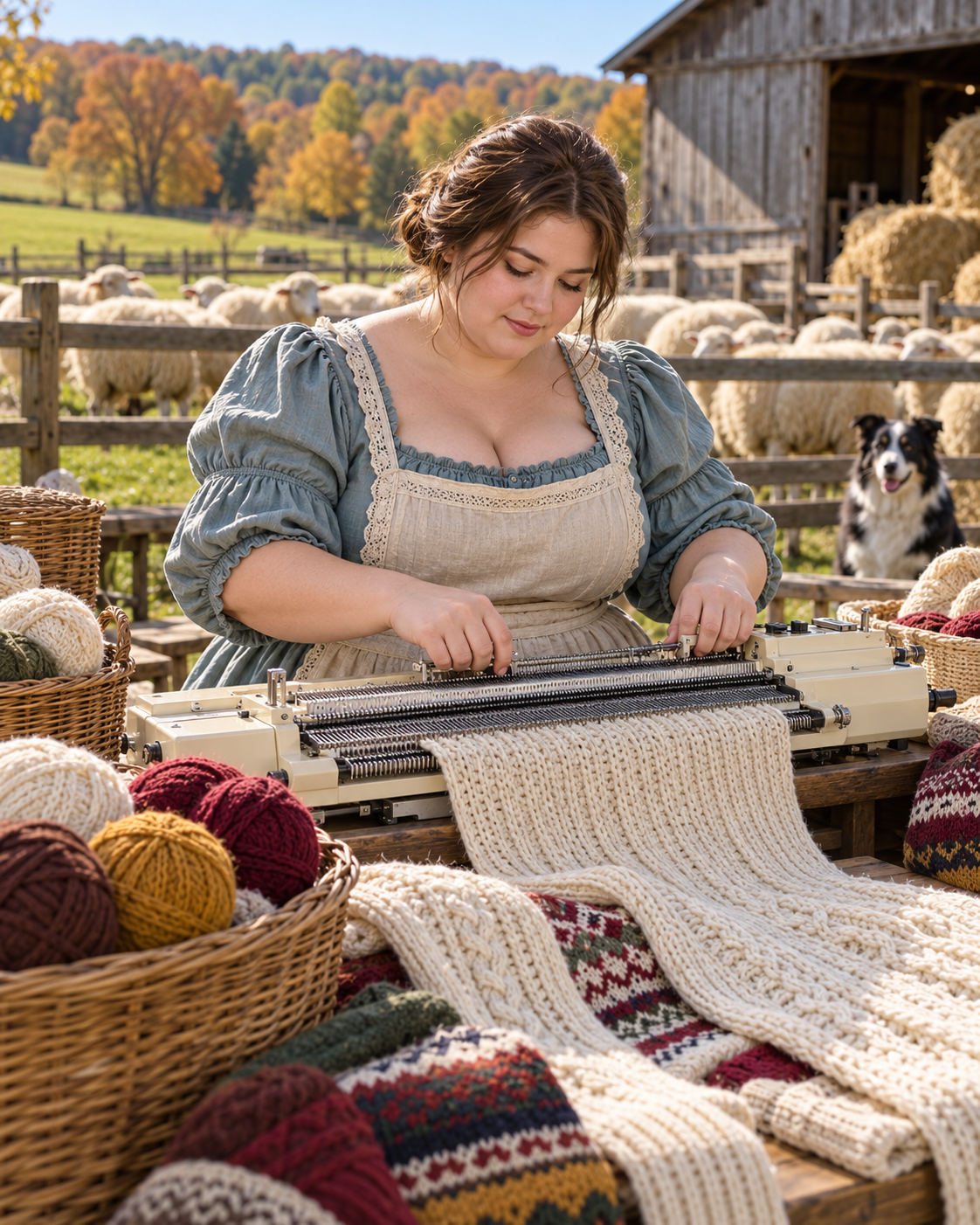
I stayed behind with the women in the knitting shed.
We had orders waiting, wages to pay, and no time to surrender to fear.
At noon, Clara Bennett, our youngest worker, hurried inside carrying a newspaper.
“Miss Whitlock, you need to see this.”
Across the bottom of the page was an announcement.
Silas Crowley had filed a claim against Mercer Ranch.
He alleged that Nathaniel Mercer had borrowed money from Crowley’s father in 1863, using the entire property as security.
The debt, including interest, supposedly remained unpaid.
I read the announcement three times.
If the claim succeeded, Crowley could seize the ranch.
Including the portion my mother had purchased.
I knew then that the threatening note was no idle cruelty.
Someone wanted the truth buried before it could become useful.
When Gideon returned that evening, his knuckles were bleeding.
I met him beside the barn.
“What happened?”
“Nothing.”
“Gideon.”
He looked away.
“Crowley told me you were using me.”
My stomach tightened.
“He said your family planned this years ago.”
I waited.
“And did you believe him?”
Gideon looked at my face.
“No.”
The answer came quickly.
Perhaps too quickly.
Then he reached into his pocket.
He handed me a small leather pouch.
Inside lay an old silver thimble.
My mother’s initials were engraved on its side.
E.W.
“Where did you get this?”
“From my father’s desk.”
My legs nearly failed.
I remembered that thimble.
My mother used to wear it while sewing by candlelight.
After her death, I searched everywhere for it.
I had always believed my father had sold it to buy food.
But here it was.
Two thousand miles away.
In Nathaniel Mercer’s desk.
Gideon caught my elbow.
“Mabel, there’s something else.”
He hesitated.
“My father used to speak about a woman who saved his life.”
I stared at him.
“He never told me her name.”
The following morning, we rode to the cemetery overlooking the valley.
Nathaniel Mercer had been buried there five years earlier.
His headstone stood beneath a crooked cottonwood.
Gideon knelt beside it and brushed away the snow.
“Before he died, he asked me to forgive him.”
I stood beside him.
“For what?”
“He wouldn’t say.”
A bitter wind swept across the hillside.
Gideon traced his father’s name with one finger.
“I thought he meant the drinking, or the years he spent away from home.”
He looked up.
“Now I’m not sure.”
I reached into my pocket and touched the silver thimble.
Then I noticed something carved into the back of the headstone.
Not part of the inscription.
Just three small letters.
E.W.T.
Gideon frowned.
“Those weren’t there when we buried him.”
Beneath the letters was a date.
April 19, 1862.
I felt the blood drain from my face.
That was my mother’s birthday.
We searched around the grave until Gideon found a flat stone half-buried near the cottonwood roots.
Underneath lay a rusted biscuit tin.
Inside was a bundle of papers wrapped in oilcloth.
The first was a letter from Nathaniel Mercer.
The second was a deed.
And the third was a document that changed everything.
It was a signed statement from a freight company employee named Samuel Crowley.
Silas Crowley’s father.
According to the statement, my mother had invested her inheritance in a shipment of farming equipment bound for Montana.
Nathaniel Mercer had agreed to receive the equipment and help establish a sheep ranch.
But Samuel Crowley had stolen the shipment and blamed Nathaniel.
My mother had traveled west to settle the dispute.
While investigating, she discovered that Crowley had falsified shipping records and sold the equipment.
When she threatened to expose him, he accused her of theft instead.
The accusation destroyed her reputation.
My father brought her back to Pennsylvania.
The charges were eventually dropped, but the damage remained.
Nathaniel later recovered part of her investment and purchased the land in both their names.
Crowley, however, retained the forged debt papers.
I read the statement with shaking hands.
At the bottom, another sentence had been added.
“I confess this freely, knowing that my son Silas must never profit from my crime.”
The signature had been witnessed by a territorial judge.
Gideon let out a long breath.
“Why would my father hide this?”
I turned to the final letter.
There, in Nathaniel’s own handwriting, was the answer.
He had promised my mother that he would protect her share until she felt safe returning.
But when Crowley threatened to expose her publicly as an accused thief, Nathaniel stayed silent rather than risk bringing her more suffering.
He intended to make things right.
Then she died.
He wrote repeatedly to my father, but received no reply.
Eventually, Nathaniel believed the Whitlocks wanted nothing more to do with Montana.
The final line made my vision blur.
“I have kept the land in Eleanor’s name because she deserves a home she may never see.”
I sat down in the snow.
For years, I had carried anger like a second heart.
I had imagined a wealthy rancher stealing my mother’s money and leaving her to suffer.
But the truth was more complicated.
Nathaniel had failed her.
Not by taking everything.
By allowing fear and shame to keep him silent.
I understood that kind of failure.
My own father had hidden the truth because he could not bear admitting how helpless he had been.
And I had nearly repeated their mistakes.
I had kept my secret from Gideon because I feared losing the one place where I finally belonged.
Then a gunshot cracked through the cemetery.
The stone beside Gideon’s shoulder shattered.
He grabbed me and pulled me behind the cottonwood.
Another shot struck the frozen ground.
“Stay down!”
Through the trees, I saw a rider on a gray horse.
A man wearing a dark coat.
Silas Crowley.
Gideon drew his revolver.
But before he could fire, Crowley turned and disappeared down the hillside.
We remained behind the tree until the hoofbeats faded.
Then Gideon looked at the documents scattered across the snow.
“He’s willing to kill for them.”
I gathered every page.
“Then we make sure everyone sees them.”
We rode straight to town.
By evening, news of the shooting had spread through every saloon and boardinghouse.
Gideon demanded that the sheriff arrest Crowley.
But Sheriff Harlan listened without moving from his chair.
“You’ve got witnesses?”
“We saw him,” Gideon said.
“In the middle of a snowstorm?”
“I know what I saw.”
The sheriff sighed.
“Crowley says he was home all afternoon.”
I stepped forward.
“Then ask his stable boy whether the gray horse was ridden.”
Harlan’s eyes narrowed.
“Careful, Miss Whitlock.”
I realized he was warning me.
Not protecting me.
Outside, Gideon caught my arm.
“We can’t trust him.”
“I know.”
“Then what do we do?”
I looked toward the knitting shed, where lamps still glowed against the darkness.
“We trust the people who have something worth protecting.”
The next morning, I gathered our workers.
There were fourteen women now.
Widows, farmers’ daughters, mothers with hungry children, and wives whose husbands had once forbidden them to earn money.
I laid the documents across the cutting table.
I told them everything.
No dramatic speeches.
No demands for loyalty.
Just the truth.
When I finished, Clara Bennett reached for the old deed.
“My husband says Crowley owns half the businesses in town.”
“He practically does,” another woman whispered.
I nodded.
“Then you understand why everyone is afraid.”
Clara looked at me.
“Are you afraid?”
My throat tightened.
“Every day.”
She folded her arms.
“Good.”
I stared at her.
“Then you’re just like the rest of us.”
One by one, the women stepped closer.
Clara spoke first.
“My brother works for the county recorder.”
Another woman raised her hand.
“My uncle drove freight wagons for Crowley’s father.”
A third said her husband had seen the bank manager riding north with two unfamiliar men.
For the first time, I understood what our little business had truly created.
Not merely stockings.
Not merely wages.
A place where women who had spent their lives being dismissed had learned to listen to one another.
Within two days, we discovered that the bank manager, Mr. Ellison, had not fled town.
He was being held at Crowley’s abandoned line cabin near the northern ridge.
Gideon wanted to ride there immediately.
I refused to let him go alone.
“We’re going together.”
“Mabel, it’s dangerous.”
“So was coming to Montana with forty-three dollars.”
He almost smiled.
We brought four ranch hands and Clara’s brother.
Under cover of darkness, we reached the cabin.
A lantern burned inside.
Through the window, I saw Ellison tied to a chair.
His face was bruised.
Two armed men guarded the doorway.
Gideon whispered a plan.
Then something unexpected happened.
A woman stepped from the shadows behind the cabin.
She was thin, gray-haired, and trembling.
“Don’t shoot,” she pleaded.
It was Ruth Crowley.
Silas’s wife.
She held a ring of keys.
“My husband says he’ll burn the ranch before he lets her have it.”
Her eyes found mine.
“I heard what happened to your mother.”
She swallowed.
“And I’ve spent twenty years pretending my own husband was a better man.”
We waited until the guards moved toward the stable.
Ruth unlocked the back door.
Gideon slipped inside and freed Ellison.
One guard returned too soon.
There was a struggle.
A gun discharged.
Gideon staggered backward.
For one terrible second, I thought he had been killed.
Then he pressed a hand against his upper arm.
Blood seeped between his fingers.
The ranch hands overpowered both guards.
I tore a strip from my petticoat and bound Gideon’s wound.
He tried to reassure me.
“It’s only a scratch.”
“Then stop bleeding on my dress.”
His weak laugh nearly broke my heart.
Ellison, shaking violently, told us Crowley had forced him to hide the original ledger.
He had refused to forge a new entry.
That was why he had been taken.
The ledger was inside the cabin, concealed beneath a loose floorboard.
We found it.
And with it, another document bearing Crowley’s signature.
A confession of sorts.
An agreement promising the two guards five hundred dollars if they prevented Ellison from appearing in court.
There could be no misunderstanding now.
When we returned to town, the sheriff could no longer ignore us.
Not with Ellison alive.
Not with the original ledger recovered.
Not with Ruth Crowley prepared to testify.
Silas was arrested the following afternoon.
He was standing outside the bank when the sheriff approached.
Crowley looked directly at me.
“You think you’ve won?”
I held his gaze.
“I think the truth has finally found you.”
He smiled without warmth.
“Truth doesn’t feed hungry people, Miss Whitlock.”
I thought of the women working through the winter.
The children whose boots now held warm feet.
The ranch hands who had received their wages because we refused to surrender.
“No,” I said.
“But decent work does.”
The territorial hearing took place three weeks later.
By then, Gideon’s arm had begun healing.
He insisted on accompanying me, though I could see the pain each time he lifted his coat.
The courtroom was crowded.
Crowley sat beside his attorney, looking confident.
For hours, witnesses testified.
Ellison presented the bank ledger.
Ruth described the threats she had heard.
Clara’s uncle confirmed the old freight records.
And I stood before the judge holding my mother’s silver thimble.
Crowley’s attorney tried to discredit me.
He suggested I had come west specifically to steal a prosperous ranch from an unsuspecting man.
A few people laughed.
I felt myself becoming that woman on the train platform again.
The one everyone had judged before hearing a single word.
Then the attorney asked whether my father had ever been accused of financial dishonesty.
I swallowed.
“Yes.”
“And your mother?”
I gripped the witness rail.
“Yes.”
He smiled.
“So dishonesty runs in your family.”
The courtroom went silent.
I thought of my mother sewing until her fingers bled.
I thought of my father dying with regret beneath his pillow.
And I thought of every woman who had ever been made to feel small so that another person could feel powerful.
“My mother was accused of a crime she did not commit,” I said.
“That accusation followed her for the rest of her life.”
My voice steadied.
“But an accusation is not proof, sir.”
I looked toward Crowley.
“And neither is a man’s reputation.”
The judge examined every document.
After a long recess, he returned.
The forged debt was declared invalid.
The original land agreement was recognized.
Crowley’s claim was dismissed, and the evidence of kidnapping, fraud, and attempted violence was referred for criminal prosecution.
Then the judge addressed me.
“Miss Whitlock, the evidence establishes that Eleanor Whitlock held an undivided one-half interest in Mercer Ranch.”
I felt Gideon’s hand find mine.
“That interest passed to her lawful heirs.”
The judge looked over his spectacles.
“Which means, Miss Whitlock, that your mother’s share belongs to you.”
I had imagined that moment so many times.
I thought I would feel victorious.
Instead, I began to cry.
Not because I had gained land.
Because my mother had finally been believed.
Outside the courthouse, Gideon stood beside me as the crowd dispersed.
The spring air smelled of wet earth.
For a while, we said nothing.
Then he spoke.
“I suppose you’ll want your half.”
I turned toward him.
“Yes.”
He nodded, though his eyes fell.
I waited until he looked at me again.
“And I want to keep working with you.”
His expression changed.
“After everything?”
“Especially after everything.”
I reached into my bag and removed a folded document.
It was a partnership agreement I had prepared with the help of a lawyer.
Half the land would remain mine.
Half would remain Gideon’s.
Our textile business would operate separately, with wages guaranteed and a portion of its profits reserved for expansion.
The women would have opportunities to earn ownership shares through their work.
Gideon read the pages slowly.
“You’ve thought about this.”
“For months.”
He looked up.
“And what about us?”
The question hung between us.
For once, I had no prepared answer.
I thought of the man who had humiliated me before strangers.
The man who had later hauled water through freezing nights.
The man who had risked his life to protect me.
I knew love could not erase cruelty.
But I also knew repentance meant little unless it became action.
“You hurt me when we met,” I said.
His eyes filled.
“I know.”
“You made me feel as though I was worth less because of how I looked.”
“I was ashamed of myself long before I was brave enough to admit it.”
I took a breath.
“I won’t spend my life trying to become small enough for another person’s comfort.”
He reached for my hand, then stopped.
“Good,” he whispered.
“Because I never want you to be anything less than exactly who you are.”
I kissed him first.
Not because he had saved me.
Not because I owed him forgiveness.
But because, somewhere between the frozen shearing shed and the courtroom, we had become two people capable of meeting each other honestly.
We married the following autumn.
It was a small ceremony beneath the cottonwood overlooking the valley.
Clara stood beside me.
Ruth Crowley attended quietly, having begun a new life in a rented cottage near town.
The women from the workshop brought flowers.
The ranch hands brought laughter.
And Gideon, standing beneath the golden leaves, cried before I reached him.
Afterward, we returned to the ranch for supper.
The same ranch where I had once been told I was not strong enough to work.
Only now, the old shearing shed had become a proper textile workshop.
There were six knitting machines.
Twenty-three women earned wages there.
And above the doorway hung a wooden sign Gideon had carved himself.
“Whitlock & Mercer Woolen Works.”
I stood beneath it for a long time.
Then Clara came outside carrying a small package.
“We made something for you.”
Inside was a blanket.
Every woman had contributed a section.
There were imperfect stitches, uneven colors, and patterns that did not quite match.
But along the border, they had sewn twenty-three names.
Clara smiled.
“We wanted you to remember what you started.”
I pressed the blanket against my heart.
“I didn’t start this alone.”
“No,” she said.
“But you showed us that we could.”
Years passed.
Our business grew.
We shipped woolen goods to mining towns, railroad camps, and distant cities.
Some seasons were difficult.
Machines broke.
Orders failed.
Storms ruined roads.
There were arguments, exhausted nights, and mornings when the accounts frightened me.
But the women had a voice in the decisions that shaped their work.
And neither Gideon nor I ever forgot what it meant to stand on the edge of losing everything.
One winter evening, our daughter Eleanor asked why my silver thimble sat inside a glass case in the workshop.
She was seven, with Gideon’s dark eyes and my stubborn chin.
“Was it very expensive, Mama?”
I smiled.
“No, sweetheart.”
“Then why do you keep it?”
I lifted the case and placed the thimble in her palm.
“Because it belonged to your grandmother.”
“Was she rich?”
I looked toward the workshop windows, where warm light spilled across the snow.
“Not when she died.”
Eleanor frowned.
“But she owned half the ranch.”
“Yes.”
“Then why wasn’t she rich?”
I sat beside her.
“Because sometimes people can take what belongs to you and convince the world it was never yours.”
She looked frightened.
I closed her fingers around the thimble.
“But that doesn’t mean they’re right.”
She considered this carefully.
“Did you get it back?”
I looked across the room.
Gideon was repairing a wooden toy beside the stove.
Clara’s oldest daughter was studying bookkeeping at the table.
Outside, women were leaving the workshop with their weekly wages tucked safely into their coats.
I thought about my mother’s final years.
Nothing could return the meals she had missed.
Nothing could restore her good name while she was alive to enjoy it.
And nothing could give me another childhood with her.
But her sacrifice had not disappeared.
It had become land.
And work.
And dignity.
And a future for people she would never meet.
“Yes,” I whispered.
“We got it back.”
Eleanor climbed into my lap.
“Did it make you happy?”
I held her close.
For a moment, I saw myself on the Montana train platform, surrounded by laughter, clutching a battered carpetbag and trying not to cry.
I remembered Gideon’s cold eyes.
The snow.
The crushing loneliness.
I remembered how close I had come to boarding the next train east.
Then I looked at the life surrounding me.
“Not the land itself,” I said softly.
“What made me happy was learning that nobody gets to decide my worth for me.”
My daughter rested her head against my shoulder.
And in the quiet of that winter night, I finally understood something my mother had tried to teach me long before I could comprehend it.
A person’s value is not measured by beauty, size, wealth, or the approval of strangers.
It is measured by what they build, what they protect, and how they treat the people who have nothing to offer them in return.
The world may refuse to see your worth.
It may laugh at your dreams.
It may close every door before you have a chance to speak.
But sometimes, the very thing people mock becomes the strength that saves you.
And sometimes, justice arrives too late for the people who deserve it most.
When that happens, the greatest honor we can give them is to build something kinder from what they left behind.
That night, after Eleanor had fallen asleep, I returned to the workshop alone.
I placed my mother’s thimble beneath the lamplight and unfolded Nathaniel Mercer’s final letter one last time.
On its back, in faded ink I had never noticed before, my mother had written a single sentence.
“Whatever happens to me, let my daughter live a life in which she never has to apologize for taking up space.”
I read it through tears.
Then I folded the letter, held it against my heart, and whispered the words I had traveled two thousand miles to say.
“I did, Mama.”
Outside, the Montana wind swept across the valley.
Inside, the machines stood silent, waiting for morning.
And for the first time in my life, I no longer felt like a woman searching for somewhere she belonged.
I was home.
THE END.