The little dragon was still waiting on the landing platform when the last ship from her clan disappeared into the sky.
Davian sat in the dim cockpit, staring at the two glowing routes on his navigation screen. One led to the nearby research outpost, where the three young dragons could receive medical attention but might never be allowed to leave. The other led to a distant sanctuary, twelve days away, with barely enough food and oxygen to get everyone there.
Behind him, Aryss rested her head against the doorway.
“Still thinking?” her translation collar asked.
“Trying to figure out how to do the right thing without getting us all killed.”
Aryss considered that for a moment.
“Hard thinking.”
Davian let out a tired laugh.
“Yeah. The hardest kind.”
He turned toward the cargo bay, where the three rescued dragons slept beneath emergency thermal blankets. The smallest had somehow managed to curl herself inside one of his spare boots. The green dragon with the injured leg lay beside her, breathing unevenly. The third, whose wings were too small to support his body, slept with his nose pressed against Aryss’s old blanket.
Davian had promised himself years ago that he would never become responsible for anyone again.
Then Aryss had arrived.
Now there were three more.
He opened the ship’s communication system and searched the planetary registry for information about the identification markings beneath the youngsters’ scales.
What appeared on the screen made him sit upright.
The markings weren’t ordinary migration records.
They were abandonment classifications.
Each dragon had been registered as “nonviable for continued clan transport.”
The phrase was cold and clinical, followed by identification numbers and brief physical descriptions. The green dragon had been classified because of a damaged foreleg. The smallest had a congenital respiratory weakness. The third had been labeled incapable of sustained flight.
Davian read the records twice.
Someone had officially documented the decision to leave them behind.
And the records indicated that whoever had abandoned them had done so legally under a centuries-old provision of the Interstellar Species Autonomy Agreement.
He felt his stomach turn.
Apparently, a clan could abandon its own young as long as the location was categorized as survivable.
“Survivable,” Davian muttered.
He remembered the collapsed canyon, the freezing chamber, and the tiny dragon too weak to stand.
Aryss approached the console.
“Found?”
“Yeah,” Davian said quietly. “I found out why they were left.”
She studied his expression.
“Like me?”
He couldn’t bring himself to lie.
“Yes.”
Aryss looked toward the sleeping youngsters.
For several seconds, her collar remained silent.
Then she said, “They were wrong.”
Davian turned to her.
“About what?”
“Us.”
Something in her voice made the decision for him.
He selected the sanctuary route.
But before he could engage the engines, an incoming transmission interrupted the navigation system.
A woman’s face appeared on the screen.
She wore the dark blue uniform of the Interstellar Biological Research Authority.
“Survey vessel Meridian Seven, this is Director Helena Voss of Outpost Eighteen. We have detected four unregistered dragon life signatures aboard your ship. You are required to report to our facility for biological examination.”
Davian kept his expression neutral.
“One of those signatures belongs to my registered navigation partner.”
“We are aware of Aryss. The other three are classified juveniles.”
“Then you know they need medical care.”
“Which our facility can provide.”
“And what happens afterward?”
There was a short pause.
“That determination falls under interspecies custody regulations.”
Davian leaned forward.
“That’s not what I asked.”
Voss’s face hardened.
“Mr. Davian, your vessel is not equipped to transport four dragons. Attempting to do so would constitute reckless endangerment.”
He looked at the medical readings scrolling along the edge of the screen.
She wasn’t entirely wrong.
The smallest dragon’s oxygen saturation was already declining.
“I understand the risks,” he said.
“Then you will comply.”
Davian ended the transmission.
The cockpit fell quiet.
Aryss watched him.
“Angry human.”
“Very.”
“At them?”
“At the people who wrote rules that make abandoning children acceptable.”
Aryss moved closer.
“Then change rules.”
Davian looked at her.
“That’s a little more complicated than fixing a wing brace.”
She nudged his hand with her nose.
“Try.”
He stared at the silent communication screen.
Then, for the first time that night, he smiled.
“All right. We’ll try.”
The Meridian Seven lifted from Veyra’s surface twenty minutes later.
Davian reduced the environmental systems to minimum operating levels, redirected power from the auxiliary laboratory, and converted the storage compartment into an emergency medical area.
Aryss helped in the only way she could.
She remained beside the youngsters, producing the low-frequency vibrations that seemed to calm them whenever the ship’s engines changed pitch.
By morning, Davian had given them names.
The green dragon became Bracken because of the dark, leaf-shaped markings along his neck.
The smallest became Pip, partly because of her size and partly because the first sound her collar produced resembled a tiny squeak.
The third became Flint, after Davian found him stubbornly trying to climb a storage shelf despite his undersized wings.
“You’re going to be trouble,” Davian told him.
Flint responded by biting the corner of his boot.
Aryss watched with unmistakable satisfaction.
“Good name.”
For two days, the journey went better than expected.
Bracken began eating without assistance. Flint discovered that he could balance on narrow surfaces more effectively than any of the others. Pip spent most of her time sleeping against Aryss, but her breathing remained steady.
Davian started to believe they might make it.
Then, on the third morning, the ship’s environmental alarm sounded.
Pip had stopped breathing normally.
Davian rushed into the cargo bay and found her lying on her side, her tiny chest rising in shallow, irregular movements.
He attached an emergency oxygen mask, but she struggled weakly against it.
Aryss circled them, distressed.
“Help her.”
“I’m trying.”
“Help!”
Davian checked the readings.
Pip’s respiratory condition was worsening because of the ship’s recycled air. The filtration system could maintain oxygen levels for healthy passengers, but it couldn’t adequately remove the trace contaminants irritating her developing lungs.
He searched his medical database.
The recommended treatment required specialized equipment.
Equipment they didn’t have.
The nearest medical facility was Outpost Eighteen.
Davian closed his eyes.
He could continue toward the sanctuary and hope Pip survived, or return to the very authority he feared might claim custody of her.
Aryss watched him silently.
Finally, he said, “We’re turning around.”
The collar flickered.
“Why?”
“Because Pip needs help now. Not nine days from now.”
Aryss looked down at the tiny dragon.
“Then we go.”
There was no resentment in her answer.
No accusation.
Only trust.
Davian altered course.
Four hours later, the Meridian Seven approached Outpost Eighteen, a sprawling research installation built into the surface of a gray, airless moon.
Director Voss was waiting when the ship docked.
So were six security officers.
Davian stepped down the ramp carrying Pip in a heated medical carrier.
“If you want to argue about custody,” he said, “you can do it after someone helps her breathe.”
Voss looked into the carrier.
For an instant, her expression changed.
Then she turned toward a medical team.
“Emergency respiratory unit. Now.”
The doctors took Pip immediately.
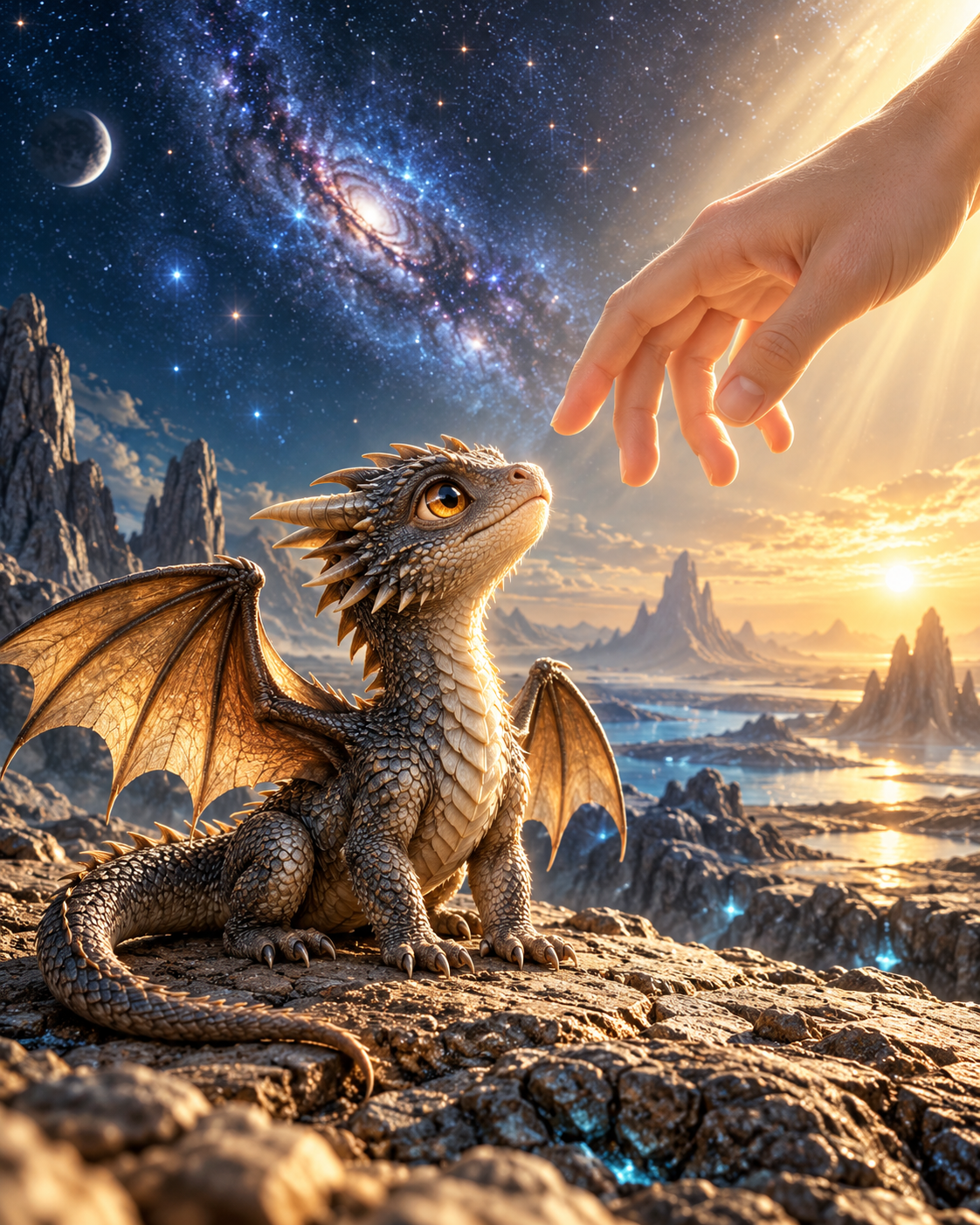
Aryss tried to follow, but security officers blocked her path.
A low vibration rolled through the docking bay.
Davian felt it in his chest.
“Aryss,” he said carefully. “They’re helping her.”
She didn’t stop.
The vibration deepened, rattling loose equipment along the wall.
One of the officers reached for his restraint device.
Davian moved between them.
“Don’t.”
Voss raised a hand.
“Everyone stand down.”
She studied Aryss.
“She understands what’s happening?”
“Better than most people here, apparently.”
Voss ignored the remark.
“Let her accompany the medical team.”
The officers stepped aside.
Aryss hurried after Pip.
Davian followed, realizing that whatever happened next, leaving this outpost would be far more difficult than arriving.
Pip survived the first night.
The doctors stabilized her breathing and discovered that a minor surgical procedure could correct part of her respiratory defect. With treatment, she would likely grow into a healthy dragon capable of surviving outside a controlled environment.
Bracken’s injured leg could also be repaired.
Flint’s wings, however, would probably never develop enough for conventional flight.
When Davian received the medical reports, he felt relief so powerful that he had to sit down.
Then Voss entered the examination room carrying a tablet.
“I have good news,” she said.
Davian looked up.
“Does it involve them coming home with us?”
“That depends on your definition of home.”
She placed the tablet on the table.
The screen displayed three transfer orders.
Bracken would be sent to a specialized rehabilitation center. Pip would remain at the outpost for continued observation. Flint would be assigned to a behavioral research program.
Davian stared at her.
“You’re separating them?”
“Each has different medical needs.”
“They’re frightened children who just survived abandonment.”
“And they’re members of a protected nonhuman species.”
“They’re also individuals.”
Voss folded her arms.
“Mr. Davian, you are a surveyor, not a licensed dragon caretaker.”
“No, I’m the person who found them.”
“That doesn’t establish legal custody.”
Davian stood.
“Neither does finding a regulation that makes their lives convenient for your department.”
Voss’s eyes narrowed.
“You are dangerously close to losing your certification.”
He looked at the transfer orders again.
Then he noticed something.
Flint’s assignment wasn’t listed as rehabilitation.
It was labeled “adaptive locomotion study.”
He tapped the entry.
“What exactly are you planning to study?”
Voss hesitated.
“Whether flight-deficient dragons can develop alternative movement strategies.”
Davian glanced toward Aryss, who was resting beside Pip’s treatment chamber.
“You already have your answer.”
Voss followed his gaze.
“Aryss is an exceptional case.”
“Maybe. Or maybe nobody bothered looking before.”
He opened his survey database and transferred two years of Aryss’s navigation records onto the examination room display.
Thousands of readings appeared across the screen.
Subsurface maps.
Atmospheric predictions.
Structural scans.
Hazard warnings that had repeatedly saved his ship from dangerous terrain.
All produced by a dragon whose own clan had declared her incapable of contributing to its survival.
Voss stared at the data.
“These measurements are hers?”
“Every one of them.”
“How did you calibrate the equipment?”
“She calibrated me.”
Despite herself, Voss looked intrigued.
Davian continued.
“Aryss couldn’t fly properly, so she learned to listen to the ground. She developed abilities nobody expected because nobody had given her the chance.”
Voss studied the records for several minutes.
Then she said something Davian hadn’t anticipated.
“If these results are independently verified, they could challenge the biological assumptions behind the abandonment classifications.”
“Then verify them.”
“It’s not that simple.”
“Nothing about this has been simple.”
Before Voss could respond, the door opened.
A security officer approached her and whispered something.
Her face went pale.
Davian immediately knew something was wrong.
“What happened?”
Voss looked at him.
“A dragon clan vessel has entered our jurisdiction.”
“And?”
“They’ve requested the return of three juveniles registered under their migration authority.”
Davian felt the room grow cold.
The clan had come back.
For a moment, he imagined frightened parents arriving to reclaim children they had lost.
Then Voss showed him the transmission.
The requesting vessel was the same one that had registered the youngsters as nonviable.
The same clan that had abandoned them.
“Why would they want them now?” Davian asked.
Voss didn’t answer immediately.
Instead, she opened another document.
“Because their registry was automatically updated when our medical system recorded the juveniles as recoverable.”
Davian stared at her.
“They left them because they thought they were useless. Now they want them because they’re getting better?”
“That appears to be the situation.”
He turned toward Aryss.
She had heard everything.
Her collar emitted a single word.
“No.”
It wasn’t loud.
But there was something final about it.
Voss sighed.
“Under current law, the clan retains primary guardianship unless permanent relinquishment can be established.”
“They abandoned them on a planet with no food and no shelter.”
“They classified the environment as survivable.”
“You saw Pip’s medical records.”
“I did.”
“Then tell me you’re not going to send her back.”
Voss looked away.
“I have forty-eight hours before the custody review.”
Davian stepped closer.
“And what happens after forty-eight hours?”
“If the review supports their claim, I’m legally required to release them.”
That evening, Davian returned to his ship without the youngsters.
They remained in the medical wing, where the doctors had promised to keep them comfortable.
Aryss refused to leave their room until Davian persuaded her that Pip needed uninterrupted rest.
Now she lay beside his chair, watching the stars through the cockpit window.
For the first time since he’d found her, she seemed very young.
“Will they take them?” she asked.
“I’m going to do everything I can to stop it.”
“Everything?”
“Everything I know how to do.”
Aryss was silent.
Then she said, “I remember.”
Davian turned.
“Remember what?”
“When my clan left.”
He waited.
“I followed. They flew. I fell.”
Her collar struggled briefly with the next sequence of vibrations.
“I called. Nobody came.”
Davian swallowed.
“I know.”
“No,” she said gently. “You know I was alone. You don’t know what I heard.”
A strange sensation moved through him.
“What did you hear?”
Aryss lowered her head.
“Their voices. They said I was too heavy. Too slow. That I would make the others die.”
Davian stared at her.
She had never spoken so clearly about her abandonment.
“They were wrong, Aryss.”
“I know now.”
She looked toward the medical wing beyond the docking bay.
“Little ones don’t know yet.”
Davian understood.
Bracken, Pip, and Flint had survived being abandoned once.
If they were returned to the same clan, they might spend the rest of their lives believing that love depended on being useful.
He opened his communication system.
There was one person he hadn’t contacted in years.
Her name was Mara Ellis, an interstellar civil-rights attorney based on a colony near Earth.
They had known each other before Davian disappeared into the surveying profession.
Before he decided that dealing with people was more trouble than it was worth.
When Mara answered, she looked surprised.
“Davian?”
“Hi, Mara.”
She stared at him.
“Are you calling because something exploded, or because you’re finally ready to apologize for missing my wedding?”
“Potentially both.”
She sighed.
“Tell me what happened.”
Davian told her everything.
He sent the abandonment records, the medical reports, the proposed custody orders, and Aryss’s navigation data.
Mara listened without interrupting.
When he finished, she leaned back in her chair.
“The law is ugly,” she said.
“I noticed.”
“But there may be an opening.”
Davian leaned forward.
“What kind?”
“The abandonment provision protects clan autonomy. It doesn’t necessarily override individual welfare when a clan voluntarily relinquishes a dependent.”
“They’ll say they never relinquished them.”
“Then we’ll need evidence that abandonment wasn’t temporary.”
“The records?”
“Those help. But the strongest evidence may come from the juveniles themselves.”
Davian frowned.
“They’re young. Pip barely communicates.”
“Not in words.”
Mara looked toward Aryss.
“But someone aboard your ship understands a language we’ve never formally recognized.”
Aryss raised her head.
The next morning, Mara arrived at Outpost Eighteen aboard a fast civilian transport.
She met with Voss and demanded an emergency review before the dragons could be transferred.
Voss initially resisted.
Then Mara showed her the legal argument.
The treaty recognized the rights of sentient species to manage their own cultural affairs. But it also recognized the right of any sufficiently communicative individual to reject harmful custodial arrangements.
The problem was that dragon communication had historically been interpreted only through adult vocalizations and ritual gestures.
Juvenile subsonic communication had never been accepted as testimony.
Mara intended to change that.
“We need Aryss to translate,” she explained.
Davian shook his head.
“Her collar isn’t certified for legal testimony.”
“Then we certify the method.”
“That could take months.”
“Not if we demonstrate that the communication is consistent, repeatable, and independently measurable.”
Voss studied the proposal.
“You want to use a planetary survey as evidence in an interspecies guardianship hearing?”
Mara smiled faintly.
“I’ve done stranger things.”
For the next twelve hours, technicians worked with Aryss.
They recorded her vibrations, compared them with previous translation logs, and tested whether she could distinguish between different objects, locations, emotions, and memories.
Aryss tolerated the examinations until one technician asked her to repeat the phrase “unfit for transport.”
She refused.
The technician tried again.
Aryss turned away.
Davian approached her.
“What’s wrong?”
Her collar flickered.
“Bad words.”
He crouched beside her.
“I know.”
“They called me that.”
Davian rested his hand against her neck.
“Then you don’t have to say it.”
Mara, watching from the doorway, stepped forward.
“Actually,” she said quietly, “that may be the most important answer we’ve recorded.”
The following morning, the custody hearing began.
The clan representative appeared through a holographic transmission, a towering bronze dragon with scarred wings and a ceremonial metal collar.
His name was Tharos.
He spoke through a professional interpreter.
“The juveniles belong to our migration line. Their recovery makes them eligible for reassessment. We request their immediate return.”
Mara stood.
“You classified them as nonviable.”
“Based on their condition at the time.”
“You abandoned them.”
“We left them on a planet with a stable atmosphere and accessible water.”
“Inside a collapsing canyon?”
Tharos shifted.
“The location was selected according to traditional survival criteria.”
Mara displayed photographs of the chamber.
“Does this look like a suitable environment for injured children?”
The dragon’s expression remained unreadable.
“Our customs are older than human civilization.”
Mara nodded.
“Age does not make a custom harmless.”
A murmur traveled through the hearing room.
Tharos lowered his head.
“Humans cannot understand the necessities of migration.”
“Then help us understand,” Mara replied. “Why didn’t you provide treatment?”
“We had insufficient supplies.”
“Why didn’t you leave a distress beacon?”
“We do not interfere with natural selection.”
“Then why are you requesting their return now?”
Tharos hesitated.
“Their recovery changes their potential contribution.”
Davian felt his hands tighten beneath the table.
There it was.
The entire argument reduced to usefulness.
Mara turned toward the hearing officer.
“We request permission to present testimony from the juveniles through an independently verified subsonic translation system.”
Tharos’s wings lifted.
“Young dragons cannot provide meaningful testimony.”
Aryss rose from her place beside Davian.
A low vibration passed through the room.
The translation system activated.
“Wrong.”
Every face turned toward her.
Tharos stared.
“A defective female?”
Davian stood so quickly that his chair scraped the floor.
Mara raised a calming hand.
“Let her speak.”
Aryss took several slow steps forward.
Her brace clicked softly against the polished floor.
Tharos studied it with visible contempt.
“You survived.”
“Yes,” Aryss answered.
“Then your abandonment achieved its purpose.”
Davian felt something inside him snap.
But before he could speak, Aryss replied.
“No.”
The room fell silent.
“I survived because someone came back for me.”
She looked toward Davian.
“He was not my clan. He was not my kind. He did not know if I was useful.”
Her collar paused as the computer processed a complex sequence.
“He helped anyway.”
For the first time, Tharos seemed uncertain.
Aryss continued.
“You left three small ones. They were cold. They were hungry. They thought they did something bad.”
The bronze dragon shifted his weight.
“They were weak.”
Aryss approached the center of the room.
“Yes,” she said.
Then she looked directly at him.
“So was I.”
Mara requested that the juveniles be brought in.
Pip entered first, carried by a medical assistant, followed by Bracken and Flint.
The moment they saw Aryss, all three hurried toward her.
Bracken limped.
Flint stumbled over his own feet.
Pip made a tiny, breathless sound and buried her face beneath Aryss’s wing.
Tharos watched without moving.
Mara activated the translation equipment.
Aryss began humming softly.
The youngsters responded.
At first, the system produced only fragments.
“Cold.”
“Dark.”
“Wait.”
Then Bracken stepped forward.
His translated words appeared on the screen.
“We waited for wings.”
Mara spoke gently.
“Whose wings?”
Bracken looked toward Tharos.
“Big ones. Our ones.”
The hearing room was completely silent.
“Did they come back?” Mara asked.
Bracken lowered his head.
“No.”
Pip pressed closer to Aryss.
The smallest dragon’s collar produced two words.
“Bad baby.”
Davian closed his eyes.
Mara crouched beside her.
“Who told you that?”
Pip trembled.
“Me.”
The answer struck harder than any accusation.
She hadn’t merely been abandoned.
She had blamed herself.
Tharos finally spoke.
“These responses are emotionally conditioned. They cannot be treated as rational testimony.”
Mara turned toward him.
“Then perhaps we should ask a rational question.”
She faced Bracken.
“Do you want to return to your clan?”
Bracken looked at the bronze dragon.
His body stiffened.
“No.”
Flint moved beside him.
“No.”
Pip’s answer was barely audible.
“Stay Aryss.”
The hearing officer requested a recess.
Davian led the dragons into a quiet waiting room while Mara spoke privately with Voss.
Nobody celebrated.
The testimony had been powerful, but the law remained complicated.
A juvenile’s preference could influence custody.
It did not automatically terminate ancestral guardianship.
Twenty minutes later, Mara returned.
Her expression told Davian everything.
“The hearing officer believes the dragons should remain under protective care,” she said.
Davian exhaled.
“But?”
“But Tharos has filed an emergency jurisdictional challenge. His clan claims the translation process violates their cultural sovereignty.”
“Can he win?”
“Possibly.”
Davian stared at the floor.
Mara sat beside him.
“There’s another issue.”
“What now?”
“The research authority has offered to sponsor permanent medical care for all three dragons.”
“That’s good, right?”
“It would be, except the agreement requires placement in separate specialized facilities.”
Davian shook his head.
“No.”
“There’s a third option.”
He looked at her.
“A private guardianship petition.”
“For all three?”
“Yes. But it requires a licensed caretaker, a suitable vessel or permanent residence, and proof of long-term financial support.”
Davian gave a humorless laugh.
“So everything I don’t have.”
Mara didn’t disagree.
He looked through the observation window.
Aryss was lying on the floor while Pip tried to climb onto her back. Bracken watched closely, and Flint was attempting to steal a medical glove.
For a brief moment, they looked like ordinary children.
Safe.
Curious.
Unaware that adults were deciding their future in another room.
Davian turned back to Mara.
“What if I sell the ship?”
She blinked.
“What?”
“The Meridian Seven. I own most of it. If I sell it, I can buy property somewhere suitable.”
“You’d lose your livelihood.”
“Maybe.”
“And your license?”
“If that’s what it takes.”
Mara studied him.
“You’re serious.”
Davian looked toward Aryss.
Two years earlier, he’d rescued a frightened dragon because he couldn’t bear to leave her alone.
He had never expected that decision to change the shape of his entire life.
“Yeah,” he said. “I am.”
But Aryss had been listening.
She approached the door and pressed her nose against his shoulder.
“No.”
Davian frowned.
“Aryss, we need somewhere safe.”
“Ship home.”
“I know.”
“Exploring home.”
He looked at her.
She continued, struggling to express something more complicated.
“Little ones need home. But you need sky.”
Davian remained silent.
Aryss nudged his hand.
“All need sky.”
For several minutes, nobody spoke.
Then Mara’s eyes widened.
“Wait a minute.”
She opened Davian’s navigation records again.
“These surveys. Are they commercially licensed?”
“Most of them.”
“How much are they worth?”
“Depends on the buyer.”
“And Aryss produced the primary data?”
“Yes.”
Mara smiled.
“Then maybe you don’t have to sell your ship.”
Three days later, Voss called an emergency meeting.
Davian entered expecting another legal obstacle.
Instead, he found Mara standing beside a representative from the Interstellar Exploration Council.
The council had reviewed Aryss’s survey data.
Her subsonic navigation techniques were unlike anything currently available to human explorers.
The recordings could improve rescue operations, geological assessments, and navigation in unstable environments.
The council wanted to establish a pilot program.
And they wanted Aryss to lead it.
Davian looked at the contract.
A research grant.
A modified exploration vessel.
A permanent medical support system.
Funding for the rescued dragons’ rehabilitation.
And a protected guardianship arrangement allowing the four dragons to remain together.
He read the document twice.
“What’s the catch?”
The council representative smiled.
“You’ll have to submit reports.”
Davian groaned.
Mara laughed.
“Some sacrifices are unavoidable.”
But the agreement still required the custody challenge to be resolved.
Tharos refused to withdraw his claim.
He argued that allowing abandoned juveniles to choose other guardians would weaken clan discipline and encourage dependence.
The final hearing took place one week later.
This time, the chamber was crowded with observers from several species.
News of Aryss’s testimony had spread.
A dragon with a damaged wing had challenged a tradition that had endured for generations.
And other clans were watching.
Tharos repeated his position.
Without strict survival standards, migration groups would be forced to carry individuals who endangered everyone.
Mara did not deny that migration involved difficult decisions.
Instead, she asked one question.
“If a juvenile cannot survive the journey, why must abandonment be the only alternative?”
Tharos remained silent.
Mara displayed the proposed rehabilitation program.
Medical transport.
Rescue partnerships.
Voluntary guardianship.
Specialized care.
None of it required forcing a migration clan to carry an injured member.
It required acknowledging that leaving someone behind did not have to mean leaving them to die.
Then Voss stepped forward.
She presented her department’s findings.
Aryss’s abilities had been independently verified.
Bracken showed unusual sensitivity to mineral disturbances.
Flint demonstrated exceptional balance and spatial awareness.
Pip, despite her respiratory weakness, responded to sound patterns beyond the normal range of adult dragons.
Their supposed defects had not erased their potential.
They had simply changed the ways that potential might develop.
Tharos watched the presentation without speaking.
Finally, the hearing officer addressed him.
“Do you still insist these juveniles are essential members of your migration group?”
Tharos hesitated.
“They may become useful.”
The officer nodded.
“That was not the question.”
A long silence followed.
Then Tharos lowered his head.
“No. They are not essential.”
“Then your claim rests on authority rather than obligation.”
The officer reviewed the evidence one final time.
The ruling was narrow but decisive.
The abandonment records constituted a voluntary relinquishment of immediate custodial responsibility. The juveniles’ clearly expressed wishes, combined with the danger of returning them, justified protective guardianship outside their birth clan.
The council’s proposed care program was approved.
Tharos’s claim was denied.
Davian didn’t move.
He had spent so long preparing for another setback that the victory barely registered.
Then Pip climbed into his lap.
Her collar flickered.
“Go home?”
Davian looked toward Mara.
She nodded.
He gathered Pip carefully in his arms.
“Yeah, little one. We’re going home.”
The Meridian Seven was refitted over the next six weeks.
The cargo bay became a shared living area with heated sleeping platforms, climbing structures, and enough space for four growing dragons to move comfortably.
A new medical unit monitored Pip’s breathing.
Bracken received a flexible support brace for his injured leg.
Flint was fitted with a lightweight harness that helped him practice controlled movement without straining his wings.
Aryss supervised every modification.
She rejected three sleeping arrangements, two feeding systems, and an entire set of floor coverings.
Davian eventually stopped arguing.
“Apparently, I’m not the captain anymore.”
Her collar responded immediately.
“Correct.”
The first official mission of the new exploration program took them to a distant moon where an earthquake had trapped a geological survey team beneath a damaged research dome.
Conventional scanners couldn’t locate the survivors through the dense mineral deposits.
Aryss stood at the edge of the fractured terrain.
Bracken beside her.
Flint balancing on a low ridge.
Pip resting safely inside the ship, monitoring their signals through the translation network.
Davian watched as Aryss lowered her chest toward the ground.
A deep vibration spread outward.
Bracken answered with a slightly different frequency.
The sensors began displaying overlapping subsurface patterns.
Davian stared at the emerging map.
Two separate resonance signatures were revealing a network of tunnels invisible to standard equipment.
“Well,” he whispered, “would you look at that.”
Aryss turned toward him.
“Found?”
He smiled.
“Yeah. I think you found them.”
Using the dragons’ guidance, the rescue team reached the trapped surveyors hours before their oxygen supply would have been exhausted.
The mission became the first publicly documented rescue completed with the assistance of a mixed human-dragon navigation team.
For the youngsters, it was simply the day everyone came home safely.
Months passed.
Bracken grew strong enough to run without his brace for short periods.
Flint never developed the ability to fly, but he became an extraordinary climber, able to navigate narrow passages that defeated both humans and adult dragons.
Pip’s lungs gradually strengthened. She developed a remarkable talent for recognizing emotional patterns in subsonic communication, often noticing distress before anyone spoke.
And Aryss continued leading them.
Not because she was the strongest.
Not because she could fly the highest.
But because she remembered what it felt like to be left behind.
One evening, nearly a year after the rescue on Veyra, Davian received an unexpected transmission.
It came from a young dragon on a distant migration route.
The message was hesitant and poorly translated.
“My wing is damaged. My clan says I cannot continue. I heard there is a place for dragons like me.”
Davian stared at the screen.
Aryss approached.
“Another?”
He nodded.
“Looks like it.”
She listened as he played the message.
Then she reached toward the communication panel and produced a gentle vibration.
The translation system displayed her answer.
“There is a place.”
She paused.
“We can help you find it.”
Davian looked at her.
He thought about the abandoned mining station on Khepri-9, the injured little dragon who had lifted her broken wing toward a stranger, and the years that had followed.
He had once believed that his life was easier because nobody depended on him.
Now his ship was noisy, crowded, constantly in need of repairs, and almost never quiet.
Flint was currently trying to dismantle a storage latch.
Bracken had fallen asleep across the main corridor.
Pip was stealing pieces of fruit from his dinner tray.
And Aryss was arranging another rescue before he’d even finished checking the fuel reserves.
He couldn’t remember the last time he’d felt lonely.
The new message appeared on the screen.
“Will you really come?”
Davian looked at Aryss.
She looked back at him.
Neither needed to ask the other.
He activated the navigation system.
“Send us your coordinates,” he said.
The reply arrived almost immediately.
“Thank you.”
Davian began calculating the route.
Aryss settled beside him, her wing brace gleaming softly beneath the cockpit lights.
It had been repaired and adjusted so many times that hardly any of the original material remained.
But she still wore it.
Not as a reminder of what she couldn’t do.
As a reminder of how far she’d come.
Several days later, their ship reached a small refueling station near the migration corridor.
A frightened young dragon waited beside the landing platform.
One wing hung awkwardly against his side.
When the Meridian Seven descended, he backed away from the noise, uncertain whether the approaching strangers meant danger.
Then the ramp lowered.
Aryss stepped into the open.
The youngster stared at her brace.
He looked at his own damaged wing.
A hesitant vibration escaped his chest.
“Same?”
Aryss moved closer.
“Almost.”
He glanced past her toward Davian and the three young dragons gathering at the doorway.
“Can you fly?”
Aryss considered the question.
“Not very well.”
The youngster lowered his head.
“Me neither.”
She touched her nose gently to his.
“That’s okay.”
He looked confused.
“Why?”
Aryss glanced toward the ship, where Davian was already making room for another passenger.
Then she answered with words she had spent years learning to understand.
“Because flying isn’t the only way to get somewhere.”
The young dragon stepped onto the ramp.
Davian watched him enter, frightened but hopeful, and realized something important.
He could not rescue every abandoned creature in the universe.
No single ship, sanctuary, or person could.
There would always be more places than he could reach, more suffering than he could prevent, and more traditions that needed to change.
But the program he and Aryss had started was growing.
Other surveyors were volunteering their ships.
Medical stations were developing agreements to protect abandoned juveniles.
A few migration clans had even begun requesting help before leaving vulnerable youngsters behind.
The old rules had not disappeared.
Some dragons still defended them.
And changing a culture would take longer than a single lifetime.
Yet there were now children who would survive because someone had finally questioned whether being different made them less deserving of care.
That evening, Davian sat in the cockpit while his unusual family settled into their familiar chaos.
Aryss rested beside him.
The new youngster slept between Bracken and Flint, with Pip curled near his injured wing.
Davian watched the stars appear beyond the window.
“Do you ever miss your old clan?” he asked quietly.
Aryss thought for a long time.
“Sometimes.”
He nodded.
“I guess that makes sense.”
“I miss what I wanted them to be.”
Davian looked at her.
She continued.
“I wanted them to come back. I wanted them to say I could stay.”
Her voice softened.
“But they didn’t.”
Davian rested a hand against her neck.
“No. They didn’t.”
Aryss looked through the open cockpit door at the four younger dragons sleeping together.
“Now I can come back for others.”
Davian smiled.
“Yeah. You can.”
She lowered her head onto his knee.
For a while, they remained there in comfortable silence.
Then her collar flickered one last time.
“Good home, Davian.”
He gently scratched the scales behind her ear.
“Good family, Aryss.”
Outside, the stars stretched endlessly in every direction.
Somewhere among them were worlds still waiting to be explored, people who needed rescuing, and frightened creatures who believed that being different meant they had no place to belong.
Davian couldn’t promise to reach them all.
But he could keep his ship flying.
And Aryss could keep listening.
Together, they had discovered something more important than a new navigation technique or a legal victory.
A life isn’t valuable because of how much it can contribute.
It isn’t valuable because it meets someone else’s expectations.
And it doesn’t become worthless when the world decides it is too difficult to care for.
Sometimes the strongest families are not the ones that share the same blood, the same abilities, or even the same species.
They are the ones who refuse to leave each other behind.
Aryss had once been abandoned because her wings could not carry her where her clan wanted to go.
In the end, those same imperfect wings had helped lead her somewhere far more important.
Home.
THE END.