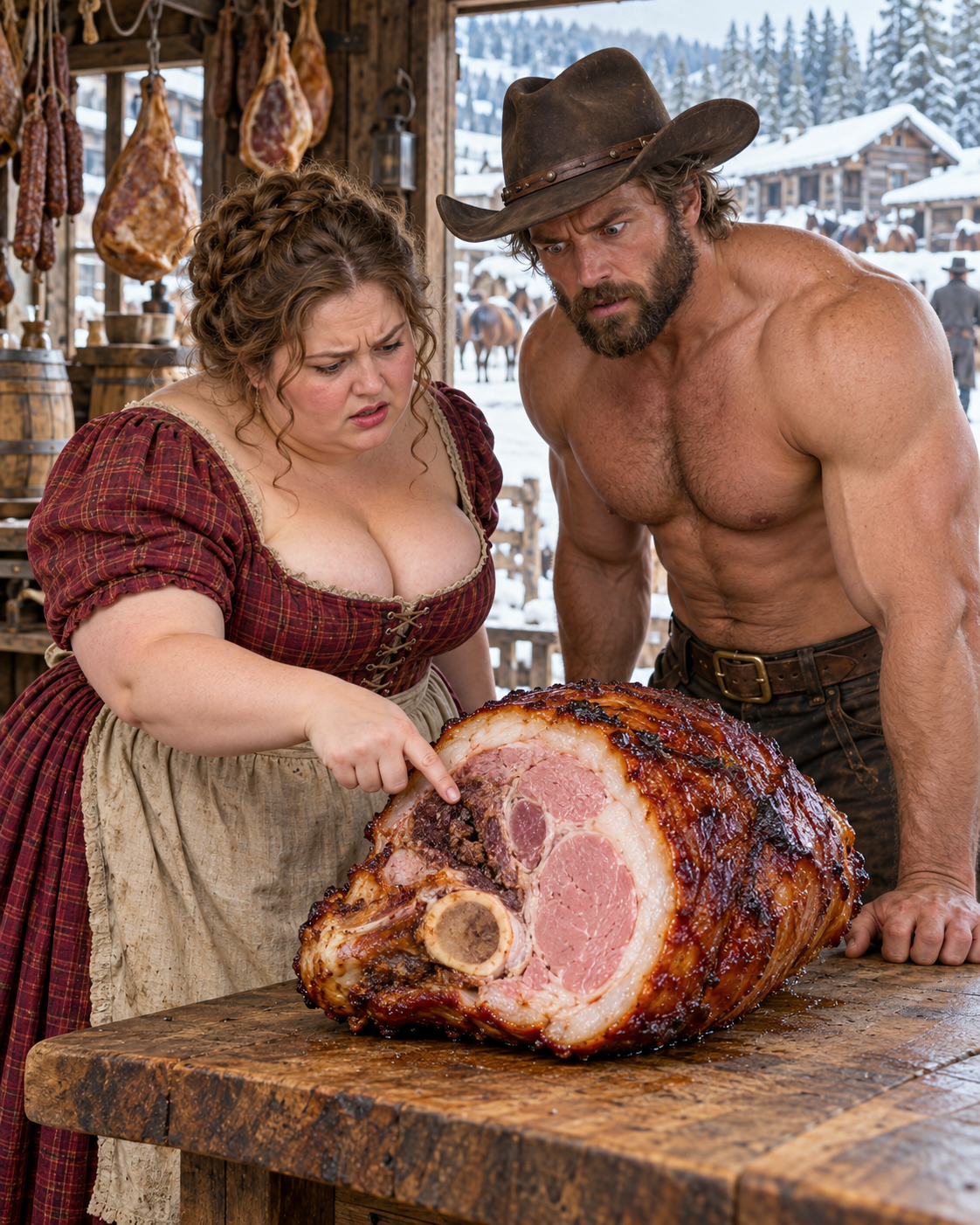
The foreman slapped a bloody pork roast onto my cutting table, called me a stupid girl before twelve hungry cowboys, and accidentally exposed his deadly secret.
The second gunshot struck the wooden post beside the bunkhouse door, sending splinters flying across my face.
Eli grabbed my collar and dragged me backward just as another bullet tore through the darkness.
“Everybody down!” he shouted.
The twelve ranch hands dropped behind overturned tables, their faces pale beneath the flickering lantern light.
Daniel slammed the door shut and threw the heavy iron bolt into place.
For several seconds, nobody spoke.
Then a voice crackled through the emergency loudspeaker mounted above the kitchen window.
“Daniel, I know you’re listening.”
Wade Mercer.
His voice sounded almost cheerful.
“You’ve got something that belongs to me. Send the girl outside with the papers, and nobody else has to get hurt.”
I looked at the brass key in my palm.
The initials carved into its handle were small enough to fit beneath my thumbnail.
H.L.
Henry Lawson.
My father.
He had carried that key on his old leather chain for as long as I could remember.
When I was little, I used to ask what it opened.
He always smiled and told me it belonged to something worth more than money.
I’d assumed he meant some sentimental keepsake.
Now, standing inside a bunkhouse surrounded by frightened men, I wondered whether my father had been trying to protect something far more dangerous.
“Where did you find this?” I asked Caleb.
He swallowed painfully.
“Inside the lining of Wade’s saddlebag. There was a note wrapped around it.”
“What note?”
Caleb looked toward Daniel.
“He burned it before I could read everything. But I saw three words.”
He hesitated.
“Under the block.”
My breath caught.
Every butcher knew what a chopping block was.
But my father had owned a particular one, an enormous maple butcher’s block scarred by decades of work.
He’d refused to replace it even when customers complained that it looked ancient.
“It’s held this family together longer than you have,” he used to joke whenever I suggested buying a new one.
After his death, the block disappeared along with the equipment from his shop.
I turned slowly toward Daniel.
“Where is my father’s chopping block?”
He stared at me.
Then his eyes widened.
“The old slaughterhouse.”
Outside, Wade’s voice returned.
“You have thirty seconds!”
Eli stepped toward the window and raised his rifle.
“That man’s got the only working long-range radio,” he muttered. “And if he cuts the generator line, we’ll freeze before anybody finds us.”
Daniel shook his head.
“There’s a backup generator in the equipment shed.”
“Not anymore,” Caleb whispered.
Everyone looked at him.
“I heard Wade talking to somebody on the radio yesterday. He said the backup had already been disabled.”
A terrible realization settled over the room.
Wade hadn’t been improvising.
He’d prepared for this.
The spoiled meat, the forged inventories, the missing equipment, and now the disabled generator.
Every weakness at Black Creek Ranch had been carefully arranged.
But why?
If Wade wanted to steal money, he could have disappeared months ago.
If he wanted to hide the meat fraud, he could have destroyed the records.
Instead, he was risking everything to recover one small brass key.
I moved toward the kitchen table.
“He’s afraid of what’s inside that block.”
Daniel caught my arm.
“Becca, he’s armed.”
“And he’s already fired at us.”
“That doesn’t mean you have to walk straight into his trap.”
I looked at the man who had signed papers stealing my father’s business.
“Then tell me everything you know.”
Daniel’s hand fell away.
For a moment, he seemed unable to speak.
Finally, he lowered himself into a chair.
“Your father discovered something about Wade three years before he died.”
The wind hammered the roof.
Daniel stared at the floor.
“Black Creek had been losing money. Cattle prices were down, feed costs were rising, and my wife, Margaret, was undergoing treatment. I trusted Wade to manage the accounts while I cared for her.”
He rubbed his face.
“He told me he could purchase surplus meat cheaply and resell it through local distributors. I thought it was legitimate.”
“But it wasn’t,” I said.
Daniel shook his head.
“Wade was buying condemned meat from dishonest suppliers, changing the labels, and selling it as inspected product.”
I thought of the greenish pocket inside the pork shoulder.
The sick men from last winter.
The hungry cowboys who might have eaten that roast if I hadn’t checked it.
“People could have died.”
Daniel’s eyes filled.
“Someone did.”
The room went utterly still.
He looked directly at me.
“A ranch cook named Martin Hale died two winters ago after a severe infection. Wade convinced everyone it came from contaminated water. Margaret suspected the meat.”
Eli made a strangled sound.
“Martin was my brother-in-law.”
Daniel lowered his head.
“I know.”
For the first time since entering the ranch, I understood the depth of Eli’s hatred.
He hadn’t merely been suspicious of Wade.
He’d been waiting for someone to confirm what his instincts had told him for years.
“My father found out?” I asked.
Daniel nodded.
“Henry refused to let Wade use his shop to process the meat. He threatened to report everything. Wade offered to buy the business, claiming it would protect Henry from the debts he’d accumulated during his illness.”
“And you signed the papers.”
“I signed what Wade put in front of me.”
I felt anger rise so sharply it made my hands shake.
“That’s not an excuse.”
“No,” Daniel whispered. “It isn’t.”
A violent crash interrupted us.
The lights flickered once.
Twice.
Then went out.
The bunkhouse disappeared into darkness.
Somewhere beneath the floor, the heating system gave a final metallic groan and stopped.
Wade had cut the generator.
A young cowboy began praying.
Tommy Briggs whispered his wife’s name.
And in the sudden silence, I heard something worse than the wind.
An engine.
Wade was starting the ranch’s snow tractor.
“He’s leaving,” Daniel said.
“No,” Eli answered from the window. “He’s driving toward the slaughterhouse.”
I grabbed my coat.
This time, nobody tried to stop me.
Eli divided the men into groups.
Four would stay with Caleb and protect the bunkhouse. Two would search for a working radio in the equipment shed. The rest would help restore power and keep the cattle alive.
Daniel insisted on coming with us.
Eli handed him a flashlight.
“If you betray that girl,” he said quietly, “the storm will be the least of your worries.”
Daniel accepted the warning without protest.
We slipped through the back door into a world that barely resembled Montana.
Snow whipped sideways so violently it felt like handfuls of broken glass striking my cheeks.
The cattle pens had become white hills.
The fence wires disappeared beneath enormous drifts.
Every familiar landmark had been erased.
Eli led the way, following the sheltered side of the feed barn.
Daniel walked behind me, clutching the flashlight beneath his coat to hide its beam.
The slaughterhouse stood nearly a quarter mile away.
Under normal circumstances, that was a five-minute walk.
That night, it felt like crossing an ocean.
Halfway there, we found blood on the snow.
Fresh blood.
Beside it lay a torn strip of brown canvas.
Eli crouched and examined the ground.
“Somebody’s hurt.”
“Caleb said Wade was alone,” Daniel murmured.
Eli looked up.
“Then who’s bleeding?”
A shape moved near the collapsed cattle chute.
I froze.
Daniel raised the flashlight.
A man staggered into the beam, holding one arm against his chest.
It was Frank Dobbins, the ranch mechanic.
His face was gray with shock.
“Wade shot me,” he gasped.
Eli hurried forward.
Frank collapsed against him.
“He caught me trying to start the old radio in the workshop.”
“Where is he now?” I asked.
Frank pointed toward the slaughterhouse.
“He’s burning everything.”
My heart dropped.
The chopping block.
The records.
Whatever my father had hidden.
I started running.
Behind me, Eli shouted my name, but I couldn’t stop.
I fought through the drifts until the dark outline of the slaughterhouse emerged behind a curtain of snow.
Orange light flickered through its broken windows.
Smoke curled from a vent in the roof.
The front doors stood open.
Inside, Wade Mercer was feeding documents into an iron stove.
And beside him stood my father’s butcher’s block.
I recognized it instantly.
The same deep knife scars.
The same iron bands around its thick legs.
The same little crescent-shaped burn from the afternoon I’d accidentally set a hot pan against the wood when I was twelve.
For one breathless moment, I wasn’t standing in a freezing slaughterhouse.
I was back in my father’s shop, hearing his laughter while he pretended to be furious about the mark.
Then Wade turned.
His rifle rose.
“Well,” he said. “The butcher’s daughter finally figured it out.”
I stopped in the doorway.
“Step away from my father’s block.”
He smiled.
“You sound just like him.”
The words hurt more than I expected.
“Did you kill my father?”
Wade tilted his head.
“Your father was already dying.”
“That wasn’t my question.”
He leaned against the block.
“Henry had a talent for making trouble. Thought honesty could save everybody. Thought if he exposed a little business arrangement, the world would reward him.”
My fingers curled inside my gloves.
“What happened that night?”
Wade studied my face.
“Funny thing about people like your father. They never understand that righteousness doesn’t make them bulletproof.”
I felt the air leave my lungs.
“He was shot?”
Wade laughed softly.
“Not everything needs a bullet, sweetheart.”
I remembered my father’s last medical records.
The sudden decline.
The unexpected collapse.
The doctor saying his weakened body had finally surrendered to the cancer.
But my father had been talking about reopening his shop the week before he died.
He’d been making plans.
He’d been hopeful.
“You poisoned him,” I whispered.
Wade’s smile disappeared.
Outside, a gust slammed the doors against the walls.
He stepped closer, rifle steady.
“Henry came here with evidence. He wanted money, justice, apologies. All those things decent people think they’re entitled to.”
He spat into the stove.
“I offered him a drink. We talked. He got sick. I sent him home.”
My stomach twisted.
“What was in the drink?”
“Something that made his heart give out faster than it would’ve otherwise.”
I stared at him.
He had just admitted it.
But there were no witnesses close enough to hear.
No recording.
Nothing except my word against his.
Wade seemed to read my thoughts.
“Nobody’s going to believe you.”
I forced myself to breathe.
“Then why are you so afraid of a chopping block?”
He glanced toward the thick wooden slab.
That single movement told me everything.
“Give me the key,” he said.
I slipped my hand into my pocket.
“Why don’t you tell me what it opens?”
His jaw worked.
“Henry kept records. Names. Payments. Deliveries. Enough to ruin people who don’t appreciate being threatened.”
“People above you?”
Wade’s silence answered.
I thought of the delivery truck in the photograph.
The invoices.
The enormous quantities of meat.
This wasn’t one ranch foreman cheating his employer.
It was a network.
And my father had discovered it.
“I don’t have the key,” I lied.
Wade fired.
The bullet struck the doorframe inches from my shoulder.
I fell backward into the snow.
“Don’t test me!”
A second later, another rifle cracked from behind the cattle pens.
Wade jerked sideways.
His weapon dropped from his hands.
Eli emerged through the swirling snow, rifle raised.
“Move away from her.”
Blood spread across Wade’s upper arm.
He stared at it in disbelief.
Then he lunged toward the stove.
Not for the rifle.
For a burning log.
He snatched it with his good hand and hurled it onto the butcher’s block.
Flames licked across the dry wood.
“No!” I screamed.
I scrambled inside, grabbed a bucket of melting snow, and threw it across the flames.
Wade charged toward the back exit.
Daniel appeared there, blocking his path.
For a moment, the two men faced each other.
Then Wade laughed.
“You think you’re innocent, Daniel?”
Daniel didn’t move.
“You signed the contracts,” Wade shouted. “You took the profits. Your ranch survived because of me!”
“I know.”
“Then get out of my way!”
Daniel’s voice broke.
“I should’ve stopped you years ago.”
Wade swung at him.
They crashed against a metal workbench.
The flashlight flew from Daniel’s hand.
I heard a sickening impact.
Daniel fell.
Wade reached for the rifle on the floor.
Eli fired again.
This time, the bullet struck the concrete beside Wade’s hand.
“Touch it,” Eli warned, “and I won’t miss.”
Wade froze.
His face twisted with hatred.
For several long seconds, nobody moved.
Then Frank’s distant voice called from outside.
“County emergency channel! We got through!”
Wade’s expression changed.
Eli took two steps forward and kicked the rifle away.
“It’s over.”
But it wasn’t.
Not yet.
I knew that as clearly as I knew the smell of spoiled meat.
We still needed proof.
And the proof was burning.
I rushed to the chopping block.
The fire had blackened one corner, but the thick maple had resisted the flames.
Steam rose from its surface.
I knelt and felt beneath the heavy wooden frame.
There.
A small brass lock hidden inside a recessed iron plate.
My hands shook so badly I nearly dropped the key.
It slid into place.
Turned.
Clicked.
A narrow wooden drawer sprang open beneath the block.
Inside was a sealed metal container.
I lifted it out.
My father’s handwriting covered a folded envelope taped to the lid.
For Rebecca.
Not Becca.
Rebecca.
He only called me that when something mattered.
My eyes blurred.
I broke the seal.
Inside were bank statements, copies of delivery receipts, photographs, and a small digital recorder wrapped in plastic.
Beneath them lay a letter.
I recognized the slant of every word.
My dearest Rebecca,
If you’re reading this, then I wasn’t able to put things right myself.
I had to stop.
The room seemed to tilt.
I pressed the paper against the chopping block and forced myself to continue.
I know you believe people are mostly good. I hope you never lose that. But being good doesn’t mean trusting everyone, and being brave doesn’t mean you should face danger alone.
I’ve found proof that men are selling food they know can hurt people. I’ve tried to make them stop. If I fail, these records can finish what I started.
And if anything happens to me, remember that my greatest achievement was never the business.
It was raising you.
I wish I’d told you that more often.
Love, Dad.
A sound escaped me that I hadn’t made since the day they lowered his coffin into the ground.
I folded over the letter, unable to breathe.
For years, I’d carried guilt about his death.
I hadn’t been there when he collapsed.
I hadn’t called him early enough.
I hadn’t known he was frightened.
Now I understood that his last days hadn’t been defined by helplessness.
He had been fighting.
Not for money.
Not for revenge.
For people he might never meet.
A hand touched my shoulder.
It was Daniel.
Blood trickled from a cut above his eyebrow.
“I’m sorry,” he whispered.
I looked up at him.
“You knew Wade was dangerous.”
He nodded.
“And you did nothing.”
His eyes lowered.
“Yes.”
I stood, clutching the container.
“Then don’t ask me to forgive you.”
“I won’t.”
Eli secured Wade’s wrists with baling wire while Daniel helped carry the records outside.
But just as we reached the doors, Wade began laughing.
“You think you’ve won?”
Nobody answered.
He looked directly at me.
“Your father’s recordings won’t matter if the wrong people get to them first.”
Something about his confidence chilled me.
“Who are they?”
He smiled through bloody teeth.
“Ask your sheriff.”
Eli stopped walking.
“What?”
Wade leaned closer.
“Who do you think warned me Henry was coming here that night?”
The wind screamed through the open doorway.
I stared at him.
My father had contacted the county sheriff before confronting Wade.
I’d found the call in his old phone records.
The sheriff had told me afterward that my father never filed a formal complaint.
At the time, I’d believed him.
Now I didn’t know what to believe.
We returned to the bunkhouse shortly before dawn.
Frank had managed to repair an old shortwave radio using parts salvaged from the workshop.
The signal was weak, but he’d reached a state highway maintenance crew stationed near the mountain pass.
They had relayed our emergency to state authorities.
The sheriff’s office was sending help.
So was the state police.
I insisted that the evidence be reported directly to state investigators.
Frank transmitted the names from the documents, the details of Wade’s confession, and the warning about the sheriff.
Then we waited.
The storm did not ease.
By morning, the bunkhouse temperature had dropped dangerously low.
The men huddled around a wood-burning stove while Eli organized blankets and rationed the remaining food.
Tommy sat beside the window, staring at the white emptiness.
“My wife was supposed to have her appointment today,” he said quietly.
I sat beside him.
“What’s her name?”
“Sarah.”
He smiled sadly.
“She keeps saying the baby kicks whenever I call.”
I looked at the men around us.
They were exhausted, frightened, and hungry.
Some had families.
Some had nowhere else to go.
All of them had trusted Wade to keep them safe.
And now we were surviving on crackers, canned beans, and whatever vegetables remained in the pantry.
I remembered my father’s hands guiding mine across a cutting board.
A good butcher doesn’t waste what can still nourish someone.
I stood.
“Who’s willing to help me cook?”
Several men looked up.
Eli raised an eyebrow.
“Cook what?”
“Everything that isn’t meat.”
An hour later, twelve cowboys were chopping potatoes, peeling carrots, opening beans, and carrying water from melted snow.
I found dried lentils, onions, flour, powdered milk, and enough beef stock cubes for a giant pot of stew.
We made biscuits in cast-iron pans.
We brewed the last of the coffee.
For the first time since the storm began, laughter returned to the bunkhouse.
It wasn’t much of a meal.
But it was safe.
And everybody ate.
Even Wade, tied to a chair near the stove, received a bowl.
He stared at it.
“You expect me to eat that?”
I looked him in the eye.
“It’s been inspected.”
Eli laughed so hard he nearly spilled his coffee.
But the relief lasted only until noon.
A heavy pounding came at the bunkhouse door.
Three men stood outside in winter gear.
The first wore a sheriff’s badge.
Sheriff Nolan Price.
He had the same square jaw and polished boots I remembered from my father’s funeral.
Behind him stood two deputies.
“Where’s Mercer?” he demanded.
Eli didn’t move aside.
“State police are on their way.”
Price’s expression tightened.
“The roads are impassable. We’re the only help you’re getting.”
I stepped forward.
“Then you won’t mind waiting.”
His eyes settled on the metal container beneath my arm.
For a fraction of a second, I saw recognition.
Then he smiled.
“Rebecca Lawson. Your father was a good man.”
Something inside me went cold.
“Did you tell Wade my father was coming to Black Creek?”
The sheriff’s smile vanished.
“Careful what you accuse people of.”
“I asked you a question.”
He stepped closer.
“Your father was confused toward the end. His illness made him suspicious.”
I remembered the letter.
The photographs.
The recorder.
“My father was dying,” I said. “He wasn’t stupid.”
Price looked past me.
“Deputies, secure the prisoner and collect the evidence.”
The two men hesitated.
They had noticed Eli’s rifle.
Daniel moved beside me.
“Nolan, these records aren’t leaving until state investigators arrive.”
Price stared at him.
Then he laughed.
“You really want to do this, Daniel?”
“I should’ve done it years ago.”
The sheriff’s face hardened.
He reached toward his holster.
A metallic click sounded behind him.
Frank had raised his hunting rifle from the kitchen doorway.
“Nobody draws anything,” he said.
For a terrible moment, I thought the bunkhouse would become a battlefield.
Then one of the deputies spoke.
“Sheriff, what’s going on?”
Price glanced at him.
“Stay out of this, Adams.”
The deputy didn’t move.
“She’s alleging you’ve been involved in a homicide.”
Price turned sharply.
“She’s a grieving girl chasing ghosts!”
And that was when I took the digital recorder from my pocket.
I’d listened to it while the men were preparing breakfast.
I pressed play.
My father’s voice filled the room.
Older.
Weaker.
But unmistakably his.
“Wade, I have copies of the purchase orders. I know you’ve been selling condemned meat.”
A scraping sound.
Then Wade’s voice.
“You don’t understand who’s involved.”
My father answered.
“Then tell me.”
A pause.
And another voice.
Sheriff Price.
“Henry, put that recorder away before you make a mistake.”
The sheriff went white.
On the recording, my father continued.
“I’ve already made copies. If anything happens to me, they’re going to the state.”
There was a crash.
A muffled struggle.
Then the recorder clicked off.
Nobody moved.
Price looked at the deputies.
“That recording is taken out of context.”
Deputy Adams slowly unfastened his holster and placed his hand over it.
“Sir, step away from your weapon.”
Price’s mouth opened.
For the first time, he looked afraid.
“You don’t know what you’re doing.”
“Maybe not,” Adams replied. “But I know what I heard.”
The second deputy moved to his side.
Price stared at them both.
Then, with shaking hands, he removed his pistol and placed it on the floor.
Eli stepped forward and kicked it away.
I had imagined this moment for years without knowing it.
Some part of me had always wanted somebody to stand up and admit that my father’s suffering had meant something.
But watching the sheriff surrender, I didn’t feel triumph.
I felt an enormous, exhausted sadness.
Justice could expose the truth.
It couldn’t give back a single ordinary afternoon in my father’s shop.
Outside, a distant mechanical rumble rose above the wind.
The state rescue convoy had finally reached the ranch.
Two tracked vehicles appeared through the blowing snow, followed by emergency personnel carrying medical supplies.
I watched investigators enter the bunkhouse, collect the evidence, and separate the prisoners.
Wade was taken away first.
He shouted threats until the door closed behind him.
Price walked out without looking at me.
Daniel voluntarily handed over the ranch’s financial records and asked to give a full statement.
Before leaving with investigators, he stopped beside my chair.
“I can’t undo what happened.”
“No,” I said.
“But I can spend whatever time I have left helping make it right.”
I looked at him for a long moment.
“Then start by telling the whole truth.”
He nodded.
And for once, I believed he meant it.
The investigation lasted eleven months.
During that time, I learned more about my father’s final years than I’d known while he was alive.
He had discovered a network of suppliers, distributors, and officials who profited from selling condemned meat under falsified inspection records.
Wade had managed the operation through Black Creek.
Sheriff Price had helped conceal complaints and warned Wade whenever investigators came too close.
The altered ownership documents were intended to give the operation control over my father’s licensed butcher shop and its distribution accounts.
But my father had refused to cooperate.
He’d collected evidence, recorded conversations, and hidden copies where he believed only I would think to look.
As for his death, investigators eventually found medical evidence consistent with a deliberate poisoning that had aggravated his already fragile condition.
Wade had counted on the cancer to conceal what he’d done.
He was wrong.
The trial lasted six weeks.
Wade was convicted of murder and multiple fraud-related offenses.
Price was convicted of conspiracy, obstruction, and corruption.
Several suppliers lost their licenses, and additional defendants faced prosecution.
Daniel’s role was examined, too.
He admitted his negligence and his participation in financial transactions he had never properly questioned.
He accepted a criminal penalty for his own misconduct and later cooperated in recovering money for the victims.
Not every outcome felt fair.
Not every guilty person received the punishment I thought they deserved.
But the truth was no longer buried.
One afternoon, shortly after the trial, I received a letter from Daniel’s attorney.
Inside was the original deed to Lawson Family Meats.
The fraudulent transfer had been set aside.
My father’s shop was legally mine again.
I sat at my kitchen table and cried.
Not because a building had returned to me.
Because for the first time, I could imagine walking through its doors without feeling that I’d failed him.
Three months later, I reopened the shop.
Eli helped restore the old butcher’s block.
Frank repaired the refrigeration equipment.
Caleb painted the storefront.
And Tommy, whose wife had delivered a healthy baby girl during the final weeks of the investigation, arrived with a homemade sign.
LAWSON FAMILY MEATS.
HONEST FOOD. HONEST WORK.
I hung it above the entrance.
On opening morning, a line formed down the sidewalk.
Some customers remembered my father.
Others had followed the case.
A few simply needed affordable groceries.
I greeted every one of them.
Behind the counter, the old butcher’s block stood beneath the brightest window.
The burn mark was still there.
So were the knife scars.
I kept them.
They reminded me that something could survive enormous damage without losing its purpose.
That afternoon, a little boy watched me trim a roast.
“How do you know if meat is good?” he asked.
His mother smiled apologetically.
I put down my knife and leaned toward him.
“You pay attention,” I said. “You check the parts people don’t usually see.”
He considered that seriously.
“Even if somebody says it’s fine?”
I smiled.
“Especially then.”
After closing, I stood alone in the shop, looking at the photograph of my father hanging above the counter.
He was wearing his old white apron, smiling as though someone had just told him a terrible joke.
For years, I’d believed his greatest lesson was how to cut meat properly.
Now I understood he’d been teaching me something much larger.
A rotten thing doesn’t become safe because powerful people insist it is.
A lie doesn’t become true because everyone is afraid to challenge it.
And courage doesn’t mean you never tremble.
Sometimes courage is simply refusing to serve what you know is wrong, even when twelve hungry men are watching and the person threatening you holds all the power.
I placed my father’s letter in a frame beside his photograph.
Then I turned off the lights.
Through the front window, I could see our new sign shining beneath the streetlamp.
For the first time in years, the future didn’t look like something I had to survive.
It looked like something I could build.
And I finally understood what my father meant when he said the most dangerous rot was the kind hidden beneath a beautiful surface.
You couldn’t always prevent it.
You couldn’t always recognize it immediately.
But when your instincts told you something was wrong, you owed it to yourself—and sometimes to everyone around you—to look deeper.
Because the truth might cost you your comfort, your security, or even the life you thought you wanted.
But silence could cost far more.
I locked the shop door and slipped the little brass key onto my father’s old leather chain.
It no longer opened a secret compartment.
It had already opened something far more important.
The truth.
And with it, the life my father had always hoped I’d have.
Not a life without fear.
A life where fear would never again make my decisions for me.
THE END.