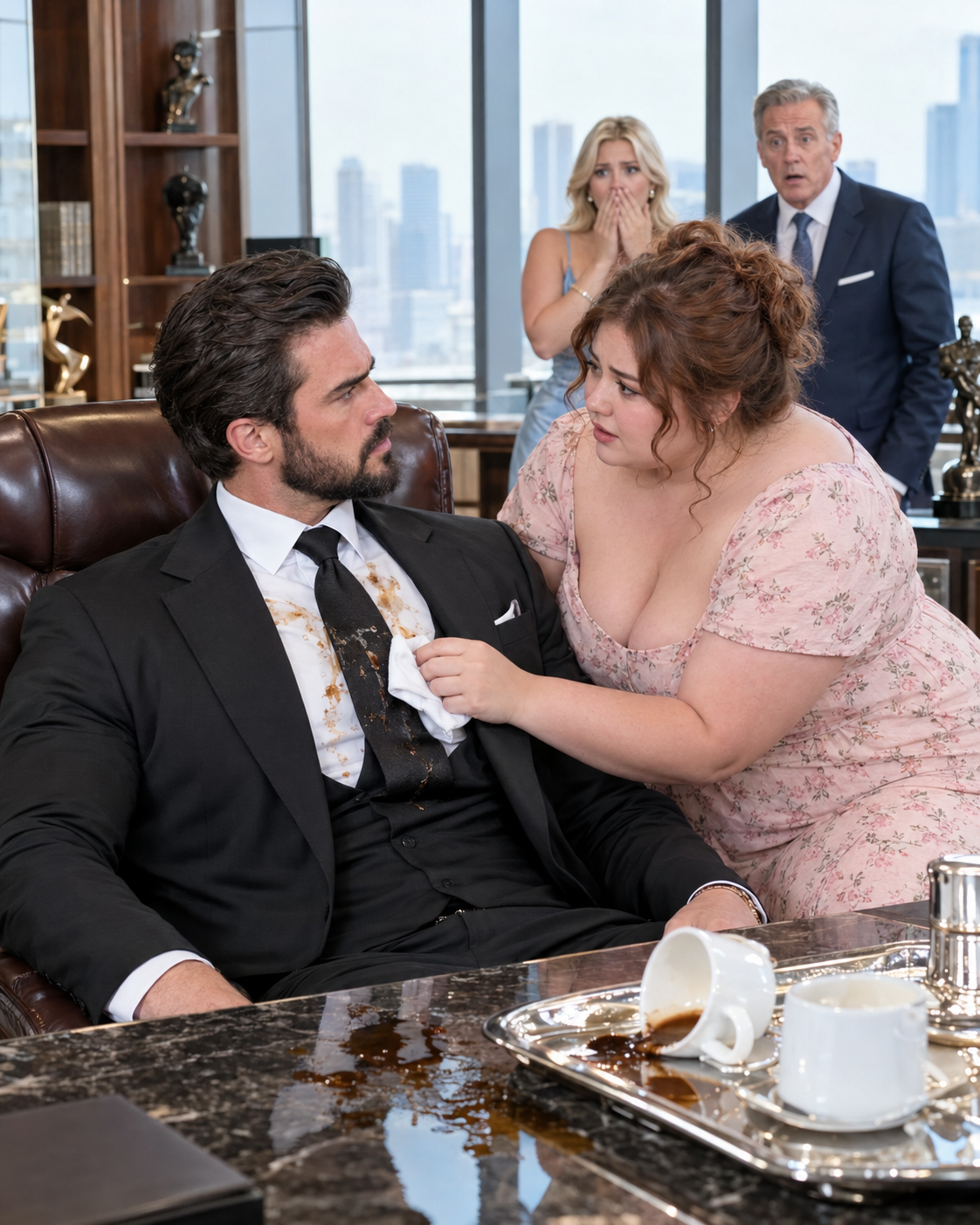
The first time Penelope Higgins met Chicago’s most feared mafia boss, she spilled an entire cup of coffee down the front of his thousand-dollar suit
Dominic didn’t answer Penelope immediately. He stood beside the desk, staring at the evidence scattered across its surface, while the rain tapped against the tall windows of his Chicago mansion. For years, he had believed that fear was the strongest protection a man could possess. Now he was beginning to understand how easily fear could turn loyal men into desperate traitors.
“I built this organization to protect my family,” he finally said. “Somewhere along the way, I started believing that protecting it meant controlling everything around me.”
Penelope slipped her hand into his. “You can’t control everything, Dominic. But you can decide what kind of man you want to be when things fall apart.”
He looked at her, and for once, there was no command in his expression. Only exhaustion, affection, and the quiet terror of losing the one person who had managed to reach him.
“We move forward,” she continued. “But we do it carefully. We find out what our enemy knows, we protect the people who have nothing to do with this war, and we stop pretending that the only way to survive is to make everyone afraid of us.”
Dominic raised her hand to his lips.
“You make it sound so simple.”
“It isn’t simple. I’m just tired of watching everyone solve their problems with guns.”
Despite everything, a faint smile touched his face. “You married into the wrong family, sweetheart.”
“Probably,” she replied. “But I’m not planning on leaving.”
For a moment, the room felt almost peaceful.
Then Dominic’s phone vibrated.
A message appeared from an unknown number. There was no greeting, no explanation, only a photograph of Penelope leaving a small bakery on the North Side two weeks earlier. Someone had taken it from across the street.
Beneath the picture were seven words.
YOUR WIFE IS THE PRICE OF YOUR NEXT MISTAKE.
Dominic’s expression changed so quickly that Penelope felt the warmth leave his hand.
“Who sent that?” she asked.
“I don’t know.”
“Then don’t tell me you’re going to lock me in this house.”
He said nothing.
She stepped in front of him. “Dominic, look at me.”
He did.
“If you shut me away every time someone threatens us, eventually I’ll be safe from everyone except the person who claims to love me.”
The words struck harder than any insult she had ever thrown at him.
He looked away, jaw tight, fighting the instinct to call every guard in the building and seal every entrance.
Finally, he put the phone on the desk.
“You stay close to me until we know who sent it.”
“I can agree to that,” she said. “But I’m not disappearing from my own life.”
He nodded.
It was a small concession, but for Dominic Moretti, it was also a beginning.
The following morning, they began building a trap.
Their rival, Vincent Rinaldi, had spent years trying to expand into territory Dominic controlled. Vincent was patient, wealthy, and far more dangerous than the loud men who mistook recklessness for courage. He preferred to let other people take the risks while he waited for the rewards.
The recent betrayals had given him an advantage. He knew enough about Dominic’s movements to anticipate his decisions, and he had begun approaching members of Dominic’s organization with promises of money and protection.
Dominic wanted to strike immediately.
Penelope wanted to know why Vincent had suddenly become so confident.
“People don’t gamble everything unless they believe the odds have changed,” she said as they reviewed the messages. “What does he think he has that you don’t?”
“More money? More men?”
“No. If that were all, he wouldn’t need to threaten me. He would simply attack.”
Dominic leaned back in his chair. “So what do you think he wants?”
“I think he wants you to react emotionally. He wants you angry enough to make a mistake.”
Dominic studied her for several seconds.
“And what makes you think you know how Vincent Rinaldi thinks?”
“I don’t. But I know what it feels like when people assume you’re too foolish to notice what they’re doing.”
She gathered the papers into a neat stack.
“People make careless decisions around someone they underestimate. Sometimes that’s the only advantage you need.”
For the next several days, Penelope worked alongside Dominic’s most trusted advisers. She listened more than she spoke, asked questions nobody expected, and gradually pieced together a pattern in Vincent’s behavior.
Three supposedly unrelated business transactions had occurred within hours of changes to Dominic’s security arrangements. Each time, someone had passed along information that should never have left the inner circle.
One name appeared repeatedly in the records: Anthony Bellini, Dominic’s longtime adviser.
Anthony had been with the Moretti family since Dominic was young. He had helped manage the organization through years of conflict and had been present at some of the most difficult moments in Dominic’s life.
Dominic refused to believe the pattern.
“Anthony taught me how to survive,” he said.
“Then he knows exactly how to hurt you,” Penelope replied gently. “I’m not saying he’s guilty. I’m saying we can’t ignore what’s in front of us just because the truth would hurt.”
Dominic’s expression hardened.
“You think I’m blind because I trust him?”
“No. I think you’re afraid that if he betrayed you, it would mean all those years of loyalty were a lie.”
For a long moment, neither spoke.
Then Dominic closed the folder.
“We find out the truth.”
They arranged three private meetings, each with a different location and time. Only Dominic, Penelope, and a handful of trusted people knew that the details were deliberately different.
Within hours, Vincent’s men began appearing near one of the locations.
The trap had worked.
But the result was not what Penelope expected.
The information had come from a source connected to Anthony, yet the trail led to a junior accountant who had recently taken out a large personal loan. When Dominic’s men questioned him, the young man admitted that he had been paid to copy schedules and financial records.
He insisted he had never met Vincent.
“I was told it was for a private investor,” he said, his face pale. “I didn’t know anyone would get hurt.”
Dominic’s voice was cold. “You sold information about my family.”
“I needed the money.”
“So did the people whose lives you put at risk.”
Penelope watched the young man struggle to keep his composure. She knew he had done something serious, but she also saw the panic of someone who had convinced himself that a series of small compromises could never lead to anything terrible.
She turned to Dominic.
“We need to know who paid him before we decide what happens next.”
Dominic looked at her, then nodded to his men.
The accountant was taken away for further questioning, alive and unharmed.
It was another small decision, but it mattered to Penelope. She was beginning to see that Dominic could choose restraint when he stopped treating it as weakness.
That evening, Anthony came to the mansion.
He walked into Dominic’s study without his usual confidence. His silver hair was damp from the rain, and he held a thick envelope in one hand.
“I assume you know about the accountant,” he said.
Dominic remained behind his desk. “I know someone in my organization has been feeding information to Vincent.”
Anthony placed the envelope on the desk.
“Then you should know that I’ve been investigating it.”
Inside were bank records, copies of messages, and photographs connecting several intermediaries to Vincent’s operation. The evidence was substantial, but it also revealed something troubling: Anthony had known about the leaks for weeks.
“Why didn’t you tell me?” Dominic demanded.
“Because I wasn’t certain who was involved. Every time I brought a suspicion to someone, Vincent seemed to learn about it before I could investigate further.”
“You could have told me.”
“And what would you have done?” Anthony asked quietly. “You were already looking for a reason to go after him. I feared you would start a war before we knew how deep the betrayal went.”
Dominic’s face darkened. “You decided what I could handle?”
“I decided that I didn’t want to bury another person I loved because you acted before thinking.”
The words hung between them.
Anthony had been more than an adviser. He had helped raise Dominic after the death of his father, teaching him how to negotiate, how to recognize danger, and how to hide his fear behind an expression nobody could read.
Dominic looked down at the records.
“Did you know Vincent was threatening Penelope?”
Anthony’s face changed.
“No. I swear to you, I didn’t.”
Penelope watched him carefully. His shock seemed genuine, but she knew appearances could be deceptive. She also understood that suspicion alone was not proof.
“We need to check everything in that envelope,” she said. “If you’re telling the truth, the evidence will support it.”
Anthony nodded without protest.
For the first time since the threats began, Dominic seemed willing to accept that trust and verification did not have to be enemies.
The next clue arrived that night.
A delivery driver brought a small package to the front gate. Inside was Penelope’s favorite silver bracelet, the one she had lost months earlier during a charity dinner. She had assumed it had slipped beneath a table or been taken by someone cleaning the room.
There was no note.
Only a tiny strip of paper bearing a date and an address.
Penelope recognized the address immediately. It belonged to an old warehouse near the river, a building that had once been used by one of Dominic’s businesses.
Dominic took the paper from her hand.
“No.”
“You haven’t even heard what I was going to say.”
“You’re not going there.”
“Then we need another way to find out why Vincent has it.”
He stared at the bracelet.
Someone had been close enough to her to take it, keep it, and return it whenever they wanted to remind her that she was being watched.
The thought made Dominic’s anger dangerous.
Penelope placed both hands on his chest.
“I’m scared, too,” she admitted. “But if you let fear make every decision, Vincent will be controlling us without ever stepping into the room.”
Dominic closed his eyes briefly.
When he opened them, the fury was still there, but he was listening.
They agreed not to visit the warehouse. Instead, Dominic arranged for his security team to observe the area from a distance while he and Penelope remained at the mansion. For once, he accepted that protecting her did not mean placing her at the center of every confrontation—or removing her from every decision.
At midnight, the security team reported movement inside the building.
Two vehicles arrived. Several men unloaded locked cases, then left separately.
One vehicle belonged to a company connected to Vincent.
The other was registered to a legitimate business whose owner had attended Dominic’s wedding.
The owner was a woman named Eleanor Shaw, a respected investor who had publicly praised Dominic’s business expansion and privately offered to help Penelope adjust to her new life.
Penelope felt an unpleasant chill.
Eleanor had been kind to her. She had sent flowers, invited her to lunch, and once sat with her for nearly an hour while Penelope admitted that she sometimes felt like an outsider in Dominic’s world.
“She knows about the warehouse,” Penelope said.
Dominic’s expression was unreadable.
“Or someone is using her company.”
“Either way, we need to talk to her.”
Dominic wanted to confront Eleanor immediately, but Penelope persuaded him to invite her to dinner instead. If Eleanor was innocent, an accusation could destroy a useful relationship. If she was involved, a confrontation might warn her that the investigation had reached her.
The dinner took place two nights later.
Eleanor arrived in a dark blue dress, carrying a bottle of wine and wearing the same warm smile Penelope remembered.
She asked about the house, the weather, and Penelope’s plans for the coming holidays. She even joked about Dominic’s habit of turning every family dinner into a business meeting.
For almost an hour, everything felt ordinary.
Then Penelope mentioned the warehouse.
Only once, casually, as if she had heard a rumor about a property changing hands.
Eleanor’s hand paused above her glass.
It was less than a second, but Penelope noticed.
“Is something wrong?” Eleanor asked.
“Not at all,” Penelope replied. “I was just wondering whether the building was still being used.”
Eleanor smiled again.
“I wouldn’t know anything about that.”
Dominic set down his fork.
“Your company’s vehicles were photographed there two nights ago.”
Eleanor’s expression did not collapse into panic. Instead, the warmth disappeared from her eyes.
“That’s an interesting accusation.”
“It isn’t an accusation,” Penelope said. “Not yet.”
Eleanor turned to her.
“You should be careful about the people you trust, Penelope. Sometimes the person who seems most interested in protecting you is the person keeping you from seeing the truth.”
Then she stood, thanked them for dinner, and left.
Dominic was already reaching for his phone.
Penelope stopped him.
“Wait.”
“She knows something.”
“Yes. But she wanted us to react. We need to find out why.”
That night, Anthony returned with the results of his investigation. Eleanor’s company had been used to transfer money through several intermediaries, but the records suggested that she was not merely helping Vincent.
She had been funding him.
More troubling still, the money had originated from an account connected to Dominic’s own family.
The account belonged to his late father’s estate.
Dominic read the documents in silence.
“That’s impossible,” he said. “The estate was settled years ago.”
“Apparently, someone kept a portion of the accounts active,” Anthony replied. “We’re still tracing the transactions.”
Penelope looked at the dates. Some payments had begun long before her marriage. Others had increased sharply in the past few months.
This was not simply a rival trying to take over territory.
Someone had been preparing for a much larger betrayal.
“Why would Eleanor use money connected to your father?” she asked.
Dominic stared at the final page.
“Because she knew him.”
Anthony’s expression tightened.
“Not just knew him. She was one of his closest business partners.”
Dominic had never heard that story. His father had spoken of Eleanor only once, years earlier, describing her as a brilliant woman who had walked away from the family’s business when it became too dangerous.
Now, it appeared, she had never truly left.
The following morning, Dominic received an invitation from Vincent Rinaldi.
It proposed a private meeting to settle their conflict before more people were harmed. Vincent promised to explain the financial transfers and identify the people responsible for the threats against Penelope.
The meeting would take place at the old warehouse.
Dominic read the invitation and laughed without humor.
“He wants us exactly where he can control the situation.”
“Then we don’t go on his terms,” Penelope replied.
They spent the day preparing. Dominic arranged independent security, established a safe location for his staff, and made sure Anthony could verify every detail without relying on a single source. Penelope insisted that the meeting have clear limits: no innocent employees, no family members, and no one brought in simply to serve as leverage.
Dominic agreed, though she could see how difficult it was for him to accept restrictions when he felt threatened.
Before they left, he found her in their bedroom, standing by the window with her hands clasped together.
“You don’t have to come,” he said.
“I know.”
“I mean it, Penelope. If you stay here, I’ll understand.”
She turned toward him.
“Do you want me there because you trust me, or do you want me here because you’re afraid?”
He looked at her for a long time.
“Both.”
She stepped closer.
“Then trust me enough to let me choose.”
He brushed a strand of hair away from her face.
“I have spent my entire life believing that loving someone means making sure nothing can hurt them.”
“And I have spent my life believing that if someone loves me, I should never be allowed to make a mistake.” She gave him a small, sad smile. “We’re both going to have to learn something new.”
He kissed her forehead.
“Stay beside me.”
“Always,” she whispered.
The warehouse smelled of damp concrete and old machinery. Rain fell steadily outside, and the river beyond the loading doors moved like black glass beneath the streetlights.
Vincent stood near the center of the building, dressed in a charcoal suit, his hands visible at his sides. Eleanor stood several feet behind him.
Dominic stopped at a measured distance.
“You asked for a meeting.”
Vincent smiled. “I asked for a chance to avoid a war.”
“You could have started by keeping your hands off my family.”
“I never touched your wife.”
“You sent threats.”
“I sent reminders. There’s a difference.”
Penelope felt Dominic’s anger rise beside her, but he did not move.
Vincent looked at her with open curiosity.
“So this is the woman who has changed Dominic Moretti.”
Penelope held his gaze.
“If you’re expecting me to be impressed by you, you’ll be disappointed.”
For the first time, Vincent’s smile faltered.
Eleanor stepped forward.
“Penelope, you have no idea what you’ve married into.”
“You’re right,” Penelope said. “I didn’t know much at the beginning. But I know enough now to recognize when someone is using the past to excuse what they’re doing in the present.”
Eleanor’s eyes narrowed.
“You think Dominic is a good man because he is kind to you?”
“No. I think he is a man who has done things he needs to answer for. The question is whether he’s willing to stop making the same choices.”
Dominic glanced at her. He did not interrupt.
Vincent sighed impatiently.
“This is why I asked for the meeting. You two have made everything unnecessarily complicated.”
He gestured toward a table holding a folder.
“The money came from your father’s estate, Dominic. Eleanor helped manage it. Your father and I had an agreement that was never completed.”
“My father is dead,” Dominic said.
“And his debts did not die with him.”
Anthony stepped forward.
“What agreement?”
Eleanor answered before Vincent could.
“Your father promised to support a partnership that would have made both families powerful. When he died, Dominic took control and changed the terms. He believed he could erase every obligation simply because he had inherited the business.”
Dominic’s face remained still.
“If my father made a legitimate agreement, show me the documents.”
Vincent opened the folder.
There were contracts, account statements, and letters bearing Dominic’s father’s signature. Some appeared genuine. Others were incomplete, with pages missing or dates that did not match the financial records.
Penelope studied them carefully.
“You’re mixing real documents with altered ones,” she said.
Eleanor’s gaze snapped toward her.
“What makes you say that?”
“This transfer is dated three months after the account was closed. And this letter refers to a company that didn’t exist until years later.”
Anthony took the folder and examined the pages.
“She’s right.”
For the first time, Vincent looked genuinely irritated.
Penelope continued. “You took an old business relationship and used it to justify years of secret payments. Then you threatened Dominic’s wife to force him into a meeting. Whatever agreement existed, this isn’t about honoring it anymore.”
Eleanor’s expression hardened.
“You have no idea what your clever little observations have cost you.”
A door slammed behind them.
Dominic’s security team had spotted movement outside. Several armed men appeared near the loading entrance, but instead of advancing, they stopped when they saw the independent security personnel blocking the exit.
Vincent looked toward them and realized that the warehouse was not the controlled environment he had expected.
Dominic’s voice dropped.
“You thought I would come here angry, with no plan, and give you the excuse you needed to start a war.”
“I thought you would come here as the man you’ve always been,” Vincent snapped.
“Perhaps that was your mistake.”
Anthony placed the folder on the table.
“We have copies of the financial records, the payment trails, and the messages linking your people to the threats against Penelope. Every one of them has been preserved outside Dominic’s organization.”
Eleanor turned sharply toward him.
“You promised me the investigation was contained.”
Anthony’s face went cold.
“I promised nothing of the sort.”
Her expression revealed more than any confession could have.
Vincent looked from Eleanor to Dominic, and for the first time, he seemed to understand that the meeting had become a liability.
“You can’t prove what happened to the money,” he said.
“Maybe not every dollar,” Penelope replied. “But we can prove enough to make sure you don’t get to hide behind your version of the story.”
Dominic took a step forward.
For one terrible second, Penelope thought he would let years of anger decide what happened next. His hands were clenched, and his eyes had gone dark with the kind of fury that had built his reputation.
Then he looked at her.
She did not tell him what to do. She simply held his gaze, trusting him to make the choice himself.
Dominic turned to his men.
“No one fires unless there is an immediate threat. Secure the evidence. Nobody gets hurt unnecessarily.”
Vincent stared at him in disbelief.
“You’re letting me walk away?”
“I’m making sure this ends on evidence, not another pile of bodies,” Dominic answered. “The records will be turned over to the authorities. Your business arrangements are finished, and any further threats against my family will be documented and answered through every lawful means available.”
Vincent laughed bitterly.
“You think you can walk away from this life just because your wife asked you to?”
“No,” Dominic said. “I think I can stop pretending that the life I built is the only one I’m allowed to live.”
Eleanor remained motionless beside the table. When the security personnel approached, she did not resist. Her eyes stayed on Dominic, filled with a mixture of anger and something that looked almost like regret.
“You have no idea what your father would think of you now,” she said.
Dominic looked at her steadily.
“Neither do you.”
They left the warehouse without a shot being fired.
But the victory did not erase what had happened.
The investigation that followed exposed years of concealed financial dealings, false records, and corrupt relationships. Vincent’s carefully constructed alliance began to crumble as the evidence reached people he had assumed would remain silent. Eleanor faced serious legal consequences for her role in the scheme, while the accountant who had sold information cooperated with investigators and accepted responsibility for his actions.
Anthony remained beside Dominic, though their relationship was no longer quite the same. Trust had survived, but it had changed. Both men understood that loyalty could not be measured by silence alone.
For Dominic, the hardest work began after the immediate danger passed.
He had spent years building an organization that depended on fear, secrecy, and obedience. Dismantling its most dangerous parts meant confronting people who profited from the old ways and admitting that some of the damage could not be repaired with a single decision.
He began restructuring his legitimate businesses, cutting ties with partners whose fortunes depended on intimidation, and cooperating with authorities where wrongdoing could be documented. Some former associates left. Others accused him of weakness. A few threatened to make him regret changing course.
Dominic did not pretend that one meeting had made him a different man overnight.
There were nights when old instincts returned, when he wanted to solve a problem with a threat because it was faster than doing the difficult work of building something better. Penelope never excused his past, and she never pretended that loving him meant approving of everything he did.
But she stayed beside him while he learned to make choices he could live with.
Months later, the mansion felt different.
The guards were still there, but the rooms no longer seemed designed to intimidate everyone who entered. The dining table was used for family meals as often as business discussions. Dominic learned that Penelope liked pancakes on Sunday mornings, hated being rushed, and had a habit of talking to herself while searching for things she had misplaced.
He also learned that she could be astonishingly stubborn about the smallest details.
One morning, he found her standing on a chair in the kitchen, reaching for a box on the highest shelf.
“Penelope.”
“I know what you’re going to say.”
“Then get down.”
“I almost have it.”
The chair wobbled.
Dominic crossed the room and caught her around the waist just as she lost her balance. The box landed on the counter, spilling flour across the floor.
They stared at the mess.
Then Penelope burst out laughing.
Dominic tried to maintain his stern expression, but the sight of flour on her nose defeated him. He laughed too, a real, unguarded laugh that echoed through the kitchen.
“You nearly gave me a heart attack,” he told her.
“You married a woman with a gift for unexpected movement.”
“I married a woman who refuses to use a step stool.”
She slipped her arms around his neck.
“And yet you seem very attached to her.”
“Unfortunately, I’m completely in love with her.”
She kissed him before he could say anything else.
Their happiness was not perfect. There were still difficult conversations, painful memories, and moments when Penelope wondered whether she could truly build a future with a man whose past would always follow him. Dominic sometimes struggled to understand that protecting her did not give him the right to make her decisions.
They learned to apologize without demanding immediate forgiveness. They learned that trust required honesty, even when honesty made them look foolish. Most importantly, they learned that love was not a contract in which one person owed the other obedience.
One afternoon, Penelope returned to the small bakery where the photograph of her had been taken. She ordered her usual coffee and sat by the window, watching people hurry past in the autumn wind.
Dominic arrived ten minutes later, carrying two paper bags from a nearby bookstore.
“You’re late,” she said.
“I was buying something.”
“For me?”
“For us.”
He handed her a small notebook with a plain leather cover. Inside the first page, he had written a single sentence.
We don’t have to become the people our worst days expected us to be.
Penelope read it twice.
“You wrote this?”
“I had help.”
“From whom?”
“An extremely demanding woman who spilled coffee on me.”
She smiled, remembering the conference room, the ruined suit, and the terrified girl who had believed her clumsiness was the most interesting thing about her.
“What happened to that suit?” she asked.
“I had it cleaned.”
“Seriously?”
“It cost a fortune.”
She shook her head, laughing. “You know, you could have just told me to leave that day.”
“I could have.”
“Why didn’t you?”
Dominic reached across the table and took her hand.
“Because everyone else in that room was afraid of me, and you were more worried about the coffee than my reputation. You saw a man in an expensive suit, not a monster whose name everyone whispered. I didn’t know how much I needed that until you came along.”
Penelope looked down at their joined hands.
“And I thought you were going to have me thrown out of the building.”
“I considered it.”
“I knew it.”
“But then you told me your name.”
Outside, the afternoon traffic rolled through the wet streets. A server brought their drinks, and Dominic moved his cup away from the edge of the table without thinking.
Penelope noticed.
“Are you still afraid I’m going to spill something on you?”
“I’m afraid you’ll spill something on me, the table, and a complete stranger before lunch.”
“That’s unfair.”
“Is it?”
She picked up her coffee carefully.
For once, she carried it without spilling a drop.
Dominic looked almost disappointed.
She laughed and deliberately nudged his shoe beneath the table.
“Don’t get too comfortable, Mr. Moretti.”
He smiled.
“I wouldn’t dream of it.”
As they sat together, Penelope understood that their story had never truly been about a clumsy woman transforming herself into the perfect mafia wife, or a feared man discovering that one person could tame him.
It was about two imperfect people learning that love could open a door, but it could not do the work of walking through it for them.
Dominic had to choose what kind of man he wanted to become. Penelope had to believe that her voice deserved to be heard, even in rooms where everyone else expected her to stay quiet. Neither could make those choices on the other’s behalf.
The world outside their window would not suddenly become gentle. Their past would not vanish, and the consequences of Dominic’s decisions would not disappear simply because he had fallen in love.
But they had stopped confusing fear with loyalty, control with protection, and silence with peace.
When they finally left the bakery, Dominic held the door open for her.
Penelope stepped onto the sidewalk, then turned back with a mischievous smile.
“One more thing.”
He raised an eyebrow. “What now?”
“If I ever spill coffee on you again, you have to admit it was fate.”
Dominic leaned down and kissed her forehead.
“If you spill coffee on me again, sweetheart, I’m buying you a travel mug.”
She laughed so loudly that a passing couple turned to look.
For the first time in years, Dominic Moretti did not care who was watching.
He took his wife’s hand, and together they walked into the busy Chicago afternoon—not as a king and his queen, not as a man who owned everything and a woman who owed him everything, but as two people who had finally learned that the strongest kind of love does not demand that someone surrender their freedom.
It gives them the courage to stand beside you while you become someone better.
And sometimes, it begins with a little coffee, a terrible first impression, and one unexpected chance to choose differently.
THE END.