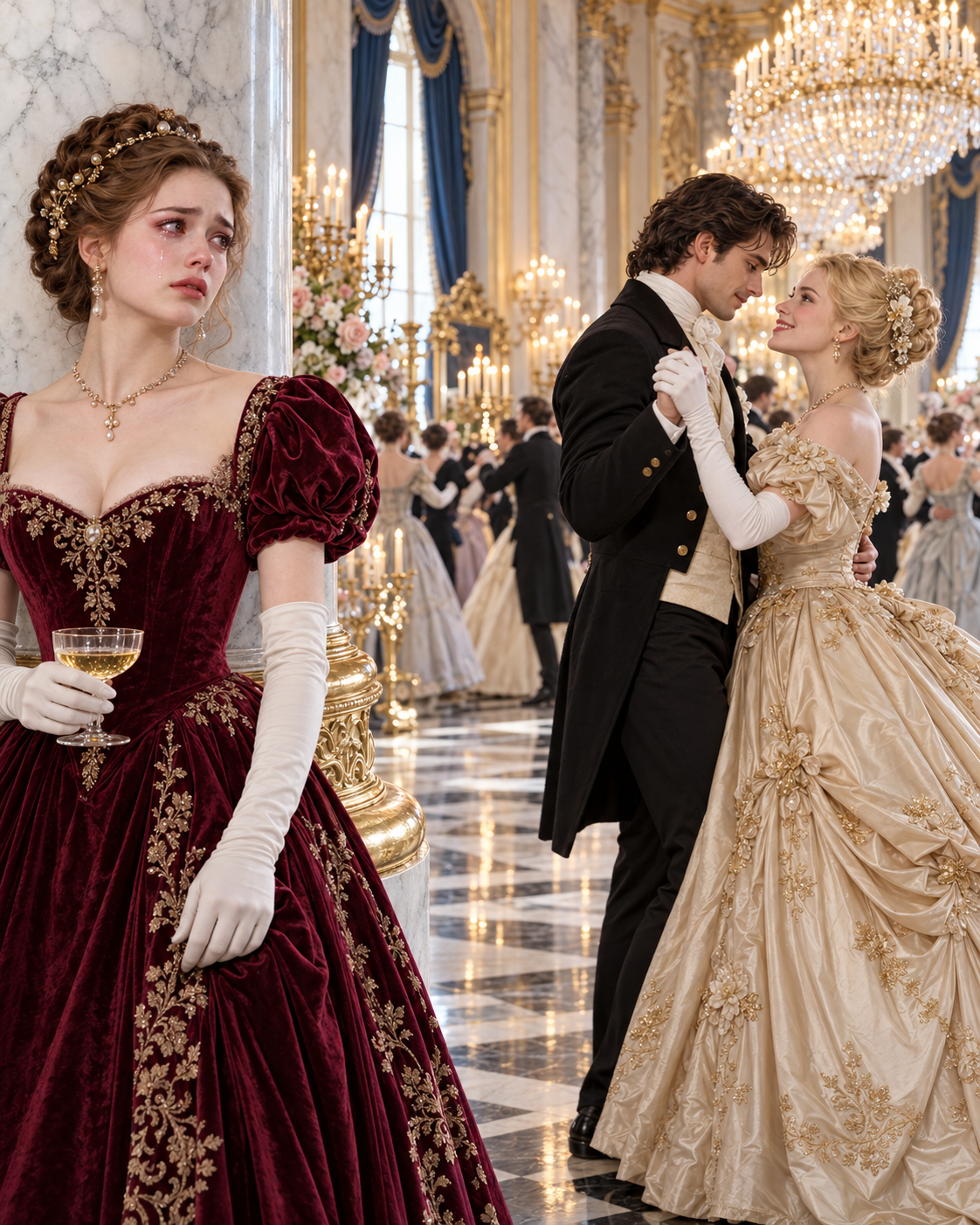
The first time Nathaniel Whitaker truly looked at his wife, she was standing across a ballroom, smiling as another woman called her a replacement.
Nathaniel stood so abruptly that his chair struck the floor behind him.
The voice beyond the study door had been quiet, almost ordinary. Yet it carried an inflection he remembered from a hundred evenings beside the drawing-room fire.
Amelia watched his face lose every trace of color.
“Don’t open it,” Pembroke whispered.
Nathaniel turned toward him.
For the first time that morning, the steward looked genuinely frightened. His eyes had fixed on the door, and his lips moved soundlessly, as though he were counting something only he understood.
Another knock came.
“Nathaniel. I haven’t much time.”
His hand reached the brass handle.
Amelia caught his wrist.
“Ask her something.”
He looked down at her fingers, then at her face.
“What?”
“Something only she would know.”
A long silence followed.
Nathaniel swallowed.
“What did you leave beneath the willow tree?”
Nothing moved outside.
Then the woman’s voice answered.
“A silver locket. You promised to return it when we married.”
Nathaniel closed his eyes.
Amelia slowly released his wrist.
The door opened.
A woman stood in the corridor wearing a dark traveling cloak, rainwater dripping from its hem onto the marble floor. Her face was thinner than the portrait above the fireplace. A pale scar crossed the corner of her eyebrow, and several strands of dark hair had escaped their pins.
But Nathaniel knew her.
“Evelyn?”
The woman attempted a smile.
It faltered when her gaze moved past him and settled on Amelia.
Then she saw the steward.
Her entire body stiffened.
“Don’t let him leave.”
Pembroke lunged toward the servants’ entrance.
Nathaniel seized him by the collar before he reached it. The two men struck the edge of the writing desk, scattering papers across the carpet.
Amelia stepped aside as the steward struggled, his polished shoes slipping against the floor.
“Take your hands off me!” Pembroke shouted.
Nathaniel tightened his grip.
“Not until you explain why a dead woman is standing in my house.”
Evelyn closed the door behind her.
“Because he made certain everyone believed I was dead.”
The rain intensified against the windows while Nathaniel listened to a woman he had mourned for nearly four years.
Evelyn remained standing near the fireplace. She had refused wine, refused a chair, and accepted only the glass of water Amelia placed in her hand.
Her fingers trembled against the crystal.
“I was supposed to leave for London the night before the accident,” she began. “I had found irregularities in the estate accounts. I thought someone was stealing from you.”
Nathaniel’s eyes shifted toward Pembroke, now confined to a chair beneath the watch of two footmen.
“You never told me.”
“I intended to.”
Evelyn looked down.
“But I discovered something worse.”
She reached into her cloak and withdrew a narrow leather notebook, its cover darkened by moisture.
“Your father’s estate was being used to secure private loans. Money was being transferred through properties that didn’t exist. When I confronted Pembroke, he said the documents had already been signed.”
Nathaniel’s jaw tightened.
“By whom?”
Evelyn looked at him.
“By you.”
Amelia felt the significance before Nathaniel spoke.
The forged authorizations had begun long before the funeral.
“Your signature was easy to reproduce,” Evelyn continued. “You signed anything Pembroke brought you. He knew your habits. He knew when you were distracted.”
Pembroke gave a humorless laugh.
“Your lordship was never particularly interested in figures.”
Nathaniel turned toward him, but Amelia spoke first.
“And the accident?”
Evelyn’s grip tightened around the glass.
“My carriage never overturned.”
Silence settled over the room.
“The horses were stopped outside the eastern woods. Two men took me from the carriage. One held me down while the other pressed a cloth over my mouth.”
Nathaniel’s expression changed.
“They told you she was dead,” Amelia said quietly.
Evelyn nodded.
“I woke in a private house near the coast. A doctor told me I had suffered a fever and could not remember my own name.”
She paused.
“For months, they gave me medicine that made it difficult to remain awake. Whenever I asked to leave, they said I was dangerous to myself.”
Nathaniel braced one hand against the mantelpiece.
“Why keep you alive?”
Evelyn’s eyes turned toward Pembroke.
“Because I had hidden the original accounts. He wanted to know where.”
Pembroke stared at the carpet.
Amelia examined the little notebook in Evelyn’s hand.
“And the letter dated after your funeral?”
“I wrote it when I managed to get a message to a former maid. I didn’t know whether anyone would ever see it.”
Her voice became quieter.
“I thought Nathaniel would come.”
The words settled heavily between them.
Nathaniel stared at the woman he had once intended to marry.
“I buried you.”
Evelyn’s eyes filled, though her voice remained steady.
“I know.”
For several minutes, nobody spoke.
Amelia was the first to move.
She collected the scattered documents, placed them in a neat stack, and crossed to the bellpull.
Nathaniel looked at her.
“What are you doing?”
“Sending for the magistrate.”
Pembroke lifted his head sharply.
“You cannot simply make accusations of kidnapping and fraud without proof.”
Amelia turned toward him.
“Fortunately, Mr. Pembroke, you’ve been remarkably generous with your records.”
His eyes narrowed.
She placed Evelyn’s notebook beside the forged authorization.
“The payments to the coastal house were disguised as maintenance expenses. The physician’s fees were entered under livestock care. And the carriage supposedly destroyed in the accident was sold eleven days later.”
Nathaniel looked at her in astonishment.
“You knew?”
“I knew someone was being kept somewhere. I didn’t know whom.”
Evelyn stared at Amelia.
“You found those payments?”
Amelia nodded.
“The accounts were complicated only because someone wanted them to be.”
For the first time since entering the room, Evelyn’s expression softened.
Pembroke suddenly leaned forward.
“You think this ends with me?”
Amelia looked at him.
His smile returned, but there was something desperate behind it.
“You have no idea whose names are in those ledgers.”
“Then we shall read them carefully,” she replied.
By afternoon, the magistrate had arrived with two constables.
Pembroke was taken into custody, though not before he requested a private conversation with Nathaniel.
Amelia advised against it.
Nathaniel agreed.
The small decision seemed to surprise them both.
Evelyn was given the blue guest chamber, away from the household staff and the rooms associated with her former life. A physician from the neighboring village examined her, while Amelia arranged for a trusted maid to remain nearby.
Nathaniel stood outside the chamber door long after it closed.
Amelia found him there as evening approached.
“She is alive,” he said.
“Yes.”
“I spent years believing—”
He stopped.
Amelia waited.
His gaze dropped to her bare left hand.
“I made you live in the shadow of someone who wasn’t even dead.”
Amelia’s expression barely changed.
“You made me live in her shadow because you would not look at the person standing beside you. Whether Evelyn lived or died doesn’t alter that.”
He looked as though she had struck him.
But she had not raised her voice.
She simply continued down the corridor.
This time, Nathaniel did not follow.
The following morning brought another discovery.
A sealed parcel arrived from a solicitor in London, addressed to Evelyn in handwriting Amelia recognized from the estate records.
Inside were copies of mortgages, correspondence, and an unsigned agreement involving three neighboring properties.
One name appeared repeatedly.
Sir Reginald Ashcombe.
Nathaniel’s closest family friend.
The man who had stood beside him at Evelyn’s funeral.
The man who had encouraged him to marry Amelia.
Amelia studied the documents at breakfast while Nathaniel stood near the window.
“Reginald said marriage would help me move forward,” he murmured.
“Perhaps he wanted you distracted.”
Nathaniel turned.
“What do you mean?”
She slid a contract across the table.
“If you had married Evelyn, she would have continued asking questions about the estate. Instead, everyone believed she was dead. You stopped overseeing the accounts, and Sir Reginald acquired the right to purchase your eastern lands if certain debts went unpaid.”
Nathaniel examined the page.
The amount was staggering.
“But those debts were never mine.”
“Not originally.”
Amelia pointed to his forged signature.
“They became yours on paper.”
Nathaniel sat down slowly.
For several moments, he seemed unable to look away from the figures.
Then Amelia noticed another detail.
The date of the final mortgage agreement.
It had been signed one week before her wedding.
That afternoon, Sir Reginald arrived without invitation.
He entered the drawing room with the confident ease of a man accustomed to finding every door open.
“Good heavens, Nathaniel. I heard there was some unpleasant business with your steward.”
His smile vanished when he saw Evelyn seated beside the window.
A moment passed.
Then another.
“Evelyn?”
She did not rise.
“Good afternoon, Reginald.”
The older man caught the back of a chair.
“This is extraordinary.”
Amelia watched him closely.
He looked shocked, certainly.
But not surprised in the way Nathaniel had been.
His gaze moved toward the windows, the hallway, and finally the door.
He was calculating.
Nathaniel stepped forward.
“We have some questions.”
Reginald recovered enough to smile.
“Of course.”
Amelia placed the mortgage agreement on the table.
“Did you know the estate was being used as security for fraudulent loans?”
Reginald glanced at the document.
“I’ve advised your husband on financial matters for years, Lady Whitaker. Such arrangements are perfectly ordinary.”
“Even when the signatures are forged?”
His smile faded.
“That is a serious accusation.”
“Indeed.”
Amelia opened another folder.
“Which is why I invited the solicitor who prepared these agreements.”
The drawing-room door opened.
A gray-haired gentleman entered, carrying a leather case.
Sir Reginald turned sharply.
The solicitor bowed.
“Good afternoon, Sir Reginald. I believe we have unfinished business.”
Mr. Ellison had served the Whitaker family before Nathaniel inherited the estate.
He had retired shortly after Evelyn’s supposed death, though the timing had never been adequately explained.
Now, standing beneath the chandelier, he removed several letters from his case.
“I was instructed to alter the debt schedules,” he said. “When I refused, I received threats against my daughter.”
Reginald scoffed.
“Absurd.”
Ellison ignored him.
“I kept copies of every instruction.”
He placed the letters on the table.
Amelia examined the handwriting.
It matched Reginald’s personal correspondence.
One instruction concerned the transfer of estate funds.
Another demanded that Evelyn’s inquiries be stopped.
The final letter was shorter.
The young woman must not be allowed to return.
Nathaniel picked it up.
His hand was steady now.
“You knew she was alive.”
Reginald said nothing.
“You watched me bury an empty coffin.”
Still nothing.
“And you stood beside me while I wept.”
Reginald’s expression hardened.
“You were never fit to manage what your father left you.”
The room fell silent.
Nathaniel lowered the letter.
“Perhaps not.”
He looked toward Amelia.
“But someone was.”
Reginald followed his gaze.
For the first time, he seemed to understand that the quiet woman he had dismissed as a convenient second wife had become the greatest threat to everything he had built.
“You should be careful, Lady Whitaker.”
Amelia closed the folder.
“Is that advice or a threat?”
His eyes darkened.
“Your position here is less secure than you imagine.”
She stood.
“My position is not the subject of this conversation.”
The confrontation might have ended there.
But Reginald suddenly reached into his coat.
Nathaniel moved instinctively toward Amelia.
A small pistol appeared in the older man’s hand.
Evelyn rose from her chair.
The solicitor backed toward the fireplace.
“Everyone remain where you are,” Reginald ordered.
His breathing had grown uneven.
Amelia looked at the pistol, then at the slight tremor in his wrist.
“You won’t get far,” she said.
“Be quiet.”
“The magistrate has copies of the documents.”
Reginald’s eyes flickered.
She continued, carefully.
“Whatever happens in this room, the evidence is already beyond your reach.”
He aimed the weapon at her.
Nathaniel stepped between them.
“Put it down.”
“Move.”
“No.”
For one terrible moment, nobody breathed.
Then Evelyn spoke.
“Reginald, look at me.”
His gaze shifted toward her.
“You tried to erase me once,” she said. “It didn’t work.”
His grip faltered.
Nathaniel moved.
The pistol discharged.
Glass shattered behind Amelia.
A sharp crack filled the room, followed by the sound of falling fragments.
Nathaniel struck Reginald’s arm, sending the weapon across the carpet.
The two men crashed into a small table.
Before Reginald could recover, the constables stationed outside rushed into the room.
Within seconds, he was restrained.
Amelia stood against the wall, her breathing shallow.
Nathaniel turned toward her.
“Are you hurt?”
She shook her head.
Only then did he notice the blood darkening his sleeve.
The bullet had grazed Nathaniel’s upper arm.
The physician assured them that the wound was painful but not dangerous.
By evening, Reginald had joined Pembroke in custody, and the solicitor’s testimony had been formally recorded.
The investigation would take months.
More forged contracts were discovered. Several officials were implicated. Properties acquired through fraudulent agreements were placed under legal review, and the missing estate funds began to be traced.
Yet the greatest changes occurred quietly, far from the magistrate’s office.
Amelia took charge of reviewing every tenancy agreement.
She ordered repairs to the northern cottages and arranged independent inspections of the estate buildings. Families charged excessive rents received corrected accounts, and Nathaniel authorized repayment where the records established overcollection.
For the first time in years, the tenants began entering the estate office without fear.
Nathaniel attended the meetings.
At first, he mostly listened.
Amelia noticed.
She also noticed that he no longer interrupted when she spoke, or turned instinctively toward the steward’s empty chair for confirmation.
One morning, a tenant asked Nathaniel whether a proposed repair could be approved.
Nathaniel looked at Amelia.
“What do you think?”
She examined the estimate.
“The work is necessary. But the contractor’s price is excessive.”
Nathaniel nodded.
“Then we find another contractor.”
No argument followed.
No explanation was demanded.
It was a small exchange, almost unremarkable.
But Amelia remembered every word.
Evelyn remained at the estate for another fortnight.
She regained strength slowly, spending long hours in the gardens where she once walked with Nathaniel.
Sometimes they spoke.
Sometimes they sat together without saying anything.
Amelia never asked what passed between them.
One afternoon, however, Evelyn found her in the greenhouse.
The glass panes were misted with condensation, and the scent of damp earth filled the narrow space.
Amelia was trimming a rosebush when Evelyn approached.
“I wanted to thank you.”
Amelia set down the shears.
“You owe me nothing.”
“I owe you more than you know.”
Evelyn looked toward the house.
“When I first saw you, I thought you must hate me.”
Amelia considered the question.
“I hated what your memory had become in my marriage. That isn’t the same as hating you.”
Evelyn gave a faint smile.
“He was always inclined to make monuments of things he couldn’t bear to lose.”
Amelia said nothing.
Evelyn touched the leaf of a climbing rose.
“I loved him once,” she admitted. “Very deeply.”
“And now?”
The older woman glanced toward the windows.
“Now I remember the girl who loved him. But I am not entirely that girl anymore.”
Amelia understood more than she expected.
Evelyn had spent years imprisoned by men determined to control her future.
Amelia had spent three years living inside a marriage that allowed her no real place.
Their circumstances were different.
But both women had been expected to remain exactly where others had put them.
Evelyn drew a folded letter from her pocket.
“I have been offered a position helping administer a charitable hospital in Bath. They need someone who understands how easily vulnerable people can disappear behind respectable paperwork.”
Amelia smiled.
“Will you accept?”
“I think I will.”
She hesitated.
“There is something else.”
Amelia waited.
“Nathaniel asked whether we might begin again.”
The greenhouse seemed suddenly very quiet.
Amelia placed the shears carefully on the bench.
“And what did you tell him?”
Evelyn met her eyes.
“That he was asking the wrong question.”
That evening, Nathaniel found Amelia in the library.
She was seated beside the fire with a book open in her lap, though she had not turned a page for some time.
He stood at the threshold.
“May I come in?”
Amelia looked up.
It was such an unfamiliar question that she almost smiled.
“Yes.”
He entered slowly.
His injured arm remained supported in a sling.
“I spoke to Evelyn.”
“I know.”
“She is leaving next week.”
Amelia closed her book.
Nathaniel approached the fireplace but did not sit.
“For years, I believed I had lost the only person who could ever understand me.”
He paused.
“When she returned, I thought everything would become simple again.”
Amelia watched the flames.
“Did it?”
“No.”
He looked at her.
“It made me realize that I had been mourning a life I imagined rather than living the one I had.”
She lowered her eyes.
Nathaniel continued, his voice quieter.
“I married you because everyone told me I should. I told myself I could offer you comfort, security, respectability.”
A faint, painful smile crossed his face.
“I never asked what you wanted.”
“No,” Amelia said.
He accepted the answer.
“I cannot give those years back.”
The room grew still.
“And I won’t insult you by pretending that a few weeks of better behavior should make you forget them.”
Amelia looked up.
For once, there was no defense in his face.
Only the discomfort of a man finally willing to see what he had done.
“What do you want from me now?” she asked.
Nathaniel glanced at her hand.
“Nothing you are not willing to give.”
She studied him for a long moment.
Then she opened her book again.
“Good night, Nathaniel.”
He bowed his head.
“Good night, Amelia.”
And he left.
Winter passed slowly.
Evelyn departed for Bath beneath a clear November sky, carrying two trunks and the small leather notebook that had helped expose the conspiracy.
Nathaniel stood beside her carriage.
They spoke privately for several minutes.
When she finally stepped onto the carriage, he kissed her hand.
It was a farewell without promises.
Amelia watched from the front steps.
Evelyn smiled at her through the open window.
“Write to me.”
“I will.”
The carriage rolled down the drive.
Nathaniel remained standing until it disappeared beyond the gates.
Then he turned toward the house.
Amelia had already gone inside.
He did not seem surprised.
By spring, the estate looked different.
Fresh slate covered the roofs of the northern cottages. The abandoned schoolroom had reopened, and a new clerk kept accounts that any tenant could request to inspect.
Amelia introduced written receipts for every payment, with duplicate records held separately from the estate office.
Nathaniel supported the changes without claiming credit.
Occasionally, he disagreed with her.
She disagreed with him just as freely.
Their discussions were sometimes sharp, sometimes amusing, and often continued long after dinner.
But neither left the room feeling unheard.
One evening, Nathaniel discovered Amelia in the study examining architectural plans.
“What are those?”
“A proposal.”
“For what?”
She turned the drawing toward him.
“A permanent school and infirmary near the western village. The estate can afford it if we postpone the ornamental lake.”
Nathaniel looked at the plans.
“My father wanted that lake.”
Amelia raised an eyebrow.
“Did he require it after his death?”
Nathaniel laughed.
It was an unexpected sound, warm and almost boyish.
She found herself smiling before she could stop.
He noticed.
But wisely, he said nothing.
The project was approved two weeks later.
At the first planning meeting, Nathaniel introduced Amelia to the contractors as the person overseeing the work.
Not as his wife.
Not as the lady of the house.
As the person responsible.
Afterward, they walked back through the gardens together.
The late afternoon sun caught the new leaves on the trees, turning them translucent against the sky.
Amelia stopped beside the old fountain.
Nathaniel halted a few steps away.
“Do you remember our wedding day?” she asked.
His expression softened.
“Yes.”
“You barely looked at me.”
He lowered his gaze.
“I remember.”
“I spent the entire ceremony wondering whether you wished someone else were standing there.”
Nathaniel’s mouth tightened.
“I did.”
Amelia looked at him.
The admission hurt, though she had known the truth for years.
He did not attempt to soften it.
“I am ashamed of that,” he said. “Not because Evelyn returned. Because you deserved to be seen even when I believed she never would.”
A breeze moved across the fountain, disturbing the water.
Amelia looked toward the house.
“For a long time, I thought that if I became quieter, kinder, more patient, eventually you would love me.”
Nathaniel remained still.
“Then I realized I was disappearing while I waited.”
He took a slow breath.
“What changed?”
She glanced down at her hands.
“I stopped asking whether I was enough for you. I started asking whether the life I was living was enough for me.”
Nathaniel looked at her for a long time.
Then he nodded.
“That was the question I should have wanted you to ask.”
Several days later, Amelia received a letter from London.
It contained a formal offer to join the governing board of a charitable organization overseeing rural schools and hospitals.
The work would require regular travel and extended periods away from the estate.
She read the invitation twice.
Then she carried it to Nathaniel.
He was reviewing construction estimates when she entered.
“I’ve been offered a position.”
He took the letter and read it carefully.
“This is extraordinary.”
Amelia watched his face.
“It would mean spending several months each year in London.”
“Yes.”
“And the estate would need another person managing the daily accounts.”
“We can appoint someone.”
She folded her hands.
“You wouldn’t object?”
Nathaniel looked genuinely puzzled.
“Why would I?”
“Because your wife would be away.”
He set down the letter.
“Amelia, you have spent years making this estate better. It would be a poor return for your work if these walls became the limit of your life.”
She looked away.
Something in her expression changed so subtly that he almost missed it.
“Thank you,” she said.
He shook his head.
“You needn’t thank me for something that should always have been yours to decide.”
In early summer, the final legal proceedings against Pembroke and Reginald concluded.
Both men were convicted of offenses arising from the fraud and Evelyn’s unlawful confinement. The estate recovered part of its stolen funds, while additional civil proceedings addressed the remaining losses.
Nathaniel sat through the hearings beside Amelia.
When the judgment was delivered, he did not look triumphant.
He looked tired.
Outside the courthouse, reporters gathered near the steps.
One gentleman asked whether Nathaniel believed his family had finally escaped disgrace.
Nathaniel looked toward Amelia, who stood beside him holding a folder of documents.
“My family’s reputation matters considerably less to me than the people who were harmed,” he answered.
Another reporter asked how he had uncovered the fraud.
Nathaniel did not hesitate.
“My wife did.”
Amelia turned toward him.
He met her eyes.
There was no grand gesture.
No possessive touch.
Only the simple acknowledgment of something she had earned.
That autumn, the new school opened.
Children gathered in the courtyard beneath strings of small paper decorations. Their parents stood nearby, some wearing their best clothes, others still marked by the day’s work.
Amelia watched a little girl struggling to carry an armful of books.
She stepped forward to help.
The child looked up.
“Are you the lady who built our school?”
Amelia smiled.
“A great many people built it.”
“But you told them we needed one.”
Amelia crouched beside her.
“Yes, I suppose I did.”
The girl considered this.
“Then I want to be like you.”
Amelia’s smile faded into something quieter.
“Be like yourself,” she said. “And don’t let anyone convince you that your questions are too troublesome.”
The girl nodded solemnly before running toward her friends.
Nathaniel had heard the exchange.
He stood nearby, holding Amelia’s gloves.
When she reached him, he offered them without speaking.
She took them.
Their fingers brushed.
Neither withdrew immediately.
That evening, Nathaniel asked Amelia to join him in the study.
The room looked different now.
The old accounts had been replaced with orderly shelves, the heavy curtains had been drawn back, and the desk stood where the afternoon light could reach it.
On its polished surface lay a small velvet box.
Amelia stopped in the doorway.
Nathaniel followed her gaze.
“I found something that belongs to you.”
He opened the box.
Inside lay her wedding ring.
The same ring she had left on his desk nearly a year earlier.
Amelia stared at it.
For a moment, the memory of that night returned with painful clarity: the ballroom, the laughter, the empty place beside her, the terrible loneliness of being married and yet entirely alone.
Nathaniel did not pick up the ring.
“I kept it,” he said. “At first because I thought you would eventually ask for it back.”
Amelia remained silent.
“Then I kept it because it reminded me of the moment you stopped accepting what I was willing to give.”
He stepped away from the desk.
“I am not asking you to wear it.”
She looked up.
“Then why show me?”
“Because I want you to know you are free to choose what happens next.”
Amelia studied the man before her.
He had once seemed untouchable, protected by grief and pride and the quiet obedience of everyone around him.
Now he stood with empty hands.
No demand.
No expectation.
Only an answer he was prepared to accept.
“And if I choose to leave?” she asked.
His throat moved.
“Then I will help you pack.”
She watched him carefully.
“And if I choose to stay?”
Nathaniel took a breath.
“Then I hope you will stay because this is a life you want. Not because you believe you owe me another chance.”
Amelia looked down at the ring.
For a long moment, she said nothing.
Then she closed the velvet box.
“I don’t want the marriage we had.”
“Neither do I.”
“I won’t become the woman who waits quietly while you decide whether she matters.”
“I know.”
“And I won’t surrender the work I’ve begun.”
“I would never ask you to.”
Amelia lifted her eyes.
“Then perhaps we can discover what kind of marriage two people might build when neither is expected to disappear.”
Nathaniel’s expression changed.
Not into triumph.
Something gentler.
“I would like that,” he said.
They did not exchange new vows that night.
There was no sudden declaration capable of repairing three years of neglect.
Trust returned in smaller ways.
Nathaniel learned to notice when Amelia grew quiet, without assuming silence meant agreement.
Amelia learned that disagreement no longer had to end in withdrawal.
They took walks without discussing estate business.
They argued over books.
They shared dinners that sometimes lasted until the candles burned low.
And slowly, the space between them became a place where neither had to compete with a memory.
Several months later, Amelia returned from London after her first extended meeting with the charitable board.
Nathaniel met her at the station.
He had arrived early, though he pretended otherwise.
She stepped from the carriage carrying a leather case and wearing a dark blue traveling coat.
He took one look at her tired face.
“Long journey?”
“Very.”
“Successful?”
“Mostly.”
He reached for her case.
She handed it to him.
As they walked toward the waiting carriage, Amelia noticed a familiar velvet box resting on the seat.
She looked at Nathaniel.
He seemed almost embarrassed.
“I thought you might prefer to decide what to do with it yourself.”
Amelia opened the box.
The ring caught the late afternoon light.
She held it between her fingers.
Then she slipped it onto her hand.
Nathaniel did not speak.
She glanced at him.
“Don’t look so astonished.”
A faint smile appeared on his face.
“I was trying not to.”
She settled back against the cushions.
“I haven’t forgotten anything, Nathaniel.”
His smile softened.
“I wouldn’t ask you to.”
“But I believe you’ve learned something.”
He looked at her.
“What?”
Amelia turned the ring once around her finger.
“That love cannot survive merely because one person is willing to endure.”
Nathaniel reached for her hand, then stopped, leaving the choice to her.
Amelia placed her fingers in his.
Outside, the carriage began moving through the golden evening, past fields where workers were returning home and cottages whose windows glowed warmly against the approaching dusk.
Nathaniel looked toward the road ahead.
“I spent so long believing love was something I had lost,” he said.
Amelia glanced at him.
“And now?”
He turned toward her.
“Now I think it’s something I have to keep choosing.”
She watched him for a moment.
Then she smiled.
“That’s a beginning.”
Years later, the people of Whitaker Estate would remember Amelia for many things.
They remembered the school that gave their children opportunities their parents had never known.
They remembered the infirmary that opened its doors without demanding payment from families who had none.
They remembered the woman who walked into leaking cottages with a notebook and refused to accept that suffering was simply the way things had always been.
And they remembered Lord Whitaker, who had once scarcely noticed his wife, walking beside her through the village with the easy familiarity of a man who no longer needed to stand ahead of her.
But Amelia herself remembered something much smaller.
A cold morning.
A quiet study.
A wedding ring resting beside a sheet of paper.
She had believed, when she placed it there, that she was ending something.
In truth, she had been reclaiming something far more important than a marriage.
Her own voice.
Nathaniel never forgot the lesson either.
He had learned that grief did not excuse neglect, that regret meant little without action, and that respect was not a reward a woman should have to earn by proving herself indispensable.
It was something she had deserved from the beginning.
Their marriage did not become perfect.
There were difficult days, misunderstandings, and moments when old habits threatened to return.
But now they knew how to speak.
More importantly, they knew how to listen.
And whenever someone asked Amelia how she had finally won her husband’s heart, she answered with a small, knowing smile.
“I stopped trying to win it.”
She would glance toward Nathaniel, who always listened to her answer without interruption.
“Then I remembered that I had a life worth living, whether he chose to share it or not.”
For Amelia, that was the truth that mattered most.
She had not found happiness by becoming the woman Nathaniel finally wanted.
She had found it by becoming the woman she had nearly forgotten she was.
And only then had they learned to love each other—not as a consolation for what was lost, but as two people freely choosing the life still waiting to be lived.
THE END.