The first time I caught eleven-year-old Henry Dalton stealing food from the pantry, he had three biscuits stuffed inside his shirt and a look of terror on his face.
Because for the first time, I was being offered a place in a household where my work was respected, where the children trusted me, and where I was beginning to feel something dangerously close to belonging.
Grant suggested we explore whether a reliable manager could help my aunt keep the boarding house open. He even offered an advance on my wages, properly documented, if it would help with the repairs.
But neither of us knew whether the landlord would agree or whether my aunt would accept help from a stranger.
The next morning, I sat down to write her a letter.
Before I could finish, Molly appeared in the doorway carrying her mother’s blue ribbon.
She climbed onto the chair beside me and laid it across my hand.
“You can borrow this,” she whispered. “Mama used to wear it when she went away. She always came back.”
I looked at that little girl, trying so hard to be brave, and realized there was something I needed to do before making any promises.
I folded the ribbon carefully and placed it back in her palm.
“Keep it safe for me, sweetheart.”
“Are you leaving?”
“I need to visit my aunt and find out how I can help her.”
Molly looked down.
“Will you come back?”
I wanted to say yes immediately.
Instead, I put my arms around her.
“I’m going to do everything I reasonably can to make that possible. And whatever happens, your father and Henry will be right here with you.”
That evening, I told Grant I wanted to take a short trip home before accepting his offer.
He agreed and promised that my position would remain open while I considered it.
Henry said very little when I explained my plans.
But after supper, he brought me the pantry ledger.
“I’ve counted everything,” he said. “And I can help Pa while you’re gone.”
I smiled at him.
“I know you can.”
He hesitated.
“Even if you don’t come back?”
That question stayed with me long after the children went to bed.
Because Henry was finally beginning to understand that grown-ups could leave without abandoning him. I couldn’t teach him otherwise by making a promise I wasn’t certain I could keep.
The next morning, my bag was packed, Grant had arranged transportation into town, and a letter from my aunt lay unopened beside my breakfast plate.
It had arrived on the early mail wagon.
I recognized her handwriting, but the envelope was marked urgent.
I sat down, slid my finger beneath the seal, and wondered whether the words inside would make my decision for me.
And as Henry watched from the doorway, I realized this wasn’t simply a choice between two homes.
It was a choice about how to care for the people I loved without losing the right to build a life of my own.
That afternoon, I asked Grant whether we could discuss a longer arrangement.
He listened while I explained the situation at the boarding house.
Then he said something I hadn’t expected.
“Before you decide, I want to be clear about one thing. You are not responsible for repairing every hurt in this family. That’s my responsibility as their father.”
I looked at him.
“I’d like you to stay because your work matters here,” he continued. “But I don’t want the children’s feelings to become a debt you think you owe.”
His words made the decision harder, not easier.
I opened my aunt’s letter with trembling fingers, aware that Henry was watching me from the kitchen doorway.
The first sentence made my stomach tighten.
“My dear Hannah, I have tried every respectable means I know to save the boarding house, but Mr. Whitcomb has informed me that unless I settle the overdue rent and repair the roof before the first heavy snowfall, I must surrender the property.”
I read the words again, hoping I had misunderstood them.
Then I reached the final paragraph.
“There is something else I have not told you. A gentleman from Cheyenne has offered to purchase the boarding house business, including its furnishings. He wants my answer within ten days. If I accept, I will have enough to settle my debts, but I will lose the home where you grew up.”
I folded the letter slowly.
For thirteen years, my aunt had kept that boarding house alive with her own two hands. She had scrubbed floors when her knees ached, cooked for travelers who sometimes disappeared without paying, and sat beside me through every fever and disappointment after my parents died.
She had never asked me for anything.
Now, when she needed help most, I was miles away, standing in a beautiful ranch kitchen with two children who had only just begun believing that grown-ups could be trusted.
“Is your aunt sick?” Henry asked.
“No, sweetheart. But she’s having some trouble with her house.”
“Can you fix it?”
I looked at the letter.
“I don’t know.”
He considered that answer for a moment.
Then he walked to the pantry, opened his little notebook, and returned with a pencil.
“When we don’t know how much flour we have,” he said, “we count it.”
I almost smiled.
“And when something is broken,” he continued, “Pa says we find out what it needs before deciding it’s ruined.”
I reached across the table and squeezed his hand.
“That sounds like very good advice.”
He looked pleased, though he tried not to show it.
By breakfast, I had made my decision.
I would travel to Cheyenne, speak with my aunt, examine the accounts, and learn exactly what could be done. I would not accept Grant’s permanent offer until I understood the cost of leaving my old life behind.
When I explained this to Grant, he listened without interruption.
“How long will you need?” he asked.
“Perhaps a week. Maybe a little longer.”
“Take the time you need.”
“I don’t want to leave you without help.”
“We managed before you arrived.”
I glanced toward the pantry.
“Not particularly well.”
To my surprise, he laughed.
“No,” he admitted. “Not particularly well.”
Then his expression grew serious.
“Hannah, I meant what I said. Your position will be waiting when you return, if you decide you want it.”
That afternoon, Molly followed me from room to room while I packed.
She didn’t cry or complain. She simply appeared wherever I went, carrying her mother’s blue ribbon.
At last, she climbed onto my bed and watched me fold my Sunday dress.
“Does your aunt have children?”
“No. Just me.”
“Then she’ll be lonely without you.”
The simple observation struck harder than anything else I had heard that morning.
“Yes,” I said. “I suppose she will.”
Molly looked down at the ribbon.
“Maybe grown-ups get lonely the same way children do.”
I sat beside her.
“They certainly do.”
She thought about this.
“Then you should go see her.”
I kissed the top of her head, and for a moment I couldn’t speak.
The following morning, Grant drove me into town in his wagon.
The sky was pale, the fields silver with frost, and the mountains beyond High Meadow looked as though someone had dusted their peaks with flour.
For several miles, Grant said nothing.
Then he asked, “Are you frightened?”
“A little.”
“Of what you’ll find?”
“Of finding out that no matter what I choose, someone I love will suffer.”
He kept his eyes on the road.
“My father once told me there’s a difference between disappointing someone and failing them.”
I turned toward him.
“I didn’t understand it until Mary died,” he continued. “I spent months trying to keep the ranch alive because I thought that was what my children needed. But I was so frightened of failing them that I barely noticed what they were asking for.”
“And what were they asking for?”
He looked at me briefly.
“Their father.”
We traveled another mile in silence.
Then he said, “Whatever happens in Cheyenne, don’t make your decision because you’re afraid of disappointing us.”
I wanted to thank him, but the words felt too small.
Instead, I watched the passing fields and wondered when this reserved, exhausted rancher had begun understanding me so well.
My aunt was waiting at the boarding house when I arrived two days later.
She looked older than I remembered.
Her gray hair was pinned neatly beneath a faded bonnet, but her shoulders had become thinner, and there were dark circles beneath her eyes.
The moment she saw me, she hurried down the steps.
“Hannah Pierce, what in heaven’s name are you doing here?”
I embraced her tightly.
“Coming home.”
She held me for a long moment.
Then she pulled back.
“You shouldn’t have spent good money traveling.”
“And you shouldn’t have been worrying alone.”
She sighed.
“Then I suppose we’re both stubborn fools.”
Inside, the boarding house smelled exactly as it always had: boiled coffee, furniture polish, and the lavender soap my aunt kept beside the washbasin.
But the familiar rooms had changed.
A stain spread across the dining room ceiling. Two upstairs bedrooms were closed because the plaster had begun to crumble. A bucket stood beneath a steady drip near the back staircase.
The house was still standing.
But barely.
That evening, after the boarders had finished supper, my aunt brought out her account books.
I had expected unpaid bills.
I had not expected so many.
There were repairs postponed for years, rising coal prices, overdue rent, and several months of unpaid lodging.
“Why didn’t you tell me?” I asked.
“Because you were finally earning a decent wage.”
“Aunt Ruth—”
“And because I was ashamed.”
She spoke so quietly that I almost missed the words.
I looked up.
“Ashamed of what?”
“Of being unable to keep the one thing your mother trusted me to protect.”
My mother’s name hung between us.
I took her hand.
“Mother trusted you to raise me. You did that beautifully.”
Her eyes filled.
“But this was supposed to be yours someday.”
“No,” I said gently. “You made it my home. That doesn’t mean you have to sacrifice the rest of your life keeping its walls standing.”
She wiped her cheeks with her apron.
“You sound different.”
“Do I?”
“More certain of yourself.”
I thought of Henry’s notebook, Molly’s ribbon, and Grant standing quietly beside the kitchen stove.
“Perhaps I’ve learned a few things.”
Over the next three days, I studied every account.
I spoke with the carpenter, visited the bank, and requested a meeting with Mr. Whitcomb.
The situation was worse than my aunt had admitted.
The necessary repairs would cost almost six months of my wages. Even if we found the money, the boarding house would continue losing money unless something changed.
But I discovered another problem.
Three long-term boarders owed substantial amounts, and my aunt had continued feeding them because she couldn’t bear to put anyone out during difficult times.
When I questioned her, she looked embarrassed.
“Mr. Bell lost his position at the railway office. And Mrs. Turner has nowhere else to go.”
“I understand.”
“Do you?”
“Yes,” I said. “But kindness cannot mean letting the entire house collapse around everyone.”
She stared at me.
I opened the ledger.
“We can help people without pretending the bills don’t exist.”
The following morning, I gathered the boarders in the dining room.
I was nervous. These were people I had known for years, people who remembered me as a shy girl carrying baskets of laundry down the stairs.
But I spoke plainly.
I explained the financial trouble, the overdue accounts, and the possibility that the boarding house might close.
Then I proposed something different.
Those who could pay would begin paying regularly. Those who couldn’t would make written arrangements or help with work that would otherwise cost money.
Mr. Bell, who had spent weeks avoiding my aunt’s eyes, offered to repair furniture and handle small maintenance jobs while he searched for employment.
Mrs. Turner, a skilled seamstress, agreed to mend linens and curtains in exchange for a portion of her rent.
A young railway clerk promised to settle his balance when his next wages arrived.
Not everyone was pleased.
One gentleman complained that my aunt had never demanded such things.
I looked directly at him.
“And that’s precisely why we’re sitting beneath a leaking ceiling.”
He left the next morning.
For the first time in years, my aunt didn’t chase after a departing boarder.
By the end of the week, we had made progress.
But not enough.
The landlord’s deadline remained.
Then, on Thursday afternoon, the gentleman who wanted to purchase the business arrived.
His name was Mr. Silas Mercer.
He wore an expensive dark coat, polished boots, and the patient expression of a man who believed everyone eventually agreed with him.
He inspected the dining room, the bedrooms, and the furniture.
Then he placed an offer on the table.
It was a fair price for the business, considering its debts.
Perhaps even generous.
My aunt’s hands trembled as she read it.
“If you accept,” Mr. Mercer explained, “I will settle the outstanding business obligations and take possession at the end of the month.”
“And my aunt?” I asked.
“She may remain for thirty days while making other arrangements.”
I studied him.
“What do you intend to do with the property?”
“Renovate it. Improve the rooms. Cater to commercial travelers rather than laborers.”
“And the current boarders?”
“They’ll have to make their own arrangements.”
My aunt lowered her eyes.
I knew what she was thinking.
The boarding house had never made much money, but it had sheltered people who might otherwise have slept in railway sheds or freezing rented rooms.
Mr. Mercer was offering her freedom from debt.
But that freedom came with consequences for the people who depended on her.
“I’ll need time,” she said.
“You have until Monday,” he replied.
After he left, my aunt sat beside the window and cried.
Not because the offer was unfair.
Because accepting it felt like admitting that thirteen years of work had been a mistake.
That evening, I wrote to Grant.
I explained the situation as clearly as I could, including the figures from the accounts and the purchase offer.
I didn’t ask him for money.
I simply needed to tell someone what was happening.
Three days later, a reply arrived.
His handwriting was firm and slightly uneven.
“Dear Hannah, Henry insists that the pantry inventory has never been more accurate. Molly has persuaded me to make cinnamon apples twice, although I believe the kitchen may never recover from my second attempt.
“The children miss you. So do I.
“I’ve enclosed the name of a reputable building contractor in Cheyenne. He once repaired our bunkhouse after a severe storm and treated us fairly. He may be able to offer another opinion.
“You have worked hard to give my children a sense of safety. I hope you will remember that you deserve the same consideration.
“Whatever you decide, you have my respect.
“Grant.”
I read the letter twice.
Then I noticed the small addition at the bottom.
In Henry’s careful handwriting were the words:
“Everything is counted.”
And beneath them, in Molly’s uneven letters:
“Come when you can.”
I pressed the paper against my chest.
The next morning, I contacted Grant’s contractor.
His name was Thomas Avery, a broad-shouldered man with a weathered face and a habit of tapping walls with his knuckles before saying anything.
He inspected the boarding house from cellar to attic.
Then he climbed onto the roof.
When he returned, his expression was serious.
“The roof needs work,” he said. “But the whole structure isn’t failing.”
I felt my shoulders loosen.
“Can it be saved?”
“Certainly. The question is whether you can afford to save it.”
He presented an estimate considerably lower than the first carpenter’s.
But there was a catch.
His crew was committed elsewhere for nearly three weeks.
By then, my aunt’s deadline would have passed.
We needed the landlord’s cooperation.
I went to Mr. Whitcomb’s office the next morning.
He was a narrow-faced man who kept every receipt in alphabetical order and regarded uncertainty as a personal insult.
“I’ve already granted Mrs. Pierce more time than I should have,” he said.
“I understand.”
“Then you understand why I cannot extend the deadline.”
I placed the revised estimate on his desk.
“The house can be repaired for less than you believed. We have a plan to restore its income, and we’re prepared to sign a formal payment schedule.”
He examined the papers.
“You’re asking me to trust a business that hasn’t paid its obligations.”
“No,” I said. “I’m asking you to consider a written agreement based on actual figures instead of promises.”
He looked mildly surprised.
I continued.
“If you refuse, my aunt may have to sell her business and leave. You’ll still own a property needing repairs, with no guarantee of finding a reliable tenant immediately.”
“And if I agree?”
“You receive regular payments, repairs made by an approved contractor, and a tenant who has cared for this building for thirteen years.”
For a long moment, he studied me.
Then he said, “Your mother was a determined woman.”
I sat very still.
“You knew her?”
“She came here once, years ago, to negotiate a lease on behalf of your aunt. She was considerably less polite than you.”
Despite myself, I smiled.
He folded the estimate.
“I’ll allow thirty additional days, provided the first payment is made before Monday and the contractor signs an agreement.”
I nearly cried with relief.
But when I returned home and calculated the money, I discovered we were still short.
Not by much.
Just enough to make every solution feel impossible.
That night, I sat at the dining room table until the candle burned low.
I could take the advance Grant had offered.
I could ask my aunt to sell the last pieces of jewelry she owned.
Or I could use nearly all the money I had saved, including the small reserve I’d set aside to begin a life of my own.
None of those choices was simple.
At last, Aunt Ruth entered the room.
“You’ve been staring at those figures for an hour.”
“I know.”
She sat opposite me.
“Hannah, I won’t let you spend everything you have on this house.”
“You spent everything you had raising me.”
“That was different.”
“Was it?”
“Yes.”
She reached across the table.
“Because I chose to do it.”
I stared at her.
“You never owed me repayment,” she continued. “And I never wanted you to believe that loving someone meant surrendering your future.”
The words brought tears to my eyes.
I’d traveled all this way fearing that choosing High Meadow would mean abandoning my aunt.
But now she was telling me something I hadn’t allowed myself to consider.
She didn’t want me trapped by gratitude.
She wanted me free.
“Then what do we do?” I whispered.
She looked toward the ceiling.
“Perhaps we stop pretending the boarding house has to remain exactly as it was.”
The next morning, we worked on a different plan.
We decided to close the two least profitable bedrooms until the repairs were completed. We revised the rates modestly, offered weekly meal arrangements to railway workers, and created a proper account system.
Aunt Ruth would manage the kitchen and guests, but she would no longer take every responsibility onto herself.
Mr. Bell agreed to become a part-time caretaker once he found steady employment, and Mrs. Turner offered to supervise the laundry.
Then I made another difficult decision.
I would contribute part of my savings, but not all of them.
The remaining amount would be covered by a small bank loan, secured against the business’s furnishings and supported by the new payment agreements.
The banker was cautious.
He demanded proof that the boarding house could earn enough to meet its obligations.
So I spent two more days preparing figures and collecting written commitments from regular guests.
When I returned, he reviewed them carefully.
Finally, he nodded.
“The amount is modest enough. I’ll approve it, provided your aunt signs the agreement herself.”
I hurried home with the papers.
Aunt Ruth read every page.
Then she took the pen.
For one brief moment, I thought she might refuse.
Instead, she signed.
“I believe,” she said, “I’d like to keep my house.”
We laughed.
Then we cried.
And afterward, we made tea because neither of us knew what else to do with so much relief.
But the hardest part of my journey wasn’t over.
Two days before I was scheduled to return to High Meadow, a sudden October storm swept across the plains.
The wind tore shutters loose, knocked branches into the streets, and turned the roads into thick mud.
By midnight, rain was pouring through the unrepaired section of the roof.
I woke to the sound of Aunt Ruth calling my name.
“Hannah! The upstairs hallway!”
I rushed from my room.
Water streamed down the wall near the back staircase. A section of wet plaster had collapsed, scattering debris across the floor.
One of the boarders was trapped in a bedroom because the swollen door wouldn’t open.
Mr. Bell and I forced it loose while Aunt Ruth guided the others downstairs.
For nearly an hour, we carried blankets, moved furniture, and placed buckets beneath the leaks.
Then I heard a sharp cracking sound overhead.
“Everyone downstairs!” I shouted.
A heavy piece of ceiling plaster fell moments after we cleared the hallway.
No one was hurt.
But the damage was worse than anything we’d imagined.
By dawn, the upper floor was unsafe to occupy.
I stood in the dining room, exhausted and covered in dust.
The payment plan had been signed.
The contractor had been hired.
The bank loan had been approved.
And now the boarding house could not safely receive half its guests.
Aunt Ruth sat beside the cold stove, staring at her hands.
“Perhaps this is the Lord’s way of telling me to stop.”
I wanted to argue.
Instead, I sat beside her.
“Perhaps,” I said softly. “But we don’t have to decide that while we’re frightened and tired.”
When Mr. Avery arrived later that morning, he inspected the damage and told us the truth.
The roof repairs could still be completed, but the upper floor would need additional work. The cost would increase, and we would need temporary accommodations for several guests.
I looked at the figures.
There was no clever arrangement that could make the new expense disappear.
For the first time, I understood that saving the boarding house might not be possible.
Not without risking everything else.
That afternoon, I walked alone through the empty upstairs rooms.
I remembered my mother brushing my hair beside the window.
I remembered Aunt Ruth teaching me to sew, the sound of laughter drifting from the kitchen, and the years when I believed those walls would always be there.
Then I looked at the broken plaster.
A home was more than a building.
But sometimes the building demanded more than the people inside could give.
That evening, I sat with Aunt Ruth and laid out three options.
We could borrow more money and attempt the repairs, accepting a serious financial risk.
We could sell the business to Mr. Mercer, settle the debts, and find another place for her to live.
Or we could negotiate to transfer the business to someone willing to operate it as a smaller boarding house while giving my aunt a secure position managing the kitchen.
She listened carefully.
Then she asked, “What would you choose?”
I shook my head.
“It isn’t my choice.”
“But I value your judgment.”
I thought for a long moment.
“I would choose the future that lets you sleep peacefully at night.”
She looked toward the staircase.
“I haven’t slept peacefully in years.”
The next morning, we requested another meeting with Mr. Mercer.
This time, we didn’t simply accept his original terms.
I showed him the revised accounts, the regular customers, and the renovation estimates.
I explained that the business had value beyond its damaged rooms.
Then I proposed a different arrangement.
He could purchase the business and its furnishings at a negotiated price, while Aunt Ruth remained as kitchen manager for one year, with regular wages and the option to leave afterward.
The existing boarders would receive sufficient notice, and those who could afford the revised rates would be offered rooms after the renovation.
Mr. Mercer was not enthusiastic.
He disliked being told how to conduct his affairs.
But he was a businessman, and the accounts showed him something worth considering.
After two days of negotiation, he agreed to most of our conditions.
Not all.
Some boarders would still have to find other accommodations. Aunt Ruth would no longer control the establishment. The furnishings would belong to someone else.
It was painful.
But it was also a way forward.
That night, I found my aunt standing in the dining room, touching the back of an old wooden chair.
“Your mother sat here the night before she died,” she said.
I joined her.
“I remember.”
“She told me not to worry about you. Said you were stronger than either of us knew.”
I swallowed.
“She was wrong about many things,” Aunt Ruth added with a faint smile. “But not that.”
Then she took my hand.
“I want to accept Mr. Mercer’s offer.”
“Are you sure?”
“No,” she admitted. “But I think I’m ready.”
The following week, the papers were signed.
The boarding house changed hands.
The debts were settled, the injured portion of the building scheduled for repair, and my aunt received enough from the sale to live modestly without constant fear.
Not everything was saved.
But neither was everything lost.
On my final morning in Cheyenne, Aunt Ruth stood beside my traveling bag.
“You’re going back to those children,” she said.
“Yes.”
“And their father?”
I felt my cheeks warm.
“To the ranch,” I corrected.
She smiled in a way that suggested she wasn’t fooled.
“Hannah, I hope you understand something.”
“What?”
“You aren’t required to become someone’s mother simply because they’ve missed having one.”
I looked at her.
“And you aren’t required to spend your life proving you deserve a place at someone else’s table.”
Her expression softened.
“If you stay, stay because you are wanted for who you are, not merely for what you can do.”
I carried those words with me all the way back to High Meadow.
When the wagon finally turned onto the ranch road, the sun was setting behind the mountains.
I could see smoke rising from the chimney.
The porch lamp was lit.
And three figures were waiting outside.
Henry spotted me first.
He raced down the steps so quickly that Grant called after him to slow down.
Molly followed, her dress fluttering around her knees.
I barely had time to step down before they reached me.
“You came back!” Molly cried.
I knelt and held her close.
“I said I’d try.”
Henry stopped a few feet away, suddenly uncertain.
I opened my arms.
He rushed into them.
For a moment, I held both children while the cold wind blew around us.
Then I looked up.
Grant stood on the porch.
He wasn’t smiling broadly or waving his hat.
He simply watched us with a look I couldn’t quite describe.
When I reached him, he took my traveling bag.
“Welcome home, Miss Pierce.”
The word home settled somewhere deep inside me.
That evening, we ate supper together.
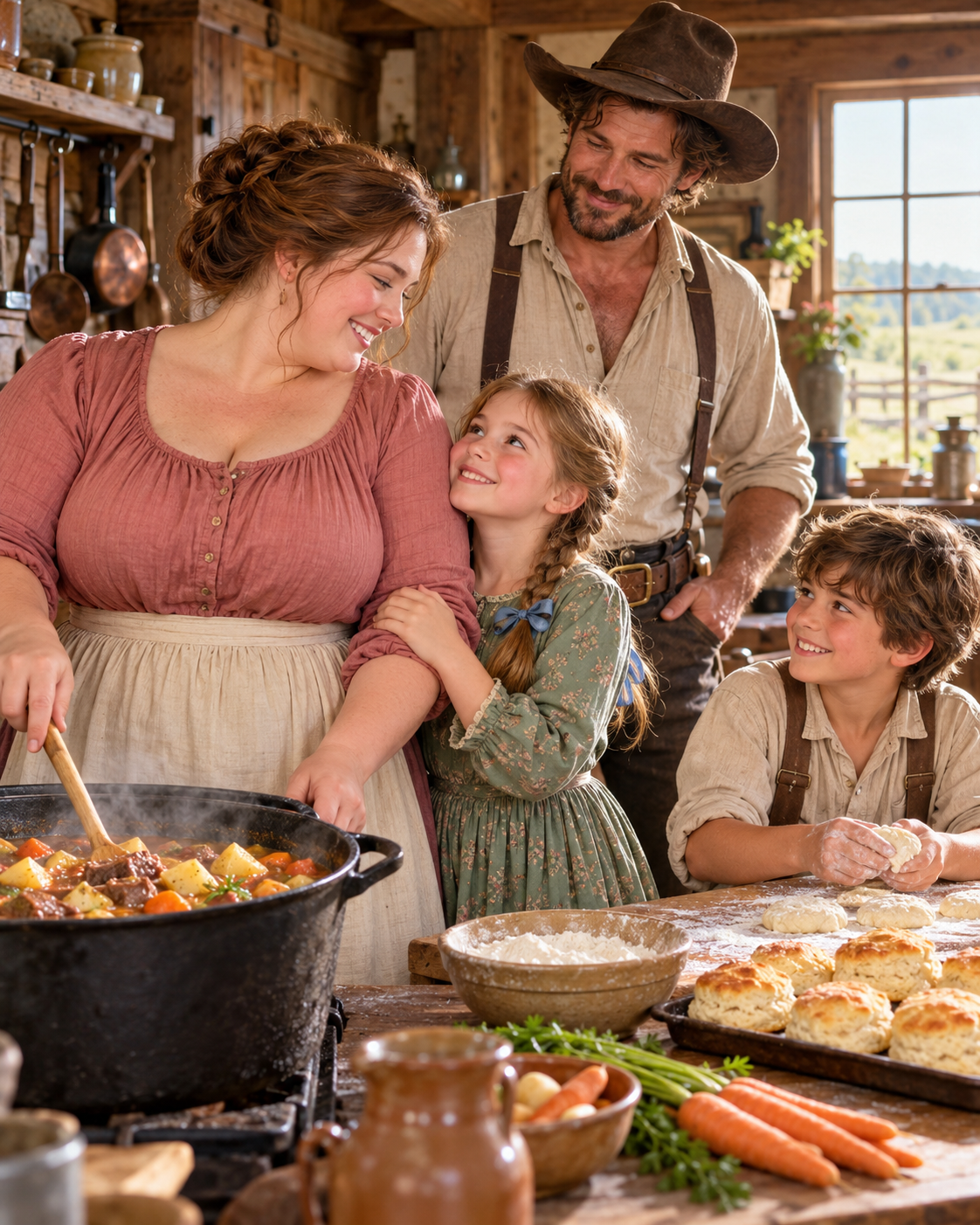
Molly talked through nearly the entire meal. Henry proudly showed me his updated pantry accounts, including the supplies he’d ordered with his father’s help.
Grant told me about a broken fence, a stubborn horse, and a day when he’d burned the biscuits so badly that the ranch hands had jokingly requested Hannah’s immediate return.
For the first time in weeks, I laughed without worrying about what tomorrow might bring.
After the children went to bed, Grant and I sat beside the kitchen stove.
I told him everything.
The storm, the damaged roof, the negotiations, and my aunt’s decision.
He listened with his usual patience.
When I finished, he said, “That must have been difficult.”
“It was.”
“Do you regret it?”
I thought about the empty upstairs rooms and the old furniture that no longer belonged to my family.
“Part of me does.”
He nodded.
“That’s understandable.”
“But she’s safe. She has enough money to live, and she won’t have to carry the whole burden anymore.”
“Then perhaps you didn’t lose the home as completely as you feared.”
I looked at him.
“No,” I said. “Perhaps not.”
He was quiet for a moment.
“Does that mean you’ve decided about my offer?”
I folded my hands.
“Yes.”
He waited.
“I’d like to stay.”
Something in his face eased.
“But there are conditions,” I added.
He straightened.
“I’m listening.”
“I want regular wages, clearly defined duties, and enough time to visit my aunt when she needs me.”
“Agreed.”
“And Henry mustn’t be responsible for managing this house. He can help, but he needs time to be a child.”
Grant smiled faintly.
“I think he’ll object to that.”
“He may.”
“What else?”
I hesitated.
“You must keep doing what you’ve been doing these past few weeks. Sitting with your children. Listening to them. Being their father even when the ranch demands your attention.”
His expression grew serious.
“I intend to.”
I believed him.
Then he surprised me.
“And I have one condition of my own.”
“What is it?”
“If you’re unhappy here, you’ll tell me. You won’t stay simply because the children are attached to you.”
I considered him.
“Agreed.”
We shook hands across the kitchen table.
But when his fingers closed around mine, neither of us withdrew immediately.
The weeks that followed were not perfect.
Winter arrived early, covering the fields in snow and forcing the ranch hands to work long hours protecting the cattle.
Molly caught a cold that kept her in bed for several days. Henry argued fiercely when Grant insisted he attend lessons instead of helping with every ranch chore.
There were disagreements over money, household routines, and the proper amount of cinnamon to put in apple preserves.
But something important had changed.
When Molly was frightened, she spoke.
When Henry was worried, he asked questions.
When Grant felt overwhelmed, he no longer disappeared into work for days at a time.
And when I needed help, I learned to request it instead of quietly doing everything myself.
One evening, shortly before Christmas, I found Henry standing beside the pantry.
The covered food tin was full.
He opened it, took one biscuit, and handed it to Molly, who was sitting on the kitchen floor dressing a rag doll.
Then he took another for himself.
No counting.
No hiding.
No frightened glances toward the doorway.
I watched from the hall, feeling a quiet happiness that seemed almost too delicate to name.
Grant appeared beside me.
“What are you smiling at?”
“Nothing extraordinary.”
He followed my gaze.
Then he understood.
For a while, we stood together without speaking.
Later that night, after the children had gone upstairs, Grant asked me to join him on the porch.
Snow lay across the fields, bright beneath the moonlight.
He leaned against the railing.
“Mary and I used to stand here after the children went to bed,” he said.
I waited.
“For a long time after she died, I couldn’t bear coming outside. Everything reminded me of what I’d lost.”
He looked toward the distant hills.
“Then tonight, I realized I wanted to show you the view.”
My heart began beating faster.
“Grant—”
“I don’t expect you to answer anything tonight.”
He turned toward me.
“But I need to be truthful. You’ve brought warmth back into this house. At first, I thought I was grateful because you were helping the children.”
“And now?”
“Now I find myself looking forward to the sound of your voice when I come through the door.”
I looked down at my hands.
He continued gently.
“I care for you, Hannah. Not because you’re good with the children or because you know how to keep the accounts. I care for you because of the woman you are.”
For a moment, I couldn’t speak.
No one had ever said those words to me quite that way.
I thought of Aunt Ruth’s warning.
Stay because you are wanted for who you are.
Not merely for what you can do.
“I care for you too,” I finally admitted.
Grant reached for my hand.
But I stopped him gently.
“There’s something we need to be careful about.”
He waited.
“Henry and Molly have already lost so much. If anything grows between us, it must happen slowly. They cannot be asked to trust another promise that neither of us fully understands.”
He nodded.
“You’re right.”
“And I need to know that I can remain myself here. Not simply become the person everyone needs me to be.”
He smiled.
“I wouldn’t want anything else.”
We stood quietly beneath the winter sky.
Then he offered his arm, and I took it.
Nothing more was promised that night.
But something honest had begun.
Through the winter and into spring, our affection grew gradually.
There were walks after supper, conversations beside the stove, and moments of shared laughter when the children were asleep.
Grant never asked me to replace Mary.
I never tried.
Her photographs remained on the mantel. Her favorite flowers grew beside the porch. Her children were encouraged to remember her without worrying that their memories would hurt anyone.
One afternoon, Molly asked whether liking me meant she was forgetting her mother.
I sat beside her on the porch steps.
“Do you think you have to stop loving one person to care about another?”
She considered that.
“No.”
“Neither do I.”
She leaned against my shoulder.
“I think Mama would like you.”
My eyes filled.
“I hope so, sweetheart.”
Henry’s acceptance came differently.
One spring morning, he handed me a new pantry ledger.
On the first page, he had written the names of everyone in the household.
Grant Dalton.
Henry Dalton.
Molly Dalton.
Hannah Pierce.
I traced my name with one finger.
“Why did you write me here?”
He shrugged.
“Because you live here.”
I smiled.
“That’s a good reason.”
He hesitated.
“Even if you and Pa don’t get married, you’ll still be our friend, won’t you?”
I looked at him carefully.
“Always, Henry. Though sometimes friendship means people live in different places.”
He nodded.
“I know.”
Then he closed the ledger.
“That’s all right. I just wanted to make sure you knew you could tell us the truth.”
I had to turn away for a moment.
Because I realized that the frightened boy who once hid biscuits beneath his shirt had learned something far more valuable than household accounting.
He had learned that love didn’t have to depend on fear.
That summer, Aunt Ruth visited High Meadow for the first time.
She arrived carrying two jars of homemade preserves, a new apron for me, and enough opinions about the kitchen to keep everyone entertained for a week.
Molly adored her immediately.
Henry challenged her to a game of checkers and lost three times before declaring that she must have practiced for fifty years.
Grant treated her with such quiet respect that I caught her watching him thoughtfully across the dinner table.
On her final evening, she found me hanging laundry behind the house.
“You look happy,” she said.
“I am.”
“Not just busy?”
I smiled.
“Happy.”
She helped me fold a sheet.
“And does he understand that?”
“I believe so.”
She studied me for a moment.
“Then perhaps you’ve finally found somewhere you can give love without having to earn your place every morning.”
I looked toward the ranch house.
Grant was teaching Henry how to repair a loose gate. Molly sat nearby, offering advice nobody had requested.
The scene wasn’t remarkable.
That was what made it beautiful.
A few months later, Grant asked me to marry him.
He did it without an audience, without a grand speech, and without pretending that marriage would erase the difficult years behind us.
We were standing in the kitchen after supper.
He had just finished drying the last plate.
“Hannah,” he said, “I’ve been thinking about the future.”
“That sounds dangerous.”
He smiled.
“I suppose it might be.”
Then he took my hands.
“I loved Mary, and part of me always will. I know you understand that.”
“I do.”
“But I also know my life didn’t end when hers did. And I don’t want to spend the rest of it pretending I haven’t been given another chance at happiness.”
My throat tightened.
“I want a life with you,” he said. “Not because this house needs someone to run it. Not because the children need someone to look after them. Because when something good happens, you’re the first person I want to tell.”
He paused.
“And when something goes wrong, you’re the person I want beside me while we work through it.”
Tears blurred my eyes.
“Will you marry me?”
I thought about the woman who had arrived at High Meadow with one suitcase, eight weeks of employment, and no certainty about tomorrow.
I thought about Henry’s frightened whisper in the pantry.
Molly’s blue ribbon.
Aunt Ruth’s brave decision to let go of a house she could no longer carry.
And Grant, who had learned that being strong didn’t mean facing every sorrow alone.
“Yes,” I whispered.
Then I laughed through my tears.
“Yes, Grant. I will.”
We married the following spring in a small ceremony near the ranch.
Aunt Ruth stood beside me. Henry carried the rings with such solemn importance that he checked his pocket six times before the ceremony began.
Molly scattered flowers along the path, then insisted on gathering some of them afterward because they were too pretty to waste.
There were no extravagant decorations.
No expensive gifts.
Just family, friends, good food, and a happiness that had taken time to become possible.
That evening, after the guests departed, I found Henry in the pantry.
For one brief moment, the sight carried me back to that first frightened night.
But he wasn’t hiding food.
He was arranging a plate of leftover wedding biscuits.
“What are you doing?” I asked.
“Saving some for tomorrow.”
I raised an eyebrow.
“Are we running short?”
He grinned.
“No, ma’am.”
“Then why?”
“Because Molly likes them. And Pa said we could have the leftovers for breakfast.”
I leaned against the doorway.
“Very sensible.”
He looked at me for a moment.
“I’m glad you stayed.”
I put my arm around his shoulders.
“So am I.”
Then he said something I would remember for the rest of my life.
“You know what I like best?”
“What?”
“I don’t have to worry all the time anymore.”
I kissed his forehead.
“That makes two of us.”
Years later, people sometimes asked me how I had managed to change the Dalton household.
They expected stories about hard work, strict routines, or some remarkable talent for understanding children.
But I never believed I had performed a miracle.
I had simply listened to a frightened boy instead of punishing him.
I had treated a grieving little girl as someone whose feelings mattered.
And I had reminded a tired father that his children needed his presence more than his perfection.
In return, they taught me something I had spent thirty years struggling to understand.
A person doesn’t have to exhaust herself proving she’s useful in order to deserve love.
A home is not a place where nothing ever goes wrong.
It is a place where mistakes can be admitted, difficult truths can be spoken, and nobody has to hide a biscuit because they’re afraid there won’t be enough tomorrow.
High Meadow still had harsh winters, broken fences, unpaid bills, and ordinary family disagreements.
Aunt Ruth still had days when she missed her old boarding house.
Grant still carried memories of Mary.
And Henry and Molly would always have moments when grief returned unexpectedly.
But we no longer treated those things as failures.
We faced them together.
And every evening, before I closed the kitchen for the night, I made sure the covered tin on the table was filled with something good.
Not because anyone was frightened of going hungry.
But because I wanted the children to grow up knowing that comfort should never have to be stolen.
Sometimes the greatest change in a person’s life doesn’t begin with a grand promise or an extraordinary act of courage.
Sometimes it begins when someone looks at a frightened child holding three stolen biscuits and chooses kindness over punishment.
And sometimes, if we’re fortunate, that single choice becomes the beginning of a home where everyone finally learns they belong.
THE END.