The first time Arthur Blackthorne heard his wife laugh in five years, it was because another woman had said something he found amusing.
Arthur turned toward Anna so sharply that the young woman took an involuntary step backward.
For a moment, the only sound in the drawing room was the rain striking the tall windows.
“What did you say?”
Anna clasped her hands before her. She was pale, but she did not look away.
“I believe Her Grace deserves to know.”
Arthur’s expression hardened.
“You are forgetting your position, Miss Anna.”
“Perhaps,” she answered. “But I remember yours.”
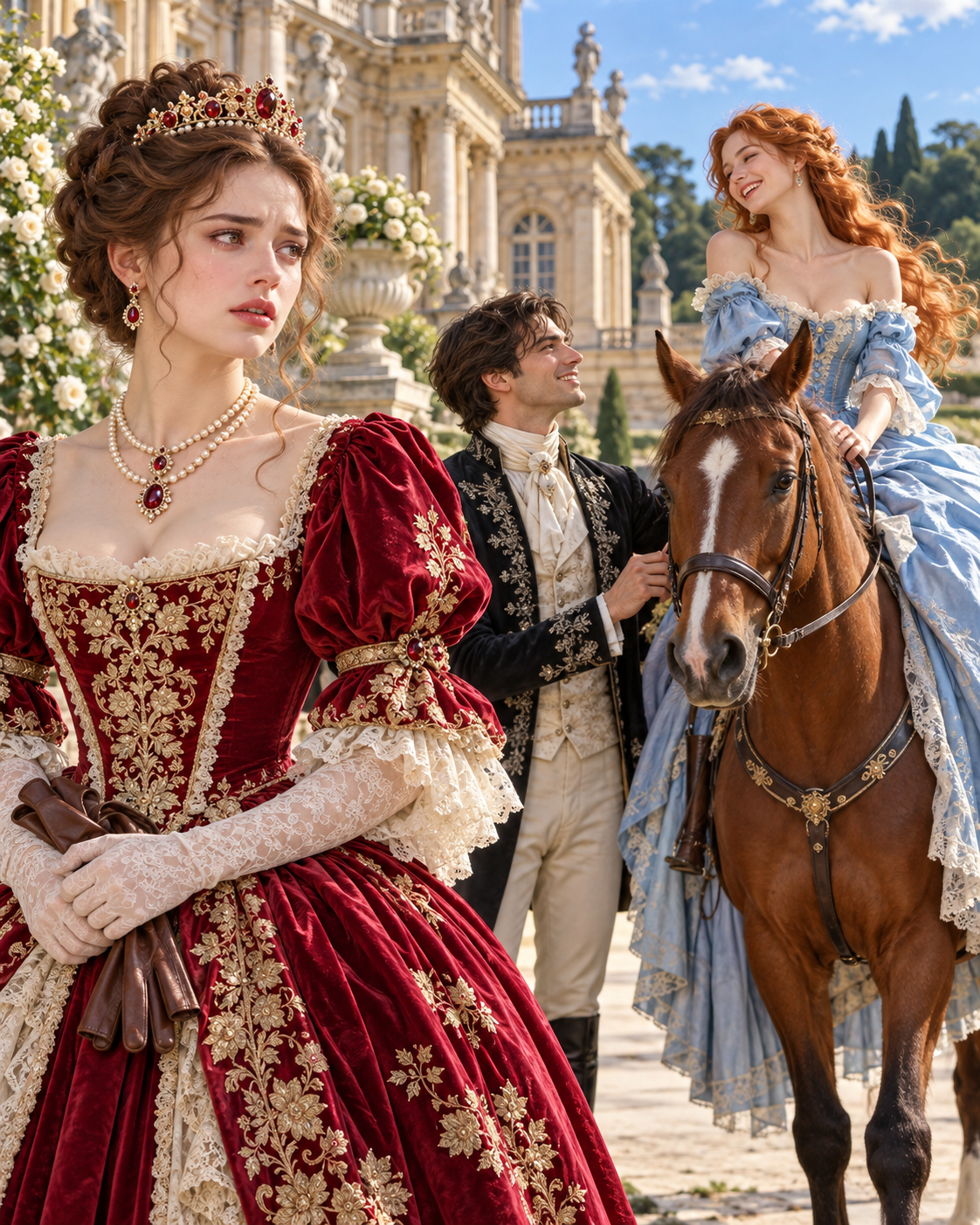
Eleanor remained beside the open door, her fingers resting against the polished wood. She had expected humiliation, anger, perhaps another cold lecture about the responsibilities of a duchess.
She had not expected to see her husband afraid of a twenty-three-year-old tutor.
“Anna,” Eleanor said gently, “what exactly did my husband ask of you?”
The young woman looked toward Arthur.
He shook his head once.
It was a small movement, almost imperceptible. But Eleanor had spent five years learning the language of her husband’s silences.
She recognized a warning.
Anna recognized it too.
“When His Lordship offered me this position,” she began, “he said the household needed a little life returned to it.”
Arthur moved toward her.
“That is enough.”
“He asked whether I enjoyed music, reading, political discussion. Whether I was comfortable speaking before gentlemen.”
Eleanor’s hand slipped from the doorframe.
Anna continued, her voice trembling slightly.
“He told me you had once possessed all those qualities.”
Arthur’s face had grown dangerously still.
“And that,” Anna added, “he hoped my presence might remind you of the woman you used to be.”
The words settled between them.
Eleanor looked at her husband.
For years, she had believed that her quietness disappointed him because she had somehow failed to become the wife he wanted.
Now she understood something far more unsettling.
Arthur knew exactly what he had taken from her.
And instead of admitting it, he had brought another woman into their home to demonstrate what was missing.
“How thoughtful of you,” Eleanor said.
There was no bitterness in her voice.
Somehow, that made Arthur look more uncomfortable.
“Eleanor, you are twisting an innocent arrangement into something unpleasant.”
“Then tell me what it was.”
“I wished to see you happy again.”
She studied him for a long moment.
“You wished to see me behave differently.”
“Is there a distinction?”
“Yes,” she replied. “A rather important one.”
Arthur looked toward Anna.
“You may leave us.”
Anna hesitated.
Eleanor gave her a reassuring nod.
The young tutor curtsied and moved toward the door, but as she passed Eleanor, she stopped.
“I am sorry, Your Grace.”
Eleanor touched her sleeve.
“You have nothing to apologize for.”
Anna’s eyes shone with unshed tears.
“I did not understand why he was so interested in the things you once loved.”
Eleanor’s expression softened.
“Neither did I.”
When Anna disappeared into the corridor, Arthur crossed to the mantelpiece and poured himself another drink.
His hand was not quite steady.
“You have made a spectacle of us both.”
Eleanor watched the amber liquid rise in his glass.
“Only because you insisted on having an audience.”
He set the decanter down harder than necessary.
“Must everything become an accusation?”
“No, Arthur. Some things are simply questions you dislike answering.”
He turned toward her.
“You have no idea what it means to carry a name like Blackthorne. Every dinner, every conversation, every careless remark has consequences. I have spent my career protecting this family.”
“And I spent five years protecting you from the embarrassment of having a wife who thought for herself.”
“That is unfair.”
“Is it?”
Her voice remained quiet.
Arthur looked away first.
Outside, the rain had begun to ease. Water fell from the stone balustrade in slow, uneven drops.
“I married you because you were extraordinary,” he said at last.
Eleanor felt something tighten beneath her ribs.
She had waited years to hear him say those words again.
“And then,” she replied, “you spent our marriage asking me to be ordinary.”
He did not answer.
She took one final look at the ruby pendant resting on the mantelpiece.
Then she left the room.
Arthur did not follow.
The following morning, Blackthorne House awakened beneath a pale, cloudless sky.
Eleanor was already dressed when her maid entered with the breakfast tray.
Mrs. Whitcomb, who had served the household since before Eleanor’s marriage, stopped just inside the doorway.
“Your Grace?”
Eleanor stood before the wardrobe, examining a collection of gowns arranged by color.
Pearl gray. Dove blue. Muted lavender. Cream.
Every dress had been selected with Arthur’s approval.
“Mrs. Whitcomb,” she asked, “what became of my green riding habit?”
The older woman blinked.
“The emerald one, Your Grace?”
“Yes.”
“I believe it was packed away after your first year of marriage.”
“Would you find it for me?”
Mrs. Whitcomb hesitated.
“His Lordship thought the color rather unsuitable.”
Eleanor turned toward her.
“I remember.”
For a moment, neither woman moved.
Then the maid’s mouth softened into the faintest smile.
“Of course, Your Grace.”
By eleven o’clock, Eleanor was riding across the northern meadow.
The green habit was slightly tight at the shoulders, and the old leather gloves had stiffened with disuse.
She scarcely noticed.
The autumn air stung her cheeks. Her horse’s hooves struck the damp earth, scattering beads of water from the grass.
She had forgotten how the wind sounded when she moved quickly enough to hear nothing else.
At the far end of the meadow, she slowed beneath a line of beech trees.
The estate stretched before her, beautiful and carefully maintained.
Five years ago, she had believed those fields would become the landscape of a happy life.
Now she wondered how much of that life she had surrendered without noticing the cost.
When she returned, Arthur was waiting near the stables.
His gaze traveled from her flushed cheeks to the green riding habit.
“I thought you had given up riding.”
“I had.”
“Then why begin again?”
Eleanor handed the reins to the groom.
“Because I remembered that I enjoyed it.”
Arthur looked toward the servants, who were doing their best not to listen.
“Could we speak somewhere private?”
She removed one glove.
“If you wish.”
They walked toward the conservatory, where the morning sun filtered through broad panes of glass.
For several minutes, Arthur said nothing.
Then he stopped beside a marble fountain.
“I have considered what you said last evening.”
Eleanor waited.
“I may have been too severe on certain occasions.”
The admission was so carefully phrased that she almost smiled.
“Certain occasions?”
Arthur exhaled.
“I am trying to meet you halfway.”
“Halfway to where?”
“To an understanding.”
“And what would that understanding require of me?”
He looked irritated.
“Must you examine every word?”
“Only the ones that concern my life.”
Arthur rubbed a hand across his forehead.
“I want things to return to the way they were.”
Eleanor looked through the glass toward the garden.
“Which year, Arthur?”
He frowned.
“What?”
“Before our marriage, when you admired my opinions? Or afterward, when you asked me not to express them?”
He drew a slow breath.
“I loved you then.”
She turned toward him.
“And now?”
The question seemed to surprise him.
“Of course I love you.”
Eleanor watched his face.
It was strange how easily he could say the words, and how difficult it had become for her to believe them.
“Then perhaps,” she said, “you should discover what that means when I am not being agreeable.”
She walked past him, leaving Arthur alone among the white roses.
That afternoon, a letter arrived from Lady Margaret Pembroke.
The invitation was written on thick ivory paper, requesting Eleanor’s presence at a gathering for the Society for the Education of Women.
Eleanor read it twice.
Three years earlier, Lady Margaret had invited her to join the society’s committee.
Arthur had dismissed the proposal.
“A duchess has charitable obligations, Eleanor, not political ambitions.”
She had declined.
Now, beneath Lady Margaret’s elegant signature, a handwritten note had been added.
I have never forgotten what you said at my dinner table. Neither have several of the women who heard you.
Eleanor held the letter against her palm.
She remembered that evening.
A gentleman had argued that educating poor girls beyond basic literacy was a waste of resources.
Eleanor had disagreed.
She had spoken about the women employed in her father’s household, the intelligence she had witnessed in them, and the opportunities denied to them.
The discussion had been lively.
Until Arthur’s expression changed.
That evening had marked the beginning of her careful silence.
She sat at her writing desk and took out a fresh sheet of paper.
For the first time in years, she accepted an invitation without asking her husband.
Arthur discovered her decision at dinner.
“You intend to attend Lady Pembroke’s gathering?”
“Yes.”
“I thought we had settled that matter.”
“We did. Three years ago.”
“Eleanor, you know how these organizations attract controversy.”
She cut a small piece of roasted pheasant.
“Then I shall have something interesting to discuss afterward.”
Arthur stared at her.
Across the table, Anna lowered her eyes to conceal an unexpected smile.
The following Thursday, Eleanor entered Lady Pembroke’s drawing room wearing a deep blue gown she had chosen herself.
Conversation slowed as she appeared.
Several ladies approached with polite greetings, but Lady Margaret crossed the room without waiting for ceremony.
“My dear Eleanor.”
She took both her hands.
“I had begun to think we had lost you.”
Eleanor returned the older woman’s warm smile.
“So had I.”
During the first hour, she listened.
The women spoke of schools without sufficient books, young girls dismissed from apprenticeships, and widows unable to manage property they had inherited.
Eleanor asked questions.
Then she offered an opinion.
No one interrupted her.
No one glanced at her husband.
By the time the meeting ended, Lady Margaret had asked her to assist with a proposal for a new school.
Eleanor left carrying several documents and a feeling she could scarcely name.
It was not triumph.
It was the unfamiliar comfort of having occupied an entire afternoon without making herself smaller.
But her return to Blackthorne House brought an unexpected development.
Arthur was waiting in his study.
Beside him stood his political secretary, Mr. Harcourt, a thin, solemn man who always appeared to be calculating the consequences of ordinary conversation.
Arthur dismissed him as Eleanor entered.
“Close the door.”
She did.
He was holding a newspaper.
“Did you speak at Lady Pembroke’s meeting?”
“Yes.”
“About the proposed education bill?”
“Among other things.”
Arthur placed the newspaper on his desk.
“My colleagues are already discussing it.”
Eleanor glanced at the printed page.
An article had appeared describing the society’s efforts, including a brief reference to the Duchess of Blackthorne’s support.
“You have become involved in a matter currently before Parliament,” Arthur said.
“I am aware.”
“And you did not think to consult me?”
She placed her gloves on a chair.
“I did not know my concern for children’s education required parliamentary permission.”
“That is not the point.”
“Then tell me what the point is.”
Arthur moved around the desk.
“I have spent months negotiating support for a different proposal. Several of the gentlemen whose votes I require oppose the very society you have joined.”
Eleanor regarded him steadily.
“Do you oppose it?”
He hesitated.
“It is more complicated than that.”
“Is it?”
“Politics requires compromise.”
“So does marriage,” Eleanor replied. “But one cannot be the only person making it.”
Arthur’s face darkened.
“You are deliberately jeopardizing my work.”
“No. I am doing something that matters to me.”
“And that matters more than my reputation?”
Eleanor looked at the newspaper.
There it was.
Not concern for her well-being.
Not fear that she might be hurt by public criticism.
His reputation.
She folded her gloves carefully.
“I shall not withdraw from the society.”
Arthur’s voice became very quiet.
“Then you leave me no choice.”
Something in his expression made her pause.
“What choice?”
He opened a drawer and removed a folded document bearing the Blackthorne seal.
“I have already written to Lady Pembroke.”
Eleanor stared at the paper.
“What have you done?”
“I explained that recent domestic circumstances make your continued participation impossible.”
For several seconds, she heard nothing but the small ticking clock on his desk.
Then she reached for the letter.
Arthur held it back.
“It has not yet been sent.”
“Give it to me.”
“Eleanor—”
“Give me the letter.”
The sharpness of her voice startled them both.
Arthur slowly placed the document in her hand.
She unfolded it.
The words were precise, courteous, and devastating.
It regretted her inability to continue.
It promised a generous donation in compensation.
And at the bottom, beneath Arthur’s signature, appeared a sentence that made her fingers turn cold.
The Duchess herself has expressed her wish to avoid further public involvement.
Eleanor raised her eyes.
“You wrote in my name.”
“I acted in your interests.”
“You lied.”
Arthur flinched.
“I protected you.”
She looked at him for a long moment.
Then she tore the letter in half.
Arthur took a step forward.
“Eleanor!”
She tore it again.
Four pieces fell onto his desk.
“I will not allow you to speak for me when I am perfectly capable of speaking for myself.”
His face flushed.
“You forget that I am your husband.”
“No,” Eleanor replied. “That is precisely what makes this so difficult.”
She left before he could answer.
That night, Arthur did not come to her room.
For the first time in many months, Eleanor was relieved.
Over the following weeks, the household changed in ways too quiet for outsiders to notice.
Eleanor began taking breakfast in the morning room, where sunlight reached the table before nine.
She resumed her correspondence with old friends.
She asked the housekeeper to reopen the small library adjoining her sitting room.
Arthur had once suggested converting it into a private reception chamber.
Now its shelves were dusted, its windows opened, and the books she had collected before her marriage were returned to their places.
Anna often joined her in the afternoons.
At first, their conversations were cautious.
Eleanor knew the young woman’s position was delicate.
Arthur paid her salary, and the incident in the drawing room had already placed her employment in danger.
One rainy afternoon, Anna arrived carrying a stack of exercise books.
“Your Grace, may I ask something?”
Eleanor looked up from a letter.
“Certainly.”
“Why did you allow him to change you?”
The question was so direct that Eleanor almost laughed.
Anna immediately reddened.
“Forgive me. That was impertinent.”
“No,” Eleanor said. “It was honest.”
She set down her pen.
“I thought love meant learning to make someone else comfortable.”
Anna considered this.
“And now?”
Eleanor looked toward the rain-darkened garden.
“Now I think love should leave room for two people to breathe.”
Anna sat silently for a moment.
Then she reached for the nearest book.
“Lady Pembroke’s school will need teachers.”
Eleanor glanced at her.
“Yes.”
“I should like to be considered.”
Eleanor smiled.
“I think you would be excellent.”
The young woman’s face brightened.
It was the first time Eleanor had seen her enthusiasm without Arthur standing nearby to admire it.
Something about that distinction mattered.
By early November, the proposed school had attracted several patrons.
Lady Margaret invited Eleanor to speak at a small gathering intended to secure the remaining funds.
Arthur learned of the invitation three days before the event.
He entered Eleanor’s library without knocking.
“You cannot be serious.”
She looked up from her notes.
“About which matter?”
“Addressing a room full of people.”
“Most of them have heard speeches before, Arthur.”
“This is not amusing.”
“I did not intend it to be.”
He closed the door.
For a moment, he seemed almost weary.
“Eleanor, I am asking you not to do this.”
She waited.
“Not as a politician. As your husband.”
That gave her pause.
Arthur moved closer.
“I know I have made mistakes.”
The words came slowly.
“I have been demanding. I have expected too much. Perhaps I forgot that you were not born into the life I lead.”
Eleanor watched him.
It was the nearest he had come to an apology.
“I am listening,” she said.
He took her hand.
For an instant, she remembered the young man who had courted her beneath the chestnut trees at her father’s estate.
His warmth. His earnestness. The way he had once kissed her ink-stained fingers and laughed.
“I want us to begin again,” Arthur said.
Eleanor’s eyes softened.
Then he added, “But you must understand that my career cannot survive another public embarrassment.”
Her hand grew still inside his.
There it was again.
The condition hidden beneath the tenderness.
She withdrew her fingers.
“I shall give the speech.”
Arthur looked at her as though a door had closed in his face.
“Then I have nothing more to say.”
Eleanor returned to her notes.
For once, his silence did not frighten her.
The evening of the gathering arrived beneath a cold November sky.
Lady Pembroke’s townhouse glowed with candlelight, its entrance crowded with carriages and footmen.
Eleanor stood before the mirror in her dressing room, fastening a pair of pearl earrings.
Mrs. Whitcomb adjusted the folds of her gown.
It was dark green.
Not modest gray. Not obedient lavender.
Green.
The maid stepped back.
“You look very much like you did when you first came here, Your Grace.”
Eleanor met her eyes in the mirror.
“Do I?”
Mrs. Whitcomb smiled.
“No, my lady. I believe you look happier.”
When Eleanor descended the staircase, Arthur was waiting in the hall.
He wore evening dress and carried his gloves in one hand.
She stopped.
“I did not know you intended to accompany me.”
“I did not intend to.”
His expression was difficult to read.
“But I have reconsidered.”
They traveled in silence.
At Lady Pembroke’s house, Eleanor was greeted warmly.
Arthur remained at her side, exchanging pleasantries with several gentlemen whose political support he valued.
For an hour, everything appeared perfectly ordinary.
Then Lady Margaret announced Eleanor’s speech.
Arthur turned toward her.
“You might still decline.”
Eleanor looked at the assembled guests.
“I know.”
She walked forward.
The room quieted.
At first, her fingers trembled against the pages she carried.
She could feel Arthur watching from beside the fireplace.
Five years of habit urged her to lower her voice, shorten her remarks, and return to her seat before anyone could object.
Instead, she placed her notes on the lectern.
She began with a story.
Not a grand argument or a political declaration.
A simple account of a young servant she had known as a girl, a woman who could memorize entire letters after hearing them read aloud but had never been taught to write her own name.
She spoke of ability mistaken for ignorance.
Of lives narrowed not by lack of intelligence but by lack of opportunity.
As she continued, the nervousness left her voice.
She did not become louder.
She became clearer.
Across the room, Anna stood beside Lady Margaret, listening with shining eyes.
Eleanor noticed her and continued.
When she finished, there was a moment of complete silence.
Then applause began.
Not polite, scattered clapping.
Real applause.
Lady Margaret rose first.
Others followed.
Eleanor stood motionless, looking out over the room.
For one brief, extraordinary instant, she felt like the young woman Arthur had once loved.
Then she understood that she had never truly stopped being that woman.
She had simply stopped allowing anyone to see her.
Arthur approached after the gathering.
His expression was unreadable.
“Your speech was well received.”
“Thank you.”
He glanced toward the guests.
“Lord Pembroke has offered his support for the school.”
Eleanor smiled.
“That is wonderful.”
Arthur hesitated.
“Several gentlemen have also spoken favorably of your remarks.”
She watched him carefully.
“Does that surprise you?”
He looked away.
“I had not expected quite such a reception.”
Eleanor understood.
He had feared her voice when he believed it might diminish him.
Now that it brought admiration, he was prepared to welcome it.
The realization did not wound her as deeply as she expected.
Instead, it made something unmistakably clear.
His approval had never been a reliable measure of her worth.
On the carriage ride home, Arthur reached for her hand.
“You were remarkable tonight.”
She looked at their joined fingers.
“Thank you.”
“I should like you to attend more gatherings with me.”
Eleanor turned toward him.
“Gatherings of my choosing?”
He paused.
“Within reason.”
She gently withdrew her hand.
Arthur leaned back against the carriage seat.
“Must you always make things difficult?”
Eleanor looked through the window.
The streets were nearly empty, the lamps casting pale circles over the wet stones.
“No,” she said. “I think I have made things much too easy.”
When they reached Blackthorne House, she went directly upstairs.
Arthur followed.
“Eleanor, we cannot continue like this.”
She stopped outside her sitting room.
“No. We cannot.”
He studied her expression.
“What are you saying?”
She opened the door.
“I am going to stay with my aunt in Bath for a while.”
Arthur went still.
“For how long?”
“I don’t know.”
“That is absurd.”
“Perhaps.”
“You are my wife.”
Eleanor turned to face him.
“I have not forgotten.”
“Then you know how such an arrangement will appear.”
She looked at him with quiet sadness.
“Arthur, even now, you are asking how my leaving will look. You have not once asked what would make me wish to stay.”
His lips parted.
No answer came.
Eleanor entered her room and gently closed the door.
Three days later, she departed for Bath.
Arthur did not come to the carriage.
But shortly before it left, Mrs. Whitcomb appeared carrying a small velvet box.
“His Lordship asked me to give you this.”
Inside lay the ruby pendant.
Eleanor studied it for a moment.
Then she closed the lid.
“Please tell him I received it.”
She did not put it on.
The weeks in Bath passed slowly.
Her aunt’s house stood on a quiet crescent overlooking a row of bare winter trees.
There were morning walks, books left open beside the fire, and evenings when Eleanor played the pianoforte badly and without apology.
She wrote frequently to Lady Margaret.
The school was progressing.
Anna had accepted a teaching position.
Several new patrons had offered assistance.
Eleanor began helping with the curriculum from afar, sending lists of books and suggestions for lessons.
For the first time in years, her days belonged to her.
Arthur wrote after ten days.
His first letter was formal.
He hoped her health had improved.
The household was functioning adequately.
He trusted she would return before the Christmas engagements.
Eleanor read it and placed it in a drawer.
A second letter arrived a week later.
This one contained a brief account of his parliamentary work, a mention of the garden, and a question about whether she needed anything.
She replied courteously.
Then, shortly before Christmas, a third letter came.
The handwriting was less careful.
Eleanor opened it beside the window.
My dear Eleanor,
I went into your library yesterday.
I had not realized how many books you had brought into our home, nor how many remained unopened after our marriage.
I found a volume of poetry with your notes in the margins.
There was a passage you had marked about the difference between being alone and being unheard.
I remembered asking you not to write in the books because it made them untidy.
It is an insignificant memory, but I have been unable to dismiss it.
I thought I was teaching you how to live in my world.
I did not consider that I was making yours smaller.
I cannot ask you to forget what I have done.
I would like, if you permit it, to understand.
Arthur.
Eleanor read the letter twice.
Then she folded it and placed it beside the others.
She did not immediately return.
An apology, she had learned, was not the same thing as change.
January brought snow.
One morning, a letter arrived from Anna.
The school had opened its first classrooms.
Twenty-seven girls attended.
Several were daughters of servants, and one had walked nearly four miles through the frost to receive her lessons.
At the bottom of the page, Anna had written:
Your Grace, I think you should see what your courage has helped begin.
Eleanor traveled to the school the following week.
It occupied a modest brick building at the edge of a market town.
The rooms smelled of fresh wood, coal smoke, and ink.
Children sat at narrow desks, their heads bent over slates.
Anna greeted her at the entrance.
“You came.”
“Of course.”
They walked together through the classrooms.
In the final room, a little girl with untidy brown curls stood to recite a passage from a book.
She stumbled over a word.
A few children giggled.
The girl flushed and looked toward Anna.
“May I try again, miss?”
Anna smiled.
“As many times as you need.”
Eleanor stood beside the doorway, watching.
There was no punishment for speaking imperfectly.
No impatience.
No command to remain silent.
Only the patient expectation that a voice, once given room, might grow stronger.
Later, as Eleanor prepared to leave, Anna handed her a folded sheet of paper.
“One of the girls made this for you.”
It was a drawing of the school.
The windows were crooked, the roof too large, and the people appeared as little more than circles with smiling faces.
Beneath it, in carefully formed letters, the child had written:
Thank you for helping us learn.
Eleanor held the drawing for a long time.
She had spent years wondering whether anything meaningful remained of the woman she used to be.
Here was an answer, written in an uncertain child’s hand.
When she returned to Bath, Arthur was waiting in her aunt’s drawing room.
He rose as she entered.
For a moment, neither spoke.
He looked older.
Not dramatically so, but there were new lines beside his mouth, and he seemed less certain of what to do with his hands.
“I hope you do not mind my coming,” he said.
Eleanor removed her gloves.
“I would have preferred a letter first.”
“You are right.”
The admission surprised her.
He glanced toward the chair opposite him.
“May I sit?”
She nodded.
They spoke for nearly an hour.
Not about society.
Not about appearances.
For the first time in years, Arthur asked questions and listened without immediately correcting her answers.
He asked about the school.
About the books she was reading.
About the people she had met.
At last, he looked down at his hands.
“I have been trying to understand how I became the man you describe.”
Eleanor remained silent.
“My father believed affection made a husband weak. He thought a respectable household should reflect one person’s judgment.”
Arthur paused.
“I used to despise that about him.”
He gave a faint, unhappy smile.
“And then I began speaking to you in his voice.”
Eleanor looked toward the window.
Snow rested along the iron railing outside.
“Understanding why you hurt someone does not undo the hurt, Arthur.”
“I know.”
“Nor does loving them.”
He nodded slowly.
“I know that now.”
She studied him.
For the first time, he seemed willing to remain uncomfortable without demanding that she rescue him from the feeling.
“What do you want from me?” she asked.
Arthur drew a breath.
“I want you to come home.”
Her eyes lowered.
“Why?”
He considered the question.
Then he answered.
“Because I miss you.”
Eleanor’s expression softened, but she did not speak.
“And because,” he continued, “I would like the chance to know the woman you have become. Even if she no longer wishes to be the woman I married.”
Eleanor sat very still.
The temptation to believe him was almost painful.
Once, she would have returned for those words alone.
But she had learned that hope required something firmer than beautiful intentions.
“If I come back,” she said, “I will continue working with the school. I will speak when I have something to say. I will ride, travel, read, and see my friends without waiting for permission.”
Arthur listened.
“And if I disagree with you,” she continued, “you will not treat disagreement as disobedience.”
He nodded.
“I understand.”
“No, Arthur. You may understand the words. I need to know whether you can live with them.”
He looked at her for a long moment.
Then he said something she had never heard him say before.
“I don’t know whether I can do it perfectly.”
Eleanor waited.
“But I am prepared to learn.”
She looked down at the child’s drawing lying on the table beside her.
A crooked schoolhouse.
A row of smiling faces.
A little girl who had asked to try again.
Eleanor finally spoke.
“I am not ready to return.”
Arthur’s face fell, but he made no protest.
“I see.”
“Perhaps one day,” she said. “But not because you have asked, or because society expects it.”
He nodded.
“Then I shall not press you.”
He rose to leave.
At the doorway, Eleanor called his name.
“Arthur.”
He turned.
“I did love you.”
His expression changed.
“I know.”
“No,” she said softly. “I don’t think you ever understood how much.”
He lowered his eyes.
Then he left.
Spring arrived with pale blossoms along the streets of Bath.
Eleanor remained with her aunt, dividing her time between the school and her growing work with Lady Margaret’s society.
Arthur continued writing.
His letters changed gradually.
He stopped asking when she would return.
Instead, he told her about the efforts he was making to support the school, the parliamentary discussions he had reconsidered, and the occasions when he had caught himself speaking too sharply to someone who disagreed.
Sometimes he failed.
Once, he wrote that he had publicly corrected a colleague so harshly that the man had left the room.
He had apologized the following morning.
Eleanor appreciated the honesty more than she would have appreciated a claim of sudden transformation.
They began meeting occasionally.
They walked in public gardens, spoke over tea, and discovered how little they had truly known about each other during their marriage.
There were difficult conversations.
There were moments when Arthur’s old impatience surfaced and Eleanor felt the familiar urge to retreat.
But now she named what troubled her.
And he was learning, slowly, not to punish her for it.
By summer, their relationship had become something neither could easily define.
They remained husband and wife.
They were not yet reconciled.
But they were no longer pretending that silence meant peace.
One afternoon, Arthur visited the school during a small celebration marking its first six months.
The children had prepared readings and songs.
He stood near the back of the classroom, listening as a young girl read aloud from a history book.
When she finished, he applauded with the other guests.
Eleanor watched him from across the room.
Later, he approached her beside the open window.
“She reminds me of you.”
Eleanor looked toward the girl.
“In what way?”
Arthur smiled faintly.
“She appears entirely unafraid of being disagreed with.”
Eleanor laughed.
The sound came naturally, without thought.
Arthur went very still.
For a moment, she saw the young man who had once looked at her across a ballroom as though the entire world had narrowed to the space between them.
But this time, he did not tell her how much he had missed that sound.
He simply smiled and allowed her laughter to belong to her.
In September, Eleanor returned to Blackthorne House.
Not as a surrender.
Not because she believed every wound had healed.
She returned because she wished to see whether they could build something honest from what remained.
The household welcomed her quietly.
Mrs. Whitcomb wept when she saw the green riding habit among the luggage.
Anna, now occupied with her teaching, came to visit whenever she could.
Eleanor’s library remained hers.
Her correspondence continued.
Arthur learned to knock before entering.
Sometimes their disagreements were sharp.
Sometimes Eleanor still felt the weight of old memories pressing against her voice.
And sometimes Arthur failed to listen until she reminded him.
But he no longer expected her silence to make the difficulty disappear.
One evening, nearly a year after the confrontation in the drawing room, Eleanor found the ruby pendant resting on her dressing table.
Arthur stood in the doorway.
“I asked Mrs. Whitcomb to bring it from the safe.”
She lifted the necklace.
“Why?”
He looked almost embarrassed.
“I thought you might wish to have it.”
Eleanor examined the stone.
It was beautiful, deep red beneath the candlelight.
“I used to think this represented the woman you wanted me to be.”
Arthur stepped closer.
“And now?”
She placed it around her neck, fastening the clasp without assistance.
“Now I think it may simply be a beautiful necklace.”
Arthur laughed softly.
“Yes,” he said. “Perhaps it is.”
She turned toward the mirror.
The woman reflected there was not the girl who had married him.
Nor was she the quiet duchess who had spent years measuring every word.
There were new lines around her eyes.
There were disappointments she could not erase.
But there was also a steadiness she had earned for herself.
Arthur came to stand beside her.
“Are you happy, Eleanor?”
She considered the question.
A year earlier, she might have answered according to what she believed he wished to hear.
Now she took her time.
“Not every day.”
He nodded.
“Neither am I.”
She looked at their reflections.
“But I am no longer afraid to tell you when I am not.”
Arthur met her eyes in the mirror.
“Then perhaps,” he said, “we are finally learning how to be married.”
Eleanor smiled, but she did not answer immediately.
Outside, evening sunlight touched the gardens, turning the windows gold.
From somewhere downstairs came the distant sound of servants laughing.
A book lay open on her bedside table.
Her riding gloves rested beside it.
There were letters waiting to be answered, lessons to be planned, and arguments she had not yet made.
Her life was no longer arranged around the preservation of another person’s comfort.
Arthur held out his hand.
“Shall we go down to dinner?”
Eleanor took it.
“Yes,” she said. “But I intend to disagree with you about the education bill.”
He glanced at her.
“I suspected as much.”
“And I have several points to make.”
Arthur opened the door.
“Then I suppose I had better listen.”
She laughed as they walked toward the staircase.
It was a small moment, unremarkable to anyone who might have witnessed it.
But for Eleanor, it meant more than all the grand declarations her husband had once made.
There had been no miraculous return to the beginning.
No promise that love would never wound them again.
They had simply begun to understand that affection without respect could become another kind of captivity.
And forgiveness, when it came, did not require forgetting.
It required truth, responsibility, and the freedom to choose what happened next.
Years later, when the school Eleanor had helped establish opened its fifth classroom, a young student asked why the duchess cared so deeply about teaching girls to speak confidently.
Eleanor considered the question.
Then she smiled.
“Because there was a time when I believed being loved meant becoming easier to love.”
The girl frowned thoughtfully.
“And were you wrong?”
Eleanor looked through the classroom window, where the afternoon light fell across rows of desks filled with books.
“Yes,” she answered. “Very.”
The child waited for her to explain.
Eleanor knelt beside her.
“The people who truly care for you may sometimes disagree with you. They may ask you to reconsider your words, or listen more carefully, or admit when you are mistaken.”
She gently straightened the girl’s crooked collar.
“But they should never require you to disappear.”
The girl thought about this for a moment, then returned to her lessons.
Eleanor remained beside the window.
Outside, Arthur was waiting near the carriage, speaking with Anna about the school’s plans for the coming term.
He looked up and caught his wife’s eye.
He did not gesture for her to hurry.
He simply waited.
Eleanor smiled.
Then she turned back toward the classroom, where a dozen young voices were rising eagerly to answer their teacher’s question.
Some were certain.
Some were hesitant.
Some would be wrong.
But every hand was raised without fear.
And Eleanor understood, at last, that the greatest gift she could offer those children was not a perfect answer, a comfortable future, or even a world that would always welcome their opinions.
It was the conviction that their voices deserved to exist, whether anyone approved of them or not.
She had once mistaken silence for devotion.
Now she knew that love worthy of the name did not ask a person to become less.
It made room for them to become fully themselves.
And this time, Eleanor intended to remain exactly where she belonged.
Not behind her husband.
Not beneath the expectations of society.
But within her own life, with her own voice, and with no need to ask permission to be heard.
THE END.