The first thing Abigail Mercer noticed was that her dead father had apparently paid a debt three months after his funeral.
The key turned once, stopped, and turned again. Abigail stood motionless beside the table, her father’s letter still open beneath her hand. Across from her, Thomas Whitcomb reached into his coat, but she caught his wrist before he could withdraw whatever he was carrying.
“Not yet,” she whispered.
The lock clicked. A narrow blade of hallway light appeared beneath the door, followed by the unmistakable sound of someone testing the handle. Abigail moved toward the fireplace, lifted the iron poker, and positioned herself where the opening door would conceal her.
The handle turned slowly. Then a man’s voice spoke through the wood.
“Mrs. Mercer, I suggest you put down whatever you’re holding. I haven’t come to hurt you.”
Whitcomb closed his eyes. Abigail watched the blood drain from his face.
“Nathaniel,” he breathed.
The name seemed to alter the air inside the room. Abigail tightened her grip on the poker, remembering the portrait that had once hung in Edward’s childhood home. A stern gentleman with silver at his temples, standing beside a hunting horse. Margaret had told her he died of fever in France.
The door opened.
The man who entered was older than the portrait, with a narrow face, a carefully trimmed beard, and eyes that moved across the room without hesitation. He wore an expensive black overcoat, though the cuffs were damp and the hem carried traces of harbor mud.
His gaze settled on Whitcomb.
“You were instructed to remain in Philadelphia.”
Whitcomb straightened. “Your instructions have cost enough people their peace.”
Nathaniel smiled faintly, then turned toward Abigail.
“Your father had your eyes. Unfortunately, he also had your habit of examining matters that ought to be left alone.”
Abigail did not lower the poker.
“You’re standing in my room without permission.”
“And you’re holding documents that belong to my company.”
“According to these documents, your company belongs to me.”
For the first time, his expression changed.
It was slight. A tightening at the corner of his mouth, nothing more. But Abigail had spent years watching powerful people conceal their anger beneath perfect manners.
She recognized the moment immediately.
Nathaniel stepped toward the table. Whitcomb moved between them.
“Careful,” the banker said.
Nathaniel looked almost amused.
“Thomas, you’ve become sentimental.”
“No. Merely tired.”
Abigail slipped the amended trust document beneath the ledger as the two men faced each other. She had already noticed something important. Nathaniel had looked at the envelope before he looked at her. He knew precisely what Whitcomb had brought.
“You forged my signature,” she said.
Nathaniel adjusted one glove.
“Your husband acted on your behalf.”
“My husband had no authority to transfer property I never authorized him to control.”
“Marriage creates certain understandings.”
“Not that one.”
The room fell silent.
Nathaniel’s eyes moved to the window. Below, a carriage wheel scraped against the cobblestones.
“You have until tomorrow evening to return those papers,” he said. “After that, the matter becomes considerably less comfortable.”
He turned toward the door.
Abigail spoke before he reached it.
“Did you kill my father?”
Nathaniel stopped.
For several seconds, he remained facing the hallway.
Then he looked over his shoulder.
“Your father died because he believed he could protect everyone without trusting anyone.”
The door closed behind him.
Whitcomb crossed the room and locked it with shaking hands. Abigail remained beside the fireplace, listening until the carriage departed.
Only then did she place the poker down.
“He didn’t answer,” she said.
Whitcomb stared at the closed door.
“No,” he replied. “He didn’t.”
By morning, Abigail had made three copies of every document in her possession. One remained hidden beneath a loose floorboard. Another went into a sealed packet addressed to a solicitor whose name Whitcomb had provided. The third she carried herself through the rain to a small accounting office near Baltimore’s commercial district.
The brass plate outside read HENRY CALDWELL, ATTORNEY AT LAW.
Inside, shelves of legal volumes rose toward a ceiling stained by years of coal smoke. A young clerk attempted to explain that Mr. Caldwell was occupied, but Abigail placed the forged amendment on his desk.
“Tell him this concerns the unlawful transfer of a substantial estate.”
The clerk glanced at the figures.
He disappeared immediately.
Caldwell was a broad-shouldered man in his forties, with tired eyes and ink stains on his fingers. He examined the documents without interrupting her, occasionally turning a page backward to compare dates.
When she finished, he removed his spectacles.
“Mrs. Mercer, do you understand what you’re alleging?”
“Yes.”
“Against your husband, his mother, and a gentleman whose financial interests extend through several states?”
“Yes.”
He leaned back.
“Then you should also understand that proving a forged signature is only part of the difficulty. They will argue that you consented privately, that your husband acted with your knowledge, or that you later accepted the arrangement.”
Abigail opened her notebook.
“Then we will show where the money went.”
She placed six pages of calculations before him.
Caldwell began reading. His expression grew increasingly serious.
The transfers had passed through three accounts before returning to a Mercer-controlled investment firm. Maintenance expenses concealed interest payments. A supposed loan repayment had been entered twice, once as a liability and once as a reduction in estate assets. Several properties had been deliberately undervalued before being transferred to the lending company.
Abigail had reconstructed the movements from bank receipts, property records, and the fragments of the estate books she had copied.
Caldwell looked up.
“Who prepared this?”
“I did.”
“Are you trained as an accountant?”
“My father taught me. Later, I managed the household accounts Edward considered too tedious to examine.”
Caldwell studied the calculations again.
“Your husband has underestimated you.”
Abigail looked toward the rain-streaked window.
“He was very comfortable doing so.”
Within a week, Caldwell filed a petition seeking an accounting of the estate and protection of its disputed assets. He also requested that the bank preserve records connected to the contested transfers.
Nathaniel responded immediately.
A letter arrived accusing Abigail of stealing confidential documents. Another claimed that she was emotionally unstable following her separation. Edward’s solicitor submitted a statement asserting that Abigail had freely authorized the disputed transactions during a period of marital reconciliation.
She read that particular statement twice.
Then she laughed.
It was a quiet, humorless sound.
During the alleged reconciliation, Edward had been living in his mother’s house, and Abigail had spent three consecutive weeks nursing a fever in the country.
There were letters proving it.
She retrieved them from her trunk.
Edward had written almost daily, mostly to complain about the inconvenience of her absence. Each envelope bore a postmark, and each letter contained the date.
His own handwriting placed them miles apart when the document claimed she had signed it in his presence.
Caldwell examined the letters the following afternoon.
“This,” he said, tapping the dates, “is the kind of evidence that changes a case.”
Abigail watched him arrange the envelopes.
For the first time since leaving her marriage, she felt something other than the exhaustion of defending herself.
She felt the quiet satisfaction of finding a number that finally balanced.
But the Mercers were not finished.
Three nights later, a fire broke out in the warehouse where several boxes of the estate’s older business records had been stored.
Abigail arrived before dawn, her skirts gathering soot along the wet pavement. Firemen moved through the ruined building, carrying blackened timbers into the street. Smoke drifted from the upper windows.
The warehouse manager approached her with his hat in his hands.
“I’m sorry, madam. The records were kept near the back wall.”
“Was anyone injured?”
“No, thank God.”
She looked at the collapsed roof.
“Did the fire begin near the records?”
He hesitated.
“I couldn’t say.”
A man standing beside the neighboring building spoke without turning around.
“It began downstairs. I saw light through the loading door before anyone raised the alarm.”
Abigail approached him.
He was a dockworker, perhaps fifty, with a weathered face and hands roughened by rope.
“Did you see anyone leave?”
He glanced toward the warehouse manager.
Then he lowered his voice.
“A gentleman. Fine coat. Didn’t belong near the docks at that hour.”
“Could you recognize him?”
The man considered her carefully.
“If I saw him again.”
She gave him Caldwell’s address.
That evening, when she returned to her lodgings, she found a letter from Edward waiting beneath the door.
For the first time, he had written without accusation.
Abigail, I need to speak with you. There are matters concerning my uncle that I did not understand when this began. Please allow me one conversation. I will come alone.
She read the letter beneath the lamplight.
Then she placed it beside the others.
Edward had always been most persuasive when he sounded reasonable.
She agreed to meet him the following afternoon in Caldwell’s office.
He arrived wearing the dark blue coat she had once bought him for their anniversary. His hair was neatly combed, and his gloves were new. Yet he looked older than he had at the railway station.
For a moment, neither spoke.
Then Edward glanced at Caldwell.
“Must he remain?”
“Yes,” Abigail said.
Edward lowered himself into a chair.
“I suppose you hate me.”
She folded her hands.
“I came to discuss the estate.”
He looked down.
“My uncle told us the investments were failing. He said your father had borrowed against several properties, and that the transfers were necessary to protect what remained.”
“Did you believe him?”
“At first.”
“And afterward?”
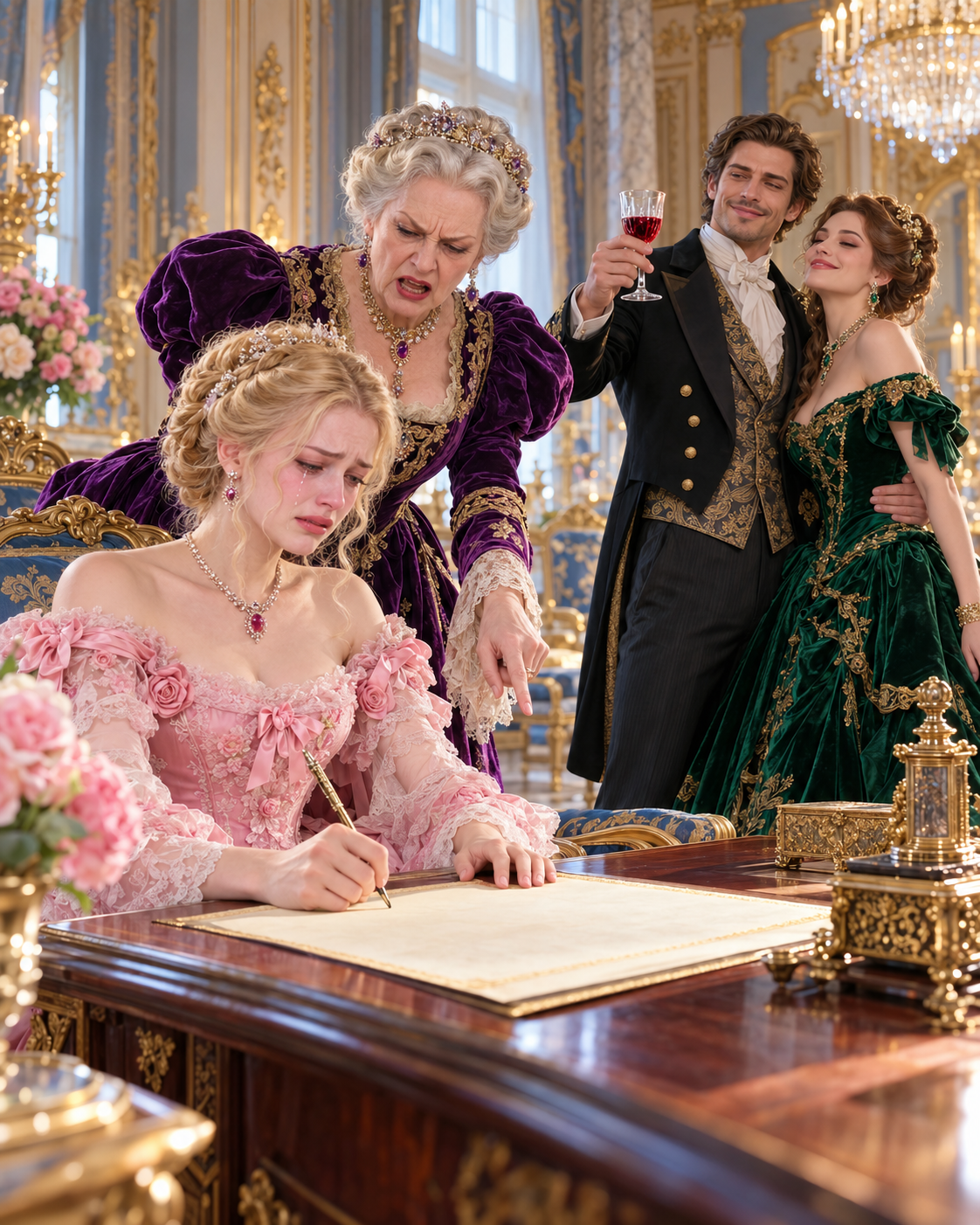
Edward rubbed his thumb against his wedding ring.
“Afterward, there was too much money involved.”
The admission settled between them.
Abigail waited.
He finally raised his eyes.
“My mother said you would never understand the arrangements. She said the family could manage the estate more responsibly.”
“And you agreed.”
“I thought we could settle everything privately.”
“You signed a statement claiming I authorized a transfer I had never seen.”
Edward looked toward Caldwell, then back at her.
“My uncle prepared it.”
“That wasn’t my question.”
His face tightened.
“Yes.”
Abigail had imagined this conversation many times. In some versions, she shouted. In others, she wept or demanded to know whether he had ever loved her.
Now, looking at the man across the desk, she felt only a terrible clarity.
He had known.
Perhaps not everything. Perhaps not at the beginning.
But enough.
“You could have told me,” she said.
Edward’s shoulders lowered.
“I was afraid of losing the family.”
She looked at the ring on his finger.
“So you chose to lose your wife.”
He did not answer.
Before leaving, Edward placed a folded paper on Caldwell’s desk.
It contained the address of a private office Nathaniel maintained near the harbor and the name of a clerk who had handled the company’s confidential correspondence.
“My uncle is moving money out of Maryland,” he said. “He leaves for New York on Friday.”
Caldwell examined the note.
“Why tell us now?”
Edward stood.
“Because my mother has begun destroying documents, and I think my uncle intends to leave us responsible for everything.”
Abigail watched him button his coat.
Even now, his fear had arrived before his conscience.
But the information was useful.
And she had learned not to reject the truth merely because she disliked the person carrying it.
The following morning, Caldwell obtained an emergency order restricting certain disputed transfers. Abigail accompanied him to the bank, where they met the manager and reviewed the remaining records.
A pattern emerged almost immediately.
Nathaniel had been transferring funds through an account connected to a shipping company. Several large payments were scheduled to clear before the end of the week.
If they succeeded, recovering the money would become considerably harder.
Abigail examined the authorization forms.
One figure caught her attention.
It was an ordinary number, entered beneath a routine description. Yet the amount matched the unexplained difference she had found in her father’s accounts months earlier.
She turned to the next page.
Then the next.
“Mr. Caldwell,” she said quietly, “these aren’t payments for shipping.”
He leaned beside her.
“What are they?”
“Repayments. But not for a loan.”
She arranged the documents chronologically.
Her father had discovered that Nathaniel was using the lending company to divert money from several estates, not merely his own. Rather than immediately expose the scheme, he had begun purchasing legitimate claims against the company through intermediaries.
Those claims were now held by the trust established for Abigail.
If properly enforced, they could give her control over the company’s remaining assets.
Caldwell followed her calculations.
“Your father was building a means to stop Nathaniel.”
“Yes,” Abigail whispered. “And Nathaniel has been trying to erase it.”
There was another discovery.
The company had collected money from families whose properties had been threatened with foreclosure. Some had paid obligations they did not legally owe. Others had surrendered land after being shown altered account balances.
Abigail read the names.
Widows. Small merchants. Farmers.
People who had never possessed enough influence to question the figures placed before them.
She thought of Margaret sitting in her drawing room, calmly explaining that complicated matters belonged in the hands of those who understood them.
For years, Abigail had been expected to accept that principle.
Now she understood how useful it had been to the people benefiting from her silence.
The case moved quickly after that.
The harbor clerk identified Nathaniel’s handwriting on several payment instructions. The dockworker recognized him as the man who had left the warehouse shortly before the fire. Whitcomb supplied correspondence showing that he had objected to the unauthorized transfers months before Abigail’s father died.
Then Caldwell uncovered a final witness.
A former household secretary named Eleanor Price had worked for Margaret Mercer during the months surrounding the disputed amendment.
She arrived at Caldwell’s office trembling so badly that Abigail offered her a chair before asking a single question.
Eleanor carried a small parcel wrapped in brown paper.
“I kept these because I knew one day someone might ask,” she said.
Inside were discarded drafts of the forged authorization.
Three versions bore corrections in Margaret’s handwriting.
The fourth contained a practice signature.
Abigail’s.
Eleanor looked at the floor.
“Mrs. Mercer made me copy your letters so she could study the way you formed certain words. I didn’t understand at first.”
Abigail touched the edge of the paper.
She remembered those letters. Polite notes thanking Margaret for invitations, asking after her health, promising visits she had rarely wanted to make.
Even her attempts at courtesy had been turned into instruments against her.
“Why didn’t you speak sooner?” Caldwell asked.
Eleanor twisted her gloves.
“My younger brother worked for the family. Mrs. Mercer said he would lose his position if I ever discussed what I’d seen.”
“And now?”
“He lost it last month anyway.”
Abigail looked at the young woman.
“Thank you for coming.”
Eleanor’s eyes filled.
“I should have come before.”
“You’ve come now.”
The hearing began on a gray Monday morning.
Abigail entered the courthouse with Caldwell beside her and Whitcomb following several steps behind. The corridor smelled of damp wool, floor polish, and old paper.
Edward stood near the far wall.
Margaret sat beside him, her posture immaculate, a lace handkerchief folded between her hands.
Nathaniel was nowhere to be seen.
Caldwell leaned toward Abigail.
“He was stopped before boarding the train. The authorities are questioning him about the warehouse fire and the financial records.”
She nodded.
Margaret looked up as Abigail passed.
For a moment, their eyes met.
The older woman offered a small, familiar smile.
Abigail did not return it.
Inside the courtroom, the proceedings began with the contested trust amendment.
Edward’s solicitor argued that Abigail had consented to the transfer and later regretted the arrangement after her marriage deteriorated.
Caldwell produced the letters bearing Edward’s own postmarks.
The solicitor’s argument faltered.
Next came the handwriting evidence, followed by Eleanor’s testimony and the drafts recovered from Margaret’s household.
Margaret remained composed until the fourth document was presented.
Then she gripped her handkerchief so tightly that the lace tore.
When called to testify, she insisted that she had acted to preserve the family.
“My daughter-in-law was inexperienced,” she said. “The estate required capable management.”
Caldwell placed Abigail’s reconstructed accounts before her.
“Are you suggesting these calculations are incorrect?”
Margaret glanced at the figures.
“I am not an accountant.”
“Then on what basis did you determine that Mrs. Mercer was incapable of managing her inheritance?”
Margaret’s lips pressed together.
No answer came.
The courtroom remained quiet.
Abigail sat with her hands folded in her lap, watching the woman who had once decided which visitors she could receive, how much money she might spend, and whether her opinions deserved to be heard.
For years, Margaret’s certainty had seemed immovable.
Now it had nowhere to stand.
The proceedings continued through the afternoon.
Bank officials confirmed the transfers. Whitcomb explained the original trust arrangements. The harbor clerk described the instructions he had received from Nathaniel’s office.
Finally, Edward was called.
He approached the witness stand slowly.
Abigail did not look away.
Under questioning, he admitted that he had signed the statement claiming she authorized the transfer, despite knowing she had not been present.
His voice faltered when asked whether his mother had instructed him to do so.
“She encouraged me,” he answered.
“And did you believe the statement was true?”
Edward stared at his hands.
“No.”
A murmur moved through the room.
Abigail felt no satisfaction.
Only the strange heaviness of hearing a truth she had carried alone finally spoken before strangers.
The judge ordered the disputed amendment set aside and directed that the estate assets be protected pending a full accounting. The evidence concerning forged documents, diverted funds, and the warehouse fire was referred for further investigation.
It was not the end of every legal battle.
But it was the first time the Mercers could no longer decide the facts simply by repeating their version more confidently.
Outside the courthouse, Edward approached Abigail beneath the stone portico.
Rain fell beyond the steps.
“Will you speak to me?”
She stopped.
Caldwell moved a short distance away.
Edward looked exhausted.
“I know an apology isn’t enough.”
“No,” Abigail said. “It isn’t.”
“I did love you.”
She studied him for a moment.
Perhaps he believed that.
Perhaps he had loved the quiet woman who arranged his home, overlooked his cruelty, and made his life easier without asking him to examine the cost.
But she was no longer willing to mistake affection for respect.
“You may have,” she said. “But you never trusted me with the truth.”
Edward lowered his eyes.
“Is there anything I can do?”
“Cooperate with the investigation. Tell them everything you know.”
He nodded.
“And us?”
Abigail looked toward the rain.
“There is no us to repair, Edward.”
She stepped past him and descended the courthouse stairs.
He did not follow.
Over the following months, the estate’s finances were examined in full.
The work was exhausting. Some records had been destroyed. Others were incomplete, and several witnesses had vanished before investigators could question them.
But the surviving accounts told a consistent story.
Nathaniel had used forged authorizations, inflated liabilities, and concealed transfers to divert assets from multiple estates. Margaret had assisted in preparing documents and pressuring Abigail to surrender control. Edward had knowingly supported the false authorization.
The investigation into the warehouse fire continued separately, while the financial proceedings resulted in further recovery orders and claims against those responsible.
Nathaniel’s influence could no longer prevent his affairs from being examined.
Margaret withdrew from society, though Abigail occasionally heard that she still described the entire affair as an unfortunate family disagreement.
Edward agreed to a legal separation settlement and eventually ceased writing.
Abigail did not ask where he went.
There were other matters requiring her attention.
The restored trust gave her control of properties, investments, and claims her father had preserved for her. She could have sold the holdings, moved somewhere quiet, and spent the remainder of her life avoiding ledgers.
Instead, she began reviewing the accounts of the families harmed by Nathaniel’s company.
One afternoon, Caldwell found her seated behind a mountain of papers, comparing an elderly widow’s mortgage records against the company’s original loan schedule.
“You realize this isn’t required of you,” he said.
Abigail continued writing.
“The interest was calculated twice.”
“I know.”
“Then she lost her house over money she never owed.”
Caldwell pulled up a chair.
“How many more?”
Abigail looked at the stack.
“Enough.”
He watched her for a moment.
Then he removed his coat.
“Show me where to begin.”
The work became larger than either expected.
With recovered funds and settlements, Abigail established a small office in Baltimore devoted to examining disputed accounts and helping families challenge deceptive financial claims.
She hired Eleanor Price as her secretary, then trained her to reconcile ledgers and identify altered entries.
Whitcomb, whose health had improved after Nathaniel’s influence over him ended, occasionally assisted with banking matters.
Their office was modest. The furniture was mismatched, the windows rattled in winter, and the heating stove demanded constant attention.
Yet people came.
A shopkeeper arrived with invoices that did not match his payments. A widow brought a foreclosure notice she could barely understand. A young woman appeared with her late mother’s accounts, afraid that her relatives had concealed part of the inheritance.
Abigail listened to each of them.
She asked questions.
She checked figures.
And when something was wrong, she did not tell them to leave complicated matters to someone else.
She showed them how to understand the numbers themselves.
One evening, nearly a year after the courthouse hearing, Abigail returned to her office to find a parcel waiting on her desk.
It was wrapped in plain brown paper and addressed in a familiar hand.
Edward’s.
Inside was a small wooden box containing her wedding ring, several personal letters, and a photograph taken during the first year of their marriage.
There was also a note.
I found these while clearing the house. I thought you might want them. I hope Baltimore has given you the life I couldn’t.
Abigail read it once.
Then she placed the ring inside the box.
She studied the photograph.
The young woman in it wore a pale dress and a carefully arranged smile. Her posture was straight, her hands neatly folded, her expression pleasant enough to satisfy anyone looking.
Abigail remembered the day.
She had been asked to sit still while Edward decided where the photographer should position her.
She had complied without thinking.
Now she looked at that younger version of herself with an unexpected tenderness.
The woman in the photograph had not been foolish.
She had been trying to build a life with the knowledge she possessed.
She had trusted people who had made trust expensive.
But she had also survived them.
Abigail closed the box and placed it in the bottom drawer.
Then she returned to her work.
Spring arrived slowly that year.
The harbor ice disappeared, the streets filled with carts carrying fresh produce, and sunlight began reaching the far corner of Abigail’s office.
One morning, Caldwell arrived carrying a sealed envelope.
“It’s from the estate court,” he said.
Abigail opened it beside the window.
The final accounting had been approved. The remaining recovered assets were released to the trust, and the principal civil claims concerning her inheritance had been resolved.
She read the figures carefully.
Then she read them again.
For years, the estate had existed in her mind as a battlefield of missing money, altered signatures, and conversations conducted behind closed doors.
Now the accounts balanced.
Her father’s work had not been entirely lost.
Caldwell watched her.
“Well?”
Abigail placed the document on the desk.
“It’s finished.”
He smiled.
“Then I suppose you should celebrate.”
She looked around the office.
Eleanor was sorting correspondence. Whitcomb was examining a bank statement near the stove. Beyond the window, a young messenger hurried through the street carrying a parcel beneath his coat.
Abigail thought about the woman she had been when she first arrived in Baltimore, frightened of every unexpected knock, uncertain whether she could support herself, carrying her father’s records as though they were the only proof that she had a right to exist outside her marriage.
She thought of the families who had recovered property because someone finally examined the figures.
And she thought of her father.
For a long time, she had been angry with him for arranging a marriage he believed might protect her. His secrecy had placed her inside the very household he feared.
She understood now that he had been desperate, and that desperation had led him to make a terrible choice.
Love had not made that choice wise.
But it had not erased the love either.
That evening, Abigail walked alone toward the harbor.
The sky was pale gold, and the water moved gently beneath the moored ships. Men called to one another from the docks. Somewhere nearby, a child laughed.
She carried her father’s final letter in her coat pocket.
She had read it many times, but one passage remained with her.
He had written that he wanted her to possess enough security never to depend upon another person’s permission to live with dignity.
Abigail unfolded the paper.
For the first time, she noticed the sadness beneath his careful words.
He had believed money could provide safety.
He had been partly right.
But money alone had not saved her.
Knowledge had helped.
Courage had helped.
So had the willingness of others to speak when silence would have been easier.
Most of all, she had needed to believe that her judgment deserved the same respect she had spent years giving everyone else’s.
A breeze lifted the edge of the letter.
She folded it carefully and returned it to her pocket.
Behind her, the city continued its ordinary evening.
There would be more accounts tomorrow, more frightened visitors, more people who had been told that they were too inexperienced or too insignificant to question the decisions made for them.
Abigail would not be able to help everyone.
But she could begin with the person who came through her door.
And she could make certain that Eleanor, and the women who followed her, learned to read the records that others had once used to keep them powerless.
Several months later, a young widow entered Abigail’s office carrying a bundle of papers tied with string.
Her hands shook as she placed them on the desk.
“My husband’s family says the business belongs to them,” she explained. “They say I wouldn’t understand the accounts.”
Abigail untied the string.
The first page contained a familiar arrangement of expenses and transfers.
She glanced at the woman across from her.
“Would you like to understand them?”
The widow hesitated.
“Do you think I could?”
Abigail pulled a chair beside her own and placed a clean sheet of paper between them.
“Yes,” she said. “And I’ll show you where to start.”
Outside, the afternoon sun moved across the Baltimore rooftops. Inside, two women bent over a ledger, following the figures line by line.
There was no grand declaration, no audience, no applause.
Only a question being answered, a skill being shared, and a woman discovering that she was capable of far more than she had been permitted to believe.
Abigail picked up her pen and drew a line beneath the first column.
For years, others had used her silence to write the story of her life.
Now she knew how to examine every page.
And when the numbers did not add up, she would never again be afraid to ask why.
THE END.