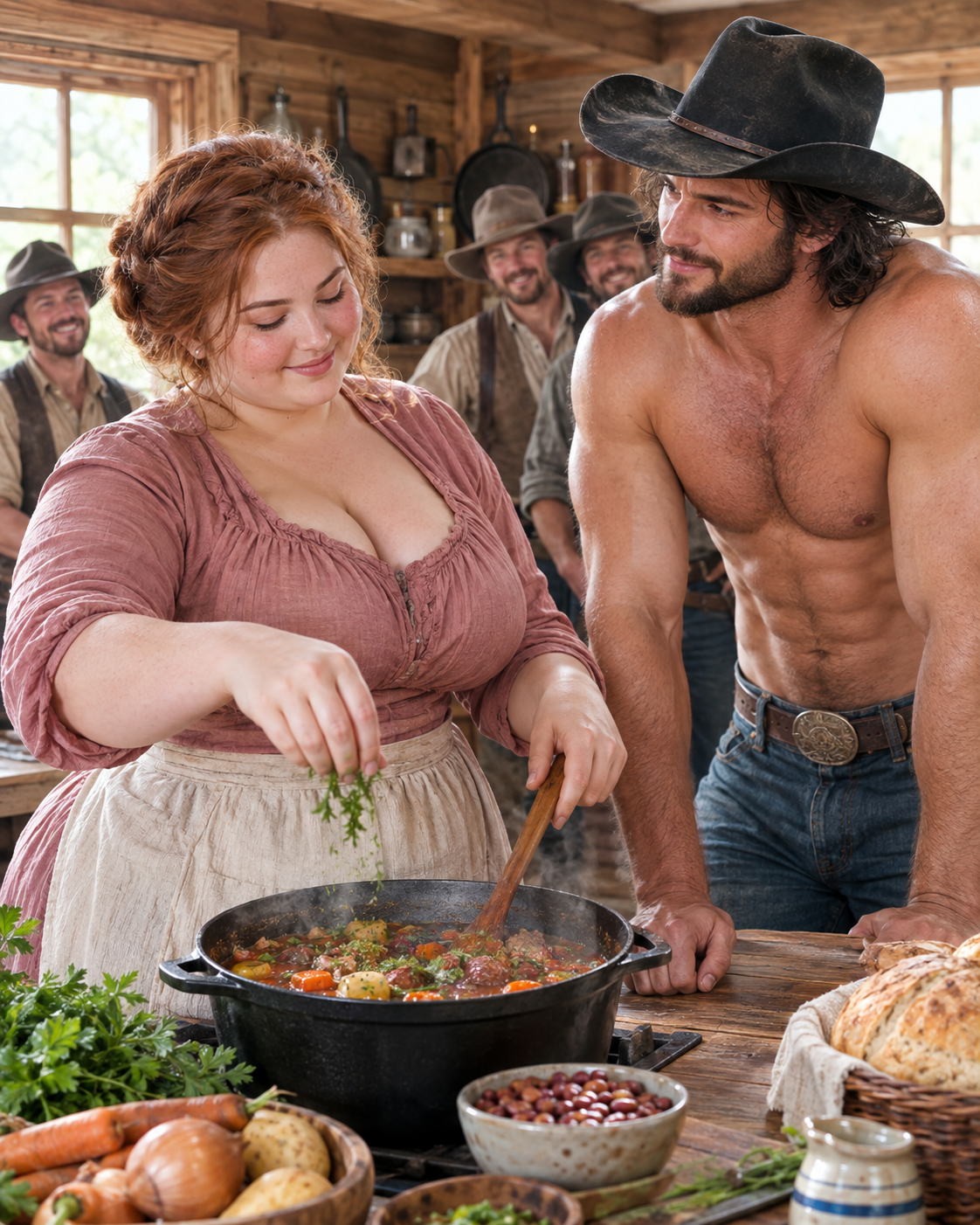
The eleven cowboys laughed when I was ordered to cook their last meal at Silver Pine Ranch, but their foreman’s cruel smile vanished when he discovered what I had hidden beneath the flour sack.
The name on the deed was mine.
For several seconds, I could hear nothing but the wind hammering against the kitchen windows and the uneven beating of my own heart.
My signature sat beneath my mother’s, written in a hand I barely recognized, dated three days before my seventh birthday.
I had never signed a deed, never owned a ranch, and never understood why my mother had spent her final years waking from nightmares with my name on her lips.
Yet there it was, in black ink, beneath a document that appeared to transfer Silver Pine Ranch into my possession.
Samuel gripped my shoulder before I could collapse.
“Don’t let that paper convince you that you understand what happened, Rebecca.”
I stared at him, searching his weathered face for a reason to trust him.
“Then tell me the truth.”
His eyes drifted toward the kitchen door, where the distant sound of boots crunching across frozen gravel grew louder.
“The truth is that your father tried to save this ranch, your mother tried to save you, and I was too much of a coward to save either of them.”
Before I could demand an explanation, another gunshot cracked across the yard.
The cowboys surged toward the windows, but Samuel pulled me away from the glass and guided me toward the pantry.
“Whoever is outside believes those documents are still hidden,” he whispered. “If he finds them in your hands, he won’t leave you alive to explain them.”
I looked toward Wade, expecting him to seize his chance to escape.
Instead, he stood motionless beside the table, staring at the old ledger with an expression that looked almost like grief.
Then he slowly removed a revolver from beneath his coat and placed it on the floor.
“I’m not running anymore,” he said.
Cole stared at him in disbelief.
“After everything you’ve done, you expect us to believe you?”
“No,” Wade answered. “I expect you to hate me, because I’ve earned it.”
For the first time since I had arrived at Silver Pine Ranch, the foreman’s arrogance disappeared completely.
What remained was a tired man who had spent too many years defending a lie that had become heavier than his own conscience.
Samuel led me into the pantry, where the smell of dried herbs and old flour hung in the air.
He shut the door behind us, then turned toward me with tears gathering in his eyes.
“Your father was the rightful owner of this ranch,” he began. “My father borrowed money from him when our family was close to losing everything, and your father never demanded repayment while we struggled.”
I listened as Samuel explained that the two families had once worked side by side, sharing cattle, equipment, harvests, and meals during the harshest winters.
Silver Pine Ranch had never been merely a business to my father.
It was the place where he had buried his first dog, built his first barn, and promised my mother that their daughter would grow up knowing the dignity of honest work.
When Samuel’s father died, however, the ranch was burdened with debts neither family could easily repay.
A wealthy land investor named Everett Crowley arrived with an offer to purchase the property, promising to preserve the ranch and keep every worker employed.
My father refused.
He believed Crowley intended to strip the land of its resources, sell the grazing rights, and abandon the men who had spent their lives working there.
That refusal began a quiet war.
Payments disappeared from the ranch accounts, cattle were sold without authorization, and forged records began appearing in the county office.
My father discovered the scheme and confronted Wade, who had been working as a bookkeeper before becoming foreman.
Wade admitted that Crowley had paid him to alter the records, promising enough money to save his family’s failing farm.
“I thought I could replace the money before anyone noticed,” Wade later confessed. “Then Crowley kept demanding more, and every lie forced me to tell another.”
When my father threatened to expose him, Crowley arranged for the forged accounts to make it appear that my father had stolen the ranch’s money himself.
The sheriff arrived with a warrant, and my father was arrested in front of the men who had trusted him.
He died several months later while awaiting trial, after an illness that had gone untreated in a crowded county jail.
My mother was left with a little girl, a mountain of debt, and a reputation that had been destroyed before she could defend it.
I pressed my hand against my mouth, struggling to breathe through the memories I had spent my childhood trying to understand.
I remembered my mother’s silence whenever someone mentioned my father.
I remembered the way she folded his letters into neat squares and hid them beneath her mattress.
Most of all, I remembered her final night, when she had held my face between her trembling hands.
“Never believe that being good means you must let bad people hurt you,” she had whispered.
I had been too young to understand.
Now every word returned with a terrible clarity.
“But why is my name on the deed?” I asked.
Samuel looked toward the pantry shelves, as though the answer might be hidden among the empty jars.
“Because your father had one last chance to protect the ranch.”
Before Crowley could seize the property through fraudulent debts, my father arranged for the land to be placed in a trust for me.
The deed was meant to remain sealed until I reached adulthood, with my mother acting as guardian and Samuel serving as a witness.
But Crowley discovered the plan.
He threatened to have me taken away from my mother and placed in state custody by using the false accusations against my father as evidence that she was unfit to raise me.
Terrified that she would lose her only child, my mother signed a statement claiming that my father had authorized the questionable transactions himself.
It was a lie, but Crowley promised that the confession would keep me safe.
Instead, it gave him the final piece he needed to bury the truth.
My mother fled Montana with me before Crowley could force her to surrender the original trust documents.
She spent the rest of her life believing that her signature had destroyed my father’s name forever.
“And the key?” I whispered.
Samuel’s eyes filled with fresh tears.
“Your father gave it to her. It opens a strongbox beneath the old office floor, where he kept the original records and the letter that proves Crowley arranged everything.”
I looked down at the brass key, realizing that my mother had carried the truth with her until the day she died.
“Why didn’t she come back?”
“Because Crowley told her that if she returned, he would make sure you disappeared.”
The words left me cold.
All those years, I had believed my mother was ashamed of our past.
In truth, she had been living with the fear that one wrong decision could cost her daughter everything.
A heavy thud shook the pantry door.
Samuel seized my arm.
“We have to move.”
When we returned to the kitchen, the cowboys had formed a line near the back entrance, their hands resting close to their belts.
Cole stood at the front, his face pale but determined.
Through the frosted glass, I could see three men gathered on the porch, one holding a lantern and another carrying a rifle.
The man in the middle wore a dark wool coat and a silver watch that caught the light.
I recognized his face from the photograph tucked inside my mother’s recipe book.
Everett Crowley had aged, but his smile remained exactly as I remembered it from the nightmares I had never understood.
He knocked again, gently this time.
“Samuel, open the door. We’ve all wasted enough years on a misunderstanding.”
Wade let out a bitter laugh.
“That’s how he always does it. Makes a threat sound like an invitation.”
Crowley called through the door, saying that he had heard rumors about missing documents and wanted to settle the matter privately.
He promised to pay every outstanding ranch debt, repair the buildings, and give the cowboys enough money to start over somewhere else.
All he wanted, he said, was the deed in my possession.
For one dangerous moment, I imagined what that money could do.
The ranch was starving, the horses needed feed, the roof leaked, and the men who had shared my first proper meal in weeks were facing an uncertain winter.
A simple signature could end their suffering.
But I thought of my father’s name, dragged through the mud by men who believed desperation could excuse betrayal.
I thought of my mother, who had sacrificed her peace to protect me.
And I understood that Crowley was offering us the same bargain that had destroyed my family once before.
A comfortable lie in exchange for the truth.
I stepped toward the door.
“Rebecca,” Samuel warned, “don’t let him frighten you into making a decision.”
“I’m not frightened anymore,” I answered, though my knees were shaking.
I opened the door only wide enough to face Crowley.
Cold air rushed into the kitchen, carrying the smell of snow and horses.
His eyes moved over me, then settled on the deed in my hand.
“Your mother should have burned that document,” he said softly.
“She should have trusted that the truth would survive.”
His smile faded.
“You don’t understand what you’re holding, young woman. This land is worth more than you could ever earn in ten lifetimes.”
“Then why are you so afraid of letting me keep it?”
Behind me, I heard Cole shift his weight, while the other cowboys stood perfectly still.
Crowley glanced at them and gave a small, dismissive shrug.
“These men need wages, not a history lesson. Ask them how long they can survive on pride.”
He was right about one thing.
They were hungry, exhausted, and frightened of losing the only homes they had ever known.
But he had mistaken their suffering for weakness.
I turned toward the table, where the empty bowls from our meal still sat beside the old ledger.
“These men worked all day with almost nothing to show for it,” I said. “Yet when I gave them a meal made from scraps, they trusted me enough to sit together and share it.”
Crowley looked impatient.
“What does that have to do with anything?”
“Everything. You believe a man’s worth is measured by what you can take from him. My father believed it was measured by what he was willing to give.”
For the first time, Crowley’s expression changed.
I held up the deed.
“This ranch will not be sold to you.”
His face hardened, and the gentleness vanished from his voice.
“Then you leave me no choice.”
He stepped forward, but Cole blocked the doorway.
“You heard her,” Cole said. “Now get off this property.”
Crowley’s hired men raised their rifles, and the cowboys immediately reached for their own weapons.
The room balanced on the edge of violence.
Then Wade stepped between them.
“Put the guns down,” he said.
Nobody moved.
Wade looked directly at Crowley.
“I altered the accounts. I helped frame Rebecca’s father. I’ll testify to all of it, and I’ll tell the county exactly where you kept the money.”
Crowley stared at him with naked fury.
“You have no proof.”
Wade reached into his coat and withdrew a small notebook, its leather cover cracked with age.
“I kept copies of every payment you made. I thought I’d need them to protect myself someday.”
He placed the notebook beside the ledger.
For a moment, Crowley looked as though he might lunge across the table and tear both documents apart.
Instead, he smiled.
“Do you really think a handful of cowboys can defeat me? I own half the county’s creditors, and the sheriff owes me more than you could imagine.”
Samuel stepped forward.
“Perhaps you should ask the sheriff whether he still owes you anything.”
A voice came from the yard.
“That would be an interesting conversation.”
Every head turned.
A county deputy stood beyond the porch, accompanied by two state investigators in heavy coats.
Samuel had sent a telegram three days earlier after discovering the ledger, and the investigators had arrived that afternoon to question the ranch’s former bookkeeper.
The gunshots had drawn them from the barn, where they had been waiting for an opportunity to approach safely.
Crowley tried to protest, but the deputy ordered his men to lower their weapons.
One of the investigators examined Wade’s notebook, then compared the entries with the records in Samuel’s ledger.
The evidence was not enough to settle every question that night, but it was enough to justify taking Crowley in for questioning.
When the investigator reached for the deed, I held it close.
“I’ll give you the original after my attorney examines it,” I said. “I’m not losing another piece of my family because someone tells me to trust them.”
He nodded with a respect I had not expected.
“That’s a sensible decision, Miss Moore.”
Crowley was escorted outside beneath the cold Montana sky, his polished boots sinking into the mud he had spent years pretending was beneath him.
As he passed me, he stopped.
“You think you’ve won,” he whispered. “You have no idea how many people will suffer when I stop paying their debts.”
I looked at him and felt something unexpected.
Not triumph.
Pity.
Because even now, with the truth closing around him, he believed fear was the only thing capable of holding people together.
“Then perhaps it’s time we learned to stand without your money,” I replied.
The door closed behind him.
For several seconds, nobody moved.
Then Cole began to laugh, a quiet, disbelieving sound that soon spread around the table.
One by one, the cowboys lowered their shoulders and released breaths they seemed to have been holding for years.
Wade remained near the stove, staring at the floor.
I approached him carefully.
“Why did you keep the copies?”
He looked up, his eyes red.
“Because I knew what I was doing was wrong. Every night I told myself I would fix it tomorrow, and every morning I found another reason to wait.”
He swallowed hard.
“Your father once gave me money to bring my sick sister to a doctor. He didn’t ask for repayment, and he never told anyone. I repaid his kindness by helping destroy him.”
I could have shouted at him.
I could have told him that his remorse meant nothing beside the years my mother had suffered.
Instead, I let the silence remain between us.
“Feeling sorry won’t bring my father back,” I finally said. “But telling the truth might stop someone else from suffering the same way.”
Wade nodded, unable to meet my eyes.
“I’ll testify.”
“Then start by telling the whole truth, even the parts that make you look worst.”
He agreed.
Over the following weeks, the ranch changed in ways none of us could have imagined.
The investigators uncovered additional records linking Crowley to several fraudulent land transfers, and the county reopened my father’s case.
Wade’s testimony helped establish how the accounts had been manipulated, while Samuel supplied letters and documents he had kept hidden for decades.
It was not an easy victory.
Some creditors refused to acknowledge the evidence, and the ranch remained burdened by debts until the trust was formally recognized.
The first snowfall arrived before the legal questions were settled.
We spent those weeks repairing fences, rationing feed, and making every sack of grain last as long as possible.
I cooked whatever I could find, sometimes stretching a pot of beans into supper for the entire ranch.
Nobody complained about scraps anymore.
The cowboys began bringing me ingredients from their own stores, and Cole learned how to knead bread without turning it into a lump of stone.
On bitter evenings, we gathered around the same table where they had once laughed at me.
We spoke about our families, our failures, and the people we wished we could see again.
I learned that a few of the men had not received letters from home in years.
Others sent most of their wages to children they barely had time to visit.
They were not merely eleven hungry cowboys.
They were eleven lives carrying burdens no one else could see.
And somehow, through a shared pot of stew and the slow work of telling the truth, we began to feel like a family.
Three months later, the county court recognized the validity of my father’s original trust.
Silver Pine Ranch legally belonged to me, though its debts and responsibilities remained very real.
I could have sold the land, taken the money, and left Montana behind forever.
There were nights when that thought tempted me, especially when I found another unpaid bill or another broken piece of equipment.
But every morning, I saw the ranch hands riding out beneath the pale sunrise, and I remembered the promise my father had made to my mother.
This place was meant to be more than a business.
It was meant to be a home.
I used what little money remained to repair the bunkhouse, purchase seed, and negotiate a manageable repayment plan with the creditors willing to work honestly with us.
Samuel helped recover the ranch’s original boundaries, while Cole took responsibility for the cattle accounts under the watchful guidance of an independent bookkeeper.
Wade remained on the ranch, but I removed him from his position as foreman until the investigation concluded.
He accepted the decision without protest.
Every Sunday, he visited my father’s grave and left a small bundle of wildflowers beside the headstone.
I never told him he was forgiven.
Some wounds cannot be healed by a single apology, and some losses cannot be repaired by years of good behavior.
But I stopped wishing for his suffering, and that was the first step toward freeing myself from the past.
In early spring, a letter arrived from the county courthouse.
Crowley had been charged with fraud, conspiracy, and multiple offenses related to the forged land records.
His influence had not disappeared overnight, but the investigation had exposed enough of his dealings that the men who once protected him began turning against him.
The letter also contained a sealed envelope addressed to me.
Inside was a final statement written by my mother, apparently intended to be delivered when the original trust was restored.
I recognized her handwriting immediately, and for a long time, I could not bring myself to unfold the paper.
When I finally did, her words blurred behind my tears.
“My dearest Rebecca, if you are reading this, then you have discovered the truth I was too afraid to tell you.”
She explained that she had never believed my father was guilty.
She had signed the false statement only because Crowley threatened to take me away, and she had spent every year afterward wishing she had found another way.
She wrote that she feared I would grow up believing courage meant never being afraid.
But courage, she said, was often the quiet decision to keep loving people when fear gave you every reason to stop.
At the bottom of the letter, she had added one final sentence.
“If the ranch is ever yours again, do not let it become a monument to what was stolen; make it a place where people who have lost everything can begin again.”
I read those words until the paper grew soft beneath my fingers.
Then I walked to the kitchen, where the cowboys were waiting for supper.
I told them about the letter, and for once, nobody tried to hide the tears in their eyes.
That evening, I made the same stew that had silenced their laughter on the coldest night of my life.
The ingredients were still simple, but there was fresh bread on the table, vegetables from our first small greenhouse, and enough meat to give everyone a generous serving.
When I placed the pot in the center, Cole raised his spoon.
“To the woman who fed eleven stubborn cowboys when she had almost nothing left.”
The men lifted their cups, and I laughed through my tears.
“To the people who finally learned how to share.”
Outside, the spring wind moved through the pine trees, carrying the scent of damp earth and new grass across the fields.
For the first time in years, Silver Pine Ranch sounded alive again.
Yet the greatest change had taken place inside me.
I no longer saw the brass key as a symbol of my family’s suffering, nor the deed as proof that someone had stolen our rightful future.
They had become reminders that the truth could be buried, delayed, and even distorted, but it could not be made harmless by silence.
A week later, I placed my mother’s recipe book on a shelf beside my father’s photograph.
The brass key rested between them.
Beneath the photograph, I wrote a small note in my own handwriting.
“Feed people when they are hungry, tell the truth when it is difficult, and never mistake kindness for weakness.”
Those became the words I tried to live by.
Years later, people would ask how Silver Pine Ranch survived its darkest winter.
Some believed it was because of the court ruling, others because of the recovered records, and a few insisted that the ranch had simply been lucky.
I always told them the same thing.
“We survived because hungry people chose to share what little they had, and frightened people finally found the courage to tell the truth.”
The ranch never became the richest property in Montana, but it became something more valuable to me.
It became a place where a man who had made terrible mistakes could begin the difficult work of accountability, where a young cowboy could learn that dignity did not depend on wealth, and where no traveler would be turned away from the kitchen table simply because the pantry was nearly empty.
Every autumn, when the first cold wind swept across the plains, I made a large pot of stew and set eleven extra bowls beside the stove.
Not because I expected eleven strangers to arrive, but because my mother had taught me that generosity was most meaningful when we could least afford it.
And whenever the cowboys gathered around the table, I remembered the night they had laughed at my flour sack, never realizing that the meal I made from scraps would become the beginning of their salvation.
The greatest inheritance my father left me was not the ranch, and the greatest gift my mother gave me was not the key.
It was the understanding that a person’s worth is never measured by what remains in their hands, but by what they choose to do with it.
Because sometimes, the meal that saves a family is made from leftovers, the truth that restores a name is hidden beneath years of fear, and the smallest act of kindness becomes the first light in a very long winter.
THE END.