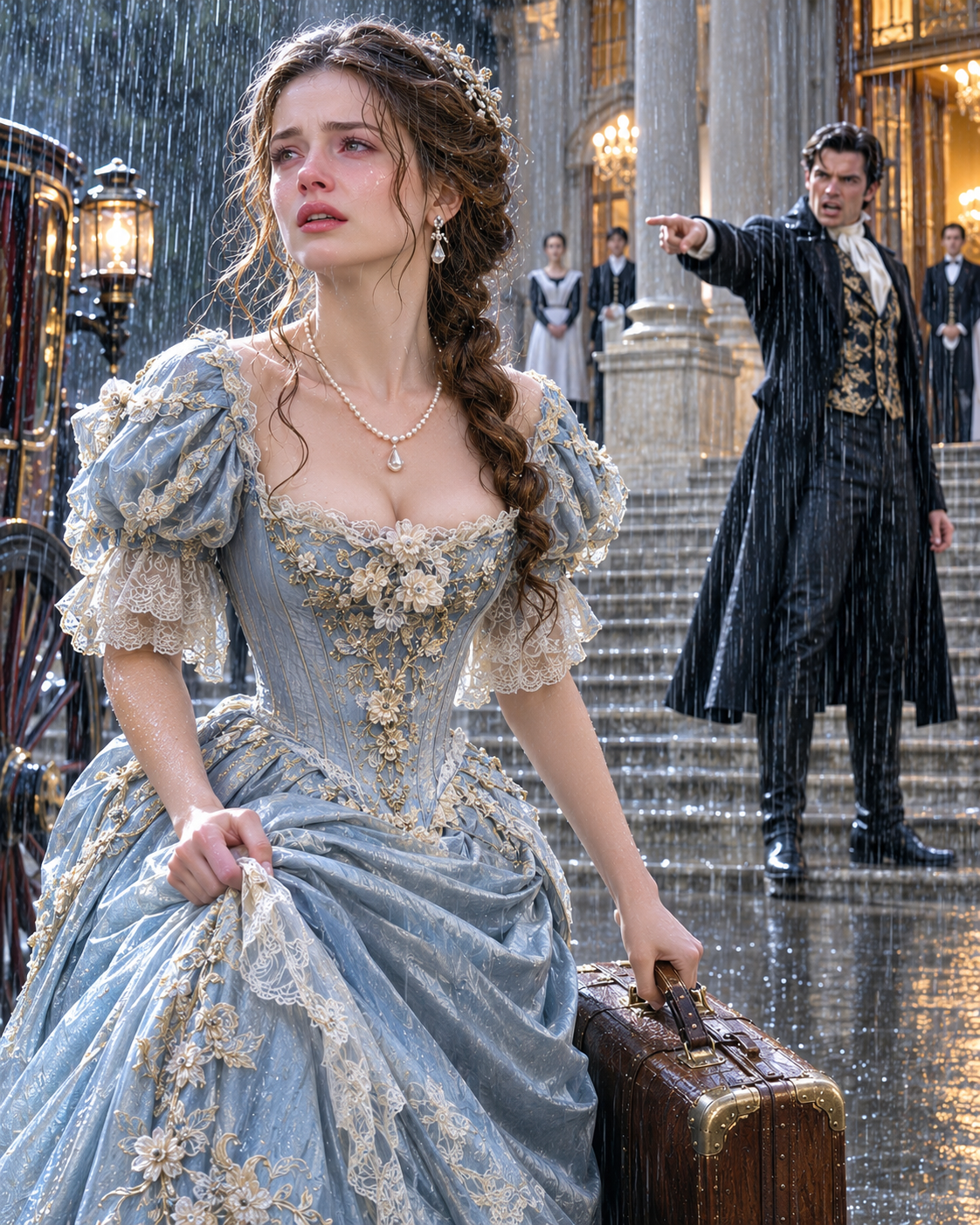
The Duke ordered his wife out of Wycliffe Hall before sunset. By breakfast, he would discover that the house he had thrown her out of had never legally belonged to him.
“The deadline is tomorrow at noon, Your Grace. Unless Lady Eleanor formally challenges this transaction, the purchasers may attempt to take possession of the eastern farmland before the matter can be resolved.”
Julian stared at the document beneath the lamplight.
The eastern farmland.
Nearly two hundred acres of fertile ground, six tenant cottages, a small orchard, and the narrow stretch of woodland separating Wycliffe Hall from the neighboring estate.
He knew the land well enough to recognize its value. He had ridden across those fields countless times, admiring the orderly hedgerows and the distant hills without once considering the families whose livelihoods depended upon them.
“What purchasers?” he asked.
Mr. Bellamy hesitated.
“Lord Ashcombe and his business associates.”
Julian looked up sharply.
Ashcombe had dined at Wycliffe Hall scarcely three weeks earlier. They had discussed horses, politics, and the declining fortunes of several neighboring landowners. Julian remembered the man expressing unusual interest in the eastern fields.
He also remembered Hargreaves standing nearby, quietly refilling their glasses.
“Are you suggesting Ashcombe knew the land was not mine to sell?”
“I am suggesting,” Bellamy replied carefully, “that he had every opportunity to discover it.”
Julian leaned against the desk.
A cold realization settled over him.
His steward had stolen from the estate for years. But the missing money had apparently been only part of a larger arrangement.
“Why would Eleanor know about this before I did?”
Bellamy removed a smaller envelope from his case.
“Because Lady Eleanor requested copies of the original settlement after discovering that your steward had been making inquiries concerning the eastern boundary. She identified several discrepancies and attempted to bring them to your attention.”
Julian remembered an evening in September.
Eleanor had entered his study carrying a folded map. He had been preparing to leave for a dinner at Ashcombe House.
She had asked him to postpone signing several estate documents.
He had told her not to involve herself in business she did not understand.
The memory struck him with such precision that he could almost hear the impatient scrape of his own chair.
“She tried to tell me,” he murmured.
Bellamy said nothing.
Julian looked down at the parchment again.
“And I ordered her out.”
The solicitor’s silence was answer enough.
For several moments, the only sound came from the rain brushing against the windows.
Then Julian straightened.
“Where is she?”
“At her late mother’s property near Fairhaven.”
“Send a carriage.”
“Your Grace, I must warn you that Lady Eleanor has expressly requested—”
“I know what she requested.”
Julian reached for his coat.
“I am not going to command her return. I am going to ask whether she will help me save the people I have endangered.”
Bellamy studied him for a long moment.
“Then I suggest you leave the carriage at the outer gate when you arrive.”
Julian frowned.
“Why?”
“Because she may be more willing to hear a husband who comes to her door than a duke who expects it opened.”
For the first time in their long acquaintance, Julian accepted the correction without argument.
By dawn, he was riding toward Fairhaven through a bitter November rain.
The road had become a ribbon of mud beneath the horses’ hooves. Bare branches reached across the narrow lanes, and the fields beyond them lay pale beneath the gathering mist.
Julian had brought no servants.
Only the documents, a sealed letter from Bellamy, and Eleanor’s old account book wrapped carefully inside his traveling case.
He had considered bringing flowers.
Then he had imagined placing a bouquet before the woman whose warnings he had dismissed while families suffered beneath leaking roofs.
He had left the flowers behind.
Fairhaven Cottage stood beyond a low stone wall, surrounded by neglected rosebushes and a small orchard.
It was not grand.
Its windows were narrow, its roof weathered, and its garden paths uneven.
Yet as Julian approached, he noticed that the front steps had been swept clean and fresh firewood had been stacked beneath the kitchen window.
Someone had been caring for the place.
He dismounted beside the gate and walked toward the door.
Before he could knock, it opened.
Eleanor stood on the threshold.
She wore a simple dark-blue wool dress, her hair loosely pinned at the nape of her neck. There was no jewelry at her throat except the thin silver chain he had noticed on the evening she left.
For a moment, neither spoke.
Julian had rehearsed half a dozen apologies during the journey.
All of them vanished when he saw her face.
She looked tired.
Not fragile.
Not defeated.
Simply tired in the quiet, unmistakable way of someone who had carried a burden far longer than anyone had realized.
“Julian.”
Her voice held neither surprise nor welcome.
“I received Mr. Bellamy’s message.”
“Then you know about the eastern fields.”
“I know.”
Rainwater slipped from the brim of his hat.
“I need to speak with you.”
Eleanor glanced toward the road.
“About the land?”
“Yes.”
She remained in the doorway.
“And when the land is secured?”
Julian understood the question.
He could have told her that he missed her.
That the house had become unbearable without her.
That he had scarcely slept since discovering the truth.
All of those things were true.
But none answered what she had asked.
“When the land is secured,” he said, “I will still owe you an apology.”
Something changed in her expression.
Only slightly.
She stepped aside.
“Come in, then.”
The cottage smelled of woodsmoke and fresh bread.
A small fire burned in the sitting room, where a writing desk stood beneath the window. Several estate maps had been spread across its surface, secured at the corners with books.
Julian noticed the familiar careful markings.
Eleanor had not stopped working.
Even after he had ordered her away, she had continued trying to protect the estate.
She saw him looking at the papers.
“The eastern families cannot survive another winter if Ashcombe takes possession,” she said.
“I know.”
“No, Julian. You have only recently begun to know.”
He accepted the rebuke.
She approached the desk and pointed toward a marked section of the map.
“Hargreaves arranged for the transfer to be recorded as a settlement of outstanding estate debts. Your signature appears on the authorization, but the property description was inserted afterward.”
Julian studied the document.
“Can you prove that?”
“The original copy in my mother’s papers contains no such description. Bellamy has both versions.”
“Then we challenge it.”
“We can. But the purchasers have already begun asserting rights over the property. Ashcombe sent men to survey the boundary yesterday.”
Julian’s hand closed around the edge of the table.
“Without permission?”
“Without mine.”
The correction was quiet.
Julian released the table.
“Of course.”
Eleanor studied him.
“Does that trouble you?”
“That he acted without the owner’s permission?”
“That I am the owner.”
The question settled between them.
Julian looked toward the window, where rainwater was gathering along the sill.
A week earlier, he might have answered defensively.
He might have spoken of his title, his position, or the humiliation of discovering that the estate associated with his family belonged legally to his wife.
Now he thought of the tenant standing beneath a leaking roof, holding a bucket while his children slept in damp rooms.
“I am ashamed,” he said.
Eleanor’s expression tightened.
“Of me?”
“Of how I treated you when I believed I held all the power.”
She looked down at the map.
Julian continued.
“I have spent years behaving as though a signature made me responsible and a title made me right. I allowed Hargreaves to steal because I found agreement more comfortable than questions.”
He swallowed.
“And when you tried to protect people who depended upon us, I punished you for it.”
The fire settled softly behind them.
Eleanor touched the edge of a folded document.
“You did not merely refuse to believe me, Julian. You made me afraid to speak in my own home.”
He closed his eyes briefly.
Those words hurt more than he had expected.
Not because they were cruel.
Because they were true.
“I know.”
“No,” she replied. “I don’t think you do. Not yet.”
He nodded.
“Then I will listen.”
For a long moment, she said nothing.
Then she drew out a chair.
“Sit down. We have work to do.”
They spent the next two hours examining maps, comparing signatures, and arranging documents in chronological order.
Eleanor explained the settlement created by her grandfather and preserved through her mother’s inheritance.
The estate lands had been entrusted to the women of her family, with legal provisions intended to prevent them from being absorbed into the debts or ambitions of their husbands.
Julian listened without interruption.
He realized that Eleanor had never concealed the truth from him. The documents had been available throughout their marriage.
He had simply never thought to ask.
Shortly before noon, a carriage approached the cottage.
Bellamy entered carrying a leather case and an expression of considerable relief.
“I have obtained a signed statement from the former assistant clerk,” he announced.
Eleanor rose immediately.
“Mr. Finch?”
“He confirms that Hargreaves ordered him to replace the final page of the authorization after His Grace had signed it.”
Julian looked sharply at the solicitor.
“Where is Finch now?”
“In my office, under the supervision of two reliable witnesses.”
“Will he testify?”
“He is frightened, but he has agreed.”
Eleanor folded her hands.
“Then we have a chance.”
Bellamy opened his case.
“A good one. But there is a complication.”
Julian had begun to dislike that particular word.
“What complication?”
“Lord Ashcombe has sent representatives to the eastern farms. They are informing tenants that their existing arrangements will be terminated unless they agree to new rents.”
Eleanor went still.
“He cannot lawfully do that.”
“Not if the property remains under your title. But confusion alone can frighten families into signing agreements they do not understand.”
Julian reached for his coat.
“I’ll go to the farms.”
Eleanor caught his sleeve.
He stopped.
She had not touched him since he arrived.
“Do not threaten him,” she said.
“I wasn’t going to.”
“Do not use your rank to frighten his men.”
Julian met her eyes.
“What would you have me do?”
“Tell the tenants the truth. Show them the records. Give them something they can rely upon.”
He nodded.
“Will you come?”
Eleanor looked toward Bellamy.
Then back at Julian.
“Yes,” she said. “But we go together.”
The eastern farms were in turmoil when they arrived.
Two unfamiliar carriages stood beside the old grain barn. Several tenants had gathered beneath the shelter of the overhanging roof, clutching papers stamped with Ashcombe’s seal.
A tall man in a dark overcoat stood before them, speaking with the polished impatience of someone accustomed to being obeyed.
Julian recognized him as Ashcombe’s agent, Mr. Vane.
Vane turned at the sound of approaching footsteps.
“Your Grace.”
His eyes moved toward Eleanor.
“And Lady Wycliffe.”
Eleanor stepped forward.
“I understand you’ve been distributing notices concerning my property.”
Vane smiled thinly.
“Lord Ashcombe has acquired an interest in these lands through a lawful agreement.”
“Then you will have no difficulty producing a valid deed of transfer.”
“The matter has already been settled.”
“Not according to the original settlement.”
She held out her hand.
“May I see the notices?”
Vane hesitated.
Julian watched the exchange without speaking.
The tenants stood nearby, uncertain where to look.
Finally, Vane handed Eleanor a paper.
She read it carefully.
Then she turned to the gathered families.
“These notices do not change your existing tenancies,” she said. “No one is required to sign anything today.”
A murmur passed through the group.
Vane stiffened.
“Madam, you are interfering in a commercial transaction.”
Eleanor looked at him.
“I am protecting property that belongs to me and the people whose homes stand upon it.”
Vane glanced toward Julian.
“Surely Your Grace will not permit—”
“My wife has spoken,” Julian interrupted.
Then he stopped.
He heard the familiar authority in his own voice.
He glanced at Eleanor.
She was watching him.
Julian corrected himself.
“Lady Eleanor is the legal owner. Mr. Bellamy has the documents to establish her title. Any further claim should be addressed through proper legal proceedings.”
Eleanor’s expression softened almost imperceptibly.
Vane looked between them.
“This will not please Lord Ashcombe.”
Julian stepped aside, leaving Eleanor unobstructed.
“Then he may discuss it with the solicitor.”
The agent departed shortly afterward.
Only when the carriages had disappeared beyond the hedgerow did the tenants begin speaking freely.
An elderly farmer named Thomas Reed approached Eleanor with his cap held tightly between his hands.
“My lady, are we truly safe from eviction?”
Eleanor glanced toward Bellamy.
“The notices have no lawful authority as they stand. We will challenge the attempted transfer, and you will receive written confirmation of your existing arrangements.”
Reed’s shoulders lowered.
His wife began to cry quietly beside him.
Julian watched Eleanor take the woman’s hands.
There was nothing theatrical in the gesture.
No grand promise.
Only the reassurance of someone who had taken the trouble to understand what was at stake.
He had once believed that leadership meant being the person everyone feared disappointing.
Now he was beginning to see how much more difficult it was to become someone people trusted.
The legal dispute continued for several weeks.
Hargreaves attempted to deny responsibility for the altered documents, claiming that Julian had approved every transaction knowingly.
But Finch’s testimony, the original settlement, and the discrepancies between the signed authorization and its later amendments established a compelling record of misconduct.
Ashcombe’s representatives eventually abandoned their immediate claim to possession while the disputed transfer was formally challenged.
The matter was not resolved in a single dramatic hearing.
There were statements, examinations, delays, and documents requiring careful verification.
Julian attended every meeting.
He listened when Bellamy explained the details.
He asked questions when he did not understand.
And when Eleanor disagreed with him, he no longer treated disagreement as defiance.
One afternoon, during a meeting concerning the estate’s winter repairs, Julian proposed diverting funds from the ornamental gardens to restore the eastern cottages.
Eleanor studied the estimates.
“It won’t be enough.”
“Then we can postpone the new stables.”
Julian looked at the figures again.
“And reduce the household entertaining budget.”
Bellamy raised an eyebrow.
Julian noticed.
“Yes, Bellamy. Even the annual winter ball.”
Eleanor almost smiled.
“You always said the ball was essential to maintaining the family’s position.”
Julian set down his pen.
“I was mistaken about several essential things.”
The room fell quiet.
Then Eleanor picked up the estimates.
“Very well. But I want the workers paid fairly, and the materials inspected before we approve the contracts.”
Julian nodded.
“Agreed.”
It was a small exchange.
Yet afterward, as Bellamy gathered the papers, Julian realized that he had enjoyed the meeting more than any lavish dinner he could remember.
For once, they had accomplished something together.
Still, Eleanor did not return to Wycliffe Hall.
Julian did not ask her to.
He rode to Fairhaven when estate matters required her attention, and sometimes they worked together until the afternoon light faded.
On those evenings, Eleanor occasionally offered him tea.
At first, he accepted with the cautious gratitude of a stranger.
Later, their conversations wandered beyond accounts and repairs.
They spoke of books, horses, the changing weather, and memories from the first years of their marriage.
Sometimes they laughed.
Sometimes an old remark would reopen a wound neither had expected.
Once, while discussing a tenant’s daughter who hoped to become a teacher, Julian mentioned that Eleanor had always been too idealistic about education.
The words left his mouth before he could stop them.
Eleanor’s expression closed.
He recognized it immediately.
That quiet withdrawal.
The same one he had mistaken for obedience throughout their marriage.
“I’m sorry,” he said.
She looked at him.
“For what?”
“For speaking as though your judgment is less practical than mine.”
He paused.
“Would you tell me what you were thinking?”
Eleanor studied him for several seconds.
Then she explained her proposal for establishing a small schoolroom near the estate cottages.
Julian listened.
By the following week, they had begun discussing costs with the village schoolmaster.
The first true test of Julian’s change came during a bitter storm in December.
Heavy rain swept across the valley for two consecutive days, filling the streams and turning the lower fields into shallow lakes.
At dawn on the third morning, a messenger arrived at Wycliffe Hall.
The narrow stone bridge near the eastern farms had partially collapsed.
Two cottages were flooded, and several families had been forced to leave their homes.
Julian was in the courtyard before the messenger had finished speaking.
By the time he reached the damaged bridge, workers were already gathering timber and rope.
The river roared beneath the broken stones.
A young farmhand approached him.
“Your Grace, we need more men to carry the beams.”
Julian removed his coat.
“Then tell me where to stand.”
For hours, he worked alongside the laborers, helping move supplies and clear the path toward the flooded cottages.
He was clumsy at first.
His hands blistered.
Twice he lost his footing in the mud.
No one laughed.
By midday, Eleanor arrived with blankets, bread, and a wagon carrying dry clothing.
She found Julian standing knee-deep in water, helping a tenant lift a wooden chest onto higher ground.
His shirt was soaked.
Mud covered his boots and trousers.
He looked up when he heard her voice.
“Eleanor.”
She surveyed the flooded yard.
“Have the families been moved?”
“All but the Reeds. Mrs. Reed refuses to leave without her husband’s medicine.”
“I brought the physician’s assistant. He has supplies.”
Julian nodded.
“Good.”
For a moment, they stood facing each other beneath the rain.
Then Eleanor took a folded blanket from the wagon and handed it to him.
“You’re shivering.”
“So are you.”
“I have the good sense to wear a proper coat.”
He smiled faintly.
“Another lesson.”
She almost returned the smile.
Then a shout came from the lower cottage.
A young boy had slipped while crossing the flooded yard and fallen against a damaged fence.
His father reached him before the current could carry him farther, but the child had injured his leg.
Julian and Eleanor hurried toward them.
Together, they helped carry the boy into a dry outbuilding, where the physician’s assistant examined him.
The injury was painful but not severe.
As the boy’s mother knelt beside him, Julian stepped outside to give the family privacy.
Eleanor followed.
The rain had eased to a fine mist.
“You could have remained at the Hall,” she said.
Julian looked toward the workers struggling to secure the damaged bridge.
“So could they.”
Eleanor pulled her shawl tighter.
“That’s not what I meant.”
He turned toward her.
“I know.”
For a moment, she seemed to search for the right words.
“You never used to notice when people needed help.”
Julian looked down at his scraped hands.
“I noticed when they failed to do what I expected. I rarely asked what made their work difficult.”
Eleanor remained silent.
He continued.
“I cannot repair what I did by working through one storm.”
“No.”
“But I can be here for the next one.”
She looked at him then.
Not with forgiveness.
Not yet.
But with something he had not seen in her face for a long time.
The willingness to believe that he might be speaking sincerely.
That evening, the families were given temporary accommodation in the unused west wing of Wycliffe Hall.
Eleanor supervised the arrangements.
Julian ensured that fires were lit, meals prepared, and sufficient bedding provided.
Several servants appeared astonished to receive instructions from both the Duke and Duchess without hearing a single disagreement about whose authority mattered most.
Late that night, Julian found Eleanor standing in the corridor outside the rooms occupied by the displaced families.
She was watching a little girl sleep beneath a borrowed quilt.
“The children will need somewhere warm to stay until the cottages are repaired,” she said softly.
“The west wing can remain open.”
“For as long as necessary?”
“Yes.”
Eleanor looked toward him.
“You used to complain that the west wing cost too much to heat.”
“I was wrong.”
She studied his face.
“You say that rather easily now.”
Julian considered her words.
“Perhaps because I have finally discovered how difficult it is to prove.”
Her expression changed.
This time, she did smile.
Only briefly.
But Julian carried the memory of it into the following morning.
By January, the legal proceedings had reached their conclusion.
The disputed transfer was formally set aside on the evidence presented, leaving Eleanor’s ownership of the eastern lands intact.
Hargreaves faced criminal proceedings over the financial misconduct and falsified records. The investigation also uncovered payments from Ashcombe’s associates that he could not satisfactorily explain.
Ashcombe denied knowledge of the fraudulent alterations.
The dispute surrounding his involvement continued separately, but his claim to the eastern property could no longer proceed on the invalid documents.
For Julian, the outcome brought relief without triumph.
The land had been protected.
The tenants remained.
But no legal decision could erase what had happened between him and Eleanor.
On the morning Bellamy delivered the final confirmation, Julian found himself standing outside the drawing room.
Inside, Eleanor was reviewing the estate’s spring planting proposals.
He watched her through the open doorway.
She was seated at the desk he had once treated as exclusively his.
Sunlight fell across the papers before her.
A cup of tea stood beside her hand.
She looked peaceful.
Julian realized that he could not remember the last time he had seen her at ease in that room before their separation.
He knocked gently against the doorframe.
Eleanor looked up.
“Come in.”
“Bellamy has received the confirmation.”
“I know. He sent me a copy.”
Julian entered.
“The eastern lands are secure.”
“Yes.”
He hesitated.
“I thought you might wish to celebrate.”
Eleanor set down her pen.
“With what?”
“I considered arranging dinner.”
She raised an eyebrow.
“An elaborate one?”
“Not unless you want it.”
“And who would be invited?”
“Whoever you choose.”
She studied him for a moment.
Then her expression softened.
“I think I would prefer something quiet.”
Julian nodded.
“Then something quiet.”
She glanced toward the papers on her desk.
“There is another matter we should discuss.”
His stomach tightened.
“Of course.”
Eleanor opened a drawer and removed a sealed document.
Julian recognized Bellamy’s handwriting.
“I have asked him to prepare a formal arrangement concerning the management of Wycliffe Hall.”
He nodded slowly.
“That is sensible.”
“The title to the estate remains mine, as it always has. But decisions concerning the land, the tenants, and the household may be made jointly, provided both parties agree.”
Julian listened carefully.
“And if we disagree?”
“Then we discuss it. We seek advice where necessary. Neither of us acts simply because we believe our position gives us the right.”
Julian looked at the document.
“What would you have me sign?”
Eleanor hesitated.
“Before that, I need to know whether you understand what I am offering.”
He looked up.
She continued.
“I am not giving you back the authority you believed you possessed. I am asking whether you wish to share responsibility with me.”
Julian felt the weight of the distinction.
For years, he had assumed that marriage meant Eleanor occupying a place within the life he had already chosen.
Now she was offering him something entirely different.
A place beside her.
Not above.
Not beneath.
Beside.
“Yes,” he said quietly.
Eleanor’s eyes searched his.
“Because you want the estate?”
“No.”
“Because you want me to return?”
Julian paused.
“I do want you to return.”
He stepped closer.
“But if you never choose to live here again, I will still honor everything we have agreed. The tenants deserve it. And so do you.”
The room was silent.
Eleanor looked down.
For a moment, he thought she might ask him to leave.
Instead, she said, “There were nights when I wondered whether you loved me at all.”
Julian felt his throat tighten.
“I did.”
“I know you believed you did.”
He lowered his eyes.
“That is not the same thing.”
“No.”
She stood slowly.
“When we married, I thought we would become companions. I imagined we would argue about books and laugh over dinner and grow old complaining about the same terrible winter weather.”
A faint smile touched her lips, then disappeared.
“Instead, I learned to measure my words before entering a room.”
Julian could scarcely bear to look at her.
“I am sorry.”
“I know.”
He lifted his eyes.
She continued.
“But an apology cannot restore the years we lost.”
“No.”
“And I cannot promise that I will never remember the way you spoke to me.”
“I would never ask you to forget.”
Eleanor looked toward the window.
Beyond the glass, workers were clearing the last of the winter debris from the gardens.
“I have been watching you,” she said.
Julian said nothing.
“I have watched you listen to people you once dismissed. I have watched you accept criticism without trying to punish the person who offered it. I have watched you come home exhausted from work you once considered beneath you.”
Her voice grew quieter.
“And I have been trying to decide whether those changes are something you have become, or something you are doing because you fear losing me.”
Julian took a breath.
“I cannot prove what I will be ten years from now.”
Eleanor turned toward him.
“No one can.”
“But I can promise to be accountable for what I do tomorrow. And the day after that.”
He paused.
“If I become the man I was, I want you to tell me. And I want to be the kind of husband who listens.”
Eleanor studied him for a long time.
Then she extended her hand.
“May I see the agreement?”
Julian handed it to her.
She read through the pages carefully, occasionally asking questions about clauses or responsibilities.
They discussed the estate committee, tenant representation, maintenance funds, and the schoolroom Eleanor hoped to establish.
For the first time in their marriage, the future took shape through a conversation neither controlled.
When they finished, Eleanor signed.
Julian signed beneath her name.
Bellamy witnessed the document later that afternoon.
The solicitor said very little.
But as he gathered his papers, he allowed himself a small smile.
“An excellent beginning,” he remarked.
Eleanor looked toward Julian.
“A beginning,” she agreed.
Spring came slowly to Wycliffe Hall.
The damaged bridge was rebuilt with stronger supports. The eastern cottages received new roofs, repaired chimneys, and proper drainage.
The estate accounts were reorganized under independent supervision, with regular reports available for Eleanor and Julian to review.
A small committee of tenant representatives began meeting with them every month.
At first, the meetings were awkward.
Several farmers seemed uncomfortable speaking openly before the Duke.
Julian noticed their hesitation.
During the second meeting, Thomas Reed raised a concern about the condition of a footpath used by children traveling to the village school.
Julian began to explain that the repairs could wait until summer.
Then he caught Eleanor’s glance.
He stopped.
“Mr. Reed,” he said, “what difficulties does the path cause in winter?”
The farmer blinked.
Then he explained.
Julian listened.
By the following week, the repairs had been approved.
It was not a grand gesture.
Yet word spread quickly through the estate that the Duke had begun asking questions before giving orders.
In April, the unused coach house was converted into a small schoolroom.
Eleanor oversaw the work, choosing sturdy desks, bright windows, and shelves for books.
Julian arranged for the roof to be repaired and helped transport several heavy crates from the village.
On the morning the schoolroom opened, children gathered outside wearing their cleanest clothes.
Their parents stood nearby, speaking quietly.
Eleanor addressed the families, thanking them for their patience and promising that the school would remain accessible to the estate children.
Then she turned toward Julian.
“Would you like to say something?”
He looked at the waiting faces.
Once, he would have delivered a speech about responsibility, tradition, and the generosity of the Wycliffe family.
Instead, he stepped forward.
“For many years,” he said, “I believed this estate was measured by the value of its land and the importance of its name.”
He glanced toward Eleanor.
“I was mistaken.”
The courtyard grew quiet.
“An estate is also measured by the lives of the people who depend upon it. We have not always treated those lives with the care they deserved.”
He paused.
“We intend to do better.”
Then he stepped back.
There was no grand applause.
Only a few nods, a murmur of approval, and the sound of children beginning to whisper excitedly.
Eleanor reached for his hand.
Julian looked down in surprise.
Her fingers closed gently around his.
She did not release him as the schoolroom doors opened.
That evening, they walked through the gardens together.
The air smelled of fresh earth and early roses. Beyond the stone walls, the fields stretched toward the hills beneath a soft golden sky.
Eleanor had returned to Wycliffe Hall several weeks earlier, though she had chosen to keep her own sitting room and writing desk.
Julian had made no objection.
Their marriage was not suddenly effortless.
There were disagreements.
Old habits occasionally resurfaced.
Some mornings, Julian spoke too sharply.
Some evenings, Eleanor withdrew before explaining what troubled her.
But the difference was that they no longer allowed silence to become punishment.
They returned to difficult conversations.
They apologized when necessary.
And slowly, the distance between them began to narrow.
As they approached the old rose garden, Eleanor stopped beside a stone bench.
“My mother used to bring me here when I was a child,” she said.
Julian looked around.
“I didn’t know.”
“She loved this part of the estate. She said roses required more patience than people expected.”
He smiled.
“That sounds like something she would say.”
Eleanor touched a newly opened blossom.
“When I inherited Wycliffe, she told me something I never understood until much later.”
“What was it?”
“She said that owning a place did not mean possessing everything within it.”
Julian considered the words.
“She was wise.”
“She could also be extraordinarily stubborn.”
He laughed softly.
“Then I can see where you inherited that quality.”
Eleanor turned toward him.
“Be careful, Julian.”
There was amusement in her voice.
He raised his hands in surrender.
“I meant it as praise.”
She laughed.
It was an easy sound.
Unrestrained.
For a moment, Julian simply listened.
He had heard that laugh during the earliest years of their marriage, before pride and carelessness had gradually driven it from their home.
He had not realized how much he missed it.
Eleanor noticed his expression.
“What is it?”
“Nothing.”
She raised an eyebrow.
He corrected himself.
“I was remembering how often you used to laugh.”
Her smile faded slightly.
“So was I.”
Julian reached for her hand.
This time, she allowed him to take it.
“I cannot give you back those years,” he said.
“No.”
“But I hope I can make the ones ahead worthy of you.”
Eleanor looked at their joined hands.
Then she stepped closer.
“I don’t need you to be worthy of some impossible standard, Julian.”
He waited.
“I need you to be honest. Kind. Willing to listen when the truth is uncomfortable.”
He nodded.
“And I need you to remember that loving someone does not give you the right to decide who they are allowed to become.”
Julian looked into her eyes.
“I will remember.”
She studied him.
Then, slowly, Eleanor rested her head against his shoulder.
For several moments, neither spoke.
The garden was quiet except for the distant call of birds settling in the trees.
Julian wrapped one arm around her.
Not tightly.
Not possessively.
Simply enough to let her know he was there.
Months later, when summer had transformed the fields into broad stretches of green and gold, Wycliffe Hall hosted its first harvest gathering under Eleanor’s direction.
There were no elaborate invitations to distant aristocratic families.
No costly decorations intended to impress neighboring estates.
Instead, long wooden tables stood beneath the trees, covered with simple linen cloths and baskets of bread.
The tenants brought food from their kitchens.
Children ran across the grass.
Musicians from the village played near the terrace.
Julian spent much of the afternoon speaking with farmers, workers, and their families.
Several people still addressed him with careful formality.
Others had begun to smile when he approached.
He did not expect their trust to be complete.
He understood now that trust was not something a title could demand.
It had to be earned repeatedly, through actions small enough to go unnoticed by those who performed them and important enough to be remembered by those who received them.
As evening approached, Eleanor found him standing beside the garden wall.
He was watching a group of children chasing one another across the lawn.
“Enjoying yourself?” she asked.
Julian turned.
“More than I expected.”
“Even without the finest silver?”
“Especially without the finest silver.”
She smiled.
He held out his hand.
“Walk with me?”
She accepted.
They crossed the garden toward the old oak tree overlooking the valley.
From there, Wycliffe Hall rose behind them, its windows glowing warmly in the evening light.
Beyond it stretched the eastern fields.
The cottages had fresh roofs.
The bridge stood strong across the stream.
And near the edge of the orchard, the new schoolroom’s windows caught the last rays of sunlight.
Eleanor followed Julian’s gaze.
“It looks different,” she said.
“The estate?”
“Yes.”
Julian considered the landscape.
The land itself had changed very little.
The same hills stood in the distance.
The same hedgerows divided the fields.
The same stone walls traced the boundaries his ancestors had once spoken of with such pride.
Yet he understood what she meant.
“It does,” he replied.
Eleanor rested her hand against his arm.
“Do you ever regret discovering the truth about Wycliffe?”
Julian looked at her.
“Which truth?”
“That it belongs to me.”
He shook his head.
“No.”
She studied him carefully.
“Not even a little?”
Julian glanced toward the Hall.
“There was a time when I would have considered it a humiliation.”
“And now?”
“Now I consider it the reason I was finally forced to examine the man I had become.”
Eleanor’s expression softened.
He continued.
“I thought the worst thing that could happen to me was losing control of Wycliffe Hall.”
He took her hand.
“But the worst thing was nearly losing you while believing I had done nothing wrong.”
For a long moment, Eleanor said nothing.
Then she reached up and gently adjusted the collar of his coat.
“You did lose me for a while,” she said.
“I know.”
“And I had to decide whether returning meant giving up the person I had fought to become.”
Julian nodded.
“I understand.”
She smiled faintly.
“I think you finally do.”
The church bells rang in the distant village.
Eleanor looked toward the horizon.
“When my mother left me this estate, I believed she had given me land, security, and a name worth preserving.”
She paused.
“But perhaps her greatest gift was the freedom to choose the life I wanted.”
Julian lifted her hand to his lips.
“And what life do you want?”
Eleanor looked toward the gathering beneath the trees, where the laughter of children mingled with music and conversation.
Then she looked back at him.
“One in which neither of us must become smaller for the other to feel important.”
Julian smiled.
“I should like that life very much.”
She stepped closer.
“Then perhaps we should continue building it.”
He kissed her gently.
There was no audience waiting for a declaration, no dramatic promise that all their difficulties were behind them.
Only a man and a woman who had nearly destroyed their marriage through pride, silence, and the mistaken belief that love could survive without respect.
Their future would still require patience.
There would be hard seasons, difficult decisions, and moments when old wounds made trust feel fragile.
But neither would face those challenges alone unless they chose to.
As they returned toward the gathering, Julian noticed Thomas Reed standing beside the terrace with his youngest daughter.
The little girl waved enthusiastically.
Julian waved back.
Eleanor watched him with a quiet smile.
Once, he had believed the people of Wycliffe existed to serve the greatness of the house.
Now he understood that the house possessed no greatness apart from the people whose lives unfolded within its walls and across its lands.
Years later, visitors to Wycliffe Hall would often remark upon the unusual partnership between its Duke and Duchess.
They saw Eleanor presiding over estate meetings, Julian discussing harvest plans with tenants, and the two of them walking together through the gardens in the evenings.
Some found the arrangement curious.
Others considered it improper that a duchess should exercise such visible authority over her inheritance.
Julian no longer troubled himself with those opinions.
When an elderly acquaintance once remarked over dinner that the Duke seemed content to let his wife govern the estate, Julian set down his glass and smiled.
“My wife governs what is rightfully hers,” he replied. “And I have the privilege of working beside her.”
The acquaintance appeared uncertain how to respond.
Eleanor, seated at Julian’s side, concealed a smile behind her napkin.
Later that night, as they climbed the staircase together, she stopped him beside the portrait of his grandfather.
“Did you enjoy shocking Lord Harcourt?” she asked.
“A little.”
“Julian.”
He laughed.
“Very well. Considerably.”
She shook her head, smiling.
Then she grew thoughtful.
“Thank you.”
He looked at her.
“For what?”
“For never making me defend my right to belong here again.”
Julian took her hand.
“You should never have needed to defend it in the first place.”
Eleanor studied him for a moment.
Then she kissed his cheek.
“Goodnight, Julian.”
“Goodnight, Eleanor.”
They continued up the staircase together.
And beneath the portraits of generations who had measured power in acres, titles, and inheritance, Wycliffe Hall quietly became something none of those painted ancestors could have bestowed.
A home where two people were finally free to be equals.
For in the end, Julian had not saved his marriage by becoming a more powerful duke.
He had saved it by learning when to lay power aside.
And Eleanor had not forgiven him because she had forgotten the pain he caused.
She had forgiven him because, over time, his actions gave her reason to trust the man standing before her rather than fear the man he had once been.
The estate remained in her name.
The title remained his.
But the life they built belonged to them both.
And that was the one inheritance neither money nor rank could ever secure: a love strengthened not by obedience, but by the daily decision to treat one another with dignity, honesty, and respect.
THE END.