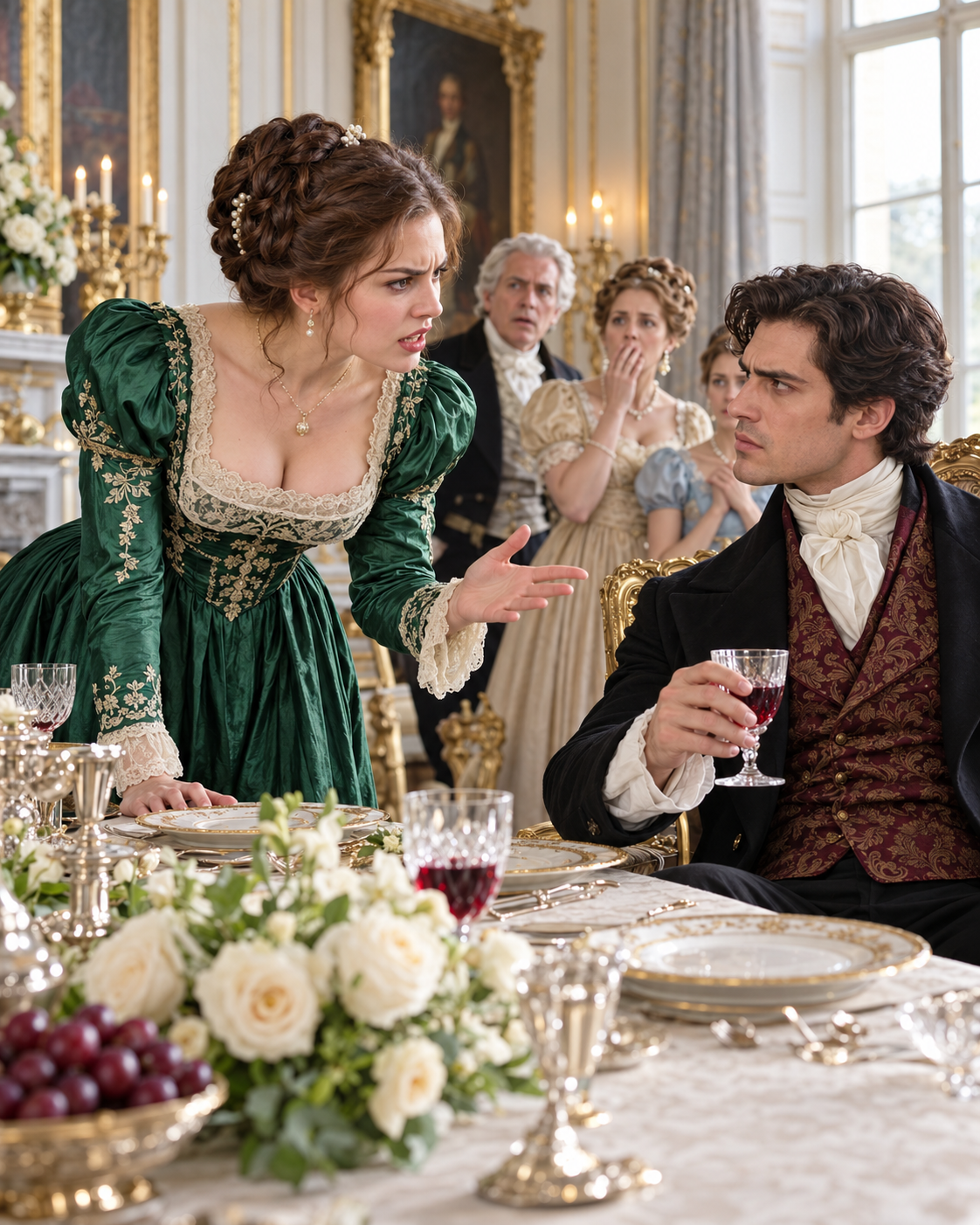
The Duke of Rothford had come to choose a wife. By the end of dinner, he was staring at the one woman who had just told him he wasn’t fit to be a husband.
“Tell her who signed that agreement before I did.”
The words fell into the room like stones dropped into still water.
Claraara stared at the document, her heartbeat growing louder with every passing second. The name beneath the heavy black strokes had been deliberately concealed, but she could make out the beginning of a capital R and the faint remains of another letter.
Her father pressed a trembling hand against the chair.
“Lord Ravenswick,” he whispered.
The Duke’s jaw tightened.
“Say his full name.”
“Edmund Ravenswick.”
Claraara’s stomach turned.
She knew that name.
Everyone in the county knew it.
Lord Edmund Ravenswick was sixty-two years old, twice widowed, and possessed of a fortune so considerable that polite society had apparently decided his cruelty was merely eccentricity.
His first wife had died after falling down a staircase. His second had vanished from public life for nearly a year before succumbing to a mysterious illness.
Claraara had met him once.
He had examined her as though she were a horse being considered for purchase.
“You agreed to marry me to that man?”
Her voice was barely audible.
Her father attempted to speak, but no words came.
“Six weeks ago,” she continued, looking at the date. “You signed this six weeks ago. While I was helping Mother plan my sister’s birthday celebration. While you were asking whether I wished to visit Aunt Margaret in Bath.”
“Claraara, I had no choice.”
She looked at him.
“No choice?”
Her father swallowed.
“The estate is in debt.”
A terrible understanding began to unfold.
The neglected west wing. The dismissed servants. Her mother’s jewelry disappearing from its familiar places. The increasingly desperate invitations sent to wealthy acquaintances.
She had noticed everything.
She had simply never imagined herself included among the assets available for liquidation.
“How much?” she asked.
Her father looked away.
“How much do you owe him?”
“Forty thousand pounds.”
Her mother made a small, broken sound.
Claraara closed her eyes.
Forty thousand pounds was not merely a debt. It was a catastrophe.
“And in exchange for forgiving it,” she said slowly, “Lord Ravenswick was to receive me.”
Her father flinched.
“He offered security. Your sister’s future would have been protected. The house would have remained ours.”
“All for the modest price of one daughter.”
“Claraara!”
“No, Father. You have mistaken my patience for permission.”
The Duke stepped closer, but Claraara raised one hand.
“Please.”
He stopped immediately.
She turned the agreement over.
There was another clause near the bottom, written in smaller script.
Her eyes narrowed.
“‘In the event of refusal by the intended bride, the creditor shall be entitled to immediate satisfaction of the outstanding obligation, secured against the residence and its remaining lands.'”
Her father sank into his chair.
Claraara looked toward her sister.
The girl’s face was wet with tears.
“Emily,” Claraara whispered. “Did you know?”
Emily shook her head desperately.
“Not until yesterday.”
“Yesterday?”
“Mother told me I must make a favorable impression upon the Duke. She said if he married me, there might still be a way to save you.”
Claraara turned toward the man standing beside her.
The Duke’s face had become unreadable.
“Your Grace,” she said, “I believe you owe me an explanation.”
He inclined his head.
“More than one.”
“Then begin with why your signature appears on a document offering me to another man.”
He looked at the agreement.
“Because Ravenswick believed I would pay generously to prevent that marriage.”
Claraara’s breath caught.
“You knew?”
“I learned of the agreement nine days ago.”
“And you signed it?”
“I signed an amendment transferring the debt to me, conditional upon proper legal execution. Your father has already signed. Ravenswick has not yet surrendered his original instrument.”
The distinction offered little comfort.
“So now I belong to you instead?”
The Duke recoiled as though she had struck him.
“No.”
“Then why is my name on this paper?”
“Because it was already there, and I wanted to make certain Ravenswick could never use it against you.”
Claraara searched his face.
“And what do you expect in return?”
“Nothing.”
She laughed once, without amusement.
“Men who possess forty thousand pounds seldom spend it without expecting something.”
“Then perhaps I am an exceptionally poor businessman.”
“Or an exceptionally accomplished liar.”
A faint shadow crossed his features.
“That is a possibility you should consider.”
The answer surprised her.
Most gentlemen would have protested their honor until the candles burned out. This one had simply acknowledged that she had reason to distrust him.
It made him considerably more dangerous.
Her father leaned forward.
“Your Grace, surely we can settle this discreetly.”
The Duke turned.
“No, Sir Henry. Discretion is precisely how your daughter came to be promised to a man without her knowledge.”
Sir Henry lowered his eyes.
The Duke removed a small watch from his waistcoat.
“Ravenswick expects your answer tomorrow morning. He believes that if I refuse to assume the debt, the marriage will proceed.”
Claraara felt a sudden chill.
“He intends to come here?”
“At eleven.”
“Then he may save himself the journey.”
The Duke looked at her steadily.
“Unfortunately, he will not.”
Something in his voice made her hesitate.
“Why?”
“Because Lord Ravenswick is not merely interested in collecting what he is owed.”
He glanced toward her father.
“He is searching for something he believes your family possesses.”
Sir Henry’s expression changed.
Not confusion.
Recognition.
And Claraara understood that the worst part of the evening had not yet begun.
The Duke requested a private conversation with her in the library.
Her mother objected immediately.
“That would be highly improper.”
Claraara turned toward her.
“Mother, I have just discovered that my marriage was arranged without my consent. I believe propriety has already suffered a fatal injury.”
For the first time that evening, Emily smiled through her tears.
The Duke offered Claraara his arm.
She ignored it and walked ahead.
He followed without comment.
The library smelled of leather, old paper, and rain-damp stone. A fire burned low in the grate, casting amber light across the bookshelves.
Claraara closed the door.
“Speak plainly.”
The Duke remained standing.
“Ravenswick believes your late grandfather left behind a collection of documents concerning the East India Company.”
She frowned.
“My grandfather was a magistrate.”
“Before that, he worked in commercial law. He investigated certain private investments involving Ravenswick’s father and several prominent families.”
“That was forty years ago.”
“Some crimes remain profitable long after the men who committed them are dead.”
Claraara folded her arms.
“What sort of crimes?”
“Fraud. Illegal transfers of property. Money diverted from widows’ settlements and charitable trusts.”
“Do you have proof?”
“Not enough.”
He paused.
“But your grandfather did.”
Claraara considered this.
Her grandfather had died when she was seventeen. He had been an exacting man, fond of chess, dreadful poetry, and peppermint sweets.
He had also trusted her with tasks he refused to give anyone else.
Cataloging his books.
Sorting his correspondence.
Maintaining the private index to his collection.
She suddenly remembered something.
A conversation beside his deathbed.
He had pressed a little brass key into her palm and murmured, “When people ask for what they have not earned, look where the honest man stands.”
At the time, she had thought he was confused.
She still possessed the key.
The Duke noticed her expression.
“What is it?”
“Why did you write to me three months ago?”
He hesitated.
“Because I needed to know whether you remembered your grandfather’s papers.”
“And why would you believe I did?”
“Because he mentioned you in a letter to my father.”
Claraara stared at him.
“Your father knew my grandfather?”
“Very well.”
“Then why was I never told?”
The Duke moved to the fireplace.
“My father died investigating Ravenswick’s investments. Officially, it was a riding accident.”
Claraara’s anger softened despite herself.
“How old were you?”
“Twenty.”
“And you believe Ravenswick was responsible?”
“I believe my father discovered something that frightened him.”
The Duke turned back.
“That was eleven years ago. Since then, three other men connected to those accounts have died under unusual circumstances.”
A log collapsed in the grate.
Claraara stood very still.
“You came here looking for evidence.”
“Yes.”
“Not a wife.”
His gaze settled upon her.
“At first, no.”
The admission irritated her more than she cared to acknowledge.
“Then your courtship of Emily was a performance?”
“A foolish one.”
“You were cruel to her.”
“I was.”
“And you expected me to admire you for admitting it?”
“No.”
He approached, stopping a respectful distance away.
“I expected you to send me from the house. I very nearly deserved it.”
“Very nearly?”
“Entirely.”
She looked away before he could see the reluctant movement at the corner of her mouth.
A knock interrupted them.
Emily entered, pale and breathless.
“Claraara, Father has gone.”
Claraara straightened.
“Gone where?”
“To Ravenswick Manor.”
The Duke swore softly.
Emily twisted her hands.
“He said he could still persuade Lord Ravenswick to destroy the agreement. Mother begged him not to go.”
“How long ago?”
“Perhaps fifteen minutes.”
The Duke reached for his coat.
“His carriage cannot have gone far.”
But before he reached the door, Emily spoke again.
“There’s something else.”
She held out a folded note.
“A servant delivered this for you, Claraara. He said it must not be opened in front of Father.”
Claraara took it.
The paper smelled faintly of lavender.
Inside were seven words.
Your grandfather’s secret is beneath the queen.
Beneath them appeared an initial.
M.
Claraara read the sentence twice.
Then a third time.
The Duke watched her face.
“Do you understand it?”
She looked toward the library’s far wall.
“Possibly.”
He followed her gaze.
Above the fireplace hung a large portrait of Queen Anne, painted in somber colors.
Her grandfather had detested the picture.
He had once called it the ugliest object in England.
Yet he had refused to let anyone remove it.
Claraara walked toward the portrait.
“Help me lift it.”
The Duke stared.
“Miss Claraara—”
“Unless Your Grace has developed a sudden affection for eighteenth-century portraiture, I suggest you make yourself useful.”
He moved immediately.
Together they lifted the heavy frame.
Behind it was a narrow recess in the wall.
And inside the recess sat a small iron box.
Claraara felt the brass key beneath the ribbon around her neck.
She had worn it for years, never understanding why she could not bear to put it away.
Her fingers trembled as she fitted it into the lock.
It turned.
Inside lay a leather-bound ledger, several sealed letters, and a miniature portrait of a beautiful young woman.
Claraara picked up the portrait.
The woman possessed dark eyes, a narrow face, and an expression of extraordinary sadness.
On the back, in her grandfather’s handwriting, were two words.
Margaret Ravenswick.
The Duke went utterly still.
“Where did you find that?”
“In the box.”
He took the miniature carefully.
“Margaret Ravenswick was Edmund’s younger sister.”
Claraara frowned.
“I thought Lord Ravenswick had no siblings.”
“That is what he wants everyone to believe.”
He opened the ledger.
As he turned the pages, the blood slowly drained from his face.
“Dear God.”
Claraara moved beside him.
“What?”
He pointed to an entry dated thirty-eight years earlier.
A substantial inheritance had been transferred from Margaret Ravenswick’s trust to her brother’s private accounts.
Two weeks later, Margaret had been declared mentally incompetent.
Three months after that, records showed her death.
But the next page contained a payment.
Made twenty years later.
To a woman named Margaret Vale.
For the maintenance of a child.
Claraara looked up.
“She survived.”
“Apparently.”
“And had a child.”
The Duke’s eyes moved rapidly over the remaining entries.
Then he stopped.
At the bottom of the page, written in her grandfather’s careful hand, was a name.
Eleanor Vale.
Claraara went cold.
Her mother’s name had been Eleanor Vale before her marriage.
For several moments, the only sound was the rain.
Then Emily whispered from the doorway.
“Mother?”
Claraara turned.
Lady Eleanor stood behind her youngest daughter, staring at the open ledger.
The color had completely left her face.
“Mother,” Claraara said slowly, “who was Margaret Ravenswick?”
Lady Eleanor closed her eyes.
“My mother.”
The revelation seemed to separate the room from the rest of the world.
Claraara stared at the woman who had raised her, corrected her posture, criticized her opinions, and insisted that proper ladies did not speak too loudly.
For the first time, her mother looked genuinely frightened.
“Why did you never tell us?”
“Because I promised your grandfather I would not.”
“Why?”
Lady Eleanor approached the fireplace.
“Because Edmund Ravenswick spent thirty years searching for me.”
She looked at the ledger.
“My mother was the rightful owner of nearly half his fortune. When she discovered what he had done, he had her confined to a private institution.”
Emily covered her mouth.
“Grandfather found her?”
Lady Eleanor nodded.
“He was the solicitor who helped her escape. He arranged a new identity for her and protected us until she died.”
Claraara’s thoughts raced.
“Then Ravenswick wants the ledger because it proves the theft.”
“Yes.”
“And he wants me because—”
Her mother began to cry.
“Because your grandfather left the evidence to you.”
Claraara stepped backward.
“He knew?”
“He believed you were the only one of us who would refuse to surrender it.”
“Then why did you allow Father to sign that agreement?”
Lady Eleanor’s expression crumpled.
“I did not know until after he had done it.”
The Duke closed the ledger.
“We must send for a magistrate.”
“No,” Lady Eleanor whispered.
Everyone looked at her.
“Edmund has men in the county courts. He has purchased favors from magistrates, clerks, and bankers. Your father went to him because he believes confession will spare his family.”
Claraara thought of her father traveling through the rain.
“He will be killed.”
The Duke did not answer.
He did not need to.
Claraara reached for her cloak.
“Then we must go after him.”
The Duke caught her wrist gently.
“Absolutely not.”
She looked down at his hand.
He released her at once.
“You cannot approach Ravenswick Manor carrying evidence that could destroy him.”
“And you cannot expect me to remain beside a comfortable fire while my father walks into a trap.”
The Duke’s expression hardened.
“This is not a drawing-room dispute.”
“No. It is something considerably worse.”
“Then understand the danger.”
“I do.”
He searched her face.
“You are determined?”
“Entirely.”
For a long moment, he said nothing.
Then he opened the library door.
“Very well. But we do this my way.”
Claraara lifted an eyebrow.
“Your Grace, given the results of your previous plans, I believe we should at least consider a second opinion.”
To her surprise, he laughed.
It was brief, low, and entirely genuine.
Then he called for his carriage.
Ravenswick Manor stood beyond a dark stretch of woodland, its stone towers rising above the rain like the remains of an abandoned fortress.
By the time they arrived, midnight had passed.
The Duke had sent his trusted steward, Mr. Pembroke, ahead with copies of the ledger’s most damning pages. A second messenger was riding toward London, carrying a sealed appeal to the Lord Chancellor and the Duke’s solicitor.
The original documents remained locked at Rothford House.
Claraara carried only the miniature portrait.
The Duke had insisted upon that precaution.
For once, she had agreed.
They entered through the eastern servants’ passage, guided by a housekeeper whose sister had once worked for Claraara’s grandfather.
Mrs. Whitcomb was a severe woman with silver hair and steady hands.
“His lordship is in the music room,” she whispered. “Your father is with him.”
“Is he alive?” Claraara asked.
“For the moment.”
The words chilled her.
They crossed a narrow corridor.
Then they heard shouting.
“You promised my daughter would be spared!”
Sir Henry’s voice.
Ravenswick answered with terrible calm.
“And I promised you that your debts would be forgiven. You should have learned by now that a promise is only as useful as the man who makes it.”
Claraara moved toward the door.
The Duke stopped her.
“Listen.”
Inside, a chair scraped violently against the floor.
“I have nothing more to give you,” her father said.
“Oh, but you do.”
Ravenswick’s voice became almost affectionate.
“You have two daughters.”
Claraara felt the Duke stiffen beside her.
“Your eldest has been troublesome,” Ravenswick continued. “Perhaps the younger will prove more obedient.”
Sir Henry made a strangled protest.
Claraara pushed open the door.
“How unfortunate for you,” she said, “that neither of us has inherited obedience.”
Three men turned toward her.
Her father sat in a chair beside the fireplace, his wrists bound.
Lord Ravenswick stood near the pianoforte.
He was tall and elegantly dressed, with thinning silver hair and a face that seemed preserved by the complete absence of kindness.
A broad-shouldered servant waited beside the door.
Ravenswick smiled.
“Miss Claraara.”
His gaze slid toward the Duke.
“Rothford. How disappointing. I had hoped you were more sensible.”
“I have often been accused of the opposite,” the Duke replied.
Claraara moved toward her father, but the servant stepped in her path.
“Stand aside,” she said.
He did not.
Ravenswick examined her with open amusement.
“You have your mother’s eyes.”
Claraara stopped.
“And you have her inheritance.”
The smile disappeared.
For the first time, genuine anger entered his expression.
“Be careful, child.”
“I am not a child.”
“No. You are a young woman who has mistaken a few family stories for legal authority.”
Claraara reached into her cloak.
Ravenswick’s eyes sharpened.
She withdrew the miniature.
His entire body went rigid.
“Where did you get that?”
“From my grandfather.”
Ravenswick took one step forward.
“Give it to me.”
“No.”
“You have no idea what you are holding.”
“A portrait of the sister you imprisoned.”
His hand struck the pianoforte with such force that several strings rang beneath its closed lid.
“She was ill!”
“She was inconvenient.”
“She was incapable of managing her affairs!”
“Then why did you continue using her signature after she was supposedly dead?”
The room fell silent.
Ravenswick stared at her.
The Duke moved closer.
“We have the ledger, Edmund.”
Ravenswick’s face changed.
Not with fear.
With calculation.
“Then we can negotiate.”
“There will be no negotiation.”
“Every man has a price, Rothford.”
The Duke’s voice was cold.
“Not every man.”
Ravenswick smiled again.
“Your father believed that too.”
The Duke froze.
Claraara felt the air leave the room.
“What did you say?” he asked.
Ravenswick lifted one shoulder.
“Your father was a persistent fool. Always asking questions. Always insisting that the truth mattered.”
The Duke’s hands curled into fists.
“Did you kill him?”
Ravenswick regarded him almost pityingly.
“I merely arranged for a horse to be frightened. The animal performed the remainder of the work.”
A terrible silence followed.
Claraara turned toward the Duke.
His face had become utterly still.
She had seen men lose their tempers before.
This was worse.
“Your Grace,” she whispered.
He did not move.
Ravenswick continued, enjoying the effect.
“He died for a handful of papers. And now you mean to repeat his mistake.”
The Duke advanced.
Claraara caught his sleeve.
“Look at me.”
His eyes remained fixed on Ravenswick.
“Please.”
Slowly, he turned.
She saw eleven years of grief burning behind his composure.
“If you strike him,” she said quietly, “he becomes a wounded nobleman. If you expose him, he becomes what he truly is.”
The Duke’s breathing slowed.
Ravenswick laughed.
“How touching.”
Then he nodded toward the servant.
“Take the girl.”
The man lunged.
Claraara stepped backward, but her cloak caught against a chair.
The servant seized her arm.
The Duke struck him with a single brutal blow.
The man stumbled into the pianoforte, sending a discordant crash through the room.
Ravenswick pulled a pistol from his coat.
“Enough!”
Everyone froze.
The pistol pointed directly at Claraara.
The Duke lifted both hands.
“Put it down.”
Ravenswick’s eyes glittered.
“Where is the ledger?”
“Safe.”
“Then send for it.”
“No.”
Ravenswick pressed the barrel closer to Claraara’s shoulder.
“Do you love her, Rothford?”
The question came so suddenly that Claraara forgot her fear.
The Duke did not hesitate.
“Yes.”
One word.
Quiet.
Absolute.
Claraara stared at him.
Ravenswick gave a delighted little laugh.
“Excellent. Then we have discovered your price.”
He turned the weapon toward the Duke.
“Tell me where the documents are.”
The Duke held Claraara’s gaze.
“At my house.”
“Where?”
“In the west study. Beneath the third drawer of my writing desk.”
Claraara’s heart sank.
He was surrendering everything.
The Duke continued.
“The key is in my coat.”
Ravenswick extended his hand.
“Give it to me.”
The Duke reached slowly inside his jacket.
But before he could withdraw anything, a sharp knock sounded from the corridor.
Ravenswick whirled.
“Who is it?”
Mrs. Whitcomb’s voice answered.
“Your lordship, Mr. Pembroke has arrived with a message from London.”
The Duke’s expression changed.
Ravenswick noticed.
“Pembroke?”
The door opened.
Mr. Pembroke entered with two armed constables and a gray-haired gentleman carrying a leather dispatch case.
Ravenswick raised the pistol.
“Get out!”
The gentleman remained perfectly calm.
“Lord Ravenswick, I am Mr. Ashcombe, a solicitor acting under instructions from His Grace’s legal representatives. The local magistrate has been notified, and these officers are here to secure the premises while a complaint concerning unlawful detention is investigated.”
Ravenswick laughed wildly.
“You have no authority over me!”
“Perhaps not to determine guilt,” Ashcombe replied, “but sufficient cause to prevent you from leaving while the proper authorities are summoned.”
The Duke spoke softly.
“Edmund, lower the weapon.”
For several seconds, Ravenswick appeared unable to decide whether to shoot or surrender.
Then Claraara saw his hand tremble.
The pistol fired.
The explosion deafened her.
Glass shattered behind the Duke.
He staggered backward.
Claraara screamed his name.
One of the constables seized Ravenswick’s arm. The other wrestled the pistol away as the room erupted into chaos.
But Claraara saw only the Duke.
He had fallen against the wall, one hand pressed to his upper arm.
Blood spread across his coat.
She reached him before anyone else.
“Do not move.”
He looked at her, pale but conscious.
“I had not intended to.”
Her hands shook as she examined the wound.
The bullet had passed through the flesh of his upper arm, missing the bone.
She tore a strip from her petticoat and pressed it firmly against the bleeding.
“You ridiculous man,” she whispered.
His mouth curved faintly.
“An accurate description.”
“You might have died.”
“I’ve endured worse dinners.”
She let out a broken laugh that became a sob.
He lifted his uninjured hand toward her cheek.
Then stopped, as though even now he feared presuming too much.
Claraara caught his fingers and held them against her face.
“Don’t you dare leave me,” she whispered.
Something softened in his eyes.
“I shall do my best to avoid it.”
Behind them, Ravenswick was being restrained.
His protests grew louder as the constables bound his hands.
But Claraara barely heard him.
For the first time in her life, she was afraid not of losing her freedom, but of losing someone who had finally learned to respect it.
The weeks that followed brought scandal beyond anything the county had witnessed in living memory.
Lord Ravenswick was taken into custody pending proceedings concerning the shooting, unlawful confinement, fraud, and allegations connected to the Duke’s father’s death.
The ledger’s contents were examined by independent solicitors. Additional records recovered from Ravenswick Manor established a pattern of diverted funds, falsified signatures, and payments made to conceal inconvenient witnesses.
The accusation concerning the Duke’s father required further investigation.
Ravenswick had spoken freely before witnesses, but a confession made in anger was not the same as a completed case.
The Duke understood that.
He wanted justice more than spectacle.
Meanwhile, Sir Henry’s marriage agreement was challenged and abandoned. It could never have compelled Claraara to marry, but the financial obligations behind it remained dangerously real.
The Duke did not simply erase the debt.
Instead, he arranged for its lawful transfer into a trust administered by independent solicitors, with a repayment schedule Sir Henry could meet through the sale of certain investments and unused land.
It was a consequence.
Not a punishment inflicted upon his daughters.
For the first time in many years, Sir Henry was required to live within his means.
He did not enjoy the experience.
But slowly, painfully, he began to understand it.
One afternoon, he found Claraara in the garden.
The autumn leaves were beginning to gather beneath the trees.
He stood beside her for a long while before speaking.
“I thought I was saving the family.”
Claraara continued trimming a rosebush.
“You were saving the house.”
Her father swallowed.
“I suppose I was.”
She looked at him.
“The house was never what made us a family.”
Tears gathered in his eyes.
“I know that now.”
She considered the man before her.
He was flawed, frightened, and far less wise than she had once believed.
But he was also her father.
And she did not wish to spend the rest of her life imprisoned by what he had done.
“I cannot pretend it did not happen,” she said.
“I would not ask you to.”
“But perhaps, in time, I can forgive you.”
Sir Henry bowed his head.
“That is more than I deserve.”
“Then spend the rest of your life becoming worthy of it.”
He nodded.
And for the first time, Claraara believed he might.
The Duke returned to Rothford House shortly after his wound began to heal.
He had spent three weeks under the care of a physician who complained frequently about the stubbornness of aristocratic patients.
Claraara visited him twice.
On the third occasion, she found him standing in the library, attempting to fasten his coat with one hand.
“You are supposed to be resting.”
He turned.
“And you are supposed to announce yourself.”
“I did.”
“I must have been distracted.”
“By your heroic struggle with a button?”
He looked down.
“The button is winning.”
Claraara crossed the room and fastened it for him.
For a moment, neither spoke.
He watched her hands.
She was suddenly aware of how close they stood.
“Your Grace,” she said quietly, “there is something we must discuss.”
His expression became serious.
“Of course.”
“You told Ravenswick you loved me.”
He looked away.
“Yes.”
“Was that true?”
He met her eyes.
“Entirely.”
Claraara’s breath caught.
He continued before she could speak.
“I was arrogant when we met. I treated your sister carelessly. I believed I could manage people as easily as I managed estates.”
“You were rather dreadful.”
“I know.”
“And accustomed to being obeyed.”
“Unfortunately.”
“And convinced that everyone would be grateful for your attention.”
He sighed.
“Are we approaching the conclusion of this indictment?”
“Not yet.”
She stepped closer.
“You were also brave. And capable of admitting when you were wrong. And willing to risk your reputation to protect people who could offer you nothing.”
His gaze softened.
“Claraara—”
“But I will never marry a man who believes he has purchased my affection.”
He stood very still.
“Nor would I ask you to.”
“I will not be managed.”
“I have abandoned any hope of managing you.”
“And I will not spend my life being grateful that a duke chose me.”
His expression grew unexpectedly tender.
“Then perhaps you might consider spending it beside a man who is grateful you chose him.”
Claraara’s eyes filled with tears.
For several seconds, she could not answer.
The Duke reached into his coat and withdrew a small velvet box.
He opened it.
Inside lay a simple gold ring set with a single sapphire.
“It belonged to my mother,” he said. “My father gave it to her when they had nothing but a small estate and an unreasonable amount of confidence.”
Claraara smiled through her tears.
“That sounds familiar.”
“He told me once that marriage was not the discovery of someone who would always agree with you.”
“How reassuring.”
“It was the discovery of someone whose honesty made you better.”
The Duke lowered the box.
“I cannot promise I shall never be foolish again.”
“That would be an impossible promise.”
“But I can promise to listen when you tell me so.”
Claraara looked at the ring.
Then at the man holding it.
“Would you truly have married Emily if I had remained silent at dinner?”
He shook his head.
“No. I had already begun to suspect the proposed courtship was unfair to her. I intended to withdraw.”
“And your letters?”
“I wrote because I admired your grandfather’s account of your judgment. Then I read an article you had written anonymously about education for girls.”
Claraara stared.
“You read that?”
“Three times.”
“It was rather severe.”
“It was magnificent.”
She laughed softly.
“Your Grace, you are becoming dangerously agreeable.”
“I assure you, the condition is temporary.”
He closed the distance between them.
“Claraara, will you marry me?”
She studied his face for a long moment.
Then she took the box from his hand.
“Yes.”
His eyes widened.
“Yes?”
“On one condition.”
He smiled helplessly.
“I should have expected that.”
“You must never stop allowing me to disagree with you.”
He took her hand.
“My darling, I suspect the greater difficulty will be persuading you to stop.”
She laughed.
And when he kissed her, it was not the triumphant kiss of a man claiming what he had won.
It was gentle.
Careful.
A question answered by another question, until neither needed words.
They married the following spring.
There was no extravagant spectacle, no procession intended to impress the nobility, and no invitation extended to Lord Ravenswick, whose legal troubles continued to occupy several very determined investigators.
Instead, they held a small ceremony beneath the ancient stone arches of the village church.
Emily stood beside Claraara wearing pale blue, the same color she had worn on the dreadful evening that had changed everything.
But this time, she smiled without fear of disappointing anyone.
She had recently accepted a place at an academy where she intended to study music.
Her mother had protested initially.
Claraara had reminded her that opportunities were more valuable than appearances.
Lady Eleanor, to everyone’s surprise, had agreed.
Sir Henry walked his eldest daughter toward the altar.
Before releasing her hand, he whispered, “You were always braver than I knew.”
Claraara looked at him.
“No, Father. I simply learned that courage sometimes means disappointing the people we love.”
He nodded, tears bright in his eyes.
At the altar, the Duke waited.
When Claraara reached him, he leaned closer.
“You look magnificent.”
“How observant.”
“I have been practicing.”
“Your progress is encouraging.”
He laughed beneath his breath.
The priest cleared his throat.
And for once, Claraara decided to remain silent.
After their marriage, the Duke and Duchess of Rothford established a charitable foundation using funds recovered from Ravenswick’s fraudulent accounts, once the proper claims and restitution had been settled.
Its purpose was simple.
To provide education, legal assistance, and practical opportunities for women whose futures had been decided by everyone except themselves.
Claraara oversaw its work personally.
She insisted upon visiting the schools, speaking with the teachers, examining the accounts, and ensuring that no girl was turned away merely because her family considered her ambitions inconvenient.
The Duke occasionally complained that his wife worked harder than his entire household.
She informed him that he was welcome to help.
He usually did.
Years later, when their daughter was old enough to ask how her parents had fallen in love, the Duke gave a solemn answer.
“Your mother informed me that I was unfit to be a husband.”
The little girl gasped.
“Was she right?”
“Entirely.”
Claraara, sitting beside the window with a book, looked up.
“And what did you do, Papa?”
The Duke smiled.
“I decided to become fit for the position.”
Their daughter considered this.
“Did it take very long?”
“Somewhat longer than I anticipated.”
Claraara laughed.
The child climbed onto her father’s knee.
“Then why did Mama marry you?”
He looked across the room at his wife.
The late afternoon sunlight rested upon her hair, illuminating the familiar strength in her expression.
“Because,” he said softly, “she believed I could become better than I was.”
Claraara closed her book.
“No, darling,” she corrected gently.
Their daughter turned.
“I married your father because he proved that he was willing to become better. There is a difference.”
The Duke bowed his head.
“A very important one.”
Outside, the gardens glowed beneath the spring sunshine.
Inside, the little girl considered her parents with the fierce seriousness of childhood.
“Then I shall only marry someone who listens to me.”
Claraara smiled.
“An excellent beginning.”
“And if he does not?”
The Duke answered before his wife could.
“Then tell him he is not fit to be a husband.”
Their daughter burst into laughter.
So did Claraara.
And the Duke, who had once entered a dining room believing that wealth, title, and authority were sufficient to secure a woman’s affection, laughed with them.
He had arrived at that first dinner intending to choose a wife.
Instead, he had met a woman who refused to be chosen like a possession.
She had challenged his pride, exposed his mistakes, and taught him that genuine love required something far more difficult than admiration.
It required respect.
And Claraara had discovered something equally important.
A woman did not need to become smaller to be loved.
She did not need to soften her intelligence, conceal her convictions, or remain silent when someone treated her unjustly.
The right person would not demand her surrender.
He would stand beside her while she became everything she was capable of being.
For the greatest love stories are not about one person rescuing another.
They are about two people who discover, through courage and honesty, that they can build a life in which neither must lose themselves.
And sometimes, the happiest marriage begins with a woman looking a powerful man directly in the eyes and telling him the truth no one else has dared to speak.