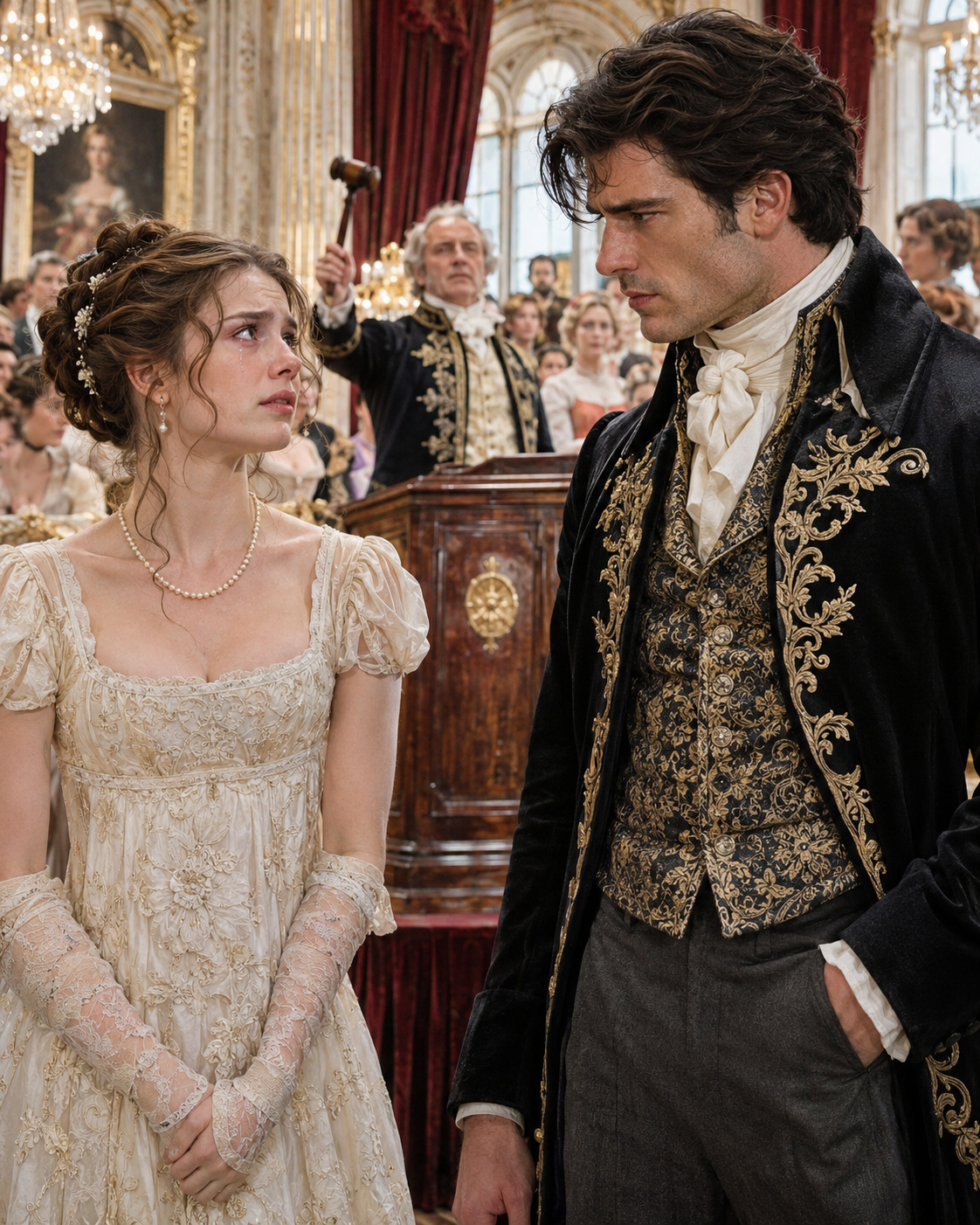
The Duke of Ravensmore offered £10,000 for a woman everyone else believed could be bought for £4,000. But when he stepped forward to claim his prize, he said something that silenced the entire room.
Sabine stared at the name written beneath the official seal. The letters were unmistakable, although the elegant handwriting surrounding them belonged to someone else. Mr. Edmund Vale. The same man her father had described as missing in the final letter he had written before his death.
For several seconds, the only sound in the breakfast room was the quiet crackling of the fire.
“Who witnessed this agreement?” Sabine asked.
The stranger holding the dispatch case glanced toward Lord Merrick.
“A respectable gentleman whose testimony has already been accepted by the relevant authorities.”
“His name is Edmund Vale.”
“That is correct.”
Sabine lifted her father’s letter.
“Then I should very much like to meet him.”
Something changed in Merrick’s expression. It was almost imperceptible—a brief tightening at the corners of his mouth—but Lady Estella noticed.
“An excellent suggestion,” she said. “Where is Mr. Vale presently residing?”
The stranger closed his dispatch case with deliberate care.
“I am not obliged to disclose the whereabouts of a private witness.”
“Yet you are quite willing to rely upon his testimony.”
“Madam, the matter is considerably more complicated—”
“Only because you are making it so.”
Sir Cassius stepped forward, his voice carrying the weary authority of a man accustomed to ending arguments simply by entering them.
“This conversation has gone far enough. Sabine, give me your father’s letter.”
She did not move.
“Sabine.”
For twenty-three years, she had been taught to recognize that particular tone. It was the voice her uncle used when servants displeased him, when tradesmen requested payment, and when she dared to question decisions supposedly made for her protection.
But this time, the paper remained in her hands.
“No, Uncle.”
The refusal was quiet.
Cassius looked as though she had struck him.
Lady Estella crossed the room and positioned herself beside Sabine.
“Sir Cassius, you will leave that young woman in peace. And you, gentlemen, will refrain from threatening her with legal proceedings until the authenticity of your documents has been established.”
Merrick gave a cold smile.
“You seem remarkably confident, Lady Estella.”
“I generally am when gentlemen arrive with suspicious papers and nervous solicitors.”
His smile vanished.
The stranger gathered his documents, murmured that formal proceedings would follow, and withdrew. Merrick lingered just long enough to look at Sabine.
“You are making a considerable mistake.”
She met his eyes.
“Then you should have no difficulty proving it.”
He bowed without warmth and followed the solicitor into the hall.
Only after the carriage departed did Sabine realize how tightly she had been holding her father’s letter. The edge had left a pale indentation across her palm.
Estella gently took the document from her.
“We must finish reading this somewhere your uncle cannot interrupt us.”
Cassius began to object, but Estella had already turned away.
“Your housekeeper tells me the west library is still locked,” she said. “I believe it is time someone opened it.”
The west library had belonged to Sabine’s father.
After his death, Cassius had ordered the room closed, claiming that its contents were too painful for the family to revisit. Sabine had accepted the explanation at seventeen, when grief made almost anything believable.
Now she followed Estella through the long corridor, noticing how the old portraits seemed to watch their progress.
At the library door, the housekeeper waited with a ring of keys.
Mrs. Whitcombe had served the Carr family for nearly forty years. Her hair was entirely white, and she had the composed expression of a woman who had learned more about the household than anyone had ever intended.
“I thought you might come here today, Miss Sabine.”
The old woman placed a small brass key in her hand.
“Your father asked me to keep this for you.”
Sabine looked at her in astonishment.
“Why didn’t you tell me?”
Mrs. Whitcombe lowered her eyes.
“Because Sir Cassius dismissed two servants for asking about the room. I had no wish to leave you alone in this house.”
Sabine felt a sudden ache behind her ribs.
All those years, she had believed herself almost entirely without allies.
The lock resisted at first. Then the key turned, and the door opened upon the stillness of a room abandoned in haste.
Dust softened the dark shelves. A green reading lamp stood beside an armchair, and a pair of spectacles rested upon an open volume as though their owner had merely stepped outside.
Sabine stopped.
Her father had worn those spectacles every evening.
She remembered him looking over their rims whenever she entered with some improbable question about the world. He never laughed at her curiosity. He always made room for her beside the fire.
Estella waited without speaking.
At last, Sabine approached the desk.
A faint circle marked the wood where her father’s tea cup had once stood.
She touched it with one finger.
Then she unfolded the letter.
The opening passages confirmed what she had already read. Her father believed that someone had altered the estate accounts and created obligations that did not exist.
But the next sentences were worse.
He had discovered that several payments supposedly made to agricultural creditors had been diverted through a private account controlled by his brother-in-law.
Cassius had claimed that the money was necessary to preserve the family’s holdings during a disastrous harvest.
In reality, the funds had been transferred to a speculative investment arranged by Lord Merrick’s father.
When the investment failed, the missing money had been disguised as personal debts belonging to Mr. Carr.
Sabine read the passage twice.
“My uncle stole from him.”
Estella’s expression remained grave.
“That appears to be what your father suspected.”
“Why didn’t he expose them?”
“Because suspicion is not proof. Your father needed the original records.”
The letter continued.
Edmund Vale, a junior clerk employed by the financial agents, had discovered the false entries. He agreed to provide copies of the genuine accounts but disappeared before delivering them.
Her father had then approached the Duke of Ravensmore.
Sabine reached the final page.
The handwriting had become uneven, as though the letter had been written during a moment of considerable distress.
Ravensmore refused to place his name against the accusations without first examining the evidence. I believed him a coward, and I said so. Yet I must acknowledge that he warned me of something I had not understood: the man controlling my accounts was also watching my correspondence.
Beneath those words was another sentence.
Should anything happen to me, the truth is not in the papers Cassius keeps. Look where your mother wished the winter roses to grow.
Sabine stared at the line.
Her mother had died when she was eight years old.
But she remembered the winter roses.
“They were in the old conservatory,” she whispered.
Mrs. Whitcombe, standing near the doorway, looked up sharply.
“Your father had the flower beds removed after your mother’s death.”
“Why?”
“He said the glasshouse needed repairs.”
Estella folded the letter.
“Then I suggest we inspect those repairs.”
They had scarcely reached the corridor when the front door opened again.
A man’s voice spoke to the butler.
Sabine recognized it before she saw him.
The Duke of Ravensmore stood in the entrance hall, rain darkening the shoulders of his coat.
His expression changed when he noticed the three women emerging from the library.
“Lady Estella.”
“Your Grace. You have arrived at a useful moment.”
The Duke looked at Sabine.
“Are you well?”
It was such an ordinary question that she nearly answered it with the polite falsehood expected of her.
Instead, she held out the letter.
“My father believed my uncle had stolen from him.”
The Duke did not immediately take it.
His gaze moved toward the open library door.
“Then you have found his correspondence.”
“You knew it existed?”
“I knew he had been keeping records. I did not know where.”
Sabine searched his face.
“Why did you refuse to help him?”
A muscle moved in his jaw.
Estella glanced between them, then quietly dismissed Mrs. Whitcombe.
The Duke removed his gloves.
“Because your father asked me to accuse men whose signatures appeared on documents I had not personally examined. One of those men was a close associate of my family. I insisted upon proof.”
“That sounds reasonable.”
“It would have been, had I stopped there.”
He looked toward the rain beyond the tall windows.
“I told him that pursuing the matter would ruin his reputation before it ruined theirs. I advised him to surrender the disputed property and accept the loss.”
Sabine said nothing.
“He asked whether I would give the same advice if the property belonged to my own family.”
“And what did you say?”
“I told him that sentiment had no place in financial affairs.”
The Duke’s voice remained steady, but his fingers closed around his gloves.
“Two weeks later, he was dead.”
Sabine looked down at the letter.
Her father had died after collapsing during a journey to London. The physician had attributed his death to an undiagnosed weakness of the heart.
There had never been any reason to question it.
Until now.
“Do you believe someone harmed him?”
The Duke hesitated.
“I have no evidence of that. And I will not burden you with an accusation I cannot support.”
For the first time, Sabine understood something about the man standing before her.
His reputation for severity had not been exaggerated. He was cautious, disciplined, and painfully aware of the consequences of acting without certainty.
But she could see how that caution had once become an excuse for doing nothing.
“You came to the auction because you felt guilty.”
“Yes.”
The admission was immediate.
“And because I discovered that the debt being used against you was connected to the accounts your father had asked me to examine.”
“Then you knew it might be fraudulent.”
“I suspected it. Paying the claim prevented your marriage from being used as its security while we investigated.”
Sabine turned away.
She wanted to thank him.
She also wanted to ask why ten thousand pounds had been easier for him to surrender than a little courage three years earlier.
Before she could speak, Estella intervened.
“There will be time for remorse later. At present, we have a conservatory to examine.”
The old glasshouse stood beyond the eastern gardens, partly concealed beneath climbing ivy.
Its iron framework had rusted, and several panes were missing. Inside, abandoned planting beds lay beneath broken tiles and scattered leaves.
Sabine remembered coming here with her mother during winter mornings, when the air smelled of damp earth and citrus leaves.
Her mother had wanted white roses growing along the southern wall.
The beds had never been completed.
Mrs. Whitcombe brought a lantern and a small garden spade.
The Duke crouched beside the lowest section of brickwork.
“These stones are newer than the others.”
Sabine knelt beside him.
A narrow strip of mortar had been applied unevenly along the base.
With careful pressure, the Duke loosened one brick.
Behind it lay a small cavity.
Inside was an oilcloth parcel.
Sabine reached for it, but the Duke stopped her.
“The covering may be fragile.”
He eased it free and placed it on an overturned planting bench.
The oilcloth opened to reveal a ledger, several folded receipts, and a narrow leather notebook.
At first glance, the pages appeared ordinary.
Then Sabine recognized her father’s handwriting in the margins.
The ledger recorded payments from the Carr estate to a series of creditors. Beside each entry, her father had written a second amount.
Some figures differed by hundreds of pounds.
Others by thousands.
Estella examined a receipt against the light.
“This signature has been traced.”
The Duke looked at her.
“Are you certain?”
“The pressure is wrong. And the final stroke has been interrupted.”
Sabine held another receipt.
It bore her father’s name.
But the handwriting belonged to no one she knew.
Then something slipped from between the ledger’s pages.
A visiting card.
On its reverse was written an address in London and a single sentence.
If Mr. Vale cannot be found, ask for his sister.
The Duke took the card.
“Mrs. Margaret Bell,” he read.
Estella’s face changed.
“Good heavens.”
Sabine looked at her.
“You know her?”
“I know the name. She was employed at Merrick House before Lord Merrick inherited the estate.”
The Duke folded the card carefully.
“Then she may know what happened to her brother.”
They returned to Carr Court shortly before dusk.
Sir Cassius was waiting in the entrance hall.
His eyes moved immediately toward the parcel beneath Sabine’s arm.
“Where have you been?”
“Walking in the gardens,” she answered.
Cassius looked past her to the Duke.
“Your Grace, I must insist that my niece’s affairs remain within the family.”
The Duke removed his damp coat.
“Then I suggest you begin treating her as a member of it.”
Cassius’s cheeks reddened.
“You have interfered quite enough.”
“Not nearly.”
The quietness of the reply made Cassius hesitate.
The Duke stepped closer.
“By tomorrow morning, I expect a complete inventory of every document relating to the Carr estate. You will also provide the names of the financial agents responsible for administering its accounts.”
“And if I refuse?”
“Then the matter will proceed without your cooperation.”
Cassius looked at Sabine.
There was no affection in his expression now.
Only calculation.
“You will regret bringing strangers into this house.”
Sabine held his gaze.
“They were strangers only because you kept everyone else away.”
That evening, the Duke arranged for two independent legal advisers to examine the recovered papers.
Estella remained at Carr Court, taking possession of the adjoining guest chamber and informing the servants that she intended to stay until Sabine’s position was secure.
Cassius withdrew to his private rooms.
For several hours, the house settled into a fragile peace.
Then, shortly after midnight, Sabine woke to the sound of footsteps outside her door.
She remained still.
A faint metallic sound followed.
Someone was testing the lock.
Sabine sat upright.
The handle turned once.
Then again.
A shadow moved beneath the door.
She reached for the bell beside her bed, but before she could pull it, a man’s voice whispered from the corridor.
“Miss Carr?”
She recognized the Duke’s voice.
“Your Grace?”
“Do not open the door yet.”
A sudden scuffle sounded outside.
Something struck the wall.
Then came hurried footsteps and the crash of a fallen candlestick.
Sabine pulled the bell.
By the time the servants arrived, the corridor was empty except for the Duke and a frightened young footman pressed against the paneling.
The Duke held a small iron key.
The footman’s face had turned gray.
“He was ordered to search your room,” Ravensmore said.
Sabine drew her dressing gown tightly around herself.
“By whom?”
The boy’s lips trembled.
“Sir Cassius, miss.”
The Duke released him.
“Go downstairs. You will not be dismissed for telling the truth.”
The footman fled.
Sabine looked at the key.
“What was he supposed to find?”
“The ledger.”
She felt the cold settle into her hands.
“Then my uncle knows what we discovered.”
“He knows enough to be frightened.”
The Duke glanced toward the staircase.
“I have arranged for the documents to be removed to a secure location before dawn.”
Sabine hesitated.
“And me?”
His expression softened.
“That choice belongs to you.”
No one had asked her that question since her father’s death.
She looked toward the dark windows.
“Then I choose to stay until I know exactly what happened.”
The Duke inclined his head.
“Very well.”
Before leaving, he placed the small iron key on the table beside her door.
“Keep this. I would rather you had evidence of tonight than another promise of protection.”
The following morning brought an unexpected visitor.
A middle-aged woman in a plain brown traveling dress arrived at Carr Court carrying a worn carpetbag.
She introduced herself as Margaret Bell.
When Estella brought her into the drawing room, Sabine noticed that the woman’s hands were red from cold and work. She declined tea, although she had clearly traveled a considerable distance.
“I received a message from His Grace,” Margaret said.
The Duke stood beside the fireplace.
“Thank you for coming.”
Margaret looked at Sabine.
“You have your father’s eyes.”
Sabine felt her throat tighten.
“You knew him?”
“He helped my brother when no one else would.”
“Edmund Vale?”
Margaret nodded.
For a moment, she seemed unable to continue.
Then she reached into her carpetbag and withdrew a small wooden box.
“My brother disappeared because he found out what Lord Merrick’s father had done with the Carr money.”
“Where is he now?” Sabine asked.
Margaret’s fingers tightened around the box.
“Alive.”
The word seemed to change the air in the room.
Sabine stepped forward.
“Then why has he never come forward?”
“Because he believed his testimony would be used to harm his family.”
Margaret looked toward the Duke.
“Three years ago, men followed him from London. They threatened to have his wife imprisoned over debts she had never incurred. My brother fled to protect her.”
“Who threatened him?”
“Two men employed by the elder Lord Merrick.”
The Duke’s expression darkened.
“Can he testify?”
“He can. But he needs to know that his wife and children will be safe.”
“You have my assurance.”
Margaret shook her head.
“With respect, Your Grace, assurances were what ruined him before.”
Sabine watched the exchange.
Then she approached Margaret.
“Your brother should not have to trust another powerful gentleman simply because he has been told to.”
The woman looked at her in surprise.
Sabine continued.
“I have money in a private trust. It was placed there for my protection. If his family needs somewhere safe to stay, I can provide it.”
The Duke turned toward her.
“Miss Carr, that money is yours. You are under no obligation—”
“I know.”
She looked at him steadily.
“That is why I can offer it.”
For a long moment, Margaret remained silent.
Then she opened the wooden box.
Inside lay several letters and a small silver watch.
“My brother kept these,” she said. “He told me that if anything happened to him, I was to give them to the Carr family.”
Sabine recognized the watch immediately.
It had belonged to her father.
She lifted it carefully.
The glass was cracked, and the hands had stopped at twenty minutes past four.
Margaret explained that Mr. Carr had given the watch to Edmund during their final meeting, asking him to deliver it to Sabine if he could not return home.
“He said there was something inside.”
The Duke examined the watch and discovered a narrow catch beneath the casing.
A folded strip of paper slipped into his palm.
It contained three words and a date.
The eastern accounts.
Beneath them was written a number identifying a bank deposit box.
Estella read the paper and exchanged a glance with the Duke.
“The original accounts may still exist.”
Margaret nodded.
“My brother said Mr. Carr had secured copies in London, but he never knew whether they had survived.”
The Duke looked at Sabine.
“Then we shall find out.”
Two days later, the party traveled to London under the protection of the Duke’s household.
Sabine had rarely left Carr Court since her father’s death. The journey felt both frightening and strangely liberating.
The city appeared beneath a gray morning sky, its streets crowded with carriages, vendors, and pedestrians moving with purposeful haste.
At the bank, the Duke’s solicitors presented the necessary documents.
The deposit box was opened in a private chamber.
Inside lay a sealed packet wrapped in faded blue ribbon.
Sabine recognized the ribbon.
Her mother had used that shade to mark the household accounts.
She untied it slowly.
The packet contained original receipts, correspondence, and a signed declaration from Edmund Vale.
Together, the documents revealed the complete financial arrangement.
Cassius had transferred estate income into a business venture controlled by Lord Merrick’s father. The venture failed, but rather than acknowledge the loss, the men concealed the transfers by inventing loans supposedly taken out by Mr. Carr.
When Mr. Carr discovered the deception, they attempted to persuade him to surrender the eastern lands as repayment.
He refused.
After his death, Cassius altered the remaining documents and continued collecting income from properties that legally belonged to Sabine.
The supposed debt of four thousand pounds had never existed.
The Duke sat motionless as the solicitor finished reading.
Sabine looked at the papers spread before her.
For years, she had believed her father had left her burdened by reckless decisions.
Now she understood that he had spent his final months trying to protect what rightfully belonged to her.
“Can we prove all of it?” she asked.
The senior solicitor nodded.
“With these records, Mr. Vale’s testimony, and the original bank entries, there is substantial evidence of fraud.”
“And the marriage agreement?”
“An agreement obtained through deception, especially one purporting to compel marriage, would be vulnerable to challenge. No court can compel you to marry Lord Merrick.”
Sabine closed her eyes briefly.
The relief was almost painful.
Yet one question remained.
“Why did my father never tell me?”
The solicitor lowered his gaze.
“Perhaps he hoped to resolve the matter before you were forced to carry its weight.”
The Duke spoke quietly.
“Or perhaps he believed the people around him would behave honorably once confronted with the truth.”
Sabine looked at him.
“And he was wrong.”
“Yes.”
The Duke did not defend himself.
“He was.”
The final confrontation took place three weeks later.
By then, Edmund Vale had returned to England with his family under independent legal protection, and the original records had been examined by investigators.
Sir Cassius and Lord Merrick were summoned to a formal hearing concerning the disputed accounts and the attempted transfer of the Carr estate.
Sabine entered the chamber beside Lady Estella.
She wore a simple dark blue gown and carried no jewelry except her mother’s small pearl brooch.
Cassius sat at one end of the room, his face drawn and pale.
Merrick stood beside his solicitor, still attempting to maintain the appearance of a gentleman inconvenienced by an unfortunate misunderstanding.
But the documents were no longer under their control.
The examining counsel questioned Cassius about the false debt, the altered records, and the agreement bearing Mr. Carr’s signature after his death.
Cassius answered carefully at first.
He blamed clerical errors.
He claimed incomplete recollections.
He insisted that every action had been taken to preserve the family’s interests.
Then Edmund Vale entered.
The clerk who had once disappeared stood before the investigators, older and visibly nervous, but determined.
He identified the altered ledgers.
He explained the transfers.
And he described the threats made against his wife when he refused to cooperate.
Lord Merrick interrupted.
“This man is a liar.”
The chairman ordered him to remain silent.
Vale looked directly at him.
“Your father told me that no one would believe a clerk over a lord.”
His voice trembled, but he did not lower his eyes.
“I believed him for three years.”
Merrick’s expression hardened.
Vale continued.
“Then I learned what happened to Mr. Carr’s daughter.”
The silence that followed was absolute.
At last, the solicitor produced the document Merrick had brought to Carr Court.
The supposed witness statement.
Vale examined it.
“That is not my signature.”
Merrick rose abruptly.
The chairman ordered him to sit.
Then another document was presented.
It was a letter written by Merrick himself, instructing the attorney to proceed with the marriage agreement before the Duke could establish the true ownership of the estate.
The letter made the purpose of the auction unmistakable.
Sabine was not being offered marriage to settle a debt.
She was being maneuvered into a union that would allow Merrick to control property his family had already attempted to steal.
Cassius lowered his head.
When asked whether he had known the debt was fraudulent, he remained silent for so long that the chairman repeated the question.
Finally, Cassius spoke.
“I believed the arrangement would restore the estate.”
“By depriving your niece of it?”
Cassius looked toward Sabine.
“I had debts of my own.”
His voice was barely audible.
“I thought I could repay everything once Merrick married her.”
Sabine studied the man who had raised her after her father’s death.
She remembered the careful meals, the strict rules, the endless reminders that she owed him gratitude.
Now those memories seemed to belong to someone else’s life.
“You could have told me,” she said.
Cassius looked up.
“I was trying to preserve your future.”
“No.”
Her voice did not rise.
“You were trying to preserve yours.”
Cassius opened his mouth, but no answer came.
The proceedings concluded with the fraudulent agreements formally challenged, the estate placed under independent protection pending final restoration, and the evidence referred for criminal investigation.
In the months that followed, Cassius and Merrick faced prosecution for their roles in the deception. The court ultimately found both men guilty of fraud and conspiracy, while the attorney who had knowingly prepared false papers was barred from continuing his practice and faced separate penalties.
The process was neither swift nor painless.
There were further hearings, uncomfortable questions, and newspaper reports that repeated the circumstances of Sabine’s public humiliation.
Some society acquaintances avoided her.
Others suddenly discovered that they had always admired her courage.
Sabine found neither reaction particularly useful.
She had more important matters to attend to.
By early spring, Carr Court had begun to change.
The west library was opened again.
The gardens were repaired.
The servants who had been dismissed unjustly were offered their former positions, and the estate accounts were placed under the supervision of professionals who answered directly to Sabine.
She did not dismiss every tradition her father had valued.
But she refused to preserve customs simply because they had allowed powerful people to remain unquestioned.
One afternoon, she stood in the restored conservatory watching gardeners prepare the southern beds.
The glass roof had been repaired, allowing sunlight to fall across the pale stone floor.
A delivery of white rose bushes waited beside the entrance.
The Duke of Ravensmore arrived shortly before tea.
Sabine saw him from the window, crossing the garden path without the usual company of servants.
He had visited several times during the legal proceedings, always with some practical reason: documents requiring signatures, reports from the solicitors, or news concerning the Vale family.
But the investigations were now concluded.
The estate was secure.
And she suspected he had finally exhausted his excuses.
He entered the conservatory carrying a small parcel.
“I hope I am not interrupting.”
“Only the planting.”
He glanced toward the rose bushes.
“Your mother’s?”
“At last.”
They stood together for a moment, watching a gardener loosen the soil beneath the southern wall.
Then the Duke offered her the parcel.
“I found this among the papers retained by my late solicitor.”
Sabine opened it.
Inside was a letter from her father, addressed to the Duke.
It had been written shortly after their final disagreement.
She looked up.
“You never received it?”
“No. It was discovered after the solicitor’s death, filed among unrelated correspondence.”
Sabine unfolded the letter.
Her father wrote that although he had been disappointed by Ravensmore’s refusal, he understood the Duke’s concerns. He admitted that anger had led him to speak unfairly.
But he also wrote something that made Sabine pause.
I have no wish to persuade you to act against your conscience. I ask only that you consider whether caution can sometimes become another name for fear.
The final paragraph was shorter.
If my daughter should ever require assistance, I hope she will find men willing to stand beside her rather than decide her future in her absence.
Sabine lowered the letter.
The Duke stood beside the window, looking toward the garden.
“He understood me better than I understood myself,” he said.
“He was very good at that.”
A faint smile touched her mouth.
The Duke turned toward her.
“I have something else to discuss with you.”
Sabine folded the letter carefully.
“Another account?”
“No.”
“A legal difficulty?”
“Not unless I make a complete fool of myself.”
She looked at him with growing curiosity.
He drew a slow breath.
“I have spent most of my life believing that influence gives a man the right to arrange matters for those around him. It took your father, and then you, to show me how easily protection becomes another form of control.”
Sabine said nothing.
He continued.
“When I paid the settlement, I believed I was correcting an injustice. But I also acted without asking what you wanted.”
“You gave me a choice afterward.”
“Eventually.”
He looked directly at her.
“I should have begun there.”
Outside, a gardener laughed at something his companion had said.
The ordinary sound drifted through the open doorway.
Sabine rested her father’s letter on the bench.
“What are you trying to tell me, Your Grace?”
The Duke removed his gloves.
For the first time since she had met him, he looked genuinely uncertain.
“I would like to know you without standing between you and some danger. Without solicitors, accounts, or obligations.”
Sabine studied his face.
“And what would that involve?”
“Conversations. Walks. Perhaps the occasional disagreement.”
“You seem to manage those rather well.”
“I have considerable experience.”
She laughed softly.
The sound surprised them both.
Then her expression grew serious.
“I will never marry simply because a gentleman has rescued me.”
“I would be disappointed if you did.”
“And Carr Court will remain mine.”
“Of course.”
“And if we should disagree?”
“I expect we shall.”
She considered him for a moment.
“Then perhaps you might begin by joining me for tea.”
The Duke bowed.
“I would be honored.”
Their attachment developed slowly.
There were no grand declarations beneath chandeliers, no extravagant promises delivered before assembled guests.
Instead, there were afternoons spent walking beside the newly restored gardens, evenings discussing books in the west library, and conversations in which neither felt compelled to surrender an opinion merely to preserve the other’s comfort.
The Duke learned that Sabine possessed a sharp wit beneath her quiet manner.
She learned that his severity often concealed an awkward kindness he had never mastered the art of expressing.
He listened when she spoke of the estate.
She challenged him when his certainty became arrogance.
And gradually, the silence between them ceased to feel like a distance that needed crossing.
Lady Estella observed their growing affection with considerable satisfaction.
When the Duke finally asked Sabine to marry him, it was on a clear September afternoon, almost a year after the auction.
They stood beneath the first flowering winter roses.
He did not kneel immediately.
Instead, he took her hand and asked whether she was happy.
Sabine looked around the conservatory.
The windows were open.
The gardens were thriving.
Somewhere beyond the trees, the church bells marked the hour.
“I am,” she answered.
“Then I hesitate to disturb such a satisfactory condition.”
She smiled.
“That has never prevented you before.”
He returned her smile.
“Sabine, I love you. I cannot promise that life beside me will always be easy, but I can promise that I will never mistake your happiness for something I have the right to arrange.”
She looked at their joined hands.
The same hands that had trembled beneath the chandeliers of the auction hall now rested steadily in his.
“And if I say no?”
“Then I shall continue to respect you, although I may become an exceptionally melancholy dinner guest.”
She laughed.
“And if I say yes?”
“Then I shall spend the rest of my life trying to deserve the answer.”
Sabine reached up and touched his cheek.
“Yes.”
The Duke closed his eyes briefly.
When he opened them, the familiar guarded expression had disappeared.
He kissed her hand.
Then, when she leaned toward him, he kissed her with a tenderness that required no audience.
Their wedding took place the following spring.
It was a small ceremony attended by close friends, members of the household, the Vale family, and Lady Estella, who wept discreetly before insisting that she had merely been troubled by the flowers.
Carr Court remained Sabine’s property, administered according to her wishes through arrangements carefully established before the marriage.
She continued managing the estate, improving conditions for its tenants, and establishing a fund to assist women whose inheritances or livelihoods had been placed under the control of unscrupulous relatives.
The first contribution came from the six thousand pounds the Duke had placed in her private trust.
He offered to replace the money.
Sabine declined.
“It was given to me so that I could choose my own future,” she told him. “I would like it to help someone else choose hers.”
Years later, when people spoke of the extraordinary auction at which the Duke of Ravensmore had bid ten thousand pounds for a young woman, they often told the story as though it were a romantic legend.
They described the magnificent intervention, the ruined villains, and the marriage that followed.
Sabine rarely corrected them.
But on one occasion, a young woman visiting Carr Court asked whether Sabine had fallen in love with the Duke because he had saved her.
Sabine considered the question carefully.
“No,” she answered.
The visitor looked disappointed.
“Then why did you marry him?”
Sabine glanced through the library window.
Outside, her husband was helping a gardener move a heavy stone planter, looking thoroughly undignified with mud on his boots and his sleeves rolled to his elbows.
A smile appeared on her face.
“Because when the danger had passed, he remembered that I was still a person with a life of my own.”
The young woman followed her gaze.
“And was that enough?”
“It was a beginning.”
That evening, after their guests departed, Sabine returned to the west library.
Her father’s spectacles still rested beside the green reading lamp, preserved in a small wooden case.
She opened the case and held them for a moment.
There were things she wished she could tell him.
That Carr Court was safe.
That the roses had finally bloomed.
That the people who had betrayed him had been held accountable.
And that the daughter he had tried so desperately to protect had learned to protect herself.
The Duke appeared in the doorway.
“Are you coming to dinner?”
“In a moment.”
He noticed the spectacles but did not interrupt.
Sabine placed them gently back in their case.
Then she crossed the room and took his offered hand.
As they walked into the warm corridor, the last sunlight settled over her father’s portrait.
For years, Sabine had believed that freedom would arrive when someone powerful enough finally came to rescue her.
But the most important moment of her life had not been the Duke’s extraordinary bid, nor the exposure of her uncle’s crimes, nor even the day she became a duchess.
It had been the quiet morning when she stood before the man who had controlled her future and said no.
Everything that followed had begun with that single refusal.
And in the years ahead, whenever another frightened young woman arrived at Carr Court seeking help, Sabine made certain that the first question she heard was not what her family expected, what society would permit, or what a wealthy gentleman might offer.
It was always the question no one had thought to ask Sabine when she needed it most.
“What do you want to do?”
Because love could offer shelter, wealth could purchase comfort, and influence could open doors.
But none of those things could replace the dignity of deciding which door to walk through.
And that was the inheritance Sabine Carr had finally reclaimed.
THE END.