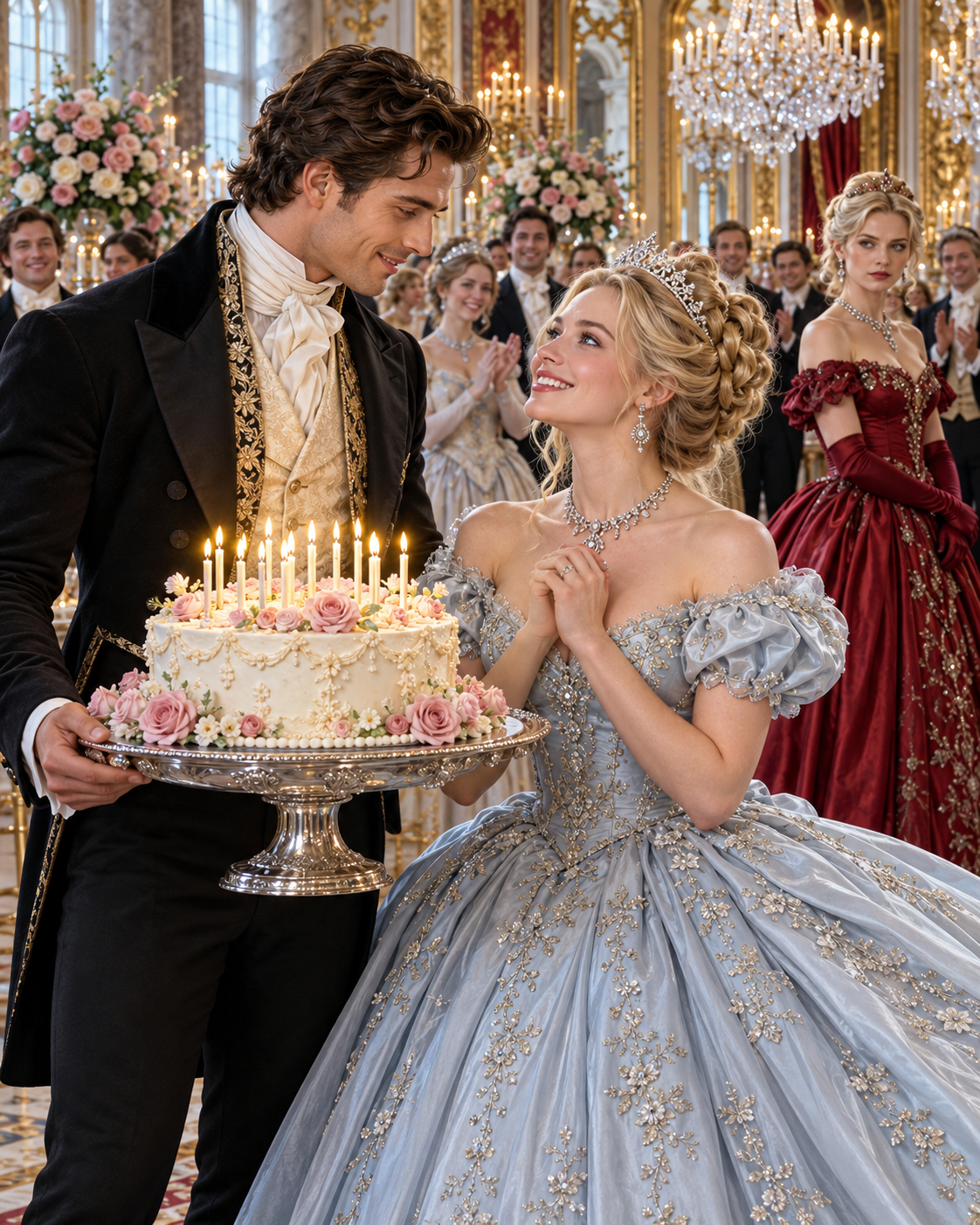
The Duke of Hearthstone gave his wife’s birthday present to another woman—and expected his wife to applaud.
The Duke of Hearthstone did not answer his wife. He stood beside the window, one hand resting against the carved wooden frame, while rainwater traveled slowly down the glass behind him. For several seconds, the only sound in the drawing room was the ticking of the clock above the fireplace. Isidora watched him without moving. She had spent seven years learning the meaning of his silences. This one was different. He was not searching for an explanation. He was deciding how much of the truth he could afford to admit.
“Answer her, Edmund,” her father said quietly.
The duke turned, his expression sharpening. “This is a private matter between my wife and me.”
“Then perhaps you should have kept it that way before introducing another woman at her birthday celebration.”
The solicitor, Mr. Whitmore, placed the ledger on the table. His movements were measured, almost gentle, but the sound of the heavy book striking the polished wood made the duchess dowager flinch.
“Your Grace, the payments are recorded here. Three transfers over the past four months, followed by a larger authorization dated seventeen days before the birthday ball.”
Edmund glanced toward his mother. She had moved to a chair near the fireplace, though she remained standing beside it, her fingers gripping its carved back.
“Those payments were entirely legitimate.”
“Then their purpose should be simple to explain,” Whitmore replied.
Edmund’s eyes returned to Isidora. “Celeste required assistance. Her family has experienced certain financial difficulties.”
Isidora looked at the figures. The first payment alone exceeded the annual income of several tenant families on the Hearthstone estate. The final amount was nearly enough to maintain the nursery, schoolroom, and household staff for years.
“Did she require assistance,” Isidora asked, “or did you require her gratitude?”
His mouth tightened.
“You have no idea what responsibilities come with my position.”
For the first time that morning, Isidora almost smiled. Not because anything amused her, but because she recognized the familiar shape of his defense. Whenever he had no reasonable explanation, he spoke of duty, rank, and burdens too complicated for her understanding.
She remembered the winter their son had been ill with fever. Edmund had remained in London for a hunting dinner. When she questioned him afterward, he had explained that a duke could not simply abandon his obligations.
Yet he had found time to purchase sapphires for Celeste.
“Which account supplied the money?” she asked.
Whitmore opened another document.
“The payments were authorized through a household account receiving income from property included in Her Grace’s marriage settlement. Whether the transfers breached the trustees’ restrictions is now being examined.”
Edmund stepped forward.
“Every account at Hearthstone is administered under my authority.”
“Not every account,” Whitmore said.
The duke stopped.
It was a small correction, delivered without satisfaction, but Isidora saw its effect. Edmund had built his marriage around the assumption that whatever belonged to her would eventually pass through his hands. He had never bothered to distinguish possession from responsibility.
His mother finally spoke.
“Surely there is no reason to involve outsiders in this humiliation. We can arrange a private understanding.”
Isidora looked at her.
“A private understanding?”
The dowager raised her chin.
“Your husband’s conduct was unfortunate. But a woman of your position must sometimes exercise restraint for the protection of her family.”
Isidora crossed the room and took the ledger from Whitmore. She turned it toward the older woman.
“Did you know he was spending money from these accounts?”
The dowager’s gaze dropped to the figures. Something flickered across her face.
“I knew he had certain expenses.”
“Did you know what they were?”
“That is hardly appropriate—”
“Did you know?”
The question was not loud. It did not need to be.
Edmund’s mother looked away.
And with that small movement, Isidora understood that the humiliation at the birthday ball had never been an isolated act of cruelty. It had been the final consequence of years in which everyone around her husband had protected his comfort at the expense of hers.
Her father approached her.
“Isidora, you need not endure another moment of this.”
She touched his sleeve.
“I know, Papa. But I would like to finish.”
Edmund gave a bitter laugh.
“Finish what? You cannot dissolve seven years of marriage because your feelings have been wounded.”
Isidora returned the ledger to the table.
“No. But I can stop allowing you to mistake my patience for permission.”
A knock sounded at the door.
The footman entered and bowed.
“Forgive the interruption, my lord. Lord Hearthstone’s carriage has been prepared, as requested.”
Edmund turned sharply.
“I made no such request.”
“No,” Isidora said. “I did.”
The footman withdrew.
For a moment, her husband simply stared at her. Then he glanced at the open documents, her father’s expression, and the wedding ring conspicuously absent from her hand.
“You intend to send me away?”
“I intend to remain here.”
“And our son?”
“He will remain with me until suitable arrangements are established.”
Edmund moved closer.
“He is my heir.”
“He is six years old.”
The words settled between them.
From somewhere beyond the drawing room came the faint scrape of a wooden toy against the nursery floor. Isidora heard it and thought of a little boy who still slept with a candle beside his bed because shadows frightened him.
Edmund seemed to hear it too.
For one fleeting instant, his expression changed.
Then his mother approached him and whispered something Isidora could not catch.
Whatever she said restored the coldness to his face.
“This is not finished,” he told his wife.
“No,” Isidora answered. “It isn’t.”
He left without another word.
His mother followed, though at the doorway she turned once, looking at Isidora with an expression that held something more complicated than anger.
“Be careful, child. Society is rarely kind to women who forget their place.”
Isidora met her gaze.
“Then perhaps society should become accustomed to being disappointed.”
The doors closed behind them.
Only after the sound of the carriage wheels faded did Isidora sit down.
Her hands were steady as she reached for her tea, but the cup was cold.
Her father knelt beside her chair, something he had not done since she was a child.
“You were magnificent,” he said.
She shook her head.
“I was frightened.”
“I know.”
For a moment she looked toward the nursery door.
“Will he try to take my son?”
Her father did not offer a comforting lie.
“He may.”
Whitmore gathered the documents.
“Then we shall proceed carefully. Her Grace has rights under the settlement, but arrangements concerning the child must be dealt with separately. We must establish the facts, secure proper advice, and avoid giving His Grace any grounds to accuse her of acting recklessly.”
Isidora nodded.
It was not the reassurance she wanted.
It was the truth she needed.
By evening, letters had departed Windham Hall for London, addressed to the marriage trustees, the family’s legal advisers, and the banking houses involved in administering Isidora’s separate property.
The following morning, Edmund returned to Hearthstone House and discovered that his wife’s departure had consequences far beyond an empty bedroom.
His steward, Mr. Bellamy, waited in the library with a stack of correspondence.
“Your Grace, several financial instructions have arrived.”
Edmund removed his gloves.
“Then attend to them.”
“I am afraid some payments now require the trustees’ approval.”
Edmund stopped.
“Which payments?”
Bellamy hesitated.
“Those connected to Her Grace’s settlement income.”
The duke stared at him.
“And who informed the trustees?”
“Her Grace’s solicitor, sir.”
Edmund threw his gloves onto the desk.
“That woman has lost her senses.”
Bellamy lowered his eyes.
He had served the family for thirty years. He had watched three generations of Hearthstone men mistake obedience for loyalty.
He had also watched Isidora spend long afternoons visiting tenant cottages, arranging medicines, and ensuring that winter coal reached households the estate accounts had overlooked.
He said nothing.
But when Edmund demanded that he prepare another payment for Celeste, Bellamy remained still.
“Your Grace, that particular account cannot be used for such a purpose.”
Edmund’s face darkened.
“You forget whom you serve.”
“No, Your Grace.”
Bellamy looked directly at him.
“I believe that has been precisely the difficulty.”
Before the duke could respond, another servant appeared with a letter.
It was from Celeste.
Edmund broke the seal immediately.
The message was brief. She had heard unsettling rumors concerning his finances. She hoped they were exaggerated. She also wished to know whether the promised residence in Bath would still be purchased before winter.
He read the letter twice.
There was no mention of his wife.
No concern for his son.
Only the house.
That evening, Edmund visited Celeste at the elegant rented residence where she had been living for several months.
She received him in a pale-green gown, the sapphire necklace displayed against her throat.
For an instant he stared at it.
“What?” she asked.
“Nothing.”
She approached, but he did not take her hand.
“People are saying Isidora has left you.”
“People have always talked.”
“They are saying her father has taken control of your accounts.”
“My accounts are not his to control.”
Celeste studied him.
“Then why have you delayed the purchase?”
Edmund looked toward the fireplace.
“There are temporary complications.”
She folded her hands.
“The jeweler has also sent another request for payment.”
He turned.
“What jeweler?”
“The man who adjusted the necklace. He said the clasp required additional work.”
Edmund’s expression changed.
“That necklace belonged to my grandmother.”
“I know. You told me.”
“It was never yours.”
Silence fell.
Celeste looked down at the sapphires.
“You gave it to me in front of half of London.”
Edmund said nothing.
She touched the central stone.
“Was the entire evening intended to wound her?”
The question surprised him.
He had expected complaints about money, perhaps tears over the house. He had not expected Celeste to question the spectacle itself.
“You knew our arrangement.”
“I knew you were unhappy in your marriage.”
He looked away.
Celeste’s voice became quieter.
“You told me she understood.”
Edmund did not answer.
And for the first time, Celeste began to suspect that she had been given a role in a performance whose true purpose she had never understood.
Three days later, Isidora received a visitor at Windham Hall.
The footman announced Lady Celeste Harcourt.
Her father immediately objected.
“Absolutely not.”
But Isidora was already standing.
“Show her into the morning room.”
Celeste entered without the sapphires.
She wore a plain gray traveling cloak, and there were faint shadows beneath her eyes. She looked younger than she had beneath the chandeliers at Hearthstone House.
Isidora remained beside the window.
“Lady Celeste.”
“Your Grace.”
Neither woman sat.
Outside, the gardeners were gathering fallen leaves from the gravel paths.
Celeste removed her gloves.
“I came to return something.”
She opened a velvet case.
Inside lay the sapphire necklace.
Isidora looked at it for a long moment.
Then she closed the case without touching the jewels.
“You should return it to the family trustees.”
Celeste swallowed.
“I believed he had the right to give it away.”
“Perhaps you did.”
The younger woman looked up.
“I also believed his marriage was an arrangement you both wished to escape.”
Isidora’s expression remained composed, though her fingers tightened slightly against the edge of the table.
“Did he tell you that?”
“Yes.”
“And you believed him?”
Celeste glanced toward the window.
“I wanted to.”
The admission hung between them.
Isidora sat down.
“Why have you come here?”
Celeste reached into her handbag and withdrew a folded letter.
“Because he asked me to sign something.”
She placed it on the table.
Isidora opened it.
The document appeared to acknowledge a debt allegedly owed to Celeste by the Hearthstone household. The amount was substantial. Attached was a separate draft letter suggesting that Isidora had approved expenses incurred during the marriage.
At the bottom of the draft was a space for Isidora’s signature.
But no signature had been supplied.
“He wanted me to say you had approved the payments,” Celeste whispered.
“Did you?”
“No.”
“Why not?”
Celeste looked toward the sapphire case.
“Because I realized he would have no difficulty making me responsible for them if that became convenient.”
Isidora examined the document again.
It was evidence, but not yet proof of every suspicion forming in her mind.
She rang for a servant.
“Please ask Mr. Whitmore to join us.”
Celeste looked alarmed.
“Will I be accused of taking the money?”
“That depends upon what you knew and what you did.”
The answer was neither cruel nor comforting.
It was the first answer anyone had given Celeste without trying to purchase her affection.
An hour later, the solicitor had taken careful notes, and Celeste had agreed to provide the original correspondence she retained.
Before leaving, she paused at the doorway.
“Your Grace, I owe you an apology.”
Isidora looked at her.
“Yes. You do.”
Celeste’s eyes filled, but Isidora did not soften the words.
“I accepted a kindness that was intended to humiliate another woman. Whatever he told me, I could have refused to stand beside him that night.”
For several seconds neither spoke.
Then Isidora inclined her head.
“I hope you make a wiser choice the next time someone offers you something that belongs to another person.”
Celeste left the necklace behind for the solicitor to handle.
And for the first time since her wedding, Isidora felt no desire to wear it.
The weeks that followed were neither peaceful nor simple.
Edmund’s legal advisers disputed the interpretation of the marriage settlement. Letters passed between London and Windham Hall, each more formally worded than the last. Financial records were examined, witnesses interviewed, and trustees required to account for payments that should never have been authorized without proper consent.
Some transactions proved legitimate.
Others did not.
Whitmore discovered that Edmund had used income connected to Isidora’s settlement to cover personal expenses while allowing obligations owed to the estate’s tenants and household suppliers to remain unpaid.
The accounts did not establish that every payment was unlawful, but they revealed enough irregularities to demand immediate correction.
A separate inquiry established that the sapphire necklace was held under a family arrangement and could not simply be disposed of at Edmund’s whim.
It was returned to the trustees.
Meanwhile, London society behaved exactly as the dowager had predicted.
Invitations ceased arriving.
Acquaintances who had once praised Isidora’s elegance suddenly found reasons not to visit.
At one afternoon gathering, a countess remarked that no sensible woman would destroy her marriage over a husband’s indiscretion.
The comment eventually reached Windham Hall.
Isidora was in the garden when her cousin brought the news.
She had been helping her son plant bulbs near the southern wall.
The boy’s small hands were covered in earth.
“Does it trouble you?” her cousin asked.
Isidora pressed a bulb into the soil.
“Sometimes.”
“Then why not defend yourself?”
She covered the bulb gently.
“Because the people who require an explanation are not necessarily willing to hear one.”
Her son looked up.
“Mama, will this flower grow?”
“If we care for it.”
“Even when it’s cold?”
“Especially then.”
He considered this with the seriousness peculiar to children.
Then he patted the earth and returned to his work.
Isidora watched him, her expression softening.
For all the legal disputes and whispered judgments, the greatest difficulty remained the boy who still asked about his father.
His name was Oliver.
He had Edmund’s dark hair and Isidora’s patient eyes, and he had begun leaving a wooden horse on the windowsill each evening.
One night, Isidora found him awake beneath his blankets.
“Does Papa know where I am?”
She sat beside him.
“Yes, darling.”
“Then why doesn’t he come?”
The question settled heavily inside her.
She could have spoken of lawyers, pride, or the cruel uncertainty of adults. Instead, she smoothed his hair.
“Your father and I are trying to decide how things should be arranged.”
Oliver frowned.
“Did I do something wrong?”
Isidora drew him close.
“Never.”
He buried his face against her shoulder.
“Will he still be my papa?”
“Always.”
She held him until he slept.
Afterward, she remained beside his bed long enough for the candle to burn low.
The next morning, she wrote Edmund a letter.
It contained no accusation.
She told him that Oliver missed him and proposed that they arrange a supervised visit at Windham Hall while their advisers worked toward a longer-term agreement.
Edmund did not reply for nine days.
When his response finally arrived, it contained conditions.
He would see Oliver only if Isidora returned to Hearthstone House and ceased her financial proceedings.
She read the letter once, folded it, and gave it to Whitmore.
“Please arrange for him to receive a more reasonable proposal.”
Her father watched her from across the breakfast table.
“You need not keep offering him kindness.”
“This is not for him.”
Her eyes moved toward the nursery.
“It is for Oliver.”
Winter arrived early.
Frost covered the fields surrounding Windham Hall, and the bare branches of the old oaks stood dark against the morning sky.
Then, in the second week of December, a letter arrived from Hearthstone’s steward.
This one was not addressed to Whitmore.
It was addressed to Isidora personally.
Mr. Bellamy requested an audience concerning circumstances that could not safely be explained in correspondence.
He arrived two days later, carrying a weathered leather ledger and looking as though he had not slept properly in weeks.
Isidora received him in the library with her father and Whitmore present.
Bellamy bowed.
“Your Grace, I have served the Hearthstone family since before His Grace was born. What I am about to say may cost me my position.”
Isidora gestured toward a chair.
“Then you should sit.”
He remained standing.
“The duke has begun selling personal possessions and borrowing against whatever income he can lawfully pledge.”
Whitmore frowned.
“To meet which obligations?”
Bellamy opened the ledger.
“Several substantial debts, sir. Some incurred before his marriage. Others more recently.”
Isidora’s father moved closer.
“How substantial?”
Bellamy named the amount.
The older man’s expression hardened.
Isidora did not speak.
The figure explained more than she wanted to understand.
Edmund had not merely been careless with money. He had been attempting to maintain an appearance of wealth while concealing obligations that had grown far beyond his comfortable personal income.
Bellamy turned another page.
“And there is something else.”
He produced a letter signed by the duchess dowager.
It had been sent to the estate office shortly before Isidora’s birthday.
The instructions were unmistakable: certain household expenses were to be recorded under the duchess’s arrangements wherever possible, and questions concerning the sapphire necklace were to be referred directly to the dowager.
Isidora stared at the signature.
Her mother-in-law had not simply tolerated Edmund’s behavior.
She had helped conceal its financial consequences.
“Why are you telling me this now?” Isidora asked.
Bellamy’s face creased.
“Because the estate servants have gone unpaid in full for several weeks, Your Grace. And because His Grace instructed me yesterday to dismiss the schoolmaster and close the village infirmary until further notice.”
Isidora rose.
The room seemed suddenly colder.
She knew the schoolmaster. She knew the infirmary nurse. She knew the children who walked through snow to attend lessons in the small stone schoolhouse.
“Those institutions are supported through charitable funds,” she said.
“They are, Your Grace. But their accounts have been confused with other estate expenses. I can no longer guarantee the money will reach them without intervention.”
Whitmore closed the ledger.
“We shall examine the records immediately.”
Isidora looked toward her father.
“I want the school and infirmary protected if it can be done without exposing their funds to further risk.”
He nodded.
“Then we shall find a lawful way.”
The investigation that followed brought another unexpected discovery.
The duchess dowager had quietly sold several pieces of jewelry from her personal collection, apparently attempting to cover Edmund’s growing debts before they became public.
Her efforts had delayed the crisis, but they had also encouraged her son to believe that someone would always repair the consequences of his decisions.
When the evidence was presented to her, she came to Windham Hall alone.
It was a bitterly cold afternoon. Snow gathered on the shoulders of her traveling cloak, and her face looked older than Isidora remembered.
She entered the drawing room without demanding that the servants announce her full title.
“I suppose you know everything.”
Isidora set aside her embroidery.
“I know enough.”
The dowager stood near the fireplace.
“His father left him with responsibilities he was never taught to manage.”
“Then someone should have taught him.”
“I tried.”
Isidora looked at her.
“Did you?”
The older woman flinched.
For a long moment, she studied the flames.
“When he was a boy, he could charm anyone into forgiving him. His father found it amusing. I thought he would grow out of it.”
“And when he didn’t?”
“I kept forgiving him.”
Isidora folded her hands.
“You expected me to do the same.”
The dowager’s eyes shone.
“Yes.”
The answer was barely audible.
Isidora had imagined this confrontation many times. She had expected excuses, anger, perhaps another warning about disgrace.
She had not expected honesty.
The dowager finally sat.
“I was cruel to you.”
Isidora said nothing.
“I watched him humiliate you because I believed a scandal would harm the family more than your unhappiness. I thought that if you remained silent, everything could continue as it always had.”
“And could it?”
The older woman shook her head.
“No.”
Snow brushed softly against the windows.
After a while, Isidora spoke.
“I do not wish you harm. But I will not return to the life you helped create.”
The dowager looked toward her.
“Will you ever forgive me?”
“Perhaps.”
Isidora picked up her embroidery.
“But forgiveness will not require me to pretend it never happened.”
The older woman remained for another hour.
Before leaving, she asked whether she might see Oliver.
Isidora allowed the visit.
From the doorway, she watched the dowager kneel awkwardly beside the boy’s chair while he showed her the wooden horse he had painted blue.
For the first time, Isidora saw her mother-in-law listen without correcting anyone.
It was a small beginning.
Nothing more.
The decisive confrontation came in February.
After months of correspondence and examination, the trustees confirmed that certain funds had been improperly directed and required repayment to the relevant accounts. Edmund’s creditors pressed their lawful claims against his personal resources, while his advisers worked to prevent the wider estate from suffering unnecessary damage.
His pride had kept him from acknowledging the situation until nearly every available choice had become painful.
Then he requested a private meeting with Isidora.
She agreed, provided Whitmore and her father remained nearby.
Edmund arrived at Windham Hall on a clear morning.
He looked thinner.
His coat was immaculate, but his face carried the exhaustion of a man who had spent too long fighting consequences that refused to disappear.
Isidora received him in the morning room.
For a while, neither spoke.
Then he looked at her bare left hand.
“I never imagined you would actually leave.”
“I know.”
“I thought you would be angry for a few days.”
“I know that too.”
He lowered himself into a chair.
“Celeste has gone to stay with relatives.”
Isidora did not respond.
“She returned the necklace.”
“Yes.”
Edmund studied the rug.
“I was cruel that evening.”
“You were.”
He looked up, apparently surprised by the absence of any attempt to soften the truth.
“I wanted to prove that you could not dictate my life.”
Isidora watched him carefully.
“Did I ever try?”
He opened his mouth.
Then closed it.
For several seconds, the only sound was a distant bell from the stable yard.
“No,” he said at last.
She waited.
Edmund looked toward the window.
“I hated that everyone admired you. My father trusted your judgment. The tenants came to you. Even the servants seemed to prefer your company.”
Isidora felt something settle into place.
It was not jealousy of Celeste that had poisoned their marriage.
It was his resentment of the respect she had earned without demanding it.
“So you humiliated me to feel powerful.”
He rubbed his forehead.
“Perhaps.”
“That is a very small word for what you did.”
He lowered his hand.
“Yes.”
The admission was quiet.
Then he asked the question she had expected from the moment he entered.
“Will you come home?”
Isidora looked at him for a long time.
Once, she had loved the way he smiled when he entered a room. She had loved his confidence, his laughter, the tenderness he sometimes showed when no one else was watching.
She had held on to those moments for years, believing they represented the man beneath his pride.
Now she understood that affection could not build a safe life where respect was absent.
“No, Edmund.”
He stared.
“Not even if I change?”
“If you change, it should not be a bargain struck to recover something you have lost.”
He looked down.
“I do not know how to be anything other than what I have been.”
“Then you must learn.”
Outside, sunlight struck the frost along the terrace.
Edmund remained seated.
“And Oliver?”
Isidora’s expression softened.
“He misses you.”
The duke closed his eyes.
“I know.”
“Do you?”
He looked at her.
She continued carefully.
“He needs a father who arrives when he promises to arrive. Who listens when he speaks. Who understands that love is not something a child should have to earn.”
Edmund swallowed.
“I want to see him.”
“Then begin by keeping an appointment.”
The first visit lasted an hour.
Oliver entered the library holding his wooden horse, stopped when he saw his father, and remained perfectly still.
Edmund knelt.
“Hello, Oliver.”
The boy looked toward Isidora.
She gave him a reassuring nod.
Then Oliver approached.
“Did you bring my soldiers?”
Edmund’s face changed.
He had promised to bring a set of painted soldiers months earlier and had forgotten.
“No,” he said.
Oliver’s shoulders fell.
Edmund hesitated.
Then he spoke without making an excuse.
“I forgot. I am sorry.”
The boy studied him.
“Will you remember next time?”
Edmund glanced toward Isidora.
She did not intervene.
“Yes,” he answered. “And if I cannot bring them, I will tell you before I come.”
Oliver considered this.
Then he placed the wooden horse in his father’s hand.
“You can play with this one today.”
Edmund stared at the toy.
His fingers closed around it carefully.
“Thank you.”
The visits continued.
Some went well.
Others were difficult.
Edmund occasionally arrived impatient, uncomfortable with the quiet demands of fatherhood. But he began to arrive on time, and when Oliver spoke, he made himself listen.
Through their advisers, Isidora and Edmund eventually reached a formal arrangement that protected the child’s welfare and established clear expectations concerning his care and contact with both parents.
Their marriage did not recover.
They agreed to live separately, and the necessary legal and financial provisions were completed with the guidance of their advisers.
The resolution was not dramatic.
There was no crowded courtroom in which Isidora delivered a triumphant speech, no sudden reversal that erased the years behind her.
There were documents, difficult conversations, and practical decisions that had to be made one after another.
But when the final arrangements were settled, Isidora walked into the gardens at Windham Hall and realized she had spent an entire morning without wondering whether she had disappointed her husband.
The feeling was unfamiliar.
It was also peaceful.
Spring returned gradually.
The bulbs Oliver had planted pushed through the thawing soil, their green shoots appearing beneath the southern wall.
Isidora began spending more time overseeing the affairs connected to her property. With her father’s encouragement and Whitmore’s assistance, she established clearer protections for the income reserved for her and her son.
She also helped organize reliable support for the village school and infirmary, ensuring their funding would be administered separately from the household expenses that had once threatened them.
The work gave structure to her days.
It demanded attention, judgment, and patience.
She discovered she possessed more of all three than anyone at Hearthstone had allowed her to demonstrate.
One afternoon, her father found her reviewing estate correspondence beneath the library windows.
“You look busy.”
“I am.”
“Happy?”
She paused.
Outside, Oliver was chasing a small brown dog across the lawn while his nurse followed at a more dignified pace.
Isidora smiled.
“I think I am learning how.”
Her father placed a hand on her shoulder.
“Your mother would have been proud.”
For a moment, Isidora could not speak.
Then she covered his hand with hers.
“I wish she had lived to see this.”
He looked toward the gardens.
“So do I.”
That summer, Windham Hall hosted a modest gathering to support the village school.
There were no elaborate displays of wealth, no grand announcements, no jewels intended to provoke envy.
The guests walked through the gardens, listened to music beneath the terrace awning, and contributed toward books and repairs for the schoolhouse.
Oliver spent the afternoon showing everyone the flowers he had planted.
Near sunset, Isidora stood beneath the old chestnut tree where her mother had once taken tea.
A servant approached with a small parcel.
It had arrived from Hearthstone.
Inside was a letter from Edmund and a carefully wrapped wooden box.
Isidora opened the box.
It contained the set of painted soldiers Oliver had been promised.
The letter was short.
Edmund explained that he had found the toys among his belongings, still unopened. He wished Oliver to have them and hoped to bring him a new book during his next scheduled visit.
There was no appeal for reconciliation.
No attempt to blame anyone.
At the bottom, beneath his signature, he had added a single sentence.
I am beginning to understand how many things I failed to notice.
Isidora read it twice.
Then she closed the letter.
She did not mistake regret for transformation. She knew that real change would reveal itself through conduct, not handwriting.
But she placed the soldiers carefully back inside their box and asked the servant to take them to the nursery.
Later that evening, Oliver found her on the terrace.
He climbed onto the bench beside her, carrying two of the painted figures.
“Papa remembered.”
“Yes, darling.”
“Does that mean he’s better now?”
Isidora considered the question.
“He is trying to do better.”
Oliver nodded thoughtfully.
Then he leaned against her.
“Can people learn to be kind?”
She wrapped an arm around him.
“I believe they can.”
“Even when they’ve been very unkind?”
She looked across the garden, where the last sunlight rested on the windows of Windham Hall.
“Yes. But they must choose it, and they must keep choosing it.”
Oliver seemed satisfied.
He placed a painted soldier in her palm.
“This one can protect you.”
Isidora smiled and curled her fingers around the tiny figure.
“I have you for that.”
He laughed.
“You’re supposed to protect me.”
She kissed his hair.
“Then perhaps we shall take care of each other.”
Several months later, a letter arrived from the duchess dowager.
She had decided to spend the winter with her sister rather than remain at Hearthstone House.
In her letter, she thanked Isidora for allowing her visits with Oliver and acknowledged that she had spent too many years confusing the preservation of appearances with the protection of her family.
There was no demand for forgiveness.
Only a request to remain part of her grandson’s life, if Isidora considered it appropriate.
Isidora wrote back that evening.
She accepted the request, subject to the arrangements already established for Oliver’s care.
Then she sealed the envelope and returned to the drawing room.
Above the fireplace hung a portrait of her mother.
For years, Isidora had remembered her as a woman of extraordinary gentleness, someone who rarely raised her voice and seemed able to quiet a room merely by entering it.
She used to believe gentleness meant enduring whatever life placed before her.
Now she understood that her mother’s calm had never been weakness.
It had been the confidence of a woman who knew the difference between kindness and surrender.
On the anniversary of the birthday ball, Isidora did something no one expected.
She held another celebration.
Not at Hearthstone House.
At Windham Hall.
The ballroom was filled with fresh flowers and warm candlelight. Musicians played beside the windows, and guests gathered beneath the painted ceiling.
Her father had insisted upon inviting everyone who had stood beside her during the most difficult year of her life.
Whitmore attended with his wife.
Mr. Bellamy, now serving in an advisory role after leaving his former position, stood near the fireplace speaking with the village schoolmaster.
The infirmary nurse arrived wearing a blue gown that Oliver had solemnly declared the prettiest in the room.
There were old friends, new acquaintances, and several people who had once been too afraid of society’s judgment to approach Isidora openly.
She welcomed them all with quiet grace.
When the musicians paused, her father raised a glass.
“To my daughter,” he said.
Isidora shook her head, smiling.
But he continued.
“Who reminded an old man that courage is not always loud, and that dignity is worth defending even when the world would prefer silence.”
The guests lifted their glasses.
Isidora felt warmth rise to her cheeks.
Across the room, Oliver waved enthusiastically.
She waved back.
Later, when the celebration had grown quieter, Isidora stepped into the corridor to escape the heat.
A young woman she barely knew followed her.
“Your Grace?”
Isidora turned.
The woman hesitated.
“I hope you will forgive my impertinence. But I wanted to tell you something.”
“Of course.”
The young woman’s hands trembled slightly around her folded fan.
“My sister is in an unhappy marriage. She believes she must remain because leaving would disgrace our family.”
Isidora listened.
“I used to believe that too,” she said.
The woman looked at her hopefully.
“What should I tell her?”
Isidora considered the question carefully.
She knew that not every woman possessed her father’s protection, a family estate, or the financial rights secured in a marriage settlement.
She would not pretend that courage alone could remove every obstacle.
“Tell her she deserves to be safe and respected. Help her understand what choices are available, and do not ask her to face the consequences alone.”
The young woman’s eyes filled.
“Thank you.”
Isidora touched her hand briefly.
“And whatever she decides, do not confuse her circumstances with her worth.”
When the woman returned to the ballroom, Isidora remained in the corridor for a moment.
Through the open doors came the sound of laughter, music, and Oliver asking someone whether birthday cake could reasonably count as supper.
She looked down at her left hand.
The pale mark from her wedding ring had disappeared.
She had once imagined that losing the ring would leave an emptiness she could never fill.
Instead, the absence had become so ordinary that she rarely noticed it.
She returned to the ballroom.
Her father was waiting beside the dance floor.
“May I have this dance?”
She smiled.
“Only if you promise not to step on my feet.”
He offered his arm.
“I make no promises.”
They danced beneath the chandeliers while Oliver attempted to imitate their steps nearby.
The music was familiar. The light was warm. The room was filled with people whose affection did not depend upon her willingness to endure humiliation.
And when the final notes faded, Isidora did not look toward the doorway, waiting for someone to arrive and decide whether the evening had pleased him.
There was no one whose permission she required.
Much later, after the guests had departed and the servants had begun extinguishing the candles, Isidora walked upstairs to the nursery.
Oliver was asleep, one small hand resting over the painted soldiers arranged beside his pillow.
She straightened his blanket and stood watching him for a moment.
Then she crossed to the window.
Beyond the gardens, the moonlight lay across the fields of Windham Hall.
She thought of the woman she had been one year earlier, standing beneath the glittering chandeliers of Hearthstone House, watching another woman wear the necklace she had been promised.
She remembered the champagne glass, the wedding ring, the tiara, and the terrible silence that had followed.
For a long time, she had believed that moment marked the destruction of her life.
Now she understood it differently.
The public humiliation had not created her strength. Nor had walking away magically resolved the damage. There had been fear, lonely nights, difficult choices, and mornings when she questioned whether she had the courage to continue.
But she had continued.
She had learned that protecting herself did not require hatred, that protecting her son did not require erasing his father, and that forgiveness could exist without reconciliation.
Most importantly, she had learned that a title, a marriage, or a beautiful necklace could never grant a person dignity.
Dignity was already hers.
She had only needed to stop allowing others to treat it as something they could take away.
Behind her, Oliver stirred.
“Mama?”
She turned immediately.
“I’m here.”
He reached out one sleepy hand.
She crossed the room and took it.
“Are you happy?” he murmured.
Isidora sat beside him, watching the moonlight touch the wooden horse on his bedside table.
For once, she did not search for the answer.
“Yes, my darling,” she whispered. “I truly am.”
Oliver smiled without opening his eyes and drifted back to sleep.
Isidora remained until his breathing grew steady.
Then she kissed his forehead, extinguished the candle, and stepped quietly into the corridor.
The house was peaceful.
The future was still unwritten.
And for the first time in her life, Isidora was not afraid of what the next chapter might hold.
She had once been known throughout society as the Duchess of Hearthstone, a woman admired for her jewels, her manners, and her devotion to a powerful husband.
Now, among the people who truly knew her, she was simply Isidora.
A mother who kept her promises.
A daughter who had found her courage.
A woman who had discovered that leaving a place where she was not respected was not the end of her story.
It was the beginning of a life she could finally call her own.
And the most precious inheritance she would ever leave her son was not a title, an estate, or a collection of sapphires.
It was the knowledge that love should never require a person to surrender their self-respect, and that real strength is not measured by how much suffering someone can endure, but by the courage to choose a better life when remaining would be easier.
THE END.