The Duke of Ashborne had spent six years teaching his wife how to become the perfect duchess. Then he fell in love with the woman who reminded him of everything he had taught her to stop being.
Eleanor looked down at the measurements written beneath her husband’s initials, then slowly raised her eyes toward the unfinished green gown hanging beside the window. The waist was narrow, the sleeves modest, and the neckline cut precisely as Arthur had always preferred. Yet the woman for whom it had been ordered was neither Celia nor herself. The name written beneath the measurements belonged to Lady Beatrice Harcourt, the recently widowed daughter of Arthur’s closest political ally.
For several seconds, Eleanor could hear nothing except the rain striking the glass. She had expected betrayal, perhaps even humiliation, but the discovery of another woman’s name seemed to open a door onto something considerably more complicated.
“Why is Lady Beatrice having her gowns made here?” she asked.
Celia closed her eyes briefly. Arthur released her wrist and stepped toward the cutting table, but Eleanor moved the card beyond his reach.
“Beatrice asked for discretion,” he said.
“Then she appears to have found the right people.”
The words were delivered without anger. That made Celia flinch more visibly than any accusation might have done.
Eleanor examined the card again. Beneath the appointment date, written in smaller letters, were the words North Gallery, after supper. She recognized the location immediately. The North Gallery belonged to Ashborne Hall, and the date coincided with the winter ball she had spent weeks arranging.
A sudden memory returned: Arthur requesting that the gallery remain closed during the festivities, supposedly because the ceiling required repairs. She had agreed without question.
“What is to happen in the North Gallery?” Eleanor asked.
Neither answered.
She folded the card, placed it in her reticule, and walked toward the door.
Arthur followed.
“Eleanor, please. This is not what you think.”
She paused with her hand on the brass handle.
“That is becoming a rather crowded explanation, Arthur.”
He looked as though he wanted to touch her, but something in her expression kept him still.
“I made mistakes,” he said quietly.
Eleanor turned.
“Mistakes are things one does without understanding their consequences. You understood yours well enough to conceal them.”
Then she stepped into the rain.
The carriage waited beneath the dripping branches of an old chestnut tree. Her footman hurried forward with an umbrella, but Eleanor barely noticed. She entered, gathered her skirts around her knees, and instructed the driver to return to Ashborne Hall.
Only when the carriage began moving did her hands start trembling.
She clasped them together.
Across from her, the empty leather seat reflected the gray afternoon light. She remembered sitting there beside Arthur after their wedding, his hand resting over hers as they traveled toward the home that would become her entire world.
He had kissed her fingertips and promised that she would never lack anything.
At the time, she had not understood that a woman could possess every luxury and still be deprived of herself.
The gates of Ashborne Hall opened shortly before one o’clock. Eleanor entered through the main doors, passed the enormous portraits of Arthur’s ancestors, and climbed the staircase without removing her wet gloves.
Mrs. Whitmore, the housekeeper, approached with a concerned expression.
“Your Grace, shall I have luncheon sent upstairs?”
“No, thank you. I should like the west morning room prepared.”
“Of course, Your Grace.”
“And please ask Mr. Pembroke to bring the household correspondence ledgers.”
The housekeeper hesitated.
“His Grace usually reviews those himself.”
Eleanor stopped.
She had heard variations of that sentence for six years.
His Grace preferred the silver arranged differently. His Grace approved the dinner menus. His Grace considered certain visitors unsuitable. His Grace believed important household matters should not trouble the duchess.
Today, the words sounded different.
“I am aware of my husband’s habits, Mrs. Whitmore. I asked for the ledgers.”
The older woman straightened.
“Immediately, Your Grace.”
By the time Arthur returned, Eleanor had spent two hours examining accounts, correspondence records, and arrangements for the winter ball.
At first, she found nothing remarkable.
Then she noticed three unusually large payments entered under the heading of estate improvements. All had been authorized by Arthur and directed through a London solicitor named Frederick Vale.
The dates corresponded with his journeys to Celia’s shop.
Another document concerned an agreement for temporary use of the North Gallery by Lady Beatrice Harcourt.
Its purpose had been left blank.
Eleanor placed the papers in a neat stack just as the door opened.
Arthur entered without knocking.
His hair was damp, and his expression had the exhausted severity of a man who had been rehearsing apologies throughout an unpleasant journey.
“We need to speak.”
“We do,” Eleanor answered.
He looked at the documents spread across the table.
“What are you doing?”
“Learning how my household operates.”
“Our household.”
She glanced up.
“Is it?”
Arthur removed his gloves slowly.
“I know you’re hurt.”
“No. You know I have discovered something you intended to keep hidden. You haven’t yet asked what it has done to me.”
He sat opposite her.
For a moment, the distance between them seemed greater than the width of the table.
“I never intended to stop loving you,” he said.
Eleanor watched him carefully.
“Do you believe that makes it better?”
He lowered his eyes.
“With Celia, I felt different. She challenged me. She laughed at me. I could speak without considering every word.”
A faint smile touched Eleanor’s lips, but there was no amusement in it.
“I used to do those things.”
Arthur looked up.
She waited.
He seemed to search for an answer that would not condemn him.
“You were very young when we married.”
“And you were old enough to know precisely what you wanted me to become.”
The mantel clock struck four.
Arthur leaned forward.
“I thought I was helping you. You were entering a world that could be cruel to women who didn’t understand its expectations.”
“Then you might have stood beside me while I learned.”
“I did.”
“No, Arthur. You stood in front of me and told me which parts of myself were permitted to pass.”
His expression tightened.
She had never spoken to him this way.
For years, disagreement had ended with Eleanor apologizing, or promising to try harder, or retreating into silence until he was satisfied.
Now she remained perfectly still.
He reached for her hand across the table.
She withdrew it.
Arthur looked at the empty space between his fingers.
“I don’t want to lose you.”
“Then tell me what Lady Beatrice is doing in the North Gallery.”
His shoulders stiffened.
“It concerns an estate matter.”
“Does Celia concern an estate matter too?”
“Eleanor—”
“I am asking you a simple question.”
He rose abruptly and crossed toward the fireplace.
“Beatrice’s late husband left considerable debts. Her family has asked for assistance. The arrangement is private because her reputation could suffer.”
Eleanor considered his answer.
“Then why conceal it from me?”
“Because you are fond of Beatrice. I didn’t want to place you in an awkward position.”
“How thoughtful.”
He turned sharply.
“Eleanor, must everything I say be taken in the worst possible manner?”
She stood.
“No. Only the things that are untrue.”
For the first time, Arthur’s composure broke.
“What do you want from me?”
She looked at the man she had spent six years loving, studying, defending, and attempting to please.
“The truth,” she said. “Even if it is the first thing you’ve ever given me that I cannot bear.”
That evening, Eleanor ate dinner alone.
Arthur had retired to his study, claiming a headache. The servants moved quietly around the enormous dining table, exchanging careful glances whenever they believed she was not looking.
She dismissed them after the second course.
The silence that followed was strangely comforting.
For years, she had been afraid of empty rooms. An unoccupied chair at dinner meant Arthur was dissatisfied, distracted, or absent. She had always searched for some way to restore his attention.
Now she found herself examining the room instead.
The crimson wallpaper had been chosen by his mother. The silver belonged to his grandmother. The enormous hunting paintings depicted men whose names she could scarcely remember.
Nothing in the room had been selected by her.
Not even the flowers.
She pushed back her chair and rang for Mrs. Whitmore.
“Tomorrow, I should like the dining-room flowers replaced with yellow roses.”
The housekeeper blinked.
“Yellow, Your Grace?”
“Yes.”
“His Grace dislikes yellow roses.”
Eleanor considered that information for a moment.
“Then perhaps he will dine somewhere else.”
The next morning, she wrote three letters.
The first went to her aunt, Lady Margaret Wycliffe, a widow who had once scandalized half of London by managing her own estate after refusing a second marriage.
The second went to an independent solicitor in Bath, whose name she obtained from an old family acquaintance.
The third was addressed to Lady Beatrice Harcourt.
She requested a private meeting.
Beatrice arrived two days later.
She entered the drawing room wearing a dark blue traveling gown and an expression of careful concern. At thirty-two, she possessed the practiced elegance of someone who had survived society’s scrutiny and learned to reveal very little.
“My dear Eleanor. Arthur mentioned you’ve been unwell.”
Eleanor poured tea.
“How considerate of him.”
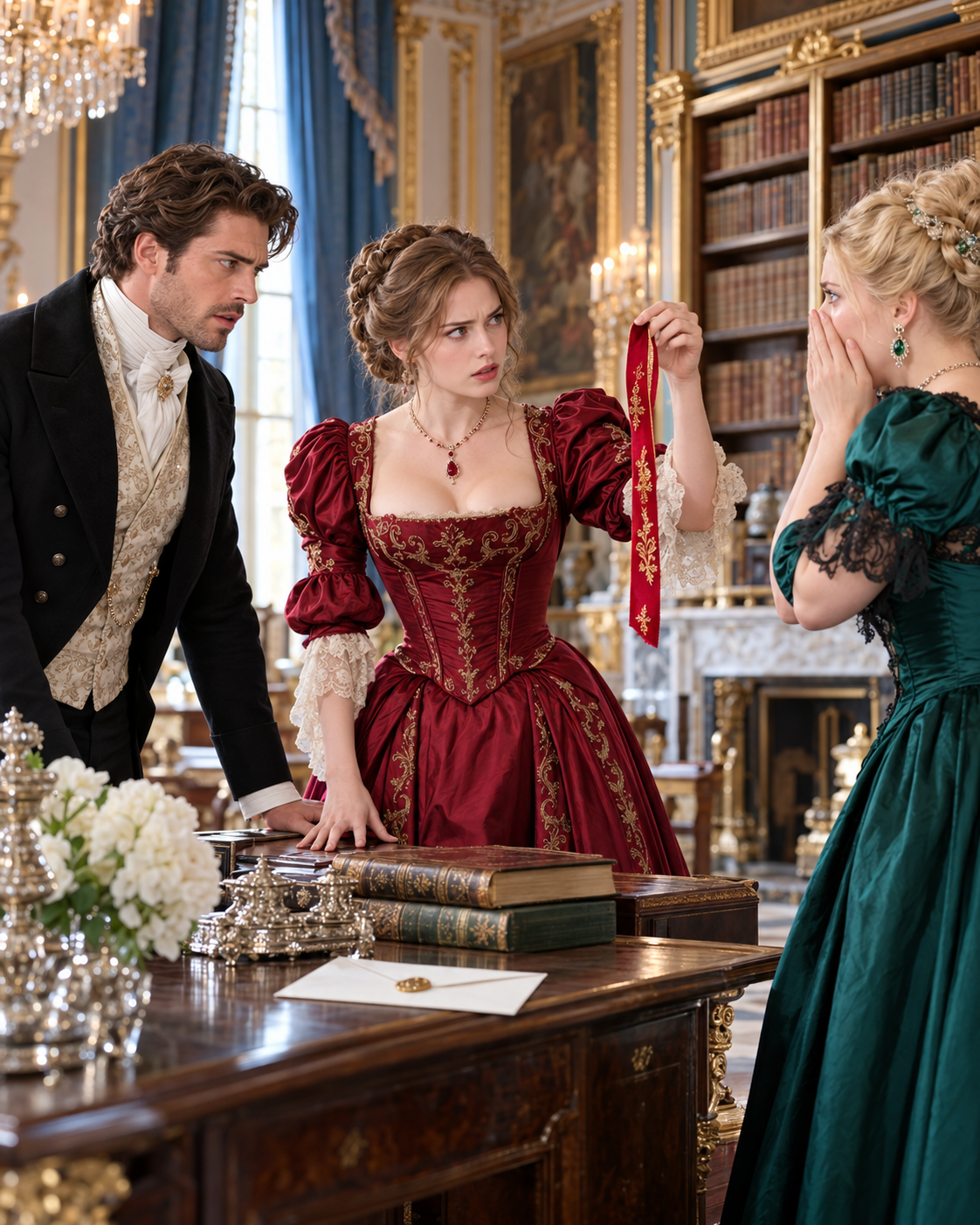
Beatrice accepted her cup.
“I hope it’s nothing serious.”
“That depends upon what you consider serious.”
The other woman’s smile faded.
Eleanor placed the fitting card on the table.
“Would you care to explain this?”
Beatrice stared at it.
For one brief instant, her composure deserted her.
“Where did you find that?”
“At Celia’s shop.”
Beatrice set down her cup.
“Then I suppose certain arrangements have become rather more complicated.”
Eleanor felt a peculiar stillness settle over her.
“Are you having an affair with my husband?”
Beatrice looked genuinely startled.
“Good heavens, no.”
She leaned forward.
“Eleanor, whatever else you believe of me, I would not do that.”
“Then explain the gallery.”
Beatrice looked toward the door.
“Has Arthur told you nothing?”
“He has told me quite enough to know how little he intends to say.”
Beatrice hesitated.
Then she drew a folded document from her handbag.
“My late husband’s creditors have been threatening to seize property belonging to my daughter. Arthur offered to help me raise funds discreetly.”
“By holding a gathering in my home?”
“A private auction. Jewelry, paintings, certain family possessions. The guests will attend the winter ball, but a few have agreed to meet separately afterward.”
Eleanor looked at the document.
It contained a list of valuables, proposed buyers, and estimated prices.
One item made her stop reading.
A diamond necklace belonging to the Ashborne family.
She knew it well.
Arthur had given it to her on their first wedding anniversary.
It was kept in her jewelry cabinet.
“Why is my necklace on this list?”
Beatrice’s face drained of color.
“I was told you had agreed.”
Eleanor looked up.
“Who told you?”
“Arthur.”
Neither woman spoke for several moments.
Beatrice finally reached across the table.
“Eleanor, I never intended to take anything from you.”
Eleanor moved the list toward her.
“Would you leave this with me?”
Beatrice nodded.
Then, after a pause, she added, “There is something else. The money Arthur promised was not intended entirely for my debts.”
Eleanor’s fingers tightened around the paper.
“What do you mean?”
“Part of it was to establish Celia’s business in London.”
The room seemed to tilt slightly.
“London?”
Beatrice watched her with visible distress.
“Arthur said you knew. He told me Celia had become unhappy in the village and that you wished to help her begin again.”
Eleanor remembered Celia’s packed trunk.
The unfinished gown.
The mysterious appointments.
Arthur had planned to purchase the dressmaking shop, arrange another establishment in London, and provide enough money for Celia to leave Ashborne without losing her livelihood.
The generous explanation Eleanor had invented for his secrecy was almost true.
Almost.
The difference lay in why he had wanted Celia to leave.
After Beatrice departed, Eleanor remained beside the window until the light began fading.
A carriage passed beneath the trees.
For one foolish instant, she imagined Arthur returning with flowers, kneeling before her, and speaking words that would restore everything.
Then she looked down at the auction list.
The necklace was valued at four thousand pounds.
A gift he had placed around her throat with trembling hands, promising it represented the beginning of their life together.
Now it had become another useful object in an arrangement she had never been consulted about.
The following afternoon, Celia arrived at Ashborne Hall.
She came without an appointment and refused the footman’s suggestion that she return another day.
Eleanor received her in the west morning room.
Celia looked exhausted. Her dark hair had been pinned carelessly, and the gold bracelet was gone from her wrist.
“I wanted to return this,” she said.
She placed the bracelet on the table.
Eleanor did not touch it.
“Did Arthur ask you to come?”
“No.”
“Then why are you here?”
Celia looked toward the windows.
“Because I have been a coward.”
Eleanor waited.
The dressmaker sat opposite her, twisting her gloves until the leather creased beneath her fingers.
“It began with conversations. He would come into the shop and complain about estate business, or the expectations of society, or the way everyone treated him like a title instead of a person.”
Eleanor listened without moving.
“He made me feel that I understood something nobody else did. I liked that. I liked being the one person who could tell him he was wrong.”
A bitter silence followed.
“Then one afternoon, he kissed me.”
Eleanor’s eyes lowered to the bracelet.
“Did you know he was unhappy with me?”
Celia swallowed.
“He said you were content. That you’d grown comfortable with your life together.”
“Was that how he explained it?”
“He said you were everything a duchess should be.”
Eleanor let out a quiet breath.
“And you were everything she shouldn’t.”
Celia looked away.
“I told myself it wasn’t love. I told myself he would become bored and return to you. Every time you invited me here, I promised myself it would be the last.”
“Yet you kept coming.”
“Yes.”
The admission was barely audible.
Eleanor rose and crossed toward the window.
Outside, the gardens lay beneath a pale winter sky. She remembered chasing Celia through those fields as children, their dresses stained with mud, their laughter carrying across the orchard.
There had been a time when she would have trusted her friend with anything.
She turned.
“Did you love him?”
Celia’s eyes filled.
“I thought I did.”
“And now?”
Celia looked down at her empty wrist.
“I think I loved being chosen by a man who had spent years making another woman feel she was never quite enough.”
Eleanor absorbed the words without answering.
Celia continued.
“I was proud of the things he disliked in you. I believed they made me different. I didn’t understand that he was using the same judgment to divide us.”
“That doesn’t excuse what you did.”
“I know.”
“Nor does it mean you were powerless.”
Celia nodded.
“No.”
For the first time, Eleanor saw her friend without the comforting memories that had always surrounded her.
Celia had been brave in certain ways and terribly weak in others. She had defended Eleanor against strangers while helping the one man who could hurt her most.
Both things were true.
“Are you going to London?” Eleanor asked.
“I was. Arthur arranged a shop and rooms above it. He said it would make everything easier.”
“For whom?”
Celia did not answer.
Eleanor returned to the table.
“You should go if London is where you wish to build your business. But not with money purchased from my marriage.”
Celia looked up sharply.
“I refused his offer yesterday.”
“Good.”
“I don’t expect you to forgive me.”
Eleanor studied her.
“I haven’t decided what forgiveness means yet.”
Celia stood, her eyes shining.
At the doorway, she paused.
“Ellie?”
Eleanor looked at her.
“I miss who we were.”
For a moment, the old nickname seemed to fill the room with ghosts.
“So do I,” Eleanor replied.
When Celia had gone, Eleanor placed the bracelet in a drawer.
She did not throw it away.
Some objects were neither precious enough to keep close nor meaningless enough to discard immediately.
Three days before the winter ball, Lady Margaret arrived in a traveling carriage accompanied by two elderly spaniels and a formidable quantity of luggage.
She entered Ashborne Hall wearing a dark green coat and carrying a walking stick she rarely needed.
Eleanor met her on the staircase.
Her aunt studied her face.
“Well,” Lady Margaret said, “someone has finally upset you enough to make you write a truthful letter.”
Eleanor laughed unexpectedly.
Then she began to cry.
Lady Margaret said nothing. She simply drew her niece into her arms and held her until the tears subsided.
That evening, they sat together in the library.
Eleanor told her everything.
The affair.
The letters.
The necklace.
The years of small corrections that had gradually made her afraid of disappointing her husband.
Lady Margaret listened without interruption.
When Eleanor finished, her aunt poured herself another glass of wine.
“I knew Arthur’s father,” she said. “He was a respectable man who believed respectability meant nobody should ever contradict him.”
Eleanor looked at the fire.
“Arthur isn’t cruel.”
“Not all harm arrives with shouting.”
“I loved him.”
“Of course you did.”
“Perhaps I still do.”
“That is possible too.”
Eleanor turned toward her.
“What should I do?”
Lady Margaret rested her glass on the table.
“Before deciding what to do about your husband, decide what you intend to do with your own life.”
Eleanor frowned.
“I don’t know.”
“Then begin there.”
The advice was almost disappointingly simple.
Yet that night, alone in her bedchamber, Eleanor opened a drawer she had not touched in years.
Inside lay her old sketchbooks.
She had once loved drawing buildings and gardens, planning imaginary homes filled with bright windows, wide staircases, and places where people could gather without feeling watched.
Arthur had praised her talent during their courtship.
After their marriage, he had gently suggested that serious architectural interests were rather unsuitable for a duchess.
Eventually, she had stopped drawing.
Now she opened the first sketchbook.
A faded pencil drawing showed a small cottage with climbing roses, a walled garden, and a spacious room overlooking the orchard.
Beneath it, in her younger handwriting, were the words A place of my own.
Eleanor touched the page.
The following morning, she sent for her solicitor.
By the day of the winter ball, Ashborne Hall had been transformed.
Hundreds of candles illuminated the galleries. Musicians rehearsed behind the ballroom doors, servants carried silver trays through polished corridors, and carriages began arriving beneath a sky the color of pewter.
Arthur had spent the preceding days attempting to restore some appearance of normality.
He sent flowers.
He apologized.
He offered to cancel the ball.
Eleanor declined.
She had made preparations of her own.
When she descended the staircase that evening, conversation in the entrance hall fell quiet.
She wore a gown of deep emerald silk, its neckline elegantly simple, its skirt moving freely around her feet.
Her dark hair fell in soft curls over her shoulders.
No elaborate pins.
No severe arrangement.
No pearls chosen to please her husband.
Arthur stared.
For a moment, she looked like the woman he had first met beneath the apple trees.
“Eleanor,” he said softly. “You look extraordinary.”
She accepted the compliment with a small inclination of her head.
“Thank you.”
He approached.
“May I speak with you privately?”
“After supper.”
“I’ve been trying to explain—”
“I know.”
She moved past him to greet their guests.
Throughout the evening, Arthur watched her.
Eleanor spoke with people she had previously avoided. She laughed with Lady Margaret, discussed estate improvements with an elderly architect, and surprised several guests by expressing strong opinions about the future of the village school.
She did not appear reckless or improper.
She appeared entirely at ease.
And Arthur realized, with a discomfort he could scarcely bear, that he had mistaken her obedience for happiness.
Shortly after eleven, the selected guests gathered near the North Gallery.
Lady Beatrice stood beside the entrance, visibly anxious.
Eleanor approached carrying a small velvet case.
Arthur intercepted her.
“What are you doing?”
“Attending the arrangement you made without me.”
“Eleanor, please. We can discuss this tomorrow.”
“No. We will discuss it now.”
She opened the case.
Inside lay the diamond necklace.
Arthur stared.
“I never intended to sell it without your permission.”
“Yet you placed it on the list.”
“I meant to ask.”
“When?”
He had no answer.
Eleanor closed the case.
“Lady Beatrice has my assistance. Her debts will be addressed through a legitimate private loan arranged by my solicitor, secured against property she herself owns. She will not need to surrender everything her husband left her.”
Arthur looked bewildered.
“How did you arrange that?”
“By asking questions.”
She turned toward Beatrice.
“The necklace is not for sale.”
Beatrice nodded, tears brightening her eyes.
“Thank you.”
The other guests were politely redirected toward the ballroom. The private auction never took place.
Arthur followed Eleanor into the deserted gallery.
Moonlight spilled through the tall windows, illuminating portraits of Ashborne ancestors whose faces seemed to watch them from the walls.
“You’ve humiliated me,” he said.
Eleanor stopped.
She turned slowly.
For a moment, Arthur looked startled by his own words.
He had meant to express frustration, but hearing them spoken aloud revealed something uglier.
Eleanor’s face did not change.
“I have spent years protecting you from embarrassment,” she answered. “Even when protecting you required making myself smaller.”
He looked away.
“I deserved that.”
“This isn’t a punishment, Arthur.”
“Then what is it?”
She took a folded document from her reticule.
“A separation agreement.”
The words seemed to empty the gallery of air.
Arthur stared at her.
“No.”
“Eleanor—”
“No,” he repeated, stepping closer. “You cannot mean this.”
“I do.”
He looked at the document but made no attempt to take it.
“We have been married six years.”
“Yes.”
“We have a life together.”
“We have a life you arranged.”
His expression crumpled.
“I love you.”
Eleanor felt the old instinct rise inside her, the desire to comfort him simply because he appeared unhappy.
For six years, his distress had been an instruction she obeyed without thinking.
Now she remained still.
“Perhaps you do,” she said. “But love that requires someone to disappear is not the kind of love I can live inside.”
Arthur pressed a hand against his forehead.
“I was a fool.”
“You were more than that.”
“I know.”
He looked at her, his eyes wet.
“I thought you were happy.”
“So did I, for a long time.”
He took a step toward her.
“Let me make it right.”
Eleanor watched his hand rise, then fall.
“You cannot return six years to me.”
“No.”
“And I cannot promise that I will become the wife you want again.”
“I don’t want that anymore.”
She believed he meant it in that moment.
But one evening of remorse could not erase years of habit, and the realization had come only when his control over her was slipping away.
“You must learn who you are without someone arranging herself around you,” she said.
Arthur lowered his head.
“Where will you go?”
“To Wycliffe Cottage. My aunt has helped me purchase it.”
He looked up.
“The place near the orchard?”
Eleanor nodded.
“I drew it years ago.”
Arthur remembered the sketchbook.
He remembered suggesting that she put it away before guests arrived.
Something in his face shifted.
He sank onto a bench beneath the window.
“I never understood what I was taking from you.”
Eleanor stood beside him for a moment.
“Neither did I.”
She left the separation agreement on the bench and returned to the ballroom.
The musicians were beginning another waltz.
Lady Margaret waited near the doors.
“Well?” she asked.
Eleanor took a slow breath.
“I think I’d like to dance.”
Her aunt smiled.
“Then you shall.”
Six weeks later, Eleanor moved into Wycliffe Cottage.
It stood on a gentle hill beyond the village, surrounded by old apple trees and a neglected garden that had not been properly tended in years.
The roof required repairs. Several windows rattled in strong winds. The kitchen was far smaller than the one at Ashborne Hall.
Eleanor loved it.
On her first morning, she opened every window despite the cold, tied her hair back with a ribbon, and walked into the garden carrying a notebook.
There were bills to consider, workmen to supervise, and decisions she had never been permitted to make.
Some frightened her.
Others delighted her.
All belonged to her.
With Lady Margaret’s guidance, she began restoring the cottage and the adjoining buildings. A former stable became a workshop, while an unused granary was converted into classrooms for village girls who wished to learn reading, arithmetic, drawing, and practical trades.
Eleanor insisted that the girls be taught how to manage accounts and negotiate payment for their work.
She remembered too clearly what it meant to depend entirely upon someone else’s decisions.
The first winter was difficult.
A storm damaged the western roof. Two workers abandoned the renovation halfway through, and several local families questioned whether a duchess living separately from her husband should be instructing their daughters.
Eleanor listened to their concerns, answered what she could, and continued.
She made mistakes.
She trusted the wrong builder.
She underestimated expenses.
Once, after an argument with a supplier, she returned home furious and spent an hour walking through the orchard in the rain.
But nobody told her that anger was unbecoming.
Nobody instructed her to lower her voice.
She discovered that a mistake could simply be corrected, without becoming evidence that she was unfit to govern her own affairs.
Arthur wrote often during those months.
At first, his letters were filled with apologies and promises.
Then, gradually, they changed.
He wrote of the estate tenants, of decisions he had reconsidered, and of the strange silence that had settled over Ashborne Hall.
He admitted that he had dismissed an employee’s complaint without listening and later discovered the man had been right.
He wrote that he was learning to ask before deciding.
Eleanor answered occasionally.
She did not offer false hope.
Nor did she deny the affection that still remained somewhere beneath her grief.
In one letter, Arthur confessed that he had visited the orchard where they first met.
He had stood beneath the highest apple tree and remembered Eleanor laughing at him from its branches.
He wrote that he had once mistaken her laughter for something he possessed.
Now he understood it had been something she had freely given.
Eleanor folded the letter and placed it in her desk.
She did not reply that evening.
Some truths deserved to be acknowledged without being rewarded.
Celia left the village in early spring.
She did not accept Arthur’s money.
Instead, she sold several valuable pieces of jewelry, borrowed a modest sum from a distant cousin, and opened a small dressmaking establishment in Bath.
Her first months were difficult, and the business nearly failed.
She worked long hours, accepted commissions she disliked, and learned that independence was less romantic when accompanied by unpaid bills.
One afternoon, Eleanor received a parcel.
Inside was a length of yellow silk and a handwritten note.
I saw this and remembered you once said yellow made every room feel like sunlight. I hope you are wearing colors you love again.
There was no request for forgiveness.
No attempt to explain the affair.
Only the fabric and the memory.
Eleanor held the silk against the window.
Then she placed it among her sewing materials.
She did not write back immediately.
Months later, she sent Celia a small commission for curtains at the schoolhouse, paying the full amount and requesting a proper invoice.
The reply arrived three days later.
Celia thanked her professionally.
Nothing more was said.
Their friendship had not been restored, but Eleanor no longer needed to pretend that every broken relationship must end in either hatred or reconciliation.
Sometimes the most honest thing two people could offer each other was distance.
By the following autumn, the schoolhouse at Wycliffe Cottage was ready to open.
Twenty-three girls arrived on the first morning, some in carefully mended dresses, others accompanied by mothers who looked uncertain whether they had made the right decision.
Eleanor stood beside the entrance wearing a simple blue gown, her hair loosely pinned, a smudge of paint still visible near her wrist.
She greeted each child personally.
One little girl, perhaps nine years old, lingered near the doorway.
Her name was Rose.
She carried a worn sketchbook against her chest and seemed reluctant to enter.
Eleanor crouched beside her.
“Is something troubling you?”
Rose looked toward the other girls.
“My father says drawing isn’t useful.”
Eleanor glanced at the sketchbook.
“May I see?”
The child hesitated, then opened it.
Inside were drawings of cottages, bridges, narrow streets, and a beautiful imaginary house surrounded by trees.
Eleanor felt an unexpected ache beneath her ribs.
“These are remarkable.”
Rose looked doubtful.
“Truly?”
“Truly.”
“But my father says girls ought to learn sensible things.”
Eleanor turned a page.
“Then perhaps we shall teach you to be a sensible architect.”
Rose stared at her.
“Can girls be architects?”
Eleanor smiled.
“They may have to argue rather fiercely for the opportunity.”
The child considered this.
Then she smiled back.
“I think I could do that.”
Across the courtyard, Lady Margaret watched the exchange with a quiet satisfaction she made no attempt to conceal.
Later that afternoon, as the last visitors departed, a familiar carriage appeared beyond the garden gate.
Arthur stepped down.
He wore a dark traveling coat and carried no flowers, no expensive gifts, and no elaborate apologies.
For a moment, they stood facing each other across the gravel path.
He looked older.
Not dramatically so, but there were new lines beside his eyes and a tiredness in his posture that had not existed when he believed the world would arrange itself according to his wishes.
“I hope I’m not intruding,” he said.
Eleanor glanced toward the schoolhouse.
“We’ve just finished.”
Arthur followed her gaze.
He watched two girls carrying a basket of books toward the entrance.
“You’ve built something extraordinary.”
“We’ve made a beginning.”
He smiled faintly.
“May I walk with you?”
Eleanor considered the request.
Then she nodded.
They followed the narrow path through the orchard, where autumn leaves lay scattered across the damp grass.
For several minutes, neither spoke.
Arthur finally stopped beside the oldest apple tree.
“I received the final papers from your solicitor.”
Eleanor looked at him.
Their separation had been formally established. The agreement protected her independent income and property, while acknowledging that their marriage remained legally intact.
“I know.”
“I’ve signed everything.”
“Thank you.”
He looked toward the distant hills.
“I used to think signing them meant accepting that I had lost you.”
“And now?”
“Now I think refusing would have meant proving that I never understood you at all.”
Eleanor felt the weight of his words.
She had imagined this conversation many times.
In some versions, he begged her to return. In others, she spoke with devastating certainty and walked away without regret.
The reality was quieter.
She still remembered the man who had sat beside her when her mother died, who had stayed awake through her fevers, and who had once carried her through a flooded courtyard because she refused to ruin her favorite shoes.
Those memories were real.
So was the harm.
She did not have to erase either.
Arthur looked at her.
“I won’t ask you to come home.”
Eleanor studied his face.
“Because you know my answer?”
“Because I’ve finally understood that home isn’t something I can command you to return to.”
The wind moved through the branches above them.
A yellow leaf drifted between their feet.
Arthur hesitated.
“Are you happy?”
Eleanor looked toward the cottage.
The windows glowed warmly in the approaching dusk. Somewhere inside, Lady Margaret was complaining about the tea, and the sound of laughter drifted faintly through the open kitchen window.
She thought of the schoolgirls, the unfinished renovations, the accounts waiting on her desk, and the plans she had made for the spring.
Some evenings, she still felt lonely.
Some mornings, she woke frightened by the responsibility of having no one else to blame for her choices.
But she no longer measured the quality of her days by whether Arthur approved of them.
“Not always,” she answered.
He seemed surprised.
She smiled.
“But when I’m happy, I know it belongs to me.”
Arthur lowered his eyes.
For a long moment, he said nothing.
Then he offered his hand.
Eleanor looked at it.
There had been a time when she would have taken it automatically, grateful for the invitation.
Now she considered what she wanted.
At last, she placed her hand briefly in his.
It was neither forgiveness nor a promise.
Only acknowledgment.
When she withdrew, Arthur let her go.
He returned to his carriage as the last daylight faded beyond the orchard.
Eleanor watched until the wheels disappeared behind the trees.
Then she turned toward the cottage.
Inside, Lady Margaret had lit the lamps, and the kitchen smelled of fresh bread.
A letter from Celia lay unopened on the hall table. Beside it rested a new proposal from the village council, requesting Eleanor’s advice on restoring an abandoned public garden.
Her life was full of unfinished things.
She found that she liked it that way.
The following morning, Eleanor rose early.
Sunlight spilled across her bedroom floor, illuminating the yellow curtains she had finally asked Celia to make.
She dressed without assistance, tied her hair with a ribbon, and carried her sketchbook outside.
The orchard was bright beneath a clear autumn sky.
She settled on the grass beneath the oldest apple tree, opened to a clean page, and began drawing the schoolhouse extension she hoped to build the following year.
For a while, she worked in silence.
Then Rose appeared at the garden gate, carrying her own sketchbook.
“Your Grace?” the girl called.
Eleanor looked up.
“Yes, Rose?”
“May I ask you something?”
“Of course.”
The child approached, studying the unfinished drawing.
“How do you know whether something you’ve made is good enough?”
Eleanor looked down at the lines on the page.
She thought of Arthur, Celia, the grand halls of Ashborne, and the young bride who had spent years believing goodness meant never disappointing anyone.
Then she looked at the girl waiting earnestly beside her.
“You listen to advice,” Eleanor said, “and you learn what you can. But you mustn’t let another person decide that the only beautiful thing about your work is how closely it resembles theirs.”
Rose considered this seriously.
“What if they don’t like it?”
“Then you ask yourself whether you still believe in it.”
The little girl smiled and opened her sketchbook.
They worked together beneath the apple tree while the morning grew warmer around them.
Before long, Eleanor laughed at something Rose said, a bright, unguarded laugh that carried across the orchard.
No one asked her to lower her voice.
No one reminded her of the dignity expected of a duchess.
And for the first time in many years, Eleanor did not even think to silence herself.
She had once believed that love meant becoming exactly what another person needed. She understood now that devotion without freedom could become a beautiful kind of imprisonment, especially when the walls were built so gently that one learned to call them home.
Arthur had loved the woman Eleanor became after years of pleasing him, then pursued another who possessed the qualities he had persuaded his wife to surrender.
Yet the greatest loss was not his affection, nor even Celia’s friendship.
It was the time Eleanor had spent believing she needed permission to be herself.
That time could not be recovered.
But the years ahead were still hers to shape.
And as she bent over her drawing, with the morning sun warming her face and a child’s laughter rising beside her, Eleanor understood something that no marriage contract, noble title, or grand declaration could ever have taught her.
The people who truly love us may help us grow, but they should never require us to disappear.
For Eleanor, the happiest ending was not winning her husband back or watching him suffer for what he had done.
It was discovering that the woman he had taught her to hide had been waiting patiently all along.
And this time, she intended to let her live.
THE END.