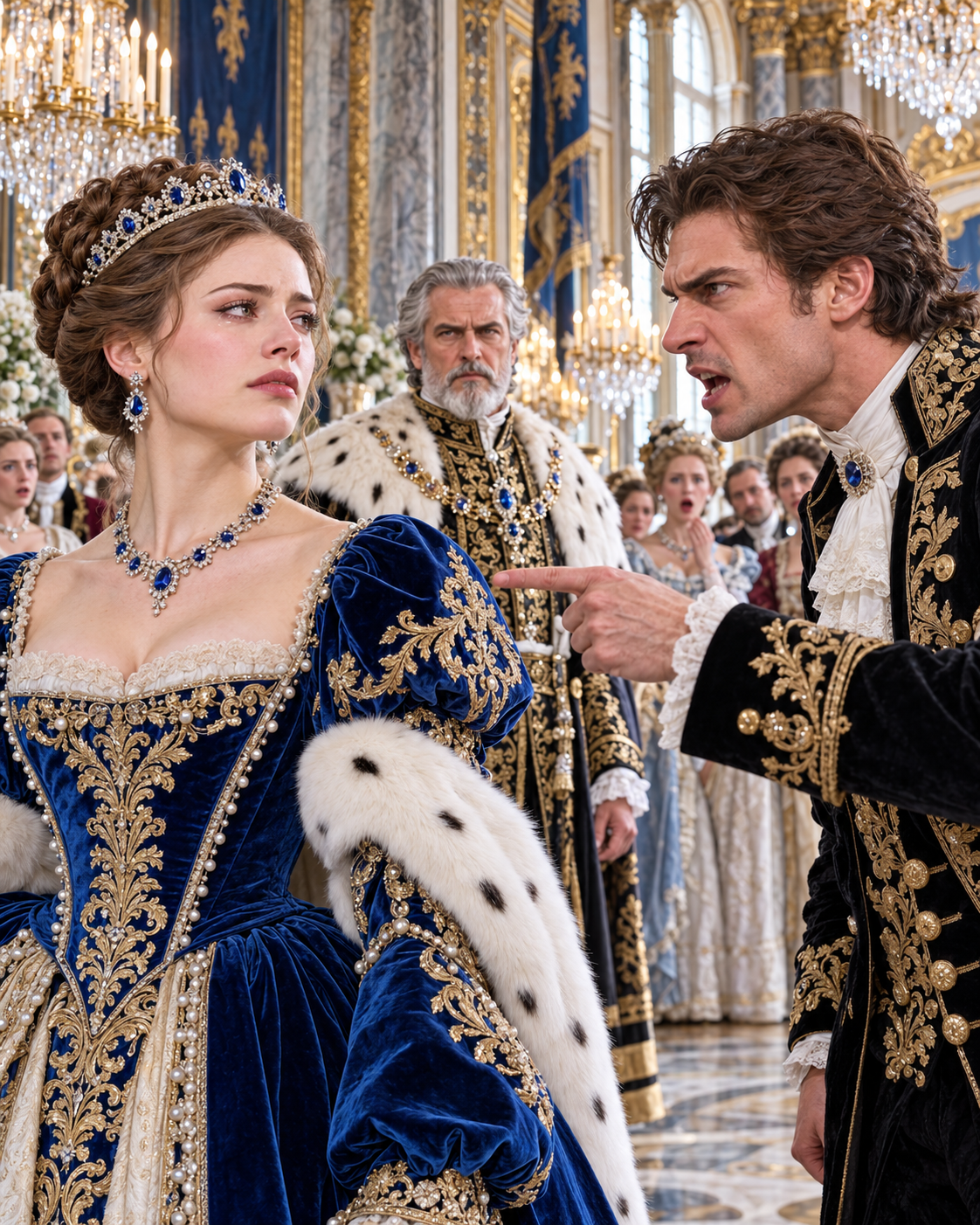
The Duke humiliated his wife in front of two hundred guests. By morning, she had discovered something far more humiliating.
THE DUCHESS WHO BOUGHT HER HUSBAND’S EMPIRE — THE FINAL CHAPTER
The signature belonged to a dead woman.
Eleanor Whitmore Ashkams stared at the document while the rain whispered against the library windows. Across the desk, her husband, Duke Nathaniel Ashkams, had gone so pale that even the candlelight could not disguise it.
The visitor from London stood perfectly still, his gloved fingers resting on the edge of the desk.
“Perhaps,” Eleanor said quietly, “someone should explain why Lady Margaret Ashkams is signing financial documents twelve years after her burial.”
Nathaniel reached for the paper.
Eleanor moved it beyond his grasp.
It was a small movement, almost effortless, but Thomas Reed saw the Duke’s jaw tighten.
For seven years, Nathaniel had never needed permission to touch anything in that house.
Tonight, even the papers belonged to someone else.
The London solicitor, Mr. Adrian Bell, removed his gloves and placed a second document beside the first.
“Her Grace’s late mother-in-law maintained a private trust for the protection of the estate’s tenant families. It was established twenty-six years ago, following a particularly devastating winter.”
Eleanor studied the faded seal.
She remembered Margaret Ashkams only through a portrait hanging above the grand staircase. A stern woman in blue silk, with dark eyes and a narrow gold wedding band.
Nathaniel had once described his mother as sentimental and impractical.
“She insisted on helping people who ought to have helped themselves,” he had said.
Now Eleanor understood why he had never allowed her to examine the older family accounts.
“The trust contained nearly forty thousand pounds,” Mr. Bell continued. “Most of it has disappeared.”
The clock ticked.
Nathaniel looked toward the fireplace.
“Mother’s affairs were settled years ago.”
“Apparently not,” Eleanor replied.
Bell unfolded the final sheet.
“Someone has continued withdrawing money under her authority. The most recent transaction was made six weeks ago.”
Thomas lowered his eyes.
Eleanor noticed.
“Thomas?”
The steward’s face seemed to age beneath the candlelight.
“There is something I should have told you, my lady.”
Nathaniel turned sharply.
“Reed, I warn you.”
But Thomas did not look at him.
Instead, he removed a folded letter from the inside pocket of his coat. The paper was soft with age, its edges repaired with narrow strips of linen.
“Her Grace gave me this three days before she died. I was instructed to keep it until the estate faced serious danger.”
Nathaniel stepped forward.
“You will give that to me.”
Thomas remained motionless.
“No, Your Grace.”
The silence afterward was extraordinary.
A servant had refused a Duke.
And the Duke, for the first time in his life, appeared uncertain what to do about it.
Eleanor accepted the letter.
The handwriting was elegant, though several lines had been written unevenly, as though the writer’s hand had grown tired.
She read slowly.
Margaret Ashkams had feared that her son’s inheritance would become a burden rather than a responsibility. She had watched Nathaniel grow into a young man who admired the privileges of his position but resented its obligations.
She had not wanted the farms, cottages, and families of Ashkams to depend entirely upon his judgment.
So she had created the trust.
Its income was intended to repair tenant homes, provide seed after failed harvests, and prevent families from losing their land during periods of hardship.
There was another provision.
If estate funds were deliberately misused, the trustees were required to investigate and seek recovery.
Eleanor reached the final paragraph.
Then she stopped.
“Thomas,” she asked, “why did Lady Margaret name you as a trustee?”
The old steward stared at the floor.
“Because she knew I would never abandon the families, my lady.”
“And why have you allowed the money to disappear?”
He closed his eyes.
For a moment, Eleanor thought he might refuse to answer.
Then he spoke.
“Because I was a coward.”
Nathaniel laughed.
It was an ugly, breathless sound.
“At last. An honest statement.”
Thomas flinched but did not retreat.
“After Her Grace died, His Grace told me the trust had been dissolved. He brought documents bearing her signature and ordered the accounts transferred.”
“You signed the transfers?” Eleanor asked.
“Some of them.”
Nathaniel spread his hands.
“There. You have your thief.”
Thomas lifted his head.
“I signed because you threatened to dismiss every tenant who had fallen behind on rent.”
“That is absurd.”
“You gave me a list of twenty-three families.”
Nathaniel’s expression hardened.
Thomas continued, his voice growing steadier.
“You said their homes would be emptied before Christmas if I refused.”
Eleanor remembered the cottages, the patched roofs, the exhausted faces of women who had apologized for offering her weak tea.
Twenty-three families.
She had met some of their children.
One little girl had proudly shown her a wooden horse repaired with twine.
“Do you still have the list?” Eleanor asked.
Thomas nodded.
“Every name.”
Nathaniel moved toward the door.
“This ridiculous meeting is finished.”
Eleanor rose.
“Not quite.”
He turned.
The firelight caught the edge of his wedding ring.
“You forget yourself, Eleanor.”
She looked at him for a long moment.
“No. I think I’m remembering myself.”
Mr. Bell reached into his leather case.
“The signatures on the recent transfers have already been examined. Several appear to have been reproduced from the late Duchess’s original documents.”
Nathaniel’s eyes narrowed.
“Appear?”
“A formal investigation will determine whether they were forged.”
“And you intend to accuse a Duke of forgery?”
Bell closed his case.
“I intend to follow the evidence, Your Grace.”
Nathaniel glanced between the solicitor, the steward, and the wife he had once dismissed as a merchant’s daughter with a checkbook.
Then he smiled.
It was a familiar smile.
Eleanor had seen it at dinner parties, charity balls, and private gatherings whenever Nathaniel prepared to humiliate someone.
“You are all making a rather amusing mistake.”
He picked up his coat.
“Ashkams is more than a house. It is a name. A position. An institution.”
He looked directly at Eleanor.
“And society will never forgive a woman who attempts to destroy her own husband’s family.”
She did not answer.
But after he left, she remained standing for several seconds, watching the door.
Because Nathaniel had finally said something she believed.
Not about the estate.
About society.
And she knew precisely how he intended to use it.
By the following afternoon, London had heard that the Duchess of Ashkams had turned against her husband.
The story traveled through drawing rooms faster than any official announcement.
Some said Eleanor had purchased the estate in a fit of jealousy.
Others claimed her father had spent a fortune to humiliate an ancient family.
One newspaper described her as a calculating merchant’s daughter determined to purchase what birth had denied her.
Nathaniel had been seen at his gentlemen’s club the previous evening, looking remarkably composed.
He had told several acquaintances that his wife was suffering from an unfortunate misunderstanding of financial affairs.
By evening, invitations began disappearing.
A luncheon was postponed.
A charity committee suddenly found itself complete.
A countess who had embraced Eleanor at the previous season’s opening ball sent a note explaining that she would be unable to receive visitors.
Eleanor arranged the letters beside her breakfast plate.
Her father watched her from across the table.
“You needn’t read them.”
“I know.”
“Then why do you?”
She turned one envelope over, studying its expensive paper.
“Because I want to remember who believed him without asking me a single question.”
Mr. Whitmore said nothing.
He had spent much of his life watching titled gentlemen accept his money while pretending to be insulted by the manner in which he had earned it.
But there was something in his daughter’s expression that troubled him.
She was not angry.
Not in any way he recognized.
She seemed to be measuring the cost of every decision before making it.
“Eleanor,” he said gently, “you can still return to London with me.”
She looked up.
“And leave the tenants here?”
“The legal proceedings can continue without you.”
She folded the last letter.
“Perhaps. But the people living on this land cannot.”
Outside, the morning sun illuminated the eastern lawns.
Beyond them stood the tenant cottages, barely visible through the trees.
Her father followed her gaze.
Then he nodded.
“Very well.”
Three days later, Eleanor received a letter from a woman she had never met.
There was no family crest, no fashionable address, and no elaborate introduction.
Only a name.
Clara Finch.
The letter contained six sentences.
Clara claimed to have worked as a companion to Lady Margaret during the final months of her life. She knew about the trust and had reason to believe the late Duchess’s death had been followed by deliberate concealment of her financial records.
She also claimed to possess an original document Nathaniel had unsuccessfully tried to obtain.
Eleanor read the letter twice.
At the bottom was a request.
Clara would meet her at the old parish church.
Alone.
Thomas strongly objected.
“His Grace still has friends in the village, my lady.”
“I know.”
“And this woman may not be who she claims.”
“Then I shall discover that quickly enough.”
He hesitated.
“Your father will be displeased.”
Eleanor reached for her gloves.
“My father has had forty years of experience being displeased by people who underestimate him.”
A faint smile touched Thomas’s mouth.
She left the manor shortly after three.
The church stood beyond a narrow lane bordered by bare trees. Fallen leaves clung to the damp stones, and the ancient wooden doors groaned when Eleanor pushed them open.
Inside, the air smelled of cold stone and candle wax.
A woman in a plain brown coat sat in the last pew.
She rose when Eleanor approached.
Clara Finch was perhaps forty-five, with tired eyes and hands roughened by work.
“Your Grace.”
“Mrs. Finch?”
“Miss Finch.”
Eleanor sat beside her.
For several moments, neither spoke.
Then Clara opened a worn leather bag.
“I was afraid you wouldn’t come.”
“Why?”
“Because I wrote to Lady Margaret once, after leaving the household. The letter was returned unopened.”
“Who returned it?”
Clara’s fingers tightened around the bag.
“Your husband.”
Eleanor waited.
Clara withdrew a small notebook.
Its cover had been repaired with black thread.
“Lady Margaret was ill during her final winter. She knew she was dying, but her mind remained clear.”
Eleanor examined the notebook.
“What is this?”
“Her private record of payments made to the trust. She asked me to copy certain entries because she feared the official accounts were being altered.”
“By Nathaniel?”
Clara looked toward the church doors.
“Not at first.”
Eleanor felt the faintest chill.
“Then by whom?”
Clara opened the notebook to a page marked with blue ribbon.
“His Grace’s former financial adviser. Mr. Charles Vane.”
The name was familiar.
Nathaniel had mentioned Vane frequently during their early marriage, always as an exceptionally clever man who understood how money should be managed.
Vane had supposedly retired to the Continent.
Eleanor had never met him.
Clara touched an entry dated twelve years earlier.
“Lady Margaret discovered that money was being moved between estate accounts without proper authorization. She intended to remove Mr. Vane and inform the trustees.”
“What happened?”
“She died before she could.”
The church bell began to ring.
Eleanor studied the notebook.
“Are you suggesting her death was suspicious?”
Clara shook her head.
“I cannot tell you that. She was very ill, and the doctor expected her to die.”
Her voice softened.
“But I can tell you something else.”
She turned to the final page.
“Someone continued using Mr. Vane’s private account after his supposed retirement.”
Eleanor looked down.
The latest entry bore a date from the previous month.
And beside it was a destination.
A private banking office in London.
That evening, Mr. Bell examined the notebook under a bright lamp.
He had been joined by a banking investigator recommended by Mr. Whitmore, a reserved gentleman named Samuel Price.
Price said very little.
He compared signatures, examined transfer dates, and arranged the documents into separate piles.
An hour passed.
Then another.
At last, he looked up.
“Mr. Vane has not retired.”
Eleanor placed her teacup down.
“Where is he?”
“London. Operating under a different business name.”
Nathaniel’s former adviser had been receiving money from several estates, including Ashkams, through a network of companies whose records appeared deliberately complicated.
But the most troubling discovery was not the existence of the accounts.
It was the identity of the person authorizing the withdrawals.
Nathaniel.
Every major transfer carried his written approval.
The Duke had not merely inherited a failing estate.
He had participated in draining it.
Eleanor looked at the evidence spread before her.
For several minutes, she said nothing.
Then she asked the question that had troubled her since visiting the cottages.
“If all this money was taken, why was the estate still demanding increased rents?”
Price glanced at Bell.
“Because the payments were being used to service other debts.”
“Which debts?”
The investigator opened a narrow folder.
“Private obligations. Gambling losses, luxury purchases, loans, and additional payments to Mr. Vane.”
Eleanor felt her hands grow cold.
Nathaniel had borrowed against the harvests of families who could barely afford bread, then forced them to pay more to conceal his losses.
The truth was uglier than she had imagined.
Not because the sums were enormous.
Because they had names attached to them.
Families.
Children.
People who would never set foot inside the ballroom where their landlord had spent their livelihood entertaining strangers.
She rose and walked to the window.
Beyond the glass, lanterns moved slowly along the path toward the stables.
“What happens if we report this?”
Bell answered carefully.
“The financial misconduct can be investigated. Some transfers may be recoverable. There may be criminal consequences, depending upon what the evidence establishes.”
“And the tenants?”
“The restructuring could protect their leases and separate the farms from the Duke’s remaining personal liabilities.”
Eleanor turned.
“Then begin there.”
Nathaniel returned to Ashkams House the following Friday accompanied by two solicitors and a woman Eleanor recognized immediately.
Lady Beatrice Harrow.
She was a fashionable widow, admired for her beauty and notorious for the expensive jewelry Nathaniel had so frequently praised.
The diamond necklace from the ledger rested against her throat.
Eleanor noticed it before Beatrice removed her gloves.
For one brief moment, the room became very still.
Nathaniel saw where Eleanor was looking.
His mouth tightened.
“Lady Beatrice has kindly agreed to serve as a witness regarding certain matters of my wife’s behavior.”
Eleanor gestured toward the chairs.
“How generous.”
Beatrice sat with the deliberate elegance of a woman accustomed to being watched.
One solicitor opened a folder.
He began discussing the possibility of challenging Eleanor’s purchase, questioning her intentions, and alleging improper influence.
Eleanor listened.
When he finished, she turned toward Beatrice.
“That necklace is beautiful.”
Beatrice touched the diamonds.
“Thank you.”
“Was it a gift?”
Nathaniel shifted.
“Eleanor, don’t be vulgar.”
She ignored him.
“I only ask because the estate accounts contain a purchase matching its description.”
Beatrice’s hand fell.
The solicitor nearest Nathaniel stopped writing.
Eleanor continued calmly.
“The payment was made during a winter when sixteen tenant families were charged additional rent for essential roof repairs that were never completed.”
Beatrice stared at her.
Nathaniel stepped forward.
“You will not embarrass my guest.”
Eleanor looked at him.
“You invited her into a financial dispute. I assumed she understood the purpose of her visit.”
A flush climbed Beatrice’s throat.
She removed the necklace.
Slowly.
Then she placed it on the table.
“Nathaniel told me it came from his mother’s collection.”
No one spoke.
Eleanor examined the diamonds without touching them.
“I’m afraid it did not.”
Beatrice rose.
Her gloves lay forgotten beside her chair.
“I think I have been given quite enough information for one afternoon.”
Nathaniel caught her wrist.
“Beatrice.”
She looked down at his hand.
“Release me.”
He did.
And she walked out without another word.
The solicitors followed soon afterward, though one paused to gather his papers with unusually careful attention.
Nathaniel remained.
For several seconds, he stared at the necklace.
Then he turned toward Eleanor.
“You have made an enemy of every person who matters.”
She looked at the abandoned diamonds.
“Perhaps we’ve always disagreed about who matters.”
The hearing took place six weeks later.
By then, winter had settled over the countryside, covering the fields with frost and turning the manor’s great windows white along their edges.
The case attracted considerable attention.
Nathaniel arrived in an immaculate black coat, carrying himself with the stiff dignity of a man determined to appear untouched by scandal.
Eleanor entered quietly beside her father and Mr. Bell.
Thomas followed with a wooden case containing the original ledgers.
Several tenant farmers sat near the back of the room.
Their coats were plain.
Their boots were clean but worn.
Nathaniel did not acknowledge them.
The proceedings lasted most of the morning.
Mr. Bell presented the estate accounts, the questionable transfers, the marriage settlement, and the documents concerning Lady Margaret’s trust.
A financial examiner explained how income intended for tenant welfare had been diverted to private accounts.
A solicitor acting for the creditors confirmed the estate’s insolvency and the terms under which the house had been sold.
Then Thomas was called.
He approached the witness stand with his shoulders rigid.
Eleanor watched him remove his spectacles and carefully clean the lenses before answering the first question.
He admitted signing several improper transfers.
He described Nathaniel’s threats.
And he accepted responsibility for his silence.
“Why didn’t you come forward sooner?” the examiner asked.
Thomas looked toward the farmers seated behind Eleanor.
“Because I was afraid of losing my position.”
“Yet you eventually came forward?”
“Yes.”
“What changed?”
Thomas’s eyes rested on Eleanor.
“Someone finally asked what was happening to the people on the land.”
A soft movement passed through the room.
Nathaniel stared straight ahead.
When his turn came, he denied any intention to defraud the trust.
He insisted that he had relied upon professional advice and that the financial arrangements were too complicated for a gentleman to supervise personally.
Then the examiner produced a letter.
It was addressed to Charles Vane.
Written in Nathaniel’s hand.
The Duke’s expression changed when he saw it.
The letter instructed Vane to continue using the late Duchess’s authorization until the remaining trust funds had been transferred.
It also contained a short sentence.
The trustees need not be troubled with details.
Nathaniel swallowed.
The examiner allowed him several moments to study the page.
“Is that your handwriting, Your Grace?”
Nathaniel looked toward his solicitor.
Then toward the judge.
Finally, he answered.
“Yes.”
The room seemed to settle around the word.
By late afternoon, the principal disputes over the purchase had been resolved in Eleanor’s favor, and orders were made to protect the estate records and allow further recovery proceedings.
The evidence concerning the trust was referred for additional investigation.
Nathaniel’s title remained his.
But the estate was no longer his to command.
The creditors could pursue his remaining assets.
His personal finances would be examined.
And the grand house bearing his family name had passed into Eleanor’s ownership under the approved sale.
Outside the hearing room, Nathaniel caught up with her near the stone staircase.
For once, he had no audience.
No admiring gentlemen.
No servants waiting to obey.
Only the sound of footsteps echoing along the corridor.
“Eleanor.”
She stopped.
He stood several feet away, his face drawn beneath the afternoon light.
“You’ve won,” he said.
She studied him.
“Is that what you think?”
“What else would you call it?”
She glanced through the window toward the waiting carriages.
“I’ve spent months trying to understand how so many people suffered while we lived comfortably.”
Nathaniel looked away.
“You could have spoken to me.”
“I did.”
He said nothing.
“I asked about the farms. The repairs. The missing payments. Every time, you told me not to interfere.”
His jaw tightened.
“You were my wife.”
“Yes.”
The word hung between them.
Nathaniel stepped closer.
“I never expected you to do this.”
Eleanor looked at the man she had once believed she might love.
She remembered the first winter of their marriage, when he had placed his coat around her shoulders during a cold carriage ride.
She remembered waiting for him at dinner while the candles burned low.
She remembered learning, little by little, that his moments of kindness depended upon her willingness to remain small.
For years, she had mistaken patience for the power to change him.
Now she understood that patience, without boundaries, could become permission.
“No,” she said softly. “You didn’t.”
He looked as though he wanted to say something else.
Perhaps an apology.
Perhaps another accusation.
But he only lowered his eyes.
Eleanor continued down the staircase.
She did not look back.
Spring arrived slowly at Ashkams.
The first repairs began before the frost had entirely left the ground.
Workmen replaced broken cottage roofs, cleared drainage ditches, and repaired the stone bridge connecting the southern farms to the village.
Eleanor established a new estate council, giving elected tenant representatives a voice in decisions affecting their leases and land.
The trust created by Lady Margaret was restored through recovered funds and a contribution from Eleanor’s father.
Its accounts would be independently audited each year.
Thomas Reed remained as steward, but under a new arrangement that required shared oversight rather than unquestioning loyalty to a single master.
The first time Eleanor presented the changes to the tenants, she expected suspicion.
She received it.
A weathered farmer named William Carter stood near the back of the gathering, his cap held between his hands.
“My lady,” he said, “we’ve heard fine promises before.”
Several people nodded.
Eleanor looked at him.
“You have.”
“What assurance have we that things will be different?”
She considered the question.
Then she placed the new lease terms on the table between them.
“Read these. Have someone independent examine them. If you find something unfair, bring it to the council before you sign.”
Carter stared at the papers.
“You’d allow that?”
“I’d expect it.”
A little murmur traveled through the room.
The farmer approached the table.
His hands were rough, the nails permanently darkened by soil.
He picked up the documents and studied them for a long time.
Then he nodded once.
Not in gratitude.
In cautious agreement.
Eleanor found the distinction more meaningful.
Her father visited in early summer.
He arrived without an entourage, bringing a small parcel wrapped in brown paper.
They walked through the gardens after luncheon, beneath trees whose branches had finally recovered their green.
Children were playing near the repaired fountain.
Their laughter carried across the lawn.
Mr. Whitmore watched them for several moments.
“You’ve made quite a place of it.”
Eleanor smiled faintly.
“It still needs a great deal of work.”
“So does everything worth keeping.”
They reached a stone bench overlooking the lower fields.
Her father handed her the parcel.
Inside was an old account book.
Its leather binding was cracked, and several pages had been carefully mended.
Eleanor recognized it immediately.
It was the first ledger she had used as a girl while helping in her father’s countinghouse.
On the inside cover, in her childish handwriting, she had written her name.
Beneath it was a column of figures.
Some correct.
Several hopelessly wrong.
She laughed softly.
“I thought you threw this away.”
“I kept it.”
“Why?”
He sat beside her.
“Because you once spent an entire afternoon trying to discover why the accounts were short by three pennies.”
Eleanor turned the pages.
“I remember. The clerk had entered a payment twice.”
“Yes.”
“And I was furious.”
“You were.”
Her father smiled.
“But you wouldn’t let me correct it for you.”
She closed the book.
For a while, they watched the children playing.
Then Mr. Whitmore spoke.
“I was afraid, when you married Nathaniel, that you would spend your life trying to prove you belonged among people who had never earned the right to judge you.”
Eleanor looked at him.
“Why didn’t you tell me?”
“I did.”
“You told me to be careful.”
He sighed.
“I hoped you would understand without having to learn everything the hard way.”
A breeze stirred the leaves overhead.
Eleanor rested the old ledger on her lap.
“I did want them to accept me,” she admitted.
“I know.”
“I thought if I learned their rules, dressed correctly, spoke carefully, and never embarrassed Nathaniel, eventually they would stop seeing me as an outsider.”
Her father waited.
She looked toward the fields.
“But the rules kept changing.”
He placed his hand over hers.
“They usually do when the purpose is to keep someone beneath you.”
Late that summer, Eleanor received one final letter from Nathaniel.
It arrived without a seal.
He had taken rooms in London, far from the elegant residence he once occupied.
Several of his former friends no longer received him.
Charles Vane had been detained while the investigation into the fraudulent transfers continued.
Nathaniel himself faced further legal proceedings concerning the trust.
The letter was shorter than Eleanor expected.
He wrote that he had spent much of his life believing the family name would protect him from consequences.
He admitted that he had treated her kindness as weakness.
He did not ask her to return.
He did not ask for money.
At the bottom, in uneven handwriting, he had written:
I thought owning everything meant I could never lose anything.
Eleanor read the line twice.
Then she folded the letter and placed it in a drawer.
She felt neither triumph nor the satisfaction she might once have imagined.
Only a quiet sadness for the years they had wasted.
Some losses could be repaired with money.
Others could only be acknowledged.
She instructed her solicitor to continue the proceedings concerning their separation and financial affairs.
Then she returned to work.
In October, exactly one year after the ballroom humiliation that had begun everything, Ashkams House opened its doors for another gathering.
There were no visiting dukes seeking favors.
No elaborate displays of jewels.
No costly entertainment paid for by debts concealed beneath polished silver.
Instead, the great hall filled with tenant families, local tradespeople, estate workers, and the children whose homes had been repaired that spring.
Long tables stood beneath the chandeliers.
Bread, roasted vegetables, fruit, and warm dishes from the estate kitchens filled the room.
Thomas Reed moved among the guests with an expression Eleanor had never seen before.
He was smiling without caution.
Near the windows, William Carter stood beside his wife and their two children.
The younger child wore new boots.
Eleanor noticed because, months earlier, she had seen him walking through winter mud with his toes exposed.
A small orchestra began to play.
Someone laughed.
A little girl dropped a spoon and crawled beneath the table to retrieve it.
Nobody scolded her for disturbing the dignity of the room.
Eleanor stood near the fireplace, watching the hall slowly fill with life.
Her father approached carrying two glasses of lemonade.
“You realize,” he said, handing her one, “that several distinguished families are deeply offended they weren’t invited.”
She accepted the glass.
“How unfortunate.”
He raised an eyebrow.
“Should I send apologies?”
Eleanor looked around the room.
At the farmers who had once approached the manor only to plead for more time.
At the housemaids who were now laughing openly with the gardeners.
At the children dancing awkwardly beneath portraits of ancestors who had probably never imagined such a gathering.
“No,” she said. “I believe everyone who ought to be here has arrived.”
Her father lifted his glass.
“To Ashkams.”
Eleanor looked toward the great staircase.
Above it hung the portrait of Lady Margaret Ashkams.
The late Duchess’s stern eyes seemed almost softened by the golden light.
Eleanor raised her glass in return.
“To those who kept it alive.”
Later, when the guests had departed and the candles were being extinguished, Eleanor remained alone in the ballroom.
The chandeliers cast faint reflections across the polished floor.
One year earlier, she had stood in that same room while two hundred people laughed at her husband’s cruel joke.
She had believed then that dignity meant enduring humiliation without allowing anyone to see the pain.
Now she understood something different.
Dignity could also mean walking away.
It could mean asking questions no one wanted answered.
It could mean refusing to purchase affection with obedience.
And sometimes, it meant opening a door that others had spent generations keeping closed.
Thomas appeared in the doorway.
“Shall I have the lights extinguished, my lady?”
Eleanor took one last look at the ballroom.
“Yes, Thomas.”
He hesitated.
“There is one more matter.”
She turned.
“The new estate accounts have arrived. For the first time in several years, the farms have completed a quarter without borrowing to cover their ordinary expenses.”
Eleanor smiled.
It was not a grand achievement by the standards of the aristocracy.
No title had been awarded.
No fashionable newspaper would devote a column to it.
But somewhere beyond the windows, families would sleep beneath roofs that no longer leaked.
Children would wake to breakfasts their parents could afford.
Farmers would plant their fields without wondering whether another unexplained charge would take away the harvest.
And the house that had once consumed their labor would finally serve the land that sustained it.
“Thank you, Thomas.”
The steward bowed.
Then, with a quiet smile, he extinguished the final chandelier.
Eleanor walked through the darkened hall toward the open doors, where the evening air carried the scent of rain-soaked earth.
She had entered Ashkams House as a merchant’s daughter whom others considered fortunate to have married a Duke.
She would leave its history as the woman who had saved it from one.
Yet the most important thing she had gained was neither the mansion nor the fortune.
It was the freedom to decide what her life would stand for.
And beneath the autumn stars, with the repaired fields stretching beyond the garden walls, Eleanor knew she would never again confuse the price of something with its worth.
Because a title may open doors, and money may purchase an estate, but neither can buy the character required to deserve what one has been given.
THE END.