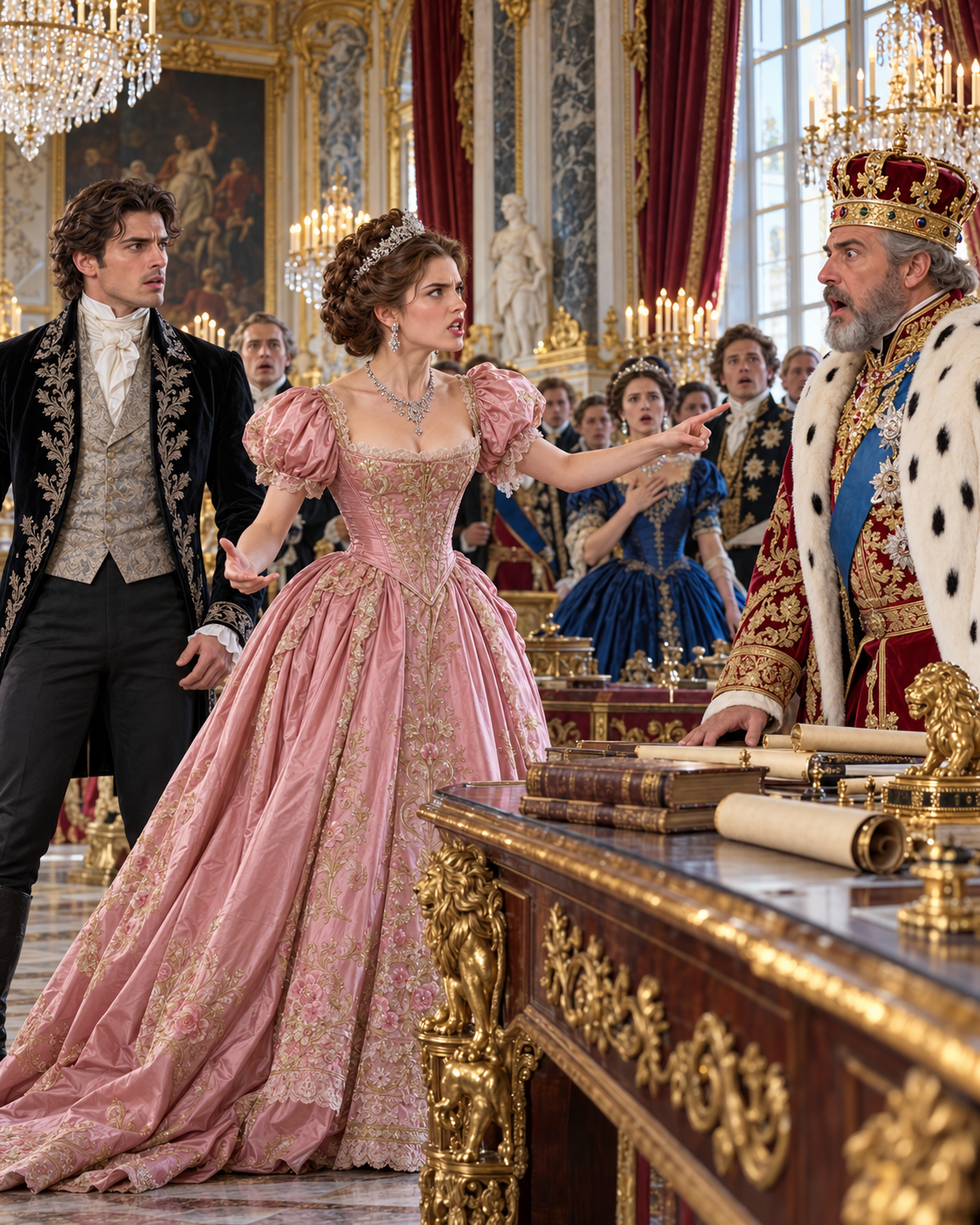
The Duke had brought his wife to the royal reception for one reason: to remind her that she was worth more in silence.
For one suspended heartbeat, Eleanor wondered whether she had misheard him.
Then the royal guards began moving toward her.
The nearest guard reached for the ceremonial sword at his waist, although he did not draw it. His companion stepped between Eleanor and the diplomatic table, blocking her view of the forged inheritance agreement.
Adrien released a long, unsteady breath.
Celeste smiled.
And Sir Edmund Wikliffe, who had spent thirty years serving the Crown, looked as though someone had just placed a death sentence in his hands.
“On what grounds?” Eleanor asked.
Sir Edmund unfolded the message again.
“Suspicion of treason, unlawful possession of confidential diplomatic information, and interference with negotiations conducted under royal authority.”
Eleanor stared at him.
“Interference?”
“The accusation alleges that you deliberately altered the agreement to implicate His Grace and destabilize the Crown’s relationship with the northern trading states.”
Adrien lowered his head.
Anyone watching might have mistaken the gesture for grief.
Eleanor knew better.
He was hiding a smile.
“Sir Edmund,” she said, “you watched me discover those alterations.”
“I did.”
“You heard the ambassador confirm that his government had never approved them.”
“I did.”
“Then you know the accusation is false.”
Sir Edmund’s gaze flickered toward the guards.
“Knowing something and proving it before the proper authority are unfortunately different matters.”
Adrien stepped forward, his voice suddenly warm with practiced concern.
“My poor Eleanor. I warned you against involving yourself in affairs beyond your understanding.”
She turned toward him.
“Did you arrange this?”
He leaned close enough that only she could hear.
“I gave you every opportunity to remain comfortable.”
The words struck harder than any admission of guilt.
Not because they surprised her.
Because she finally understood how little he had ever regarded her as a person.
She had been an inheritance with a pulse.
A signature he could manufacture.
A face he could display at receptions.
And when she became inconvenient, a woman he could condemn.
The guards closed around her.
Before they escorted her away, Eleanor turned toward Sir Edmund.
“May I ask one question?”
He hesitated.
“Quickly.”
“Who signed the arrest warrant?”
Sir Edmund glanced at the red seal.
“The order bears the authority of the Lord Chamberlain.”
“That wasn’t my question.”
His eyes lifted.
Eleanor held his gaze.
“Who signed it?”
Sir Edmund examined the document more carefully.
A strange expression crossed his face.
Then he folded it.
“Take Her Grace to the eastern antechamber. She is not to be questioned without my presence.”
Adrien opened his mouth.
Sir Edmund interrupted him.
“And nobody leaves this ballroom.”
The Duke’s expression darkened.
For the first time, Eleanor saw that her husband was not the most powerful man involved.
He was merely the most frightened.
The eastern antechamber overlooked the palace’s winter gardens.
Moonlight fell through tall windows, illuminating marble statues and bare branches silvered with frost. A fire burned low in the hearth, but the room felt cold.
Eleanor stood beside the window while two guards remained outside.
She had not been searched.
Neither had her evening purse been taken.
That struck her as unusual.
A woman accused of treason should hardly have been permitted to retain her personal belongings.
She opened the purse and withdrew the small ivory notebook she had carried for years.
Its pages were filled with observations that no one in her husband’s household had considered important.
Shipping schedules.
Currency conversions.
Foreign-language phrases.
Names overheard at dinners.
Figures from newspapers and parliamentary reports.
Adrien had once discovered her writing in it and laughed.
“Keeping a diary of your little thoughts?”
She had smiled and closed the cover.
He had never asked again.
Now she opened to an entry dated eleven weeks earlier.
Alderton grain purchases.
Six warehouses acquired near the eastern ports.
Three shipping companies consolidated under unfamiliar names.
Insurance policies purchased against political unrest.
She had recognized a pattern without fully understanding its purpose.
Tonight, she finally did.
The forged trade agreement was not intended merely to enrich Alderton merchants.
It was designed to create a shortage.
The merchants would buy grain cheaply under privileged customs arrangements, restrict its distribution, and sell it when desperate households could no longer afford bread.
The Crown would be blamed for failing to protect the people.
Alderton would become rich.
And someone standing behind Alderton would gain something more valuable than money.
Political power.
The antechamber door opened.
Sir Edmund entered alone.
He closed it carefully behind him.
“Your Grace.”
Eleanor did not turn.
“Have you come to tell me my husband has generously offered to forgive me?”
“No.”
“Then perhaps that I’ve been convicted before supper?”
“I have come to ask why the Lord Chamberlain ordered your arrest using a seal that ceased to be valid nineteen years ago.”
She turned.
Sir Edmund held out the warrant.
The red wax bore the royal lion beneath a five-pointed crown.
“The sovereign’s private warrants have carried a six-pointed crown since the accession of His Majesty’s father,” he explained. “This impression belongs to the old chamberlain’s office.”
“Could someone have stolen the seal?”
“Possibly.”
“Or deliberately copied it.”
“That is what concerns me.”
Eleanor looked toward the closed door.
“Then the order did not come from the King.”
“I have sent a trusted messenger to confirm that.”
“How long will it take?”
“Longer than we can safely afford.”
He approached the table and placed the forged inheritance document before her.
“I need you to tell me everything you know about Alderton.”
Eleanor opened her notebook.
For several minutes, she spoke while Sir Edmund listened without interruption.
She described the warehouses, the shipping routes, the suspicious insurance purchases, and the gradual accumulation of grain reserves across three counties.
Then she showed him something she had nearly forgotten.
A newspaper clipping.
It concerned the resignation of the former Minister of Commerce, Lord Harrowmere, following allegations of financial misconduct.
The article mentioned that Harrowmere had lost his position after an investigation into government contracts.
But Eleanor had underlined another sentence.
The minister’s private fortune had subsequently been purchased through intermediaries whose identities remained undisclosed.
Sir Edmund stared at the clipping.
“Why did you mark this?”
“Because the purchasing company used the same registered address as an Alderton subsidiary.”
He looked up sharply.
“How did you discover that?”
“I read the commercial registry.”
“Most people would not consider that interesting.”
“Most people were permitted to have interesting conversations at dinner.”
For the first time that evening, Sir Edmund almost smiled.
Then he became serious.
“Lord Harrowmere is the King’s Lord Chamberlain.”
Eleanor felt the pieces settle into place.
The invalid warrant.
The figure watching from the gallery.
The forged treaty.
The controlled grain supply.
A disgraced minister had not disappeared from power.
He had simply moved behind a curtain.
“Sir Edmund,” she said, “I don’t believe Lord Harrowmere intends to profit from this agreement.”
“What do you believe?”
“He intends to use the public anger it creates to weaken the King.”
Sir Edmund remained motionless.
“That,” he said eventually, “is a very dangerous accusation.”
“Then we should find evidence before he discovers what we’ve understood.”
A sharp knock sounded at the door.
Sir Edmund opened it a fraction.
A guard whispered something.
The advisor’s face hardened.
“What happened?”
“The interpreter has been found dead.”
Eleanor’s stomach tightened.
Sir Edmund looked past the guard.
“Where?”
“In the passage beneath the western staircase. The physician has been summoned.”
The guard hesitated.
“There is something else, sir.”
“Speak.”
“The man was carrying a note addressed to Her Grace.”
Eleanor stepped forward.
Sir Edmund took the folded paper.
Inside, written in hurried French, were seven words.
The fourth ledger is beneath the chapel.
Eleanor read them twice.
Then she noticed the final mark beneath the message.
A small triangle enclosing the number nine.
She had seen it before.
On a shipping invoice delivered to Vale House three weeks earlier.
An invoice Adrien had ordered burned.
“He’s telling us where they keep their true accounts,” Eleanor whispered.
Sir Edmund studied the note.
“Or someone is attempting to lead us into a trap.”
“Both could be true.”
He folded the paper.
“The palace chapel has several chambers beneath it. Most are used for storage.”
“Can you reach them?”
“Not without attracting attention.”
Eleanor looked toward the window.
Beyond the gardens, a narrow covered passage connected the eastern wing to the chapel.
“Then perhaps we shouldn’t approach from inside the palace.”
Sir Edmund followed her gaze.
“No.”
“Sir Edmund—”
“Absolutely not.”
She closed her notebook.
“An innocent man has just died because someone was afraid he might speak. My husband has pledged my inheritance to finance a conspiracy. And the person responsible may soon control the food supply of half the kingdom.”
“Precisely why I cannot allow you to wander through the gardens.”
“Then come with me.”
He looked at her for a long moment.
Finally, he sighed.
“I am beginning to understand why your husband preferred you silent.”
Eleanor gave him a small, humorless smile.
“Unfortunately for him, I have never been particularly obedient.”
They left through a servants’ staircase shortly before eleven.
Sir Edmund borrowed a dark cloak from the antechamber wardrobe, while Eleanor exchanged her delicate evening slippers for sturdy boots brought by a discreet palace maid.
The maid’s name was Margaret.
She was perhaps twenty, with anxious eyes and a small scar beneath her chin.
As Eleanor fastened the cloak, Margaret caught her sleeve.
“Your Grace, may I tell you something?”
“Of course.”
“My brother works at the Alderton warehouses.”
Sir Edmund stopped.
Margaret swallowed.
“He says grain has been arriving every night, but nothing is leaving. The managers tell the workers to remain silent.”
“Has he reported it?”
“He tried.”
Her voice trembled.
“Three days ago, the overseer said anyone who spoke about the warehouses would lose their position. Yesterday, two men disappeared.”
Eleanor took the maid’s hand.
“What is your brother’s name?”
“Thomas Bell.”
“I will remember it.”
Margaret’s expression changed.
Not because of the promise.
Because Eleanor had asked.
They crossed the winter garden beneath a sky crowded with clouds.
The palace windows glowed behind them, distant music drifting through the cold air.
The chapel stood beyond a row of cypress trees.
Its carved stone walls were dark with age, and the narrow door to the crypt passage was locked.
Sir Edmund removed a key from his pocket.
Eleanor raised an eyebrow.
“Do you ordinarily carry keys to royal crypts?”
“After thirty years of diplomatic service, one learns that knowing how to enter a room is often more useful than knowing how to leave it.”
The lock turned.
Inside, the passage smelled of damp stone and candle wax.
Their footsteps echoed down a narrow staircase.
At the bottom stood three storage chambers.
The first contained broken furniture.
The second held crates of ceremonial silver.
The third was empty.
Or appeared to be.
Eleanor approached the far wall.
The stonework had been repaired recently. The mortar was paler than the surrounding joints.
She knelt.
Near the floor, someone had scratched a small triangle into the stone.
Inside it was the number nine.
“Here.”
Sir Edmund brought the lantern closer.
Together, they examined the wall until Eleanor noticed a narrow brass handle concealed behind a removable wooden molding.
She pulled.
A section of shelving moved forward.
Behind it was a small iron door.
Sir Edmund stared.
“I have served this palace since before your marriage, Your Grace.”
“And?”
“I had no idea this existed.”
“Then perhaps the people who built it were not particularly eager to be discovered.”
He unlocked the door with a key found hanging behind the shelving.
Inside was a chamber no larger than a pantry.
Four leather-bound ledgers rested on a wooden desk.
Eleanor approached the fourth.
Its pages contained names, dates, and amounts transferred through foreign banks.
She turned several sheets.
Then stopped.
Lord Harrowmere.
Adrien Vale.
Alistair Alderton.
Payments to customs officers, parliamentary secretaries, provincial officials, and members of the royal household.
The conspiracy extended far beyond one forged agreement.
Sir Edmund leaned over her shoulder.
“Good God.”
Eleanor continued reading.
Near the middle of the ledger, a column of figures identified grain purchases scheduled for the following month.
Beside them was a single instruction.
Distribution suspended until the announcement of emergency powers.
She looked at Sir Edmund.
“They intend to manufacture a crisis and then offer the solution.”
He nodded grimly.
“Emergency powers would allow the Lord Chamberlain to recommend extraordinary trade commissioners.”
“Commissioners appointed from Alderton’s allies.”
“Who would control the royal treasury’s emergency spending.”
“And the grain supply.”
Eleanor turned the page.
A folded letter slipped from between two sheets.
Its seal had already been broken.
She unfolded it.
The handwriting was familiar.
Adrien’s.
Harrowmere must be informed that Eleanor has begun asking questions concerning the eastern warehouses. She has access to older commercial records and possesses an inconvenient memory for figures. If her inheritance cannot be secured through ordinary means, alternative provisions must be considered.
Eleanor read the final sentence.
Then read it again.
Her husband had not merely prepared to steal from her.
He had discussed removing her as an obstacle.
Sir Edmund saw her expression.
“What does it say?”
She handed him the letter.
He read it silently.
When he finished, his face had tightened with anger.
“I am sorry.”
Eleanor looked down at her wedding ring.
For years, she had imagined that Adrien’s cruelty came from disappointment.
Perhaps he had wanted a more beautiful wife.
A more fashionable wife.
Someone easier to display before the court.
She had blamed herself for failing to become what he wanted.
Now the truth stood before her in black ink.
He had never been disappointed.
He had been calculating.
A noise sounded beyond the hidden doorway.
Both of them froze.
Footsteps.
Several pairs.
Then a familiar voice.
“Search the chambers.”
Adrien.
Sir Edmund extinguished the lantern.
The darkness closed around them.
Eleanor heard the heavy scrape of boots across stone.
“His Lordship wants the woman alive,” Adrien continued. “The advisor is expendable.”
Sir Edmund drew a small pistol from inside his coat.
Eleanor touched his wrist.
“Don’t.”
He looked toward the door.
“They have us trapped.”
“Not yet.”
She had noticed something near the chamber ceiling.
An iron ventilation grate.
A draft moved faintly through it, carrying the smell of incense.
Above them was the chapel.
She glanced at the desk.
A narrow ladder stood folded against the wall.
Sir Edmund understood immediately.
He positioned it beneath the grate.
Eleanor climbed first.
The metal screws were old and loose.
She worked them free with the narrow clasp from her evening purse.
Below, Adrien’s footsteps approached.
“Edmund,” he called softly. “There’s no reason to make this unpleasant.”
Sir Edmund looked up at Eleanor.
She pulled the grate aside.
A narrow shaft opened above her.
“Go,” he whispered.
She squeezed into the passage.
Her gown caught on a rusted nail, tearing the fabric from knee to hem.
She scarcely noticed.
Sir Edmund handed her the ledger and the letter.
Then he followed.
Moments later, the hidden door crashed open beneath them.
Eleanor crawled through the shaft until the passage widened beneath a stone slab.
She pressed upward.
The slab shifted.
Cold air washed across her face.
She emerged behind the chapel’s organ loft.
Sir Edmund followed, breathing heavily.
Below, candlelight illuminated empty pews.
The altar stood deserted.
For a moment, Eleanor thought they had escaped.
Then applause echoed through the chapel.
Slow.
Deliberate.
A man stepped from the shadows near the altar.
He wore a black court uniform with silver embroidery.
A small silver ornament glittered at his cuff.
Lord Harrowmere.
“Remarkable,” he said. “Duke Vale assured me his wife possessed no useful intelligence whatsoever.”
Eleanor descended the steps from the organ loft, holding the ledger against her chest.
Sir Edmund followed, keeping the pistol concealed beneath his cloak.
Harrowmere watched them with an almost affectionate smile.
“Lady Vale. You have caused an extraordinary amount of inconvenience.”
“Then I assume the evening has been disappointing for you.”
“On the contrary. I have learned something valuable.”
“And what is that?”
“That your husband is a fool.”
A side door opened.
Two armed men entered.
Adrien followed them.
His expression was cold with fury.
“Eleanor.”
She regarded him steadily.
“Your Grace.”
His eyes moved to the ledger.
“Give that to me.”
“No.”
Harrowmere chuckled.
“You see? This is what happens when one allows women to believe their opinions have consequences.”
Eleanor looked toward the altar.
“Then perhaps you should explain why so many men have been frightened of mine.”
Harrowmere’s smile faded.
He stepped closer.
“You mistake curiosity for power.”
“And you mistake power for immunity.”
He drew a thin document from his coat.
“The King is presently considering a decree authorizing emergency commercial measures. By morning, those measures will be enacted. Your accusations will be dismissed as the desperate inventions of a disloyal wife.”
Sir Edmund spoke.
“The King has not authorized your warrant.”
Harrowmere tilted his head.
“Of course he hasn’t.”
For a moment, even Adrien looked startled.
Harrowmere continued calmly.
“His Majesty is a sentimental young man. He must be persuaded by circumstances rather than reason.”
He gestured toward the ledger.
“Give me the book, Lady Vale, and I may permit you to retire quietly to one of your country properties.”
“And if I refuse?”
“Your husband will become a widower before sunrise.”
Adrien’s face drained.
He had known about the forged signature.
He had known about the conspiracy.
But Eleanor saw that he had not fully understood the price of failure.
“That wasn’t our arrangement,” he whispered.
Harrowmere did not look at him.
“Arrangements change.”
Eleanor’s fingers tightened around the leather binding.
She could feel Sir Edmund shifting beside her.
Two guards blocked the main entrance.
Another stood near the side passage.
There was no obvious escape.
Then the chapel bells began to ring.
Once.
Twice.
Three times.
Harrowmere turned sharply toward the windows.
“Who ordered that?”
Nobody answered.
The bells continued.
Not the measured tolling of a service.
A frantic, insistent alarm.
Across the palace grounds, distant voices rose.
Footsteps sounded beyond the doors.
Harrowmere’s expression changed.
“What have you done?”
Eleanor smiled faintly.
“Something my husband never expected.”
Adrien stared at her.
She remembered Margaret’s anxious face and the small brass bell cord hanging beside the servants’ staircase.
Before leaving the antechamber, Eleanor had given her a folded instruction.
If we do not return before the eleventh bell, ring the chapel alarm and tell the Captain of the Royal Guard that Sir Edmund is missing.
Margaret had obeyed.
Harrowmere seized Eleanor’s arm.
“Give me the ledger.”
She twisted away.
The document fell open between them.
One page tore loose.
Harrowmere lunged for it.
Sir Edmund drew his pistol.
“Release her.”
The guards raised their weapons.
For several terrible seconds, nobody moved.
Then the main chapel doors burst inward.
A dozen royal guards entered beneath the command of Captain Rowan Ashford.
His sword was drawn.
“By order of His Majesty, nobody is to leave this chapel.”
Harrowmere stepped back.
“Captain, you are interfering with a matter of state.”
Ashford’s expression remained hard.
“His Majesty is aware.”
“Of what?”
“Of the unauthorized warrant, the disappearance of Sir Edmund, and the suspicious movements of armed men beneath the royal chapel.”
Harrowmere glanced toward Adrien.
For the first time, Eleanor saw genuine uncertainty in his eyes.
Then another figure entered.
The King.
He wore no crown.
Only a dark military coat, his face pale with anger.
Every man in the chapel bowed.
Eleanor began to lower herself into a curtsy, but His Majesty raised a hand.
“Lady Vale, remain standing.”
He approached the torn page lying on the floor.
Captain Ashford retrieved it and handed it to him.
The King read.
His expression grew colder with every line.
“Lord Harrowmere.”
“My sovereign, I can explain.”
“I sincerely hope so.”
The King looked toward the guards.
“Disarm these men.”
Harrowmere’s composure broke.
“Your Majesty, the kingdom faces an economic catastrophe. The grain reserves are insufficient. The treasury is vulnerable. I acted to protect the Crown.”
Eleanor stepped forward.
“No, my lord. You acted to protect the profits of the men who purchased those reserves.”
The King turned toward her.
“Explain.”
Eleanor opened the ledger.
And for the first time in her married life, she spoke before the most powerful men in the kingdom without lowering her eyes.
She described the false translations.
The unauthorized customs exemptions.
The grain warehouses.
The forged inheritance transfer.
The payments to royal officials.
Then she explained the conspiracy’s final purpose.
“Your Majesty, these men intended to make ordinary families desperate enough to accept any solution they offered. They would create hunger, then sell bread at a price that purchased political obedience.”
The chapel fell silent.
The King examined the figures.
“Can this be independently verified?”
“Yes, Your Majesty. The original customs records, warehouse inventories, and foreign correspondence will confirm it.”
Sir Edmund stepped forward.
“The ambassador has already denied authorizing the revised treaty. His testimony is recorded by my office.”
Captain Ashford bowed.
“And I can place reliable officers at the warehouses before dawn.”
The King closed the ledger.
“Then do so.”
Harrowmere staggered backward.
“You cannot act on the word of this woman!”
The King turned slowly.
“Why not?”
“She is merely—”
“Choose your next words carefully.”
Harrowmere stopped.
The King’s voice remained controlled.
“This woman has provided evidence. You have provided threats.”
He nodded to Captain Ashford.
“Arrest Lord Harrowmere, Alistair Alderton, and every official identified in these records. Secure the warehouses and preserve their contents. I want the foreign ambassadors informed that the Crown will review the treaty in their presence.”
Then he turned toward Adrien.
The Duke stood motionless.
“Your Grace,” the King said, “I understand that your wife’s inheritance was pledged against these arrangements.”
Adrien swallowed.
“Your Majesty, I was misled.”
Eleanor felt something inside her finally settle.
For years, she had waited for him to admit what he had done.
Now, hearing him lie when the truth was exposed, she understood that confession would never make her whole.
She stepped beside Sir Edmund.
“Your Majesty, may I present a letter written by my husband?”
Adrien’s eyes widened.
“Eleanor, please.”
She did not look at him.
The King accepted the letter.
He read it.
Then passed it to Captain Ashford.
“Take the Duke into custody.”
Adrien moved toward Eleanor.
“Eleanor, listen to me.”
Two guards stopped him.
He struggled once, then fell still.
“We can repair this. I can explain everything.”
She turned.
For a moment, the chapel seemed to disappear around them.
She saw the man who had offered her his arm at their wedding.
The husband who had ignored her when she spoke.
The stranger who had calculated the value of her inheritance while she lay ill.
And she realized how much of her life she had spent waiting for tenderness from someone who considered kindness a weakness.
“No, Adrien.”
His face crumpled.
“You are my wife.”
She removed her wedding ring.
“That was never enough to make you my husband.”
She placed it in his open hand.
The guards led him away.
By dawn, the palace was surrounded by messengers, soldiers, and government clerks.
The Alderton warehouses were secured before the first market bells rang.
Their inventories confirmed Eleanor’s calculations.
Enough grain had been concealed to feed several provinces through the approaching winter.
The conspirators had manufactured the appearance of scarcity.
Within two days, the Crown ordered controlled releases of the stored grain at regulated prices.
The announcement prevented a sudden market panic.
It also exposed the people who had profited from suffering.
The arrests continued for weeks.
Several officials confessed.
Others attempted to flee.
Lord Harrowmere was tried before a special royal tribunal, and his carefully constructed network began to collapse under the weight of its own records.
Adrien’s trial followed.
His wealth, title, and connections could not erase the forged signature or the letter written in his own hand.
Eleanor did not attend the sentencing.
She had already heard everything she needed.
Instead, she returned to Vale House for the last time.
The servants stood quietly along the entrance hall as she entered.
Her gowns, books, and personal belongings had been packed.
Her childhood portrait rested beside the staircase.
For years, it had remained hidden in a storage room because Adrien disliked the way she appeared in it.
She was seventeen in the painting.
Standing beneath an apple tree.
Holding a book.
Smiling without permission.
Eleanor approached the portrait.
Then she laughed softly.
Not because anything was amusing.
Because she remembered that girl.
The girl who had loved languages and mathematics.
Who had imagined traveling across Europe.
Who had believed marriage would mean sharing a life with someone who wanted to know her thoughts.
She had spent years trying to become smaller.
Now she wondered why.
“Your Grace?”
Margaret stood behind her.
Eleanor turned.
“Yes?”
“The carriage is ready.”
Eleanor studied the young maid.
“Would your brother still be interested in working somewhere safer?”
Margaret blinked.
“Thomas?”
“Yes.”
“I believe so.”
“Then tell him I shall need a trustworthy warehouse manager.”
Margaret stared.
Eleanor smiled.
“And I shall also need someone who is not afraid to tell me when I am making a mistake.”
Six months later, the Vale marriage was annulled by royal decree following a legal inquiry into its fraudulent financial arrangements.
Eleanor’s inheritance was restored.
The Crown offered her a substantial reward for uncovering the conspiracy.
She declined the money.
Instead, she requested something that surprised the entire court.
Permission to establish a commercial school for women.
Not a finishing academy.
Not a place to teach embroidery, music, and the proper arrangement of flowers.
A school where women could study languages, mathematics, international trade, and property law.
A school where daughters could learn to protect the fortunes they inherited and understand the documents they were asked to sign.
The first classes opened the following spring.
Thirty-two women enrolled.
Among them were two widows, three merchants’ daughters, a former governess, and a young maid named Margaret Bell.
Thomas became manager of the estate’s newly established grain distribution company, which operated under transparent contracts and independent accounting.
The company paid fair wages.
It also maintained emergency reserves that could not be sold without public oversight.
Some aristocrats called Eleanor reckless.
Others called her unfeminine.
She found that neither criticism troubled her anymore.
One afternoon, Sir Edmund visited the school.
He stood in the doorway of a classroom where young women were debating the terms of a fictional trade agreement.
Their voices overlapped with laughter and animated disagreement.
He watched for several minutes.
Then he turned toward Eleanor.
“Your Grace, I believe you have created something rather dangerous.”
She raised an eyebrow.
“Have I?”
“A generation of women who know precisely what their signatures are worth.”
Eleanor smiled.
“Then I hope they use them wisely.”
Sir Edmund looked around the room.
“I have another reason for visiting.”
He handed her an envelope bearing the royal crest.
Inside was an invitation.
The King wished her to accept a permanent position as an independent advisor to the Crown on commercial policy.
Eleanor read the letter.
Then set it aside.
“Will the position require me to attend royal receptions?”
Sir Edmund chuckled.
“Occasionally.”
“And will I be expected to remain silent?”
“Quite the opposite.”
She considered the invitation.
Beyond the window, sunlight spilled across the courtyard, where students crossed between buildings carrying books against their chests.
Eleanor watched them for a long moment.
Then she reached for a pen.
“I accept.”
Sir Edmund bowed.
“I believe His Majesty will be pleased.”
Eleanor signed her name.
Her real signature.
Her own decision.
Years later, when people spoke of the scandal that had nearly brought the kingdom to its knees, they remembered the forged treaty, the secret warehouses, and the downfall of powerful men.
But Eleanor remembered something else.
A quiet moment beside a diplomatic table.
A single mistranslated word.
A husband who had ordered her not to sound intelligent.
And the extraordinary freedom that began when she finally stopped obeying.
Because silence had never made her valuable.
It had merely made her convenient.
And the worth of a woman had never depended upon the permission of a man to recognize it.
The end.