The Duchess of Colwick discovered her husband’s three-year affair at a winter gala—when another woman reached for his hand as though she had every right to it.
The solicitor did not immediately explain what the final instruction meant. He remained seated behind his desk, one hand resting on the document, while Lord Braeford stood beside the window with his back to the room.
Marisol read the sentence again.
Her husband had instructed his legal representatives to prepare a petition removing her from the management of the Colwick estate, alleging that her judgment had become unreliable and that her increasing interference threatened the family’s financial interests.
The instruction was dated six months before the winter gala.
Six months before she had discovered Sylvana.
Six months before Lennox had accused her of invading his private affairs.
And nearly six months before he had begun treating her with an unfamiliar, exaggerated kindness.
She remembered the flowers delivered to her sitting room without occasion. The invitations he had encouraged her to decline. The physician he had suggested she consult because she seemed unusually tired.
She had mistaken those gestures for the awkward attentions of a husband whose affection had faded.
Now they looked rather different.
“Has he filed it?” she asked.
“Not yet,” the solicitor replied. “But he has taken preliminary steps.”
Lord Braeford turned from the window.
“Then we must act before he does.”
Marisol remained seated. Her eyes were fixed on the date beneath her husband’s signature.
“Why hasn’t he filed it?”
The solicitor hesitated.
“That is what concerns me.”
He opened another folder and removed a handwritten memorandum.
“His representatives appear to have been waiting for something. An event that would make his allegations more convincing.”
Marisol looked up.
“What sort of event?”
“Something that could be presented as evidence of instability. An improper confrontation, perhaps. An accusation made publicly without sufficient proof.”
The winter gala returned to her with uncomfortable clarity.
Lennox’s smile across the ballroom.
Sylvana’s hand resting on his sleeve.
The deliberate absence of embarrassment.
Marisol slowly set the document down.
“He wanted me to make a scene.”
Neither man answered.
“He wanted me to accuse him in front of everyone.”
Her father crossed the room and stopped beside her chair.
“Marisol—”
“But I didn’t.”
“No,” he said quietly. “You didn’t.”
For the first time that morning, she allowed herself a small, exhausted smile.
“Then he must be terribly disappointed.”
The solicitor gathered the papers into a careful stack.
“Disappointed men can become dangerous, Your Grace. Particularly when they believe they are running out of time.”
Marisol rose and reached for her gloves.
“Then we should make certain he runs out of options first.”
By the following afternoon, Colwick House had become a place of carefully maintained appearances.
Servants continued polishing silver. Fires were laid in every occupied room. Fresh flowers appeared beneath portraits of ancestors who had survived wars, bankruptcies, and marriages of questionable wisdom.
Yet something had shifted beneath the familiar routine.
Marisol noticed it in the way the household secretary stopped speaking when she entered the library.
She noticed it when the steward, Mr. Harcourt, avoided her eyes while presenting the weekly accounts.
Most tellingly, she noticed that the locked cabinet containing the estate’s original ledgers had been moved from her study.
She stood before the empty space for several moments.
Then she rang the bell.
Harcourt appeared almost immediately.
“Your Grace?”
“Where are the ledgers?”
He glanced toward the door.
“His Grace requested that they be transferred.”
“To where?”
“The west office.”
“And who has the key?”
A pause.
“His Grace.”
Marisol studied the man who had worked beneath her direction for seven years.
His collar was slightly crooked. His hands, usually steady, worried the edge of his coat.
“Mr. Harcourt, are you being threatened?”
His expression changed so quickly that she almost regretted asking.
“No, Your Grace.”
She waited.
He swallowed.
“Not directly.”
Marisol moved toward the desk and opened a drawer.
Inside lay a small notebook containing the names of every estate employee, their families, and the circumstances that might affect their livelihoods.
She had maintained it for years.
Harcourt’s youngest daughter had recently recovered from a prolonged illness. His eldest son was preparing to enter university.
She closed the notebook.
“You have served this household faithfully. Whatever happens between His Grace and me, I will not permit you to be punished for telling the truth.”
The steward’s shoulders lowered slightly.
“His Grace has ordered an examination of the accounts.”
“By whom?”
“A gentleman from London. Mr. Vane.”
Marisol recognized the name.
Edmund Vane was a financial adviser whose reputation depended less upon accuracy than upon his willingness to make inconvenient figures appear respectable.
“When is he expected?”
“Tomorrow morning.”
“And what is he examining?”
Harcourt looked toward the corridor again.
“Your Grace’s expenditures.”
The silence that followed seemed to stretch through the entire room.
Marisol had personally reduced the estate’s outstanding debts, renegotiated agricultural leases, and restored income from two neglected properties.
Now her husband intended to use the very accounts she had rescued as evidence against her.
She nodded once.
“Thank you, Mr. Harcourt.”
He remained at the doorway.
“Your Grace, there is something else.”
She turned.
“The gentleman from London has asked for every letter bearing your signature.”
Marisol felt the cold settle somewhere beneath her ribs.
“Every letter?”
“Yes, Your Grace. Even the old ones.”
After he left, she stood motionless beside the desk.
Lennox was not merely searching for evidence.
He was searching for examples.
Examples of her handwriting.
Examples of her signature.
The realization made the forged Hertfordshire authorization considerably more troubling.
That evening, Marisol wrote three letters.
The first went to her solicitor, requesting an independent examination of the disputed signatures.
The second went to her father, asking him to arrange discreet protection for the original documents already in his possession.
The third was addressed to the former employee of the Hertfordshire household.
Marisol wrote it herself.
She did not ask the woman to accuse anyone. She did not promise money in exchange for testimony.
She simply asked whether they might speak privately, and assured her that no answer would be demanded against her will.
When she finished, she sealed the envelopes and placed them in the hands of a messenger she had trusted for years.
Then she went downstairs to dinner.
Lennox was waiting.
He stood beside the fireplace, holding a glass of brandy.
“You’ve been busy,” he observed.
Marisol took her seat.
“The estate rarely manages itself.”
He smiled without warmth.
“That may soon cease to be your concern.”
A servant entered carrying soup.
Marisol waited until the door had closed.
“Is that a promise?”
Lennox lowered his glass.
“I have tolerated your interference for longer than I should.”
“Nine years, to be precise.”
“Do not turn this into a performance.”
She unfolded her napkin.
“Then stop giving me an audience.”
His expression hardened.
For a moment, she thought he might strike the table.
Instead, he sat opposite her and began eating.
The meal continued beneath the watchful eyes of painted dukes and duchesses.
Neither mentioned Sylvana.
Neither mentioned Hertfordshire.
But halfway through the second course, Lennox spoke again.
“Lady Kestrel will be visiting tomorrow.”
Marisol’s knife stopped against her plate.
“Here?”
“She has been invited.”
“By whom?”
“By me.”
She looked at him across the candlelight.
“Then I trust you have arranged suitable accommodations.”
His eyes narrowed.
“You will treat her with courtesy.”
Marisol returned to her dinner.
“I have always treated guests with courtesy, Lennox. It is the hosts who occasionally disappoint me.”
The next morning, Lady Sylvana Kestrel arrived in a carriage trimmed with dark green velvet.
She stepped into the entrance hall wearing a traveling gown of pale gray silk, her gloves fastened with tiny pearl buttons.
Marisol received her beneath the great staircase.
For a brief moment, the two women regarded each other without speaking.
Sylvana was beautiful in a manner that required no introduction. Her expression was composed, her posture impeccable, and her eyes possessed the careful alertness of someone entering unfamiliar territory.
“Your Grace,” she said.
“Lady Kestrel.”
Sylvana glanced toward the staircase.
“I hope my visit is not inconvenient.”
Marisol offered a restrained smile.
“That depends entirely upon its purpose.”
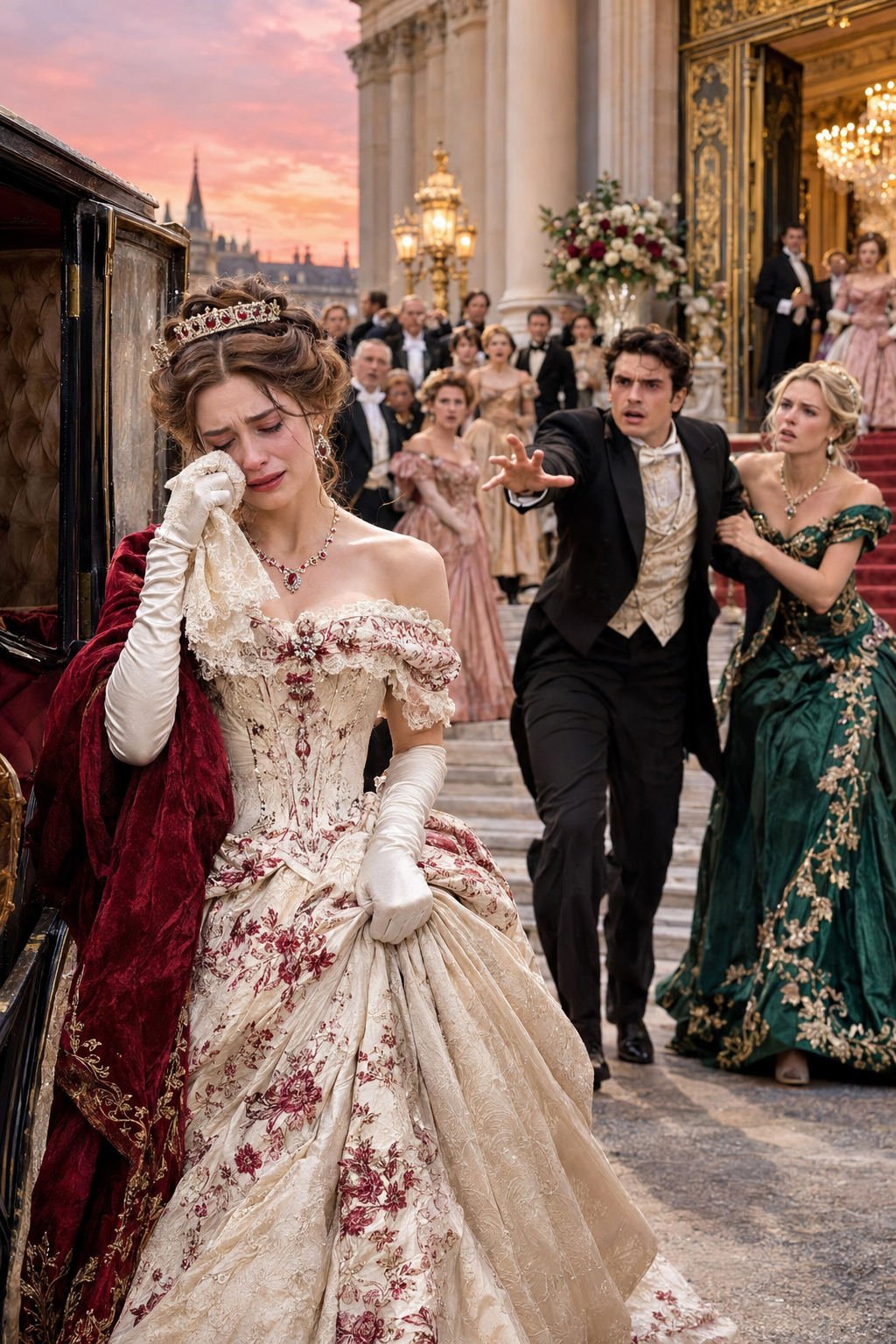
A faint color rose in Sylvana’s cheeks.
Lennox appeared before she could answer.
“My dear Sylvana.”
His familiarity was immediate.
Too immediate.
Marisol watched him take the woman’s hand.
Then she noticed something unexpected.
Sylvana did not look pleased.
She looked frightened.
During luncheon, Lennox dominated the conversation with remarks about London society and the coming spring season.
Sylvana answered politely, but her attention repeatedly returned to Marisol.
Once, when Lennox mentioned Hertfordshire, her fork struck the edge of her plate.
The sound was slight.
Marisol heard it nevertheless.
Later, as the gentlemen withdrew, Sylvana remained near the drawing-room window.
“I understand you have been making inquiries,” she said.
Marisol stood beside a table of winter roses.
“About what?”
Sylvana’s fingers tightened around her gloves.
“You know perfectly well.”
“Then perhaps you should tell me what you believe I know.”
The younger woman looked toward the door.
For the first time, her polished composure faltered.
“Lennox said you would try to ruin me.”
Marisol considered her carefully.
“And what did he say you had done?”
Sylvana’s eyes filled, though no tears fell.
“He said you had agreed to everything.”
Marisol felt an unfamiliar stillness settle over her.
“Agreed to what?”
Sylvana opened her mouth.
Footsteps sounded in the corridor.
She immediately stepped away.
Lennox entered smiling.
“There you are.”
Sylvana lowered her gaze.
Marisol understood then that the woman standing before her was not simply guarding a secret.
She was trapped inside one.
Two days later, the former Hertfordshire employee arrived at Lord Braeford’s London residence.
Her name was Mrs. Eliza Fenwick.
She was a widow in her forties, with roughened hands and a careful manner that suggested years spent measuring every word before speaking.
Marisol received her in a small sitting room overlooking the garden.
No servants remained nearby.
Mrs. Fenwick sat on the edge of her chair.
“I was told there would be a solicitor.”
“He is available,” Marisol replied. “But I wished to speak with you first.”
The woman looked down at her hands.
“I don’t want trouble.”
“Neither do I.”
Mrs. Fenwick gave a faint, disbelieving smile.
“Trouble has a way of finding people who work for gentlemen.”
Marisol did not contradict her.
Instead, she poured tea and waited.
After several minutes, Mrs. Fenwick began speaking.
She had entered service at the Hertfordshire residence nearly three years earlier.
Lady Sylvana had lived there regularly, although her presence was concealed whenever visitors connected to the Colwick family were expected.
The household expenses were paid through an agent.
Instructions arrived under false names.
And Lennox visited frequently.
None of this surprised Marisol.
What came next did.
“His Grace kept a locked writing desk in the upstairs study,” Mrs. Fenwick said.
“He never allowed anyone to touch it.”
Marisol leaned forward.
“Did you ever see what was inside?”
“Only once.”
Mrs. Fenwick hesitated.
“There were papers. Letters. Some bearing your name.”
Marisol felt her fingers tighten around the teacup.
“My name?”
“Yes, Your Grace. And there was a seal.”
“What sort of seal?”
“A silver one. With the Colwick crest.”
Marisol knew the object immediately.
It was a family seal used for private correspondence, one she had believed lost during renovations two years earlier.
Mrs. Fenwick continued.
“One evening, I heard His Grace arguing with another gentleman. They were discussing a signature that had not been accepted.”
“Who was the gentleman?”
“I never learned his name. But His Grace called him Edmund.”
Edmund Vane.
Marisol looked toward the solicitor, who had quietly entered at her invitation.
He made a note.
Mrs. Fenwick’s voice grew softer.
“His Grace said they needed a better example. Something no one could question.”
Marisol remembered the letters removed from her study.
For a moment, the room seemed unusually cold.
“Why have you come forward?” she asked.
Mrs. Fenwick looked at her directly.
“Because Lady Kestrel was crying when I left.”
Marisol waited.
“She said she had been promised a future. But every time she asked when things would change, His Grace told her there were still arrangements to make.”
Mrs. Fenwick pressed her hands together.
“And then I heard him say that once the duchess was removed, everything would be settled.”
The words remained between them.
Marisol had spent weeks believing Lennox intended to conceal his betrayal.
Now she understood that concealment had only been the beginning.
He intended to erase her authority before she could challenge him.
That afternoon, the solicitor initiated the formal steps toward judicial separation.
The petition was supported by sworn testimony, financial records, and evidence of Lennox’s continuing relationship with Sylvana.
Separate proceedings were prepared concerning the forged authorizations and the suspected misuse of estate funds.
Marisol insisted that every allegation be supported by documents.
No rumor would be included.
No accusation would be made merely because it seemed plausible.
Her solicitor regarded her with something approaching admiration.
“Most people in your position would be tempted to expose him publicly.”
Marisol closed the folder.
“Public humiliation would satisfy me for an afternoon. I would prefer a judgment that survives the afternoon.”
The first serious confrontation came the following week.
Lennox received formal notice of the proceedings while entertaining two acquaintances in his library.
By the time Marisol returned from visiting her father, he was waiting in the entrance hall.
His face was pale with anger.
“You have disgraced this family.”
She removed her gloves.
“I have asked a court to examine what has been done in its name.”
“You have no idea what you are inviting.”
“I have a very clear idea.”
He stepped closer.
“You think your father can protect you forever?”
Marisol held his gaze.
“No. That is why I have retained a solicitor.”
For several seconds, Lennox seemed unable to answer.
Then he laughed sharply.
“You will regret this.”
She moved past him.
“Perhaps. But regret is not a reason to remain.”
That night, Marisol discovered that her private correspondence had been searched.
The drawer beside her bed stood slightly open.
A ribbon she used to bind letters lay on the carpet.
Nothing appeared missing.
But the arrangement of the papers had changed.
She did not summon Lennox.
Instead, she instructed her maid to pack a small traveling case.
Before dawn, Marisol left Colwick House for her father’s residence.
She took her personal possessions, copies of her records, and the notebook she had kept throughout her years managing the estate.
She did not take anything belonging to Lennox.
At the front steps, she paused and looked back at the windows of the house.
Nine years earlier, she had entered those doors as a bride, believing that devotion could be built through patience and shared responsibility.
She had spent countless mornings in the estate office, countless evenings reviewing accounts while her husband entertained guests.
She had mistaken being indispensable for being valued.
The realization hurt more than she expected.
But when the carriage door closed, she did not ask the driver to wait.
The proceedings moved slowly.
Lennox’s representatives challenged the authenticity of the records and suggested that Marisol’s father had encouraged her to fabricate accusations.
They questioned her judgment.
They described her attention to financial detail as excessive.
They implied that her insistence upon managing the estate had created unnecessary strain within the marriage.
Marisol listened to these arguments without interruption.
Then the independent handwriting examiner delivered his findings.
The disputed signatures were imitations.
Several had been produced using the same distinctive errors.
And the pressure patterns suggested that the writer had practiced from genuine examples.
The solicitor placed the report beside the original documents.
“Mr. Vane will have difficulty explaining this.”
Yet Lennox still refused to concede.
Instead, he made one final attempt to regain control.
A letter arrived at Lord Braeford’s house, offering Marisol a private settlement.
She would receive a generous annual allowance and a residence of her choosing.
In exchange, she must withdraw the allegations concerning the forged documents, abandon the financial inquiry, and agree never to discuss the Hertfordshire property.
Her solicitor read the offer twice.
“It is more than many women could expect.”
Marisol looked at the amount.
It would have provided comfort for the rest of her life.
But beneath the figures lay the familiar assumption that her silence could be purchased.
“What happens to the estate accounts?” she asked.
“They would remain under His Grace’s control.”
“And the forged signatures?”
“The agreement would require you to cease pursuing the matter.”
She pushed the letter away.
“Then it is not a settlement.”
Her solicitor looked up.
“It is an expensive request for permission to continue.”
The decisive evidence arrived three weeks later.
Mrs. Fenwick had remembered that the Hertfordshire household maintained a correspondence register recording deliveries and instructions from London.
The register had been left with a former housekeeper when the residence was abruptly closed.
Through lawful inquiries, the solicitor obtained the woman’s cooperation.
The register contained dates, names, and references to documents sent between Lennox and Edmund Vane.
Several entries corresponded precisely with the suspicious transfers.
One referred to the silver Colwick seal.
Another recorded a packet of original letters bearing Marisol’s signature.
But the most important entry concerned an instruction issued shortly before the winter gala.
The solicitor read it aloud in his office.
“His Grace requires the duchess’s conduct to be observed closely at the forthcoming gathering. Any public disturbance should be documented.”
Lord Braeford closed his eyes.
Marisol remained perfectly still.
Lennox had not merely anticipated her humiliation.
He had arranged the circumstances in which it might occur.
Sylvana’s conspicuous behavior at the gala had been part of a calculated attempt to provoke her.
And if Marisol had responded as he expected, her anger might have been used to support his allegations.
For several moments, nobody spoke.
Then Marisol asked for another sheet of paper.
She wrote a brief statement describing exactly what she had witnessed that evening.
No embellishment.
No speculation.
Only what she knew.
When she finished, she placed her pen down.
“Now he may explain the rest.”
The hearing drew considerable attention among those who followed the affairs of the aristocracy.
Lennox arrived wearing the composed expression of a man accustomed to being believed.
Marisol entered beside her solicitor, dressed in a simple dark gown.
She carried no jewels beyond her wedding ring.
During the examination of the financial records, Lennox maintained that the transactions had been authorized for legitimate household purposes.
He denied knowingly permitting any forged signatures.
He suggested that Edmund Vane had acted independently.
But the correspondence register contradicted him.
So did the instructions preserved by the former housekeeper.
When questioned about the Hertfordshire residence, Lennox’s answers became increasingly guarded.
He admitted visiting the property.
He acknowledged Lady Sylvana’s presence.
But he insisted that the arrangement had no connection to the disputed financial transfers.
Then Sylvana was called to give evidence.
Marisol had not seen her since the visit to Colwick House.
The younger woman appeared thinner, her face pale beneath the brim of her hat.
She avoided looking at Lennox.
Her testimony began quietly.
She acknowledged the relationship.
She confirmed that Lennox had maintained the residence.
And when asked whether he had ever discussed his marriage, she hesitated.
The room fell silent.
Finally, she lifted her head.
“He told me the duchess had agreed to live separately.”
Lennox shifted in his seat.
Sylvana continued.
“He said she wished to withdraw from society. That she was no longer capable of managing the estate.”
Marisol watched her without expression.
“And did you believe him?” the examining counsel asked.
Sylvana’s fingers tightened around her handkerchief.
“For a time.”
“What changed your mind?”
The young woman looked toward Marisol.
“She did not behave like the woman he described.”
Lennox’s counsel rose to object to the implication.
But the damage had already been done.
Sylvana lowered her gaze and continued answering questions.
She had never seen any agreement signed by Marisol.
She had never heard Marisol consent to the arrangement.
And Lennox had repeatedly promised that the duchess would soon be removed from his affairs.
By the end of the session, Lennox’s composure had begun to fracture.
The court did not resolve every financial allegation that day.
Further inquiries would be required concerning Vane’s involvement and the disputed authorizations.
But the evidence supporting Marisol’s petition had become substantial.
When the court ultimately granted the judicial separation, the decision established that she was no longer required to remain within the marital household.
The financial issues were addressed through further proceedings and a negotiated arrangement made under the scrutiny of her legal representatives.
Lennox was required to account for the unauthorized expenditures.
The disputed transactions were referred for appropriate investigation.
Marisol recovered control over her separate property and secured an independent income.
The result did not erase nine years of marriage.
It did not restore the trust that had been destroyed.
But it gave her something she had nearly forgotten she possessed.
A future that did not require her husband’s permission.
Several months later, Marisol returned to Colwick House for the last time.
Not to reconcile.
Not to argue.
She had come to collect a small wooden writing box that had belonged to her mother.
The house seemed strangely unchanged.
The same portraits watched from the walls.
The same clock ticked in the entrance hall.
Yet the rooms no longer felt like places she had to defend.
Lennox was waiting in the library.
He looked older.
The confidence that had once filled every room around him had diminished into a weary stiffness.
“I suppose you’ve come to enjoy your victory,” he said.
Marisol placed her gloves on the desk.
“I came for my mother’s box.”
He looked away.
For a moment, she thought he would allow her to leave without another word.
Then he spoke.
“Was there truly nothing worth saving?”
Marisol regarded him quietly.
She remembered their early years, the plans they had made, the mornings when he had sought her advice and the evenings when she had believed his gratitude meant affection.
There had been happiness.
She would not deny it merely because it had ended.
“There was,” she said.
His expression softened.
“Then why couldn’t you forgive me?”
Marisol looked toward the window, where sunlight rested across the garden paths.
“Because forgiveness and surrender are not the same thing.”
Lennox said nothing.
She picked up the wooden box.
“You did not simply love someone else. You tried to make me powerless so that I could not object.”
He lowered his eyes.
For the first time, he offered no explanation.
Marisol walked toward the door.
“Goodbye, Lennox.”
He did not follow.
Outside, the gardens were beginning to bloom.
The last traces of winter had disappeared from the stone terraces, and the air carried the faint scent of damp earth.
Her father waited beside the carriage.
He did not ask what had been said.
He simply opened the door.
“Where shall we go?” he asked.
Marisol looked toward the road beyond the gates.
For years, her days had been measured by the needs of the Colwick estate.
Now there were other possibilities.
She had already begun advising her father on the management of his properties.
A small house near the countryside had been secured in her own name.
And a charitable association supporting widows and women without independent means had invited her to help oversee its finances.
For once, her work would belong to a purpose she had chosen.
“Home,” she answered.
Her father smiled.
“Braeford?”
Marisol considered the question.
Then she shook her head.
“Not quite.”
The carriage moved forward.
Behind them, Colwick House disappeared beyond the trees.
Marisol did not turn to watch it vanish.
In the months that followed, she discovered that freedom was rarely dramatic.
It was waking without dread.
It was opening a letter without wondering who had read it first.
It was making a decision and knowing that no one would punish her for having an opinion.
Some mornings, grief still arrived unexpectedly.
A familiar melody might remind her of a happier evening.
The sight of a winter rose might return her to the ballroom where everything had begun.
She allowed those memories to exist without permitting them to govern her life.
Sylvana eventually sent a letter.
It contained no elaborate defense, only an acknowledgment of the harm she had helped cause and an apology that asked for nothing in return.
Marisol read it beside the window of her new study.
Then she placed it in a drawer.
She did not reply immediately.
Some wounds required distance before words could be offered honestly.
One spring afternoon, Lord Braeford visited her while she was reviewing plans for a new residence intended to shelter women who had lost their financial security.
He stood beside her desk, examining the figures.
“You have taken on a great deal.”
Marisol smiled faintly.
“I have had practice.”
He looked at the papers, then at his daughter.
“Are you happy?”
She considered the question with the seriousness it deserved.
Outside, sunlight moved across the garden. A servant passed beneath the windows carrying freshly cut flowers.
Marisol rested her pen on the desk.
“I am beginning to be.”
Her father reached for her hand.
Neither spoke for a while.
There was no need.
Years later, people would remember the Duchess of Colwick for the scandal that had surrounded her marriage.
Some would speak of the judicial separation.
Others would recall the forged signatures, the hidden residence, or the duke whose carefully constructed deception had collapsed beneath the weight of his own records.
But those who truly knew Marisol remembered something else.
They remembered a woman who had been offered comfort in exchange for silence and had chosen uncertainty instead.
A woman who understood that dignity could not be restored by humiliating another person, but only by refusing to participate in her own humiliation.
And a woman who had learned, after nine years of protecting a household that failed to protect her, that loyalty without respect was not devotion.
It was captivity dressed in familiar clothes.
On the anniversary of the winter gala, Marisol attended a small gathering at her father’s home.
There were no grand chandeliers, no crowded ballroom, and no carefully staged displays of affection.
Only friends, warm candlelight, and the gentle sound of conversation.
At one point, someone asked whether she regretted leaving Colwick House.
Marisol looked down at the glass in her hand.
For a moment, she remembered another glass of champagne, untouched beneath the glittering lights of a winter ballroom.
Then she lifted her eyes.
“I regret how long I believed endurance was the same as strength.”
She set the glass aside and returned to her friends.
Beyond the windows, snow began to fall.
This time, it did not remind her of betrayal.
It reminded her of the evening she had finally stopped waiting for someone else to decide what her life was worth.
And as the first white flakes settled across the garden, Marisol understood something she wished she had known years earlier.
A person does not lose dignity when someone betrays their trust.
They lose it only when they are persuaded that their worth depends upon the betrayer’s approval.
She had once believed that preserving her marriage meant preserving herself.
Now she knew better.
Sometimes the bravest way to honor a promise is to recognize when the person who received it has destroyed the very trust upon which it was made.
And sometimes, the most meaningful victory is not watching another person fall.
It is discovering that you can stand, entirely on your own.
THE END.