The dragon had been sitting on Nora Hale’s porch for three days when the Conclave finally sent someone to take it away.
The first time Nora Hale saw a dragon kneel before a human, she thought something terrible had happened.
It was a cold morning on Veldan’s Reach, six weeks after Finn Okafor had asked her to participate in the Conclave’s expanding research program. Nora was carrying a bucket of feed toward the barn when Scorch suddenly stopped beside her.
His copper-black wings folded tightly against his body. The small ridges along his spine rose, and a low vibration passed through his chest.
Nora followed his gaze toward the eastern wheat field.
A transport had landed beyond the irrigation towers.
Standing beside it was a young woman in a torn blue jacket, perhaps twenty years old, with a frightened expression and a bandage wrapped around her left wrist.
In front of her crouched a dragon nearly twice Scorch’s size.
Its scales were pale silver, its horns curved backward like polished bone, and one enormous wing dragged across the ground.
The young woman took a hesitant step.
The dragon lowered its head until its forehead touched the dirt.
Nora had seen Scorch bow his head when he wanted affection. This was different. The silver dragon looked as though it were surrendering.
Then the woman whispered something.
The creature began to tremble.
Scorch made a sound Nora had never heard before, a deep, mournful note that seemed to rise from somewhere beneath the earth.
“Easy, boy,” she murmured.
But Scorch was already moving.
He crossed the field with his wings partially spread, placing himself between the silver dragon and the frightened young woman.
For one terrible moment, Nora thought the two creatures would attack each other.
Instead, the silver dragon pressed its forehead against Scorch’s chest.
And Scorch wrapped one wing around it.
Nora stood motionless.
Behind her, Finn emerged from the transport carrying a medical case.
“Nora,” he said quietly, “we need your help.”
She looked from the silver dragon to the young woman.
“What happened?”
Finn hesitated.
“The Conclave tried to separate them.”
The young woman turned toward Nora. Her eyes were swollen from crying.
“They said he was malfunctioning,” she whispered. “They said dragons aren’t supposed to feel what he feels.”
Nora looked at the trembling creature.
“And what does he feel?”
The young woman swallowed.
“He misses my mother.”
For a moment, the entire field seemed to fall silent.
Nora lowered her bucket.
“Come inside,” she said.
The young woman’s name was Elara Voss. She came from a mining settlement on the distant moon of Talren, where her mother had worked as a physician for nearly thirty years.
Three months earlier, a reactor accident had destroyed the settlement’s medical wing.
Elara’s mother had died evacuating patients.
The silver dragon, named Aster, had been found beside the ruins, refusing food and attacking anyone who attempted to move him.
Conclave specialists assumed he had suffered neurological damage from radiation exposure.
But Elara knew something they didn’t.
Her mother had spent years treating injured wildlife around the settlement. Aster had visited the medical wing regularly, sometimes remaining outside the windows for hours.
After the accident, Elara began visiting the ruins every evening.
She would sit beside the broken walls and talk about her mother.
Eventually, Aster started sitting beside her.
Two weeks later, he followed her home.
The Conclave took him away four days after that.
“They told me he was dangerous,” Elara said, sitting at Nora’s kitchen table. “But he never hurt anyone. He only got frightened when they tried to put him in a containment chamber.”
Nora poured tea into two mismatched cups.
She glanced toward the window, where Scorch and Aster lay together beneath the apple trees.
“What did they do to him?”
Finn placed his medical case on the table.
“They attempted to erase the emotional imprint.”
Nora slowly turned toward him.
“Erase it?”
Finn’s expression tightened.
“The Conclave developed a neural procedure decades ago. It was intended to stabilize dragons after traumatic bonding failures.”
“And did it work?”
“Sometimes.”
Nora waited.
Finn looked down.
“Sometimes it destroyed their ability to bond again.”
The kitchen became very quiet.
Outside, Aster lifted his head, watching Elara through the glass.
Nora remembered the first night Scorch had slept on her porch, curled beneath Ray’s old rocking chair.
She remembered how the little creature had pressed against her legs whenever she cried.
And she remembered how frightened she had been when she realized that loving him meant having something to lose again.
“You’re telling me,” she said carefully, “that when a dragon loves someone too much, your people try to make it stop?”
Finn did not answer immediately.
Then he said, “I’m telling you we may have spent centuries mistaking grief for disease.”
Nora looked at Aster.
His silver scales caught the morning sunlight, but the creature remained exhausted, his wounded wing trembling whenever he moved.
“Then we’re going to help him,” she said.
Finn exhaled.
“Nora, there’s something else.”
She knew from his expression that she wouldn’t like it.
“Director Saul has ordered Aster’s return.”
Elara’s teacup rattled against its saucer.
“When?”
Finn looked toward the sky.
“By sunset.”
Nora stood.
“No.”
“Nora—”
“I said no.”
Finn rose as well.
“You don’t understand. Aster is classified as a high-risk neurological specimen. Saul has authorization to retrieve him by force.”
Nora walked to the kitchen window.
Scorch lifted his head as though sensing her distress.
She pressed her palm against the glass.
Three years earlier, she had buried her husband beneath a white stone beside the orchard.
She had promised herself afterward that she would never again become involved in anything she couldn’t control.
But now a frightened girl sat in her kitchen, and a wounded dragon lay beneath her trees.
Nora turned back.
“Then we’d better make sure Saul doesn’t arrive to find a frightened animal.”
Finn frowned.
“What are you suggesting?”
She looked at Elara.
“I’m suggesting we find out what Aster is trying to tell us.”
By noon, Finn had assembled his portable psionic echo equipment in the barn.
The procedure was similar to the one he had used on Scorch, except Aster’s emotional patterns were far more unstable.
Nora sat beside Elara while Finn adjusted the instruments.
Scorch remained near the silver dragon’s injured wing.
“Whatever happens,” Finn warned, “don’t force a response. If Aster becomes distressed, we stop immediately.”
Elara nodded.
She placed her hand against Aster’s forehead.
“It’s all right,” she whispered. “I’m here.”
The instruments flickered.
At first, the readings showed familiar patterns: sorrow, fear, recognition, attachment.
Then something strange appeared.
A second emotional signature emerged beneath Elara’s.
Finn leaned forward.
“That isn’t possible.”
Nora looked at him.
“What?”
“There’s another imprint.”
Elara went pale.
“My mother’s?”
Finn studied the readings.
“No. Older.”
The barn lights dimmed.
Aster’s eyes opened.
For one heartbeat, Nora felt something move through the air, like the pressure before a thunderstorm.
Then the world disappeared.
She was standing in a vast chamber beneath a violet sky.
Thousands of dragons circled overhead.
Below them stood figures from dozens of alien civilizations, their faces hidden behind ceremonial masks.
In the center of the chamber, a dragon larger than any Nora had ever imagined lay chained to a black stone platform.
Its scales glowed like molten stars.
A voice echoed through the darkness.
“Emotion is instability. Attachment is weakness. Memory is contamination.”
Nora tried to move.
She couldn’t.
A machine descended toward the chained dragon.
The creature screamed.
The sound passed through Nora’s bones.
Then she saw something that made her blood turn cold.
The dragon wasn’t fighting to escape.
It was shielding a smaller creature beneath its wing.
A hatchling.
Copper-black.
Scorch.
Nora gasped.
The vision shattered.
She fell backward into Finn’s arms.
Elara was crying.
Aster had collapsed, his breathing shallow.
Scorch stood over him, wings spread, his eyes glowing with an unfamiliar golden light.
Finn stared at the equipment.
“What was that?” Nora demanded.
He didn’t answer.
“Finn.”
He looked at her, his face drained of color.
“That wasn’t Aster’s memory.”
“Then whose was it?”
Finn turned toward Scorch.
“His.”
For several minutes, nobody spoke.
Nora knelt beside Scorch, running her fingers over the familiar ridges of his neck.
He leaned against her, but his body trembled.
Finn replayed the readings.
The images appeared in fragments: a chamber, a chained dragon, an ancient machine, and a small copper-black hatchling.
“Scorch was there,” Finn whispered. “But that chamber predates modern Conclave civilization.”
Nora frowned.
“How old is he?”
“We believed approximately four years.”
“And now?”
Finn looked at the dragon.
“I don’t know.”
The answer frightened Nora more than she expected.
She had always thought of Scorch as a young creature, awkward and mischievous, with an appetite for stolen eggs and a habit of sleeping on her boots.
But what if he had lived another life before finding her?
What if the creature she loved carried memories of suffering she could never understand?
Elara approached quietly.
“Aster showed us because Scorch was here,” she said.
Finn nodded slowly.
“Their emotional patterns connected. Aster’s grief opened a pathway into Scorch’s suppressed memory.”
“Suppressed by whom?” Nora asked.
Finn hesitated.
Then his communicator sounded.
Director Saul’s face appeared above the device.
“Doctor Okafor. Your authorization to conduct independent research has been suspended.”
Finn stiffened.
“Director, I have new evidence—”
“You will cease all procedures immediately. A recovery unit is approaching the Hale property.”
Nora stepped into view.
“Scorch isn’t going anywhere.”
Saul’s expression hardened.
“Mrs. Hale, your custody agreement is conditional.”
“Then perhaps your conditions need changing.”
“You are interfering with Conclave security.”
“And you’re frightening creatures who haven’t done anything wrong.”
Saul leaned closer.
“You have no understanding of what these animals are capable of.”
Nora felt Scorch press against her leg.
“No,” she said. “But I know what they’re capable of feeling.”
Saul’s expression changed.
For a moment, something resembling fear crossed his face.
“Doctor Okafor,” he said quietly, “has the copper-black dragon demonstrated memory transmission?”
Finn said nothing.
Saul closed his eyes.
“That is unfortunate.”
The transmission ended.
Finn stared at the empty projection.
Nora felt a cold knot form in her stomach.
“He knew,” she whispered.
Finn nodded.
“He knew what Scorch was.”
The recovery transport arrived twenty minutes before sunset.
It descended beyond the wheat field, its engines flattening the golden stalks in widening circles.
Nora stood on her porch with Finn and Elara beside her.
Scorch waited at the bottom of the steps.
Aster remained behind him, his injured wing supported by a temporary brace.
Director Saul emerged with twelve armored escorts.
But this time, he was not carrying legal documents.
He carried a narrow black device.
Finn recognized it immediately.
“Director,” he said sharply, “put that away.”
Saul ignored him.
“Nora Hale, by authority of the Conclave’s Emergency Biological Security Charter, both dragons are hereby placed under protective containment.”
Nora stepped forward.
“You already gave me custody.”
“That decision was made without knowledge of the creature’s true classification.”
“What classification?”
Saul looked at Scorch.
“An Echo-Bearer.”
Finn went still.
Nora glanced at him.
“What does that mean?”
Saul answered before Finn could.
“It means the dragon can awaken ancestral memories in others of its species. Memories that were deliberately sealed for the preservation of interstellar peace.”
Elara stared at him.
“You sealed their memories?”
Saul’s jaw tightened.
“Certain historical events were deemed too dangerous to preserve.”
Nora felt anger rise through her chest.
“You don’t get to decide what someone is allowed to remember.”
Saul raised the black device.
“You have no idea what remembering could unleash.”
Scorch growled.
The ground trembled.
For the first time, Nora saw genuine terror in Saul’s eyes.
“Stand down,” he ordered.
The escorts raised their weapons.
Nora stepped between them and Scorch.
“Don’t.”
Finn caught her arm.
“Nora, the device is a neural suppressor. If he activates it, Scorch could suffer permanent damage.”
Nora looked at Saul.
“Please,” she said. “Whatever you’re afraid of, we can talk about it.”
Saul’s fingers tightened around the device.
“I am trying to prevent a catastrophe.”
“Then tell us what happened.”
He hesitated.
And in that hesitation, Scorch moved.
Not toward Saul.
Toward Nora.
He pressed his forehead against her back.
Suddenly, she felt warmth spread through her chest.
A memory rose within her.
Ray standing in the kitchen, flour on his cheek, laughing because he had ruined another loaf of bread.
Ray holding her hand during the first terrible winter on Veldan’s Reach.
Ray lying in the hospital, his voice weak but steady.
“Promise me you won’t stop living, Nora.”
She remembered squeezing his fingers.
“I don’t know how to do this without you.”
Ray had smiled.
“You don’t have to know yet.”
Nora’s eyes filled.
The memory shifted.
She saw herself three years earlier, kneeling beside Ray’s grave.
Above the orchard, hidden among the clouds, a tiny copper-black dragon watched her.
It returned the following day.
And the next.
Through storms, harvests, and long winter nights, it remained nearby.
Not because she had summoned it.
Not because she possessed some extraordinary power.
Because her sorrow had reached something inside it that the Conclave had spent centuries trying to silence.
Nora opened her eyes.
Scorch was looking at her.
She understood then.
He hadn’t come to her because she was special.
He had come because she was hurting.
And he had recognized the pain.
“Scorch,” she whispered, “you don’t have to protect me from everything.”
The dragon’s eyes softened.
“You can trust me to protect you, too.”
Saul activated the suppressor.
A piercing vibration swept across the field.
Aster screamed.
Scorch collapsed.
Nora fell to her knees beside him.
His wings convulsed, claws tearing through the soil.
“Stop it!” she shouted.
Saul’s face twisted with desperation.
“I warned you!”
Finn lunged toward the device, but two escorts seized him.
Elara ran to Aster.
The silver dragon thrashed helplessly, his wounded wing striking the ground.
Nora wrapped both arms around Scorch’s neck.
His scales had become frighteningly cold.
“Stay with me,” she whispered.
The suppressor’s pitch rose.
Nora pressed her forehead against his.
She thought of Ray.
Of the empty farmhouse.
Of all the mornings she had believed she would never feel joy again.
And then she spoke.
“You found me when I was lost. Now let me find you.”
Something moved beneath Scorch’s scales.
A faint golden light appeared along his spine.
Saul stared.
“No.”
The light brightened.
Scorch lifted his head.
The suppressor shattered in Saul’s hand.
A wave of golden energy spread across the wheat field.
It passed through Nora without pain.
Through Finn.
Through Elara.
Through the armed escorts.
Every person fell silent.
Above them, the evening sky filled with images.
Not projections.
Memories.
Thousands of dragons soaring over ancient oceans.
Cities built beneath their wings.
Children from forgotten civilizations sleeping safely beside enormous creatures.
Humans and aliens sharing food around fires while dragons watched from nearby hills.
Then the memories darkened.
A war.
A terrible one.
Not between dragons and the Conclave.
Between the Conclave’s founding civilizations themselves.
The dragons had tried to intervene.
They had carried wounded soldiers from battlefields, protected refugees, and refused commands to destroy civilian settlements.
But their ability to share emotional memories made them dangerous to the leaders who wanted the war to continue.
A dragon could show a soldier the suffering of his enemy.
It could make a commander feel the terror of a child on the opposite side.
It could expose lies that governments had buried beneath generations of propaganda.
So the founders had made a decision.
They would suppress the dragons’ emotional abilities.
They would sever their ancestral memories.
And they would teach future generations that the creatures were dangerous unless carefully controlled.
The final image appeared above the field.
The enormous dragon from Scorch’s memory lay chained beneath the ancient machine.
A hatchling struggled beneath her wing.
She lowered her head and touched his forehead.
A voice filled the sky.
“Remember for us.”
Then darkness.
The vision ended.
Nora found herself kneeling in the wheat, Scorch breathing heavily beside her.
Nobody moved.
Even the escorts had lowered their weapons.
Finn stared at the sky with tears on his face.
Elara held Aster’s head against her chest.
Saul stood motionless.
His hands were shaking.
For a long moment, the only sound was the wind moving through the fields.
Then one of the escorts removed his helmet.
“My grandmother told stories about dragons,” he said quietly. “She said they used to carry people across the mountains during storms.”
Another escort lowered her weapon.
“My father said they were guardians.”
Saul turned toward them.
“Those are legends.”
Finn stepped forward.
“No,” he said. “They’re memories.”
Saul looked at Scorch.
For the first time, his expression held no authority.
Only exhaustion.
“You don’t understand,” he whispered. “If the Conclave learns the truth, entire governments could collapse.”
Nora rose slowly.
“Then perhaps they should have been built on something stronger.”
Saul looked at her.
“You would risk interstellar stability for two dragons?”
Nora shook her head.
“No. I would risk it for the truth.”
Saul’s shoulders sagged.
And then he did something none of them expected.
He sat down in the dirt.
“I was seven,” he said quietly, “when my father disappeared.”
Finn frowned.
Saul stared at the broken suppressor.
“He was a historian. He discovered fragments of the original dragon records. He believed the Conclave had falsified its founding history.”
Nora listened.
“He tried to publish them,” Saul continued. “The Council declared him mentally unstable. They took him away.”
His voice cracked.
“I spent my entire life believing that if I protected the system, I could prevent anyone else from suffering what he suffered.”
Finn approached him.
“And now?”
Saul looked toward Scorch.
“Now I think I’ve been protecting the people who took him.”
The admission did not erase what he had done.
Scorch still lay injured.
Aster could barely stand.
And the fear Saul had caused would not disappear simply because he had finally recognized it.
But Nora saw something in his expression that she understood.
The terrible moment when a person realizes that surviving pain has not necessarily made them wise.
Sometimes it has only made them afraid.
She approached him.
“Then help us change it.”
Saul looked up.
“How?”
Nora glanced at Finn.
“Show everyone what we saw.”
Finn’s expression changed.
“The echo transmission.”
Saul shook his head.
“The Council controls every major communications network.”
“Not every network,” Finn said.
He looked toward the farmhouse.
“Veldan’s Reach still uses independent agricultural relays.”
Nora blinked.
“My weather towers?”
Finn smiled faintly.
“Your weather towers.”
Within an hour, the farmhouse had become the center of the most extraordinary communication effort in Conclave history.
Finn connected his equipment to Nora’s agricultural relay system.
Elara helped stabilize Aster.
Saul provided authentication codes that allowed the transmission to reach several restricted scientific networks.
And Nora did what she had always done when faced with an impossible task.
She made coffee.
She brought blankets.
She repaired a damaged cable with tools from Ray’s old workshop.
She kept everyone moving.
At midnight, Finn completed the connection.
“The transmission will reach seventeen inhabited systems immediately,” he said. “More if the independent stations repeat it.”
Saul stood beside him.
“The Council will call it fabricated.”
“Then we’ll give them the original echo data.”
“They’ll call it dangerous.”
Nora looked at Scorch, who had recovered enough to curl beside the kitchen stove.
“Then let people decide for themselves.”
Finn activated the relay.
The ancient memories spread across the stars.
On mining moons, workers stopped their machines.
In crowded orbital cities, families gathered around public displays.
On distant frontier settlements, children watched dragons soar through forgotten skies.
Across the Conclave, people saw the truth their ancestors had been denied.
And something extraordinary began happening.
Dragons that had remained isolated for generations started approaching inhabited settlements.
Some appeared outside hospitals.
Others waited near schools, farms, and refugee shelters.
They were not attacking.
They were remembering.
But the Conclave did not surrender its authority quietly.
Three days after the transmission, the Central Council issued an emergency decree.
Finn was accused of unauthorized biological experimentation.
Saul was removed from office.
And Nora Hale was summoned to stand before the Council on charges of destabilizing interspecies relations.
The penalty included permanent exile from Conclave territory.
Veldan’s Reach was Conclave territory.
If convicted, Nora would lose her farm.
Her home.
Ray’s grave.
Everything she had spent years struggling to preserve.
Finn brought the news to her at sunrise.
Nora listened without interrupting.
Then she walked outside.
Scorch followed her to the orchard.
The white stone stood beneath the oldest apple tree, its inscription worn slightly by three winters.
RAYMOND HALE
Beloved husband. Gentle heart. Always home.
Nora knelt beside it.
“I wish you were here,” she whispered.
Scorch settled beside her.
She ran her fingers over the stone.
“I finally started living again, Ray. And now they’re asking me to leave everything behind.”
The dragon rested his head against her shoulder.
Nora closed her eyes.
She remembered Ray’s final words.
You don’t have to know yet.
For three years, she had believed courage meant learning to endure what could not be changed.
But perhaps courage also meant standing against what should never have been accepted.
She rose.
“All right,” she whispered.
Scorch lifted his head.
“We’re going.”
The Council chamber occupied the highest tower of the Conclave’s capital world, a vast structure surrounded by floating gardens and shimmering defensive shields.
Nora had never traveled beyond Veldan’s Reach.
Now she stood before representatives of forty-seven civilizations, wearing the same plain brown coat she used during harvest season.
Scorch waited beside her.
Finn and Elara stood nearby.
Saul had agreed to testify.
The Council’s presiding elder, a tall, silver-skinned being named Vaelor, regarded Nora with open disapproval.
“You have distributed classified historical material without authorization.”
Nora nodded.
“Yes.”
“You have encouraged unauthorized contact with protected biological species.”
“Yes.”
“And you have publicly challenged the legitimacy of Conclave governance.”
Nora considered that.
“I challenged the legitimacy of lying to people.”
A murmur moved through the chamber.
Vaelor’s expression hardened.
“Do you understand the consequences of your actions?”
Nora looked around.
“I understand that you’ve spent generations telling people dragons are dangerous because they feel too much.”
She rested her hand against Scorch’s neck.
“But maybe the danger was never that they could feel what others felt.”
She looked directly at Vaelor.
“Maybe the danger was that they could make you feel it, too.”
The chamber fell silent.
Vaelor leaned forward.
“You speak of compassion as though it were a universal solution. Have you considered what unrestricted emotional transmission could do to civilizations already divided by conflict?”
“Yes,” Nora said.
“Then you understand why regulation is necessary.”
“I understand why consent is necessary,” she replied. “Not chains. Not erased memories. Not taking someone away because they love somebody.”
Vaelor’s eyes narrowed.
“And what gives a human farmer the authority to determine the future of an entire species?”
Nora looked down at Scorch.
“Nothing.”
The answer surprised everyone.
She continued.
“That’s the point. I don’t get to decide for dragons. Neither do you.”
Scorch stepped forward.
A golden light shimmered beneath his scales.
Several guards moved toward their weapons.
Nora raised her hand.
“Wait.”
The dragon looked at her.
She understood what he wanted.
Not through words.
Through the quiet certainty that had grown between them.
“You want them to see,” she whispered.
Scorch lowered his head.
Nora turned toward the Council.
“He wants to share something.”
Vaelor stiffened.
“Absolutely not.”
But another council member, an elderly woman with translucent blue skin, slowly stood.
“I would like to see.”
A second representative rose.
Then another.
Within moments, more than half the chamber was standing.
Vaelor looked around in disbelief.
“You cannot possibly consent to an uncontrolled neurological event.”
The elderly representative answered calmly.
“Then let us choose whether to receive it.”
Scorch waited.
One by one, the representatives stepped forward and placed their hands against the circular platform surrounding him.
Those who refused remained untouched.
The golden light spread gently through the chamber.
Nora expected another vision of war.
Instead, she saw something small.
A child crying beside a broken toy.
A mother kneeling to comfort him.
An old man sharing his last meal with a stranger.
A wounded soldier being carried from a battlefield by someone wearing the enemy’s uniform.
A farmer sitting alone beside her husband’s grave.
And a tiny dragon watching from the orchard, uncertain whether to approach.
The memories moved through the chamber like warm sunlight.
There was no accusation.
No punishment.
Only the simple truth of lives connected by kindness.
When the light faded, several representatives were crying.
The elderly blue-skinned woman spoke first.
“We were taught that emotional attachment made dragons unreliable.”
She looked at Scorch.
“But they were never unreliable.”
Her voice trembled.
“They were unwilling to stop caring.”
Vaelor remained seated.
For a long moment, he stared at his hands.
Then he slowly removed the ceremonial chain from around his neck.
“I cannot undo what was done,” he said.
Nora answered softly.
“No.”
He looked toward the other representatives.
“But perhaps we can stop doing it.”
The Council’s vote lasted until dawn.
When the final result appeared, the chamber erupted.
The neural suppression program was abolished.
All surviving historical records concerning dragons were ordered released to independent archives.
Existing custody laws were suspended pending review, and a new interspecies commission was established with representatives from scientific communities, civilian settlements, and dragon-bonded individuals.
Most importantly, the Council formally recognized dragons as sentient beings entitled to autonomy.
They could no longer be classified as biological assets.
They could no longer be forcibly bonded, transferred, or subjected to memory alteration without consent.
Saul accepted responsibility for his actions and agreed to testify in the investigation into the suppression program.
Finn was appointed to lead a voluntary research initiative.
Elara returned to Talren with Aster, where they planned to rebuild the medical wing her mother had once served.
And Nora?
Nora declined every official position offered to her.
She wanted to go home.
Six months later, the wheat fields of Veldan’s Reach were golden again.
The farmhouse looked much as it always had.
The fence still needed repairing.
The kitchen window still stuck during rainstorms.
Ray’s old rocking chair still creaked whenever the wind crossed the porch.
But the house was no longer quiet.
Scorch had grown nearly as large as a transport shuttle, though he still insisted on trying to squeeze beneath the porch roof.
Three younger dragons had begun visiting the orchard.
One slept beside the barn.
Another followed Nora whenever she collected eggs.
The third had developed an unfortunate fascination with stealing her gardening gloves.
Nora complained about them constantly.
She also kept extra food ready.
Finn visited twice a month, bringing research notes and terrible jokes.
Elara sent letters from Talren, often accompanied by drawings of Aster helping carry supplies to the rebuilt hospital.
Saul wrote once.
His letter was brief.
He had found records concerning his father.
The man had died many years earlier, but his research survived.
Saul had donated the documents to the new public archive.
At the bottom of the letter, he had written a single sentence.
I spent my life believing that controlling what frightened me would keep everyone safe. You taught me that understanding it might have been the better choice.
Nora folded the letter and placed it beside Ray’s photograph.
That evening, she carried two cups of coffee onto the porch.
She stopped when she realized what she had done.
For years, the second cup had been an accident, a painful habit left behind by a life that no longer existed.
But this time, she smiled.
She set one cup beside Ray’s empty chair.
Then she sat down with the other.
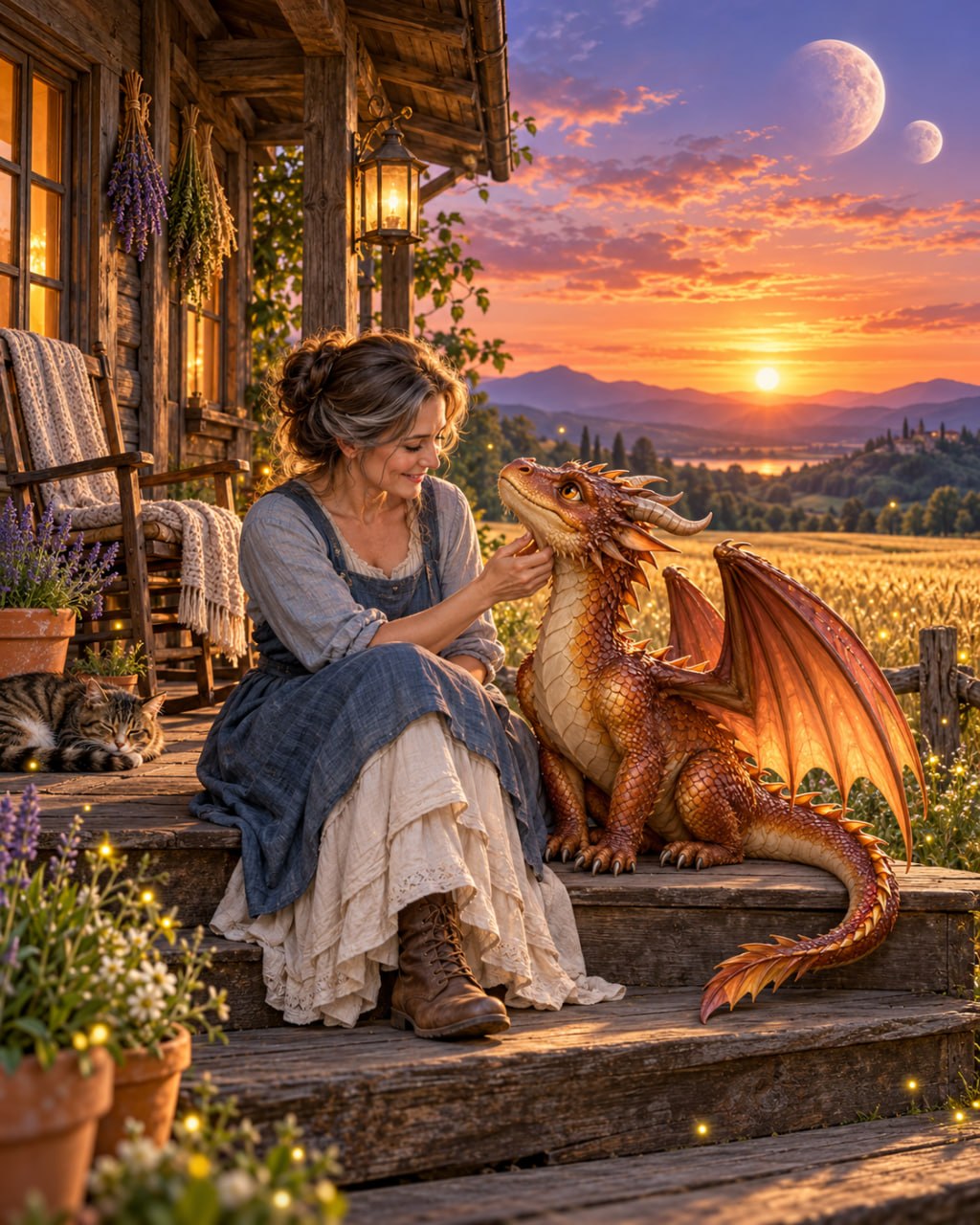
Scorch approached from the orchard, his enormous wings rustling through the apple branches.
He lowered his head into her lap.
Nora laughed.
“You’re getting too big for that.”
He ignored her.
Beyond the fields, the sun descended behind the distant mountains, painting the sky copper and gold.
Nora stroked his scales.
“You know,” she whispered, “I used to think moving forward meant leaving everything behind.”
Scorch closed his eyes.
“But I was wrong.”
She looked toward Ray’s grave, visible beneath the oldest tree.
“Love doesn’t disappear when someone leaves us. Sometimes it changes shape. Sometimes it becomes a memory. Sometimes it becomes the courage to help someone else.”
A soft rumble rose from Scorch’s chest.
Nora smiled.
“And sometimes,” she continued, “it turns up in your chicken coop and steals your eggs.”
The dragon opened one eye.
She laughed so hard that tears gathered at the corners of her eyes.
This time, they weren’t tears of grief.
At least, not entirely.
They were something richer, something she had once believed impossible.
Happiness that made room for sorrow.
Love that did not require forgetting.
A life that could honor what had ended while welcoming what was still beginning.
Above the farmhouse, three young dragons lifted into the evening sky.
Their wings caught the fading sunlight as they circled the orchard.
Scorch raised his head and answered their distant calls.
Then he looked back at Nora.
Waiting.
She understood.
“Go on,” she whispered. “I’ll be here.”
He spread his copper-black wings.
For a moment, the enormous dragon stood silhouetted against the sunset, powerful enough to shake the earth and gentle enough to rest his head in a lonely woman’s hands.
Then he leaped into the sky.
Nora watched him climb.
She no longer feared that every goodbye would become permanent.
She had learned that love was not a promise that nothing would ever be lost.
It was the willingness to open your heart even knowing loss was possible.
And somewhere among the stars, an entire civilization was learning the same lesson.
The dragons had not returned to teach the galaxy how to conquer.
They had returned to remind it how to care.
As the last sunlight disappeared, Nora rose from her chair and carried both coffee cups inside.
Tomorrow there would be fences to mend, fields to tend, and hungry dragons to feed.
There would be ordinary frustrations and unexpected joys.
There would still be moments when she missed Ray so fiercely that she could hardly breathe.
But there would also be laughter.
Friendship.
New beginnings.
And a copper-black dragon who had chosen her not because she was powerful, important, or extraordinary, but because she had continued loving even when her heart was broken.
Nora switched on the kitchen light.
Outside, Scorch’s joyful roar rolled across the wheat fields.
She smiled.
For the first time in three years, the future no longer felt like an empty place she was being forced to enter.
It felt like somewhere she wanted to go.
And she knew, at last, that Ray would have wanted that for her.
THE END.