The day Grant Hollis threw my supper into the mud before twelve ranch hands, he called me worthless, unaware I knew why his cookhouse had been abandoned.
For several seconds, I could hear nothing except the rain striking the cookhouse roof.
The empty cradle.
The white hospital walls.
Thomas standing beside my bed with his hat crushed between his hands.
And the words that had haunted me for twenty-seven years.
“I’m sorry, Mabel. Our little girl didn’t make it.”
I had believed him because Thomas was my husband, because I loved him, and because a woman who has just given birth is sometimes too broken to question the hands that hold her.
Now Eleanor Price stood before me with a sealed document suggesting that the greatest sorrow of my life had been built upon a lie.
“Don’t,” I whispered.
Eleanor’s eyes filled with tears.
“Mabel—”
“Don’t tell me my daughter lived unless you can prove it.”
My voice sounded strange, sharp enough to make Eli retreat from the doorway.
Grant reached toward me, but I stepped away.
I had survived hunger, widowhood, humiliation, and the loss of everything Thomas and I had built together.
But I did not know whether I could survive discovering that my husband had stolen twenty-seven years from me.
Eleanor placed the document on the table.
“Your daughter was born alive on March seventeenth, eighteen hundred and seventy-one, at St. Agnes Hospital in Cheyenne.”
I stared at her.
“She weighed six pounds and four ounces. She had a little birthmark beneath her left shoulder. The midwife recorded it because she thought it resembled a crescent moon.”
My hand flew to my mouth.
I remembered the midwife holding something small and warm against my cheek.
I remembered hearing a cry.
Thomas had told me afterward that the sound belonged to another baby.
For twenty-seven years, I had accepted that explanation.
“Where is she?” I asked.
Eleanor looked toward Grant.
“That’s what Clara spent the last years of her life trying to discover.”
Grant stood so abruptly that his chair struck the floor.
“Then tell us everything.”
Eleanor opened her suitcase again and removed a thick bundle of letters tied with blue ribbon.
“First, you must understand something. Clara did not abandon your daughter. And Thomas did not begin this terrible business by himself.”
She hesitated.
“The man responsible for separating these families still lives in this county.”
A gust of wind rattled the windows.
Outside, a horse whinnied in the darkness.
Eleanor lowered her voice.
“His name is Silas Whitcomb.”
Grant’s expression changed so suddenly that I felt cold.
Silas Whitcomb owned the largest cattle operation east of Iron Creek. He controlled the grain contracts, employed half the county’s freight drivers, and had recently offered to purchase Grant’s ranch.
I had met him twice.
Both times, he had complimented my cooking while looking at me as though I were furniture.
“Whitcomb?” Grant said.
Eleanor nodded.
“Twenty-seven years ago, he was a banker. And he was the man who arranged for Mabel’s daughter to disappear.”
I gripped the table.
“Why would a banker want my child?”
“Because your husband owed him money. And because Whitcomb’s wife desperately wanted a baby.”
I felt the floor tilt beneath me.
Eleanor explained that Thomas had borrowed money to build our roadside diner long before it became successful. When a disastrous winter destroyed his first business, Whitcomb acquired his debts.
Then I became pregnant.
Whitcomb’s wife, Margaret, had suffered several miscarriages. According to Eleanor, Whitcomb approached Thomas with a proposition so monstrous that my mind refused to accept it.
He would forgive every dollar Thomas owed him if Thomas surrendered our newborn daughter.
Thomas refused.
At first.
But Whitcomb threatened to have him imprisoned over documents he claimed were fraudulent.
“He told Thomas that you would be turned out into the street while recovering from childbirth,” Eleanor said. “He convinced him there was no other way.”
I looked at the handwriting on the letter.
My husband’s careful, familiar handwriting.
The same hands that had kneaded bread beside me every Sunday.
The same hands that had held mine while we buried my mother.
Those hands had signed away our child.
“No,” I said quietly.
Then louder, “No. He could have told me.”
Eleanor lowered her head.
“Yes, Mabel. He could have.”
That simple acknowledgment hurt more than any excuse would have.
I had spent twenty-seven years mourning a daughter who had been breathing somewhere beneath the same enormous sky.
And every morning, Thomas had kissed my forehead and allowed me to believe she was dead.
Grant moved beside me.
For once, the man who had once called me worthless seemed unable to find a single word.
I turned toward him.
“And Clara? How does she fit into this?”
Eleanor untied the letters.
“Clara discovered what Whitcomb had done.”
Her story began three years after my daughter’s birth, when Clara was helping deliver meals to families displaced by a spring flood.
Among them was Margaret Whitcomb, who had arrived carrying a little girl named Rebecca.
Clara noticed the child had a crescent-shaped birthmark beneath her shoulder.
Later, while helping Margaret unpack, Clara found a hospital record identifying the girl’s mother as Mabel Foster.
She confronted Whitcomb.
He threatened her.
But Clara was not easily frightened.
She began asking questions, speaking to nurses and tracking down the midwife who had attended my delivery.
Then she discovered something else.
Whitcomb had purchased Iron Creek’s debts through a collection of dishonest transactions. He was preparing to seize the ranch while disguising his ownership behind another company.
Clara gathered evidence.
She intended to expose him.
“And that was when our daughter was born,” Grant whispered.
Eleanor nodded.
Clara had delivered a baby girl named Rose.
I remembered the photograph of the infant wrapped in white.
I remembered Thomas’s description of a terrified woman arriving at our diner.
Whitcomb had threatened to take Rose and send her away if Clara continued investigating.
When Grant and Clara argued, she had been trying to persuade him to confront Whitcomb.
Grant, already burdened by debt and frightened of losing the ranch, accused her of spreading rumors that would ruin them.
He ordered her to stop interfering.
She refused.
And in anger, he told her to leave.
“She believed you had chosen Whitcomb over her,” Eleanor told him.
Grant closed his eyes.
“I told her to get out. I never meant—”
“But you did tell her,” Eleanor said gently.
He sank back into his chair.
For the first time since I had known him, Grant Hollis looked like a man who understood that regret could not undo a single spoken word.
Clara fled with Rose and sought refuge at our diner because Thomas knew Whitcomb’s secrets.
But Whitcomb’s men followed her.
To protect the child, Thomas arranged for Rose to travel west with a family he trusted.
Clara went into hiding, believing Whitcomb would eventually stop searching.
Instead, he sent a message claiming that Grant had died.
Eleanor paused.
“She believed it for eleven years.”
Grant stared at the rain-darkened window.
“Eleven years.”
“When she finally learned you were alive, she was told Rose had vanished. She couldn’t bear to return without her.”
I felt grief settle over the room, heavy as wet wool.
Then I asked the question that mattered most.
“Where is Rebecca? Where is my daughter?”
Eleanor looked at the document.
“Margaret Whitcomb died eight years ago. Rebecca left Silas’s household shortly afterward.”
“Where did she go?”
“She was working as a schoolteacher in Willow Bend. Clara found her there last year.”
My heart leaped.
“Then she’s alive?”
“She was when Clara last saw her.”
I pressed my palms against the table, struggling to breathe.
Eleanor continued carefully.
“Clara told Rebecca the truth about her birth. Rebecca refused to believe her. Whitcomb had raised her, and he had spent years convincing her that her real mother had willingly surrendered her.”
I flinched.
“She thinks I sold her?”
Eleanor nodded.
The pain was so sudden that I folded forward.
Grant caught my arm before I fell.
For years I had imagined my daughter in heaven, safe from sorrow.
Now I imagined a grown woman walking through life believing that her mother had considered her a burden.
I could hardly endure it.
Eleanor placed another letter before me.
“This came from Rebecca six months ago.”
The handwriting was graceful and firm.
If Mrs. Foster is alive, why has she never looked for me?
Seven words.
Seven words that broke my heart more completely than twenty-seven years of mourning.
I took the letter and held it against my chest.
“Because I buried you,” I whispered. “Because they told me you were gone.”
Grant knelt beside my chair.
“We’ll find her.”
I looked at him through tears.
“Whitcomb owns the stagecoach company, the grain warehouses, half the roads through this valley. If he learns we’re searching—”
“He’ll learn,” Grant said. “And he can do his worst.”
Eleanor’s face tightened.
“There’s something else you should know.”
She reached into the suitcase and removed a folded legal notice.
Whitcomb had filed a claim against Iron Creek Ranch.
The hearing was scheduled for Monday.
Three days away.
If Grant failed to satisfy the alleged debt, Whitcomb would take possession of the property, including the cookhouse.
And Eleanor believed the evidence Clara had collected was hidden somewhere inside its walls.
That explained the abandoned kitchen.
The scratched photograph.
The warning beneath the hearth.
Suddenly, what had seemed like an old husband’s cruelty looked like the aftermath of a much larger crime.
“Why didn’t you come sooner?” Grant demanded.
Eleanor’s fingers tightened around the suitcase handle.
“Because I was afraid.”
She looked at me.
“And because Silas Whitcomb is my brother.”
Nobody spoke.
Eleanor continued before Grant could react.
“I helped raise Rebecca. I loved that child. But I watched Silas destroy families to protect his reputation, and I did nothing.”
Her chin trembled.
“Clara made me promise that if I ever found the courage, I would tell the truth.”
“And now?” I asked.
“Now I’m old enough to understand that silence is not innocence.”
A knock sounded against the cookhouse door.
Eli entered, his hat dripping rainwater.
“Mr. Hollis, there’s a rider at the gate.”
Grant rose.
“Who?”
“One of Whitcomb’s men. Says his employer wants Mrs. Foster brought to his house before morning.”
A cold, terrible certainty moved through me.
Whitcomb knew.
He knew Eleanor had come.
And he knew the truth was no longer safely buried.
Grant reached for his coat.
“Tell him Mrs. Foster isn’t going anywhere.”
But I was already standing.
“No.”
Grant turned.
“Mabel—”
“I spent twenty-seven years letting men decide what I was allowed to know. I’m finished with that.”
I walked toward the window.
Beyond the glass, the rider waited beneath the dripping branches of a cottonwood tree.
“He wants me frightened. Let him wonder why I’m not.”
The rider departed carrying our refusal.
An hour later, we heard hoofbeats returning from the north.
Six riders.
Then eight.
Their lanterns moved across the dark prairie like angry fireflies.
Grant gathered the ranch hands in the yard.
“We have no quarrel with anyone tonight,” he told them. “But nobody enters this cookhouse without permission.”
I stood beside the hearth holding my mother’s skillet.
Eli glanced at it.
“Planning to knock somebody senseless, Mrs. Foster?”
“Only if they insult my gravy.”
A few men laughed, though their faces remained tense.
Then the riders stopped outside.
Silas Whitcomb dismounted.
He was a broad man with a silver beard, polished boots, and the confidence of someone accustomed to buying his way through every locked door.
He entered the cookhouse without removing his hat.
“Mrs. Foster,” he said pleasantly. “I understand you’ve received some upsetting news.”
I looked directly at him.
“My daughter is alive.”
He did not blink.
“That depends on what stories you’ve been told.”
“Did you take her?”
Whitcomb sighed.
“Your husband made a decision. A difficult decision, but one intended to spare his family.”
I stepped closer.
“You stole my child.”
His smile disappeared.
“Be careful what you accuse a man of, Mrs. Foster.”
Grant moved beside me.
“Get out.”
Whitcomb ignored him.
“I’ve come to offer a reasonable settlement. The ranch’s debts will be forgiven if Mrs. Price returns certain papers belonging to my family.”
Eleanor stood beside the hearth, her face pale.
“And Rebecca?” I asked.
Whitcomb’s eyes narrowed.
“What about her?”
“Tell me where she is.”
“Rebecca has no desire to meet the woman who gave her away.”
My fingers curled against my apron.
Then I noticed something.
Whitcomb wore a small silver horseshoe pin on his vest.
The same design as Eleanor’s necklace.
The same design visible in the corner of the old photograph.
I remembered Clara’s recipe box.
The horseshoe carved beneath its lid.
And suddenly, I understood where she might have concealed the evidence.
Whitcomb followed my gaze.
His expression changed.
Only slightly.
But enough.
“I’ll give you until tomorrow evening,” he said.
Then he turned and left.
We waited until his horses disappeared into the darkness.
I went straight to the hearth.
Grant watched as I lifted the wooden recipe box from its shelf.
Inside were Clara’s handwritten recipes, arranged beneath faded paper dividers.
I turned it upside down.
A narrow compartment had been carved beneath the bottom.
The wooden panel resisted my fingernail.
Eli brought a small knife.
I eased the panel free.
Inside lay three folded documents and a key wrapped in cloth.
The first was a deed showing that Whitcomb had purchased Iron Creek’s debt using money unlawfully withdrawn from accounts belonging to several local families.
The second contained the names of a midwife, a hospital clerk, and a banker who had witnessed the transfer of my newborn daughter.
The third was a sworn statement written by Margaret Whitcomb shortly before her death.
I recognized the woman’s name.
My hands shook as I read.
I raised Rebecca as my own, but I knew she belonged to Mabel Foster. My husband obtained the child through threats and deception. I was selfish enough to accept what another woman had lost.
Beneath those words, Margaret had written something that made my breath catch.
Rebecca is not my husband’s daughter, but I loved her. If she ever learns the truth, tell her that love cannot make a stolen child rightfully yours.
I closed my eyes.
Margaret had loved my daughter.
And wronged me.
Both things were true.
Grant examined the little key.
It bore the number seventeen.
“What’s it open?”
Eleanor leaned forward.
“The old railway freight office. Clara kept a trunk there.”
“Why didn’t you tell us?”
“She never told me where she put the key.”
I looked at the clock.
Nearly midnight.
The freight office was twelve miles away.
And Whitcomb had given us until tomorrow evening.
“Then we leave at first light,” I said.
Grant shook his head.
“Whitcomb will expect that.”
Eli stepped forward.
“There’s a wagon trail behind the north pasture. We can reach the railway before sunrise without passing the main road.”
Grant considered him.
“Get the horses.”
I looked at the remaining documents.
“We’ll need witnesses.”
“I’ll bring the sheriff,” Eli said.
Eleanor gave a bitter smile.
“My brother helped finance his election.”
“Then we find someone Whitcomb hasn’t purchased,” I answered.
Before dawn, Grant, Eli, Eleanor, and I rode toward the railway freight office.
The prairie lay silver beneath the moon.
Cold wind pressed against my cheeks.
For the first time in years, I felt something stronger than grief moving through me.
Hope.
Terrifying, dangerous hope.
At the freight office, an elderly clerk named Joseph Bell recognized Clara’s name.
He took one look at Eleanor and went pale.
“Mrs. Hollis told me somebody might come.”
He led us to a row of storage trunks.
Number seventeen stood against the far wall.
Inside were more letters, a child’s wooden horse, and a leather-bound ledger containing Whitcomb’s transactions over twenty years.
But beneath the ledger lay something unexpected.
A recent letter addressed to Clara.
The return address was a boardinghouse in Willow Bend.
It was signed Rebecca Whitcomb.
The letter described a woman who had recently begun asking questions about the hospital where she was born.
A woman who wanted to know whether her mother truly had abandoned her.
I read the last sentence aloud.
If Mabel Foster is alive, I want to hear the truth from her own mouth.
My eyes filled.
“She wants to see me.”
Grant placed his hand on my shoulder.
“Then we’ll take you to her.”
But Joseph Bell had one more piece of news.
A young schoolteacher had passed through the freight office two days earlier, asking about Iron Creek Ranch.
She had been traveling with a little girl, perhaps six years old.
The child carried a red ribbon in her hair.
“Where did they go?” I asked.
Joseph hesitated.
“They were taken toward Whitcomb’s property.”
I felt a sharp pain beneath my ribs.
“Taken?”
“His men said Miss Rebecca had been requested at the house.”
Grant cursed under his breath.
Eleanor gripped the ledger.
“My brother knows she’s looking for you.”
We rode back toward Iron Creek with the terrible realization that my daughter might be closer than I had ever imagined.
By noon, black smoke rose above the eastern pasture.
Grant pulled his horse to a stop.
“The cookhouse.”
My heart seemed to stop.
We galloped toward the ranch.
Flames climbed the old stone walls.
Men carried buckets from the trough while Eli’s friends dragged furniture into the yard.
The roof had begun collapsing.
And somewhere inside, beneath the crackling timber, I heard a familiar voice.
“Mrs. Foster!”
It was Ben, the stable boy.
He had gone inside to rescue the recipe box.
Now he was trapped behind a fallen beam.
Before anyone could stop me, I seized a wet blanket and ran through the doorway.
Heat struck my face.
Smoke swallowed the room.
I could barely see the table where I had served my first successful supper.
The shelves were burning.
The photographs were gone.
But I heard Ben coughing near the pantry.
“Keep talking!” I shouted.
“Here!”
I found him crouched beneath the broken window.
A burning beam lay across the narrow passage.
I tried to lift it.
It wouldn’t move.
Then Grant appeared through the smoke.
Together, we shoved the timber aside.
He lifted Ben into his arms while I held the blanket over the boy’s head.
We stumbled into the yard just as the roof gave way.
The stone chimney collapsed with a thunderous crash.
For a moment, all I could do was kneel in the mud, coughing.
Then Ben clutched my sleeve.
“I’m sorry, Mrs. Foster. I couldn’t save your things.”
I pulled him against me.
“You came out alive. That’s all I wanted.”
Grant stood watching the ruins.
His face was gray with ash.
“Whitcomb,” he said.
I looked at the smoke rising into the afternoon sky.
He had tried to burn away the truth.
Instead, he had burned the only place where I had begun to feel whole again.
And something inside me hardened.
“We’re going to Willow Bend,” I said.
Grant looked at me.
“Not yet.”
“Why?”
“Because Whitcomb expects us to chase Rebecca. He’ll destroy the evidence while we’re gone.”
Eleanor stepped forward.
“Then we bring the evidence into the open.”
There was a county gathering scheduled that evening in the courthouse square.
Whitcomb intended to announce his purchase of several neighboring properties.
Almost every rancher, merchant, and wagon driver in the valley would attend.
And the territorial circuit judge was visiting for a hearing the following morning.
I looked at the leather ledger beneath Eleanor’s arm.
“Then that’s where we go.”
At sunset, we entered the courthouse square.
Lanterns swung beneath the wooden awnings.
Men gathered around barrels of cider.
Women stood in small groups near the steps.
Whitcomb occupied the center of the platform, smiling as though the whole valley belonged to him.
When he saw us, his smile faded.
Grant climbed the steps.
“Silas, we’ve come to discuss your accounts.”
A murmur spread through the crowd.
Whitcomb laughed.
“Not the time, Hollis.”
“Seems as good a time as any.”
Eleanor stepped forward with the ledger.
“I know where the money came from, Silas.”
Whitcomb’s face turned crimson.
“You have no right—”
“I have every right to tell the truth about what I witnessed.”
She opened the book.
One by one, she read the names of families whose lands had been taken through falsified debts.
A widow whose cattle had been seized.
A blacksmith whose shop had been sold.
A rancher forced off property his father had worked for forty years.
People began pushing forward.
Whitcomb’s lawyer tried to interrupt, but the visiting judge, Nathaniel Mercer, stepped out of the courthouse.
“Let the lady finish.”
Eleanor handed him the documents.
Whitcomb backed away.
“These are fabrications.”
“Then you won’t object to a formal examination,” the judge replied.
I climbed onto the platform.
My knees trembled.
I had never spoken before so many people.
But I thought of a little girl growing up believing her mother had sold her.
And I found my voice.
“Twenty-seven years ago, this man took my newborn daughter from me.”
The square fell silent.
“He told my husband that our debts would be forgiven if we surrendered her. When my husband refused, he threatened him until fear became stronger than courage.”
I swallowed.
“My husband lied to me. I believed my baby had died. Every birthday, I placed flowers beside an empty cradle.”
Several women began crying.
Whitcomb shouted, “She’s a grieving woman! She doesn’t know what she’s saying!”
I turned toward him.
“I know exactly what I’m saying.”
Then I held up Margaret’s confession.
“Your own wife admitted what you did.”
The judge read the statement carefully.
He looked at Whitcomb.
“You will remain here until we determine whether these documents are authentic.”
Whitcomb stepped backward.
Then he suddenly lunged toward Eleanor.
He seized the ledger.
But Grant caught his arm.
The two men struggled.
A lantern struck the platform and shattered.
Flames spread across the boards.
Someone screamed.
Whitcomb pulled a pistol from beneath his coat.
The entire crowd froze.
“Nobody moves!”
Grant raised his hands.
“Put it down, Silas.”
Whitcomb’s eyes darted wildly.
“You think you can take everything from me?”
I stepped forward.
“You already took everything from other people.”
His pistol swung toward me.
Then a woman’s voice rang from the edge of the crowd.
“Father!”
Whitcomb turned.
A young woman stood beside a little girl wearing a red ribbon.
The young woman had dark hair pinned beneath a plain brown bonnet.
Her face was pale.
Her eyes were wide with fear.
But I knew her.
Not from memory.
Not from photographs.
From something deeper and more painful.
I recognized the shape of her mouth.
The gentle crease between her eyebrows.
The way she pressed one hand against her heart when frightened.
She looked like the daughter I had imagined a thousand times.
“Rebecca,” I whispered.
The young woman stared at me.
Whitcomb shouted for her to leave.
Instead, she walked toward the platform.
“I heard what you said,” she told him.
His expression twisted.
“Rebecca, go home.”
“Is it true?”
He said nothing.
“Did you take me from my mother?”
“Everything I did was for you.”
Rebecca looked at the pistol in his hand.
“Then why are you pointing a gun at her?”
Whitcomb’s face collapsed.
For one brief moment, he looked like an exhausted old man rather than the most powerful landowner in the county.
Then Grant stepped forward.
“Give me the pistol.”
Whitcomb’s hand trembled.
Slowly, he lowered it.
The sheriff moved in and took the weapon.
Judge Mercer ordered Whitcomb detained pending an investigation.
But I barely heard him.
Because Rebecca was looking at me.
Her eyes filled with tears.
“Are you Mabel Foster?”
I nodded.
She came closer.
“I thought you didn’t want me.”
My throat closed.
“Oh, sweetheart.”
The word escaped before I could stop it.
“I wanted you every day of my life.”
Rebecca covered her mouth.
“They told me you gave me away because you were poor.”
“I was poor,” I whispered. “But I would have worked until my hands bled to keep you.”
She began crying.
I reached for her, then hesitated.
Twenty-seven years could not be erased with an embrace.
She had grown into a woman without me.
She had learned to walk, speak, read, and love while I sat beside an empty cradle.
I had no right to demand her affection simply because I had suffered.
So I lowered my hands.
“You don’t have to call me Mother,” I said. “You don’t have to love me today. I only ask that you let me know you.”
Rebecca stared at me for several seconds.
Then she stepped forward and placed her arms around my shoulders.
I held her carefully at first.
Then fiercely.
And when she whispered, “I’ve wondered about you my whole life,” I broke into sobs.
The little girl with the red ribbon approached us.
“Mama?”
Rebecca wiped her cheeks.
“This is my daughter, Annie.”
I knelt.
Annie studied me solemnly.
“Are you my grandmother?”
I laughed through my tears.
“If you’ll let me be.”
She considered that.
“Do you make cookies?”
The question was so unexpected that Rebecca began laughing.
I smiled.
“Little lady, I make the finest cookies west of the Mississippi.”
Annie slipped her hand into mine.
“Then I think you’ll do.”
Behind us, Grant stood with his hat pressed against his chest.
I saw tears shining in his eyes.
But our story was not finished.
The following morning, Judge Mercer examined the papers Clara had hidden.
Within days, a formal investigation uncovered Whitcomb’s fraudulent debts, forged signatures, and threats against several witnesses.
The original hospital records confirmed that Rebecca had been born to Thomas and Mabel Foster.
Whitcomb’s claim against Iron Creek was suspended, and the ranch remained in Grant’s hands while the courts sorted through the stolen properties.
Eleanor agreed to testify against her brother.
It was not easy.
I found her one evening standing beside the ruined cookhouse, crying quietly.
“He was cruel,” she whispered. “But he was still my brother.”
I stood beside her.
“Both things can be true.”
She looked at me.
“Will you ever forgive Thomas?”
That question had followed me since the moment I opened his letter.
I had loved Thomas.
He had been kind in a hundred ordinary ways.
He had brought me wildflowers when we couldn’t afford roses.
He had sat beside me through illness and held me after my mother’s death.
But he had also watched me grieve a living child.
And no amount of kindness could make that betrayal disappear.
“I don’t know,” I answered.
Eleanor nodded.
“Perhaps that’s something you don’t have to decide today.”
A week later, Rebecca came to Iron Creek with Annie.
She brought a small wooden box containing letters, photographs, and a pair of baby shoes Margaret had kept.
We spent hours sitting beneath the cottonwood trees, filling the empty spaces between our lives.
Rebecca told me about her childhood, her years teaching school, and the husband she had lost to pneumonia.
I told her about our diner, my mother’s skillet, and the stubborn little girl I had once imagined growing into a woman.
Sometimes we laughed.
Sometimes we cried.
Sometimes silence was all either of us could manage.
One afternoon, Rebecca asked about Thomas.
“Was he a good man?”
I looked toward the prairie.
“He did good things.”
She waited.
“And he did something terribly wrong.”
I turned to her.
“I think people are often more complicated than we want them to be.”
Rebecca nodded slowly.
“Margaret loved me.”
“I know.”
“She was kind to me.”
“I believe you.”
Her eyes filled.
“Does that hurt you?”
“Yes,” I admitted. “But I’m glad you were loved.”
She leaned against my shoulder.
And for the first time, I understood that loving my daughter did not require me to erase the woman who had raised her.
Three weeks later, another visitor arrived.
An elderly cowboy named Samuel Reed stepped down from a wagon carrying a weathered saddlebag.
He asked to speak with Grant.
When Grant saw him, his face went white.
“Samuel?”
The man removed his hat.
“I’ve been looking for you for a long time.”
Samuel had been the driver of the wagon that carried Clara and Rose west after they fled Whitcomb’s men.
He had believed both mother and child were dead after an accident near the mountains.
But Rose had survived.
She had been raised by a family in Colorado.
And Samuel knew where she was.
Grant sank onto the porch steps.
“She’s alive?”
Samuel nodded.
“Married now. Has two boys. Lives near Fort Collins.”
For a long moment, Grant could not speak.
Then he covered his eyes.
I sat beside him.
He reached for my hand.
“After all these years,” he whispered.
I squeezed his fingers.
“Then don’t waste another day.”
Grant traveled to Colorado the following week.
I remained at Iron Creek with Rebecca and Annie, helping the ranch hands rebuild the cookhouse.
When he returned twelve days later, a young woman rode beside him.
She had auburn hair, Clara’s smile, and eyes remarkably like Grant’s.
Her name was Rose Bennett.
She dismounted slowly, looking toward the stone building.
“So this is where my mother cooked.”
Grant nodded.
“Every Sunday.”
Rose turned toward me.
“Father says you saved this place.”
I shook my head.
“No. Your mother loved it first. I only helped it remember what it was.”
Rose embraced me.
And when she stepped away, Grant was smiling through tears.
The man who had once eaten alone beside a dark window now stood surrounded by family.
That winter, we rebuilt the cookhouse with stronger beams, wider windows, and a proper porch facing the creek.
The ranch hands carved a wooden sign above the entrance.
CLARA’S TABLE
Beneath it, in smaller letters, they added:
There’s always room for one more.
The first supper was held on Christmas Eve.
Snow covered the pasture fences.
Lanterns glowed along the porch.
Inside, every chair was occupied.
Rebecca sat beside Annie, who insisted on helping me roll biscuit dough.
Rose and her boys decorated the windows with evergreen branches.
Eli brought a fiddle.
Samuel Reed told stories that grew more ridiculous each time he repeated them.
And Grant stood beside the hearth holding a plate of apple pie.
He waited until the laughter quieted.
“There’s something I need to say.”
Everyone looked toward him.
He turned to me.
“The first day Mrs. Foster came here, I told her we needed a cook, not another mouth to feed.”
I felt my cheeks warm.
“The second day, I threw her supper into the mud.”
Eli muttered, “Worst mistake you ever made.”
A few men chuckled.
Grant smiled faintly.
“It was one of many.”
Then his expression grew serious.
“I thought being hard would keep me from being hurt again. I thought if I expected nothing from anyone, nobody could disappoint me.”
He looked around the room.
“But all I did was teach people to be afraid of me.”
His gaze returned to mine.
“Mabel, you gave this ranch more than food. You reminded us that kindness isn’t weakness.”
He paused.
“And you taught me that a man can spend half his life standing beside an open door and still be too frightened to walk through it.”
My eyes filled.
Grant set down his plate.
“I don’t know what the years ahead will bring. But if you’ll allow it, I’d like to spend them making sure you never have to face another winter alone.”
The room went very quiet.
I looked at Rebecca, who smiled through tears.
Then at Rose.
Then at Annie, who whispered loudly, “Is he asking Grandma to marry him?”
Everyone burst into laughter.
Grant’s ears turned crimson.
I walked toward him.
“Grant Hollis, are you proposing to me in front of twelve hungry cowboys?”
He cleared his throat.
“Well, I was hoping to do it before they ate all the pie.”
I laughed.
And then, for the first time in years, I let myself imagine a future without fearing it would be taken away.
“Yes,” I whispered.
Grant stared.
“Yes?”
“Yes, you stubborn old fool.”
He pulled me into his arms as the room erupted in cheers.
But that night, after everyone had gone to bed, I returned alone to the hearth.
I placed Thomas’s final letter beside the fire.
For months, I had carried it with me, reading it until the paper softened at the folds.
He had written of his shame.
Of the threats.
Of the terrible decision he had made and the years he had spent trying to undo it.
He had tried to find Rebecca.
He had failed.
And in the end, he had left the truth where he hoped I might someday discover it.
I looked at his handwriting one last time.
“I loved you, Thomas,” I whispered.
“And I wish you had trusted me enough to tell me the truth.”
I did not forgive him completely that night.
Perhaps I never would.
But I no longer needed to carry his silence as though it were my punishment.
I folded the letter and placed it inside a wooden box beneath the hearth.
Not to hide it.
But because some memories deserve a resting place.
When I turned, Rebecca stood in the doorway.
She had heard my last words.
“Are you all right?” she asked.
I smiled through tears.
“I think I’m learning to be.”
She crossed the room and embraced me.
For a long while, we stood beside the fire, two women who had spent twenty-seven years missing each other without knowing why.
Then she whispered, “I wish we’d had more time.”
I held her closer.
“So do I.”
Outside, the wind swept across the frozen prairie.
Inside, the fire burned warmly.
And I realized something I wished I had understood when I first arrived at Iron Creek carrying forty-three dollars and my mother’s cast-iron skillet.
A life can be stolen from you in pieces.
A home.
A marriage.
A child.
Your faith in the people you love.
But the people who take those things do not get to decide what you build afterward.
I could not recover Rebecca’s childhood.
Grant could not recover his years with Clara.
Neither of us could bring back the days lost to fear, pride, and cruel decisions.
Yet we could choose what happened next.
We could tell the truth.
We could leave room for forgiveness without pretending the wounds had never existed.
And we could love the people standing before us instead of spending the rest of our lives mourning only those who were gone.
Years later, when travelers asked how Clara’s Table became the busiest cookhouse in the county, Eli always told them the same story.
He would point toward the enormous stone hearth and say, “It started the day a foolish rancher threw the best supper he’d ever been offered straight into the mud.”
Then he would grin at Grant.
“And thank the Lord that the woman who cooked it was too stubborn to leave.”
Grant would shake his head.
The men would laugh.
And I would carry another plate to the table.
Because at fifty-three, I had arrived at Iron Creek believing I was starting over with nothing.
But I had brought my mother’s skillet, a heart that still knew how to love, and two hands willing to feed anyone who entered my door.
In the end, those were not small things.
They were enough to rebuild a home.
Enough to reunite a family.
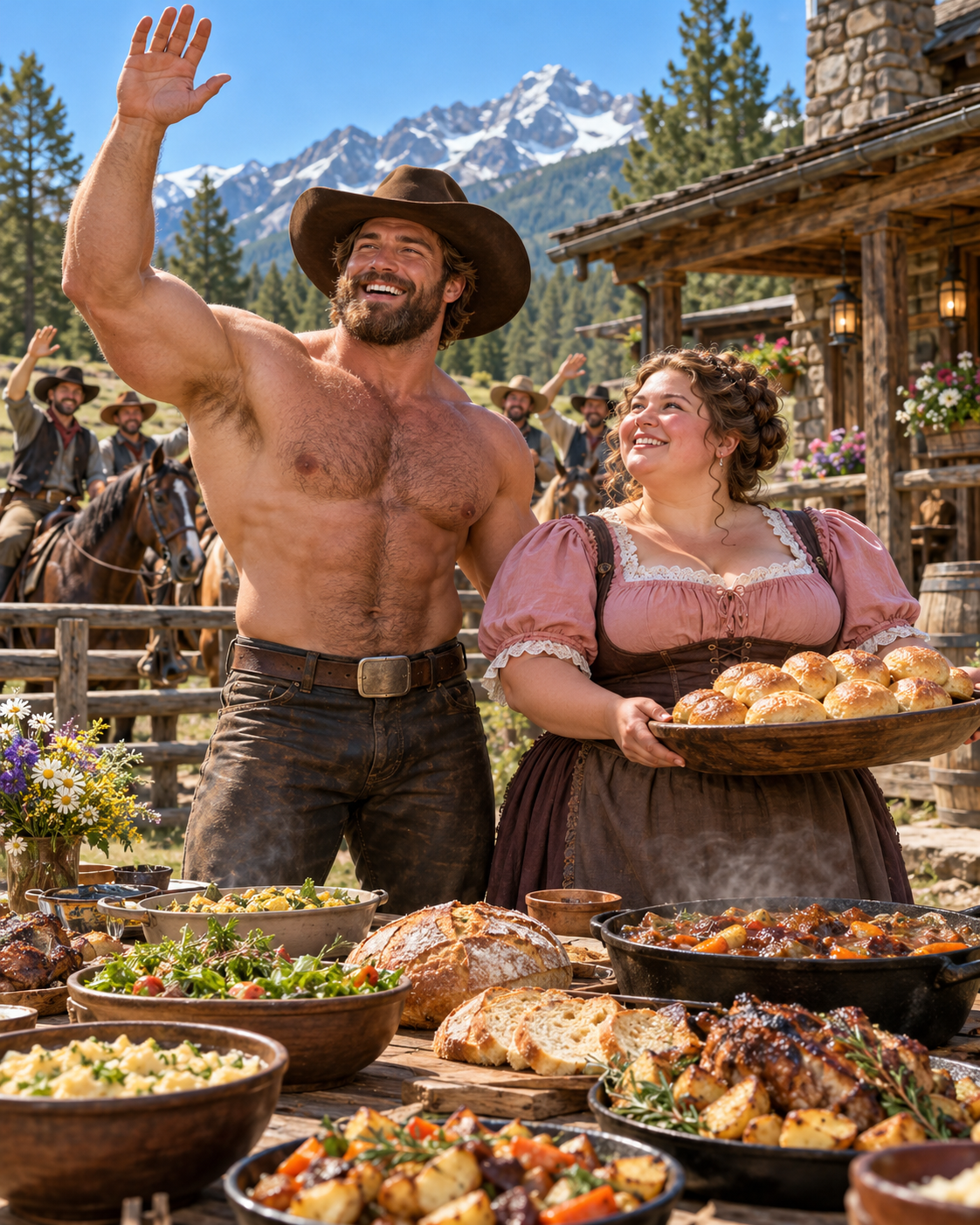
Enough to turn a place filled with sorrow into a place where laughter belonged.
And whenever Annie asked me what made a family, I never told her it was blood alone.
I told her it was the people who showed up when you were hungry, who stayed when the truth became difficult, and who made room for you at their table even when your life had become a tangled mess.
Then I would slide another warm biscuit onto her plate and smile.
“Remember this, sweetheart. Nobody is worthless simply because somebody failed to see their worth.”
And every evening, as the lanterns glowed and the smell of fresh bread drifted across the prairie, there was one thing I made certain of.
At Clara’s Table, nobody ever had to eat alone.
THE END.