The day Curtis Vain publicly called me a starving nobody and demanded Mabel Turner marry his chosen widower, I discovered someone had secretly forged the debt that could destroy us both.
The pounding on the front door came again, harder this time, and every person in the Turner House seemed to stop breathing at once.
“Walter, don’t trust Silas.”
The voice outside was rough and desperate, but I recognized something beneath the fear that made my stomach tighten.
It was Silas Boon’s voice.
I turned toward the door, but Mabel caught my wrist before I could move.
Her fingers trembled against my skin, and when I looked into her eyes, I saw a fear deeper than anything Curtis Vain had managed to inspire.
“Please,” she whispered, “don’t let him take you away from here.”
I had spent most of my life being told that I was nobody, that I had no family worth searching for and no past worth remembering, yet suddenly every person in the room seemed to know something about me that I did not.
Gordon Pike stood near the table, clutching the original loan agreement, while Curtis watched the door with an expression that was almost impossible to read.
Edna remained in her chair, her face buried in her hands.
Then Silas shouted again.
“Walter, open this door before Vain gets you killed!”
I pulled my wrist free from Mabel’s grasp, not because I wanted to leave her, but because I could no longer bear standing in a room where everyone seemed to be protecting me from a truth they had helped create.
When I opened the door, Silas stumbled inside, his gray hair disheveled and blood running from a cut above his eyebrow.
He slammed the door shut behind him and pressed his back against it.
For several seconds, he looked at me without speaking.
Then his gaze moved to the envelope in my hand, and something inside his face seemed to collapse.
“You found it,” he murmured.
Before I could answer, Curtis stepped forward.
“Silas, you should have stayed at your shop.”
Silas laughed bitterly, wiping the blood from his eyebrow with his sleeve.
“And you should have gone to prison twenty years ago.”
The words struck the room like a gunshot.
I looked between them, struggling to understand how the two men who had given me work and threatened my future could be connected to my father’s death.
“Tell me the truth,” I demanded.
Silas lowered his eyes.
“Your father was my best friend, Walter, and I failed him.”
He explained that my father, Thomas Hayes, had worked as a bookkeeper for Curtis’s freight business before investing his savings in a small transport partnership.
At first, the business prospered, but Thomas soon discovered that Curtis had been falsifying shipping records, diverting payments, and charging customers for freight that had never been delivered.
The missing money was substantial enough to ruin several families.
Thomas gathered copies of the accounts and planned to take them to a federal investigator passing through the county.
Silas had helped him collect the evidence, using the blacksmith shop to hide the original ledger inside an iron compartment beneath the furnace.
But Curtis learned about the investigation.
He threatened Thomas, then offered Silas money and protection if he would reveal where the documents were hidden.
Silas refused at first.
Then Curtis threatened to frame him for the theft and make sure his young daughter lost the home her mother had died to keep.
“I was afraid,” Silas admitted, his voice breaking. “I told him about the compartment, but I swore I hadn’t seen the ledger itself.”
Curtis’s expression hardened.
“You were paid to keep quiet, Silas. You made your choice.”
“No,” Silas replied, lifting his head. “You made sure I believed I had no other choice.”
He told us that Thomas had discovered the betrayal before Curtis could seize the evidence.
That night, my father hid the ledger somewhere else, then rode out to meet the investigator alone.
He never arrived.
His horse was found near the river the following morning, and his death was ruled an accident.
I had been too young to understand the details, but I remembered my mother’s face when the sheriff delivered the news.
I remembered the way she held me so tightly that I could barely breathe.
I remembered her whispering that my father had been a good man, even when everyone else began calling him a thief.
For years, I had wondered whether she was simply trying to protect my memory of him.
Now I understood that she had been protecting the truth.
“Did Curtis kill my father?” I asked.
Silas looked toward the freight magnate.
“I don’t know who struck the final blow, Walter, but Curtis arranged the meeting, and he made certain nobody investigated what happened afterward.”
Curtis shook his head with theatrical disappointment.
“An old man’s guilt is not evidence.”
He turned toward Gordon.
“Give me that agreement, and I will forgive your foolish interference.”
Gordon looked down at the paper in his hand, then slowly folded it.
“No.”
Curtis stared at him as though he had never heard the word spoken by someone who mattered.
Gordon had spent years building his fortune through land investments and freight contracts, and I suspected he had learned long ago that money could make people overlook almost anything.
But now he looked ashamed.
“I agreed to marry Mabel because you told me the boarding house was drowning in legitimate debt,” he said. “You promised that the marriage would settle everything.”
He glanced at Mabel, whose face had gone pale.
“I thought I was offering her security. I didn’t realize I was being used to purchase her silence.”
Mabel’s voice was quiet, but it carried through the room.
“You weren’t offering me security, Mr. Pike. You were agreeing to take away my freedom.”
Gordon lowered his head.
For the first time that evening, Curtis looked genuinely cornered.
Then he reached into his coat and withdrew my father’s letter.
“You all seem to have forgotten something,” he said, holding the paper above the lamp.
“If the evidence disappears, all your accusations become nothing more than stories told by desperate people.”
He moved the letter toward the flame.
I lunged, but Silas caught my shoulder, holding me back.
“Don’t,” he whispered. “That’s what he wants.”
Curtis smiled and lowered the paper until its edge began to blacken.
Then Edna rose from her chair.
“Stop!”
Her voice was so sharp that Curtis paused.
She crossed the room slowly, wiping her tears with the back of her hand.
“You’ve taken enough from this family.”
Curtis gave her a cold look.
“Sit down, Edna.”
“No.”
She reached into the pocket of her dress and withdrew a small brass key.
“I kept the original ledger after your men searched the shop.”
Silas stared at her in disbelief.
“You told me you had burned it.”
“I told you that because I was afraid you would go after Walter if you knew where it was.”
Edna turned toward me, and the shame in her eyes was almost unbearable.
“Your father gave it to me the night before he died. He said that if anything happened to him, I had to protect his son and keep the truth alive.”
My anger rose so suddenly that I could hardly speak.
“You let me grow up believing my father had left us with nothing.”
Edna flinched.
“I thought I was protecting you.”
“You protected yourself,” I said, my voice breaking. “And you let everyone else pay for it.”
She bowed her head.
I wanted to hate her, but I could see the years of fear written across her face, and I knew that fear could make decent people do terrible things.
It did not excuse what she had done.
But it helped me understand how the truth had remained buried for so long.
Edna handed me the brass key.
“The ledger is beneath the loose stone in the old smokehouse behind the boarding house,” she whispered. “Your father hid it there because he knew Curtis would search the blacksmith shop.”
Before anyone could move, Curtis lunged toward me.
Mabel stepped between us.
It was a small movement, almost instinctive, but it stopped him long enough for Gordon to seize his arm.
Curtis struck Gordon across the face, sending him stumbling against the table.
I caught Curtis by the coat and drove him away from Mabel, but Silas shouted for me to stop before the struggle turned into something neither of us could undo.
Curtis straightened his coat, breathing hard.
“You think a ledger will destroy me?” he hissed. “Half this town owes me money. The sheriff depends on my business. People will believe what I tell them.”
“Perhaps,” I answered. “But they will have a choice once they see the truth.”
For a moment, nobody moved.
Then Curtis backed toward the door, his eyes fixed on me with a hatred that seemed to promise years of trouble.
“This town will bury you just as it buried your father.”
He left before anyone could stop him.
The sound of his carriage wheels faded into the darkness, but the fear he had brought into the house remained.
Mabel touched my arm.
“Are you all right?”
I looked at her, and despite everything that had just happened, the first thing I felt was gratitude that she was still standing beside me.
“I don’t know,” I admitted.
She squeezed my hand.
“Then we’ll find out together.”
Those five words gave me more strength than any threat or promise of money ever could.
Before dawn, Silas, Gordon, and I went to the old smokehouse behind the boarding house.
The air was bitterly cold, and frost covered the grass as we crossed the yard.
Edna remained inside with Mabel, too ashamed to face us, though I knew she was listening for every sound.
The smokehouse had not been used for years, and its wooden door groaned when I pushed it open.
Inside, dust covered the shelves, and the smell of old timber hung heavily in the air.
Edna had described a loose stone near the rear wall.
I found it beneath a broken shelf.
The brass key opened a small iron box buried underneath.
Inside lay a thick ledger wrapped in oilcloth, along with a photograph of my father standing beside Silas and a man I did not recognize.
There was also a letter addressed to me in my father’s handwriting.
My hands began to shake before I even opened it.
The letter was brief.
Thomas wrote that he had made mistakes, trusted the wrong men, and failed to understand how far greed could drive someone who had once been his friend.
But he wanted me to know that his greatest regret was not losing his business.
It was the thought that his son might grow up believing that a man’s worth could be measured by his possessions.
He urged me to judge people by what they did when they had nothing to gain, and to remember that courage was not the absence of fear but the decision to do what was right despite it.
At the bottom, he had written one final sentence.
“If you ever find yourself standing between a powerful man and someone he believes is helpless, remember that silence is the one thing that makes his power possible.”
I lowered the letter, unable to speak.
For years, I had carried shame that did not belong to me.
Now I finally understood the man my father had been, and the kind of man he had hoped I would become.
Gordon opened the ledger while Silas examined the accounts.
Page after page revealed false invoices, diverted payments, and names of officials who had accepted bribes.
Several entries connected directly to the debt Curtis had imposed on the Turner House.
The original loan had been paid in full years earlier, but Curtis had altered the records and continued collecting interest from Edna.
The marriage arrangement was not merely a cruel business tactic.
It was an attempt to bring the boarding house under Gordon’s ownership, silence Mabel, and prevent anyone from examining the original transactions.
There was enough evidence to expose Curtis, but only if we could get it beyond his influence.
Gordon offered to send the ledger to a trusted attorney in the state capital, someone who had handled fraud cases without accepting favors from powerful businessmen.
Silas insisted on accompanying him.
Before they left, he turned to me.
“I won’t ask you to forgive me, Walter. I gave Curtis the chance to hurt your father, and I have spent twenty years knowing that my fear helped him get away with it.”
I studied the old blacksmith, remembering the steady hands that had taught me to shape hot iron and the quiet patience he had shown me when I arrived in town with nothing.
“You can’t change what you did,” I told him. “But you can decide what you do now.”
He nodded, tears gathering in his eyes.
For the first time, I believed he understood that remorse was not the same as redemption.
Redemption required action.
The following weeks were the hardest Red Willow had seen in years.
Curtis tried to dismiss the ledger as a forgery, but the attorney found matching records in the freight company’s archives and discovered that several former employees had kept copies of suspicious transactions.
One by one, witnesses began speaking.
A retired clerk admitted that Curtis had ordered him to alter invoices.
A former driver described being paid to move goods that never appeared on official records.
Even the sheriff, realizing that his own name appeared in the ledger, finally agreed to cooperate with the state investigators.
Curtis was arrested before the first winter snow melted.
The trial lasted months, and every day brought another revelation about the money he had stolen and the lives he had damaged.
The evidence surrounding my father’s death was less conclusive, but investigators uncovered proof that Curtis had arranged the secret meeting and ordered his men to intercept Thomas before he could reach the authorities.
One of those men eventually confessed that he had struck my father during the confrontation, causing him to fall from his horse near the river.
The death that had been called an accident was finally recognized as the result of a deliberate act of violence.
Curtis was convicted of fraud, bribery, and conspiracy, and he spent the rest of his life facing the consequences of the empire he had built on fear.
Gordon testified against him and withdrew his proposal to Mabel without asking for anything in return.
Before leaving Red Willow, he apologized to her privately.
“I thought money could solve every problem,” he admitted. “I never considered that I might become part of someone else’s cruelty.”
Mabel accepted his apology, but she did not pretend that his intentions had made his actions harmless.
“I hope you become a better man,” she told him. “Not because you feel ashamed, but because someone else’s freedom should matter to you even when it costs you something.”
Gordon left town a quieter man than the one who had arrived.
As for Edna, forgiveness came more slowly.
Mabel could not simply forget the years of fear, the threats, or the secret debt that had nearly destroyed everything she loved.
But she allowed her aunt to remain at the boarding house, provided she helped keep the accounts honest and told the truth whenever someone asked what had happened.
Their relationship was never quite the same, yet over time they learned to speak without hiding behind excuses.
I understood that forgiveness did not mean pretending the hurt had never happened.
Sometimes it meant refusing to let the hurt decide what kind of person you would become.
When the court finally cleared my father’s name, I returned to the Turner House carrying the official documents beneath my arm.
Mabel was in the kitchen, kneading bread with flour dusting her sleeves.
She looked up when I entered, and the moment she saw my face, she stopped working.
“Well?” she asked.
I placed the papers on the table.
“My father was innocent.”
For several seconds, she said nothing.
Then she came around the table and wrapped her arms around me.
I held her tightly, grieving for the years my family had lost and the man I had never been allowed to know.
For the first time, those memories did not feel like an accusation.
They felt like something I could finally carry without being crushed beneath their weight.
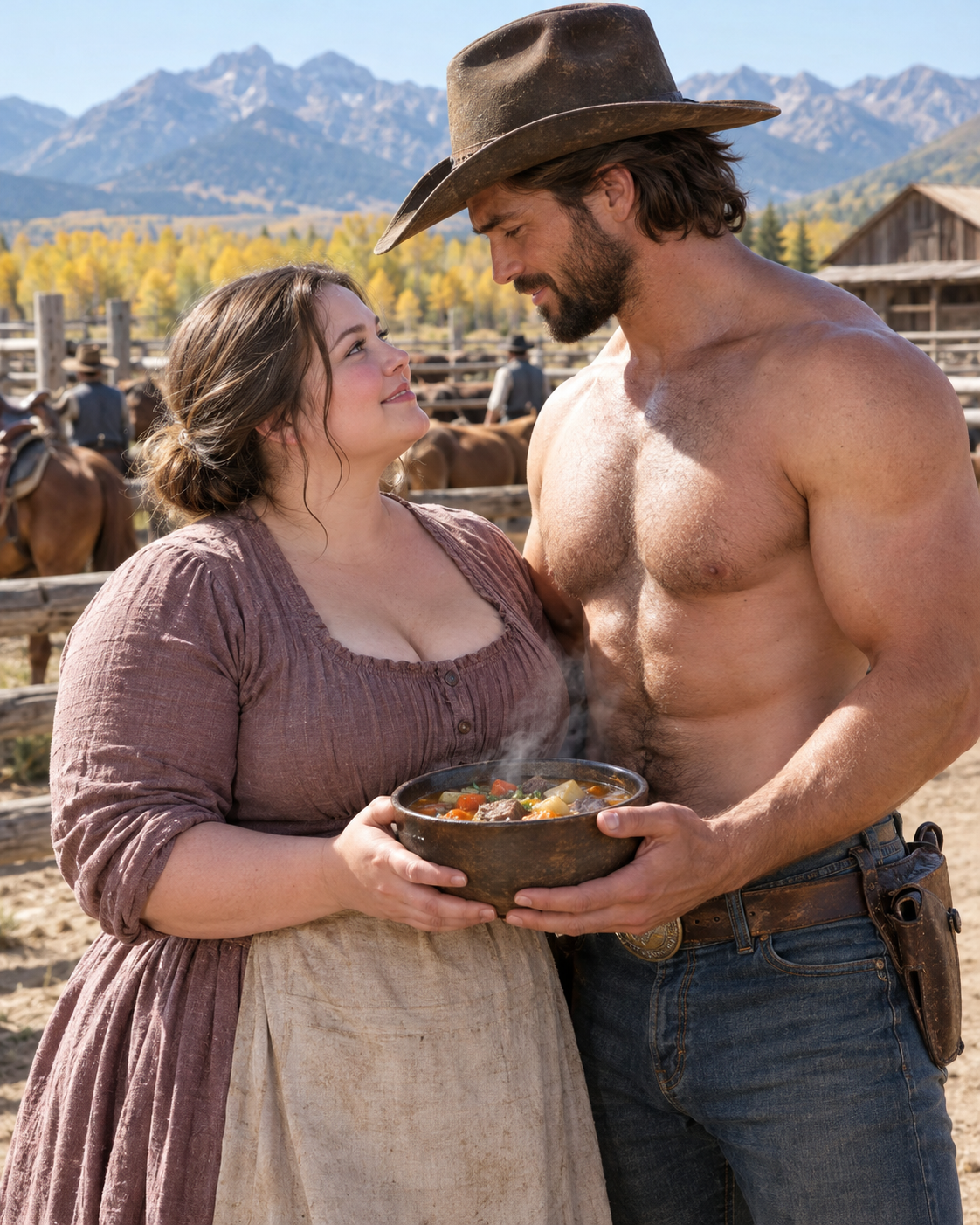
That evening, Mabel prepared the same beef stew she had served me on my first night in Red Willow.
We sat together at the kitchen table while the wind rattled the windows, and she placed a generous bowl in front of me.
I looked at it and smiled.
“You know, I still owe you for that first meal.”
She shook her head.
“You paid me back a hundred times over.”
“No,” I said gently. “You gave me something I couldn’t earn with money.”
She tilted her head, waiting.
“You made me feel like I still belonged among decent people.”
Her eyes softened.
“Walter, you belonged among them before you ever walked through my door.”
Those words stayed with me long after we finished eating.
Spring arrived slowly in Red Willow, bringing muddy roads, fresh grass, and the sound of hammers repairing the damage winter had left behind.
With the fraudulent debt erased, the Turner House was finally free.
Mabel refused to sell it, even when investors offered her more money than she had ever imagined seeing in one place.
Instead, she repaired the empty rooms and began offering inexpensive lodging to widows, injured laborers, and travelers who had run out of luck.
I continued working with Silas, though our friendship was different now.
He never asked me to forget his betrayal, and I never pretended that trust could be restored overnight.
We rebuilt it slowly, through honest work and difficult conversations.
Eventually, I purchased a small share of the blacksmith shop, using the money recovered from my father’s business partnership.
For the first time in my life, I had a future that did not depend on someone else’s generosity.
But I never forgot the woman who had fed me when I possessed nothing but eleven cents and a bruised sense of pride.
One evening, months after the trial ended, I found Mabel sitting on the porch, watching the last sunlight fade behind the hills.
I sat beside her, and for a while we listened to the crickets singing in the grass.
“I used to think people would only respect me if I became someone important,” I admitted.
Mabel looked at me with a faint smile.
“And now?”
“Now I think the important part was learning who deserved my respect before I had anything to offer.”
She leaned her head against my shoulder.
Neither of us needed to say what had grown between us during those long months of fear, work, and uncertainty.
It was not a grand romance built on wealth or promises.
It was something quieter, formed through meals shared after difficult days, hands offered without expectation, and the courage to stand beside someone when walking away would have been easier.
I reached for her hand, and she held mine as naturally as if it had always belonged there.
Years later, people in Red Willow would tell the story of Curtis Vain’s downfall as though it had been caused by the ledger alone.
They would speak of the witnesses, the trial, and the powerful businessman who had finally been forced to answer for his crimes.
But I knew the truth was much simpler.
Curtis began losing his power the moment ordinary people decided that fear would no longer keep them silent.
My father had tried to expose him.
Silas had finally confessed his part in the betrayal.
Gordon had chosen truth over his own convenience.
Edna had surrendered the secret she had carried for twenty years.
And Mabel had refused to let a hungry stranger believe that his life was worth less than anyone else’s.
I learned that kindness does not always look heroic, and courage does not always arrive with a weapon or a speech.
Sometimes courage is a tired woman filling a bowl with stew when she cannot afford to waste a single serving.
Sometimes it is a frightened man admitting what he did wrong.
Sometimes it is telling the truth even when the truth threatens everything you have spent your life protecting.
The Turner House remained standing, its windows glowing warmly on cold nights, its kitchen filled with the smell of bread and stew.
And whenever a stranger appeared at the door with empty pockets and a weary face, Mabel would set another place at the table.
I used to believe that my father had left me with nothing, but in the end, he left me something more valuable than money, land, or a respected name.
He left me the chance to choose what kind of man I would be.
And every time I watched Mabel welcome someone who had been rejected by the world, I remembered the lesson that had saved us both.
A person may lose everything that money can buy and still possess the one thing greed can never truly own: the ability to show kindness when cruelty would be easier.
Because the greatest measure of a human being is not how high he rises when the world gives him power, but how gently he treats someone who has none.
And sometimes, the smallest act of mercy becomes the beginning of a justice that powerful people spend their entire lives trying to bury.
THE END.