The bride ordered the widowed ranch cook to leave her wedding in the middle of a thunderstorm.
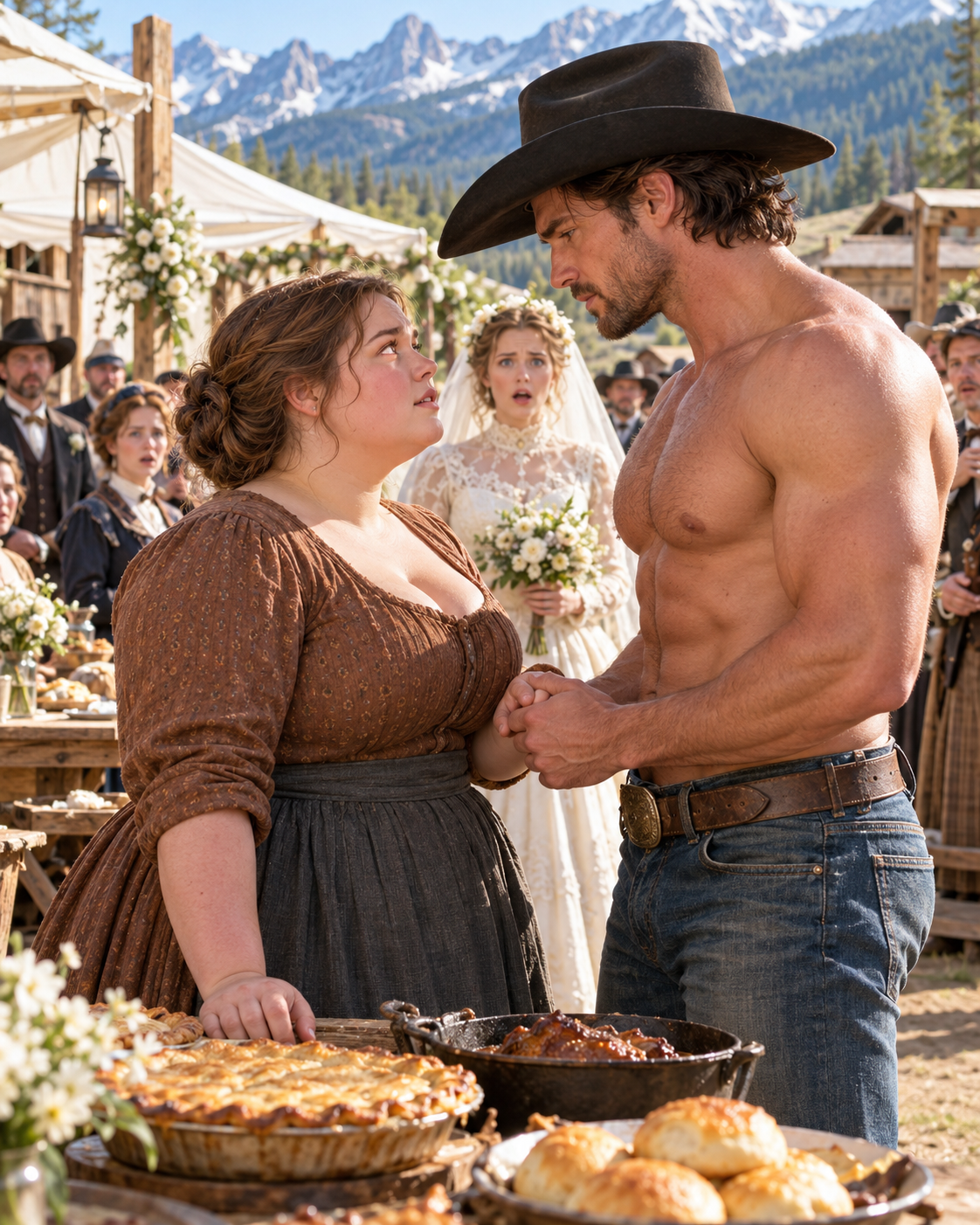
June stared at Grant’s outstretched hand while thunder rolled across the hills surrounding Blackpine Ranch. Behind him, Harold Warren held the cattle contract like a weapon, and Caleb Mercer looked as though someone had just informed him the ranch was burning.
For several seconds, nobody spoke.
Then June did something Grant hadn’t expected.
She picked up her suitcases, walked past his offered hand, and placed them beside the kitchen doorway.
“I’m not leaving,” she said quietly.
Elsie Warren let out an irritated laugh. “I believe I already dismissed you.”
June turned toward her. “You may dismiss me from your wedding supper, Miss Warren. But you don’t own this ranch, and you don’t employ me.”
Grant’s expression changed. A small, unmistakable smile appeared beneath his dark mustache.
“She’s right,” he said.
Harold Warren stepped forward. “You’d better remember who helped finance this operation, Lawson.”
“I remember,” Grant answered. “I also remember that your agreement is with Blackpine Ranch, not with the woman who cooks our supper.”
Caleb finally found his voice.
“Grant, the contract is more complicated than that.”
The words settled heavily between them.
June looked from one man to the other. She understood enough about ranch business to know when trouble was serious. During her three months at Blackpine, she’d watched Grant and Caleb struggle through late bills, weak cattle prices, and repairs they could barely afford.
She had never imagined her employment might become the spark that threatened everything.
“Then perhaps,” she said, “we ought to hear what the contract actually says.”
Harold’s face darkened.
“This is none of your concern.”
“Considering you’re threatening my livelihood over it, sir, I believe it has become my concern.”
Caleb glanced at Grant, then reluctantly reached for the document.
“The Warrens advanced us eighteen hundred dollars in April,” he explained. “We agreed to supply sixty head of cattle before the end of October. If we fail, the balance becomes due immediately, with interest.”
“And you’ll fail,” Harold interrupted. “I’ve already spoken to two cattle buyers who won’t touch your stock without my recommendation.”
Grant’s jaw tightened.
“You’ve been doing business behind our backs?”
“I’ve been protecting my interests.”
June watched Caleb’s face. The other ranch owner wasn’t merely frightened. He looked ashamed.
“How much of the herd is ready?” she asked.
Caleb hesitated.
“Forty-seven head. Maybe fifty, if the weather holds.”
“Thirteen short,” June murmured.
Harold smiled.
“Now perhaps you understand why a sensible businessman doesn’t insult his most important customer.”
Grant took one step toward him.
“Threatening my employees isn’t business.”
“No,” Harold replied. “It’s a lesson in knowing your place.”
That was when June realized something important.
Harold Warren wasn’t angry about roast beef.
He was angry because someone he considered beneath him had refused to obey his daughter.
And now he wanted everyone in the tent to see the consequences.
June removed her apron from her suitcase and folded it carefully over her arm.
“Mr. Warren, I’ll finish the supper because your guests deserve to eat. Afterward, if Mr. Lawson and Mr. Mercer decide my employment causes more trouble than they can bear, I’ll accept their decision.”
Grant immediately shook his head.
“June—”
“Please,” she said softly. “Let me finish.”
Her voice trembled, but her gaze remained steady.
“I’ve spent too many years allowing other people to decide what I’m worth. I won’t do it anymore. But neither will I stand here while good men lose their ranch because of me.”
For the first time, Harold seemed uncertain how to answer her.
Then a terrible cracking sound came from outside.
The tent shuddered violently.
A support rope had snapped in the storm.
One side of the canvas sagged toward the tables, sending guests scrambling backward as rain poured through the opening.
Someone screamed.
The fiddler dropped his instrument.
And then the nearest support pole began to fall.
Grant moved before anyone else.
He lunged across the muddy floor, caught the heavy pole against his shoulder, and shouted for the ranch hands.
“Get those people away from the canvas!”
June grabbed a little girl standing frozen beside the dessert table and pulled her toward the kitchen entrance.
“Come with me, sweetheart. Quickly!”
The girl’s mother followed, stumbling over a chair.
Within moments, the wedding celebration had dissolved into confusion.
Caleb and three cowboys rushed outside to secure the ropes. Grant held the pole until another man could brace it. June directed frightened guests toward the ranch house, where the dining room and kitchen offered shelter.
Elsie stood beneath the leaking canvas, her beautiful dress splattered with mud.
“My wedding!” she cried. “Everything is ruined!”
June stopped beside her.
“Miss Warren, you need to get inside.”
“Don’t touch me!”
“Then walk on your own, but please move.”
Another gust struck the tent.
Elsie finally obeyed.
By the time everyone reached the ranch house, the wedding flowers were soaked, the musicians were huddled beneath the porch, and the expensive celebration looked nothing like the event Harold Warren had paid for.
But everyone was safe.
June returned to the kitchen and checked the roast.
It was ready.
She took a deep breath, wiped rainwater from her forehead, and began carving.
Twenty minutes later, she carried the first platter into the crowded dining room.
Nobody laughed at her appearance.
Nobody called her hired help.
Instead, an elderly guest stood and quietly thanked her for getting the children out of the tent.
Others followed.
June nodded awkwardly and returned to the kitchen before anyone noticed the tears in her eyes.
Grant found her there after supper.
His shirt was soaked, and a dark bruise was forming along his shoulder.
“You should have that looked at,” June said.
“I’ve had worse.”
“That doesn’t make it sensible.”
He smiled.
“There’s the woman who tells me when I’m being foolish.”
She reached for a clean cloth and filled a bowl with warm water.
“Sit down.”
Grant obeyed.
For several minutes, she cleaned a shallow scrape on his forearm while the sounds of the wedding drifted faintly through the doorway.
Finally, he said, “I meant what I told them.”
June kept her eyes on the bandage.
“About leaving?”
“About standing beside you.”
She stopped.
“Grant, you can’t throw away your ranch because someone insulted me.”
“I wasn’t throwing anything away.”
“You were willing to.”
He looked at her carefully.
“June, when Thomas was alive, did he ever ask you to make yourself smaller so other people would feel comfortable?”
Her breath caught.
“No,” she whispered.
“Then why are you asking me to become a smaller man just because I care about you?”
She lowered her hands.
For three months, she had tried to convince herself that Grant’s kindness meant nothing beyond friendship.
He was a respected ranch owner. She was a widowed cook with very little money and a body people had spent years teaching her to apologize for.
She’d buried those feelings beneath work because hoping for more seemed dangerous.
Now, standing close enough to see the tiny scar beside his left eyebrow, she could no longer pretend she didn’t understand.
“Grant,” she said, “what exactly are you telling me?”
He looked toward the doorway, ensuring they were alone.
“I’m telling you that when I think about Blackpine five years from now, I don’t just imagine better cattle and repaired fences.”
June barely breathed.
“I imagine you sitting on the porch after supper, telling me I haven’t worked hard enough to deserve another biscuit.”
A startled laugh escaped her.
“That sounds about right.”
“And I imagine myself listening.”
Her eyes filled.
But before she could answer, Caleb appeared in the doorway.
“Grant. We need to talk. Now.”
The expression on his face erased the warmth of the moment.
Harold Warren had left the wedding early.
And he’d taken the contract with him.
The next morning, Blackpine Ranch woke beneath a gray sky. Broken branches littered the yard, the wedding tent hung in torn folds, and muddy wagon tracks crossed the pasture road.
June had barely finished preparing breakfast when Grant and Caleb entered the kitchen.
Neither looked rested.
Caleb placed a ledger on the table.
“I owe you both an explanation.”
Grant folded his arms.
“Start with the truth.”
Caleb rubbed his tired face.
“In April, after the creek flooded and we lost those calves, I went to Warren for the advance. He offered the money, and I thought it was our only chance.”
“You told me it was a standard delivery agreement,” Grant said.
“It mostly was.”
“Mostly?”
Caleb swallowed.
“If we can’t deliver the full sixty head, Warren has the right to demand payment against my share of the ranch.”
Grant stared at him.
“You pledged your ownership?”
“Only as security.”
“Without telling me?”
Caleb looked away.
June remained silent. This was a conversation between two men whose partnership stretched back fifteen years.
But she could see the pain in Grant’s expression.
He had trusted Caleb with his livelihood, and Caleb had concealed a danger that might cost them everything.
“I thought I could fix it,” Caleb whispered.
Grant leaned against the table.
“That’s what makes it worse. You didn’t trust me enough to let me help.”
A painful silence followed.
Finally, June spoke.
“How much time do we have?”
“Six weeks,” Caleb answered.
“And how many cattle can you reasonably gather?”
“Fifty, perhaps fifty-two.”
June looked toward the window.
Beyond the yard stretched hundreds of acres of pasture, wooded hills, and rough grazing country.
“What about the north meadow?”
Grant frowned.
“What about it?”
“I’ve seen cattle grazing beyond the old stone crossing. More than a dozen, some days.”
Caleb shook his head.
“Those aren’t ours. They’re from the neighboring Miller property.”
“All of them?”
Grant considered the question.
“Not necessarily.”
The previous spring, a section of Blackpine’s northern fence had collapsed during the flood. Several animals had wandered into the wooded grazing land, and the ranch hands had never recovered every missing head.
Grant straightened.
“Caleb, how many were unaccounted for?”
“Nine, possibly eleven.”
June watched the men exchange a look.
For the first time that morning, hope entered the kitchen.
The search began the following day.
Grant, Caleb, and four ranch hands rode north before sunrise, carrying ropes, supplies, and enough food for two days.
June prepared their provisions, checking each parcel twice.
As Grant tightened his saddle, she approached him with a wrapped bundle.
“Extra biscuits,” she said.
He accepted them with a smile.
“Are you trying to keep me from starving?”
“I’m trying to make sure you remember to eat.”
He leaned closer.
“And if I come home with all the cattle?”
“I might bake you a pie.”
“What kind?”
“Depends how many cattle you bring back.”
He laughed.
Then his expression softened.
“June, about what I said in the kitchen that night—”
She touched his sleeve.
“I haven’t forgotten.”
“I don’t want you feeling pressured to answer.”
“I don’t.”
He studied her face.
“Good.”
Then he mounted and rode away.
June stood in the yard until the riders disappeared beyond the cottonwoods.
She had spent the previous winter grieving a man she’d loved deeply.
She had believed that part of her life was finished.
Now she found herself praying for another man’s safe return.
And the realization frightened her.
Two days passed.
Then three.
On the fourth afternoon, a rider appeared on the southern road.
It was young Matthew Briggs, one of Blackpine’s cowboys.
His horse was lathered with sweat.
June hurried outside.
“Matthew? Where’s Grant?”
The boy dismounted awkwardly.
“He’s alive, ma’am.”
Those three words nearly brought her to her knees.
“What happened?”
“We found the cattle. Eight with our brand, maybe two more farther up the ridge. But the creek rose during the night. Mr. Lawson tried to bring the herd across before the water got worse.”
Matthew swallowed.
“His horse lost its footing.”
June gripped the porch railing.
“Was he thrown?”
“Yes, ma’am. Hit his leg against a rock. Caleb stayed with him. They sent me for the wagon.”
Within minutes, June was preparing blankets, clean cloths, boiled water, and a medical bag.
Old Mrs. Fletcher, who helped with laundry twice a week, watched her moving through the kitchen.
“You’re going with them, aren’t you?”
“Of course.”
The older woman studied her kindly.
“Then I suggest you stop pretending he’s only your employer.”
June paused.
Mrs. Fletcher said nothing more.
She didn’t need to.
By evening, the wagon reached the creek crossing.
Grant sat beneath a cedar tree with his injured leg stretched before him. His trousers were torn, and blood had dried along his boot.
When he saw June climb down from the wagon, his face changed.
“You’re supposed to be at the ranch.”
“And you’re supposed to be sensible enough not to fall into a creek.”
Caleb gave an exhausted chuckle.
Grant attempted to stand.
June pointed at him.
“Don’t.”
He sat back down.
She knelt beside him, carefully examining the injury. The leg was badly bruised, with a deep cut below the knee, but he could move his foot and toes.
Still, the swelling worried her.
“We’re getting you home,” she said. “Then I’m sending for the doctor.”
Grant reached for her hand.
“June—”
“Don’t argue.”
“I wasn’t going to.”
His large fingers closed gently around hers.
“I was going to say I’m glad you came.”
Her expression softened.
“There’s nowhere else I’d be.”
The journey home was slow.
Grant winced each time the wagon struck a rut, though he tried to hide it. June sat beside him, keeping his injured leg supported and checking the bandage.
At one point, he looked toward the distant hills.
“We found eight.”
“Eight cattle?”
He nodded.
“That’s something.”
“It’s not thirteen.”
“No,” June said. “But it means you’re closer than you were yesterday.”
He smiled faintly.
“You always find something worth holding on to.”
She looked down at their joined hands.
“Not always.”
That night, the doctor examined Grant and confirmed that his leg was not broken. He would need rest, clean dressings, and several weeks without riding.
Grant accepted this news with the expression of a man sentenced to prison.
June accepted it as an opportunity.
For the next ten days, she made certain he followed every instruction.
She brought meals to his room, changed his bandages, and confiscated his boots whenever he attempted to sneak outside.
One afternoon, she found him studying cattle records with his injured leg propped on a chair.
“You should be resting.”
“I am resting.”
“You’re working.”
“I’m working while resting.”
June placed a bowl of stew before him.
“You’re impossible.”
He looked up.
“Then I suppose you’ll have to keep me.”
She froze.
Grant’s expression grew serious.
“June, I don’t mean to make light of this.”
She sat across from him.
“Neither do I.”
He took a breath.
“I know you loved Thomas. I know you still do. And I wouldn’t ask you to forget one minute of that life.”
Her eyes glistened.
“But I love you, June Parker. Not because you cook for me. Not because you take care of this place. I love the woman who tells the truth when it’s uncomfortable, who remembers every man’s birthday, who keeps working when she’s frightened, and who refuses to let cruel people decide who she is.”
June covered her mouth.
For years, she’d believed the best parts of her life belonged to the past.
Now a man was offering her something she hadn’t dared imagine.
But she couldn’t answer immediately.
“Grant,” she whispered, “I’m afraid.”
“I know.”
“What if you wake up one morning and realize everyone was right about me?”
His forehead creased.
“Right about what?”
“That I’m too old to start again. Too heavy. Too ordinary. That a man like you could have chosen someone younger, prettier, someone—”
“June.”
He waited until she met his eyes.
“Do you think I haven’t seen you?”
She shook her head.
“I’ve seen you carrying flour sacks when the men were too busy to help. I’ve seen you kneeling beside a sick calf because nobody else had the patience. I’ve seen you laugh until your cheeks turn red.”
He squeezed her hand.
“I know what you look like. And I wouldn’t change a thing.”
June cried then.
Not because he’d rescued her.
But because he had spoken to her as though loving her required no explanation.
She leaned forward and kissed him.
It was a gentle kiss, awkward at first, made even more awkward by Grant’s injured leg and the chair between them.
When they separated, both were smiling.
“I love you too,” she whispered.
For one beautiful afternoon, the ranch’s troubles seemed far away.
Then Harold Warren returned.
He arrived in a polished carriage with two men June recognized from the county cattle auctions.
Grant met them on the porch, leaning heavily on a cane.
Caleb stood beside him.
Harold wasted no time.
“I understand you’ve recovered some missing cattle.”
“Eight head,” Caleb answered.
“Still short.”
“We have three weeks,” Grant said.
Harold smiled thinly.
“Indeed. But I’ve come with a proposal.”
He produced another document.
“If Mercer signs over his share of Blackpine now, I’ll forgive the outstanding balance and allow Lawson to remain as managing partner.”
Caleb stared at the paper.
“You want half the ranch?”
“I want security for my investment.”
“You’re asking for property worth considerably more than the debt,” Grant said.
Harold shrugged.
“You’re welcome to refuse.”
June stood just inside the doorway, listening.
She noticed something peculiar.
One of the men accompanying Harold wouldn’t look at Grant.
The other kept glancing toward the stable.
After the visitors departed, June found Matthew Briggs repairing a harness.
“Those two men who came with Mr. Warren,” she said. “Do you know them?”
Matthew nodded.
“One’s a cattle broker named Pierce. The other works for Warren.”
“Have you seen them before?”
The boy hesitated.
“Once. Up near the north road, about a month ago.”
June frowned.
“Doing what?”
“Looking over the cattle pens. I figured they had business with Mr. Mercer.”
That evening, June mentioned the encounter to Grant.
He listened carefully.
“There’s nothing unlawful about cattle buyers inspecting stock,” he said.
“No. But why does Mr. Warren seem so certain you’ll fail to meet the delivery?”
Grant didn’t answer immediately.
June continued.
“He keeps offering solutions that end with him owning the ranch.”
Caleb, sitting nearby, lowered his eyes.
“I should never have signed that agreement.”
Grant rubbed his forehead.
“We can’t undo April. We have to deal with October.”
June looked at the ledger.
“Then stop trying to solve everything by yourselves.”
Both men turned toward her.
She continued.
“You have neighbors. Other ranchers. People who’ve worked beside you for years. Have you asked any of them for help?”
Grant shook his head.
“They have their own troubles.”
“Perhaps. But you won’t know unless you ask.”
The next morning, June rode into town with Mrs. Fletcher.
They visited the feed store, the blacksmith, and three neighboring ranch families.
June didn’t beg.
She explained the situation plainly, asking whether anyone had cattle available for purchase, knew a buyer willing to advance payment, or could recommend a fair way to settle the contract.
Some people offered sympathy.
Others declined.
But one man, Samuel Miller, listened with unusual interest.
“Blackpine’s missing cattle?” he asked.
June nodded.
“We recovered eight.”
Miller rubbed his chin.
“I’ve seen three more with Lawson’s brand in the timber beyond my upper pasture. I was planning to send word when the creek settled.”
June nearly dropped her gloves.
“Three?”
“Could be four. Hard to count in those trees.”
Before leaving, Miller added something else.
“You tell Grant I’ll help bring them in. His father helped mine through the drought of ’58. Debts like that aren’t written in ledgers.”
When June returned, Grant was waiting on the porch.
She climbed down from the wagon with a smile she couldn’t contain.
“How would you feel about three more cattle?”
His eyes widened.
“Where?”
“Samuel Miller’s upper pasture.”
Grant caught her around the waist and lifted her off the ground before remembering his injured leg.
They both cried out.
June laughed.
“Put me down, you ridiculous man!”
He lowered her carefully, grinning despite the pain.
“June Parker, you may have just saved us.”
“Not yet,” she said. “But we’re getting closer.”
Over the following week, neighboring ranchers helped recover the animals. Miller’s cowboys found three Blackpine steers, and Caleb negotiated to purchase two market-ready animals from a smaller ranch west of town.
The numbers finally added up.
Sixty head.
The full contracted delivery.
For the first time in months, Caleb slept through the night.
Then, two days before the deadline, trouble returned.
A ranch hand discovered that the gate to the holding pasture had been left open.
Seven cattle were missing.
Grant stood in the yard staring at the broken latch, his face drained of color.
The gate hadn’t blown open.
Someone had removed the retaining pin.
Caleb examined it and swore under his breath.
“That’s no accident.”
June felt cold.
She remembered the men who’d visited with Harold Warren.
But suspicion wasn’t proof, and she knew better than to accuse anyone without evidence.
Grant ordered the men to search immediately.
June went to the stable and found Matthew saddling his horse.
“Did anyone come through the yard last night?”
He nodded reluctantly.
“Mr. Warren’s hired man stopped by yesterday evening. Said he had a message for Mr. Mercer.”
“Did you see him leave?”
“Not properly. I was feeding the horses.”
June thanked him and returned to the house.
She told Grant what she’d learned.
His face hardened.
“We’ll speak to the sheriff.”
“And find those cattle,” June added.
The sheriff examined the damaged gate that afternoon but couldn’t establish who had opened it.
Grant was furious.
Caleb looked defeated.
Then June noticed fresh hoofprints leading toward the wooded creek road.
“Those aren’t heading for the open range,” she said.
Grant studied the tracks.
“No,” he agreed. “They’re heading toward the abandoned logging pasture.”
By sunset, the missing animals had been found grazing beyond a damaged fence, close to the creek. The cowboys drove them home under lantern light.
All seven were accounted for.
The following morning, Harold Warren arrived expecting a surrender.
Instead, he found sixty cattle gathered in the holding pens, ready for delivery.
Grant stood beside Caleb at the gate.
June watched from the porch.
Harold’s expression changed when he saw the herd.
“Well,” he said stiffly. “It appears you’ve been fortunate.”
“Hardworking,” Grant corrected.
Caleb handed him the delivery records.
“The cattle are ready for your men to inspect. We’ll fulfill the agreement as written.”
Harold examined the papers without speaking.
Then he looked toward June.
“I suppose you consider this some great victory.”
June descended the porch steps.
“No, Mr. Warren. I consider it a good day’s work.”
He turned away.
But Elsie, who had accompanied her father, remained standing beside the carriage.
Her wedding dress was gone. She wore an expensive traveling coat, and for the first time, she looked uncertain.
“Mrs. Parker,” she said.
June stopped.
Elsie glanced at Grant, then back at her.
“I’ve been told what you did during the storm. Helping the children. Making certain everyone ate.”
June waited.
Elsie swallowed.
“I shouldn’t have spoken to you the way I did.”
It wasn’t a graceful apology.
There were no tears, no dramatic promises, and no sudden transformation into a better woman.
But the words had clearly cost her something.
June considered them carefully.
“No,” she said. “You shouldn’t have.”
Elsie lowered her eyes.
“I suppose I owe you an apology.”
“You do.”
A long silence followed.
Finally, Elsie whispered, “I’m sorry.”
June nodded.
“Thank you for saying it.”
Elsie looked up hopefully.
“Then we’re finished with this unpleasantness?”
June’s expression remained gentle.
“I won’t hold on to bitterness, Miss Warren. But I won’t pretend the words didn’t hurt, either.”
Elsie had no answer.
June returned to the house.
She didn’t need Elsie’s approval anymore.
That evening, Blackpine’s dining room was filled with laughter.
The cattle had been accepted, the immediate debt obligation was satisfied, and the ranch could finally begin rebuilding its reserves.
Caleb raised his coffee cup.
“To June Parker, who found three cattle, kept us fed, and apparently possesses more business sense than either of her employers.”
The cowboys cheered.
June blushed.
“Someone still has to wash those dishes.”
Grant stood.
“Then we’ll all wash them.”
The room erupted in laughter.
Later, after the dishes were finished and the men had gone to their quarters, June joined Grant on the porch.
The air was cool, carrying the smell of damp earth and autumn grass.
Grant handed her a small wooden box.
June looked at it, then at him.
“What’s this?”
“Open it.”
Inside lay a simple gold ring, worn smooth with age.
“It belonged to my mother,” he said. “My father gave it to her when they married.”
June touched the ring carefully.
“Grant…”
“I know we’ve only known each other a few months. And I know there are things we still have to learn about one another.”
He took her hand.
“But I’ve never been more certain of anything.”
June’s eyes filled.
“Are you asking me to marry you?”
“I am.”
She looked toward the dark pasture.
For one fleeting moment, she thought of Thomas.
She remembered his gentle hands, the sound of his laughter, the little house they’d shared, and the future they’d once imagined.
Loving Grant didn’t erase those memories.
It simply meant her heart had discovered room for another chapter.
She turned back toward him.
“Yes,” she whispered.
Grant blinked.
“Yes?”
June laughed through her tears.
“Yes, you great stubborn man. I’ll marry you.”
He slipped the ring onto her finger and gathered her into his arms.
But June pulled back just enough to look him in the eye.
“There’s something you should understand.”
“Anything.”
“I won’t stop working simply because I become your wife.”
Grant smiled.
“I wouldn’t dream of asking.”
“And I won’t have people suggesting I married you for the ranch.”
“Then we’ll tell them you married me for my charming disposition.”
She laughed.
“You’ve very little of that.”
“Fortunately, you seem willing to tolerate me.”
He kissed her beneath the porch lantern.
Their wedding took place the following spring, when the cottonwoods were green and the creek ran clear.
It was nothing like Elsie Warren’s expensive celebration.
There were no imported flowers, no elaborate decorations, and no wealthy guests demanding special treatment.
Mrs. Fletcher baked the cake.
Caleb arranged the chairs beneath the cottonwood trees.
Matthew Briggs cleaned the old carriage until its brass fittings shone.
And the ranch hands contributed whatever they could, from fresh flowers to polished lanterns.
June wore a modest cream-colored dress that fit her full figure beautifully. She had sewn much of it herself, with Mrs. Fletcher’s help.
When she looked into the mirror that morning, she did not search for ways to appear smaller.
She saw a woman who had survived grief, rebuilt her life, and learned to stand upright beneath the weight of other people’s judgments.
Grant waited beneath the trees in his best dark suit.
When June approached, he removed his hat.
His eyes filled with tears.
Caleb leaned toward him.
“Careful, partner. You’re going to embarrass yourself.”
Grant didn’t look away from June.
“Wouldn’t be the first time.”
They exchanged their vows before their friends.
Grant promised to love and honor her through whatever years they were given.
June promised to stand beside him in hardship and happiness, speaking honestly even when the truth was inconvenient.
When the minister pronounced them husband and wife, Grant kissed her gently.
The ranch hands applauded so loudly that the horses startled in the nearby pasture.
That evening, June sat beside her new husband beneath the cottonwoods while laughter drifted from the dining tables.
Caleb had hired another cook for the celebration, and June had insisted on remaining out of the kitchen for once.
Grant noticed her watching the guests.
“What are you thinking?”
She smiled.
“About the first day I arrived here.”
“You looked frightened.”
“I was.”
“You hid it well.”
“No, I didn’t.”
He chuckled.
“Perhaps not.”
June rested her head against his shoulder.
“I thought I was coming here because I needed a job.”
“And now?”
She looked toward the ranch house, where warm light shone through the windows.
“Now I think I was coming here because I needed to remember who I was.”
Grant kissed her forehead.
“You never lost that woman, June.”
“Maybe not,” she whispered. “But I nearly stopped believing in her.”
Their life wasn’t perfect after that.
Some winters were difficult. Cattle prices rose and fell. Grant’s injured leg ached during cold weather, and June occasionally grew impatient with his stubbornness.
They disagreed about money, argued over repairs, and learned that marriage required more than loving words exchanged beneath a cottonwood tree.
But they worked through those disagreements together.
June eventually organized the ranch kitchen as a proper business operation, keeping careful accounts and teaching two young women from town how to cook for large crews. She insisted they receive fair wages and be treated with respect.
Grant supported her plans, though he learned quickly that interfering with her kitchen arrangements was rarely appreciated.
Caleb, having learned a painful lesson about secrecy, never again signed an agreement without discussing it openly with his partner.
As for Harold Warren, he continued buying and selling cattle, though Blackpine gradually established relationships with other customers and no longer depended on his approval.
Elsie remained a difficult woman, but when she encountered June in town, she addressed her politely.
That was enough.
June didn’t need everyone to become kind.
She only needed to stop allowing unkind people to determine the boundaries of her life.
Years later, one of the young women working in June’s kitchen arrived in tears after a man at the general store mocked her appearance.
June listened without interrupting.
Then she placed a warm biscuit on a plate and sat beside her.
“Can I tell you something?” she asked.
The girl nodded.
“There was a time I thought every cruel word spoken about me must contain some truth.”
“What changed?”
June looked through the window.
Grant was outside teaching a young ranch hand how to repair a fence. His hair had begun turning silver at the temples, but his broad shoulders remained unmistakable.
“I met people who saw me clearly,” she said. “And eventually, I learned to see myself that way too.”
The girl wiped her cheeks.
“But what if people keep saying awful things?”
“They probably will, sometimes.”
“Then how do you make it stop hurting?”
June considered the question.
“You may not always be able to stop it from hurting. But you can decide whether their cruelty gets to make your choices.”
She reached across the table and squeezed the girl’s hand.
“You don’t need to become smaller to deserve a place in this world.”
That evening, as sunset turned the Blackpine hills gold, June stood on the porch beside Grant.
He slipped an arm around her waist.
“Long day?”
“A good one.”
He smiled.
“Any biscuits left?”
“One.”
“Just one?”
“And I was saving it for myself.”
Grant sighed dramatically.
“After all these years, you’re still a hard woman to negotiate with.”
June laughed and handed him half.
They stood together, sharing the biscuit while the last sunlight faded across the pasture.
Once, June had believed dignity was something other people could take away from her.
She had spent too many years accepting insults because she needed work, swallowing tears because she feared loneliness, and apologizing for a body that had carried her through grief and hardship.
But Blackpine had taught her something she would never forget.
Respect was not a reward for being beautiful, wealthy, thin, or powerful.
It was something every human being deserved.
And love, the kind worth keeping, did not ask a person to shrink so someone else could feel important.
It made room for them to stand tall.
June Parker Lawson never forgot the stormy wedding where a wealthy bride tried to send her away.
But when she remembered that evening, she no longer thought first about the humiliation.
She remembered a man standing in the rain, refusing to let cruelty go unanswered.
She remembered the decision to put down her suitcases.
And most of all, she remembered discovering that her future was not something other people had the right to decide.
Sometimes the bravest thing a person can do is walk away from disrespect.
And sometimes, when a place is truly worth belonging to, the bravest thing is to stay, stand your ground, and refuse to surrender your dignity.
June had finally learned the difference.
And that knowledge was worth more than every acre of Blackpine Ranch.
THE END.