The auctioneer raised his hammer over my Colorado ranch, and the banker smirked at my disgrace, unaware a stranger carried proof of his betrayal.
Clara’s hand tightened around mine as Walter Hensley’s shadow stretched across our kitchen floor.
“Don’t open it, Elias,” she whispered.
Outside, the wind rattled the porch railing, and the banker knocked again, harder this time.
“I know you’re in there, Brooks. We can settle this like civilized people.”
I looked at Clara.
Her face had turned pale, but there was something else in her eyes.
Not surprise.
Recognition.
“You knew he would come,” I said.
She swallowed.
“I hoped he wouldn’t.”
Hensley’s voice rose above the storm.
“Tell him, Clara. Tell him why your father really left Colorado.”
The words struck her harder than the cold ever could.
I had spent years believing the worst thing a person could lose was a home.
Standing beside Clara that night, I began to understand that losing faith in someone might hurt even more.
“Who was your father?” I asked.
She looked toward the window.
“Thomas Mason.”
The name meant nothing to me.
Then she added something that made the blood drain from my face.
“But that wasn’t the name he used when he worked at the bank.”
A terrible silence settled between us.
“His name was Thomas Whitcomb.”
I knew that name.
Every rancher in Silver Creek knew it.
Twenty-two years earlier, Thomas Whitcomb had been accused of stealing nearly forty thousand dollars from First County Bank.
He had vanished before the sheriff could arrest him.
Hensley had spent years telling anyone who would listen that Whitcomb was a coward and a thief.
My own father had believed him.
“Your father was the missing bank clerk?” I whispered.
Clara nodded.
“And he spent the rest of his life trying to prove he wasn’t a criminal.”
Before I could respond, glass shattered in the front room.
Clara screamed.
I grabbed the iron poker beside the stove and hurried toward the sound.
A stone lay among the broken glass, wrapped in a piece of paper.
Outside, Hensley’s automobile was already turning around.
I unfolded the note.
“Burn the documents, or the next thing through that window won’t be a stone.”
For several seconds, I stood motionless.
Then I heard Clara crying quietly behind me.
I had never seen her cry.
Not at the auction.
Not when she discovered how ruined the ranch really was.
Not even when I treated her as though her presence were an inconvenience.
But now her shoulders trembled.
“I’m sorry,” she whispered.
I wanted to demand why she’d brought danger to my doorstep.
Instead, I put down the poker.
“Tell me everything.”
We sat at the kitchen table while the storm pressed against the walls.
Clara opened her satchel and removed a small photograph.
A young man stood outside First County Bank beside another man whose handsome smile I recognized immediately.
Walter Hensley.
“My father was the bank’s chief bookkeeper,” she began.
“He discovered that Hensley was creating false debts against struggling ranchers.”
She turned the photograph over.
On the back, in faded ink, someone had written three words.
“Remember the truth.”
Clara continued.
“When my father confronted him, money disappeared from the bank’s accounts, and Walter blamed him.”
“Why didn’t he go to the sheriff?”
“He tried.”
Her voice broke.
“The sheriff told Walter everything.”
The room seemed to grow colder.
“My father ran because he believed they’d kill him before he reached a judge.”
For years, Thomas had lived under another name in Kansas, raising Clara alone after her mother died.
He worked repairing wagons and keeping accounts for small businesses.
He never stopped collecting evidence.
When he died the previous spring, he left Clara a locked trunk containing old ledgers, letters, and copies of transactions.
Among them were records involving the Brooks ranch.
“Your father wasn’t simply borrowing money,” Clara said.
“He was paying off a debt that never existed.”
I stared at her.
“My father worked himself into an early grave.”
“I know.”
“He sold half our cattle to keep the bank satisfied.”
“I know, Elias.”
The anger that rose inside me frightened even myself.
“And you knew all this before answering my advertisement?”
Clara lowered her eyes.
“Yes.”
The word hurt more than I expected.
“Then why did you come?”
She looked at me with tears shining along her lashes.
“Because your advertisement was the first time I’d seen someone from Silver Creek asking for a wife instead of a miracle.”
I said nothing.
“I wanted to bring you the documents, Elias. I wanted to help expose Walter.”
She wiped her cheek.
“But when we exchanged letters, I started looking forward to hearing about your horses, the mountains, and the way you described your mother’s roses.”
Her voice softened.
“Somewhere along the way, I stopped thinking only about justice.”
I looked away.
She had offered me her savings, her courage, and perhaps her heart.
And I had offered her a room and a warning that she could leave.
“Why didn’t you tell me sooner?” I asked.
“Because I was afraid you’d believe Hensley before you believed me.”
That accusation should have offended me.
Instead, it filled me with shame.
Because until that moment, she had been right.
The following morning, I rode into Silver Creek with the threatening note hidden inside my coat.
Clara insisted on accompanying me.
“No,” I told her.
“If he’s dangerous, you’ll be safer here.”
She folded her arms.
“He knows where I live, Elias.”
I almost smiled.
“You’re stubborn.”
“And you’re discovering it rather late.”
We went together.
The sheriff’s office stood beside the courthouse, its windows fogged by the stove inside.
Sheriff Daniel Mercer listened without interrupting as I described the stone, the threat, and Hensley’s visit.
Then he examined the note.
“Did you actually see Hensley throw it?”
“No.”
“Then you’ve got a broken window and a suspicion.”
Clara leaned forward.
“We also have records showing fraudulent loans.”
Mercer’s expression changed.
“Those are serious accusations, Mrs. Brooks.”
The words made me glance toward Clara.
She didn’t correct him.
Neither did I.
“Then investigate them,” she replied.
Mercer closed the ledger she had placed before him.
“These documents are decades old.”
“So are some of the crimes,” Clara said.
He stood.
“I suggest you both go home.”
Outside, I noticed Hensley’s automobile parked across the street.
Through the bank window, Walter watched us.
He raised his coffee cup in a mocking salute.
Clara caught my sleeve before I could cross the road.
“He wants you angry.”
“I am angry.”
“Then don’t give him the satisfaction of making you foolish.”
We returned to the ranch without speaking.
That evening, something happened that changed the way I saw her.
I found Clara in the barn, kneeling beside our oldest mare, Daisy.
The animal had stopped eating and was trembling.
I knelt beside them.
“She’s getting old,” I murmured.
Clara gently rubbed Daisy’s neck.
“Then we’ll make her comfortable.”
I watched her working beneath the dim lantern.
“Why did you spend all your savings on a man you barely knew?”
She kept her eyes on Daisy.
“Because someone once saved my father when everyone else called him a thief.”
“Who?”
“A farmer in Kansas.”
She smiled sadly.
“He gave us shelter without asking what we could pay.”
Her fingers moved through the mare’s mane.
“My father told me that kindness is only expensive when people start keeping score.”
Something shifted inside me.
For four years, I had measured everything I lost.
Cattle.
Land.
Money.
Ruth.
The future I thought I deserved.
Clara had arrived with almost nothing left to give, yet she had never once asked what she would receive.
That night, I knocked on her bedroom door.
She opened it wearing a plain white nightdress beneath a wool shawl.
For a moment, neither of us spoke.
“I owe you an apology,” I said.
She waited.
“I treated you like a burden because I couldn’t bear needing your help.”
Her expression softened.
“Needing someone doesn’t make you weak.”
“I know that now.”
I took a small velvet box from my pocket.
Inside lay the gold ring I had purchased months earlier.
“I can’t promise you an easy life.”
“I never asked for one.”
“I can’t promise the ranch will survive.”
“I know.”
My hands trembled.
“But I can promise you’ll never have to face whatever comes next alone.”
Clara’s eyes filled.
“Elias…”
“Will you marry me, Clara Mason? Properly, before a preacher, with a chance to say no?”
She laughed through her tears.
“Yes, Elias Brooks.”
Then she stepped into my arms.
And for the first time since Ruth died, I held someone without feeling that I was betraying the dead.
Three mornings later, we married in the little white church outside Silver Creek.
There were only seven witnesses.
The preacher.
His wife.
Two neighboring ranchers.
Their children.
And old Mrs. Bennett, who brought Clara a bouquet of dried lavender.
When the preacher pronounced us husband and wife, Clara looked up at me with such tenderness that I nearly forgot the trouble waiting outside.
Nearly.
Because Walter Hensley stood across the street when we left the church.
He didn’t smile.
He simply watched.
Two nights later, our barn caught fire.
I woke to the smell of smoke.
By the time I reached the porch, orange flames were climbing the western wall.
“Horses!” I shouted.
Clara was already pulling on her boots.
We ran through the snow together.
The heat struck my face like an open furnace.
Inside, the horses screamed against their stalls.
I freed the first two while Clara dragged Daisy toward the door.
A burning beam collapsed behind her.
“Clara!”
She stumbled.
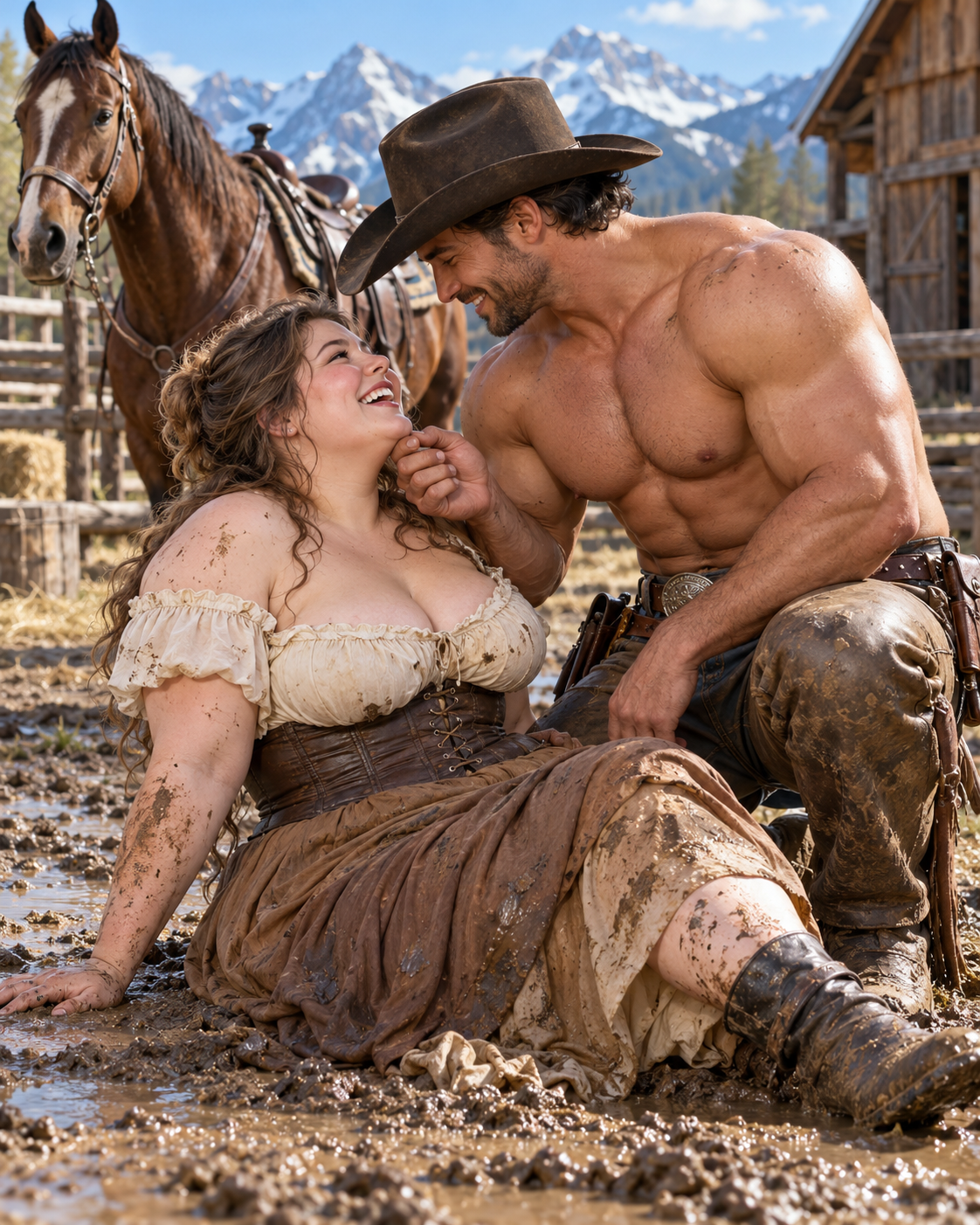
I threw myself through the smoke, caught her around the waist, and pulled her outside seconds before the roof gave way.
We fell into the snow, coughing.
Behind us, the barn collapsed with a sound like thunder.
For one dreadful moment, I couldn’t feel her moving.
Then she lifted her head.
“Elias?”
I pressed my forehead against hers.
“I’m here.”
She touched my cheek.
“Did we save them?”
I looked toward the pasture.
Three frightened horses stood trembling in the darkness.
“Yes.”
She smiled weakly.
Then she fainted.
I carried her into the house, wrapped her in blankets, and sent a neighbor for the doctor.
The doctor said she’d inhaled smoke but would recover.
I sat beside her bed until sunrise.
As she slept, I realized something that terrified me.
I loved her.
Not because she’d saved my ranch.
Not because she’d brought proof that my father might have been cheated.
I loved her because when the barn burned, she ran toward the animals instead of away from the flames.
Because she fought for what mattered.
Because she believed a broken life could still become something beautiful.
And because the thought of losing her made every other loss seem small.
At dawn, Mrs. Bennett arrived carrying a basket of food.
She took one look at the blackened barn and crossed herself.
“That wasn’t lightning,” she said.
I frowned.
“How can you tell?”
“My grandson saw a motorcar near your west gate last night.”
“Whose car?”
She hesitated.
“One of the bank’s.”
Before noon, Sheriff Mercer appeared.
I expected him to investigate the fire.
Instead, he held up a folded warrant.
“You’re under arrest, Elias.”
Clara had awakened and stood in the kitchen doorway.
“For what?”
Mercer avoided her eyes.
“Insurance fraud.”
I stared at him.
“What insurance?”
“The policy on your barn.”
“I haven’t insured that building in years.”
Mercer unfolded another document.
“According to the bank, you renewed the policy last month.”
Clara stepped forward.
“That’s impossible.”
Mercer placed his hand on his revolver.
“Don’t make this difficult.”
They took me through Silver Creek in handcuffs.
People came out of shops to watch.
Some shook their heads.
Others whispered behind their hands.
And as I passed First County Bank, I saw Hensley standing in the doorway.
He was smiling again.
The jail cell smelled of damp straw and rust.
I spent two nights there.
On the third morning, Clara arrived with a man I’d never seen before.
He wore a dark suit and carried a leather briefcase.
“This is Samuel Price,” she said.
“He’s an attorney from Denver.”
I stood.
“How did you afford an attorney?”
Clara gave me a tired smile.
“I sold my mother’s silver watch.”
My heart sank.
“Clara, you shouldn’t have.”
“Then stop looking so guilty and listen.”
Price opened his briefcase.
“The insurance company has confirmed that the policy was submitted using a forged signature.”
“That proves I didn’t buy it?”
“Not by itself.”
He pulled out another paper.
“But the application was processed through First County Bank.”
I felt my pulse quicken.
“And there’s something else.”
He produced a small handwritten letter.
“An employee has agreed to testify.”
“Who?”
“Margaret Bell. Hensley’s assistant.”
I knew Margaret.
She had worked at the bank since I was a boy.
A quiet widow who rarely spoke above a whisper.
“Why would she help us?”
Price’s expression darkened.
“Because Walter threatened to take her home if she didn’t cooperate.”
The next afternoon, I was released pending investigation.
But Hensley wasn’t finished.
That evening, Margaret Bell disappeared.
Her house stood empty.
Her supper was still on the stove.
And her front door had been left open.
Sheriff Mercer insisted she’d gone visiting relatives.
Clara didn’t believe him.
Neither did I.
We searched the roads outside town until the sun disappeared.
Near an abandoned railway depot, Clara spotted something half buried in snow.
A woman’s glove.
Inside was a folded piece of paper.
On it, written in shaky pencil, were four words.
“Look beneath the floor.”
Clara stared at the message.
“My father wrote something like this once.”
She reached into her coat and unfolded a letter Thomas Mason had left her.
Near the bottom was a sentence I’d overlooked.
“When the truth is needed, remember where I first learned to hide it.”
Clara’s face changed.
“The depot.”
“What?”
“My father used to keep records here when he worked for the railroad before joining the bank.”
We entered the abandoned building with one lantern.
The place smelled of rotting timber and dust.
Beneath a loose floorboard behind the ticket counter, we found an old tin box.
Inside were letters, a small ledger, and a photograph of three men.
One was Thomas Whitcomb.
One was Walter Hensley.
The third was my father.
On the back, in my father’s handwriting, were the words:
“Thomas knows. If anything happens to me, he has the proof.”
I sank onto the floor.
My father had known.
He hadn’t simply been another victim.
He had been helping Thomas.
Clara knelt beside me.
“Elias…”
I opened the ledger.
Page after page documented false charges, forged mortgages, and transfers of property into companies controlled by Hensley.
Then I reached the last entry.
My father’s name appeared beside a payment of eight thousand dollars.
Underneath were two words.
“Silence secured.”
I felt sick.
Had my father accepted money to keep quiet?
Had everything I believed about him been a lie?
Clara took the book.
“Wait.”
She examined the handwriting.
“This isn’t your father’s signature.”
“How do you know?”
“Because the handwriting matches the insurance application.”
She looked up.
“Someone forged both.”
A floorboard creaked behind us.
We turned.
Sheriff Mercer stood in the doorway with his revolver drawn.
“Put the box down.”
My blood went cold.
Clara slowly rose.
“You were working with him.”
Mercer said nothing.
I moved in front of her.
“Where’s Margaret?”
“She’s alive.”
“Where?”
“That’s not your concern.”
He pointed toward the door.
“You’re coming with me.”
We walked outside into the freezing darkness.
A wagon waited beyond the trees.
Walter Hensley stood beside it.
His face was twisted with fury.
“You should have taken your ranch and kept your mouth shut, Brooks.”
Clara stepped forward.
“You ruined my father’s life.”
Hensley laughed bitterly.
“Your father ruined himself by thinking honesty was worth dying for.”
The words struck Clara like a physical blow.
I felt her hand slip into mine.
“What did you do to him?” she whispered.
Hensley looked almost pleased.
“He could have been wealthy.”
“Answer her,” I said.
“He refused to cooperate.”
Hensley shrugged.
“So I made sure no one would believe him.”
Mercer shifted uneasily.
“That’s enough, Walter.”
But Hensley continued.
“Your father spent twenty years running from a crime he never committed, and all he had to do was destroy a few papers.”
Clara’s face crumpled.
I tightened my grip on her hand.
“And my father?” I demanded.
Hensley turned toward me.
“Your father was more troublesome.”
The wind howled through the pines.
“He discovered the forged accounts and threatened to testify.”
I remembered my father’s final winter.
His exhausted face.
His trembling hands.
The night he’d collapsed in the field after working until dark.
“You kept increasing his debt,” I whispered.
“I offered him a bargain.”
Hensley’s expression hardened.
“Keep quiet, and the ranch survives.”
“And he refused.”
“Yes.”
For the first time, I understood why my father had died still fighting.
He hadn’t been chasing a hopeless dream.
He’d been protecting something he believed was right.
Hensley reached for his revolver.
“Enough talking.”
Before he could raise it, a voice sounded from the trees.
“I believe we’ve heard enough.”
Lanterns appeared along the road.
Samuel Price stepped forward beside two armed deputies and a federal investigator.
Margaret Bell emerged behind them, wrapped in a blanket.
Hensley stared in disbelief.
Mercer lowered his weapon.
Clara exhaled sharply.
Price approached us.
“Mrs. Bell told us where Mercer intended to take you.”
Margaret looked at Clara.
“I’m sorry I didn’t speak sooner.”
Clara crossed the snow and embraced her.
Hensley tried to run.
He made it only a few yards before a deputy tackled him.
His revolver disappeared into the snow.
As they dragged him to his feet, he shouted that nobody could prove anything.
Price held up the ledger.
“We’ll let a jury decide.”
But the victory wasn’t complete.
Not yet.
The investigation that followed uncovered years of fraud.
Hensley’s associates had used forged contracts and invented penalties to seize land throughout the valley.
Several families had lost everything.
Some had moved away.
Others had died believing they’d failed the people they loved.
The truth couldn’t restore all those years.
It couldn’t bring my father back.
It couldn’t return Clara’s childhood.
And it couldn’t rebuild our barn overnight.
But it gave us something neither of us had expected.
A chance to begin again without living beneath someone else’s lie.
At Hensley’s trial, Clara testified about her father.
Her voice shook only once.
“He died believing the world would remember him as a thief.”
She looked directly at the jury.
“I want the world to know he was an honest man.”
When my turn came, I told them about the ranch, my father’s sacrifices, and the fire.
Then I looked at Hensley.
For years, I had imagined that confronting the man responsible for our suffering would make me feel powerful.
Instead, I felt tired.
“I used to think losing my ranch meant losing everything my family stood for,” I said.
“But land isn’t what makes a family honorable.”
I glanced toward Clara.
“It’s the choices people make when no one is watching.”
Months later, Hensley was convicted of fraud, forgery, and conspiracy.
Mercer lost his badge and was sentenced for his part in the scheme.
The fraudulent charges against our ranch were voided, and much of the money Clara had used to save it was returned.
Other families received settlements or recovered property where the law allowed.
But the morning that mattered most came after the trial, when Clara and I stood beside two graves.
My father’s.
And Ruth’s.
The snow had melted from the cemetery, revealing the first green shoots of spring.
I placed fresh flowers beside Ruth’s headstone.
“I loved her,” I told Clara quietly.
“I know.”
“Part of me thought loving you meant forgetting her.”
Clara slipped her hand into mine.
“Love doesn’t have to erase what came before.”
I looked at the woman beside me.
She had survived betrayal, fire, humiliation, and fear.
Yet somehow, she still believed tomorrow could be good.
“I wish I’d met you sooner,” I whispered.
She smiled.
“Then you might not have been ready to recognize me.”
I laughed softly.
And for the first time in years, the sound didn’t feel wrong.
That spring, we rebuilt the barn with help from neighbors who had once watched my humiliation at the courthouse.
Margaret Bell brought sandwiches for the workers.
Samuel Price helped us establish a small cooperative so local ranchers could borrow money without falling into another Hensley’s hands.
Mrs. Bennett planted roses beside our porch.
Clara insisted we keep Daisy in a warm stall, even though the old mare could barely work.
And every evening, when the mountains turned gold beneath the setting sun, we sat together on the porch and planned the life we’d once been too frightened to imagine.
One afternoon, nearly a year after the auction, Clara found me repairing the fence near the pasture.
She stood watching for several minutes, smiling in a way I couldn’t understand.
“What’s wrong?” I asked.
“Nothing.”
“Clara.”
She walked toward me, took my hand, and placed it gently against her stomach.
For a moment, I didn’t understand.
Then her eyes filled with tears.
“Elias, we’re going to have a baby.”
The world seemed to stop.
I stared at her.
“Are you certain?”
She laughed.
“Quite certain.”
I dropped my hammer.
Then I gathered her into my arms and held her so tightly she protested that I was crushing her.
I kissed her forehead.
Her cheeks.
Her trembling hands.
And then I cried.
Not from grief.
Not from shame.
But from the overwhelming realization that life had given me something I never thought I deserved again.
A future.
That winter, our daughter was born during the first snowfall.
We named her Hope Elizabeth Brooks.
Clara chose Hope.
I chose Elizabeth, my mother’s name.
When the doctor placed that tiny girl in my arms, I thought about the courthouse steps, the raised auction hammer, and the woman who had walked into a crowd of strangers carrying everything she owned.
I remembered how I’d offered her a way out.
How I’d mistaken her courage for pity.
How close I had come to sending away the greatest gift my life would ever know.
Clara watched me from the bed.
“What are you thinking?” she asked.
I sat beside her, holding our daughter between us.
“That I was wrong about something.”
She smiled.
“Only one thing?”
I laughed through my tears.
“I thought you came here to save my ranch.”
“And?”
I looked into her eyes.
“You came here and taught me how to live again.”
Clara reached up and touched my cheek.
“No, Elias.”
Her voice was gentle.
“We saved each other.”
Years later, people in Silver Creek still told the story of the strange woman who stopped an auction with her life’s savings.
They spoke about the corrupt banker, the burned barn, the hidden ledger, and the trial that changed the valley.
But whenever someone asked me what really happened that November morning, I always told them the part they never expected.
The greatest thing Clara gave me wasn’t the money.
It wasn’t the proof that cleared my father’s name.
It wasn’t even the daughter who filled our quiet rooms with laughter.
It was the courage to believe that being broken didn’t mean being finished.
My father had taught me how to work the land.
Ruth had taught me what love could feel like.
But Clara taught me that accepting someone’s hand doesn’t make a man smaller.
Sometimes, it’s the only way he learns to stand again.
And I learned something else, something I hope our daughter will carry long after Clara and I are gone.
A home isn’t saved by stubborn pride, and love isn’t measured by how much one person sacrifices while the other stands ashamed.
A home survives when two people choose to carry the weight together.
Every morning, I still rise before the sun.
I still walk the pastures where my father once worked.
And sometimes, when the house is quiet, I think about all the years I wasted believing that my failures were greater than my worth.
Then I hear Clara calling from the kitchen.
I smell fresh bread.
I hear our daughter laughing.
And I remember a cold November day when a stranger in a faded blue coat refused to let a wooden hammer decide the rest of my life.
That coat still hangs beside our front door.
Its sleeves are worn, and one pocket has a small tear from the day we escaped the burning barn.
Clara has offered to mend it a dozen times.
But I’ve asked her to leave it exactly as it is.
Because whenever life becomes difficult, whenever the bills grow heavy or the winter feels endless, I look at that old blue coat and remember something worth more than every acre of land we own.
Sometimes, the person who changes your destiny doesn’t arrive with a promise that everything will be easy.
Sometimes, she arrives with trembling hands, an empty purse, and a heart brave enough to stay.
And when I look back on that auction, I no longer remember Walter Hensley’s cruel smile.
I remember Clara standing in front of the crowd, frightened but determined, asking for nothing except the chance to stand beside me.
I once believed the saddest thing in the world was losing everything.
Now I know something far sadder.
It’s having someone willing to love you through your darkest days and being too ashamed to let them.
I almost made that mistake.
Thank God the woman I married was stubborn enough not to let me.
And if our daughter ever asks why we named her Hope, I’ll tell her the truth.
Because on the day I thought my life was over, her mother walked into it and proved that sometimes the most beautiful beginnings arrive disguised as the very end.
THE END.