On the morning of her wedding, Anora Bramwell ran away from a duke. Twenty minutes later, she found him hiding on the same train.
For several seconds, Anora could hear nothing but the sea.
The ring lay between them, catching the last copper light of the evening, while her father’s warning trembled in her hand.
“Edward,” she said at last, “what does this mean?”
The Duke of Westeran did not immediately answer.
It was the first time she had seen him look genuinely frightened. Not embarrassed, not uncomfortable beneath the weight of some social obligation, but frightened in a way that made him seem suddenly younger.
“Where did you get that letter?” he asked.
“It was inside your ring box.”
“I know where it was. I mean, who gave it to you?”
Anora stared at him.
“You did.”
He closed his eyes briefly.
“Of course.”
Something cold settled beneath her ribs.
“Edward, I have spent three months learning to trust you. Please do not make me regret it.”
He reached for her hand, then stopped himself.
“Your father came to see me four days ago. He was ill. Very ill, I thought. He asked me to promise that you would read his letter before I proposed.”
“And you agreed?”
“Yes.”
“Yet you intended to propose without mentioning it.”
“I intended to tell you everything tonight.”
“After I accepted?”
His silence was answer enough.
Anora snapped the velvet box shut.
She had never imagined that such a small sound could feel so final.
“Then perhaps,” she said, “we have not come as far from that railway carriage as I believed.”
She turned toward the promenade.
Edward followed, keeping several paces between them.
“Anora, there are circumstances you do not understand.”
“Then explain them.”
“Your father borrowed money from mine seventeen years ago.”
She stopped.
The lamps along the promenade flickered in the gathering darkness.
“My father has never borrowed money from anyone.”
“That is what he wanted you to believe.”
Anora faced him again.
Edward’s jaw tightened.
“The debt was secured against Bramwell Hall. The original agreement gave my father the right to claim the estate if repayment was not made by Michaelmas of this year.”
She stared at him, struggling to arrange his words into something sensible.
“Michaelmas is in September.”
“Yes.”
“And our wedding was meant to take place in June.”
“Yes.”
The realization came slowly, then all at once.
“The marriage settlement.”
Edward looked away.
Anora remembered her father’s sudden insistence upon the engagement, her mother’s strained smiles, the endless discussions about property and allowances that had seemed so tedious at the time.
She remembered one winter evening when her father had stood alone in the library, staring at a document with his hands pressed against the desk.
When she had entered, he had folded it so quickly that the paper tore.
“Was I meant to be the repayment?” she asked.
“No.”
“Do not insult me with an easy answer.”
Edward stepped closer.
“The marriage would have extinguished the debt. My father wrote that provision into the original agreement.”
“How convenient.”
“Anora—”
“And did you know?”
He hesitated.
Her heart sank.
“Did you know before we became engaged?”
“Yes.”
The word struck harder than she expected.
She remembered all the evenings he had appeared indifferent, the formal dinners, his carefully measured compliments. She had believed him merely uncomfortable with their arrangement.
Now she wondered whether he had been studying a transaction already completed.
“You knew,” she whispered, “and you never told me.”
“I was twenty-nine when my father died. The agreement was among his private papers. By then, our families had already discussed the match.”
“That does not answer my question.”
“No,” he said quietly. “It doesn’t.”
Anora looked at the ring box in her hand.
It contained no extravagant diamonds, no family heirloom, nothing resembling the ring once chosen for her by strangers.
She had thought that meant something.
Perhaps it still did.
But she could no longer bear to discover what.
“I should like to return to my hotel.”
Edward stepped aside.
This time, he did not follow.
By the time Anora reached her rooms, rain had begun tapping against the windows.
She placed the velvet box on the dressing table and sat beside it without removing her coat.
For three months, she had allowed herself to believe that the story of their failed wedding had become something lovely.
Two frightened people escaping a life neither wanted, discovering each other through ordinary conversations, slowly building an affection free from obligation.
Now she realized that freedom had been an illusion.
At midnight, there was a knock.
Her landlady, Mrs. Bell, appeared holding a telegram.
“It came just now, miss. The messenger said it was urgent.”
Anora unfolded the thin paper.
Her mother’s message contained only seven words.
YOUR FATHER COLLAPSED. COME HOME AT ONCE.
She was on the first train the following morning.
She had nearly reached London when someone entered her compartment.
Edward.
His coat was damp from the rain, his face exhausted, and he carried nothing but a small travelling case.
Anora stared at him.
“Have you made a habit of appearing on trains when I least desire your company?”
“Apparently.”
“I am not in a humorous mood.”
“Neither am I.”
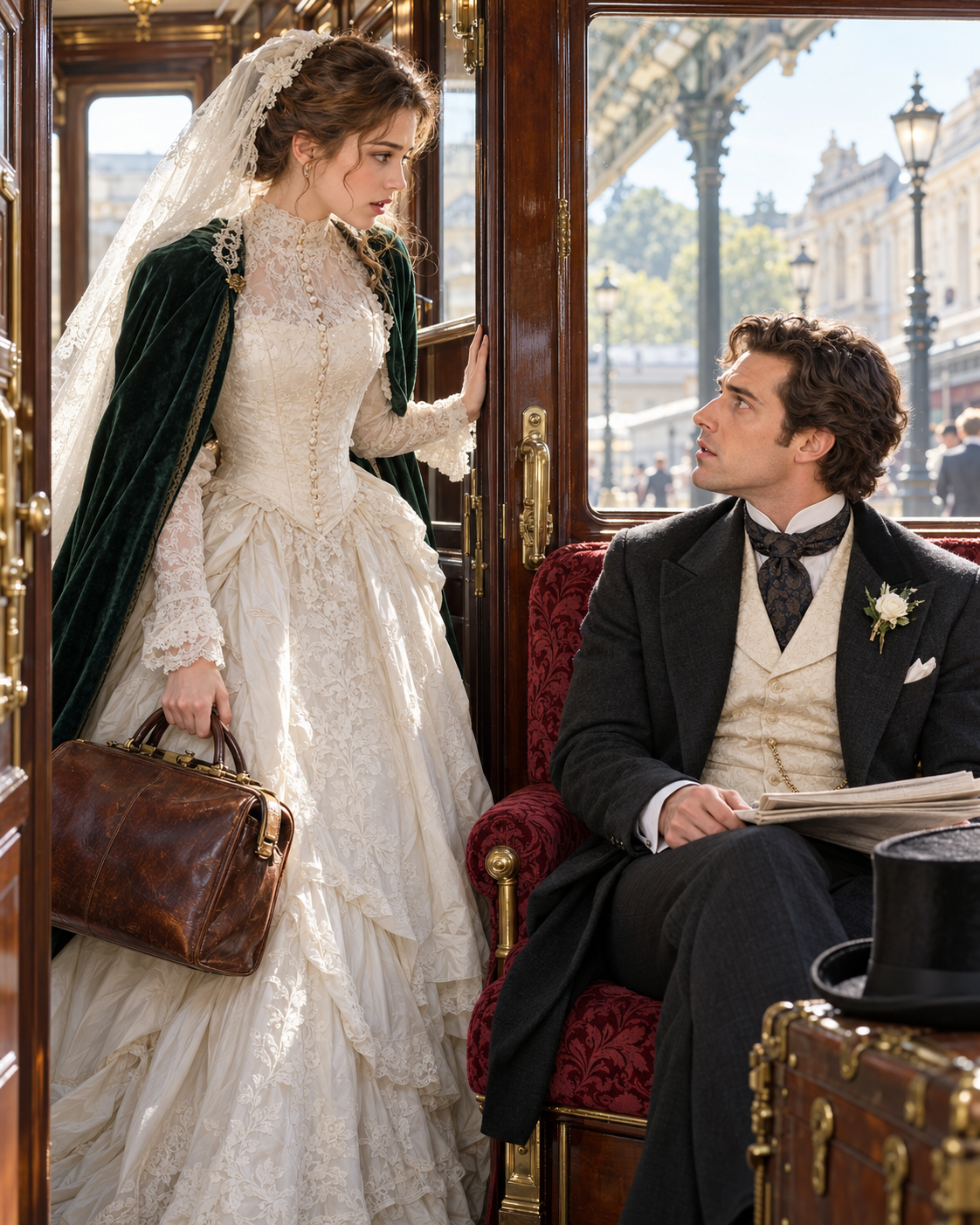
He placed a sealed envelope on the seat between them.
“Your father sent another letter. It arrived at my solicitor’s office yesterday.”
She made no move to touch it.
“I have no interest in more secrets.”
“Then let me remove one.”
Edward sat opposite her, deliberately leaving the envelope within her reach.
“Your father did not borrow the money for himself.”
Anora looked up.
“He borrowed it to save my mother.”
She frowned.
“Your mother?”
“Seventeen years ago, my mother was accused of stealing jewels belonging to Lady Ashcombe. The accusation was false. My father knew it was false. But the woman who made it possessed letters that could have destroyed my mother’s reputation.”
Anora listened, scarcely breathing.
“The letters were written by my mother to a married gentleman before her own marriage. They were harmless, but the gentleman was politically important, and Lady Ashcombe threatened to publish them as evidence of an affair.”
“What has that to do with my father?”
“Your father discovered that Lady Ashcombe had stolen the jewels herself and intended to blame my mother. He obtained evidence. But before he could bring the matter to court, someone demanded an enormous payment to keep the letters private.”
“And my father paid?”
“He did.”
“Why?”
Edward looked down.
“Because my mother was his sister.”
Anora stared.
“That is impossible.”
“It is not.”
“My father has no sister.”
“He had one.”
The carriage seemed to tilt beneath her.
Edward continued carefully.
“She was born Elizabeth Bramwell. She married my father against the wishes of her family. Your grandfather disowned her. Your father maintained contact secretly, but after her death, he never spoke of her again.”
Anora pressed her hands together.
“Then you and I…”
“Are first cousins.”
For a moment, the sound of the wheels became unbearable.
Anora rose so abruptly that her shoulder struck the luggage rack.
“No.”
Edward remained seated.
“Anora—”
“No. You knew?”
“I learned yesterday.”
“But the marriage…”
“Our fathers concealed the connection. My father persuaded himself that the families’ estrangement made it irrelevant. Your father believed the marriage would repair what had been broken.”
Anora gripped the seat.
The absurdity was almost enough to make her laugh.
All those months, they had been treated like strangers.
And now she discovered that the man she had fallen in love with was bound to her by blood.
“You cannot be certain,” she whispered.
Edward handed her the envelope.
Inside was a copy of a baptismal record, an old marriage certificate, and a letter written in a woman’s delicate hand.
Anora recognized her father’s name immediately.
My dearest Thomas,
Whatever Father says, you shall always be my brother.
She read the words again.
Her knees weakened.
Edward stood, but did not approach.
“The woman who wrote that letter was my mother.”
Anora covered her mouth.
For all the indignities of their arranged marriage, for all their family’s deceptions, she had never imagined anything so cruel.
The train thundered through a tunnel.
Darkness swallowed the windows.
When daylight returned, Anora was sitting again, the letter folded between her fingers.
“Why would they arrange such a marriage?”
Edward’s expression hardened.
“I intend to ask your father precisely that.”
They reached Bramwell Hall shortly after four.
The house seemed unnaturally quiet.
No servants hurried through the hall. No flowers decorated the staircase. The grand clock in the entrance chamber had stopped, its hands fixed at twenty minutes past eleven.
Anora’s mother met them outside the library.
She looked ten years older than she had on the wedding morning.
“Anora.”
Her voice broke.
Anora embraced her.
“Where is Father?”
“Upstairs. He has been asking for you.”
Lady Bramwell glanced toward Edward, and something like fear passed over her features.
“You should not have brought him.”
“He brought himself,” Anora replied.
They found Sir Thomas Bramwell propped against pillows in his bedchamber.
His face was pale, his once-powerful hands thin against the counterpane.
Yet when he saw Edward, his expression changed from exhaustion to anger.
“You,” he whispered.
Edward bowed stiffly.
“Sir Thomas.”
“I told you to keep away from her.”
“You told me to give her a letter.”
“I told you to protect her.”
“By allowing her to remain ignorant?”
Sir Thomas turned toward Anora.
“My darling girl.”
She stood at the foot of his bed.
“Is it true?”
He closed his eyes.
“Anora—”
“Is Elizabeth Bramwell your sister?”
His fingers tightened on the blanket.
“Yes.”
Anora felt the last fragile hope inside her collapse.
“And Edward is her son?”
“Yes.”
She looked toward the window.
A summer afternoon lay beyond it, warm and golden, as indifferent to her pain as the sea had been the night before.
For several moments, nobody spoke.
Then Sir Thomas began to weep.
Anora had never seen her father cry.
Not when her grandfather died. Not during her brother’s funeral. Not even when she fled her wedding and brought disgrace upon the family.
But now tears rolled down his cheeks.
“I thought I could mend it,” he whispered.
Edward stared at him.
“Mend what?”
“Everything.”
The old man struggled to sit upright.
“Your mother was seventeen when she married Westeran. My father forbade it because he knew what kind of man the duke’s father had been. But Elizabeth loved him. She would not listen.”
Edward’s voice was quiet.
“My father was not a kind husband.”
“No,” Sir Thomas said. “He was not.”
A terrible understanding began to settle across Edward’s face.
Sir Thomas continued.
“Your mother came to me after the first year. She was frightened. She wanted to leave him. I promised to help. But he discovered our plans.”
Anora looked between them.
“What happened?”
Sir Thomas swallowed.
“He threatened to destroy Elizabeth’s reputation. The letters were his invention. Lady Ashcombe was merely a willing accomplice. The jewels, the accusation, the scandal—all of it was a means to frighten her into obedience.”
Edward went still.
“My father told me she died of fever.”
“She did.”
Sir Thomas’s voice trembled.
“But before that, she begged me to take you away.”
Edward gripped the back of a chair.
“And did you?”
“I tried.”
“Did you?”
“No.”
The answer filled the room.
Sir Thomas covered his face.
“I was afraid. Your father threatened to ruin us all. I had already borrowed money to settle the scandal, and he held the debt over me. I told myself I would wait until I had enough influence, enough money, enough courage.”
His voice broke.
“By the time I found it, Elizabeth was dead.”
Edward turned away.
Anora saw his shoulders rise with a breath that seemed almost painful.
For years, the duke had believed his mother had been a distant, delicate woman who had scarcely cared for him.
Now he was being told she had fought to take him away.
“Why the marriage?” Anora asked again.
Sir Thomas looked at her helplessly.
“Your grandfather’s will contained a provision. Bramwell Hall would pass outside the family if there were no direct marriage alliance with the Westeran line before the end of this year. My father believed such an alliance might eventually reunite the families.”
“Even after what happened to Elizabeth?”
“He never amended the will.”
Edward’s eyes narrowed.
“And my father’s debt?”
“Would have been cancelled under the marriage settlement.”
“So you intended to use us to rescue the estate.”
Sir Thomas could not deny it.
Anora stood perfectly still.
She loved her father. She had loved him all her life.
But love, she was beginning to understand, did not make a person incapable of terrible selfishness.
“You might have told me,” she said.
“I could not bear for you to despise me.”
“And so you gave me no choice.”
Sir Thomas reached toward her.
She did not take his hand.
For the first time, Anora understood something that frightened her more than the scandal itself.
Her father’s regret was genuine.
So was the harm he had done.
That evening, Edward left Bramwell Hall without saying goodbye.
Anora watched his carriage disappear between the trees.
She did not follow.
There were some truths a person could not repair with tenderness, and some affections that could not survive merely because they had been sincere.
For three days, the house remained silent.
On the fourth morning, Anora entered her father’s study.
She found the documents exactly where he had left them.
The mortgage agreement.
The marriage settlement.
Her grandfather’s will.
And beneath them, a leather-bound ledger containing payments made over seventeen years.
She spent the day reading.
At dusk, she discovered something that made her sit upright.
The loan had been repaid.
Not recently.
Twelve years earlier.
Yet interest had continued to accumulate, each payment entered under a different name.
Anora examined the signatures.
Then she found the final receipt.
It bore the name of Lord Ashcombe, nephew of the woman who had once threatened Elizabeth.
She understood enough to send immediately for her father’s solicitor.
Mr. Pembroke arrived the following morning, visibly uncomfortable.
“Miss Bramwell, these are complicated matters.”
“Then explain them simply.”
He adjusted his spectacles.
“Your father borrowed against the estate, yes. But the debt passed through several hands.”
“Until Lord Ashcombe acquired it.”
“That is correct.”
“And although it was repaid, he continued to demand interest.”
Pembroke looked startled.
“Where did you find that?”
“In my father’s own records.”
He hesitated.
Then he lowered his voice.
“Lord Ashcombe has been using the debt to control your father for years.”
Anora’s fingers tightened around the ledger.
“And the marriage?”
“Would have transferred certain assets into the Westeran settlement, beyond Ashcombe’s immediate reach.”
“Then my father was not merely trying to save the estate.”
“No.”
Pembroke looked toward the closed door.
“He was trying to escape a blackmailer.”
Anora sat very still.
“Does Edward know?”
“I do not believe so.”
“Then he must.”
She sent a telegram that afternoon.
Edward did not answer.
She sent another the following morning.
Still nothing.
On the sixth day, a letter arrived from London.
It contained a single sentence.
I am attempting to discover whether my father left any part of his life untouched by cruelty.
There was no signature.
Anora recognized the handwriting.
She pressed the letter against her chest, then placed it beside the old railway ticket she had kept.
That night, she made a decision.
She would go to London herself.
Not to persuade Edward to love her.
Not to beg forgiveness for a crime neither had committed.
But because the truth had already taken too much from them, and she refused to let it take their courage as well.
Lord Ashcombe received her in a drawing room filled with expensive paintings and the scent of cigar smoke.
He was a narrow-faced man with silver hair and an expression of habitual amusement.
“Miss Bramwell. What an unexpected pleasure.”
“I have come about my father’s debt.”
His smile faded slightly.
“An unpleasant subject for a young lady.”
“Then you should find it easier to discuss with someone who is not easily frightened.”
Ashcombe leaned back.
“Your father owes a considerable sum.”
“He owes nothing.”
Anora placed the ledger on his desk.
“I have proof.”
For the first time, the man’s composure faltered.
He opened the book, scanned two pages, and shut it.
“Where did you get this?”
“From the man you have been tormenting.”
His eyes sharpened.
“You are playing a dangerous game.”
“No, Lord Ashcombe. I am ending one.”
He rose.
“Your father signed documents that could ruin him.”
“And you have collected money against a debt that no longer exists.”
He moved toward the fireplace.
“Do you know what happens to young women who make accusations against gentlemen of standing?”
Anora felt fear rise, cold and immediate.
But she remained where she stood.
“I imagine,” she answered, “they are told to be quiet.”
A voice came from the doorway.
“Not today.”
Edward stood there.
Beside him was Mr. Pembroke and a solemn gentleman carrying a portfolio.
Ashcombe’s face drained of colour.
Edward crossed the room.
“Miss Bramwell was kind enough to give you an opportunity to confess. You have declined it.”
He turned toward the gentleman beside him.
“Mr. Harcourt, would you explain?”
The solicitor opened his portfolio.
“The ledger has been examined. We have also recovered the original mortgage discharge from the Westeran estate archives. It is dated twelve years ago.”
Ashcombe seized the arm of his chair.
“That proves nothing.”
“It proves,” Edward said, “that you have been collecting money under false pretences.”
“And that is not all,” Harcourt added.
He produced a second document.
“We have sworn testimony concerning the forged correspondence used against the late Duchess of Westeran.”
Ashcombe’s expression changed completely.
Anora looked at Edward.
He had not merely been hiding.
He had been searching.
For the first time since their last meeting, their eyes held.
Something passed between them that neither was ready to name.
Ashcombe gave a bitter laugh.
“You think society will believe the daughter of a ruined baronet and the son of a disgraced woman?”
Edward stepped closer.
“I do not require society to believe anything. I require the court to examine evidence.”
Ashcombe opened his mouth, but nothing came.
Within a fortnight, legal proceedings had begun.
The matter became the subject of considerable gossip, though not the sort Lord Ashcombe had anticipated.
Documents emerged.
Witnesses came forward.
A former maid testified that Elizabeth Westeran had been threatened repeatedly by her husband.
A retired clerk produced correspondence showing that the debt had been discharged years before Ashcombe’s demands continued.
The accusations once used to shame Elizabeth were revealed as part of a calculated deception.
And for the first time, Edward learned the full story of his mother’s final years.
She had not abandoned him.
She had fought for him.
The discovery did not erase his childhood, but it altered the shape of every memory he had carried.
When the proceedings ended, Lord Ashcombe faced prosecution for fraud and extortion.
Bramwell Hall was no longer threatened by the fraudulent debt.
Yet another matter remained.
Anora and Edward could not marry as they had once imagined.
Their kinship had changed everything.
One afternoon, several weeks after the hearings, they met in the garden of Bramwell Hall.
The roses had been removed from the central beds.
In their place, Anora had planted lavender, pale foxgloves, and small white daisies.
Edward noticed immediately.
“An improvement.”
“An enormous one.”
They walked beside the gravel path.
Neither reached for the other’s hand.
At last, Edward stopped beneath an old lime tree.
“I have brought something for you.”
He offered her a small parcel wrapped in brown paper.
Inside was the gold ring from the velvet box.
Anora looked up sharply.
“Edward.”
“I know.”
He gave a sad smile.
“I am not asking what I once intended to ask.”
She turned the ring in her fingers.
“Then why give it to me?”
“Because it was never part of the settlement. I chose it myself. And I do not wish our families’ mistakes to make every good thing between us seem false.”
Anora felt tears gather.
He continued.
“I loved you before I knew the truth. That will always be part of our history. But I have no desire to turn affection into another obligation.”
She looked down at the ring.
For months, she had imagined love as the answer to every question.
Now she understood that sometimes love asked people to surrender the future they had wanted.
“Do you think we shall ever be happy?” she whispered.
Edward considered the question.
“Yes.”
“Even after this?”
“Especially if we refuse to spend the rest of our lives being governed by it.”
She laughed softly through her tears.
“And what will you do?”
“I intend to restore the cottages on the western estate. I have been neglecting them for years.”
“Your tenants will be delighted.”
“I should also like to establish a scholarship in my mother’s name.”
Anora smiled.
“She would have liked that.”
“I hope so.”
He hesitated.
“And you?”
Anora looked toward the house.
“My father has offered me an income independent of the estate. I intend to use it.”
“For what?”
“A school.”
Edward raised an eyebrow.
“Good heavens. Are you planning to educate the entire county?”
“Only the girls whom everyone insists have no need of learning.”
He laughed.
It was a genuine laugh, warm and unguarded, and she realized she would always be grateful to have heard it.
They stood together in the fading sunlight.
Then Edward held out his hand.
Anora took it.
Not as a promise of marriage.
Not as an act of farewell.
But as an acknowledgment that something meaningful could remain even when it had changed.
A year later, the old west wing of Bramwell Hall opened as a school for girls whose families could not afford a private education.
Anora supervised the work herself.
She argued with builders, examined accounts, interviewed teachers, and discovered that she possessed a talent for administration that would have astonished her younger self.
Her father lived long enough to attend the opening.
He watched from a chair beneath the lime tree as thirty-two girls entered the building carrying slates and books.
When Anora approached him, he caught her hand.
“I thought I was saving your future,” he said.
She sat beside him.
“I know.”
“I nearly destroyed it.”
Anora looked toward the schoolroom windows.
“You made choices for me because you were afraid.”
“Yes.”
“And I must make mine because I am not.”
He began to cry.
This time, she took his hand.
Forgiveness had not come quickly.
It had required anger, honest conversations, and the painful acceptance that the past could not be rewritten.
But she had discovered that forgiveness did not mean pretending no harm had been done.
It meant refusing to allow that harm to govern every day that followed.
Edward attended the school’s second anniversary.
He arrived by train, carrying a parcel of books and looking faintly uncomfortable beneath the attention of several curious pupils.
Anora met him at the entrance.
“You are late.”
“The railway was delayed.”
“An extraordinary coincidence.”
“I assure you, I did not hide behind a newspaper.”
She laughed.
They walked through the school together, stopping to listen as a young girl read aloud from a book far beyond the lessons her parents had once imagined she would receive.
Edward watched the child’s face brighten when she completed the passage.
“Your mother would have been proud,” Anora told him.
He looked at her.
“So would yours.”
Outside, the afternoon sun warmed the gravel paths.
The school bell rang.
Children spilled into the garden, laughing and calling to one another, their voices filling a place that had once been dominated by silence and obligation.
Edward stood beside Anora beneath the lime tree.
“Do you ever regret that morning?” he asked.
She considered the question.
“The wedding?”
“The train.”
Anora smiled.
“Never.”
He looked toward the girls racing across the grass.
“Nor do I.”
For a moment, they stood in companionable silence.
Then Anora reached into her pocket and withdrew the old railway ticket.
Its edges were almost worn away.
Edward stared.
“You kept it?”
“Of course.”
“Why?”
She turned it over.
On the back, beneath his faded question, she had written a new answer.
Would you have stayed if I had asked you to?
Below it were four words.
I am glad we left.
Edward read them, and his eyes softened.
He returned the ticket without speaking.
Because by then, they both understood what their families had never learned.
Love was not ownership.
Duty was not obedience.
And a person’s future was not a debt to be settled by someone else.
They had boarded that train believing they were escaping one another.
Instead, they had escaped the lives chosen for them.
The journey had led through heartbreak, betrayal, and truths neither could have imagined.
It had not given them the marriage their families planned, nor the romance they had briefly hoped to claim.
But it had given them something neither had possessed on that June morning.
The freedom to decide what kind of people they wished to become.
And sometimes, the greatest love story is not the one that ends with two people standing before an altar.
Sometimes it is the one in which two people find the courage to open a door, step into the unknown, and allow each other to live freely.
Anora folded the ticket and slipped it back into her pocket.
Then she turned toward the school, where the children were waiting.
And this time, when the bell rang, she did not run away.
She walked forward.
THE END.