On my third day at a Colorado ranch, the head cook dumped my soup before everyone, smiling coldly, unaware I knew the secret she was hiding.
For a moment, nobody moved.
The wind howled against the windows, rattling the old wooden frames as Margaret continued pounding on the back door.
Caleb stood so still that I could hear the ticking of the clock above the stove.
“Caleb, please!” Margaret shouted. “You don’t understand what you’re doing!”
I looked down at the photograph in my trembling hands.
The young woman holding the baby had my eyes.
The same deep brown eyes I had spent thirty-two years studying in mirrors, wondering which parent had given them to me.
“Who is she?” I repeated.
Caleb swallowed hard.
“Her name was Rebecca.”
“Rebecca who?”
His eyes met mine.
“Rebecca Morgan.”
A strange coldness spread through my chest.
Morgan.
The same name painted above the ranch entrance.
The same name belonging to the man standing before me.
“Was she your wife?”
Caleb shook his head.
“My sister.”
I stared at him, trying to understand what those two words meant.
Then my eyes dropped toward the baby in the photograph.
“Are you telling me that’s my mother?”
Caleb opened his mouth.
But before he could answer, the back door shook violently.
“Open this door!” Margaret screamed.
Caleb turned toward the sound.
“Go home, Margaret.”
“You know what happened the last time someone tried to tell that story!”
His face hardened.
“That was thirty-two years ago.”
“And some things are better buried!”
Something about the way she said it made my stomach twist.
I stepped toward the door.
“Then maybe it’s time somebody dug them up.”
Caleb reached for my arm.
“Anna, wait.”
But I was finished waiting.
I had spent my entire life being told what I was allowed to know about myself.
My grandmother had loved me fiercely, but whenever I asked about my parents, her smile always disappeared.
She would touch the silver necklace around my neck and whisper, “You were loved before you ever took your first breath.”
I had believed that was enough.
Now I wasn’t so sure.
I unlocked the door.
Margaret stumbled inside, her gray hair soaked with melting snow.
The moment she saw the photograph, she stopped breathing.
“Where did you find that?”
“Behind the kitchen wall.”
Her eyes darted toward Caleb.
“You kept it?”
Caleb didn’t answer.
Margaret looked at me again, and something shifted in her expression.
For the first time since I arrived, she wasn’t looking at my body.
She was looking at my face.
“You look just like her,” she whispered.
“Then tell me what happened to her.”
Margaret pressed a hand against her mouth.
Caleb stepped forward.
“Rebecca was Anna’s mother.”
The words struck me so hard I had to grip the counter.
My mother had a name.
A face.
A place in the world.
And she had once stood in the same kitchen where I had been humiliated only hours earlier.
“What happened to her?”
Caleb lowered his gaze.
“She died when you were six months old.”
I felt the familiar ache of an old loss.
But something about Margaret’s reaction made it different this time.
She shook her head.
“No.”
Caleb turned sharply.
“Margaret.”
“No,” she repeated, louder now. “You don’t get to tell half the truth anymore.”
The wind screamed outside.
And Margaret said the words that changed everything.
“Rebecca didn’t die in an accident.”
Caleb’s face went white.
I felt my knees weaken.
“What accident?”
Margaret looked at him.
“You never told her?”
Caleb closed his eyes.
My grandmother had always said my parents died in a winter storm.
Their truck supposedly slipped off a mountain road, leaving me an orphan before my first birthday.
It was a story I had repeated so many times that it had become part of my identity.
But now the people who knew my parents were looking at each other like prisoners standing before an unlocked cell.
“Sit down, Anna,” Caleb said.
“I don’t want to sit down.”
“Please.”
“No.”
My voice cracked.
“I have spent thirty-two years wondering why I didn’t have parents. You’re going to tell me the truth while I’m standing.”
Caleb nodded slowly.
Then he pulled out a chair and sat himself.
“Your father was named Daniel Collins.”
He paused.
“He worked on this ranch.”
I pressed my fingers against the necklace.
“He was a ranch hand?”
“He was our foreman.”
Caleb gave a sad smile.
“The best man I ever knew.”
My throat tightened.
“Then why did Grandma tell me he was a mechanic?”
“Because your grandfather hated him.”
The room seemed to shrink.
Caleb explained that my mother had been the only daughter of Walter Morgan, the wealthy, powerful owner of the ranch.
Rebecca had fallen in love with Daniel, a hardworking man who had grown up poor.
Walter believed the Collins family was beneath his.
When Rebecca became pregnant, he demanded she leave Daniel.
She refused.
They married in secret.
Six months after I was born, a terrible argument erupted during a snowstorm.
My parents planned to leave Colorado and start over in Oregon.
They never made it.
“The police said their truck lost control on the pass,” Caleb whispered.
I stared at him.
“But you don’t believe that.”
Caleb’s jaw tightened.
“I never did.”
Margaret moved toward the stove.
“Your father received a threatening letter the day before they left.”
I turned toward her.
“From whom?”
Neither answered.
I didn’t need them to.
“My grandfather.”
Caleb nodded.
I felt something ugly rise inside me.
“Did he kill them?”
“We never proved anything,” Caleb said.
“That wasn’t my question.”
His eyes shone.
“I don’t know.”
For several seconds, the only sound was the wind.
Then I asked the question that hurt most.
“Why didn’t you come for me?”
Caleb looked as though I had struck him.
“I tried.”
“Then why did Grandma raise me alone?”
He leaned forward, his hands shaking.
“Because your grandfather made sure I couldn’t reach you.”
I stared at him.
Caleb explained that after the funeral, Eleanor had taken me to Silverton.
She feared Walter would claim custody and raise me under his control.
Caleb had been twenty-one, grieving his sister and frightened of his father.
He wanted to help.
But Walter threatened to destroy Eleanor financially if the family ever contacted him again.
My grandmother disappeared with me.
Caleb spent years trying to find us.
Eventually, he discovered where we lived, but Eleanor begged him to stay away.
“She said you were happy,” he whispered. “She said reopening the past would only hurt you.”
I turned toward the window.
I remembered my grandmother working double shifts at the diner.
Her swollen feet.
Her cracked hands.
The nights she pretended she wasn’t hungry so I could have another serving.
“She wasn’t happy,” I whispered.
“She was exhausted.”
Caleb wiped his eyes.
“I know.”
“No, you don’t.”
My voice shook.
“You had this ranch. You had money. We had a leaking roof and a heater that barely worked.”
He didn’t defend himself.
That somehow made it worse.
I wanted someone to argue with.
Someone to blame.
Instead, I stood in a warm kitchen surrounded by people who had known my family while I had grown up believing I had none.
Then Margaret spoke.
“There’s something else.”
Caleb looked up sharply.
“Don’t.”
She ignored him.
“Your grandfather didn’t just threaten Eleanor.”
Margaret stared at the photograph.
“He paid someone to keep her quiet.”
I felt the air leave my lungs.
“What?”
“Every month, for almost twenty years, money was sent to an account in Silverton.”
“That isn’t true,” I whispered.
My grandmother had struggled for every dollar.
Margaret shook her head.
“The money wasn’t for her.”
I looked between them.
“Then who was it for?”
Margaret’s lips trembled.
“Someone who knew what happened on that mountain.”
Before I could ask another question, headlights flashed across the kitchen window.
A truck had pulled into the courtyard.
Caleb stood immediately.
“Nobody was supposed to be coming tonight.”
Through the snow, I saw a dark pickup stop near the barn.
A tall man climbed out.
He wore a black coat and carried a leather briefcase.
Margaret gripped the counter.
“Oh, God.”
Caleb moved toward the front entrance.
“Stay here.”
But I followed him.
I had been told to stay behind too many times already.
The stranger stepped onto the porch and removed his hat.
He appeared to be in his late sixties, with silver hair and tired blue eyes.
When he saw me, he stopped.
For several seconds, he looked unable to speak.
Then he whispered, “Rebecca?”
Caleb moved between us.
“What are you doing here, Thomas?”
The man looked at Caleb.
“I heard Eleanor’s granddaughter was working here.”
“Who told you?”
“Margaret.”
I turned.
She stood behind us, her face wet with tears.
“I called him after supper,” she admitted.
The stranger stepped closer.
“My name is Thomas Reed.”
His gaze returned to me.
“I was the deputy sheriff who investigated your parents’ deaths.”
A terrible silence settled over the porch.
Thomas opened his briefcase.
“I should have come thirty-two years ago.”
He removed a yellowed envelope.
“I’ve carried this longer than any man should carry a lie.”
Caleb stared at it.
“What is that?”
Thomas looked directly at me.
“The statement your father made two days before he died.”
My hands went numb.
“You’re telling me my father knew something was going to happen?”
Thomas hesitated.
“He knew someone was afraid of what he had discovered.”
I took the envelope.
Inside was a handwritten statement bearing Daniel Collins’s signature.
I recognized his name from the few documents my grandmother had kept.
My father described missing cattle, altered sale records, and money disappearing from the ranch accounts.
He believed someone had been using the business to conceal theft.
At the bottom, one sentence had been underlined.
“If anything happens to Rebecca or me, investigate the financial records held by Walter Morgan’s attorney.”
I slowly lowered the paper.
My grandfather hadn’t just hated my father for marrying his daughter.
My father had discovered something.
And someone had wanted him silent.
“Why wasn’t this given to the police?” I asked.
Thomas looked ashamed.
“Because I was the police.”
He explained that Walter Morgan controlled half the county through business relationships and political favors.
When the accident occurred, Thomas was ordered to close the investigation quickly.
The truck had been found at the bottom of a ravine.
Both my parents were dead.
But one detail had never made sense.
The brake line had been damaged.
“Cut?” Caleb asked.
Thomas nodded.
The expression on Caleb’s face terrified me.
For thirty-two years, he had suspected murder.
Now the possibility was standing in front of him with a badge-shaped shadow.
“Who ordered you to close the case?” I asked.
Thomas answered quietly.
“Sheriff Richard Bell.”
“Where is he now?”
“Dead.”
I felt my hope collapse.
Then Thomas continued.
“But I recently found something among his belongings.”
He reached into the briefcase again.
This time, he removed a small cassette tape.
Margaret made a strangled sound.
“No.”
Thomas looked at her.
“You recognize it?”
She leaned against the wall.
“I thought it was destroyed.”
Caleb stared at her.
“Margaret, what have you done?”
And that was when the woman who had humiliated me in front of the ranch hands began to cry.
Not angry tears.
Not embarrassed tears.
The kind that come from a wound hidden so long it has become part of the body.
“I was there,” she whispered.
“Where?” I asked.
“The night your parents left.”
My heartbeat thundered.
Margaret explained that she had been a young kitchen assistant at the time.
Rebecca had come downstairs carrying me.
Daniel was loading their truck.
Walter confronted them near the barn.
Their argument was so loud that Margaret heard it from the kitchen.
Walter threatened to cut Rebecca out of his will.
She told him she didn’t care.
Then Daniel accused Walter’s business partner, Victor Harlan, of stealing money through falsified cattle shipments.
Walter refused to listen.
Daniel threatened to contact state investigators.
“Victor was standing outside the office,” Margaret whispered. “He heard everything.”
I looked at Caleb.
“Where is Victor now?”
Caleb’s expression darkened.
“He died twelve years ago.”
Another dead end.
But Thomas shook his head.
“His son is alive.”
“Who is his son?”
Thomas glanced toward Margaret.
She began shaking her head.
“Please don’t.”
“His name is Everett Harlan,” Thomas said.
Caleb went completely still.
I had heard that name before.
Everett Harlan owned the bank holding the ranch’s largest commercial loan.
He had visited on my second day, wearing an expensive suit and smiling at Margaret as if they shared a private understanding.
Caleb had barely spoken to him.
“He’s been trying to buy this place,” Caleb said.
Thomas nodded.
“And he’s been buying up old properties connected to his father’s businesses.”
I struggled to breathe.
“Why?”
“Because certain records never disappeared.”
Caleb turned toward Margaret.
“Is that why you’ve been acting strangely?”
She looked at me, her eyes red.
“I didn’t know who you were when you arrived.”
“Then why did you hate me?”
Margaret covered her face.
For a moment, I thought she wouldn’t answer.
Then she whispered, “Because Eleanor Collins was the woman who kept me from going to prison.”
I stared at her.
Margaret explained that after my parents died, she discovered missing pages from the ranch ledgers.
She had seen Victor carrying documents out of Walter’s office.
When she confronted him, he threatened to accuse her of theft.
Terrified, she took copies of several pages and hid them.
Victor found out.
He demanded she surrender everything.
Eleanor helped her escape the ranch that night.
But Margaret eventually returned after Victor promised to leave her alone.
“Your grandmother made me swear never to forget what happened,” she whispered.
“Then why did you?”
Margaret looked broken.
“Because I was a coward.”
She glanced at the photograph in my hands.
“When you walked into this kitchen, I saw Eleanor in your eyes. I was afraid you would ask questions I couldn’t answer.”
I swallowed against the anger burning in my throat.
“So you decided to humiliate me?”
She nodded miserably.
“I thought if I made you miserable enough, you’d leave.”
I looked at her for a long time.
Then I said, “You could have warned me.”
Margaret lowered her head.
“Yes.”
“You could have protected me.”
“Yes.”
“Instead, you made me feel worthless.”
She began sobbing.
And for the first time, I understood something I had never wanted to understand.
People could be frightened.
People could be wounded.
And they could still choose to hurt someone innocent.
Their pain did not erase mine.
I stepped away from her.
“I don’t forgive you.”
Margaret nodded.
“I know.”
Outside, the storm intensified.
Thomas placed the cassette on the table.
“There’s a recording on this tape. Sheriff Bell made it during a private interview with Victor Harlan.”
Caleb found an old cassette player in his office.
The machine crackled when he pressed play.
For a moment, there was only static.
Then a man’s voice filled the room.
“Victor, tell me what happened to Daniel Collins.”
Another voice answered.
“I only wanted the documents.”
My entire body went cold.
The sheriff asked, “Did Walter know about the truck?”
A long pause followed.
Then Victor spoke again.
“No. Walter thought I was sending someone to scare Daniel.”
I gripped the table.
Victor’s voice continued.
“The mechanic wasn’t supposed to touch the brakes.”
Margaret began crying again.
Caleb closed his eyes.
And I felt the last fragile pieces of my childhood story fall apart.
My parents hadn’t died because of an icy road.
They had died because someone believed money was more important than two human lives.
The recording continued.
Victor said he had paid a mechanic to sabotage the truck.
He claimed the plan was to frighten Daniel into surrendering the records.
But once the brakes failed on the mountain road, there was no stopping what followed.
The sheriff asked why Victor had never confessed.
Victor laughed bitterly.
“Because the dead don’t need the truth.”
I pressed my hand against my mouth.
For thirty-two years, I had imagined my parents’ final moments.
The falling snow.
The frightened screams.
My mother’s arms reaching toward my father.
Now those images were unbearable.
Caleb stopped the tape.
Nobody spoke.
Then Thomas said, “There’s enough here to reopen the investigation.”
Caleb looked at him.
“Why bring it now?”
Thomas met his eyes.
“Because I recently learned Everett Harlan has been paying people to locate the missing financial records.”
Margaret stiffened.
Caleb turned slowly toward her.
“Where are they?”
She looked toward the kitchen.
And suddenly, I remembered the loose wooden panel.
The photograph.
The strange empty space behind it.
Margaret walked to the wall, removed the panel completely, and reached deep inside.
She pulled out a narrow metal box covered in dust.
My breath caught.
“Eleanor put it there,” Margaret whispered.
“Why didn’t she take it?”
“Because she believed somebody would search her home.”
Margaret handed the box to me.
“She said that one day, if the truth ever came back to this ranch, it should belong to you.”
Inside were handwritten ledgers, old bank receipts, and letters addressed to my mother.
At the very bottom lay a folded sheet of blue stationery.
My name was written across the front.
Anna.
The handwriting was delicate and slightly slanted.
I opened it with shaking fingers.
“My darling girl,” it began.
Tears blurred the words.
My mother had written the letter shortly before leaving the ranch.
She described the first time she held me.
How I had opened my eyes and stared at her as though I already knew her.
She wrote about Daniel singing terribly off-key while rocking me to sleep.
About the little yellow blanket she had knitted.
About the home they planned to build near the Oregon coast.
Then came the sentence that broke me.
“If the world ever makes you feel small, remember that your existence is not something you must apologize for.”
I stopped reading.
My whole life, I had apologized.
For taking up space.
For eating in public.
For laughing too loudly.
For being the woman I was instead of the woman other people thought I should become.
And there, in handwriting older than my memories, my mother was telling me I had never needed permission to exist.
I sank into a chair and cried.
Caleb knelt beside me.
“I’m sorry, Anna.”
I looked at him through tears.
He had lost his sister.
He had carried guilt for decades.
But he had also allowed fear to keep him away.
“I needed you,” I whispered.
He nodded.
“I know.”
“Grandma needed you.”
His voice broke.
“I know.”
I wiped my face.
“Then don’t spend the rest of your life apologizing. Do something different.”
He looked at me.
“What do you want me to do?”
“Tell the truth.”
The next morning, the storm finally passed.
Sunlight spread across the frozen fields, turning the mountains gold.
Thomas contacted state investigators.
Caleb called his attorney.
The documents were secured, copied, and delivered to authorities.
Within days, investigators began examining the old financial records and the circumstances of my parents’ deaths.
Everett Harlan denied knowing anything about his father’s crimes.
But the ledgers revealed transactions that raised serious questions about assets his family had inherited.
For the first time, the Harlan name was being examined instead of feared.
The investigation took months.
It uncovered evidence of fraud, intimidation, and the decades-old cover-up.
Thomas publicly admitted his own failure to report the evidence.
He accepted the consequences rather than hiding behind his age.
Everett was eventually charged in connection with a more recent attempt to conceal financial records, though he was not accused of involvement in my parents’ deaths.
No courtroom could give me back my mother and father.
But at last, their names were no longer buried beneath a convenient lie.
During those months, Margaret continued working at the ranch.
She stopped making cruel remarks.
She stopped laughing when the men made jokes about other people.
One afternoon, she approached me while I was preparing bread.
“Anna, may I say something?”
I kept kneading the dough.
“You can.”
“I was cruel because I was scared. But I need you to understand that fear doesn’t excuse what I did.”
I looked at her.
She was trembling.
“I know I can’t ask you to forgive me,” she continued. “I just wanted you to hear me admit it.”
I watched her for a moment.
Then I said, “I believe you’re sorry.”
Her eyes filled.
“But trust takes longer than an apology.”
She nodded.
“Then I’ll spend the time earning it.”
And she did.
Not with dramatic speeches.
With small, ordinary acts of decency.
She defended a young dishwasher when someone mocked his stutter.
She taught a nervous new ranch hand how to prepare breakfast.
She began treating people as though their dignity mattered even when nobody important was watching.
By spring, Caleb offered me the position of head cook.
Margaret supported the decision.
I almost refused.
Part of me still believed I was the woman who had walked into that kitchen with eighty-seven dollars and nowhere else to go.
But then I remembered my mother’s letter.
I accepted.
We changed the kitchen.
Every ranch hand was expected to clean up after himself.
Nobody was allowed to humiliate another person at the table.
And everyone, regardless of their job, was invited to sit down and eat together.
One evening, Caleb entered while I was preparing beef and barley soup.
The same recipe Margaret had poured into the slop bucket.
He watched me stir the pot.
“Your grandmother would be proud.”
I smiled sadly.
“I hope so.”
Caleb hesitated.
“There’s something I’ve been meaning to ask.”
I looked up.
He held a small envelope.
Inside were photographs of my parents, a copy of their marriage certificate, and an old picture of Caleb holding me as a baby.
On the back, my mother had written, “Anna and her favorite uncle.”
I laughed through my tears.
Caleb’s face softened.
“I know I don’t deserve to ask this,” he said, “but would you let me be your uncle now?”
For a moment, I couldn’t speak.
Then I stepped forward and wrapped my arms around him.
“You already are.”
He held me as though he were trying to make up for thirty-two lost years.
We both knew he couldn’t.
But maybe love wasn’t about recovering every lost moment.
Maybe it was about refusing to waste the moments still ahead.
That summer, I returned to Silverton and visited my grandmother’s grave.
I brought wildflowers, a photograph of my parents, and a small container of soup.
I sat beside her headstone until the evening shadows stretched across the grass.
“I found them, Grandma,” I whispered.
“I found where I came from.”
The breeze moved gently through the trees.
I placed my mother’s letter beside the flowers.
“You should have told me.”
My voice trembled.
“But I understand why you were afraid.”
I thought of all the years she had protected me.
All the sacrifices I hadn’t recognized.
And all the secrets that had slowly crushed her.
“I wish you had trusted me with the truth.”
I sat quietly for a long time.
Then I smiled through my tears.
“And I wish you could see the kitchen now.”
When I returned to Morgan Creek Ranch, the dining room was crowded.
The ranch hands were laughing.
Margaret was helping serve dinner.
Caleb stood near the fireplace, talking with an elderly neighbor.
The air smelled of fresh bread and roasted beef.
Nobody turned away when I entered.
Nobody looked at my body before looking at my face.
One of the younger ranch hands raised his bowl.
“Anna, any chance there’s more soup?”
I laughed.
“There’s always more.”
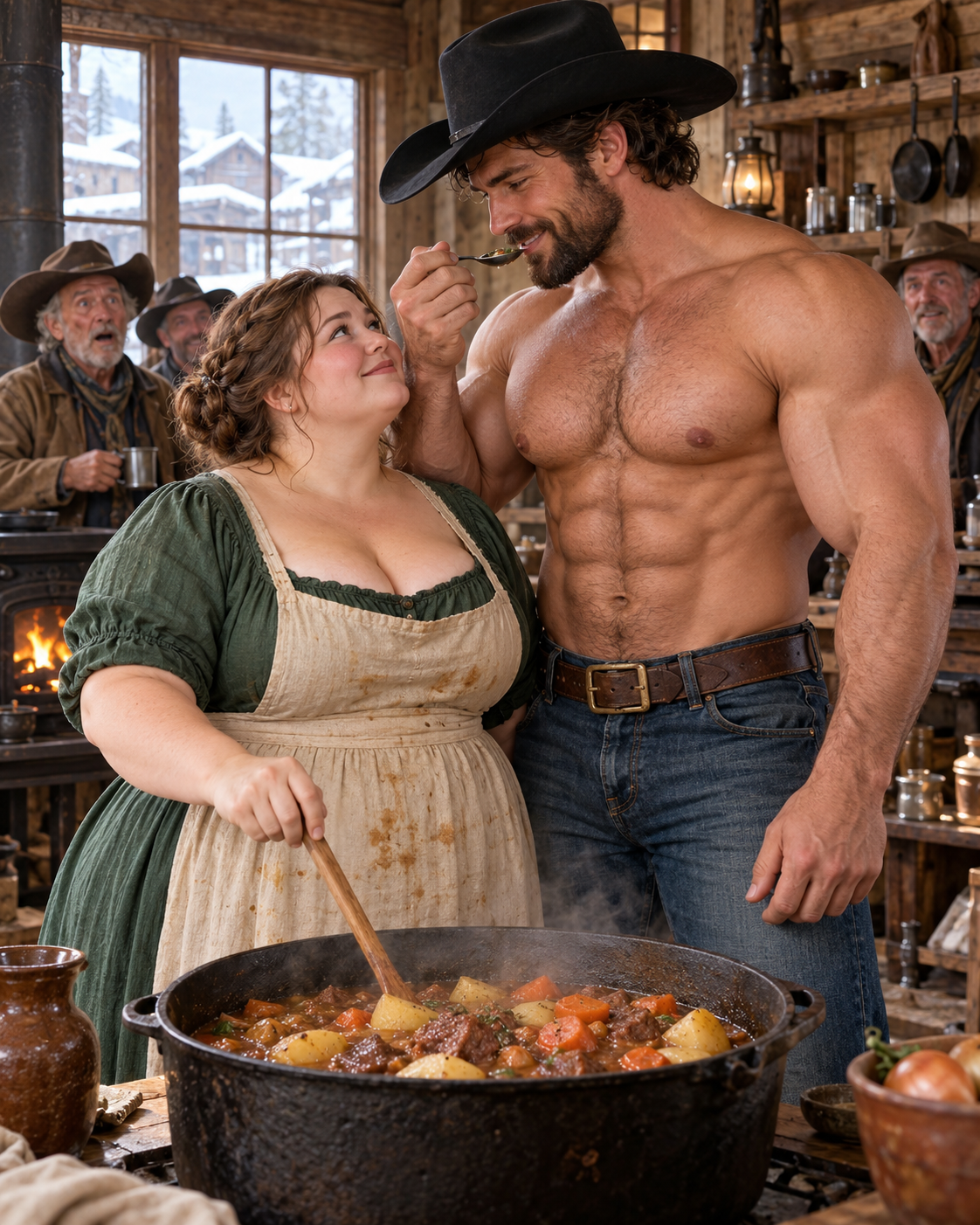
Caleb walked toward me and tasted a spoonful from the pot.
He smiled.
“Perfect, Anna.”
Two simple words.
Just like the two words he had spoken on the day he defended me.
But this time, I didn’t need anyone to silence the room.
I knew who I was.
I knew where I belonged.
And I finally understood that dignity is not something another person can hand you.
It is something you possess even when the world refuses to recognize it.
Cruel people may try to make you feel small.
Fearful people may hide the truth.
Even those who love you may make painful mistakes.
But none of them gets to decide your worth.
That night, after everyone had gone to bed, I stood alone in the kitchen and placed my mother’s photograph beside the stove.
Her smile looked brighter in the warm light.
For thirty-two years, I had believed my story began with tragedy.
Now I understood that it had begun with love.
And although the past had stolen so much from us, it had not taken everything.
My mother’s courage had survived in a letter.
My father’s honesty had survived in a forgotten statement.
My grandmother’s love had survived in every meal she taught me to cook.
And somehow, against everything that had tried to destroy us, I had survived too.
I touched the silver necklace around my neck and whispered, “I’m home, Mom.”
Then I turned off the kitchen lights, leaving one small lamp burning beside her photograph.
Because some people spend their whole lives searching for a place where they are finally accepted.
And sometimes, after years of heartbreak, that place is waiting behind the very door they were once afraid to open.
THE END.