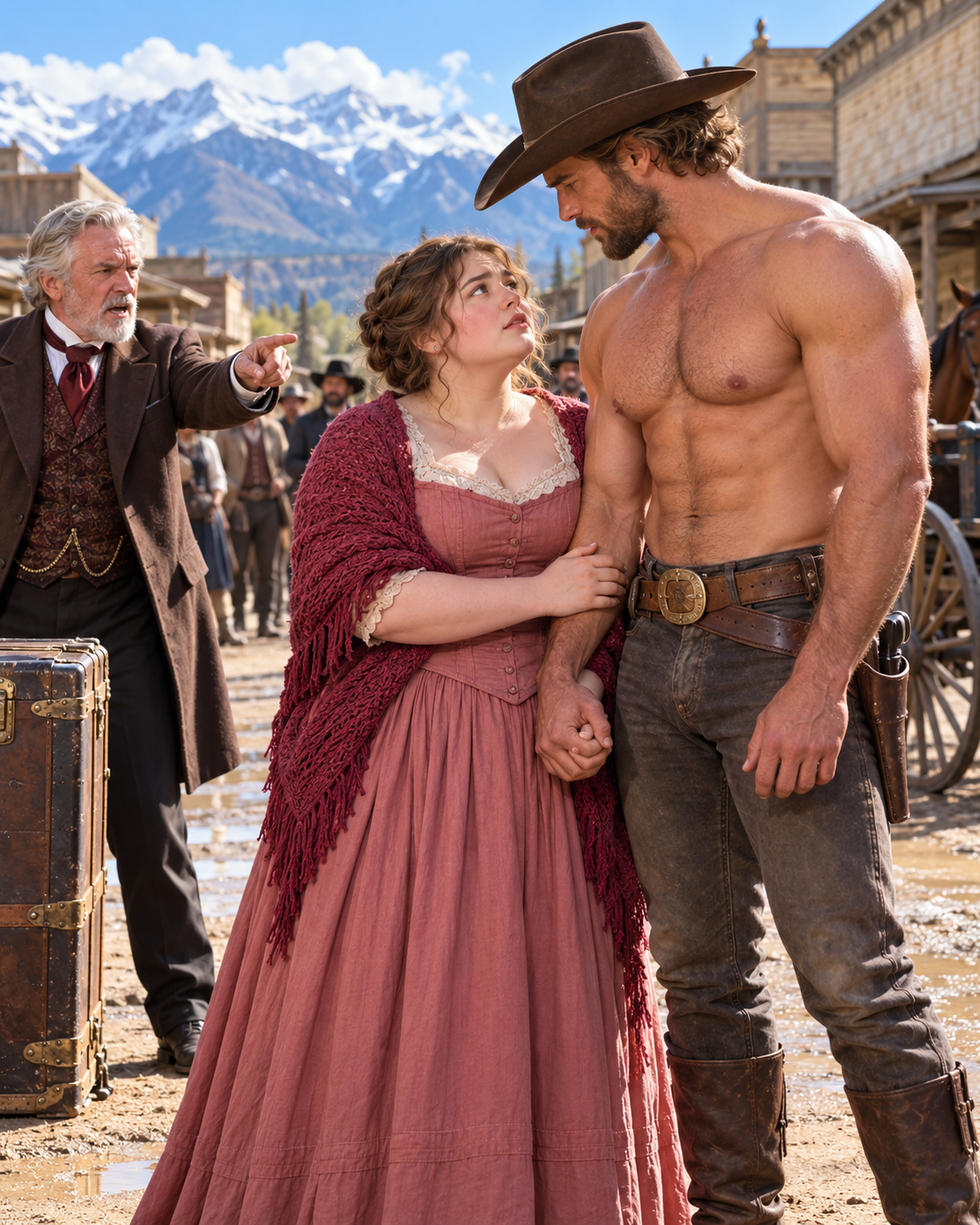
My father left me standing outside the general store in Black Pine, Montana, with one battered suitcase and a debt I hadn’t known existed.
I picked up my pen and began to write.
For several minutes, the only sounds in the kitchen were the scratching of my pen and the soft crackling of the fire. Outside, snow drifted against the windows, and the first pale light of morning rested on the frozen pasture.
George sat across from me, drinking his coffee without asking what I intended to say.
That was one of the things I had come to appreciate about him. He never mistook silence for permission to make decisions on my behalf.
I wrote three sentences, crossed out two, and started again.
Dear Father,
I am relieved to hear that you have found employment. I hope you will make something good of this opportunity. But I cannot send you money, and I will not ask Mr. Bellamy to forgive a debt that belongs to you.
My hand stopped.
The words looked harsher on paper than they had sounded in my head.
I remembered my father teaching me to ride when I was eight, holding the reins while I bounced nervously on an old brown mare. I remembered the winter he carried me home through deep snow after I’d twisted my ankle.
There had been good memories. That was what made the bad ones so difficult to accept.
“Does refusing him make me ungrateful?” I asked.
George lowered his cup.
“Grateful for what?”
“For raising me.”
He considered that.
“Did he feed you when you were little?”
“Of course.”
“Did he give you a roof?”
“Yes.”
“Those were his responsibilities, Helen. Not loans he gets to collect when you’re grown.”
I stared at him.
Nobody had ever explained it quite that way.
I finished the letter, sealed it, and placed it inside the envelope without money.
The fifty dollars went back into the little wooden box beneath my bed.
For the first time, I had told my father no.
And I was terrified of what would happen next.
The next two weeks passed quietly enough that I almost began to believe Edwin would accept my decision.
The snow grew deeper. The men brought cattle down from the higher pastures, and I helped George prepare a new system for recording feed supplies.
One afternoon, while comparing the previous year’s winter expenses, I noticed something unusual.
The ranch had purchased nearly a hundred sacks of grain from a merchant in Black Pine, but only seventy-eight were recorded as delivered.
I checked the freight receipts twice.
Then I checked the stablemaster’s notes.
Twenty-two sacks were missing.
When I showed George, he frowned.
“Could’ve been an error.”
“Twenty-two sacks is an expensive error.”
That earned me one of his rare smiles.
He brought the matter to his foreman, Thomas Reed, a gray-haired man who had worked the ranch for fifteen years.
Thomas scratched his beard.
“We’ve had shortages before. Figured the supplier was cheating us.”
“Then perhaps we should count the deliveries before paying for them,” I suggested.
Thomas looked at George.
George looked at me.
“She’s right,” George said.
From then on, every delivery was counted, signed for, and entered into a single ledger.
Some of the younger hands teased that I was more frightening with a pencil than George was with a rifle.
I took it as a compliment.
Little by little, the ranch began to feel like home.
I learned which floorboard creaked outside the pantry. I knew that Thomas preferred his biscuits slightly burned and that Samuel, whose wrist had healed, secretly saved the sweetest apples for the horses.
I learned that George disliked onions, loved fresh bread, and sometimes stood outside at sunset looking toward the mountains with an expression I couldn’t quite understand.
But I also learned something else.
George Bellamy could endure almost anything except the thought of disappointing someone who trusted him.
One evening, I found him sitting at the dining table with a letter in his hand.
He quickly folded it when I entered.
“Something wrong?” I asked.
“Just business.”
He smiled, but it didn’t reach his eyes.
I didn’t press him.
Respect, I was learning, meant allowing another person some privacy even when you cared about them.
Three days before Christmas, my father arrived.
I heard the wagon before I saw it.
The wheels rattled over frozen ground, followed by the sharp voice I would have recognized anywhere.
“Where’s Bellamy? Tell him Edwin Foster’s here.”
I was kneading bread when Thomas appeared in the kitchen doorway.
“Miss Helen,” he said carefully, “there’s a gentleman outside asking for you.”
I wiped my hands on my apron.
My father stood in the yard wearing a thin coat and an expression of wounded indignation.
He looked older than I remembered.
His cheeks were hollow, and his boots had split along the sides.
For one painful second, all I wanted was to bring him inside, sit him beside the fire, and feed him.
Then he opened his mouth.
“So this is where you’ve been hiding.”
The tenderness vanished.
“Hello, Father.”
He looked me up and down.
“You’ve grown comfortable.”
“I’ve been working.”
“Working?” He gave a bitter laugh. “In a house like this? With Bellamy paying for everything?”
“My wages pay for my labor.”
“Your wages should be helping your family.”
I felt several ranch hands watching from near the barn.
“Please lower your voice.”
“I’ll speak however I please to my own daughter.”
The familiar shame rose in my chest.
For twenty-six years, that tone had been enough to make me apologize, even when I hadn’t done anything wrong.
But I wasn’t standing in his kitchen anymore.
And I wasn’t eight years old.
“What do you want, Father?”
“Fifty dollars. And I want Bellamy to stop hounding me about that debt.”
“George hasn’t been hounding you.”
Father blinked at my use of George’s first name.
Then his expression changed.
“Well, well. So that’s how it is.”
Heat rushed into my cheeks.
“Don’t.”
“Does he intend to marry you? Is that what you’ve been promised?”
“That is none of your business.”
He stepped closer.
“You watch yourself, Helen. Men like Bellamy don’t marry women they take in out of pity.”
The words struck exactly where he meant them to.
For a moment, I was the girl who had stood beside the church door while two young women whispered about my broad hips and rounded face.
I remembered the dresses I had altered to make myself less noticeable.
The dinners I’d skipped because Father said a woman my size shouldn’t ask for seconds.
And now he was standing in front of the first home where I’d ever felt welcome, trying to make me ashamed of myself again.
“That’s enough.”
George’s voice came from behind me.
He had crossed the yard without either of us noticing.
My father straightened.
“Bellamy. Good. We have business.”
“We do,” George replied. “And it doesn’t involve speaking to Helen that way.”
Father laughed nervously.
“I’m her father.”
“Then act like one.”
Silence settled over the yard.
My father looked from George to me, searching for the obedience he had always been able to summon.
“Helen, get your things. You’re coming with me.”
My heart hammered.
George didn’t move.
He didn’t put a hand on my shoulder or step between us.
He simply waited.
I understood why.
This was my choice to make.
“No, Father.”
He stared at me.
“What?”
“I’m not coming.”
“You’d turn your back on your own blood?”
“I’m not turning my back on you. I’m refusing to go back to the way things were.”
His face darkened.
“After everything I’ve done for you?”
I took a breath.
“You gave me a home when I was a child. I worked to help keep it when I was grown. I loved you through every broken promise. But I cannot spend the rest of my life paying for your mistakes.”
For a moment, something fragile flickered in his expression.
Then anger covered it.
“You’ll regret this.”
“Maybe,” I whispered. “But it will still be my decision.”
Father turned toward George.
“She’s your problem now.”
George’s jaw tightened.
“She isn’t a problem, Foster.”
My father climbed into his wagon.
He didn’t say goodbye.
I watched him drive away through the snow, and when the wagon disappeared around the trees, my knees nearly gave way.
George stepped closer.
“Would you like to go inside?”
I nodded.
He walked beside me without touching me.
Only when we reached the kitchen did I begin to cry.
I expected him to leave, embarrassed by my tears.
Instead, he pulled out a chair, placed a clean handkerchief beside my elbow, and set another log on the fire.
“I’m sorry,” I whispered.
“What for?”
“For making such a scene.”
He turned toward me.
“Helen, you stood up to someone you’ve been afraid of your entire life. That’s not a scene.”
I covered my face.
“I still love him.”
“I know.”
“And I hate that I do.”
George sat across from me.
“You don’t have to hate him to protect yourself.”
Those words stayed with me long after the fire had burned low.
Christmas arrived beneath a clear, bitterly cold sky.
The ranch hands decorated the dining room with pine branches. Samuel carved a little wooden horse for Thomas’s youngest grandson, and I spent most of Christmas Eve making pies.
George disappeared into town two days earlier and returned with a mysterious package he refused to discuss.
At supper, the men exchanged small gifts and told stories that became increasingly ridiculous as the evening progressed.
When the others finally wandered toward the bunkhouse, George remained beside the fireplace.
“I have something for you,” he said.
He handed me a narrow wooden box.
Inside lay a beautiful fountain pen with a dark polished barrel and a silver-colored cap.
I was speechless.
“I noticed you kept repairing that old pen,” he explained. “Thought you might like one that worked properly.”
I touched the pen carefully.
No man had ever given me something because he had noticed what I needed.
“George, it’s wonderful.”
He looked almost embarrassed.
“It’s only a pen.”
“No,” I said softly. “It isn’t.”
I wanted to reach for his hand.
For a moment, I thought he wanted the same thing.
Instead, he wished me a merry Christmas and went upstairs.
I remained beside the fireplace, holding the little box against my chest.
The new year brought harder weather.
A January storm swept down from the mountains with such force that the barn doors shook on their hinges.
For two days, snow fell without stopping.
By the third morning, Thomas discovered that a section of fencing near the north ravine had collapsed, leaving a small herd exposed.
George and four hands rode out before sunrise.
I watched them disappear into the white distance with an uneasiness I couldn’t explain.
By noon, the wind had worsened.
By three o’clock, two riders returned.
George wasn’t with them.
“Where is he?” I demanded.
Thomas climbed stiffly from his horse, his face gray with exhaustion.
“One of the younger hands got separated. George went after him.”
“Who?”
“Caleb.”
Caleb was barely nineteen.
He’d come to the ranch the previous autumn and still wrote his mother every Sunday.
I looked toward the mountains.
“How long ago?”
“Nearly two hours.”
Thomas tried to organize another search, but the horses were exhausted and the visibility was almost gone.
Then I remembered the supply maps.
Weeks earlier, while reorganizing the ranch records, I had found an old survey showing abandoned line cabins scattered across the northern grazing range.
One stood less than two miles from the ravine.
“Thomas,” I said, “does George know about the old Miller cabin?”
He frowned.
“Of course. But nobody’s used it in years.”
“Is the roof still sound?”
“Last I heard.”
I hurried to the office and pulled the survey from the cabinet.
“If George found Caleb, he’d look for shelter. He wouldn’t try to cross the ridge in this weather.”
Thomas studied the map.
Then he pointed toward a narrow valley.
“There’s a lower trail here.”
“Could you reach it?”
He hesitated.
“Maybe.”
I folded the map.
“Then that’s where we look.”
Thomas took two men and the strongest horses.
I wanted to go, but he refused.
“We need you here, Miss Helen. Keep the fires burning and prepare the sickroom.”
So I did.
I heated water, laid out blankets, and checked the medical supplies.
Then I waited.
Every minute seemed to stretch into an hour.
By darkness, the wind had weakened.
I stood at the kitchen window, staring into the night.
At last, a lantern appeared beyond the barn.
Then another.
I ran outside without remembering my coat.
The riders emerged from the storm, their horses staggering with exhaustion.
George was among them.
But he wasn’t sitting upright.
Thomas and Samuel were supporting him between their horses.
“His leg!” Thomas shouted. “Get blankets!”
I hurried forward.
George’s face was pale, and there was blood frozen along the side of his trousers.
“George?”
He opened his eyes.
“Helen?”
“I’m here.”
“Caleb?”
“He’s safe,” Thomas answered. “We found him at the cabin.”
George closed his eyes again.
I had never been so frightened.
We carried him inside and sent for the doctor as soon as the road became passable.
Until then, I cleaned the wound and kept him warm.
A fallen branch had struck his leg while he was helping Caleb reach shelter. The injury was deep, but the bone appeared unbroken.
For three days, George remained in bed with a fever.
I barely slept.
I sat beside him through the long nights, changing cool cloths and listening to his breathing.
Sometimes he spoke in his sleep.
Once, just before dawn, he whispered my name.
I leaned closer.
“I’m here.”
His hand moved across the blanket, searching.
I took it.
Even half-conscious, his fingers closed gently around mine.
That was when I finally admitted the truth to myself.
I wasn’t simply grateful to George Bellamy.
I loved him.
And the thought of losing him made the world seem impossibly empty.
By the fourth morning, his fever broke.
He woke to find me asleep in a chair beside the bed, still holding his hand.
“Helen?”
I opened my eyes.
He was watching me.
“You’re awake.”
“Apparently.”
I laughed, then unexpectedly began to cry.
His expression changed.
“Did something happen?”
“You nearly died, you stubborn man.”
He looked down at our joined hands.
“I’m sorry.”
“You should be.”
His thumb brushed lightly across my knuckles.
“Did Caleb make it home?”
“Yes. His mother sent a letter thanking you.”
“Good.”
I shook my head.
“Is that all you can say?”
“What would you like me to say?”
I looked at him for a long moment.
“That you’ll stop behaving as though everyone else’s life matters more than yours.”
His expression softened.
“I never said my life didn’t matter.”
“Then start acting like it.”
He held my gaze.
“Does it matter to you?”
The room grew very quiet.
“More than you know.”
For one breathless moment, I thought he would say something that might change everything.
Then footsteps sounded in the hallway, and the doctor entered.
Whatever George had been about to say remained unspoken.
His recovery took several weeks.
During that time, I managed the household, oversaw supply orders, and helped Thomas keep the ranch accounts current.
George protested at first.
Then one afternoon, while reviewing the figures I’d prepared, he raised his eyebrows.
“You saved us nearly two hundred dollars this quarter.”
“Two hundred and sixteen,” I corrected.
He smiled.
“Of course.”
For the first time, I allowed myself to imagine a future in which I wasn’t merely employed at Bellamy Ranch.
A future where I belonged there because someone wanted me beside him.
But I was afraid to hope too much.
George had never spoken of marriage.
And I knew how easily gratitude could be mistaken for affection.
One afternoon in March, a letter arrived from a lawyer in Helena.
It was addressed to me.
I opened it with trembling hands.
My father had been arrested after attempting to obtain money using a fraudulent promissory note.
The letter explained that Edwin had named me as someone who might help settle the matter.
There was also a short message in his own handwriting.
Helen, I have nowhere else to turn. Please don’t abandon me.
I sat at the kitchen table for a long time.
Then I carried the letter to George’s office.
He was standing beside the window, leaning on a cane while his leg continued to heal.
I handed him the paper.
He read it carefully.
“What do you want to do?” he asked.
“I don’t know.”
“Would you like me to contact the lawyer?”
“Would you?”
“Of course.”
I hesitated.
“George, if I help him again, will you think less of me?”
He looked genuinely startled.
“Why would I?”
“Because everyone can see what he’s done.”
George folded the letter.
“Helen, kindness isn’t foolishness. But neither is saying no.”
I looked at the fire.
“What if he has changed?”
“Then he’ll have to prove it through his actions.”
“And if he hasn’t?”
“Then your life still belongs to you.”
The next morning, I wrote to the lawyer.
I would not assume my father’s debt or provide money to settle the accusation. I would, however, be willing to receive a letter from Edwin if he wished to explain himself honestly.
It was the hardest decision I’d made since arriving at the ranch.
Two weeks later, a reply came.
My father had admitted that he had signed the note without authority. The lawyer said the matter would proceed through the courts, but Edwin’s acknowledgment had helped clarify the facts.
Enclosed was a letter.
For once, there were no demands.
Father wrote that he had spent years blaming everyone else for his failures. He admitted that he had treated me cruelly and used my loyalty to protect himself from consequences.
He didn’t ask for forgiveness.
He simply said he was ashamed.
I read the letter three times.
Then I put it away.
I wasn’t ready to answer.
Spring began to soften the hills.
The snow melted into streams, and the first green shoots appeared in the pasture.
George’s leg grew stronger. He resumed riding short distances, though Thomas made certain he didn’t overdo it.
One evening, I found him standing on the porch, watching the sunset.
“Beautiful night,” I said.
He turned.
“It is.”
I stood beside him.
Below us, the ranch stretched toward the mountains, peaceful beneath the fading light.
“George?”
“Hmm?”
“Do you ever wish things had happened differently?”
He took his time answering.
“Some things.”
“Like what?”
“I wish I’d never done business with your father.”
I looked down.
“Oh.”
He turned toward me.
“Not because of you.”
“Then why?”
“Because I hate that the worst day of your life became the day I was fortunate enough to meet you.”
My breath caught.
George stared out across the pasture.
“I’ve wanted to tell you something for months.”
My heart began to pound.
He took off his hat.
“When you first came here, I thought you were a woman who needed a place to rest. Then you took hold of this entire ranch and made it better than I ever managed.”
I smiled faintly.
“You weren’t doing terribly.”
“I was doing terribly.”
I laughed.
He looked at me then, with an openness I’d never seen before.
“Helen, you’ve become the person I look for when I come home. When something good happens, I want to tell you. When something goes wrong, I want to hear what you think.”
He swallowed.
“I don’t know when that happened. I only know it did.”
Tears filled my eyes.
“George…”
“But I need you to understand something.”
His voice grew serious.
“You’re employed here, and I own this ranch. I won’t put you in a position where you feel you have to return my feelings to keep your home.”
He reached into his coat and withdrew a folded paper.
It was a letter of recommendation.
He had written it himself, describing my work, my honesty, and my ability to manage a large household and complex accounts.
“Thomas knows a family near Bozeman looking for someone with your skills,” he explained. “If you’d rather go, I’ll help you make arrangements.”
I stared at the paper.
For a moment, I thought he was sending me away.
Then I understood.
He was giving me a choice.
Again.
“You would let me leave?”
His smile was sad.
“I’d hate every mile between us. But yes.”
I stepped closer.
“And if I don’t want to leave?”
He looked at me.
“Then I’d be a very happy man.”
I reached for his hand.
“George Bellamy, you are the most frustrating man I’ve ever met.”
His eyebrows rose.
“Am I?”
“You spend months making me feel safe, then offer to send me away just when I’ve finally found somewhere I want to stay.”
His face changed.
“Helen, are you saying—”
“I’m saying I love you.”
The words came out in a rush.
I hadn’t planned them.
I hadn’t rehearsed them.
But once spoken, they felt truer than anything I’d ever said.
George stood perfectly still.
Then he took both my hands.
“Would you mind saying that again?”
I laughed through my tears.
“I love you.”
He lowered his forehead gently against mine.
“Thank God.”
I smiled.
“Is that your answer?”
“No.”
He pulled back just enough to look into my eyes.
“My answer is that I love you, Helen Foster. I’ve loved you for longer than I’ve had the courage to admit.”
Then, very carefully, he kissed me.
It wasn’t a dramatic kiss.
There were no witnesses, no grand declarations, no applause.
Just a quiet porch, the smell of spring earth, and a man who had never once asked me to become someone else.
And it was everything.
We didn’t marry immediately.
That surprised nearly everyone.
Thomas grumbled that George was a fool for waiting, while Samuel insisted the ranch had never looked more like a proper home.
But George and I agreed that we wanted time.
I continued working, receiving my wages and keeping my own savings.
We walked together in the evenings, talked about the future, and learned the ordinary things that love alone doesn’t teach.
We learned how to disagree without trying to wound each other.
We learned that George worried in silence, while I sometimes worked too hard because resting still made me feel guilty.
We learned that tenderness was not simply holding hands beside a fire.
Sometimes it meant telling the truth when the truth was uncomfortable.
In June, another letter arrived from my father.
He had been sentenced for his offense and was serving his punishment. His letter was brief.
He wrote that he had begun working in the prison workshop and hoped to earn an honest living when he was released.
He asked whether I might someday be willing to speak with him.
I held the letter for a long time.
Then I wrote back.
I told him I hoped he would continue changing.
I told him that I could not pretend the past had never happened.
And I told him that forgiveness, if it came, would take time.
It was not the answer he might have wanted.
But it was an honest one.
That autumn, George asked me to marry him.
He did it in the kitchen while I was measuring flour.
There was no elaborate speech.
He simply stood beside the table, looking unusually nervous, and said, “Helen, would you consider spending the rest of your life with me?”
I turned around, flour covering my hands.
“Are you asking because you need someone to manage the accounts?”
He grinned.
“That’s certainly one advantage.”
I raised an eyebrow.
He quickly added, “But mostly because I can’t imagine a good life that doesn’t include you.”
I laughed.
Then I said yes.
We married in the little church in Black Pine on a clear October morning.
Thomas stood beside George, Samuel carried flowers, and half the town seemed determined to attend.
I wore a simple ivory dress with lace at the sleeves.
For once, I didn’t worry whether the fabric made me look too broad or too round.
When I walked down the aisle, George looked at me as though I were the most beautiful sight he’d ever seen.
And for the first time in my life, I believed a man could look at me that way without pretending.
My father wasn’t there.
I had considered inviting him, but circumstances made his attendance impossible, and I wasn’t certain I was ready to share that day with him even if it had been possible.
I felt sadness about that.
I also felt peace.
Both feelings were allowed.
After the ceremony, George and I returned to the ranch beneath a sky streaked with gold.
The men had decorated the porch with pine branches and autumn flowers.
There was music, laughter, and more food than anyone could reasonably eat.
Later, when the guests had gone and the house was quiet, I found George standing beside the fireplace.
He was holding the old ledger.
The one that had frightened me so badly months earlier.
“Remember this?” he asked.
I nodded.
He opened it to the page containing Edwin Foster’s name.
The original debt remained recorded, followed by the payments Father had made before his arrest.
George had made no effort to hide it.
“Why are you showing me this?”
“Because I want us to start our marriage without any unfinished misunderstanding between us.”
He placed the ledger on the table.
“The debt remains between your father and me. You’re not responsible for a penny of it. You never were.”
I looked at the page.
A year earlier, seeing my name connected to that debt had made me feel trapped.
Now it reminded me of the moment a stranger had refused to treat me as property.
George closed the ledger.
“There’s something else.”
He handed me a small document.
It was an agreement recognizing my independent savings and my continuing role in managing the ranch’s household finances, with compensation for that work clearly stated.
I stared at it.
“George, we’re married now.”
“I noticed.”
I laughed.
“Then why would you still pay me?”
“Because you still work.”
I looked up.
“And because I want you to have money that is yours,” he continued. “Not money you have to ask me for.”
I put the paper down.
Then I wrapped my arms around him.
For a long time, neither of us spoke.
The following years were not perfect.
There were harsh winters, sick cattle, disappointing harvests, and days when George and I argued over matters that seemed terribly important until supper.
There were times when my father’s letters reopened old wounds.
There were moments when I wondered whether I had truly forgiven him, and others when I realized forgiveness didn’t have to mean giving him unlimited access to my life.
Eventually, after his release, Edwin found steady work with a carpenter in Helena.
He wrote regularly.
At first, I answered only occasionally.
Later, I agreed to meet him in Black Pine.
George offered to accompany me.
I asked him to wait nearby instead.
My father looked thinner and older than I’d imagined.
When he saw me, he removed his hat.
“Helen,” he said quietly.
“Hello, Father.”
His eyes filled with tears.
“I’m sorry.”
I waited.
He didn’t make excuses.
He didn’t ask for money.
He didn’t tell me I owed him anything.
He simply apologized for the ways he had failed me.
I listened.
Then I told him the truth.
“I loved you even when you made me feel worthless. But I won’t ever live that way again.”
He nodded.
“I know.”
We spoke for nearly an hour.
When we parted, I allowed him to embrace me.
It wasn’t a perfect reconciliation.
I didn’t suddenly trust him with everything.
But for the first time, I saw a possibility of knowing my father without being responsible for saving him.
And that was enough for one day.
When I returned to the wagon, George was waiting.
“How was it?” he asked.
“Hard.”
He nodded.
“Would you like to talk?”
“Not yet.”
“All right.”
He helped me into the wagon and took the reins.
Halfway home, I rested my head against his shoulder.
“George?”
“Yes, sweetheart?”
“Do you remember the day we met?”
He smiled.
“I remember a woman standing outside the general store with a suitcase in one hand and enough courage in her eyes to frighten a regiment.”
I laughed.
“I was terrified.”
“I know.”
“I thought my life was over.”
He drew me a little closer.
“And now?”
I looked toward the mountains, where the late afternoon sunlight touched the highest peaks.
“Now I think it was only beginning.”
Years later, people in Black Pine still told the story of the day Edwin Foster tried to settle a debt by giving away his daughter.
Some told it as a romance.
Others told it as proof that George Bellamy was an unusually honorable man.
But when people asked me about that day, I always corrected one small detail.
George hadn’t saved me by taking me home.
He had saved me from an impossible bargain by refusing to make it.
Everything afterward, the work, the friendships, the love, and the life we built together, grew from the freedom of being allowed to choose.
I had arrived at Bellamy Ranch believing that my value depended on how useful I could make myself to other people.
I spent years learning something different.
I was worthy of respect before I cooked a single meal, balanced a single ledger, or earned a single dollar.
And I was worthy of love before a man ever noticed me.
George never asked me to be smaller, quieter, prettier, or easier to please.
He simply made room for me to be myself.
In return, I learned to love him not because I needed rescuing, but because we were better together.
That became the foundation of our marriage.
Not debt.
Not obligation.
Not fear of being left behind.
Choice.
And on the evenings when the ranch was quiet, when the kitchen smelled of fresh bread and the mountains turned purple beneath the setting sun, George would sometimes find me sitting at the old dining table with my accounts spread around me.
He’d lean against the doorway and ask, “Miss Foster, are you quite certain you want to stay?”
Even after years of marriage, he occasionally called me Miss Foster just to make me smile.
And I would look up at the man who had once given me a choice when everyone else seemed determined to take mine away.
“Yes, Mr. Bellamy,” I’d answer. “I’m certain.”
Because the greatest love I ever knew was not the kind that claimed me, purchased me, or demanded that I prove my worth.
It was the kind that opened a door, stepped aside, and trusted me to decide whether I wanted to walk through it.
And every day, in a hundred ordinary ways, we continued choosing each other.