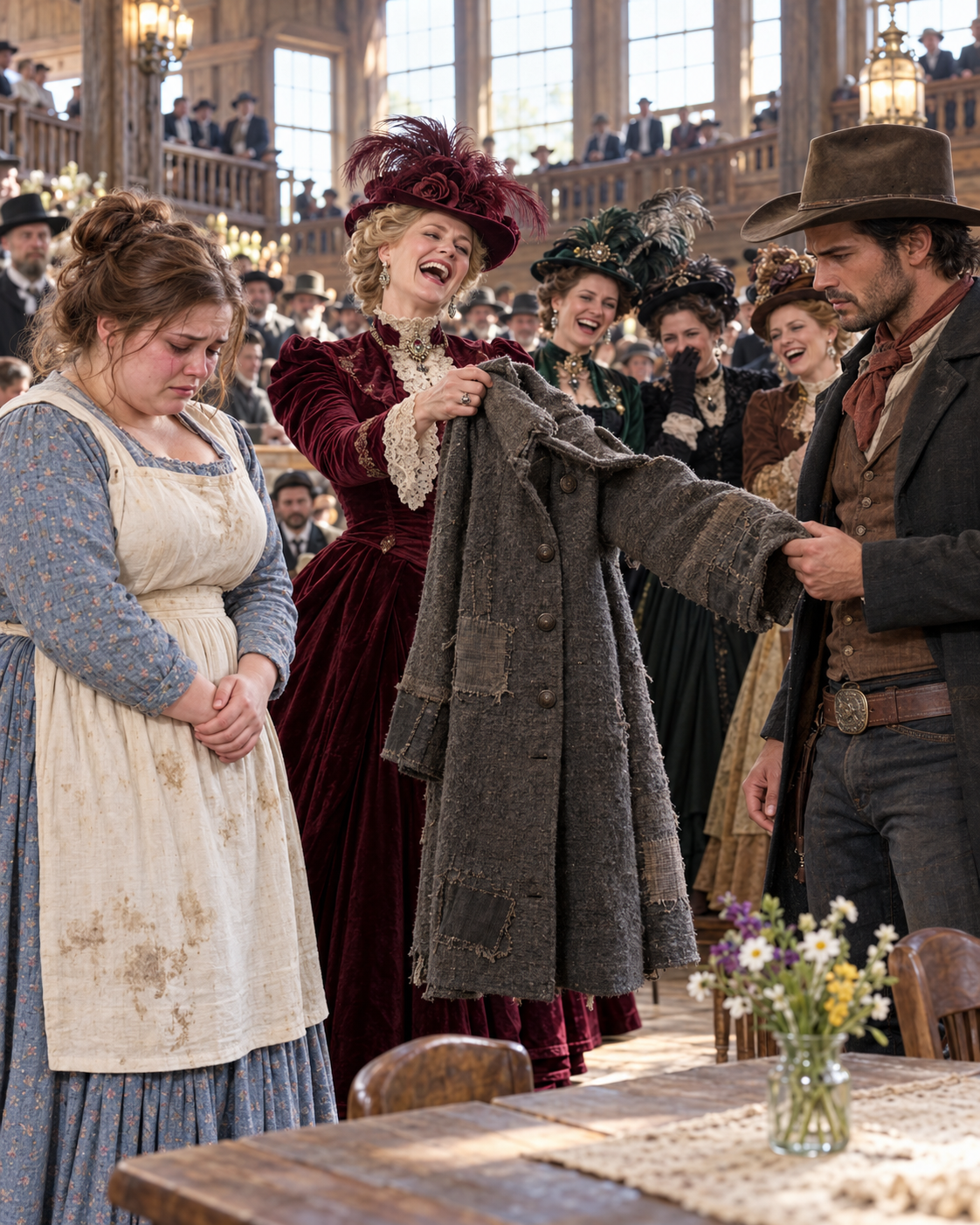
Lenora Voss held up my oversized winter coat in front of the entire town and laughed. “Who on earth would need a coat this big?
There was no evidence that she had written the anonymous notes, and I knew better than to accuse her without proof.
But the signed complaint was enough to raise questions about whether my application had been handled fairly.
The committee voted to reconsider it without Lenora participating.
By a narrow majority, my membership was approved.
I should have felt triumphant.
Instead, I felt exhausted.
I walked outside with Clara, holding the approval letter so tightly that its edges bent.
Across the street, Lenora stood outside her shop.
For once, she wasn’t smiling.
That evening, Gideon visited with another offer.
He wanted me to supply winter workwear for neighboring ranches, which could guarantee orders for several seasons.
But I would need more equipment, additional employees, and a larger workshop.
He offered to advance enough money to help me expand, with repayment arranged through future orders.
It was a generous proposal.
It was also a frightening one.
I’d spent years struggling to survive on whatever work came through my door. Now I had to decide whether to risk everything I’d saved on a business that might finally become something substantial.
The next morning, Lenora appeared alone at my workshop.
She looked tired, and she carried no envelope.
“I understand you’re considering expanding,” she said.
“Yes.”
Her eyes moved toward the sewing machines.
“My shop has been losing customers. I may have to dismiss two seamstresses before Christmas.”
I didn’t know what to say.
Then she made an unexpected request.
“Would you consider hiring them if I can’t keep them employed?”
I studied her face.
She hadn’t apologized for the exhibition. She hadn’t acknowledged how her complaint had harmed me.
But the two women she mentioned had never done me any wrong.
One had three children. The other cared for an elderly mother.
I could refuse and allow Lenora to face the consequences of losing business.
Or I could take on two more employees when I wasn’t even certain I could afford the expansion myself.
“I won’t make promises I can’t keep,” I told her. “But if your seamstresses need work, they’re welcome to speak with me directly.”
Lenora looked down.
“Thank you.”
After she left, Clara asked whether I had lost my senses.
“She’s been trying to destroy you for months.”
“I know.”
“And you’re willing to help the women working for her?”
I looked around the little workshop my father would never get to see.
“Yes,” I said. “Because they aren’t the ones who tried to destroy me.”
That afternoon, I placed Gideon’s proposed contract beside my account books.
I had enough money to remain comfortable if I kept my business small. Expanding meant debt, responsibility, and the possibility of failing in front of the very town that had once laughed at me.
But staying small meant turning away customers and opportunities I’d worked years to earn.
I picked up my pen and began calculating what it would truly cost to give five women, including myself, a reliable living.
I hadn’t made my final decision. I still needed to negotiate the contract, inspect a larger workshop, and speak with the women whose livelihoods might depend on mine.
For the first time, though, I wasn’t asking whether I deserved the opportunity.
I was asking whether I could build something strong enough to last.
And that question deserved more than a frightened answer.
The first thing I did was turn Gideon Thorne’s contract facedown on my kitchen table. Not because I doubted his intentions, but because the numbers I’d written beside it frightened me more than Lenora Voss ever had.
Five women. Three sewing machines. A rented workshop. Enough wool to outfit forty ranch hands before the first heavy snow.
And if I miscalculated by even a few dollars, I could lose everything I’d spent years building.
Clara Bennett stood across from me, holding a cup of coffee that had gone cold.
“You’re going to do it, aren’t you?”
“I haven’t decided.”
“You’ve been adding those figures since breakfast, Maybelline. You know exactly what you want.”
I looked at the account book. She was right about what I wanted. I wanted a business large enough to provide steady wages, including my own. What I didn’t know was whether wanting something badly enough made it wise.
My father had taught me that a seam could look beautiful from the outside while coming apart underneath. Before sewing anything important, he’d turn the fabric over and examine the hidden stitches.
I decided that was how I would approach Gideon’s offer.
The following morning, I went to the bank.
Mr. Ellsworth, the bank manager, had known me since I was a girl. He had also rejected my request for a small business loan two years earlier.
Back then, he’d explained that unmarried women without substantial property made uncertain borrowers.
This time, I brought contracts, receipts, my membership approval, and a complete record of my earnings.
He studied everything carefully.
“Your business has grown considerably, Miss Whitcomb.”
“Yes, sir.”
“But your proposed expansion would require a substantial commitment.”
“I understand.”
He tapped the contract.
“Mr. Thorne is willing to advance payment against future deliveries?”
“Yes.”
“Then why do you need additional financing?”
“Because I won’t put every dollar of his advance into machinery and leave myself unable to pay wages if a supplier delivers late.”
He raised his eyebrows.
I felt my cheeks warming.
“I’ve thought about this, Mr. Ellsworth.”
“I can see that.”
He finally offered me a modest loan, secured against the equipment I intended to purchase.
It wasn’t generous, and the interest made me uncomfortable. But the amount was manageable if the contracts proceeded as planned.
I left without signing.
For the first time in my life, I understood that being offered money didn’t mean I had to accept it immediately.
That afternoon, Gideon arrived at my workshop.
He found me sitting among fabric samples, comparing prices from three suppliers.
“Looks like you’re preparing for battle,” he remarked.
“In a manner of speaking.”
He took off his hat.
“Have you decided about my proposal?”
“I have conditions.”
His expression changed, though not unpleasantly.
“Then I’d better sit down.”
I explained that I wanted a written schedule of payments, a clear agreement about rejected garments, and protection against delays caused by severe weather.
I also wanted the right to accept orders from other customers.
Gideon listened without interrupting.
When I finished, he smiled.
“Those are sensible terms.”
“You aren’t offended?”
“Maybelline, if I wanted someone who agreed with everything I said, I wouldn’t be looking for a business partner.”
That word stayed with me.
Partner.
Not charity case. Not poor unfortunate woman. Not the oversized seamstress Lenora had mocked before the entire town.
A business partner.
We signed the revised agreement two days later.
I rented the empty building beside the blacksmith’s shop, ordered two additional sewing machines, and hired a carpenter to construct cutting tables.
Clara became my head assistant.
The two seamstresses from Lenora’s shop, Ruth Palmer and Edith Bell, came to interview the following Monday.
Both appeared nervous.
Ruth was a quiet woman in her forties whose husband had been injured in a logging accident. Edith, barely twenty-three, supported her widowed mother.
“Mrs. Voss says you might have work,” Ruth began.
“I do.”
“But she also said you might not be able to pay us regularly.”
I almost laughed at the irony.
Instead, I showed them my contracts and explained my wage schedule.
“I’ll pay every Saturday for work completed during the week. If business slows, I’ll tell you before making promises I can’t keep.”
Edith studied me.
“Would we be expected to work Sundays?”
“No. Not unless there’s an emergency, and even then, you’d have the choice.”
Ruth glanced at Edith.
“Mrs. Voss never gave us that choice.”
I didn’t ask what else Lenora had done.
I offered them both positions.
Three weeks later, Whitcomb’s Winter Garments opened its doors.
I had painted the name myself on a wooden sign, though the letters weren’t perfectly straight.
Clara said it gave the place character.
For a little while, everything went better than I dared imagine.
Orders arrived from ranchers in two neighboring counties. A freight company requested heavy driving coats. The schoolteacher asked whether we could make winter uniforms for several children whose families couldn’t afford expensive clothing.
We worked from morning until evening, sometimes laughing, sometimes arguing over measurements, always learning.
I discovered that managing people required a different sort of patience from sewing.
Ruth could construct a sleeve faster than anyone I’d ever met, but she refused to ask for help when something went wrong.
Edith was excellent with fine finishing, though she occasionally became distracted and cut fabric before checking the measurements twice.
Clara had the sharpest eye for mistakes, but her criticism could sting.
There were disagreements over schedules, misplaced scissors, uneven seams, and one unfortunate afternoon when a pot of coffee overturned onto a stack of paper patterns.
Yet every Saturday, when I placed their wages into their hands, I felt something I couldn’t explain.
Those envelopes represented more than money.
They meant four women could stand in a grocery store and purchase what their families needed without begging anyone for permission.
Then, in early November, the first disaster arrived.
A wagon carrying two bolts of expensive wool overturned while crossing a flooded creek.
The driver escaped without serious injury, but nearly half the shipment was soaked.
When the freight company finally delivered it, the fabric smelled of muddy water.
I knew immediately that much of it might be ruined.
Clara spread the damaged wool across our cutting tables.
“Can we save it?”
“Some of it.”
“How much?”
I examined the discoloration along the edges.
“Not enough.”
We had twenty-six coats due within eighteen days.
Without that wool, we couldn’t finish them.
I sent a telegram to the supplier requesting replacement material.
Their reply came the following afternoon.
They would replace the shipment, but delivery would take at least three weeks.
Three weeks.
I stared at the message until the words blurred.
That evening, Gideon found me sitting alone in the workshop.
The women had gone home. One lamp burned beside the cutting table.
“Clara said something happened.”
I handed him the telegram.
He read it, then looked at the damaged wool.
“Can you use material from another supplier?”
“Not without changing the specifications.”
“Would that be a problem?”
“It would be dishonest if I did it without telling the customers.”
He nodded slowly.
“Then tell them.”
I looked up.
“Tell them what?”
“Exactly what happened. Give them the choice of waiting or accepting another fabric.”
“And if they cancel?”
“Then they cancel.”
I swallowed.
“That could ruin us.”
“Maybe. But delivering coats you know aren’t what people ordered could ruin you just as surely.”
He left me with that thought.
The next morning, I wrote to every affected customer.
Some agreed to wait. Others accepted alternative wool at a reduced price.
Three canceled their orders.
I refunded their deposits, although doing so emptied almost all the money I’d set aside for emergencies.
By Friday, I had enough cash to pay my employees.
Barely.
I slept poorly that night.
Then Saturday brought news that made the ruined shipment seem like a minor inconvenience.
Mr. Ellsworth summoned me to the bank.
He was standing behind his desk when I arrived, his expression unusually stiff.
“Miss Whitcomb, we’ve received information that your business may be facing serious financial difficulties.”
“Who told you that?”
“I’m not at liberty to say.”
“Is this about the damaged wool?”
“Among other matters.”
He opened a folder.
“Your loan agreement allows the bank to review its security if there’s reason to believe the business is at substantial risk.”
I felt the blood drain from my face.
“Are you demanding repayment?”
“Not at present. But we require updated accounts and confirmation that your principal contracts remain active.”
I asked him whether he had spoken with Gideon.
“No.”
“Then you’re relying on rumors.”
He avoided my eyes.
I went home furious.
By Monday, the gossip had reached the entire town.
Whitcomb’s Winter Garments was failing.
I had supposedly spent Gideon’s money foolishly.
Someone claimed my employees hadn’t been paid.
Another insisted that customers were demanding refunds because my coats were defective.
None of it was true.
But rumors didn’t need to be true to cause damage.
Two customers came to collect their unfinished garments. Another refused to pay his remaining balance until he could inspect every seam.
Clara confronted me after supper.
“This is Lenora.”
“We don’t know that.”
“Who else benefits?”
“That isn’t proof.”
“Sometimes proof is standing right in front of you.”
I understood her anger. I shared it.
But I’d spent too many years being judged by people who thought they already knew the truth.
I wouldn’t become one of them.
Instead, I gathered our records.
Every order, every payment, every returned deposit, every letter from the freight company.
I asked Gideon to confirm in writing that his contract remained valid.
Then I arranged a meeting with Mr. Ellsworth.
The following Tuesday, I returned to the bank carrying enough paperwork to fill a flour sack.
I spent nearly two hours explaining my finances.
At the end, Mr. Ellsworth removed his spectacles.
“Your records are unusually thorough.”
“My father taught me to count every stitch. I learned to count every dollar the same way.”
He almost smiled.
“The bank will not demand early repayment.”
Relief made my hands tremble.
“But Miss Whitcomb,” he added, “you should understand that someone has made repeated inquiries about your financial standing.”
“Someone?”
He hesitated.
“I cannot disclose private correspondence without authorization.”
I leaned forward.
“Then can you tell me whether any of those inquiries came from a person who owns a competing dressmaking business?”
His silence was answer enough to make me suspicious.
But still not enough to accuse anyone.
I returned to the workshop determined to keep working.
Three days later, however, Ruth arrived carrying a letter.
She looked close to tears.
“Maybelline, I need to show you something.”
The envelope contained an offer from Lenora Voss.
She was offering Ruth and Edith their former positions back, at higher wages than she’d ever paid them before.
There was one condition.
They had to return immediately, before my largest order was completed.
Clara read the letter and slammed it onto the table.
“She’s trying to leave us without workers.”
Ruth twisted her apron.
“I don’t want to go. But my husband’s medicine costs money, and she’s offering almost twice what I earned before.”
I felt a sharp pain beneath my ribs.
Not because Ruth might leave.
Because I understood why she was considering it.
For a moment, I wanted to remind her how Lenora had treated her.
But Ruth already knew.
She didn’t need guilt added to her troubles.
“Take the letter home,” I said. “Discuss it with your family.”
Ruth began crying.
“I’m sorry.”
“Don’t apologize for wanting to take care of your husband.”
That evening, Clara accused me of surrendering.
“We can’t finish those coats without Ruth.”
“I know.”
“Then why are you letting her leave?”
“Because she’s a person, Clara. Not a piece of equipment I purchased.”
Clara stared at me.
Then she sat down.
“I hate how frightened I am.”
“So do I.”
The next morning, Ruth returned.
She placed Lenora’s letter on my desk.
“I’ve decided to stay.”
I could hardly believe it.
“Why?”
“Because my husband reminded me of something.”
She wiped her eyes.
“When he was injured, Mrs. Voss reduced my hours. She said my family troubles weren’t her responsibility.”
I looked away.
“He told me higher wages don’t mean much if a person can take away your livelihood whenever they please.”
“Ruth, I can’t promise you’ll never face difficulties here.”
“I know.”
She smiled faintly.
“But at least you’ll tell me the truth.”
Edith chose to stay as well.
Yet their loyalty left me with another question.
Was I paying them fairly enough?
I examined our accounts and realized I could increase their wages modestly if I delayed purchasing a fourth sewing machine.
It would make our work harder for a while.
I made the decision anyway.
When I announced the raises, Clara shook her head.
“You’re going to be the death of your own profits.”
“Possibly.”
Then she smiled.
“But I suspect we’ll work faster knowing you value us.”
The next two weeks tested every bit of that loyalty.
We worked long days, rotating between machines and cutting tables, taking short breaks to rest our hands.
The repaired wool was used for smaller garments where the damaged sections could be discarded safely.
I sold the unusable remnants to a merchant who wanted stuffing material, making certain he understood their condition.
Nothing was wasted that could honestly be salvaged.
On the morning of our largest delivery, snow began falling before dawn.
By noon, the road toward Gideon’s ranch had disappeared beneath white drifts.
The men were supposed to collect their coats that afternoon.
Instead, a young ranch hand arrived on horseback, his face red with cold.
“Miss Whitcomb, Mr. Thorne sent me. We’ve got trouble.”
I followed him outside.
“What’s happened?”
“One of our supply teams hasn’t returned from the northern pasture. Four men went out yesterday. The storm caught them coming back.”
My stomach tightened.
“Are they lost?”
“We think they’re sheltering near the old line cabin. Mr. Thorne’s organizing a search.”
I looked toward the finished coats hanging inside.
They were the very garments those men had been waiting for.
“How many searchers?”
“Six, maybe eight.”
“Bring a wagon to my workshop.”
He blinked.
“What?”
“Bring a wagon. I’ll have coats ready.”
Within an hour, Clara, Ruth, Edith, and I had gathered every suitable garment we could spare.
Some were completed orders awaiting collection.
Others were samples and partially finished coats that required hurried alterations.
We worked with the kind of concentration that leaves no room for fear.
Clara reinforced buttons while Edith finished cuffs.
Ruth adjusted a coat for a particularly broad-shouldered rancher.
I packed spare wool mittens, scarves, and thick cloth wraps.
When Gideon arrived, snow clung to his beard and hat.
“Maybelline, I can’t take merchandise that belongs to your customers.”
“You’re not taking it permanently. You’re borrowing what may keep men warm enough to get home.”
“And if something gets ruined?”
“Then we’ll make another.”
He studied my face.
“You’ve already lost money this season.”
“I know.”
He didn’t argue further.
By late afternoon, the search party had departed.
The storm worsened.
Wind rattled the workshop windows so violently that Edith suggested boarding them shut.
We stayed together that night, feeding the stove and listening for horses.
Sometime after midnight, Clara fell asleep in a chair.
Ruth whispered prayers under her breath.
I sat at my sewing machine, repairing a torn sleeve simply because my hands needed something to do.
At dawn, we heard hoofbeats.
I rushed outside.
Gideon rode at the front of the returning party.
Behind him came a wagon carrying two exhausted men wrapped in blankets.
The other missing men followed on horseback.
All four were alive.
One had frostbite on several fingers. Another had injured his ankle. But they had survived the night inside the line cabin.
Gideon climbed down stiffly.
“They were nearly out of firewood,” he said. “Couldn’t have ridden through that weather in what they were wearing.”
He touched the thick coat he’d borrowed from the workshop.
“These helped us bring them back.”
I looked at the men climbing carefully from their horses.
Their faces were pale, their movements slow.
For the first time, I truly understood what my father’s lessons had meant.
A coat wasn’t merely fabric.
Sometimes it was the difference between enduring a winter night and never coming home.
Word spread quickly.
Within days, people who had laughed at my exhibition coat were coming into the workshop asking about reinforced shoulders and double-lined sleeves.
The local newspaper printed an account of the search, mentioning the clothing we’d supplied.
Orders began arriving faster than we could process them.
And then Lenora Voss walked through my door.
She came alone, without her usual gloves or carefully arranged hat.
Her face looked drawn.
“Maybelline, may I speak with you?”
Clara immediately rose from her chair.
“I think we’ve heard enough from Mrs. Voss.”
I touched Clara’s arm.
“It’s all right.”
Lenora glanced at the other women.
“In private, please.”
We went into my small office.
For several moments, she said nothing.
Then she reached into her handbag and placed a folded document on my desk.
It was a notice from the owner of her shop building.
She was behind on her rent.
If she couldn’t settle the balance within thirty days, she would have to leave.
“I thought you should know,” she said.
“Why?”
“Because you might be interested in purchasing my equipment.”
I stared at her.
“You’re closing?”
“I may have no choice.”
I had imagined this moment more times than I wanted to admit.
I’d pictured Lenora finally understanding what humiliation felt like.
I’d imagined telling her that she deserved everything happening to her.
But the woman standing before me wasn’t the triumphant figure who had mocked my coat.
She looked exhausted and frightened.
“What happened to your customers?” I asked.
“They went elsewhere.”
“All of them?”
“Enough.”
She swallowed.
“I’ve spent months trying to compete with you. I lowered my prices, offered credit I shouldn’t have offered, and purchased more fabric than I could sell.”
I waited.
“Some of those decisions were foolish.”
“Some were cruel,” I said quietly.
She looked down.
“Yes.”
The admission surprised me more than any insult she’d ever delivered.
“Did you send the anonymous notes?”
Lenora’s hands tightened around her handbag.
After a long silence, she nodded.
“Two of them.”
I felt suddenly cold.
“And the complaints about my finances?”
“I made inquiries. I also told people your business was failing.”
“Even after you knew it wasn’t?”
She didn’t answer.
I thought of the nights I’d lain awake worrying about paying wages.
The customers I’d nearly lost.
The shame I’d carried home from the exhibition hall.
“Why?”
Her eyes filled with tears.
“Because when people started choosing your work over mine, I thought it meant there was nothing valuable left about me.”
I stared at her.
“You tried to convince an entire town there was nothing valuable about me.”
“I know.”
“No, Lenora. I don’t think you do.”
She flinched.
I took a breath.
“You made me afraid to walk through town. You made my employees worry about their wages. You tried to damage a business that other families depend on.”
“I’m sorry.”
The words were quiet.
I wanted to believe them.
But an apology couldn’t erase unpaid bills or frightened workers.
“What are you asking me to do?” I said.
“Nothing. I came to offer the machines before they’re taken by the landlord.”
She rose.
At the door, she paused.
“Your father would have been proud of you.”
For some reason, that hurt more than anything else she’d said.
“Please don’t speak for my father.”
She nodded and left.
That evening, I told Clara everything.
She listened without interruption.
When I finished, she said, “You’re not thinking about saving her shop, are you?”
“I don’t know what I’m thinking.”
“Maybelline.”
“She has equipment we need.”
“So buy it at a fair price.”
“And the women who still work there?”
Clara sighed.
“You’re thinking about them.”
“Someone has to.”
The next morning, I visited Lenora’s shop.
It was quieter than I remembered.
Two seamstresses sat near the window, working on a mourning dress. Neither looked up when I entered.
Lenora stood behind the counter.
“I didn’t expect you.”
“I’ve come to discuss the equipment.”
She led me into the back room.
There were three machines, two pressing tables, and shelves filled with fabric.
All useful.
But I noticed something else.
A row of unfinished orders hung along the wall.
“Customers’ garments?”
She nodded.
“Some have been waiting for weeks.”
“Can you finish them?”
“Not all of them.”
I looked at the work.
Several dresses had delicate detailing I couldn’t have produced as efficiently as Lenora could. Her skill had never been in question.
Only what she’d chosen to do with it.
“I have a proposal,” I said.
She turned.
“I’ll purchase two machines at a fair price, provided your landlord confirms they’re yours to sell. I’ll also offer interviews to your employees.”
Her expression crumpled.
“And the unfinished orders?”
“If the customers agree, we can arrange to complete them. But the payments will be accounted for properly.”
“That’s more generous than I deserve.”
“I’m not offering this because you deserve it.”
I paused.
“I’m offering it because people shouldn’t lose their livelihoods simply because you and I have been enemies.”
Lenora began crying.
I didn’t embrace her.
I didn’t tell her everything was forgiven.
Some wounds needed time.
Others left scars.
But we began discussing the terms.
The arrangement wasn’t simple.
The landlord had a claim against some of Lenora’s equipment, so the purchase required his written approval.
Several customers wanted refunds rather than finished garments.
The two seamstresses were understandably hesitant to leave a shop they’d worked in for years.
There were difficult conversations and more paperwork than I could have imagined.
Eventually, we reached an agreement.
I purchased two machines, hired one additional seamstress, and accepted the unfinished orders of customers who wanted my workshop to complete them.
Lenora retained her finest machine and enough supplies to continue taking small alteration jobs from her home.
It wasn’t a miraculous rescue.
She still had debts to pay.
She still had a reputation to rebuild.
And I still had reasons not to trust her.
But the arrangement gave us both a chance to move forward without destroying each other.
By Christmas, Whitcomb’s Winter Garments employed five women.
We delivered every remaining winter coat, although several arrived later than originally promised.
The bank loan was current.
The workshop had enough orders to carry us into spring.
We weren’t wealthy.
There were mornings when the stove refused to draw properly, afternoons when machinery broke, and evenings when I worried about expenses.
But we were earning an honest living.
One Saturday, Gideon came to collect a new coat I’d made for him personally.
It was dark brown, lined with heavy wool, and fitted across his shoulders.
He tried it on before the mirror.
“Well?”
I adjusted the collar.
“It fits.”
He grinned.
“That’s all I get?”
“The stitching is straight, the shoulders are reinforced, and the sleeves should allow you to work without tearing them.”
“Sounds like a fine coat.”
“It is.”
He laughed.
Then he grew serious.
“Maybelline, I’ve been meaning to ask you something.”
I looked up.
“Would you let me take you to supper next Saturday?”
My fingers stopped moving.
For a moment, I was the woman at the exhibition again, painfully aware of my size, my appearance, and all the reasons people might laugh.
Then I remembered the contracts I’d negotiated, the women I’d hired, the nights I’d worked through fear, and the men who had returned safely from the mountains wearing garments I’d made.
I no longer wanted to measure myself by what strangers might think.
“Are you asking as a customer?” I said.
He smiled.
“No, ma’am.”
“Then I’d like that.”
We went to supper the following Saturday.
It was pleasant and occasionally awkward.
Gideon talked too much about cattle prices when he was nervous. I discovered that I could talk too much about sewing machines.
We laughed over pie.
He walked me home.
There was no grand declaration beneath the moonlight, no sudden promise that my life would become perfect.
Only a good man asking whether he might visit again.
I said yes.
That winter, Lenora sent me a letter.
Inside was a small payment toward the expenses her false accusations had caused, along with a written acknowledgment of what she’d done.
The amount wasn’t large.
It didn’t settle everything.
But it was a beginning.
I placed the letter in my desk and continued working.
In March, the town exhibition committee invited me to display my garments again.
Clara wanted me to refuse.
“They laughed at you last year.”
“I remember.”
“Then why go back?”
I looked around the workshop.
Five women were working at their machines. Orders hung neatly along the walls. The sound of stitching filled the room like steady rainfall.
“Because last year, I was ashamed of what I’d made.”
Clara shook her head.
“You shouldn’t have been.”
“I know that now.”
At the exhibition, I displayed six winter coats, a traveling cloak, and two children’s garments.
I also brought the original oversized coat.
The one Lenora had held up for everyone to laugh at.
I placed it in the center.
A young woman approached my table, studying the heavy fabric.
She was broad-shouldered and full-figured, much as I had been at her age.
“Did you make this?” she asked.
“Yes.”
“It’s beautiful.”
I smiled.
“Thank you.”
She touched the reinforced sleeve.
“I’ve always wanted to learn to sew, but my mother says my hands are too clumsy.”
I looked at her fingers.
They were strong, with short nails and a small scar near one knuckle.
“My father said I had hands made for hauling potatoes,” I told her.
She laughed.
“Did he really?”
“He did. Then he taught those same hands how to make a coat.”
“Do you think I could learn?”
I glanced toward Clara, who was arranging our display.
She gave me a knowing smile.
“Come by the workshop Monday morning,” I said. “We’ll find out.”
The girl thanked me and hurried away.
I watched her disappear into the crowd.
A year earlier, I’d stood in that same hall wishing I could become invisible.
Now I stood beside the work of my own hands without wanting to hide any part of myself.
Later that afternoon, I noticed Lenora near the entrance.
She was examining a display of embroidered linens.
Our eyes met.
She approached slowly.
“Your coats are very fine, Maybelline.”
“Thank you.”
She hesitated.
“I was wrong about them.”
I looked at the original coat hanging between us.
“You were.”
She nodded.
For once, she didn’t make an excuse.
We spoke briefly about the exhibition, then she moved on.
I felt no sudden rush of affection.
But neither did I feel the old burning anger.
That was enough.
As the afternoon light faded, Gideon arrived to help carry our display back to the workshop.
He stopped before the original coat.
“Still think it’s too big?” I asked.
He examined it thoughtfully.
“Depends who’s wearing it.”
I laughed.
Then he reached for my hand.
“Do you know what I remember most about that first day?”
“Your twelve-coat order?”
“No.”
“What, then?”
“The way you reached for that coat when everyone laughed. You handled it so carefully, even though they were trying to make you ashamed of it.”
I looked down.
“I’d spent nineteen evenings making it.”
“I could tell.”
He squeezed my hand.
“You believed in the work even when you were having trouble believing in yourself.”
Outside, the mountains were still covered in snow, though spring had begun to soften the air.
I thought of my father, who had taught me to measure twice and cut once.
I thought of Ruth, Edith, Clara, and the women who now had wages they could depend on.
I thought of Lenora, learning the difficult lesson that another woman’s success did not have to mean her own destruction.
And I thought of the frightened seamstress who had once believed that being large, unmarried, and different made her somehow less deserving of respect.
I wished I could speak to that woman.
I wished I could tell her that dignity wasn’t something a room full of strangers could give or take away.
It was something she already possessed.
There would be more difficult winters. More unpaid invoices, broken machines, disappointed customers, and choices without easy answers.
My business would never be protected from every failure.
Neither would my heart.
But I had learned something more valuable than the ability to sew a strong seam.
I had learned that kindness didn’t require surrendering my boundaries, that forgiveness didn’t require pretending harm had never happened, and that confidence wasn’t the absence of fear.
Sometimes confidence was simply opening the workshop door the morning after a terrible day and doing the next honest thing.
Gideon lifted the last coat from its display stand.
“Ready to go home?”
I looked once more around the exhibition hall.
The place where I’d once been humiliated had become the place where I’d offered another young woman her first chance.
“Yes,” I said.
And as we walked into the cool mountain evening, I realized my father had been right about something all along.
The finest things in life weren’t always the prettiest or the most fashionable.
They were the things made with care, strengthened through hardship, and dependable when the weather turned cruel.
A good coat could keep out the winter.
A good livelihood could give a family dignity.
And a good heart, I had finally learned, could remain generous without allowing anyone to tear it apart.
I locked the workshop that night with my father’s old brass key, then slipped it into my pocket beside a new order from the girl I’d met at the exhibition.
She had written her name carefully at the top of the page.
Beneath it were four words.
“I want to learn.”
I smiled all the way home.
Because the greatest thing I’d made that year wasn’t a coat, a successful business, or even a new life for myself.
It was a place where another woman could begin believing that her hands, her dreams, and her future were worth something.
And unlike a winter coat, that was something I hoped would never wear out.
THE END.