I stood frozen beside the iron stove, my fingers wrapped around a dented pot of broth, while the wind battered the windows of the Dawson Ranch in Montana.
I stared at the sentence on the damp paper until the words blurred before my eyes.
“Ask Jacob what really happened to your father.”
For several seconds, the only sound in Samuel’s bedroom was the wind scraping against the windows and the faint crackle of the fire.
Jacob stood beside the window, staring into the white wilderness where the stranger had disappeared.
I had never seen him look so frightened.
Not when the blizzard trapped us at the ranch, not when Samuel’s fever climbed through the night, and not even when he believed his nephew might die.
This fear was different.
It was the fear of a man who had spent years building walls around a truth that had finally found its way home.
I folded the note and slipped it into my pocket.
“Jacob, I want an answer.”
He turned toward me, his eyes searching my face as though he were trying to decide how much pain I could bear.
“Not here, Grace.”
“Where, then? In another room? Another year? Another decade?”
My voice trembled, but I refused to lower it.
Samuel watched us from beneath his blankets, his small hand gripping the edge of the quilt.
Jacob glanced at the boy and softened his voice.
“Samuel needs rest.”
“And my father needed the truth.”
The words escaped before I could stop them.
Jacob closed his eyes.
For a moment, I thought he would walk away, just as powerful men had always done whenever a poor woman demanded an explanation.
Instead, he nodded toward the staircase.
“Come with me.”
I followed him down to his private office, carrying the note in my pocket like a piece of ice pressed against my heart.
The room smelled of leather, woodsmoke, and old paper.
A fire burned low in the stone hearth, illuminating shelves filled with account books and framed photographs of Dawson men standing proudly beside their cattle.
Jacob shut the door and crossed to his desk.
He opened the bottom drawer, removed a small wooden box, and placed it between us.
“I should have told you the truth when you first arrived,” he said.
I remained standing.
“Then start talking.”
He lifted the lid.
Inside lay several folded letters, a tarnished pocket watch, and a photograph of a thin man with tired eyes and a familiar smile.
My father’s smile.
I reached for the photograph, my fingers suddenly numb.
The picture had been taken years before our family lost everything, back when my father still owned a small farm outside town.
He had stood beside a younger Jacob Dawson, one hand resting on the boy’s shoulder.
On the back, someone had written a date and a few words.
For the two boys who believed the world could still be made fair.
I looked up sharply.
“Why do you have this?”
Jacob lowered himself into his chair.
“Because your father was the only man who ever stood up to mine.”
He told me that my father, Daniel Miller, had worked as a bookkeeper for the Dawson ranch when Jacob was a teenager.
Daniel had discovered that Jacob’s father, Silas Dawson, was secretly withholding wages from several ranch hands and falsifying the accounts to hide the money.
My father had confronted him privately, believing that an honest conversation could correct the wrongdoing.
Instead, Silas threatened to ruin him.
When Daniel refused to stay silent, Silas accused him of stealing from the ranch.
The accusation spread through town before my father could defend himself.
Neighbors who once welcomed us began turning away, and merchants stopped extending credit to our family.
My father’s reputation was destroyed, and our farm was eventually lost to debt.
I gripped the edge of the desk until my fingers hurt.
I remembered those years more clearly than I wanted to.
I remembered my mother selling her wedding ring to buy flour, my father returning home after midnight with mud on his boots, and the way he would sit alone in the kitchen after believing we were asleep.
I had always thought he was defeated by bad luck.
Now I understood that someone had deliberately taken the life he had worked so hard to build.
“Why didn’t he tell me?” I whispered.
Jacob’s expression softened.
“Because he was trying to protect you and your brother from the hatred that had already swallowed him.”
I shook my head, struggling to reconcile the father I remembered with the truth unfolding before me.
“What happened to him?”
Jacob stared into the fire.
“After the accusation, your father went to the county office to obtain copies of the original accounts. He believed the records would prove his innocence.”
He paused, and I felt my stomach tighten.
“On his way home, his wagon overturned on an icy road. He was found beside the creek the next morning.”
I stopped breathing for a moment.
My father had died when I was seventeen, during another bitter winter.
I remembered the minister standing on our porch, my mother’s silent collapse, and the terrible emptiness that followed us into the spring.
The official report had called it an accident.
“You’re saying Silas Dawson killed my father?”
“No,” Jacob answered quickly. “I’m saying my father had threatened him, ruined his livelihood, and sent him onto a road in the middle of a storm with everything he owned falling apart around him.”
He swallowed hard.
“I have no proof that Silas caused the accident. I won’t lie to you by pretending I do.”
His honesty unsettled me more than a convenient confession would have.
Jacob reached into the box and removed a folded letter.
“This was written by your father three days before he died. My father intercepted it and kept it hidden.”
I took the letter with trembling hands.
The paper had yellowed, but the handwriting was unmistakable.
My dear Grace, it began.
If you are reading this, then perhaps I have finally found the courage to tell you what I should have explained long ago.
I pressed the letter against my chest before continuing.
Your father has done things he cannot undo, and he believes fear can protect the people he loves. I have learned that fear only teaches good people to remain silent while wrong is done around them.
I had to stop reading.
Those words sounded exactly like the father I remembered, the man who had taught me to share our last loaf of bread with a hungry traveler.
I continued through tears.
Never let another person’s cruelty convince you that kindness makes you weak. And never allow a powerful man’s shame to become your burden to carry.
At the bottom was a final sentence.
If I cannot put things right, I pray you will have the courage to do what I could not.
I lowered the letter.
For years, I had carried my father’s death as a wound without a name.
Now the wound had a name, a history, and a living witness sitting across from me.
But it also had another face.
Jacob Dawson.
“You knew who I was when you hired me,” I said.
He nodded.
“I recognized your name on the application. I had spent years trying to find you, but every lead ended in a closed door.”
“Then you hired me because you felt guilty.”
“At first, yes.”
His answer cut deeper than I expected.
He leaned forward, resting his elbows on his knees.
“I told myself I could give you honest work, pay you fairly, and somehow make up for what my family had done. I convinced myself that if I treated you well, I wouldn’t have to face what I was too cowardly to tell you.”
I stared at him, remembering every dismissive remark, every time he had spoken over me, and every moment he had made me feel small.
“You wanted forgiveness without giving me the truth.”
Jacob looked down.
“Yes.”
The fire snapped between us.
For the first time, he did not defend himself with money, authority, or a cold command.
He simply sat there, allowing me to see the shame he had carried for years.
I wanted to tell him that his confession changed nothing.
I wanted to throw the letters into the fire and leave the ranch before sunrise.
But then I remembered Samuel’s feverish face, the ranch hands shivering beneath their blankets, and Jacob sitting beside his nephew through the longest night of his life.
A man could be guilty and still love someone.
A man could be frightened and still choose to do the right thing.
That did not erase his wrongdoing.
It only made the choice before him more important.
“Who wrote the note about my father?” I asked.
Jacob’s expression changed.
“I don’t know.”
“You expect me to believe that?”
“No,” he replied. “I expect you to ask questions until you find someone who can prove it.”
For several seconds, I studied his face.
Then I took the letters and photograph from the desk.
“These belong to me now.”
“They always should have.”
I turned toward the door, but Jacob spoke before I could reach it.
“Grace, there’s something else.”
I stopped.
He pulled a second document from the box, one that looked newer than the others.
It was a copy of a payment record from the year my father died.
The signature at the bottom belonged to Silas Dawson, but the name written beside the payment was not my father’s.
It was the name of the town doctor.
The same doctor who had treated my little brother.
I read the entry twice.
A payment had been made to ensure that certain medical records would remain private.
I looked at Jacob.
“Was my brother’s medicine withheld because of my father?”
“I don’t know,” he said. “But if the doctor accepted money from my father, he may know why.”
Before I could answer, a heavy knock shook the office door.
One of the ranch hands stood outside, pale and breathless.
“Mr. Dawson, there’s a rider coming up the trail.”
Jacob rose immediately.
“Who is it?”
The ranch hand glanced toward me.
“Can’t say, sir. But he’s carrying a rifle, and he says he won’t leave until Miss Miller comes outside.”
A chill moved through my body.
Jacob reached for the revolver in his desk, then stopped and looked at me.
“I won’t let anyone hurt you.”
I thought of my father’s letter.
Never allow a powerful man’s shame to become your burden to carry.
“Then don’t hide behind a gun,” I told him. “Let’s find out what he wants.”
We stepped onto the porch together.
The snow had begun to fall again, drifting across the yard in slow, silent waves.
A rider waited near the gate, his horse stamping nervously against the frozen ground.
He was a broad-shouldered man with a weathered face and a dark scarf covering the lower half of his mouth.
When he saw me, he dismounted and removed his gloves.
“Grace Miller?”
“Yes.”
He reached inside his coat.
Jacob shifted beside me, but I raised a hand to stop him.
The stranger pulled out a small silver locket and held it toward me.
I recognized it immediately.
My mother had worn that locket every Sunday until the day she died.
After her funeral, it had disappeared from the house.
“Where did you get that?” I demanded.
The man’s expression hardened.
“From your father’s belongings. He gave it to someone before he died, along with a set of records that could destroy the Dawson name.”
Jacob went rigid.
“What records?”
The stranger ignored him.
“My name is Elias Turner. I worked for Silas Dawson for fifteen years, and I helped him bury the truth about Daniel Miller.”
The words seemed to silence the entire ranch.
Elias looked at me with eyes that had grown tired of carrying their own secrets.
“I was there the night your father died.”
My knees weakened, but I forced myself to remain standing.
“Tell me what happened.”
He glanced at Jacob, then toward the dark road behind him.
“Not out here. There are men who still believe those records should never be found.”
Jacob stepped forward.
“If you know something about Daniel’s death, you’ll tell us everything.”
Elias gave a bitter laugh.
“Your father used to speak the same way, young Dawson. He believed the truth would protect him.”
Jacob flinched.
“And you let him die,” he said.
Elias lowered his head.
“Yes.”
The confession came so quietly that I almost missed it.
He explained that Silas had ordered him to follow my father on the night of the accident and retrieve the account books he was carrying.
Elias had caught up with Daniel near the creek, where the road had become slick with ice.
They argued.
Daniel refused to surrender the records.
Elias grabbed the reins, trying to stop the wagon, and the horse panicked.
The wagon slid off the road and overturned near the embankment.
Elias insisted he had not pushed my father or intended to kill him, but he had fled rather than summon help.
By the time anyone found Daniel, the cold had already taken its toll.
I listened without speaking, every word tearing open a memory I had spent years trying to bury.
“You left him there?” I whispered.
Elias’s eyes filled with tears.
“I was a coward.”
I slapped him.
The sound cracked through the cold air.
He did not raise a hand to defend himself.
“You watched my family suffer,” I said, my voice shaking. “You watched my mother bury her husband and then struggle to feed her children, and you said nothing.”
“I know.”
“No, you don’t.”
My tears finally spilled over.
“You don’t know what it feels like to tell a little boy that his father isn’t coming home. You don’t know what it’s like to sit beside your brother while he begs you to make the pain stop, knowing you have nothing left to give him.”
Elias lowered his head, and for once, his silence was the only honest response he could offer.
Then he handed me a leather packet.
Inside were copies of the original ranch accounts, letters from Silas Dawson, and a signed statement describing the night my father died.
There were also records of payments made to the doctor after my brother’s illness.
I felt the world shift beneath my feet.
The two tragedies that had shaped my life were no longer separate misfortunes.
They were connected by the same powerful man, the same frightened witnesses, and the same terrible decision to protect a reputation at the expense of innocent lives.
Jacob took the packet and examined the documents.
His hands shook as he read the first page.
“My father did this,” he whispered.
Elias nodded.
“And when he died, I thought the truth would die with him.”
Jacob looked at me.
“I can’t undo any of it, Grace. But I can make sure the truth is heard.”
For a moment, I saw the choice before him.
He could hide the records, pay Elias to disappear, and protect the ranch that carried his family name.
Or he could risk everything he had inherited to do what his father had refused to do.
I did not ask him to prove his worth with a grand speech.
I simply waited.
Jacob turned toward the ranch hand standing in the doorway.
“Get the horses ready. We’re taking these records to the sheriff as soon as the road is safe.”
Then he looked at Elias.
“And you’ll come with us.”
Elias nodded without protest.
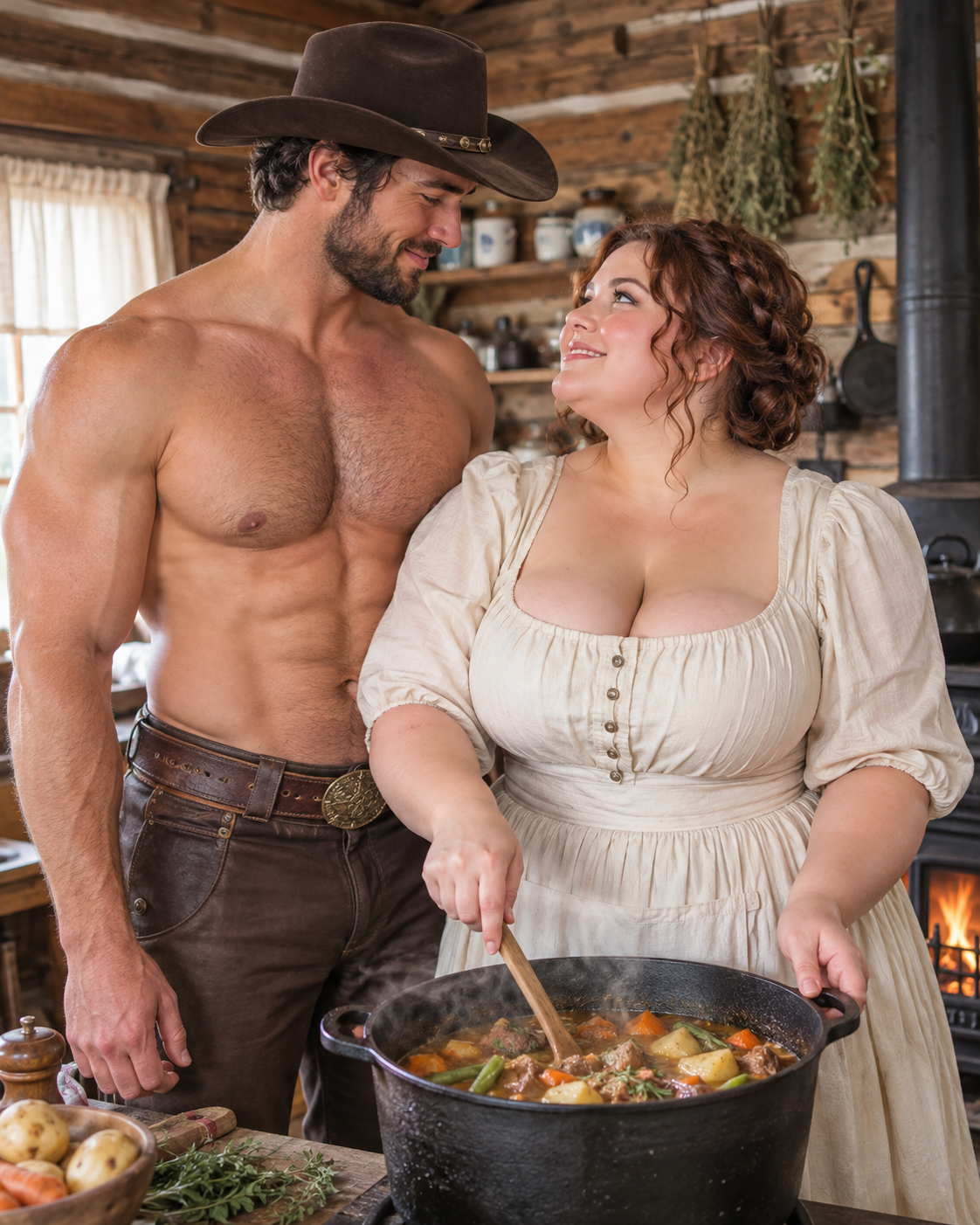
That night, I returned to the kitchen and made another pot of broth.
Not because I believed soup could heal every wound, but because the ranch hands were still recovering, Samuel was still weak, and people needed care even when the world around them had become unbearable.
Jacob came downstairs shortly before midnight.
He stood quietly beside the stove, watching me stir the pot.
“I used to think strength meant never admitting you were wrong,” he said.
I kept my eyes on the broth.
“That must have been a lonely way to live.”
“It was.”
He hesitated.
“I don’t expect you to forgive me.”
“Good.”
He gave a small, painful smile.
“I suppose I deserved that.”
I finally looked at him.
“Forgiveness isn’t a payment you can demand because you’ve decided to become a better man. It’s something I may or may not find when I’m ready.”
Jacob nodded slowly.
“Then I’ll try to become someone who deserves the chance.”
It was the first promise he had made that did not sound like an attempt to control the outcome.
Over the next two days, the blizzard weakened, and the ranch slowly returned to life.
Samuel’s fever finally began to fall under the doctor’s care, and the sick ranch hands regained enough strength to sit at the table.
I continued preparing small meals, keeping the broth warm, and watching carefully for any sign that someone was getting worse.
When the doctor arrived, Jacob confronted him with the payment records.
At first, the old man denied everything.
Then Elias gave his statement, and the doctor broke down.
He admitted that Silas Dawson had paid him to conceal the truth about the missing medicine and had threatened to destroy his practice if he spoke.
The doctor had allowed fear to become an excuse for silence, and that silence had helped ruin a family already struggling to survive.
He could not bring my brother back.
He could not restore the years my mother had spent grieving or return the father I had lost.
But he agreed to testify before the sheriff, and for the first time, the people responsible for our suffering would have to answer questions they had avoided for years.
When the roads finally opened, Jacob rode into town with Elias and the records secured in a leather case.
I watched from the porch as their horses disappeared beyond the bare cottonwoods.
I did not know whether the sheriff would believe every word or whether the people who had benefited from Silas’s lies would try to bury the truth again.
But I knew one thing.
This time, no one would be allowed to pretend that nothing had happened.
Three days later, Jacob returned with news.
The sheriff had opened a formal investigation, and Elias had given a sworn statement confirming the circumstances surrounding my father’s death.
The doctor had also agreed to testify about the withheld medicine and the payments he had accepted.
There would be hearings, difficult questions, and consequences that might take months to unfold.
Justice would not arrive in a single dramatic moment.
It would require patience, evidence, and the courage to keep speaking even when powerful people wanted the conversation to end.
Jacob understood that better than he ever had.
He also announced that the ranch would repay the wages Silas had stolen from former workers and establish a fund to help families who could not afford medical care.
Some townspeople called it an attempt to buy forgiveness.
Others said it was the first decent thing a Dawson had done in years.
I refused to decide what it meant until I saw whether he followed through.
He did.
Over the following months, payments reached families who had waited decades for what they were owed, and a small room beside the ranch kitchen was turned into a place where injured workers could rest until the doctor arrived.
Jacob never asked me to stand beside him when people praised his efforts.
He knew that rebuilding trust was not the same as repairing a fence.
One could be finished in an afternoon.
The other had to be earned, one honest decision at a time.
As for me, I stayed at the ranch, though not because I owed Jacob anything.
I stayed because the work mattered, because the men treated one another more kindly after surviving the blizzard, and because Samuel had begun following me around the kitchen, eager to learn how to chop vegetables without cutting his fingers.
One bright spring morning, I found Jacob standing beside the old stove, holding the photograph of my father and himself.
He had placed it in a simple wooden frame.
“I thought it belonged somewhere people could see it,” he said.
I studied the photograph for a long time.
My father looked young in it, full of hope, unaware of the suffering waiting ahead.
But he was smiling.
For years, I had remembered him mostly through the pain of losing him.
Now I wanted to remember the man who had believed that honesty mattered even when it cost him everything.
“Thank you,” I told Jacob.
He nodded, his eyes bright.
“I wish I could have given it back sooner.”
“So do I.”
We stood together in silence, allowing the past to remain what it was without pretending it had become harmless.
Then Samuel came running into the kitchen, carrying a wooden spoon like a sword.
“Miss Grace, Uncle Jake says I can help with supper!”
I raised an eyebrow at Jacob.
“Did he now?”
Jacob’s mouth twitched.
“I thought it was time I learned how much work you do in here.”
Samuel laughed, and for the first time, the sound of a child’s laughter in that house did not carry the shadow of an approaching tragedy.
That evening, we ate together at the long ranch table.
The men told stories, the fire burned warmly, and Samuel insisted that his bowl of broth tasted better because he had helped stir it.
I let him believe that.
Sometimes, people needed to feel that they had contributed something good to the world, even if their contribution was only a spoonful at a time.
Later, after everyone had gone to bed, I stepped onto the porch and watched the stars emerge above the Montana hills.
Jacob joined me, leaving a respectful distance between us.
“Do you think your father would have forgiven me?” he asked.
I considered the question carefully.
“I think my father would have wanted you to tell the truth, even when it hurt. I think he would have wanted you to protect the people your family once harmed.”
Jacob looked toward the dark pasture.
“And do you forgive me?”
I watched the wind move through the grass, carrying the scent of damp earth and the promise of a new season.
“I don’t know yet,” I answered honestly. “But I know I no longer want to spend my life letting what happened to my family decide who I become.”
He accepted my answer without argument.
That mattered more than he probably understood.
In the months that followed, the ranch became known not for the wealth of its owner but for the way it treated the people who worked there.
Jacob learned to listen before giving orders, and I learned that standing up for myself did not require me to become cruel.
I never forgot my father or my brother, and I never pretended that a few good deeds could erase the past.
But I stopped believing that the past had the right to steal every good thing that came after it.
Sometimes, when winter returned and the wind rattled the kitchen windows, I made a fresh pot of broth and carried it to anyone who needed warmth.
I did it for the sick, the tired, and the frightened, but I also did it for the sixteen-year-old girl I had once been, the girl who had sat beside her dying brother and wished desperately that she had something more to give.
Now I understood that kindness was not a promise to save everyone.
It was the refusal to abandon someone simply because saving them might be difficult.
And perhaps that was the lesson the blizzard had left behind.
A person’s worth was never measured by the title they carried, the money they owned, or the power they held over others.
It was measured by what they chose to do when someone weaker stood before them, asking for help.
Jacob Dawson had inherited a ranch, a fortune, and a name that once frightened an entire town.
But the thing that finally began to change his life was the quiet courage of a woman he had mistaken for nothing more than a cook.
And I had arrived at his ranch believing that I needed to prove I was worth something.
I left that winter knowing I never should have had to.
Because sometimes, the people who save us do not arrive with medicine, money, or grand promises.
Sometimes, they arrive carrying a dented pot, a little warmth, and the stubborn belief that even in the darkest night, no human being should have to suffer alone.
And when I think back to the night the blizzard nearly took Samuel and the ranch hands, I no longer remember Jacob’s cruel words as clearly as I remember the moment he finally understood what they had cost him.
For the first time, he saw me not as a servant standing in his kitchen, but as a human being whose compassion had revealed the truth about his own heart.
I never needed him to call me a hero.
I only needed him to understand that kindness was never weakness, and that doing the right thing mattered most when no one was watching.
That spring, as the last patches of snow melted beneath the Montana sun, I planted a small garden behind the kitchen in memory of my father and brother.
Samuel helped me bury the seeds, pressing each one into the earth with solemn little fingers.
“Will they really grow?” he asked.
I smiled and covered the final seed with soil.
“If we give them what they need, and we don’t give up on them, they have a chance.”
He considered that carefully before taking my hand.
I looked across the yard at Jacob, who was helping two ranch hands repair a broken fence, and then toward the hills where the road disappeared into the distance.
For the first time in years, the future did not feel like a place where old grief waited to ambush me.
It felt like a field that had not yet been planted.
And I finally understood that while we cannot always choose what is taken from us, we can choose what we grow in its place.