I caught my maid stealing flour before sunrise, and when my foreman demanded her dismissal in front of everyone, I discovered a betrayal buried beneath my ranch.
The shotgun blast shattered the silence.
I threw myself toward Sarah just as Matthew lunged sideways, and the bullet tore through the wooden doorframe above our heads. Joseph screamed. Tommy scrambled away from the fireplace, while Caleb charged toward the window with his knife raised.
“Stop!” I shouted. “Nobody fires another shot!”
But Frank Dawson had already kicked the door open.
Snow swirled around his boots, and the shotgun in his hands looked as familiar as the face I had trusted for twelve years. Behind him stood Matthew, his wrists bound with rope, blood running from a cut above his eye.
Frank’s gaze settled on Sarah.
“There’s the little troublemaker,” he said. “Your father should have learned to keep his family out of other people’s business.”
Sarah went rigid.
I stepped between them.
“You’re going to tell me what happened to my father.”
Frank smiled without warmth.
“Your father died because he couldn’t understand when a business decision needed to be made.”
The words struck me harder than the gunshot.
My father had built Granite Ridge Ranch from a few hundred acres of stubborn Wyoming land into one of the most prosperous cattle operations in the territory. He had taught me to ride, to repair a broken fence, and to judge a man’s character by how he treated an animal that could do nothing for him.
I had spent eleven years believing he died peacefully after a brief illness.
Now I was beginning to understand that the man who had supposedly helped our family survive that loss might have been responsible for it.
“Put down the gun, Frank.”
He tilted his head.
“You’re still giving orders as though this place belongs to you.”
“It does.”
“Not for much longer.”
Frank pulled a folded document from his coat and tossed it onto the cabin floor.
It landed beside the broken pie.
“Your father signed the transfer before he died. Matthew was supposed to inherit half the property, but he disappeared before the papers could be registered. You were never meant to own everything, Daniel.”
I stared at the document.
The signature looked authentic. The seal was our family’s, and the date was eleven years old.
But something about the final paragraph bothered me.
My father had always insisted that no sale or transfer involving Granite Ridge could be finalized without two witnesses and an independent surveyor. This document carried only one witness’s signature.
Frank Dawson’s.
“You forged this.”
“Prove it.”
Matthew suddenly laughed, a bitter, exhausted sound.
“That’s what he told Father, too.”
Frank spun toward him and struck him across the face with the shotgun stock.
Matthew fell to his knees.
Sarah cried out, and something inside me finally broke free from the fear that had kept me obedient for so long.
I charged Frank.
We crashed into the table, sending plates and the remaining pie tumbling to the floor. The shotgun discharged into the ceiling. Dust and splinters rained down around us.
Frank was stronger than I remembered, but he was also surprised. I caught his wrist and drove him against the wall, struggling to keep the weapon pointed away from the others.
“Daniel!” Matthew shouted. “His left pocket!”
I didn’t understand until Frank reached desperately for something beneath his coat.
A small brass key slipped from his fingers.
It struck the floor and skidded beneath the bed.
Frank’s expression changed.
For the first time that night, the man who had always seemed prepared for every possibility looked genuinely afraid.
Sarah saw it, too.
She darted forward, snatched the key, and backed away before Frank could grab her.
“Give it to me!” he roared.
“No.”
The single word came from Sarah so quietly that everyone seemed to hear it.
She stood with her shoulders shaking, but she didn’t retreat.
“My father died protecting this key. My mother spent eleven years telling me that one day someone would come looking for it.”
Frank lunged toward her.
Caleb tackled him from behind.
Together, the three of us forced Frank to the floor and bound his hands with the rope that had been around Matthew’s wrists. The struggle left us breathless, but the shotgun finally lay harmlessly beneath the bed.
Outside, the storm continued to bury the cabin.
For several seconds, nobody spoke.
Then Matthew looked at me.
“There’s something you need to know about Father.”
I wanted to strike him. I wanted to embrace him. I wanted to demand eleven years of explanations before allowing him another word.
Instead, I knelt beside him and helped him sit against the wall.
“Start at the beginning.”
Matthew closed his eyes.
“Eleven years ago, Father discovered that Frank had been selling cattle through a trading company in Cheyenne. He’d been changing the herd counts, falsifying transport records, and pocketing the difference. At first, the losses were small enough to hide in the books.”
He swallowed.
“Then Father discovered the money wasn’t the only thing missing. Frank had been using the ranch’s land deeds as collateral for loans we never authorized. If those debts came due, Granite Ridge would have been seized.”
I glanced at Frank.
He stared at the floor, his jaw clenched.
“Father confronted him,” Matthew continued. “He told Frank he’d turn over every record to the authorities. Two nights later, Father was found at the bottom of the ravine near the north pasture.”
The cabin seemed to tilt around me.
“The doctor said it was an accident.”
“Frank paid the doctor to say that.”
My hands curled into fists.
“And you let me believe it?”
Matthew looked at me with eyes full of shame.
“I was twenty-two, Danny. I had seen what Frank could do. He told me he’d kill you next if I spoke. He said he’d already arranged everything to make your death look like another riding accident.”
“Why didn’t you come back when you were safe?”
“Because I wasn’t safe.”
Matthew leaned forward.
“I tried to get the evidence to a federal investigator in Cheyenne. Frank’s men intercepted me on the road. They beat me, stole the records, and left me for dead. I woke up in a freight wagon three days later, hundreds of miles away. By the time I made it back to Wyoming, Frank had told everyone I’d been killed in the same accident that took Father.”
He looked down at his scarred hands.
“I should have found you sooner. But every time I got close, someone warned me that you were being watched.”
“And Sarah?”
At her name, Matthew’s face softened.
“Her mother, Elizabeth, was Father’s daughter.”
The words settled over the cabin like another snowfall.
I turned toward Sarah.
She stood perfectly still, the silver locket clasped in one hand.
“My father never told me he had another daughter,” I said.
“Because he was ashamed,” Matthew replied. “Elizabeth was born before Father married our mother. He loved her, but his family threatened to disown him if he publicly acknowledged her. He promised Elizabeth that one day he’d make things right.”
Sarah’s eyes shone with tears.
“He never did.”
“No,” Matthew admitted. “He didn’t.”
For a moment, the anger in her face seemed greater than her grief.
“My mother spent her whole life waiting for a father who never came. She died believing she wasn’t worth claiming.”
Matthew bowed his head.
“I’m sorry.”
“Don’t apologize for him.”
Sarah’s voice trembled, but she held his gaze.
“Tell me the truth about what happened to her.”
Matthew looked at me before answering.
“Elizabeth was the ranch’s bookkeeper. She discovered Frank’s fraud and helped Father gather evidence. The night Father died, she was supposed to meet him at the old assay office near the abandoned silver mine. Frank found out.”
Sarah pressed the locket against her chest.
“My mother died in a house fire when I was fourteen.”
“That wasn’t an accident,” Matthew said.
Frank began to struggle against his bindings.
“Enough of this nonsense!”
Nobody looked at him.
Matthew continued.
“Elizabeth escaped the fire, but she was badly injured. She managed to hide the original account ledger and a set of letters before she died. She left them where Father had instructed her to keep them.”
He nodded toward the brass key in Sarah’s hand.
“Beneath the old assay office, there’s a locked iron box. The key opens it.”
I stared at the small piece of brass.
All those years, the truth had been lying somewhere on my own land while I trusted the man who had buried it.
“Why didn’t you retrieve it yourself?”
“Because I never knew where Elizabeth had hidden the key. Sarah found it among her mother’s belongings last spring. I contacted her when I learned she worked here, and I told her enough to understand why it mattered.”
Sarah nodded slowly.
“He gave me money to help the three men because he knew Frank had started paying people to search the old cabin. Matthew thought Frank would eventually discover where the evidence was hidden.”
She looked at the pies scattered across the floor.
“I wasn’t just feeding those men. They were the only people who had seen Frank’s men transporting cattle at night. They agreed to testify if they could survive long enough to tell their story.”
Frank stopped struggling.
His eyes moved from Sarah to Matthew, then to the key.
“You stupid girl,” he whispered. “You have no idea what’s in that box.”
“Then you’ll have plenty of time to explain it to a judge,” I replied.
A distant horn sounded through the storm.
Caleb moved to the window and peered into the darkness.
“Lights on the road.”
I felt the first flicker of relief I’d experienced in hours.
Before leaving the ranch, I had sent a short message over the radio to the county sheriff, telling him about the missing payroll, the forged cattle-sale document, and the armed confrontation at the trapping cabin. I hadn’t known whether the message would get through the storm.
Now, two sets of headlights were approaching the clearing.
Frank saw them, too.
His face hardened.
“You think this ends with me in prison? You think a few papers will save you?”
He leaned toward me, lowering his voice.
“Your ranch is buried in debt. I’ve been paying off the people who own those notes for years. Even if you prove the cattle theft, you’ll lose everything when the loans come due.”
I studied him for a long moment.
“Then I’ll face that when it comes.”
Frank laughed.
“You’ll be nothing without Granite Ridge.”
I thought of Joseph’s swollen leg, Tommy’s hollow cheeks, and Caleb’s desperate eyes when he had first seen me enter the cabin.
“No,” I said. “I’ll be nothing if I let men like you decide what a man’s worth.”
The sheriff and two deputies entered minutes later, bringing the smell of cold air and wet wool with them. They took one look at the shotgun, the bound foreman, and the injured men, and immediately separated everyone for questioning.
Frank demanded a lawyer.
Matthew was taken to a doctor.
Joseph was loaded into the ambulance, with Sarah refusing to leave his side.
Before the doors closed, Joseph reached for my hand.
“Mr. Cooper?”
“Yes?”
“I don’t know if I can ever work again.”
I swallowed the lump in my throat.
“You don’t have to earn your place in this world by breaking your body for me. We’ll make sure you get the treatment you need.”
He searched my face, as if expecting to discover a trick.
Then he nodded, exhausted.
As the ambulance disappeared into the snow, I turned toward Sarah.
She was staring at the locket in her palm.
“Will you come with me to the assay office?” I asked.
She looked up.
“Tonight?”
“Tonight.”
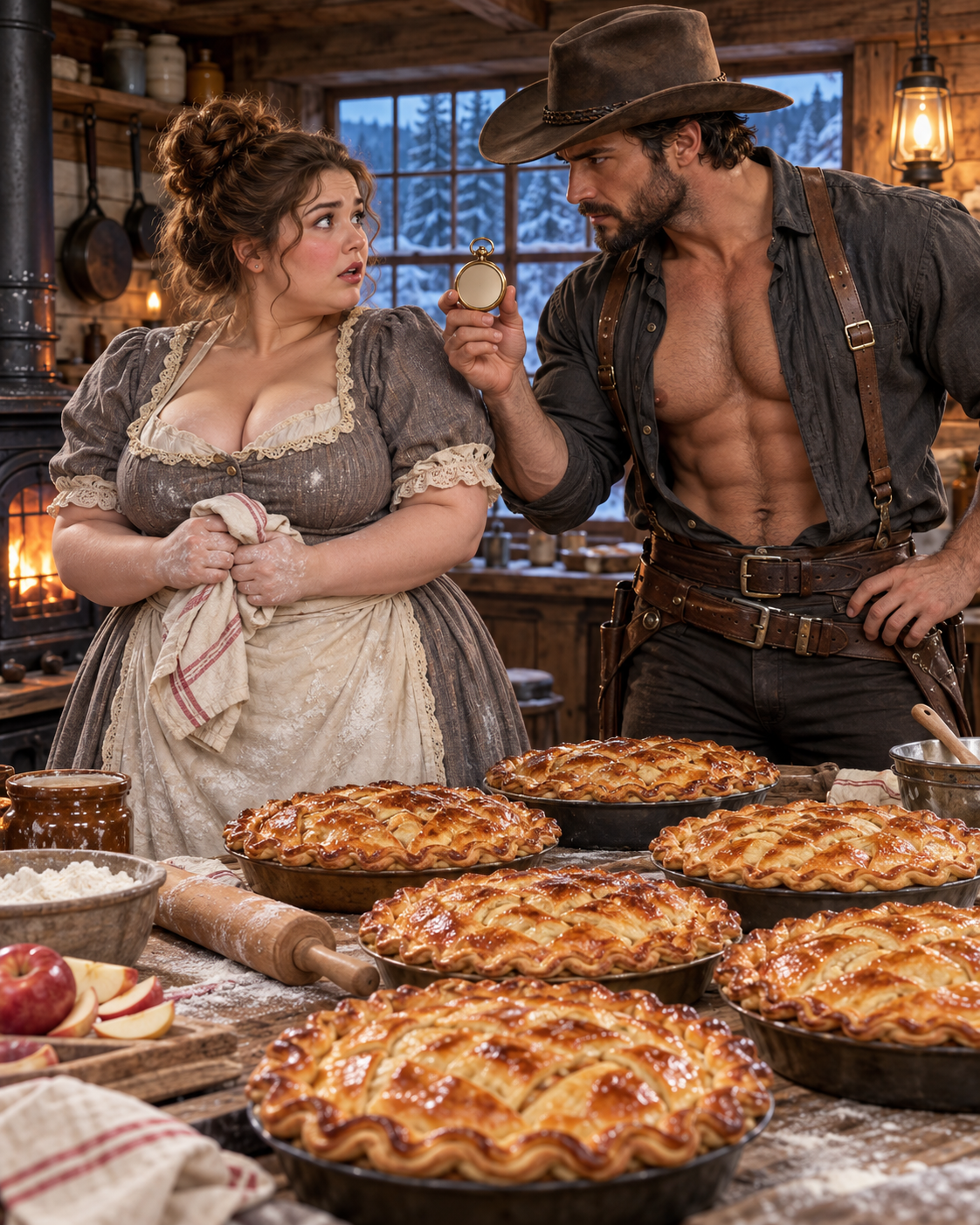
The storm was beginning to weaken, but the eastern horizon remained black. We followed the sheriff’s vehicle back toward Granite Ridge, then took two horses from the stable and rode north toward the abandoned silver mine.
Matthew insisted on coming despite his injuries.
“I’ve spent eleven years running from this place,” he said. “I’m finished running.”
The assay office stood at the edge of a ravine, its roof half collapsed and its windows dark. We dismounted beside a rusted windmill, then pushed through the warped wooden door.
Inside, the air smelled of dust, damp stone, and old machinery.
Sarah examined the walls until she found a small carving of an apple tree near the hearth.
“My mother used to draw this whenever she was thinking,” she whispered.
Beneath the carving, the floorboards were newer than the surrounding wood.
We pried them loose and uncovered a narrow stone stairway leading into the earth.
At the bottom sat a black iron box.
Sarah inserted the brass key.
It turned with a heavy click.
Inside were three leather-bound account books, a bundle of letters tied with blue ribbon, and a small envelope bearing my name.
My hands shook as I opened it.
Daniel,
If you are reading this, I have failed to protect you from the truth, and I pray you will be stronger than I was.
I let fear convince me that silence could protect the people I loved. Instead, it gave a dishonest man the power to hurt them all.
Matthew knows some of what I discovered, but Elizabeth has the full record. She is my daughter, and I have been a coward for every year I allowed the world to believe otherwise.
I cannot undo what I have done to her. I can only leave you the chance to do better.
Do not mistake loyalty for obedience, my son. A loyal man tells you when you are wrong. A man who profits from your blindness will call your silence respect.
If Granite Ridge is ever to be worthy of its name, let it be a place where the truth is worth more than the land.
Father.
I read the letter twice.
Then I lowered it, unable to speak.
For years, I had imagined my father as a man without serious faults, a man whose death had left our family with nothing but grief and good memories. Now I understood that even he had allowed shame and fear to wound people he loved.
His failures did not excuse Frank’s crimes.
But they explained how those crimes had grown in the darkness.
Sarah opened the account books. The first contained records of cattle sales stretching back more than a decade. The second listed payments to men who had helped conceal the fraud. The third contained copies of loan agreements, each bearing signatures that appeared to belong to my father but differed subtly from the signature on his letter.
Among the letters was a confession from the doctor who had declared Father’s death accidental, along with a sworn statement from a former ranch hand who had witnessed Frank pushing Father toward the ravine during their final confrontation.
There was enough evidence to bring Frank down.
But the most important document was a letter written by Elizabeth.
It explained that the forged loans had been secured against property that belonged jointly to my father and Matthew. Because the transfer papers were fraudulent, the lenders had no lawful claim to the land.
Frank had not merely stolen our cattle.
He had built his entire fortune on a lie.
By sunrise, we had delivered copies of the documents to the sheriff and a federal investigator. Frank was charged with cattle theft, forgery, fraud, and conspiracy connected to the deaths of my father and Elizabeth.
The investigation lasted eight months.
During that time, I learned things about my family that I wished I could have learned under happier circumstances. I discovered that Elizabeth had once sent Father a letter asking him to attend Sarah’s school graduation. He had kept the invitation in his desk for years but had never answered it.
I discovered that Matthew had tried to send me messages from three different towns, and that Frank’s men had intercepted every one.
And I discovered that the ranch I had considered my inheritance had been built, in part, on the labor and suffering of people whose names I barely knew.
The court proceedings were brutal.
Frank’s lawyers argued that the documents were fabricated, that Matthew had invented the story out of jealousy, and that Sarah had stolen the account books to claim a share of the property.
But the witnesses told their stories.
Caleb described the cattle sales he had seen in the darkness. Tommy identified the men who had carried the forged transport papers. Joseph, still recovering from surgery, testified from his hospital bed about the unpaid wages and Frank’s threats.
The former ranch hand confirmed that he had seen Frank arguing with my father beside the ravine.
Then the doctor confessed that he had falsified the death report after Frank threatened his family.
Piece by piece, the wall of lies collapsed.
Frank Dawson was convicted and sentenced to prison. The charges related to the deaths of my father and Elizabeth led to additional proceedings, and he was ultimately held responsible for the crimes that had destroyed both families.
The lenders withdrew their claims when the forged agreements were exposed.
Granite Ridge survived.
But survival was not the same as healing.
The first thing I did after the court’s decision was pay Caleb, Tommy, and Joseph every dollar they were owed, including compensation for the injuries and hardship they had suffered. I also arranged medical care for Joseph and offered all three men the choice of returning to the ranch or starting new lives elsewhere.
Joseph returned six months later, walking with a cane and carrying a small wooden box of apple seeds.
“Sarah said you wanted an orchard,” he explained.
I smiled.
“I do.”
“Then these are for you.”
We planted them beside the creek, where the soil was rich and the spring sun reached the ground early.
The second thing I did was change the way Granite Ridge operated.
Every worker received a written contract and a copy of the payroll record. Wages were paid directly, and no foreman could sign for another man’s earnings. Accounts were reviewed by an independent bookkeeper, and workers could bring complaints directly to me without fear of dismissal.
Some of the older hands complained that I was turning a ranch into an office.
I told them that honest work had nothing to fear from honest records.
The third thing I did was ask Sarah what she wanted.
She stood with me on the porch one evening, watching the last light settle across the pastures.
“I want to know who my mother was,” she said. “Not just the woman who raised me, but the woman she might have become if she’d been given the chance.”
I handed her the letters we had recovered from the iron box.
“They’re yours.”
She held them against her chest.
“And the ranch?”
I looked across the land my father had loved and my brother had lost eleven years trying to protect.
“You belong here if you want to. Not because of your blood, and not because of what Father owed your mother. Because you’ve earned the right to choose your own future.”
For the first time since the night in the cabin, Sarah smiled without sadness.
She chose to stay.
Over the following year, she helped establish a small schoolhouse for the children of ranch workers and neighboring families. She used her mother’s letters to create a library, filling its shelves with books about farming, medicine, history, and the wider world beyond the mountains.
She also began baking apple pies every Sunday.
At first, she made them only for the men who had suffered under Frank. Eventually, the smell drifted through the kitchen on cold mornings, drawing workers from the barns and visitors from the road.
We never charged anyone for a slice.
Matthew stayed, too.
Forgiveness did not arrive between us in a single conversation. There were nights when I resented him for leaving me alone with my grief, and mornings when he could not meet my eyes because he remembered the years he had spent hiding.
But we learned to speak honestly, even when the truth hurt.
One evening, while repairing a fence near the northern pasture, Matthew finally asked the question I had carried since the night he returned.
“Do you think Father would be proud of us?”
I drove the last nail into the post and considered his words.
“I think he’d be ashamed of some of the things he did.”
Matthew nodded.
“And proud of some of the things we’re trying to fix,” I continued. “Both can be true.”
He looked toward the orchard, where the young trees were beginning to grow.
“I wish he’d had the courage to do it himself.”
“So do I.”
The following spring, we held a small memorial for our father and Elizabeth beneath the apple trees. Sarah placed her mother’s silver locket beside Elizabeth’s name on the wooden marker. Matthew laid down the letter Father had written to me, and I placed a handful of earth over the roots of the nearest tree.
There were no grand speeches.
We simply stood together, remembering two people whose lives had been shaped by love, fear, and the consequences of silence.
As the years passed, Granite Ridge became known for something more valuable than the number of cattle it raised.
People knew that workers were paid fairly, that injured hands received care, and that nobody would be threatened for speaking the truth. Neighbors came to us when they needed help after a storm, and we sent men and supplies whenever another ranch suffered a loss.
The orchard grew, producing its first small harvest three years after we planted it.
Sarah baked the first apples into pies and brought one to my office.
She set it on my desk with a familiar smile.
“Four in the morning,” she said. “Just like the first time.”
I laughed.
“I seem to remember accusing you of stealing flour.”
“You did.”
“I also seem to remember that you were feeding three starving men.”
“And you nearly let Frank convince you I was the criminal.”
Her words were gentle, but they stayed with me long after she left the room.
That evening, I walked alone to the orchard and sat beneath the largest tree. Its branches had grown strong enough to shelter me from the wind, and its blossoms moved softly in the fading light.
I thought about how easily I had mistaken comfort for security. For twelve years, I had believed that trusting Frank meant I was a good employer and a capable ranch owner. I had accepted reports instead of asking questions, signatures instead of meeting faces, and familiar assurances instead of uncomfortable truths.
My blindness had not made me as guilty as the man who stole wages or murdered to protect his fortune.
But it had given him room to act.
I could not return the years stolen from Matthew. I could not give Sarah the childhood her mother had deserved. I could not bring back the health Joseph had lost in that freezing cabin.
What I could do was refuse to let those losses become meaningless.
I could build a ranch where a frightened worker did not have to hide in the snow to be heard. I could teach my children, if I ever had them, that authority was a responsibility rather than a privilege. And I could remember that a man’s character was revealed not by how confidently he gave orders, but by whether he listened when someone with less power dared to speak.
The next winter, snow covered Granite Ridge again.
One morning, I woke before sunrise and followed the smell of apple pie into the kitchen.
Sarah stood beside the stove, brushing flour from her hands. Joseph sat at the table, telling a story that had the other ranch hands laughing so hard they could barely breathe. Matthew was pouring coffee, and a young stable boy was carefully arranging plates.
For a moment, the scene reminded me of the night everything had nearly fallen apart.
But there were no hidden pies, no starving men, and no fear in the room.
Sarah noticed me in the doorway.
“Morning, Mr. Cooper.”
I looked around the warm kitchen, at the faces of people who had once been betrayed by the very place they helped build.
“Morning,” I replied. “How many pies this time?”
“Enough for everyone.”
I pulled out a chair and sat down.
Outside, the mountains stood silent beneath the snow, guarding a land that had witnessed more cruelty than I would ever fully understand. Inside, the kitchen filled with the simple sounds of people sharing food, telling stories, and trusting one another enough to laugh.
And I finally understood what my father had meant in his last letter.
A ranch was not the land written on a deed, the cattle counted in a ledger, or the money stacked inside a safe.
It was the people who depended on one another when the weather turned cruel, when the truth became dangerous, and when doing the right thing demanded more than words.
Granite Ridge had nearly been destroyed because powerful men believed that fear could keep their secrets buried forever.
It survived because one woman refused to let three hungry men die in silence.
And every time the smell of apple pie drifted through the kitchen before sunrise, I remembered the lesson that had saved us all:
The greatest betrayal is not always the lie someone tells you. Sometimes, it is the truth you refuse to hear because believing it would require you to change.
THE END.