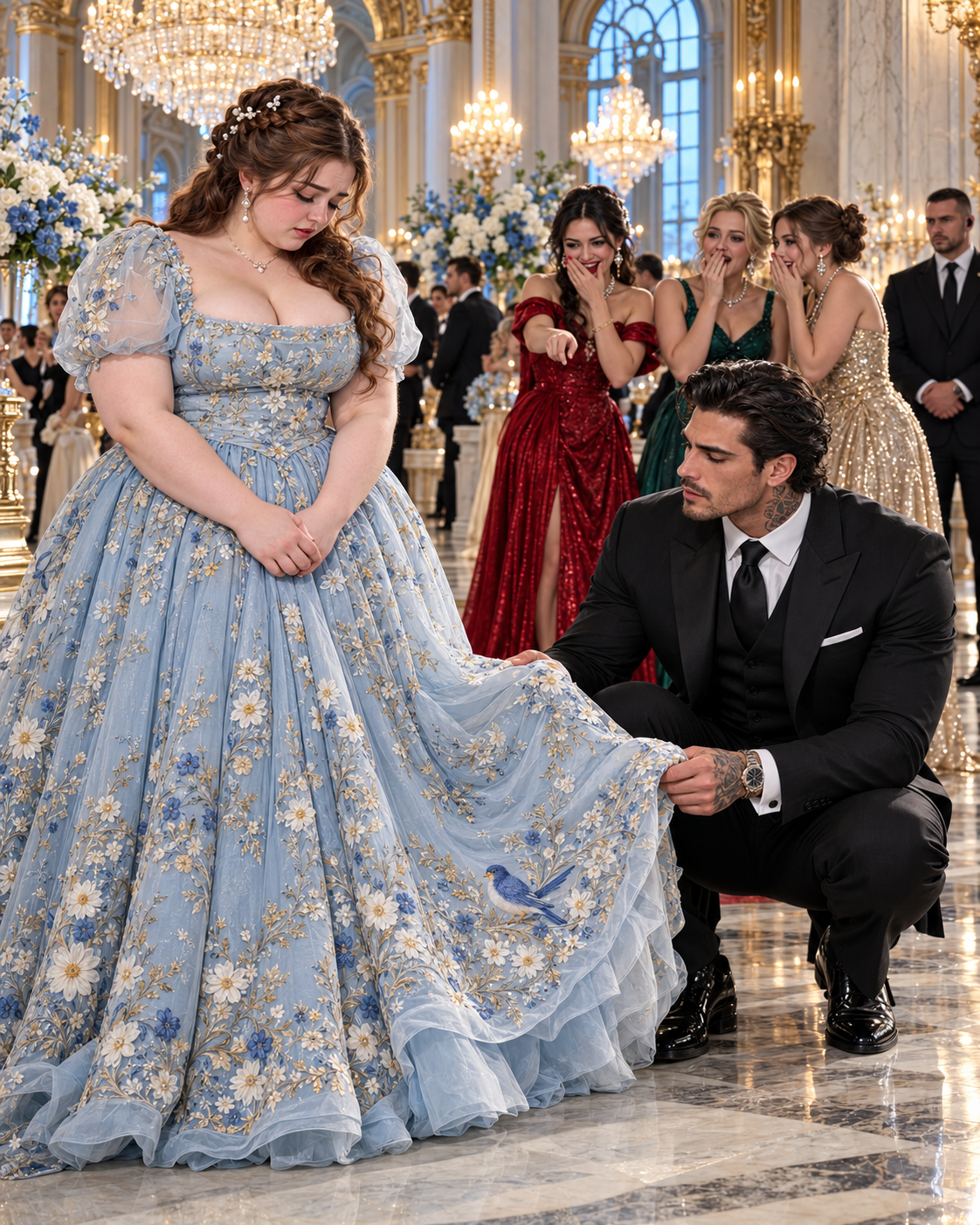
Hattie Kincaid heard the fabric rip before she felt the cold air against her back. Her stepsister Blair had stepped on the hem of her gown, and the tearing sound was loud enough to turn heads across the ballroom.
She located a modest apartment above a small shop.
It wasn’t elegant, but it had good windows and enough space for her sewing machine.
She paid the application fee and began gathering her documents.
She told only one person in the house.
Mrs. Odessa Bell, the longtime housekeeper who had helped raise her.
Odessa was in her sixties, with strong hands and an expression that could silence even Blair.
“I was wondering when you’d finally do it,” Odessa said.
Hattie smiled.
“I’m scared.”
“Most worthwhile things are frightening at first, sweetheart.”
They agreed Odessa would help carry out Hattie’s belongings the following Friday, when Meredith and Blair were scheduled to attend a luncheon.
But Meredith discovered the apartment application before then.
Hattie returned from a fabric supplier one evening to find her bedroom drawers open and her paperwork spread across the bed.
Meredith stood beside the window holding the apartment lease.
“What is this?”
Hattie stopped.
“My new place.”
“You think you’re leaving?”
“Yes.”
Meredith’s face hardened.
“You’re abandoning your family for a man you barely know.”
“I’m leaving because I need a life of my own.”
Meredith tore the application papers in half.
Hattie flinched but didn’t move.
“You don’t get to make decisions like that while you’re living under my roof,” Meredith said.
“Then I’ll leave tonight.”
But Meredith had already taken her purse and keys.
Before Hattie could reach the doorway, her stepmother stepped into the hall and slammed the bedroom door.
A moment later, the lock turned.
Hattie froze.
“Meredith?”
No answer.
“Open the door.”
“You’ll come out when you remember how to behave.”
Hattie heard footsteps moving away.
Then Blair’s laughter.
Her phone was downstairs, charging beside the kitchen counter.
The windows were too high above the ground for her to climb out safely.
For the first time, Hattie understood just how far Meredith was willing to go to stop her.
By midnight, Odessa realized something was wrong.
Hattie hadn’t come down for supper.
Meredith claimed she was resting.
But when Odessa carried a tray upstairs, she heard three quiet knocks from behind the locked door.
“Hattie?”
“Mrs. Bell,” came the muffled reply. “Please help me.”
Odessa tried the handle.
Locked.
She went downstairs and asked Meredith for the key.
“Leave her alone,” Meredith snapped. “She needs time to think.”
Odessa stared at her.
“You’ve locked a grown woman in her bedroom?”
“This is a private family matter.”
“No, ma’am. It’s a locked door.”
Meredith threatened to fire her.
Odessa removed her apron and placed it on the kitchen counter.
“Then I suppose my employment here has ended.”
She took the spare key from the old housekeeping cabinet, climbed the stairs, and opened Hattie’s door.
Hattie was sitting beside her sewing machine, clutching a small bundle of clothes.
When she saw Odessa, she began to cry.
Odessa wrapped her arms around her.
“Come on, baby. We’re leaving.”
They packed what they could carry.
Hattie took her grandmother’s sewing journal, her identification, some finished embroidery, and the small tin containing her savings.
She left the furniture.
She left the expensive curtains she had sewn for Meredith.
And she left the torn gown from the gala hanging inside the closet.
Downstairs, Meredith was waiting.
“You walk out that door,” she said, “and you are never coming back.”
Hattie looked at the woman who had controlled her home for years.
For once, she didn’t plead.
“I understand.”
Odessa opened the front door.
And together, they stepped into the humid Alabama night.
Hattie went to Odessa’s sister’s home rather than Ennio’s.
She wanted somewhere Meredith wouldn’t immediately think to search, and she needed time to decide what to do next.
Ennio called the following morning.
When Hattie told him what happened, his voice went dangerously quiet.
“Did she hurt you?”
“She locked me in my room.”
There was a pause.
“Where are you?”
“Somewhere safe.”
“Do you want me to come?”
Hattie looked at Odessa, who was sitting across the kitchen table.
She remembered the armed guards, the whispered stories, and how easily Ennio could frighten people.
Part of her wanted to ask him to make Meredith regret everything.
But another part feared what that kind of protection might cost.
“No,” she said gently. “Not yet.”
Ennio didn’t argue.
“What do you need?”
Hattie looked at the crumpled remains of her lease application.
“I need to find out whether I can still get my apartment. And I need to speak with someone about what Meredith did.”
“I can help you find an attorney.”
“I’d appreciate that.”
“Anything else?”
She hesitated.
“Yes. Please don’t send anyone to the house.”
Ennio was silent for a moment.
Then he answered, “All right.”
It was the first time Hattie had asked a powerful man to respect a boundary.
And he had.
Two days later, the apartment manager confirmed that Hattie’s application was still valid.
Her first boutique customer also called to say she loved the embroidery samples and wanted to place a larger order.
For the first time in years, Hattie could see the outline of an independent future.
But that afternoon, Odessa received a call from an unfamiliar number.
It was Meredith.
She wasn’t asking Hattie to return.
She was threatening to accuse Odessa of stealing valuable jewelry unless Hattie came back to the house and withdrew any complaint about being confined.
Odessa listened without interrupting.
Then she hung up.
Hattie sat across from her, stunned.
“She wouldn’t actually do that, would she?”
Odessa’s expression was grave.
“She just might.”
Hattie could ask Ennio to intervene, knowing his influence might be enough to frighten Meredith into silence.
She could report the threat and risk a painful public confrontation that might drag Odessa into it.
Or she could attempt to negotiate with Meredith, knowing what had happened the last time she trusted her stepmother.
That evening, Ennio arrived at the front porch carrying no flowers, no gifts, and no promises that he could fix everything.
He simply asked, “Would you like me to stay?”
Hattie looked at the man who had helped her believe she deserved a different life.
Then she looked back through the doorway at Odessa, the woman who had risked her livelihood to give Hattie her freedom.
“I want you here,” Hattie said. “But there’s something I need you to promise me before we decide what happens next.”
Ennio waited.
And Hattie realized the hardest part of escaping Meredith might not be leaving the house at all.
It might be learning how to accept help without surrendering control of her life again.
Ennio stood on Odessa’s sister’s front porch, waiting for Hattie to finish the sentence that seemed to cost her every ounce of courage she possessed.
“I need you to promise me something,” she said. “No threats. No men showing up at Meredith’s house. No making people disappear from my life just because they’ve hurt me.”
His expression remained unreadable.
Behind him, the evening sky stretched pink and gold over the quiet Mobile neighborhood. A black sedan waited at the curb, its driver standing discreetly beside the passenger door.
Ennio glanced toward the car, then back at Hattie.
“You think that’s what I would do?”
“I don’t know what you would do,” she answered. “And that’s what scares me.”
For a man accustomed to people lowering their eyes when he entered a room, her answer was unexpectedly painful.
He could have told her that Meredith deserved whatever consequences came her way. He could have explained that men in his position didn’t survive by asking permission.
Instead, he looked at the woman standing before him, her soft brown hair loosely tied behind her head, her face exhausted from two sleepless nights.
“I promise,” he said.
Hattie studied him.
“Even if she keeps threatening Odessa?”
“Even then. We handle this your way.”
“And if my way takes longer?”
“Then I’ll learn to be patient.”
For the first time since Meredith locked her bedroom door, Hattie felt something inside her loosen.
She stepped aside.
“Would you like some coffee?”
Ennio smiled.
“I’d like that very much.”
Inside, Odessa watched him carefully as he sat at the small kitchen table.
She placed a mug in front of him and folded her arms.
“Mr. Valtrani, I’ve known this girl since she was small enough to sit on a sewing table. She’s had enough people deciding what’s best for her.”
Ennio met her gaze.
“I understand.”
“Understanding and doing are two different things.”
“Yes, ma’am.”
Odessa raised an eyebrow.
Then she nodded.
“Well. At least you’ve got manners.”
Hattie nearly laughed into her coffee.
For a few precious minutes, the three of them simply sat together, discussing nothing more threatening than the weather and Odessa’s stubborn kitchen faucet.
But peace didn’t last long.
The following morning, Hattie received an email from the boutique owner who had commissioned her largest order.
The order had been suspended.
According to the message, someone had contacted the boutique with allegations that Hattie had stolen expensive fabrics and jewelry from her stepmother’s home.
Hattie read the email twice.
Then she walked into the kitchen and handed Odessa her phone.
Odessa’s expression darkened.
“She really intends to destroy everything, doesn’t she?”
Hattie sank into a chair.
“I thought leaving would be enough.”
Odessa sat beside her.
“Some people don’t mind losing control until they see you surviving without them.”
That afternoon, Hattie met with an attorney named Caroline Price, a sharp-eyed woman in her forties whose office overlooked downtown Mobile.
Ennio had provided several names, but Hattie had chosen Caroline herself.
After listening to the entire story, Caroline closed her notebook.
“Your stepmother cannot legally confine you to a bedroom, threaten false accusations, or interfere with your business through knowingly false statements without risking consequences.”
“Can we make her stop?”
“We can take steps. But I need you to understand something.”
Hattie waited.
“If Meredith insists on escalating this, you may have to speak publicly about what happened.”
Hattie looked down at her hands.
For years, she had hidden the cruelty inside that beautiful house.
Nobody outside the family knew how Meredith spoke to her at breakfast, how Blair mocked her body, or how many nights she had fallen asleep believing she was unworthy of anything better.
The thought of strangers examining her private humiliation made her stomach twist.
Caroline leaned forward.
“You don’t have to decide everything today. But we should preserve the messages, document the threats, and consider reporting the confinement.”
Hattie nodded.
“I’ll do it.”
When she left the office, Ennio was waiting beside his car.
He didn’t ask what Caroline had said.
He simply opened the door.
“Where would you like to go?”
Hattie considered the question.
“My new apartment.”
The apartment wasn’t glamorous.
The wooden floors were scratched, the kitchen cabinets had mismatched handles, and the bathroom mirror leaned slightly to one side.
But sunlight poured through the front windows, illuminating the empty living room.
Hattie walked slowly across the floor.
“It’s perfect.”
Ennio surveyed the room.
“The kitchen faucet leaks.”
“I noticed.”
“And that window doesn’t close properly.”
“I can fix it.”
He looked at her.
“You’re really determined to do this yourself.”
She smiled.
“I’ve spent years living in a beautiful house that never felt like mine. I think I can survive a leaking faucet.”
Ennio chuckled.
Then he reached into his pocket.
“I brought something.”
Hattie’s smile faded slightly.
“Ennio…”
“It’s not money.”
He handed her a small photograph.
It showed two young women sitting on the steps of a modest home, their arms linked together.
One was unmistakably Eleanor Kincaid.
The other had dark hair, laughing eyes, and a tiny embroidered swallow pinned to her blouse.
“My mother and your grandmother,” he said.
Hattie stared.
“Where did you find this?”
“In my mother’s things. I hadn’t looked through that box in years.”
She traced Eleanor’s face with one fingertip.
“They look so happy.”
“They were.”
Ennio stood beside her.
“Apparently, your grandmother helped my mother when she first arrived in Alabama. Lucia spoke very little English then. Eleanor taught her sewing techniques and helped her find work.”
Hattie smiled through sudden tears.
“My grandmother always said that kindness travels farther than money.”
“My mother remembered it for the rest of her life.”
They stood together in the empty apartment, two people connected by women who had offered each other friendship when they needed it most.
Then Ennio said something Hattie hadn’t expected.
“My mother would have liked you.”
Hattie looked up.
“You barely know me.”
“I know you were frightened, humiliated, and treated cruelly. And you still helped someone else preserve something precious.”
Hattie swallowed.
“That’s what my grandmother would have done.”
“Then perhaps I’ve already met the most important part of you.”
She leaned against his shoulder.
For once, the silence felt safe.
Three weeks later, Hattie’s life began settling into something almost ordinary.
Odessa helped her find a secondhand cutting table. Her first independent commission was completed ahead of schedule, and another boutique requested samples.
Ennio visited when his schedule allowed, sometimes bringing dinner, sometimes simply sitting with her while she worked.
He learned not to interrupt when she was counting stitches.
She learned that beneath his intimidating reputation was a man who hated olives, drank terrible coffee, and still kept his mother’s birthday marked on his calendar.
But the shadows surrounding his life never disappeared entirely.
One evening, Hattie arrived at his waterfront office and found two men arguing behind a closed glass door.
She couldn’t hear their words, but she saw Ennio’s expression turn cold.
When he noticed her standing outside, he ended the conversation immediately.
Later, while they ate dinner, she asked whether something was wrong.
“Business,” he answered.
“What kind?”
He set down his fork.
“Complicated business.”
Hattie nodded, although the answer troubled her.
She wasn’t naïve.
She knew affection couldn’t erase a lifetime of dangerous associations.
And she knew the man who had defended her in a ballroom wasn’t necessarily the same man his enemies encountered.
“Ennio, I don’t want to spend my life wondering whether someone is going to get hurt because you’re angry.”
He looked at her for a long moment.
“Neither do I.”
“Then what are you going to do about it?”
He had no immediate answer.
That troubled him more than he admitted.
Meanwhile, Meredith’s attempts to discredit Hattie were beginning to backfire.
Caroline sent formal notices demanding that Meredith stop making false allegations against Hattie and Odessa.
Hattie also made a report about being locked in her bedroom.
Meredith responded with outrage.
She told friends that her stepdaughter was ungrateful, unstable, and being manipulated by a dangerous man.
Blair repeated the story at luncheons and charity events, carefully portraying herself as the concerned sister.
But people had begun remembering what happened at the gala.
They remembered Blair standing on Hattie’s gown.
They remembered Meredith ordering her away.
And they remembered Ennio Valtrani placing his jacket around a trembling young woman while everyone else watched.
One afternoon, the boutique owner who had suspended Hattie’s order called.
“I owe you an apology,” she said.
Hattie sat straighter.
“Why?”
“I should have spoken directly to you before making assumptions. I’ve reviewed the situation, and I would like to reinstate the commission.”
Hattie closed her eyes.
“Thank you.”
“Actually, there’s something else. We’re organizing a regional showcase for independent designers. Would you be interested in presenting a collection?”
For several seconds, Hattie couldn’t speak.
Then she whispered, “Yes.”
That night, she told Ennio the news over dinner.
He stood, walked around the table, and kissed her forehead.
“I knew someone would recognize your talent.”
Hattie smiled.
“I didn’t.”
“Do you now?”
She thought of her grandmother’s sewing machine, the tiny apartment, and the long hours she spent working alone.
“I’m learning.”
The showcase was scheduled for six weeks later.
Hattie named her collection Homecoming.
Every design incorporated a swallow with one blue stitch.
But as preparations began, Meredith found another way to reach her.
The letter arrived on a Thursday morning.
It came from an attorney representing Meredith’s interests.
According to the letter, Meredith intended to dispute Hattie’s ownership of several pieces of equipment and materials she had taken when leaving the house.
She also claimed that certain embroidered designs belonged to the Kincaid family business.
Hattie stared at the pages.
“There is no family textile business.”
Caroline examined the letter.
“Then we’ll make her establish whatever claim she thinks she has.”
“But my grandmother gave me that sewing machine.”
“Do you have anything showing that?”
Hattie hesitated.
Eleanor had given her the machine shortly before she died.
There had been no formal paperwork, only a handwritten note tucked inside the machine’s drawer.
Hattie remembered the words.
For the hands that will make beautiful things long after mine are still.
But she had left the note behind when she escaped.
Along with several of Eleanor’s original journals.
And Meredith knew it.
Hattie suddenly understood the purpose of the letter.
Her stepmother didn’t simply want money.
She wanted Hattie to return to the house.
That evening, Hattie told Odessa.
The older woman’s mouth tightened.
“Your grandmother kept everything. Receipts, patterns, notes. She even saved grocery lists.”
“The journals are still there.”
Odessa nodded.
“And Meredith knows how much they mean to you.”
Hattie looked toward the window.
She had promised herself she would never walk through that front door again.
But the journals contained decades of Eleanor’s work, including the original swallow design.
Losing them would feel like losing her grandmother twice.
“I need to get them back.”
Odessa shook her head.
“Not alone.”
Caroline arranged for a supervised visit so Hattie could retrieve clearly identified personal belongings, with any disputed items to be addressed separately.
Meredith reluctantly agreed after receiving a formal request.
Ennio offered to accompany Hattie.
She refused.
“This is something I need to face without you standing beside me.”
He didn’t like it.
But he respected her decision.
Instead, Caroline accompanied Hattie and Odessa to the Kincaid house on a bright Saturday morning.
Blair opened the door.
Her smile disappeared when she saw Caroline.
“Mother didn’t say you were bringing a lawyer.”
Caroline answered pleasantly.
“Now she knows.”
Inside, everything looked exactly as Hattie remembered.
The polished staircase.
The enormous dining table.
The flowers arranged in a vase Hattie had once spent an hour cleaning.
But the house seemed smaller somehow.
Maybe because she was no longer afraid of belonging nowhere else.
Meredith waited in the sitting room.
“You’ve caused quite enough embarrassment,” she said.
Hattie didn’t respond.
Caroline stepped forward.
“We’re here to collect the agreed personal items.”
Meredith gestured impatiently toward the staircase.
“Then get on with it.”
Hattie entered her former bedroom.
The walls were bare.
Her old sewing table had been pushed into a corner.
And the shelf where Eleanor’s journals had once stood was empty.
She turned toward Meredith, who had followed them upstairs.
“Where are my grandmother’s books?”
Meredith folded her arms.
“I don’t know what you’re talking about.”
“The sewing journals. There were seven.”
“Perhaps you misplaced them.”
Hattie felt anger rising.
Not the desperate anger that made her want to cry.
Something steadier.
“Those books belonged to me.”
Meredith shrugged.
“Prove it.”
For a moment, silence filled the room.
Then Odessa spoke.
“Mrs. Kincaid, I packed those journals into a wooden box myself after Eleanor died.”
Meredith turned sharply.
“Stay out of this.”
“No, ma’am.”
Odessa reached into her handbag and removed her phone.
“I took a photograph of the box when we moved it into Hattie’s room. You can see the journals and Eleanor’s handwritten dedication.”
Caroline glanced at the screen.
“Please send that to me.”
Meredith’s face flushed.
Blair stepped forward.
“Are you seriously going to make a scene over some old books?”
Hattie looked at her stepsister.
“They’re old books to you. They’re part of my family to me.”
Blair rolled her eyes.
And something inside Hattie finally settled.
She no longer needed Blair to understand.
She only needed to stop allowing her cruelty to define her.
Meredith eventually admitted that she had moved the journals into a storage closet.
But when Hattie opened the wooden box, only six were inside.
The seventh, Eleanor’s earliest journal, was missing.
That was the one containing the original swallow pattern.
“The blue book,” Hattie said.
Meredith looked away.
“Perhaps it was thrown out.”
Hattie’s breath caught.
Odessa stepped closer.
“Meredith.”
For the first time, the older woman used her employer’s first name.
“Where is it?”
Meredith’s expression changed.
Something like resentment flickered beneath her anger.
“You all act as though Eleanor was some kind of saint.”
Hattie stared.
“She was kind to you.”
“She was always kind to everyone. And your father never stopped talking about her.”
Hattie frowned.
“My father?”
Meredith gave a bitter laugh.
“Your father admired Eleanor. He admired your mother’s family. He admired everyone who came before me. And after your mother died, no matter what I did, I was always the second woman in that house.”
Hattie felt the air leave her lungs.
For years, she had wondered what she had done to deserve Meredith’s hatred.
Now she understood something painful.
The resentment had never truly been about Hattie.
She had simply been the person Meredith could punish without confronting her own bitterness.
“That wasn’t my responsibility,” Hattie said quietly.
Meredith’s eyes filled with angry tears.
“You have no idea what it’s like to be invisible.”
Hattie looked at her.
“Yes,” she replied. “I do.”
The words left Meredith speechless.
Caroline gently touched Hattie’s arm.
“We should finish collecting your things.”
But as they turned to leave, Blair spoke.
“The blue book is in Mother’s desk.”
Meredith whipped around.
“Blair!”
Blair looked exhausted.
“You said you were going to burn it. I didn’t want another argument about it.”
Hattie went still.
Meredith said nothing.
Caroline calmly asked that the journal be returned.
Several minutes later, Hattie held the faded blue volume against her chest.
The leather cover was worn, the pages yellowing at the edges.
Inside, Eleanor’s handwriting filled every page.
And near the middle was a drawing of two swallows flying toward one another.
Beneath them, a familiar note.
One blue stitch, so love can always find its way home.
Hattie closed the book.
She had finally recovered what she came for.
But as she walked toward the door, Meredith called after her.
“After everything I’ve done for you, you’re really going to leave me here?”
Hattie stopped.
For years, those words would have been enough to make her turn around.
This time, she faced her stepmother without lowering her eyes.
“You gave me a roof,” she said. “But you made me feel I had to earn the right to stand beneath it.”
Meredith’s expression faltered.
“I won’t pretend that didn’t happen. And I’m not coming back.”
Then Hattie walked outside.
The showcase approached faster than Hattie expected.
She worked late into the night, sketching patterns, fitting garments, and carefully stitching the tiny blue feathers into each design.
Odessa brought homemade meals and insisted she take breaks.
Ennio arranged for a professional photographer to visit, but only after asking whether Hattie wanted the introduction.
She accepted.
Slowly, she was learning that accepting support wasn’t the same as surrendering independence.
Yet Ennio was facing troubles of his own.
A longtime associate had challenged his decision to withdraw from several illegal operations connected to his organization.
The decision wasn’t simple.
There were financial consequences, dangerous loyalties, and people who had depended on Ennio’s influence for years.
One evening, he arrived at Hattie’s apartment looking unusually tired.
She set aside her embroidery.
“What happened?”
He loosened his tie.
“I’m changing things that should have changed a long time ago.”
“Because of me?”
He considered the question.
“You made me ask whether the life I’ve built is one I actually want to keep living.”
Hattie sat beside him.
“I won’t ask you to become someone you’re not.”
“I know.”
“But I can’t build a future with someone whose world depends on fear.”
Ennio looked at his hands.
“I’ve spent years believing fear was the only thing that kept people loyal.”
“And now?”
He glanced at Eleanor’s swallow pattern hanging beside her sewing table.
“Now I’m wondering whether loyalty that has to be frightened into existence is loyalty at all.”
Hattie took his hand.
She didn’t promise that everything would work out.
Neither did he.
Some changes required more than good intentions.
But for the first time, Ennio was willing to accept that his choices had consequences he couldn’t simply command away.
On the morning of the showcase, disaster struck.
A delivery containing several finished garments arrived with water damage.
The boxes had apparently been left exposed during heavy rain.
Hattie opened the first carton and felt her heart sink.
Two delicate embroidered jackets were stained.
A silk dress had absorbed moisture along its hem.
Hours of work appeared ruined.
She stood in the middle of her studio, unable to speak.
Odessa examined the garments.
“We can save some of them.”
“Not all.”
“No,” Odessa admitted.
Hattie pressed both hands against her face.
The collection was supposed to prove she could succeed on her own.
Now, only hours before the biggest opportunity of her career, she might have to withdraw.
Ennio arrived shortly afterward.
He examined the damage and immediately reached for his phone.
“I can call the organizers. We can arrange another date.”
Hattie shook her head.
“They won’t reschedule an entire showcase for me.”
“Then we can—”
“Ennio.”
He stopped.
She looked around the room.
“I need to think.”
He put away his phone.
“All right.”
Hattie studied the damaged garments again.
The stains couldn’t be completely removed in time.
But the fabric itself was still beautiful.
And Eleanor had taught her something about damaged cloth.
A flaw didn’t always have to be hidden.
Sometimes it could become part of the design.
Hattie took a blue pencil and began sketching.
Instead of trying to disguise every damaged area, she planned to add embroidered branches, waves, and swallows over the affected sections.
She called two seamstresses she had recently befriended and asked whether they could help.
Both arrived within an hour.
Odessa organized supplies.
Ennio carried tables and boxes without being asked.
For six frantic hours, they worked together.
By late afternoon, Hattie held the final garment against the light.
It wasn’t what she had originally designed.
It was better.
Every repaired piece now carried a visible story of transformation.
That evening, the showcase filled a renovated historic hall near downtown Mobile.
Boutique owners, local designers, journalists, and charity supporters gathered beneath high windows.
Hattie stood backstage, smoothing the sleeves of her own emerald-green dress.
She had made it herself.
It fitted her full figure beautifully, with soft pleats around her waist and delicate embroidery along the neckline.
For the first time, she didn’t wonder whether she looked too large for the room.
She wondered whether her designs were ready.
Odessa appeared beside her.
“Your grandmother would be proud.”
Hattie smiled nervously.
“I wish she could see this.”
Odessa touched the blue swallow embroidered near Hattie’s wrist.
“She can, sweetheart. In every stitch.”
The lights dimmed.
The first model stepped onto the runway.
Then another.
Then another.
The audience watched as garments adorned with swallows, flowers, and intricate blue patterns moved beneath the lights.
Hattie listened to the applause growing with each design.
When the final model emerged wearing the restored silk gown, the room fell briefly silent.
Across the hem, dozens of embroidered swallows appeared to rise from dark blue waves toward the sky.
The water damage had disappeared beneath a design that gave the dress a completely new meaning.
Then the applause began.
And it didn’t stop.
Hattie stepped onto the runway with trembling hands.
She looked into the audience.
Odessa was standing.
Caroline was smiling.
And Ennio, seated near the front, was clapping with an expression Hattie had never seen before.
Unmistakable pride.
For one extraordinary moment, she felt entirely visible.
Not because someone powerful had chosen her.
But because she had finally allowed the world to see what she could create.
The following morning, Hattie’s inbox was filled with inquiries.
Two boutiques requested wholesale discussions.
A local arts organization invited her to teach a workshop.
A journalist asked for an interview about her grandmother’s embroidery traditions.
It was more attention than Hattie had ever imagined.
But amid the congratulations came another message.
From Blair.
“I saw the photographs. Mother did too. I think we should talk.”
Hattie stared at the screen.
She hadn’t heard from her stepsister since the day she recovered Eleanor’s journals.
She almost deleted the message.
Instead, she waited until the following afternoon and replied.
“We can talk somewhere public.”
They met at a quiet café.
Blair arrived wearing expensive sunglasses and carrying a designer handbag.
For several minutes, she seemed unable to begin.
Finally, she removed the glasses.
“I owe you an apology.”
Hattie said nothing.
Blair looked down at her coffee.
“I tore your dress on purpose.”
“I know.”
“I was jealous.”
Hattie studied her.
“Of what?”
Blair gave an uncomfortable laugh.
“That’s the embarrassing part. You had something that was yours. You could make beautiful things without anyone giving you permission.”
Hattie remembered years of insults, ruined clothes, and deliberate humiliation.
“You could have had your own interests.”
“I know.”
“Instead, you made mine miserable.”
Blair nodded slowly.
“Mother always compared us. I thought if she approved of me, I would finally feel good enough.”
“And did you?”
Blair shook her head.
For a moment, Hattie saw not the confident woman who had humiliated her at the gala, but someone who had spent years chasing approval that never satisfied her.
It stirred compassion.
But compassion didn’t erase what had happened.
“I appreciate the apology,” Hattie said. “But I can’t pretend we’re suddenly sisters who trust each other.”
Blair swallowed.
“I understand.”
“And if you really want things to change, stop helping Meredith hurt people.”
Blair nodded.
“I already told her I won’t lie for her anymore.”
They parted without embracing.
It wasn’t a perfect reconciliation.
But it was the first honest conversation they had ever shared.
Months passed.
Hattie’s small apartment became a working design studio, and eventually she leased a larger space with room for cutting tables, sewing machines, and two employees.
She named the business Blue Swallow Textiles.
On opening day, Eleanor’s photograph hung beside Lucia’s, both framed above the first embroidery table.
Beneath them rested a carefully preserved reproduction of the handkerchief that had brought Hattie and Ennio together.
The original remained safely in Ennio’s possession.
He visited the studio that evening after the guests had gone.
Hattie was sitting on the floor, surrounded by ribbons, tissue paper, and discarded packaging.
“You look exhausted,” he said.
“I am.”
“Happy?”
She smiled.
“Very.”
He sat beside her, ignoring the expensive trousers he was probably ruining.
For a while, they watched the sunset through the front windows.
Then Ennio reached for her hand.
“I’ve been thinking about something.”
Hattie laughed softly.
“That sounds dangerous.”
“Sometimes.”
His expression turned serious.
“I’ve spent much of my life trying to control everything around me. People, money, outcomes. I thought control meant safety.”
Hattie listened.
“But meeting you has taught me something I should have understood years ago.”
“What?”
“You cannot build something good while refusing to let another person choose whether they want to be part of it.”
Hattie’s throat tightened.
Ennio continued.
“I’m still dealing with the consequences of my past. I won’t pretend otherwise. Some business relationships have ended. Others are being untangled. I can’t promise an easy life.”
“I don’t need an easy life.”
“I know. But you deserve an honest one.”
He took a breath.
“I love you, Hattie.”
She stared at him.
Those words would once have frightened her.
She might have wondered whether love meant obligation, whether affection could be withdrawn, whether she would have to earn every moment of kindness.
But the man sitting beside her wasn’t demanding an answer.
He was simply offering the truth.
“I love you too,” she whispered.
Ennio smiled.
Then Hattie added, “But I need something from you.”
“Anything reasonable.”
She laughed.
“That’s a very lawyerly answer.”
“Caroline’s been a bad influence.”
Hattie squeezed his hand.
“I need us to keep choosing each other freely. No secrets that could put me in danger. No deciding what’s best for me without asking.”
Ennio nodded.
“And I need you to tell me when I get it wrong.”
“Oh, I can absolutely do that.”
He laughed, and she rested her head against his shoulder.
Meredith never became the loving stepmother Hattie had once wished for.
The legal dispute eventually ended after Meredith withdrew her claims and agreed in writing to stop making false allegations about Hattie and Odessa.
The matter of Hattie’s confinement was addressed through legal channels, with consequences that made it clear Meredith couldn’t simply dismiss what she had done.
She remained bitter.
Sometimes she sent messages through relatives, insisting that Hattie had abandoned her.
Hattie learned that she didn’t have to answer every accusation.
Forgiveness, she discovered, wasn’t the same as allowing someone back into a position where they could hurt her again.
Blair occasionally sent brief updates.
Their relationship remained distant but civil.
It was enough for the time being.
Odessa, meanwhile, became the unofficial heart of Blue Swallow Textiles.
She insisted she wasn’t an employee.
Hattie insisted she deserved payment for the administrative work she had willingly taken on.
They eventually compromised on a part-time position with proper wages and plenty of opportunities for Odessa to tell everyone what to do.
And Ennio?
He continued the difficult process of separating his legitimate businesses from the criminal world that had shaped his reputation.
There were setbacks.
There were investigations, painful decisions, and people who resented his changing priorities.
Hattie didn’t excuse his past.
Nor did she pretend love alone could repair it.
But she watched his actions carefully, and she saw him beginning to accept responsibility rather than demanding loyalty through fear.
Their relationship wasn’t a fairy tale.
It was two imperfect people learning to build something neither had known how to create before.
Trust.
One year after the charity gala, Hattie returned to the same ballroom.
This time, she wasn’t attending as Meredith’s unwanted stepdaughter.
She was an invited designer, honored for her contributions to a community arts program that taught sewing and textile design to women rebuilding their lives after difficult circumstances.
She wore a midnight-blue gown of her own creation.
Along the hem, small embroidered swallows flew toward a rising sun.
Ennio stood beside her, dressed in a dark suit.
As they entered the ballroom, Hattie paused.
She remembered the sound of fabric tearing.
The laughter.
The humiliation.
The terrible certainty that everyone in the room was judging her body, her clothes, and her worth.
Ennio noticed her hesitation.
“Are you all right?”
Hattie looked around.
“I was remembering something.”
“Do you want to leave?”
She smiled.
“No.”
Across the ballroom, a young woman in a simple dress stood nervously beside a display of handmade scarves.
She was visibly uncomfortable among the wealthy guests, tugging at her sleeves and glancing toward the exit.
Hattie recognized that expression.
She excused herself and approached.
“Did you make these?”
The young woman nodded.
“Yes, ma’am.”
Hattie gently touched the edge of a beautifully woven scarf.
“Your work is wonderful.”
The woman blushed.
“Thank you. I’m just starting out.”
“So was I.”
They talked for several minutes.
Before leaving, Hattie offered her business card and invited her to visit the studio.
When she returned, Ennio was watching with a quiet smile.
“What?” she asked.
“Nothing.”
“Ennio.”
He took her hand.
“I was just thinking about my mother.”
Hattie glanced at the swallow embroidered on her wrist.
“Lucia?”
“She believed one small kindness could change the direction of someone’s life.”
Hattie looked back toward the young designer, who was now smiling as another guest examined her scarves.
“She was right.”
Later that evening, Hattie stood before the audience to accept her award.
She had prepared a speech, but when she unfolded the paper, she found herself looking at Odessa in the front row.
Then at Ennio.
Then at the photograph of Eleanor she had tucked into her small evening bag.
She set the paper aside.
“A year ago,” she began, “I stood in this room believing that one humiliating moment could define the rest of my life.”
The audience grew quiet.
“I spent a long time thinking that if I worked hard enough, stayed quiet enough, and made myself useful enough, people would finally decide I deserved kindness.”
She paused.
“But kindness shouldn’t be something we have to earn by disappearing.”
Odessa pressed a tissue against her eyes.
Hattie continued.
“My grandmother taught me to embroider swallows. She always added one blue stitch and said it would help them find their way home.”
She smiled.
“For years, I thought home was a place someone else had to let me stay.”
Her voice softened.
“Now I understand that home can also be the life we build when we finally believe we deserve to belong.”
She glanced toward Ennio.
“And sometimes, the people who help us get there aren’t the ones who rescue us. They’re the ones who stand beside us while we learn how to rescue ourselves.”
The applause rose slowly, then filled the ballroom.
When Hattie stepped down, Ennio reached for her hand.
“You were extraordinary.”
She smiled.
“I was terrified.”
“I know.”
“Did it show?”
“Not nearly as much as you think.”
They laughed.
Outside, the warm Alabama night had settled over Mobile.
The city lights reflected on the dark water beyond the ballroom windows.
Ennio slipped his jacket around her shoulders, just as he had done one year earlier.
Hattie looked at him.
“You know, the last time you did that, my dress was torn.”
He smiled.
“And now?”
“Now I’m wearing something nobody can take from me.”
He glanced at the gown.
“Your own design?”
Hattie shook her head gently.
“My confidence.”
Ennio kissed her forehead.
And as they walked toward the waiting car, Hattie realized something that would have seemed impossible to the frightened young woman she had once been.
She didn’t need Meredith’s approval.
She didn’t need Blair’s admiration.
She didn’t even need Ennio’s power to prove her worth.
She had built a life with her own hands, one careful stitch at a time.
There would still be difficult days.
Ennio’s past would not vanish overnight. Family wounds would not heal simply because she had succeeded. And there would always be people who misunderstood her choices.
But Hattie no longer believed that happiness meant a life without problems.
It meant having the freedom to face those problems without losing herself.
That night, before going home, she asked Ennio to stop by her studio.
Inside, the room smelled faintly of linen, lavender, and freshly pressed cotton.
She switched on the light above her sewing table and opened Eleanor’s blue journal.
On the final page, beneath a delicate drawing of a swallow, her grandmother had written a message Hattie had read countless times.
“Never let anyone convince you that the hands which create beautiful things belong to someone without beauty.”
Hattie ran her fingers across the fading ink.
For so many years, she had thought Eleanor was talking about embroidery.
Now she knew her grandmother had been talking about something much greater.
The courage to create a life.
The strength to walk away from cruelty.
The grace to accept love without surrendering freedom.
And the responsibility to offer others the kindness that once helped you survive.
Ennio waited quietly beside the doorway.
Hattie closed the journal, turned out the light, and took his hand.
For the first time in her life, she wasn’t walking toward a home where she would have to make herself smaller.
She was walking toward a future that had room for all of her.
And somewhere in the quiet folds of an old embroidered handkerchief, two little swallows seemed to have finally found their way home.
THE END.