Grant Holloway laughed at me before every ranch hand in the Iron Pine dining hall, but the trembling horses knew a terrible secret he refused to believe.
For seven years, I had buried my husband in my heart, but that afternoon at Iron Pine Ranch, the mountain returned something that should have been buried with him.
I stood frozen in the snow, staring at the leather saddlebag half-buried beneath a splintered fence post.
The initials D.T. were burned into the worn leather, just as I remembered them.
Daniel Turner.
My husband.
My knees weakened so suddenly that Grant Holloway caught my elbow.
“Mabel, what’s wrong?”
I couldn’t answer.
The wind had stopped, leaving behind a silence more frightening than the avalanche itself.
I knelt beside the saddlebag and brushed away the snow with trembling fingers.
There was a small tear near the buckle.
I knew that tear.
Daniel had caught the leather on a broken wagon nail during our last summer together.
I had offered to mend it, but he laughed and told me a working man’s possessions didn’t need to look pretty.
Now that same saddlebag lay before me, hundreds of miles from the Wyoming mountains where my husband had died.
“Where did this come from?” I whispered.
Grant crouched beside me.
“I don’t know.”
I looked up at him.
“Daniel was carrying this when he died.”
Grant’s eyes moved from my face to the initials.
Something changed in his expression.
It was brief, almost invisible, but I had spent enough years watching people to recognize fear.
“Let’s get you inside,” he said.
I pulled the saddlebag against my chest.
“Not until you tell me why my dead husband’s belongings are buried on your ranch.”
Grant opened his mouth, but Noah came running through the snow.
“Mr. Holloway! There’s something else!”
We followed him toward the remains of the western bunkhouse.
The avalanche had destroyed nearly everything in its path, leaving broken timber scattered across the white hillside.
But beneath the wreckage, where the old storage shed had stood, the snow had exposed a narrow wooden door.
It was set into the ground, reinforced with rusted iron.
I had worked at Iron Pine for three winters, yet I had never seen it.
Noah pointed toward the opening.
“The slide tore the shed right off its foundation.”
Grant stared at the door.
For the first time since I had known him, he looked like a man who wished the mountain had remained silent.
“Everyone back to the storehouse,” he ordered.
Noah hesitated.
“Sir, shouldn’t we see what’s down there?”
“I said get back.”
His voice was sharp enough to make the boy flinch.
I watched Grant carefully.
Then I asked the question that had already begun forming in my mind.
“What are you hiding?”
He looked at me for a long moment.
“Something that should have been settled years ago.”
He turned away before I could demand more.
But when he reached the eastern path, I noticed his hands shaking.
That night, I sat alone in the kitchen with Daniel’s saddlebag on the table.
The ranch had survived, but the western buildings were gone, and the cattle needed shelter before another storm arrived.
Outside, the men worked beneath lantern light, repairing fences and searching for missing animals.
Inside, I worked at the stubborn buckle.
The leather had hardened with age, and the clasp resisted my fingers.
Finally, it opened.
I found a rusted pocketknife, a small bundle of receipts, and a blue wool mitten.
The mitten belonged to me.
I had lost it during our first winter in Wyoming, and Daniel had kept it because he claimed it smelled like home.
I pressed it against my face.
For a moment, I was twenty-six again, standing in our little cabin while Daniel kissed my forehead before leaving for work.
Then I found the envelope.
It was folded beneath the lining, carefully protected by a scrap of oilcloth.
My name was written across the front.
Mabel.
Not Mrs. Turner.
Not my dear wife.
Just Mabel, in Daniel’s uneven handwriting.
I held the letter so tightly that the paper trembled.
Inside were three pages.
The first began with words that stole the breath from my lungs.
“My darling Mabel, if this reaches you, I have failed to come home.”
I covered my mouth.
Daniel had written the letter before his death.
He had known something was wrong.
I forced myself to continue.
“The men are being sent through Black Elk Pass tomorrow, though the snow is already breaking along the northern ridge.”
My heart began beating painfully.
“I warned Mr. Rourke, but he says the cattle must reach the railway buyers before the weather closes the trail.”
Silas Rourke.
I remembered him.
A broad-shouldered trail boss with a silver watch chain and a voice that made grown men lower their eyes.
He had been the man who told me Daniel was dead.
He had also been the man who handed me my husband’s wedding ring.
I kept reading.
“There is something else, Mabel, and I fear it may be the reason he refuses to delay.”
Daniel explained that several ranchers had entrusted Rourke with cattle to sell.
The animals were supposed to be delivered to legitimate buyers, with the proceeds returned to their owners.
But Daniel had discovered that Rourke was selling some of them under different brands and hiding the money.
The storm was not merely an inconvenience.
It was an opportunity.
If the herd disappeared in a mountain disaster, no one would know exactly how many animals had already been stolen.
My hands turned cold.
On the final page, Daniel had written one sentence so heavily that the pen nearly tore through the paper.
“If anything happens to me, find the man who owns Iron Pine Ranch, because he knows where the missing cattle went.”
I read those words three times.
Then I heard footsteps behind me.
Grant stood in the doorway.
His coat was wet with melting snow, and his face looked ten years older than it had that morning.
“You opened it,” he said quietly.
I rose from my chair.
“You knew Daniel?”
Grant didn’t answer.
“Did you know my husband?”
“Yes.”
The word landed between us like a stone.
I had lived under his roof for three winters.
I had cooked his meals, washed his shirts, and tended him through a fever that nearly killed him.
And he had known my husband’s name all along.
“How long?”
Grant looked toward the floor.
“Since before you arrived.”
I felt something inside me turn hard.
“Then why didn’t you tell me?”
He moved toward the table, but I stepped away.
“Don’t touch me.”
He stopped.
For several seconds, only the kitchen clock made a sound.
Then Grant spoke.
“Because I was ashamed.”
I almost laughed.
Ashamed.
Such a small word for seven years of grief.
“You let me believe Daniel died because the mountain was cruel.”
“The mountain did kill him.”
“But men sent him there.”
Grant closed his eyes.
“Yes.”
I wanted to strike him.
Instead, I asked something worse.
“Were you one of those men?”
His silence answered before his mouth did.
“I was Rourke’s business partner.”
The room seemed to tilt.
Grant continued, his voice barely above a whisper.
“I helped finance the cattle drive, but I didn’t know he was stealing until the accounts stopped matching.”
“Daniel knew.”
“Daniel came to me.”
I stared at him.
“He came here?”
“Not to this ranch. I met him at a trading station near the Wyoming border.”
Grant reached into his coat and removed a small brass key.
“He told me about the false brands and the missing money. He wanted help.”
“And what did you do?”
Grant’s face crumpled.
“I told him I needed proof.”
My throat tightened.
“He had proof.”
“He had suspicions and figures he had copied. I thought Rourke would deny everything.”
I stepped closer.
“Did you warn Rourke?”
Grant looked away.
“Yes.”
The answer was so soft that I almost missed it.
I gripped the table to remain standing.
“You told the man stealing cattle that my husband had discovered him?”
“I thought confronting him would stop it.”
“And then Daniel died.”
Grant nodded.
I looked at the hands that had pulled me from the snow.
The same hands had once signed papers with the man who destroyed my life.
“Get out,” I whispered.
“Mabel, there’s more.”
“Get out.”
He obeyed.
But before he reached the door, he turned.
“Rourke didn’t die, Mabel.”
I stared at him.
“What?”
“He disappeared after the avalanche. Everyone assumed he went south.”
Grant swallowed.
“But six months ago, I received a letter.”
He placed a folded piece of paper beside the stove.
“It said the past wasn’t finished with us.”
Then he left.
I didn’t sleep that night.
I read Daniel’s letter until the words blurred, then studied the receipts hidden inside his saddlebag.
Several carried the same unfamiliar mark, a circle split by three diagonal lines.
One receipt listed eighteen cattle.
Another listed twenty-four.
And beneath them was a name I recognized.
Elias Mercer.
Mercer had arrived at Iron Pine two months earlier, claiming to be a traveling livestock buyer.
He was polite, well dressed, and strangely interested in the ranch’s western acreage.
He had visited Grant three times.
Each time, they had argued behind closed doors.
At dawn, I found Noah in the stable, wrapping a blanket around an injured mare.
“Have you seen Mr. Mercer lately?”
Noah frowned.
“He came yesterday morning.”
“Before the storm?”
“Yes, ma’am.”
“What did he want?”
“Said he was looking for Mr. Holloway.”
Noah hesitated.
“Funny thing, though.”
“What?”
“He went up toward the western storage shed when he thought nobody was watching.”
I felt the blood drain from my face.
The buried door.
The saddlebag.
The old secret.
Someone had been searching for something before the avalanche exposed it.
“Noah, listen carefully.”
He straightened.
“I need you to keep the other men away from that cellar.”
“Why?”
“Because I don’t think the danger ended when the snow stopped falling.”
He looked toward the mountains.
“Do you think another slide is coming?”
“I think something worse may already be here.”
By midday, Grant had organized a crew to recover tools from the wreckage.
I watched from the kitchen window as men carried splintered beams across the snow.
Then I saw Mercer riding through the southern gate.
His horse was dark brown, his coat lined with fur.
He dismounted beside Grant, smiling as though he had arrived for a pleasant business visit.
I went outside.
Mercer removed his hat.
“Mrs. Turner. I hear you saved everyone.”
I looked directly into his eyes.
“Did you know my husband?”
His smile weakened.
“I’m afraid I didn’t have the pleasure.”
“His name was Daniel Turner.”
For the briefest moment, Mercer’s fingers tightened around his hat.
Then his expression softened.
“My condolences.”
I could almost hear Daniel speaking beside me.
Watch what men do when they believe you’ve seen too much.
Mercer turned toward Grant.
“I came to discuss our arrangement.”
“There is no arrangement,” Grant replied.
Mercer’s smile disappeared.
“Perhaps we should speak privately.”
I stepped between them.
“Whatever concerns Iron Pine concerns the people who work here.”
Mercer looked at me with sudden coldness.
“Some matters are better left to gentlemen.”
Seven years earlier, words like those might have silenced me.
Not anymore.
“Then perhaps gentlemen should learn to keep better accounts.”
I watched the color leave his face.
Grant looked from Mercer to me.
“Inside,” he said.
We entered his office, where the stove barely warmed the air.
Mercer remained standing.
“I don’t know what she’s told you,” he began.
Grant placed Daniel’s letter on the desk.
Mercer stared at the handwriting.
Then he laughed.
“Old papers prove nothing.”
I removed the receipts from my apron.
“What about these?”
His laughter stopped.
Grant unfolded one and pointed to the strange brand.
“Rourke used this mark on the cattle he stole.”
Mercer reached for his coat.
“You’re making a mistake.”
“No,” Grant said.
“I made my mistake seven years ago.”
Mercer turned toward the door.
Noah was standing in the hallway.
Behind him stood two ranch hands.
Mercer’s expression changed completely.
The polished buyer vanished.
In his place stood a frightened, angry man.
“You have no idea what you’re digging into.”
“Then tell us,” I said.
He looked at me with something close to hatred.
“Your husband should have kept his mouth shut.”
The room went silent.
I had imagined hearing those words for seven years.
Now that they were real, I felt strangely calm.
“Tell me what happened to Daniel.”
Mercer glanced at the window.
Then he reached inside his coat.
Grant lunged before the pistol cleared the leather.
A shot exploded through the office.
Glass shattered.
Noah shouted.
Grant and Mercer crashed against the desk, scattering papers across the floor.
I grabbed the iron poker beside the stove and struck Mercer’s wrist.
The pistol fell.
Noah seized it.
Mercer struggled once, then stopped when the two ranch hands pinned his arms.
Grant staggered backward.
Blood darkened his sleeve.
“Mr. Holloway!” Noah cried.
“It’s my arm,” Grant said through clenched teeth.
I tore a strip from my apron and pressed it against the wound.
Mercer stared at me from the floor.
“You’re all fools.”
I looked down at him.
“Maybe. But we’re still alive.”
We bound Mercer and locked him in the stone storehouse under guard.
Grant insisted the sheriff in Ketchum must be notified immediately, but the mountain roads were buried and another storm was gathering.
Noah volunteered to ride south with two experienced hands once the weather cleared.
Until then, we were alone with our prisoner.
And the secret beneath the western shed remained unopened.
That evening, Grant sat at the kitchen table while I changed the dressing on his arm.
He winced but said nothing.
Finally, he spoke.
“I don’t expect you to forgive me.”
I tightened the bandage.
“Good.”
He nodded.
“I thought I could bury what happened by building something decent afterward.”
I looked around the kitchen.
The warm stove.
The clean shelves.
The wooden table where the men had laughed at my warning.
“Did you hire me because of Daniel?”
Grant hesitated.
“Yes.”
The admission hurt more than I expected.
“You knew who I was from the beginning?”
“I saw your name when you applied.”
“Then all those years, every meal, every conversation…”
“I wanted to help.”
“You wanted to feel better.”
He lowered his eyes.
I sat across from him.
“There’s a difference.”
For a long time, neither of us spoke.
Then Grant reached into his vest and placed the brass key on the table.
“It opens the cellar beneath the shed.”
“What’s inside?”
“Records. Old contracts. Papers I hid when Rourke began threatening me.”
“Why keep them?”
“Because destroying them would have made me no better than him.”
I stared at the key.
“You already knew the cellar might contain proof.”
“Yes.”
“And you never told anyone.”
Grant’s voice broke.
“I was a coward, Mabel.”
I picked up the key.
“Then tomorrow, we find out what your cowardice cost.”
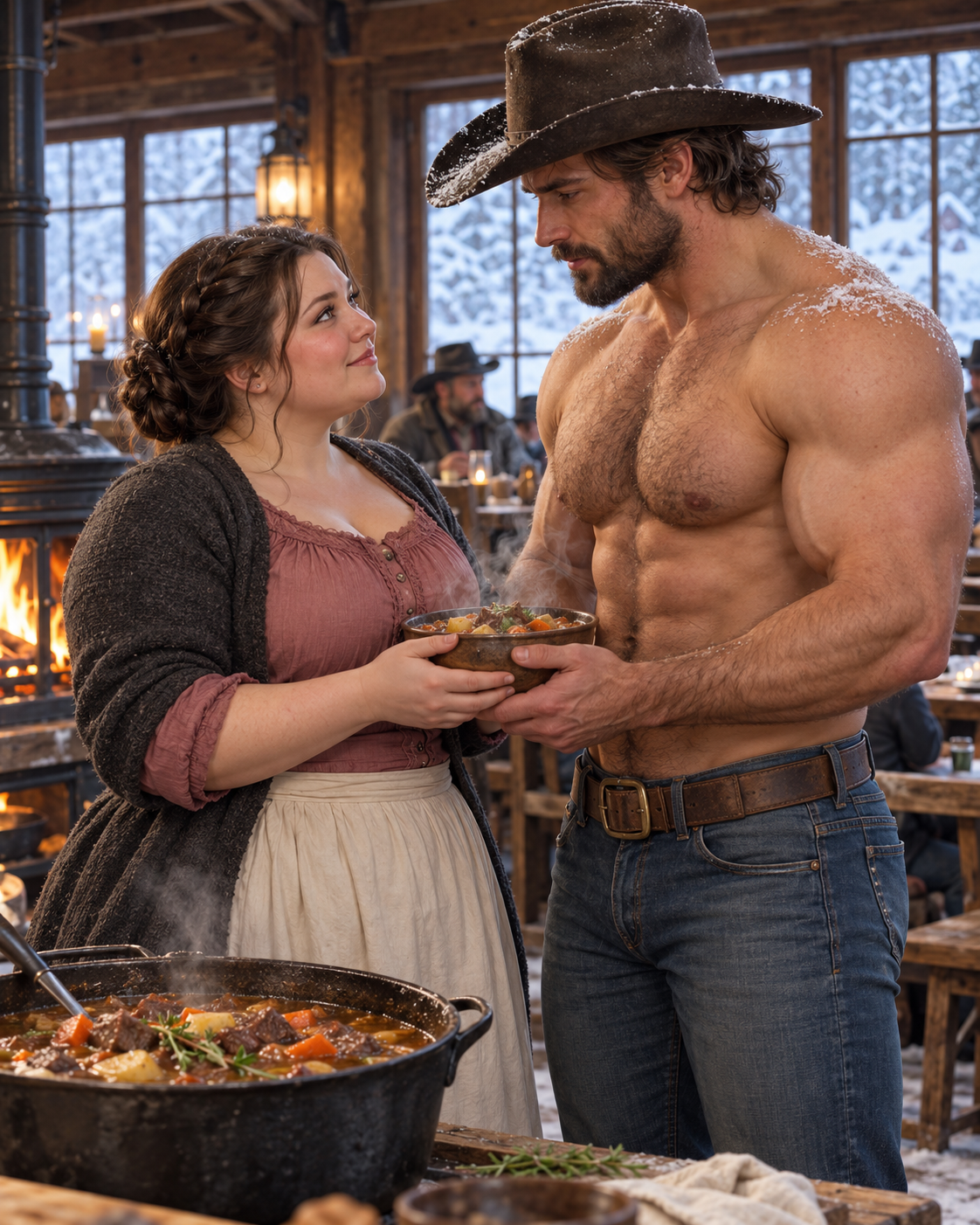
The following morning, Noah and I returned to the western ruins.
Grant followed despite his injured arm.
The air smelled of broken pine and freshly exposed earth.
We cleared snow from the cellar entrance and forced the swollen door open.
A narrow staircase descended into darkness.
Noah lit a lantern.
The cellar was colder than the world outside.
Wooden shelves lined the walls, supporting crates, ledgers, and rusted tools.
But someone had recently disturbed the dust.
Fresh boot prints crossed the floor.
And beside the far wall stood a heavy wooden trunk.
Its lock had been broken.
I looked at Grant.
“Was this here before?”
He nodded slowly.
“But it was locked.”
Inside, we found several account books and bundles of old correspondence.
Beneath them lay a smaller box wrapped in oilcloth.
The name Turner was written across its lid.
My hands began to tremble.
Grant stepped back.
“I never saw that box.”
I opened it.
Inside were Daniel’s work gloves, a photograph of us on our wedding day, and a sealed statement bearing three signatures.
Daniel Turner.
Samuel Price.
And Silas Rourke.
I unfolded the paper.
It was a confession.
Not a complete one, but enough.
Rourke admitted to falsifying livestock records and stealing money from ranchers.
He agreed to repay the losses in exchange for Daniel and another witness keeping the matter private until the cattle drive ended.
At the bottom, in different handwriting, someone had added a warning.
“Rourke intends to destroy the witnesses before the herd reaches Black Elk Pass.”
The note was signed Samuel Price.
I remembered Samuel.
He had been Daniel’s closest friend.
They had worked together for five years.
After the avalanche, Samuel disappeared.
I had always assumed he was buried somewhere beneath the snow.
But the final page contained an address in Montana, written just six months earlier.
And beneath it were four words.
“Samuel Price is alive.”
Noah let out a breath.
Grant leaned against the wall.
I stared at those words until the lantern light blurred.
Someone had known the truth.
Someone had survived.
And someone had been waiting.
Then footsteps sounded above us.
A ranch hand appeared at the entrance.
“Mr. Holloway! You’d better come quickly!”
We hurried outside.
The guard posted at the stone storehouse lay unconscious beside the door.
The lock had been smashed.
Mercer was gone.
And so were two horses.
For three days, the storm kept us trapped at Iron Pine.
Each night, I dreamed of Daniel standing on a snowy ridge, trying to tell me something I could not hear.
Each morning, I woke with his letter beneath my pillow.
Grant ordered armed watches around the remaining buildings.
Noah stayed close to me, though I could see fear in his eyes.
On the fourth morning, the sky cleared enough for a rider to reach town.
Noah left with the confession, copies of the ledgers, and a letter for the sheriff.
Before mounting, he pressed something into my palm.
It was a small wooden horse Daniel had carved years earlier.
Noah had found it in the saddlebag.
“I thought you should have this.”
I closed my fingers around it.
“Thank you.”
He smiled.
“I’ll bring help.”
I watched him ride through the southern gate.
Then I turned toward the mountains.
The fresh snow glittered in the sunlight, beautiful enough to make a stranger forget what lay beneath it.
I knew better.
Four nights later, someone knocked on my kitchen door.
It was nearly midnight.
Grant had gone to check the eastern fences, and the ranch hands were asleep.
I took the shotgun from above the stove.
“Who’s there?”
A weak voice answered.
“Someone who knew Daniel Turner.”
I opened the door a few inches.
An old man stood on the porch.
His beard was white, his coat torn, and his right hand shook uncontrollably.
A deep scar ran from his temple to his jaw.
He looked at me with eyes full of exhaustion.
“Mabel?”
I tightened my grip on the shotgun.
“Who are you?”
He removed his hat.
“My name is Samuel Price.”
The world seemed to stop.
I had pictured Samuel dead for seven years.
Now he stood before me, aged almost beyond recognition.
“How did you find me?”
“Your boy reached Ketchum. Word traveled.”
He swayed, gripping the doorframe.
“I’ve been trying to get here since I heard about the avalanche.”
I lowered the gun.
“Come inside.”
He sat beside the stove while I warmed soup.
His hands were badly scarred, and he walked with a limp.
When he saw Daniel’s photograph on the table, his face collapsed.
“I should have come sooner.”
I sat opposite him.
“Tell me what happened.”
Samuel closed his eyes.
“The snow wasn’t the only thing waiting for us at Black Elk Pass.”
My heart began beating faster.
He explained that Rourke had divided the herd before the storm, sending the stolen cattle south with men who had been paid to keep quiet.
Daniel discovered the plan and threatened to expose him.
Rourke responded by ordering the remaining cattle through the dangerous pass, knowing the storm would erase the evidence.
But Daniel refused to abandon the younger hands.
“He could have ridden back,” Samuel whispered.
“He had time.”
I gripped the table.
“Why didn’t he?”
“Because three boys were still up there.”
Samuel’s voice broke.
“One had a broken leg. Another had lost his horse.”
I pressed my knuckles against my mouth.
“Daniel went back for them.”
Samuel nodded.
“He got two boys down.”
“And the third?”
Samuel stared into the fire.
“I was the third.”
I could barely breathe.
“He came back for me, Mabel.”
Tears slipped down his cheeks.
“He pulled me from the snow, put me on his horse, and sent me toward the lower trail.”
“What happened to him?”
Samuel swallowed.
“Rourke was waiting above the pass.”
The room turned cold.
“He had a rifle.”
I stared at Samuel.
“No.”
“I heard the shot.”
My hands went numb.
“Daniel fell near the ridge, and then the snow broke.”
For seven years, I had imagined my husband buried beneath a wall of white.
I had never imagined him facing another man’s weapon before the mountain took him.
“Did Rourke shoot him?”
Samuel looked straight into my eyes.
“I don’t know if the bullet struck him.”
He lowered his head.
“But I know Daniel was alive when the avalanche started.”
I covered my face.
The grief I had carried for seven years returned with a force that made my chest ache.
Samuel reached across the table.
“I’m sorry.”
I shook my head.
“Why didn’t you tell me?”
“Rourke’s men found me afterward. They said they’d kill my family if I spoke.”
His voice trembled.
“I ran. I changed my name. I spent years believing silence was the only way to keep everyone safe.”
I looked at the scars on his hands.
“And now?”
Samuel lifted his eyes.
“Now I’ve buried my wife, my children are grown, and I cannot bear another night knowing Daniel died while I lived.”
Before I could answer, the front door opened.
Grant stepped inside, carrying a lantern.
He stopped when he saw Samuel.
The two men stared at one another.
Then Grant whispered, “Samuel?”
Samuel rose slowly.
“You remember me.”
Grant looked devastated.
“I thought you were dead.”
Samuel’s face hardened.
“You thought that about a great many things.”
Grant said nothing.
Samuel reached into his coat and removed a small notebook.
“This is the rest of the evidence.”
He placed it on the table.
“Names. Payments. The men who helped Rourke steal cattle.”
Grant opened the notebook.
His face turned white.
“What is it?” I asked.
He pointed to a name near the bottom.
Elias Mercer.
Beside it was another.
Silas Rourke.
And beneath both, written in careful letters, was a third name.
Thomas Holloway.
Grant’s younger brother.
The brother he had told me died of fever twelve years earlier.
I looked up.
Grant seemed unable to speak.
Samuel watched him with bitter eyes.
“Your brother didn’t die, Grant.”
Grant’s knees nearly gave way.
“He changed his name.”
I stared at the notebook.
Then understanding struck.
“Elias Mercer.”
Samuel nodded.
“The man who’s been visiting this ranch is Thomas Holloway.”
Grant sank into a chair.
“My own brother.”
Samuel’s voice was quiet.
“He helped Rourke carry out the fraud, and afterward he helped him disappear.”
I remembered Mercer’s hatred when he mentioned Daniel.
The way Grant had grown frightened when I found the saddlebag.
The strange visits.
The arguments behind closed doors.
Everything began to fit together.
“Why did Thomas come back?” I asked.
Samuel looked toward the dark window.
“Because Rourke is dying.”
The words startled me.
Samuel continued.
“He’s been living under another name near the Canadian border. Thomas wanted the remaining money and the records that could prove who stole it.”
Grant looked up.
“And my cellar?”
“Thomas knew you kept evidence. He wanted to destroy it before anyone else found it.”
I touched Daniel’s letter.
“Then why was his saddlebag there?”
Samuel’s expression softened.
“Because I brought it.”
I stared at him.
“What?”
“Six months ago, I came to Iron Pine while you were away visiting a sick neighbor.”
He looked at Grant.
“I wanted him to know I was still alive.”
Grant closed his eyes.
Samuel continued.
“I left Daniel’s belongings inside the old shed, along with a warning.”
“Why didn’t you come to me?”
His voice cracked.
“Because I was afraid you’d hate me.”
I looked at the broken man before me.
He had carried guilt across seven years and hundreds of miles.
“You should have trusted me with the truth.”
“I know.”
I touched his scarred hand.
“But you came back.”
He began to cry.
Outside, a horse whinnied sharply.
Then another.
I rose at once.
The horses were restless.
Again.
Before I reached the door, a gunshot rang through the night.
Grant grabbed his rifle.
Samuel moved toward the window.
A lantern was burning near the barn.
Then flames climbed the wooden wall.
“Fire!” I shouted.
We rushed outside.
The barn roof glowed orange against the dark sky.
Ranch hands stumbled from their quarters, pulling on coats.
Grant shouted orders while Samuel and I dragged water buckets from the well.
Then a figure appeared beyond the fence.
Mercer.
Thomas Holloway.
He held a rifle and stood beside two saddled horses.
“Grant!” he shouted.
Grant stopped.
His brother stepped into the lantern light.
“Give me the ledgers!”
Grant raised his rifle.
“It’s over, Thomas.”
Thomas laughed bitterly.
“You always did think you were the righteous one.”
“Put down the gun.”
“After you spent years hiding the same papers that could hang me?”
Grant lowered his rifle slightly.
“I was trying to protect you.”
Thomas shook his head.
“No. You were protecting yourself.”
The fire spread toward the hayloft.
Behind me, a horse screamed inside the burning barn.
I turned.
A young mare was trapped in her stall.
Noah’s favorite.
I ran toward the flames.
“Mabel!” Grant shouted.
But I was already inside.
Smoke filled the barn, stinging my eyes.
The mare kicked desperately against the wooden partition.
I wrapped my apron around my hand and lifted the latch.
The animal stumbled free.
I slapped her flank, sending her toward the open door.
Then I heard a sharp crack overhead.
A burning beam fell across my path.
Heat rushed over my face.
I stumbled backward.
For one terrible second, I was certain I would die in that barn.
Then someone grabbed my arm.
Samuel.
“Move!” he shouted.
He pulled me beneath a collapsing support as sparks rained around us.
We reached the doorway just as the roof began to fall.
Outside, Grant and Thomas were struggling in the snow.
The rifle discharged.
Grant dropped to one knee.
Thomas staggered backward, clutching his side.
For a moment, neither brother moved.
Then Thomas fell.
Grant crawled toward him.
“Tommy.”
The name sounded unbearably young.
Thomas stared up at the sky.
“Do you remember when Father took us fishing?”
Grant pressed a hand against his brother’s wound.
“Don’t talk.”
Thomas smiled faintly.
“You always caught the biggest trout.”
Grant’s face twisted.
“I’ll get help.”
Thomas shook his head.
“I was never good at being second.”
Blood darkened the snow beneath him.
He looked toward me.
“Your husband…”
I stepped closer.
Thomas struggled for breath.
“Rourke ordered the shot.”
My chest tightened.
“But Daniel wasn’t the man he meant to kill.”
I stared at him.
“What?”
Thomas coughed painfully.
“He wanted Samuel dead. Samuel had the records.”
Samuel stood beside me, trembling.
Thomas looked at Grant.
“Daniel stepped between them.”
His voice faded.
“I saw it.”
I felt my knees weaken.
Daniel hadn’t merely warned men about danger.
He had stood between a murderer and his friend.
Thomas reached weakly toward his brother.
“I’m sorry.”
Grant took his hand.
For several seconds, the two men looked at one another.
Then Thomas’s fingers went still.
Grant bowed his head.
I had never heard a grown man weep the way he did that night.
Not loudly.
Not dramatically.
Just a quiet, broken sound that seemed to come from somewhere beyond words.
By morning, the barn was gone.
The eastern pasture smelled of smoke, and blackened beams lay beneath a thin covering of fresh snow.
But every horse had escaped.
Grant survived with a fractured shoulder, and Samuel suffered burns on one hand.
Noah returned two days later with the sheriff and four deputies.
When the officers examined the ledgers, letters, and signed confession, there was enough evidence to begin pursuing the surviving men involved in Rourke’s crimes.
Thomas was buried on a small rise east of the ranch.
Grant insisted on digging part of the grave himself.
I watched him shovel frozen earth with his uninjured arm, tears falling silently into the snow.
He did not ask me to comfort him.
And I did not.
Some sorrow must be faced without expecting another person to carry it.
In December, word arrived that Silas Rourke had been located near the Canadian border.
He was gravely ill, but still alive.
The authorities intended to bring him back to answer for the crimes revealed in Daniel’s papers.
I read the message beside the kitchen stove.
For years, I had imagined justice as something fierce and satisfying.
I thought it would feel like a door slamming shut on all my pain.
Instead, I felt tired.
Daniel was still gone.
No prison sentence could give me back his laughter, his warm hands, or the little cabin we had once dreamed of filling with children.
But the truth mattered.
It mattered because his name had been buried beneath a lie.
And lies, I had learned, could destroy people long after the men who told them were gone.
Samuel remained at Iron Pine through the winter.
He helped repair the ranch and slowly regained strength.
Sometimes we sat together in the evenings while he told me stories about Daniel.
Small stories.
The way he sang badly while sharpening tools.
How he once gave away his last dollar to a hungry family.
How he carried a blue wool mitten because he missed his wife.
Those stories hurt.
But they also brought pieces of my husband home.
One evening, Grant came into the kitchen carrying a wooden box.
He placed it on the table.
“These are the deeds to the eastern meadow and the old stone storehouse.”
I frowned.
“Why are you showing me?”
“Because I want them to belong to you.”
I stared at him.
“Grant…”
“I can’t undo what happened to Daniel.”
He looked down.
“But I can stop pretending that regret is the same as making things right.”
I shook my head.
“I don’t want payment for my husband’s life.”
“I know.”
His voice was steady.
“This isn’t payment. It’s land you can use however you choose. No conditions.”
I studied his face.
The proud man who had once laughed at my warning had changed.
Not because the mountain frightened him.
But because he had finally learned what his silence had cost.
I took the deeds.
Not because I forgave everything.
But because I understood that something good could still grow from ruined ground.
By spring, the stone storehouse had become a shelter for travelers caught by bad weather.
We stocked it with blankets, dried food, firewood, and lantern oil.
Above its door, Noah carved a wooden sign.
TURNER’S REFUGE.
Beneath the name, he added a smaller line.
“No one is too unimportant to be heard.”
The first traveler who used it was a young widow with two children, stranded after her wagon broke an axle.
I watched her children sleep beside the stove, their faces peaceful beneath warm blankets.
And for the first time in seven years, I realized I was no longer living only in the shadow of the day Daniel died.
I was building something from what he had taught me.
One April morning, Samuel and I walked toward the western ridge.
The snow was melting, and dark earth showed beneath the pines.
Wildflowers had begun pushing through the ground where the avalanche had destroyed the bunkhouse.
I carried Daniel’s wooden horse in my pocket.
We stopped beside a small stone marker Noah had placed near the trail.
Daniel Turner.
Beloved husband.
A man who turned back for others.
I knelt and set the wooden horse against the stone.
Samuel stood silently behind me.
“I used to think courage meant never being afraid,” I said.
He looked at me.
“What do you think now?”
I brushed a little dirt from the marker.
“I think courage is being afraid and refusing to let someone else face the danger alone.”
Samuel nodded.
The breeze moved gently through the pines.
Somewhere below us, horses grazed in the spring sunlight.
For a moment, I closed my eyes.
I imagined Daniel standing beside me, his old hat tilted against the sun, smiling that crooked smile I had loved.
I could almost hear him say, “You did good, Mabel.”
When I opened my eyes, the mountain stood quiet and enormous against the blue sky.
It had taken my husband.
It had nearly taken the ranch.
But it had also uncovered the truth that men had tried to bury.
I reached for Samuel’s arm, and together we began walking home.
That evening, Noah came running into the kitchen with a letter from Wyoming.
It was from one of the young ranch hands Daniel had saved at Black Elk Pass.
He was now a father of three.
Inside the envelope was a photograph of his family and a simple message.
“My youngest son is named Daniel Turner, because I am alive to hold him only because your husband came back for me.”
I sat beside the stove and cried.
Not the desperate tears of a woman who had lost everything.
But the quieter tears of someone who had finally discovered that love does not end where a life ends.
Sometimes it keeps walking through the world in people who survived because someone cared.
Grant entered the kitchen and found me holding the photograph.
He didn’t ask why I was crying.
He simply placed another log on the fire and sat nearby.
After a while, I handed him the letter.
He read it slowly.
Then he wiped his eyes.
“Daniel was a better man than I ever knew.”
I looked toward the window, where the last sunlight rested on the Sawtooth Mountains.
“He was a good man,” I said.
“And that’s something every one of us can still choose to be.”
Outside, the evening bells sounded from the horses’ harnesses.
For once, the sound did not remind me of death.
It reminded me of home.
And I finally understood that the greatest warning the mountain had given us was not about snow or danger.
It was about the terrible cost of refusing to listen.
A proud man had once dismissed a frightened woman’s warning, and lives had been lost.
Years later, another proud man had listened, and lives had been saved.
The difference between tragedy and survival had been nothing more extraordinary than humility.
I folded Daniel’s letter and placed it inside the wooden box beside our wedding photograph.
Then I opened the kitchen door and stepped into the cool spring air.
For seven years, I had waited for the past to release me.
Now I knew I had been waiting for something else.
The courage to carry its lessons forward without letting its sorrow destroy the life I still had.
And somewhere beneath the quiet stars, I hoped Daniel knew that the woman he loved had finally found her way home.
THE END.