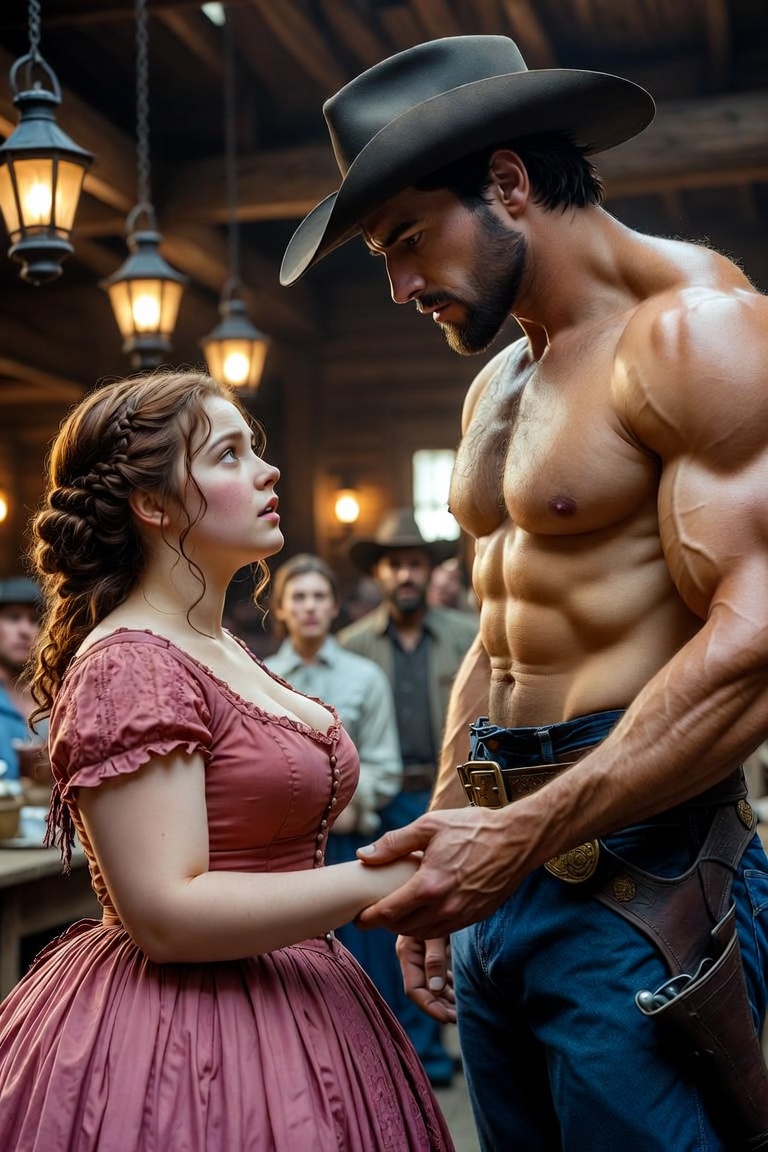
At the Cedar Ridge harvest dance, my father ordered me off the floor when the richest rancher in Texas chose me over my beautiful sister, unaware he knew the secret they’d buried.
My father stood beneath the porch light, clutching the blue leather folder as though it contained the last pieces of a life he had spent years trying to protect. The wind moved through the burned fields behind him, carrying the smell of smoke that still lingered months after the wildfire, and I suddenly understood that the ashes had destroyed our old home but had not destroyed the secrets buried beneath it.
I held my mother’s letter in one hand and the trust agreement in the other, while Daniel Brooks watched my father with the exhausted expression of a man who had waited too long for the truth to come out.
“Rachel, please listen to me before you open that folder,” my father pleaded.
For years, I had imagined what it might feel like to hear those words from him, to finally be asked instead of ordered, to be treated like a daughter whose feelings mattered. Yet now that the moment had arrived, all I felt was the ache of remembering how many times I had begged him to listen when he was too busy counting debts to notice my tears.
I looked toward Matthew, but he remained several steps away, respecting the space I had asked for without saying a word. His silence reminded me that this was my fight, and whatever truth waited inside that folder, I would face it with my own eyes.
“Open it,” I told my father.
His fingers tightened around the worn leather.
“Your mother was frightened near the end,” he said. “She believed everyone wanted something from her, and I thought I was protecting her.”
Daniel shook his head slowly.
“Protection doesn’t require forged signatures, Robert.”
The words struck the porch like a gunshot, and my father flinched as though the accusation had finally found the place he had hidden from himself.
He opened the folder.
Inside were old deeds, bank statements, letters written in my mother’s careful handwriting, and a document bearing a signature that looked like hers but was not quite right. Beneath it lay a transfer agreement claiming that she had willingly surrendered her inherited property to secure our ranch’s debts.
I recognized the land described in the papers immediately. It was the broad stretch of pasture beyond the creek, where my mother had once taught me to ride a young mare without a saddle, laughing whenever I fell into the soft grass.
My father had always called that property worthless.
But the trust documents Daniel had brought showed that the land contained a protected water source and valuable mineral rights, making it worth far more than the entire ranch we had lost.
I looked at the transfer agreement again, then at the man who had raised me.
“Did you sign her name?”
My father closed his eyes.
For several seconds, the only sound was the wind rattling the loose boards along the porch.
“Yes,” he whispered.
The single word broke something inside me that no fire could ever have reached.
He explained that the ranch had begun falling into debt years before my mother died, after two disastrous seasons and a series of cattle losses left him desperate to keep the family property from foreclosure. When a lender offered him a temporary extension in exchange for additional collateral, he had panicked and used my mother’s land to secure the loan.
At first, he told himself he would repay the money before anyone discovered what he had done.
Then the interest grew, the cattle market collapsed, and each attempt to save the ranch only dragged him deeper into the debt he had created.
When my mother discovered the forged transfer, she demanded that he confess and restore the property to her trust.
Instead, he begged her to give him time.
She refused.
According to my father, their final argument had ended with my mother threatening to tell Daniel everything, even if it meant losing the ranch and exposing the family to public shame.
“She wanted to protect you,” he said, looking at me through wet eyes. “She knew that one day the debt would fall on your shoulders, and she didn’t want you to inherit my mistakes.”
I swallowed hard, trying to reconcile the man standing before me with the father I had spent my life trying to please.
“And you let me believe I had to save the ranch,” I said. “You watched me work until my hands bled, and you never told me there was another way.”
His shoulders sagged.
“I was ashamed.”
“Shame doesn’t excuse what you did.”
“I know.”
For once, he didn’t argue.
Then Daniel removed another document from the folder, a handwritten statement my mother had prepared shortly before her death. He explained that she had entrusted it to his office, intending it to serve as evidence if my father ever attempted to sell or mortgage the land again.
The original statement had vanished after her funeral, but Daniel had kept a certified copy.
My mother’s words were brief, yet each sentence felt like she was sitting beside me, speaking through the years she had been denied.
She wrote that the land belonged to me, that my father had no authority to transfer it, and that she wanted me to have the freedom to decide what kind of life I would build when I was old enough to understand its value.
At the bottom, she had added one final line.
Do not let anyone convince you that loving your family means surrendering the life that is yours.
I pressed the paper to my chest, and the tears I had held back finally spilled over.
My mother had known how easily I would confuse sacrifice with duty because she had watched me do it since childhood. She had tried to leave me something stronger than money, something that would remain mine even when the people I loved demanded everything I had.
But the discovery of the forged documents was only the beginning.
Daniel warned us that the lender had already begun preparing a legal claim against the property, relying on the fraudulent transfer agreement my father had signed. If we failed to challenge it before the next hearing, the land could be tied up in court for years, leaving me unable to sell, develop, or use it as security for my own business.
My father offered to confess publicly and accept whatever punishment came.
I watched him carefully, searching for the familiar selfishness that had once shaped every decision he made.
For the first time, I saw a man who seemed willing to lose something rather than make me lose it for him.
“I will tell the truth,” he said. “All of it.”
I wanted to believe him, but trust was not a gate that opened simply because someone finally knocked.
“You will tell the truth because it is the right thing to do,” I answered. “Not because you expect me to forgive you.”
He nodded, accepting the distinction.
The following morning, Daniel arranged a meeting with the bank’s legal representative, and Matthew offered to accompany us as a witness. Before we left, however, I asked Matthew to wait outside while I spoke with Daniel alone.
I needed to know one thing that had been haunting me since I first opened the letter.
“How long have you known my mother?”
Daniel studied me for a moment, then reached into his briefcase and withdrew a small photograph.
It showed my mother standing beside a younger Matthew near the same wooden fence where I had once learned to ride. His face was thinner, his hair darker, but his unmistakable eyes were fixed on my mother with the quiet respect I had come to recognize.
“Matthew was working with a neighboring ranch when your mother began investigating the water rights,” Daniel explained. “He helped her find an independent surveyor because she suspected your father was concealing the property’s real value.”
I stared at the photograph, remembering Matthew’s expression when he had first seen the envelope.
“Why didn’t he tell me?”
“Your mother asked him not to reveal anything until the trust could be properly secured. After she died, he discovered that the documents had been altered, but he couldn’t prove who had done it.”
Daniel paused before continuing.
“He also knew your father was struggling, and he believed that confronting him without evidence would only make things worse.”
I felt a complicated mixture of gratitude and hurt.
Matthew had not hidden the truth to gain my land, but he had still carried a piece of my history that belonged to me. His intentions might have been honorable, yet I needed him to understand that honesty could not be something he offered only when the timing suited him.
When I found him outside, he was leaning against his truck, watching the early sunlight spread across the ruined hills.
“You should have told me about my mother,” I said.
He didn’t deny it.
“You’re right.”
“Even if she asked you to keep it secret?”
“Especially because it concerned you.”
His answer surprised me more than an excuse would have.
He explained that he had respected my mother’s wishes for years, but after discovering the altered documents, he had become afraid that telling me without proof would only deepen the pain I was already carrying. Then, when he realized how much he cared for me, that fear had become tangled with another one: the possibility that I might believe he wanted the property more than he wanted me.
“I made the decision for you,” he admitted. “And I know that’s exactly what you never wanted anyone to do again.”
I looked at the man who had offered me a partnership when I expected charity, who had pulled me from a burning field without asking for anything in return, and who now stood before me without trying to defend his mistake.
“I don’t need you to be perfect, Matthew,” I said. “I need you to trust me with the truth, even when it’s painful.”
He reached for my hand, then stopped, allowing me to decide whether I wanted the touch.
I took his hand.
“Then no more secrets,” he promised.
“No more secrets,” I repeated, though I knew keeping that promise would be harder than saying it.
The legal battle lasted nearly four months.
My father’s confession, Daniel’s certified records, and the evidence of the forged signature eventually forced the lender to withdraw its claim against the inherited property. The bank still pursued the legitimate debts attached to the old ranch, but the land my mother had protected was restored to my name through the court’s ruling.
When Daniel called to tell me the decision had been finalized, I sat alone in my small office and cried over a piece of paper.
Not because I had become wealthy overnight, and not because the land would solve every problem, but because for the first time, something my mother had intended for me had survived the choices of everyone around her.
The victory also came with consequences.
My father faced legal penalties for the fraudulent transfer and lost the authority he had once exercised over our family’s remaining finances. Some neighbors turned away from him, while others admitted they had suspected something was wrong but had been too afraid to speak.
He moved into a modest house near town and began working for a local livestock auction, determined to repay what he could rather than asking me to rescue him.
I visited him once a week, but I stopped paying his bills and stopped rearranging my life whenever he needed something.
At first, he seemed wounded by the distance.
Then, slowly, he began to understand that my boundaries were not punishments designed to make him suffer. They were the conditions under which a relationship might one day become honest.
Lillian surprised me most of all.
She could have returned to the easy life she had once expected, finding another wealthy man to support her and pretending the scandal had never happened. Instead, she began helping me establish a breeding and training operation on the recovered property.
She learned to clean stalls, repair tack, and keep records, often making mistakes that would have embarrassed the old version of herself.
One afternoon, I found her sitting beside the paddock, crying as she watched our mother’s favorite mare graze.
“I used to think you were lucky because you could do everything,” she confessed. “I never understood that you were doing everything because nobody else would.”
I sat beside her.
“I used to think you were loved because everyone noticed you,” I admitted. “I didn’t understand how lonely it could be to need everyone to keep noticing.”
She leaned against my shoulder, and for a long time, neither of us spoke.
We did not become inseparable overnight, and there were still old resentments we had to untangle. But we began telling each other the truth, even when it made us uncomfortable, and that was more valuable than pretending we had never hurt each other.
By the following spring, the recovered land had begun to look alive again.
I repaired the old fencing, built a small stable, and started training horses for neighboring ranchers. The first few months were difficult, and there were nights when I worried about feed costs, veterinary bills, and whether I had mistaken independence for the ability to do everything alone.
Matthew never offered to take over.
Instead, he reviewed my business plans when I asked, introduced me to reliable buyers, and treated every agreement between us as something that deserved to be written down and honored.
When my first breeding contract brought in enough money to cover the stable’s expenses for six months, I bought myself a new saddle.
It was not the most expensive saddle in Cedar Ridge, but I chose it because it fit me perfectly, and I paid for it with money I had earned under my own name.
I kept the receipt tucked inside my desk as a reminder of how far I had come.
One evening, Matthew arrived at the paddock carrying a small wooden box.
The sunset painted the hills gold, and the mares moved quietly through the tall grass while he stood beside the fence, looking more nervous than I had ever seen him.
“I have something for you,” he said.
Inside the box was the ring he had offered me months earlier, simple and elegant, with a small stone that caught the light without demanding attention.
I looked at it, then at him.
“I meant what I said the night I proposed,” he told me. “I want a life with you, but I don’t want you to feel that accepting me means giving up any part of yourself.”
He took a breath.
“If you want to keep your land separate from mine, we will. If you want your business to grow beyond anything I own, I will stand beside you and watch you do it.”
For a moment, I couldn’t speak.
I had spent so much of my life believing love meant being useful, being quiet, and making myself smaller so someone else could feel secure. Matthew was offering me something I had never known how to ask for: a future in which I could remain entirely myself.
“I won’t promise that we will never hurt each other,” I said. “I won’t promise that I will always agree with you, or that I will stop choosing my work when it matters.”
He smiled gently.
“Good. I would worry if you did.”
I laughed, and the sound surprised me with its freedom.
Then I took the ring from the box and slipped it onto my finger.
“Yes, Matthew,” I whispered. “I will marry you, because I want to, not because I need somewhere to go.”
He drew me into his arms, and when he kissed me, there was no audience, no family watching, and no debt waiting to decide what my future should look like.
There was only the quiet certainty that we had chosen each other freely.
We married in the spring beneath the old oak tree overlooking my mother’s land, with Daniel sitting in the front row and Lillian holding a bouquet of wildflowers she had gathered herself.
My father attended too, sitting quietly at the back.
He did not ask to walk me down the aisle, and I did not ask him to.
After the ceremony, he approached me with tears in his eyes and told me that my mother would have been proud of the woman I had become.
I believed him, though I understood that pride could not erase the years I had spent feeling invisible.
“I hope one day you can forgive me,” he said.
I held his gaze.
“I hope one day we can build something better than what we had,” I answered. “But it will take time.”
He nodded, and for once, he did not ask me to make that time shorter for his comfort.
That night, after the guests had gone and the horses had settled into their stalls, Matthew and I walked across the pasture beneath a sky crowded with stars.
He asked whether I regretted the months of fear, the legal battle, or the painful truths that had changed our family forever.
I thought of the burned ranch, my mother’s letter, my sister’s tears, and the girl I had once been, standing in the shadows while everyone praised someone else.
“No,” I said at last. “I regret believing that I had to earn the right to be treated with love.”
Matthew squeezed my hand, and we continued walking toward the stable lights.
The land was still scarred in places, and our future would bring its own troubles, but I no longer mistook hardship for proof that I had failed. I had learned that being strong did not mean carrying every burden alone, and forgiving someone did not mean handing them the power to hurt me again.
Most importantly, I had learned that love was not a debt to be repaid, a prize to be won, or a cage disguised as shelter.
Real love made room for the truth.
It respected the word no, celebrated the word yes when it was freely given, and understood that two people could build a life together without either one disappearing inside the other.
As the first light of dawn touched the hills, I stood beside my husband and watched my mares run across the pasture my mother had fought to protect.
For years, I had believed my greatest achievement would be saving the ranch that had consumed my childhood.
Now I understood that the ranch had never been the most important thing I had saved.
I had saved the right to choose my own future.
And when I looked at Matthew, then at the open land stretching beyond us, I finally understood the truth my mother had tried to leave me all along: a woman does not become worthy of love when someone chooses her; she becomes free when she realizes she was worthy long before anyone noticed her.
THE END.