At 29, Hannah Sterling had spent years saving strangers in the emergency rooms of St. Jude’s Hospital.
Hannah stared at the date until the numbers blurred. Tomorrow was November 3. The envelope had been prepared before she ever found Victor’s wrecked Maybach, before she drove through the gates of Cliffhaven, and perhaps before Preston accused her of stealing forty vials of fentanyl.
“Who is she?” Victor asked.
“Emily Dawson,” Hannah whispered. “She’s a nurse in my emergency department. She was my friend.”
On the surveillance monitor, Emily stood beneath the floodlights with snow collecting on her shoulders. Her dark hair had escaped its usual neat bun, and a thin streak of blood marked her cheek. She looked frightened enough to collapse.
Marcus studied the monitor. “She came alone. But that doesn’t mean nobody followed her.”
“Bring her into the security vestibule,” Victor ordered. “Search the vehicle first.”
Hannah turned sharply. “She’s injured.”
“And someone tried to kill me tonight,” Victor replied. “I’m not making the same mistake twice.”
There was no anger in his voice, only the hard calculation of a man accustomed to surviving betrayal. Hannah hated that she understood his caution.
Five minutes later, Emily appeared on another monitor inside the small, brightly illuminated vestibule. Two security officers stood several feet away while Marcus spoke to her through an intercom.
“I need to see Hannah,” Emily pleaded. “Please. I don’t have much time.”
Hannah stepped toward the microphone.
“I’m here, Emily.”
The other woman’s face crumpled.
“Oh, thank God.”
“Why are you here? And why is that envelope dated tomorrow?”
Emily glanced toward the security camera, her trembling hands tightening around the paper.
“Because tomorrow is when they’re going to say you killed a patient.”
The room became painfully silent.
Hannah felt her heartbeat hammer against her ribs.
“What patient?”
Emily lifted the envelope.
“Margaret Keene. Seventy-three years old. Cardiac patient. She was admitted to the surgical observation unit this afternoon.”
Hannah frowned. “I haven’t treated anyone named Margaret Keene.”
“I know. That’s why I came.”
Emily pressed her palm against the glass separating the vestibule from the interior corridor.
“Preston has already prepared a medication administration report with your electronic signature. It says you gave her fentanyl at 9:42 tonight. She’s alive right now, Hannah. But he’s scheduled a private procedure for six tomorrow morning, and he told the nurses nobody is allowed to question his orders.”
Hannah struggled to absorb the words.
The theft accusation had been devastating. But this was something else entirely.
Preston wasn’t simply trying to end her career.
He was preparing to make her responsible for a death that hadn’t happened yet.
Victor’s expression changed. He looked toward Marcus, who was already contacting the security team.
“Bring her in,” Victor said. “And get our medical staff ready.”
When Emily entered the study, Hannah noticed bruising around her left wrist. The moment she saw it, her professional instincts overcame her shock.
“Who did that?”
Emily pulled her sleeve down.
“It doesn’t matter.”
“It matters to me.”
Emily began crying.
“Preston found out I copied the original inventory records. He told me if I didn’t help him, he’d make sure my younger brother lost his place on the transplant list.”
Hannah stared at her.
“Your brother, Daniel?”
Emily nodded.
For years, Hannah had watched Emily work double shifts to support Daniel through kidney failure. Preston knew exactly which threat would frighten her most.
“He said he had connections with the transplant committee,” Emily whispered. “I believed him.”
“You should have told me.”
“I wanted to. But then I saw the paperwork for Margaret Keene, and I realized he wasn’t going to stop.”
Emily placed the envelope on Victor’s desk.
Inside were copies of medication orders, an unsigned death summary, and a document labeled INCIDENT REVIEW: STERLING, HANNAH.
The summary described Margaret’s death from an accidental opioid overdose.
It even included a statement attributed to Hannah, supposedly admitting that exhaustion had caused her to administer the wrong dose.
Hannah read the words twice.
The statement was dated tomorrow at 7:15 a.m.
For a moment, she couldn’t breathe.
Then her expression hardened.
“He’s writing the ending before the patient dies.”
Victor leaned forward.
“Which means we still have time to change it.”
Hannah looked at him, suddenly aware that she knew almost nothing about the man whose life she had saved.
“Why were you investigating Preston in the first place?”
Victor remained silent long enough for her to wonder whether he intended to answer.
Finally, he opened a drawer and removed an old photograph.
It showed a smiling young woman standing beside a hospital bed, holding a little boy with dark curls. A second woman, older and exhausted, sat nearby.
“The woman standing is my sister, Catherine,” Victor said.
Hannah glanced at the photograph.
“She’s beautiful.”
“She was.”
The single word changed the atmosphere.
Victor looked down at the photograph.
“Three years ago, Catherine entered St. Jude’s for what should have been a routine procedure. She died after receiving medication that wasn’t recorded in her chart. The hospital called it an unforeseeable complication.”
Hannah felt a chill.
“Who was her surgeon?”
“Preston Hale.”
She closed her eyes.
Victor continued quietly.
“I accepted the hospital’s explanation because Catherine had asked me to stop interfering in her life. She thought my money made me believe I could control everything.”
His fingers tightened around the photograph.
“Six months ago, a former hospital accountant contacted me. She’d discovered suspicious payments connected to private medical shipments. Catherine’s records were among those altered.”
“What happened to the accountant?”
“She disappeared before we could meet.”
Hannah looked at the photographs scattered across the desk.
“And you think Preston was involved?”
“I know he approved the altered medication records. What I don’t know is who paid him, or why Catherine was allowed to die.”
For the first time, Hannah saw something behind Victor’s intimidating composure that had nothing to do with power.
Grief.
It was the kind that remained long after condolences had stopped arriving.
“Your sister had a son?” Hannah asked.
Victor nodded.
“Oliver. He’s eight now.”
“Does he live here?”
“With his father in Vermont.”
Hannah studied the photograph once more.
“Then he deserves the truth.”
Victor looked at her, and something in his expression softened.
Before either could speak again, Marcus’s phone rang.
He listened for several seconds, then crossed the room.
“Sir, we’ve traced the company listed on the medication transfer. North Atlantic Clinical Logistics. Its registered address is a rented office, but the warehouse photographs lead to a property outside Portland.”
“Who owns it?”
Marcus glanced at Hannah.
“A holding company controlled by Dr. Hale.”
Emily covered her mouth.
But Marcus wasn’t finished.
“The holding company has another investor. A company called Ardent Medical Recovery.”
Victor went completely still.
Hannah noticed.
“What is Ardent?”
Victor looked toward the windows.
“A subsidiary of my family’s investment group.”
Hannah stepped backward.
The man offering to save her career had just revealed that his own financial empire was connected to the conspiracy.
“Did you know?”
“No.”
“Victor.”
He met her eyes.
“I didn’t know, Hannah.”
“Then who did?”
Marcus answered before Victor could.
“Your chief financial officer. Adrian Mercer.”
Victor’s jaw tightened.
For years, Adrian Mercer had controlled the financial structure of Vane Holdings, managing billions in investments and acquisitions. He had been Victor’s closest business associate, the man trusted to maintain order while Victor traveled.
He had also been sitting beside Catherine’s hospital bed the night she died.
Victor remembered that now.
Adrian had insisted that the hospital was doing everything possible.
He had persuaded Victor not to demand an independent examination.
And when Catherine died, Adrian had personally arranged the settlement that prevented further questions.
Victor rose abruptly, ignoring the pain in his injured chest.
“Get me every transaction Ardent has made in the past five years.”
Marcus nodded.
“And contact federal investigators,” Victor added. “No private confrontation. No warning calls. I want this handled by people who can put every one of them behind bars.”
Hannah was surprised.
A man with Victor’s reputation could have pursued revenge in far darker ways.
Instead, he seemed determined to secure something he couldn’t buy.
Justice.
But time was running out.
At St. Jude’s, Margaret Keene was waiting for a procedure that could end her life.
“We need to stop Preston tonight,” Hannah said.
Marcus shook his head.
“The roads are nearly impassable. Police units are responding to collisions across the county.”
“Then call the hospital.”
Emily grabbed Hannah’s arm.
“No. Preston controls the surgical unit tonight. If he knows we have the records, he’ll destroy everything and move Margaret.”
Hannah stared at the falsified medication report.
She suddenly remembered something from her final shift.
Three days earlier, St. Jude’s had installed a temporary medication tracking system during a software upgrade. The hospital’s main electronic records could be amended by authorized administrators, but the dispensing cabinets still sent encrypted transaction receipts to an independent pharmacy auditing service.
Those receipts were transmitted automatically.
And they couldn’t be changed by Preston.
“Victor,” she said slowly, “you told me you had access to independent records.”
He nodded.
“Some of them.”
“Do you have the original dispensing logs?”
“Not yet.”
“Then that’s what we need.”
She explained the temporary system. Every controlled medication withdrawal generated a machine identification number, a staff credential reference, and a digitally signed time record. Even if an administrator altered the hospital database, the external audit trail would preserve the original event.
“The inventory report proves Preston authorized a transfer after I left,” she said. “But those cabinet records may show who actually removed the medication.”
Victor turned to Marcus.
“Find the auditing company.”
Marcus was already typing.
Twenty minutes later, the storm had intensified into a white wall beyond the windows. Cliffhaven’s generators hummed as the main power failed.
Inside the study, Marcus established a secure call with a compliance director at the independent auditing company.
Hannah provided her professional identification and explained the discrepancy, but the director refused to release confidential records without proper legal authority.
Victor could have threatened him.
Instead, he asked the director to preserve every relevant record and immediately notify the company’s legal department.
Marcus connected the call to a federal investigator already reviewing suspicious pharmaceutical shipments connected to North Atlantic Clinical Logistics.
Within the hour, an emergency preservation request was underway.
Hannah watched the process with mounting impatience.
“Margaret doesn’t have an hour,” she said.
Victor turned toward her.
“Then we use what we already have.”
Emily swallowed.
“I know someone who might help.”
She reached into her coat and removed her phone.
“Dr. Samuel Brooks. He’s the overnight attending physician in the medical intensive care unit. Preston hates him because he reported a surgical billing discrepancy last year.”
“Can we trust him?” Marcus asked.
Emily looked at Hannah.
“He’s the one who helped Daniel get his transplant evaluation.”
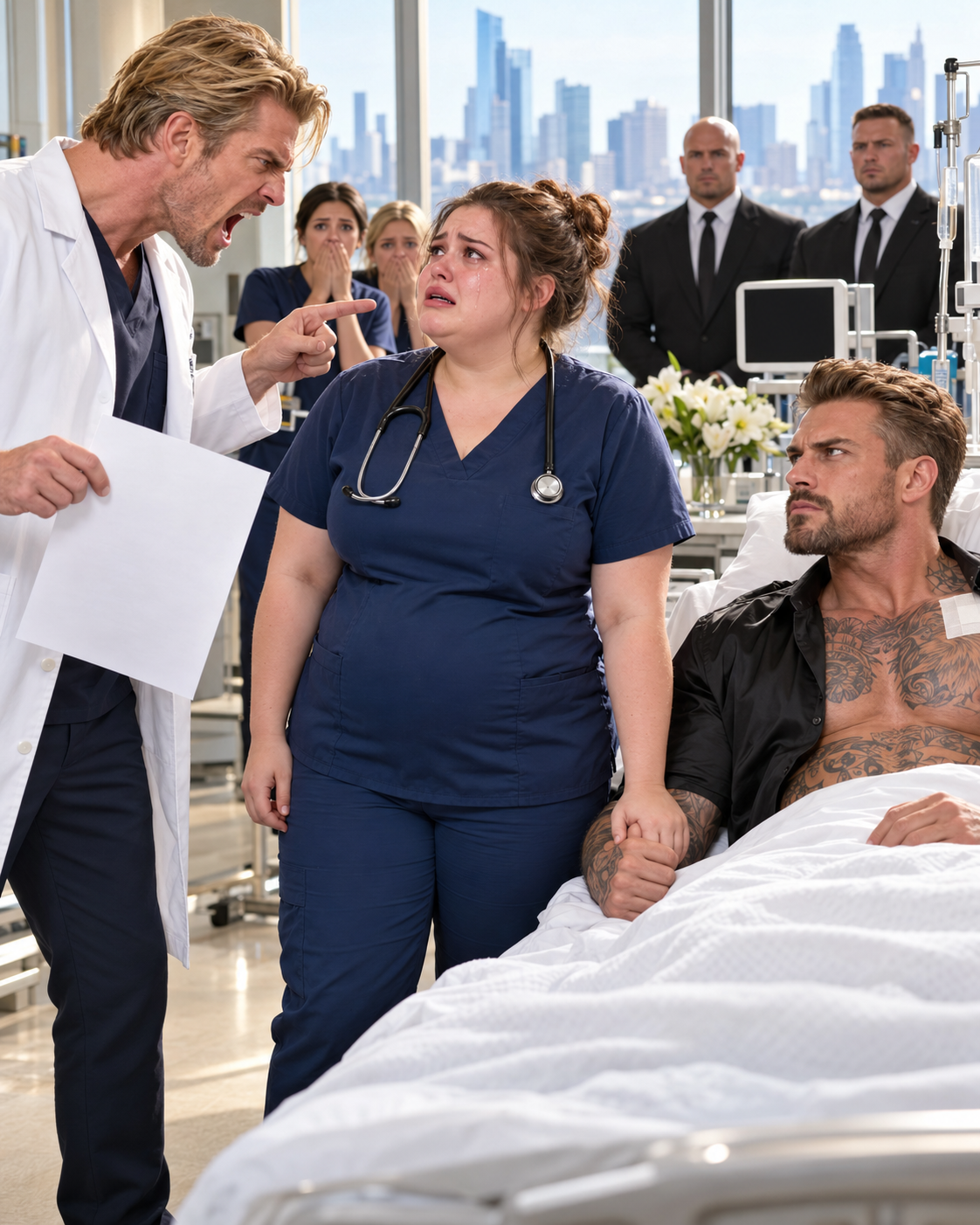
Hannah remembered Samuel Brooks as a quiet, methodical physician who refused to discharge patients until he was satisfied they were stable.
She had once watched him spend an entire night beside an elderly patient whose family couldn’t arrive until morning.
“Call him,” Hannah said.
Samuel answered on the fourth ring.
“Emily? Is everything all right?”
“No,” Hannah replied, taking the phone. “Dr. Brooks, it’s Hannah Sterling. I need you to listen carefully.”
There was a pause.
“Hannah? I heard what happened.”
“Margaret Keene is in surgical observation. I believe her medical record has been falsified and that she’s in immediate danger.”
Samuel’s voice sharpened.
“What evidence do you have?”
Hannah described the forged medication administration report and the death summary dated for the following morning.
She expected disbelief.
Instead, Samuel asked one question.
“Is she still alive?”
“Yes.”
“Then I’m going to examine her myself.”
The call ended.
For the next eleven minutes, nobody in the study spoke much.
Emily sat near the fireplace, holding a mug of tea she never drank. Marcus monitored security reports while Victor struggled to hide the pain spreading through his chest.
Hannah noticed his shallow breathing.
“You’re getting worse.”
“I’m fine.”
“That’s not a medical assessment.”
He attempted a faint smile.
“You always this demanding?”
“Only when my patients are stubborn.”
She checked his pulse and persuaded him to let his private physician examine the wound beneath his bandages. The doctor, Dr. Conrad Ellis, entered reluctantly, his earlier contempt still evident.
“Mr. Vane should never have been allowed out of bed,” he said.
Hannah stepped aside but remained close enough to observe.
When Conrad removed the dressing, she noticed a spreading discoloration around Victor’s lower ribs.
His pulse was accelerating.
“His pressure needs checking again,” she said.
Conrad frowned.
“I know how to examine a patient, Nurse Sterling.”
“Then you know worsening pain and a rising pulse after blunt trauma can mean internal bleeding.”
Victor looked between them.
Conrad’s expression tightened.
“There’s no reason for alarm.”
Hannah stared at him.
“Where’s the imaging report from the hospital?”
“The examination was sufficient.”
“No imaging?”
“He refused transport.”
Victor shook his head.
“I didn’t refuse. You told me it wasn’t necessary.”
The study fell silent.
Hannah felt the familiar warning sensation that came whenever something in a patient’s presentation failed to match the explanation.
She looked directly at Conrad.
“Who told you to keep him here?”
The physician said nothing.
Marcus moved toward the door.
Conrad stepped backward.
“Mr. Vane, I’ve served this family for sixteen years.”
“And now you’re going to answer her question,” Victor said.
Conrad glanced at the security officers outside.
Then he reached into his medical bag.
Hannah saw the movement before anyone else.
“Marcus!”
The security director crossed the room as Conrad pulled out a syringe.
Marcus caught his wrist before he could reach Victor.
The syringe struck the floor and shattered.
Conrad struggled briefly, then collapsed into a chair, his face drained of color.
“They threatened my daughter,” he whispered.
Victor stared at him.
“Who?”
“Adrian Mercer. He said if you survived the accident, I had to make sure you didn’t survive the night.”
Hannah looked at the shattered syringe, then at the physician.
“What was in it?”
Conrad began shaking.
“I don’t know. He sent it with instructions.”
Marcus ordered the syringe fragments secured and Conrad detained for the authorities.
Hannah turned back to Victor.
“We’re getting you to a hospital.”
He tried to protest.
She interrupted him.
“Your sister died because people changed medical records and convinced everyone not to question them. I’m not going to let you become another unexplained complication.”
Victor looked at her for a long moment.
Then he nodded.
“All right.”
The estate’s emergency helicopter couldn’t fly through the storm, but Marcus had an armored medical transport vehicle equipped for severe weather. A nearby regional hospital, unaffiliated with St. Jude’s, agreed to receive Victor for emergency evaluation.
As the transport crew prepared to leave, Samuel Brooks called.
His voice sounded strained.
“Margaret Keene is alive. I’ve moved her to intensive care under my supervision.”
Hannah closed her eyes in relief.
“Thank God.”
“But there’s a problem,” Samuel continued.
“Preston found out I intervened. He’s telling hospital security that I’ve kidnapped a patient.”
“Can he make that accusation stick?”
“Not if the records are examined. But he’s trying to have me removed from the unit.”
Victor held out his hand for the phone.
“Dr. Brooks, this is Victor Vane. Federal investigators are already involved. Preserve the original chart and contact the hospital’s patient safety officer directly. Don’t confront Hale alone.”
Samuel hesitated.
“Victor Vane?”
“Yes.”
“Then you should know something. I recognized the name on the falsified medication order.”
Hannah leaned closer.
Samuel continued.
“The order uses an emergency override credential assigned to a surgeon who died fourteen months ago.”
“Who?” Hannah asked.
“Dr. Nathaniel Price.”
Emily gasped.
Hannah remembered Nathaniel Price.
He had been a respected anesthesiologist who supposedly died after losing control of his car on an icy road.
He had also been the physician who repeatedly questioned unusual medication shortages before his death.
“Dr. Price reported discrepancies,” Hannah whispered.
Samuel’s voice lowered.
“Exactly. And the last person recorded entering his office before he died was Preston Hale.”
Suddenly, the conspiracy stretched much further into the past.
Catherine Vane.
Nathaniel Price.
Forty missing vials.
A staged overdose.
And a surgeon who had somehow survived every suspicious death surrounding him.
Hannah felt anger replace her fear.
For years, she had believed that hard work and honesty were enough to protect a medical career.
Now she understood that integrity sometimes required something far more difficult.
Refusing to remain silent.
Victor was transported shortly after midnight. At the regional hospital, imaging revealed a small but significant splenic injury that required urgent treatment and close monitoring. Hannah remained nearby while the trauma team took over, answering questions about the roadside rescue and Victor’s deteriorating condition.
Before the doctors wheeled him away, Victor caught her hand.
“You saved me twice.”
“Then stop making it so difficult.”
His fingers tightened gently around hers.
“There’s something else you should know.”
Hannah leaned closer.
“My sister kept a journal,” he whispered. “After her death, Adrian told me it had been destroyed. But last month, someone mailed me a page from it.”
“What did it say?”
Victor’s eyes darkened.
“Catherine wrote that she had discovered children being used to conceal medical billing fraud. She believed the hospital was charging for treatments that had never been provided.”
Hannah’s breath caught.
“Children?”
Victor nodded.
“Her last entry said she had given the evidence to someone named Sterling.”
Hannah stared at him.
Sterling.
Her own surname.
“My father,” she whispered.
Victor watched her expression change.
“Your father?”
“Daniel Sterling. He worked in hospital compliance before he died.”
Hannah’s father had passed away four years earlier after a sudden heart attack. For most of her life, he had taught her that a person’s character was revealed by what they did when nobody was watching.
He had also warned her never to accept a report simply because it carried an official signature.
At the time, she thought he was teaching her to be a careful nurse.
Now she wondered whether he had been preparing her for something else.
“My father left me a box,” Hannah said. “Documents, old notebooks, photographs. I never opened most of it.”
“Where is it?”
“In my apartment.”
Victor glanced toward Marcus.
“Get it secured.”
Hannah shook her head.
“No. I’ll go with you.”
“Hannah, it’s too dangerous.”
She bent closer.
“Victor, these people have taken almost everything from me. I’m not letting them take the truth, too.”
For once, he didn’t argue.
While Victor underwent treatment, Marcus arranged for two security officers and a state police liaison to accompany Hannah to her apartment. The storm was beginning to weaken, leaving the roads covered in ice and broken branches.
When they reached the building shortly before dawn, Hannah immediately noticed the front door standing slightly open.
She had locked it before leaving.
Inside, drawers had been emptied, cushions sliced open, and papers scattered across the floor.
Someone had searched everything.
Her father’s wooden keepsake box lay broken beside the couch.
Hannah knelt among the debris.
The notebooks were gone.
So were his old employment records.
She pressed a hand against her mouth.
“Too late,” Marcus murmured.
But Hannah barely heard him.
She remembered her father’s strange habits, the way he never trusted electronic records alone. He had taught her to keep duplicate copies of important documents somewhere unexpected.
Then she looked toward the kitchen.
Years earlier, her father had given her a battered red cookbook filled with handwritten recipes. He had insisted she take it when she moved out, even though she rarely cooked.
The book still stood on the highest shelf.
Hannah climbed onto a chair and opened it.
Between two pages was a folded letter.
Her name appeared on the front.
The handwriting was unmistakably her father’s.
She unfolded it carefully.
My dear Hannah,
If you are reading this because something has happened at St. Jude’s, then I owe you an apology. I wanted to tell you everything, but I was afraid of placing you in danger.
Some of the people entrusted with protecting patients have been using the hospital to steal money, divert medication, and conceal negligence. Catherine Vane discovered part of it. Dr. Price discovered another part. We tried to bring the evidence forward.
I kept copies of the original records in a place connected to the first day you decided to become a nurse.
Remember what I told you when you were twelve: the truth doesn’t become less true because powerful people refuse to hear it.
I love you. Dad.
Hannah read the letter until tears blurred the ink.
The first day she decided to become a nurse.
She remembered it perfectly.
She had been twelve when her mother suffered a severe allergic reaction during a family picnic. Her father rushed her to a small community clinic, where a nurse named Evelyn Carter calmly saved her mother’s life.
Afterward, Hannah told her father she wanted to help people the way Evelyn had.
He had taken her photograph beside the clinic’s old oak tree.
The photograph still hung in her childhood home.
Then Hannah remembered something else.
Her father had purchased a small memorial plaque for the clinic after Evelyn retired.
A plaque bearing her mother’s name.
“The clinic,” Hannah whispered.
Marcus looked at her.
“What clinic?”
“Harbor Point Community Clinic. Dad funded a memorial garden there.”
She stood.
“I know where he hid the records.”
They arrived at Harbor Point just after sunrise.
The clinic had been closed for renovations, but its administrator agreed to meet them after a police officer explained the urgency.
Behind the building stood a small garden buried beneath fresh snow.
At its center was a bronze plaque mounted on a stone pedestal.
In gratitude for the hands that gave our family another tomorrow.
Hannah knelt beside it.
Her father had installed the plaque himself.
She ran her fingers along its edge and noticed one fastening screw was slightly different from the others.
With help from the maintenance supervisor, the plaque was carefully removed.
Behind it lay a sealed metal compartment.
Inside were three encrypted storage drives and a handwritten notebook wrapped in waterproof material.
Hannah stared at the contents.
Her father had protected the evidence for years.
And now, finally, she had found it.
The records were turned over to federal investigators that morning.
By noon, the picture had become horrifyingly clear.
Adrian Mercer had used Ardent Medical Recovery to funnel money through fraudulent healthcare contracts. North Atlantic Clinical Logistics provided false transportation records and concealed medication diversions. Preston Hale had altered patient records to disguise shortages, unauthorized treatments, and preventable deaths.
Several senior administrators had received payments in exchange for approving false reports.
Catherine Vane had uncovered financial irregularities while reviewing the charitable medical foundation she supported.
Nathaniel Price had discovered discrepancies in the controlled-medication system.
Daniel Sterling had preserved evidence after hospital leadership ignored his warnings.
And all three had become obstacles.
Investigators still needed to establish exactly how Catherine and Nathaniel died, but the new evidence gave them a foundation far stronger than suspicion.
Preston’s attempt to frame Hannah had been triggered when a hospital audit threatened to reveal the missing medication.
He needed someone whose credentials could be misused, whose reputation was vulnerable, and whose past relationship with him made retaliation easier to disguise as a personal dispute.
He chose Hannah because he believed she would surrender.
He had mistaken her compassion for weakness.
That afternoon, Preston attempted to leave Maine aboard a privately chartered aircraft.
Federal agents detained him before departure.
Adrian Mercer was arrested at his Boston residence after investigators obtained evidence linking him to the attack on Victor’s car.
Conrad Ellis agreed to cooperate, providing the messages and payment records connected to the attempt on Victor’s life.
Emily gave a detailed statement explaining how Preston had threatened her brother’s medical treatment.
And Margaret Keene, whose death had been planned on paper, remained alive under Samuel Brooks’s care.
Hannah learned the news while sitting beside Victor’s hospital bed.
He had survived the internal injury and was recovering, although the surgeon had ordered several days of observation.
When Marcus called to confirm Preston’s arrest, Hannah didn’t cheer.
She simply lowered her head.
For a long time, she had imagined that vindication would feel like triumph.
Instead, she felt exhausted.
Victor watched her carefully.
“You’re free, Hannah.”
She shook her head.
“Not yet.”
“What do you mean?”
“People were hurt. Your sister died. Dr. Price died. My father carried this alone. Margaret almost became another victim.”
She looked toward the window.
“I don’t think being proven innocent is enough.”
Victor reached for her hand.
“Then what would be enough?”
Hannah thought about the nurses who had been afraid to speak, the patients whose records had been altered, and the families who might never learn what really happened.
“Making sure the truth doesn’t disappear again.”
Over the following weeks, investigators widened their inquiry. Some hospital leaders resigned, others were suspended, and St. Jude’s was placed under independent oversight while authorities examined years of patient records and financial transactions.
Hannah’s suspension was lifted.
The hospital administration formally acknowledged that the evidence used against her had been fabricated.
She received a written apology and an invitation to return to her position.
But when she read the letter, she realized something had changed.
She still loved nursing.
She still believed in St. Jude’s patients.
What she no longer believed was that a prestigious institution deserved her loyalty merely because its name appeared above the entrance.
She met with the newly appointed hospital director and requested stronger whistleblower protections, independent medication audits, and a confidential reporting process that could not be controlled by a single department chief.
The director agreed to implement reforms under external supervision.
Only then did Hannah consider returning.
Meanwhile, Emily’s brother remained on the transplant waiting list under the care of an independent medical team. Investigators found no evidence that Preston had actually controlled his transplant priority, though he had used the threat to manipulate Emily.
Hannah visited Emily one evening after work.
For several minutes, they sat across from each other without speaking.
Finally, Emily whispered, “I don’t deserve your forgiveness.”
Hannah looked at her bruised wrist, now healing.
“You should have told me the truth.”
“I know.”
“You nearly helped destroy my life.”
Emily began crying.
“I know.”
Hannah took a slow breath.
“But you came to Cliffhaven. You warned us about Margaret. You chose to stop.”
She leaned forward.
“Forgiveness doesn’t mean pretending nothing happened. It means giving someone the chance to become better than the worst thing they’ve done.”
Emily covered her face.
And for the first time since that terrible night, Hannah felt some of the weight lift from her chest.
Three months later, Victor invited Hannah to Cliffhaven.
The Atlantic was calm that afternoon, its surface glittering beneath the spring sunlight. The black cliffs that had seemed so threatening during the storm now looked almost peaceful.
Hannah arrived carrying a small gift.
Victor met her at the entrance without a cane, though a faint stiffness remained when he moved.
“You look better,” she said.
“That’s because my favorite nurse keeps calling to remind me to follow doctor’s orders.”
“Someone has to.”
He smiled.
They walked toward the garden overlooking the ocean.
There, Victor had built a modest memorial beneath a flowering dogwood tree.
Three names were engraved on the stone.
Catherine Vane.
Nathaniel Price.
Daniel Sterling.
Hannah stopped.
Her fingers rose to her lips.
“Victor…”
“Your father deserves to be remembered,” he said. “So do the others who tried to protect people.”
She stepped closer to the memorial.
For years, she had believed her father died carrying ordinary regrets and unfinished plans.
Now she understood that he’d spent the final years of his life trying to expose a dangerous secret.
She wished she could tell him she’d found the records.
That she’d understood his message.
That his courage hadn’t been wasted.
Victor stood quietly beside her.
After a while, Hannah handed him the small package she’d brought.
Inside was an inexpensive silver keychain shaped like a stethoscope.
Victor laughed softly.
“Is this supposed to remind me to stop getting injured?”
“Partly.”
He turned it over.
On the back, Hannah had engraved five words.
Every life deserves another tomorrow.
Victor stared at the message.
Then he looked toward the memorial.
“My sister used to say something similar.”
Hannah smiled through her tears.
“Maybe she and my father understood something the rest of us were still learning.”
Victor slipped the keychain into his pocket.
“There’s something I want to show you.”
He led her into the renovated east wing of Cliffhaven, where architects and medical planners were reviewing drawings spread across a conference table.
At the center was a proposal for a new community medical foundation.
Its purpose was to provide affordable emergency care, fund independent patient advocacy, and support healthcare workers who reported wrongdoing.
Victor explained that he had committed the initial funding but intended to establish independent governance so that no wealthy donor could control patient care.
“I was hoping you’d help design it,” he said.
Hannah stared at him.
“Me?”
“Someone needs to make sure it serves patients rather than reputations.”
She looked at the plans.
For the first time in months, she felt excited about the future without fearing what might happen next.
“I’ll help,” she said. “But I have conditions.”
Victor raised an eyebrow.
“Of course you do.”
“No special treatment because of your name. No decisions made without the medical staff. And every complaint gets reviewed by someone independent.”
He smiled.
“Anything else?”
“Yes.”
She stepped closer.
“If you’re going to call yourself my friend, you need to stop treating every disagreement like a business negotiation.”
Victor laughed, a genuine, unguarded sound.
“That might be the hardest condition.”
Hannah smiled.
“Then we’ll work on it.”
As they stood beside the sunlit windows, Victor took her hand.
Their connection had begun in wreckage and fear, surrounded by strangers who believed power mattered more than truth.
It had grown slowly through difficult choices, painful discoveries, and moments when neither had been certain they could trust anyone.
Victor had learned that wealth could purchase security but not integrity.
Hannah had learned that compassion did not require surrendering her own safety or voice.
Neither spoke of promises they weren’t yet ready to make.
But when Victor asked whether she would stay for dinner, Hannah answered without hesitation.
“I’d like that.”
A year later, the Catherine Vane and Daniel Sterling Foundation opened its first community clinic, with a memorial scholarship honoring Nathaniel Price. Hannah remained a practicing nurse while serving on the foundation’s independent patient advisory board.
At the opening ceremony, she stood before a room filled with physicians, families, reporters, and former patients.
Margaret Keene sat in the front row, alive and smiling.
Emily stood beside her brother Daniel, who was continuing his medical treatment with renewed hope.
Victor waited near the back, deliberately avoiding the spotlight.
Hannah unfolded a small piece of paper.
She had prepared a long speech, but looking at the faces before her, she decided she needed only a few words.
“A year ago,” she began, “I thought losing my career would be the worst thing that could happen to me. I was wrong. The worst thing would have been losing my courage to do what was right.”
The room fell silent.
“I was taught that saving lives meant knowing what to do when someone stopped breathing. But I’ve learned that sometimes saving lives means refusing to sign a lie, asking the question nobody wants answered, or standing beside someone everyone else has abandoned.”
Her eyes found Victor.
“Power isn’t measured by how many people fear you. It’s measured by how many people are safer because you chose to use it well.”
Victor lowered his head, visibly moved.
Hannah looked toward the memorial photographs displayed behind the podium.
“And courage doesn’t always arrive with certainty. Sometimes it arrives frightened, exhausted, and completely alone. Sometimes it looks like a nurse who pulls over on a dangerous road because someone needs help.”
Applause filled the room.
Later, when the visitors had gone and the clinic’s lights glowed softly against the evening sky, Hannah walked outside with Victor.
He reached for her hand.
“Do you ever regret stopping that night?”
Hannah looked at him.
She remembered the icy highway, the shattered Maybach, and the injured stranger struggling to breathe.
She remembered being terrified of losing everything.
And she remembered the simple choice she’d made before she knew his name.
“No,” she answered. “Because the moment I stopped, I remembered who I was.”
Victor gently kissed her forehead.
Far beyond the clinic, the Atlantic rolled against the Maine coastline, carrying its endless rhythm into the darkness.
Hannah had lost her certainty, her reputation, and nearly her future.
But she had discovered something that no accusation, betrayal, or powerful enemy could take away.
The truth might be buried beneath money, fear, and carefully manufactured lies. It might take years to uncover, and standing beside it might cost more than anyone expected.
But it remained the truth.
And sometimes, one ordinary person refusing to abandon another was enough to begin bringing it into the light.
That was the lesson Hannah carried into every shift, every difficult decision, and every life she fought to save.
You cannot always choose the storms that come for you.
But you can choose who you become when they do.
And sometimes, the life you stop to save becomes the reason your own life finds its way home.
THE END.