All 36 cowboys pushed their supper plates away, buttoned their coats, and walked into the freezing snow.
Inside was a narrow gold wedding band that had belonged to his mother.
Helen stared at it.
George’s voice broke slightly.
“I’ve kept this because it was the one thing my father gave her that never made her unhappy.”
He closed the pouch without offering the ring.
“I’m not going to ask you to marry me tonight. Not with everyone watching, and not when you have a train ticket in your pocket. You deserve time to decide what you want.”
Helen looked at him, surprised by how much those words mattered.
“But I need you to know that I love you,” he continued. “And if you decide to leave, I’ll help you and Samuel settle wherever you choose.”
For the first time since arriving at Pine Creek Ranch, Helen didn’t feel as though her future depended on someone else’s generosity.
She had money enough to start over.
She had a son who needed security.
And she had a man standing before her who was finally brave enough to tell her the truth.
“George,” she said softly, “there’s something I haven’t told you either.”
His expression changed.
Helen glanced toward Samuel.
“Two weeks ago, I received a letter from my late husband’s brother in Denver. He offered Samuel a place at a good school and offered me work keeping house for his family.”
George stood perfectly still.
“I haven’t answered him,” Helen continued. “I was trying to decide whether we should go.”
She looked toward the ranch house, where supper was growing cold.
“I love what we’ve built here. And I think I love you, too. But Samuel is getting older. He needs more than a kitchen full of men who adore him.”
George nodded slowly.
“He does.”
“And I need to know that if I stay, it won’t be because I’m afraid of starting over again.”
“Then don’t decide tonight,” George said.
It was the answer Helen hadn’t expected.
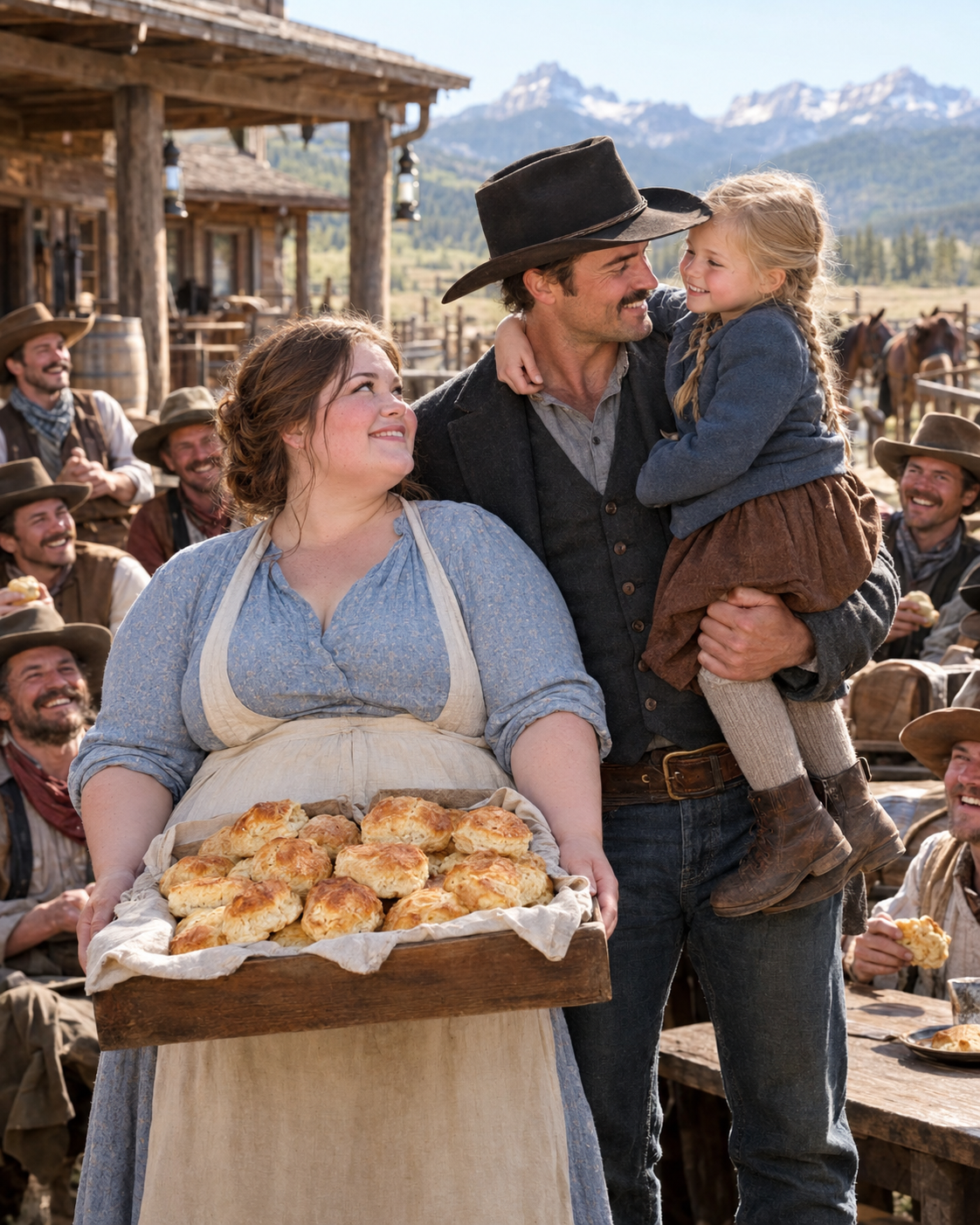
A few minutes later, the cowboys finally went inside. Buck grumbled about his ruined boots, Tommy carried Samuel on his shoulders, and thirty-six men sat down to eat a supper they had nearly let go cold.
George remained outside with Helen.
He offered his arm, but she didn’t take it immediately.
Instead, she looked toward the mountain pass, now disappearing beneath fresh snow.
The train tickets were tucked safely in her apron.
Denver meant schools, steady work, and a future she could explain to her son without making promises she couldn’t keep.
Pine Creek meant belonging, love, and the possibility of building a home with a man who was still learning how to let someone share his life.
In the morning, Helen would need to write an answer to her brother-in-law.
And soon, George would have to leave for Denver to settle his father’s estate.
She slipped her hand into his.
“Will you make me one promise?”
“Anything I can.”
“Whatever happens, we won’t let fear make this decision for us.”
George squeezed her fingers.
“I promise.”
But when they stepped into the warm kitchen and Samuel ran to embrace her, Helen knew love alone couldn’t settle the question waiting for her.
She still had to decide which kind of home would give her son the future he deserved.
And this time, the choice had to be hers.
Buck pulled a folded sheet from his coat. The men had agreed to contribute part of their winter wages toward building Helen and Samuel a proper home beside the ranch house. A home with two bedrooms, a larger stove, and windows that didn’t let the wind through.
“We know it’s not finished,” Buck said. “But we’re willing to work Sundays once the weather clears.”
Helen covered her mouth.
George looked at the paper, then at the men.
“You boys can’t afford this.”
“Neither could Mrs. Carter afford to feed half of us extra biscuits,” Buck answered. “Didn’t stop her.”
George slowly folded the paper.
“You’re all going to freeze if you keep standing around.”
“Then give us a reason to go inside,” Buck said.
George turned to Helen. He reached into his coat and withdrew the small leather pouch he carried everywhere.
Helen stood beside the kitchen window long after the last cowboy had gone to bed, watching snow gather along the fence rails. The train tickets lay on the table beside George’s mother’s wedding ring, which he had entrusted to her for safekeeping until she made her decision.
She hadn’t asked him for the ring. In fact, she’d tried to refuse it.
But George had closed her fingers gently around the little leather pouch.
“Keep it until you know what you want,” he’d said. “And whatever you decide, I’ll never hold it against you.”
Now, with Samuel asleep in the adjoining room, Helen wondered whether love was supposed to make a decision easier or simply make every possible answer hurt.
She unfolded the letter from her late husband’s brother again.
Thomas Carter lived in Denver with his wife, Eleanor, and their three children. They had offered Helen a position managing their household, a bedroom for Samuel, and the chance to enroll him in a proper school.
The salary was respectable. The house was comfortable. And Thomas had made it clear that Samuel would be treated as family.
It was everything Helen had prayed for when she’d been standing outside that boardinghouse six months earlier, holding her son’s hand while their belongings sat in the dirt.
Back then, she would have accepted without hesitation.
Now she had something she’d never expected to find again.
A place where she was loved.
But was that enough?
The following morning, Helen rose before dawn and found George already sitting in the kitchen.
He was holding a cup of coffee that had long since gone cold.
“You haven’t slept,” she said.
“Neither have you.”
She set fresh water on the stove and reached for the coffee pot.
George watched her for a moment.
“I’ve been thinking about Samuel.”
Helen turned.
“He’s getting old enough to need lessons beyond what I can teach him,” George continued. “There’s a school in Silver Creek, but it’s almost eighteen miles down the mountain.”
“And nearly impossible to reach in winter.”
“I know.”
George rubbed his hands together.
“I won’t pretend otherwise.”
Helen appreciated that more than he probably understood.
For months, people had made promises about her future without considering the difficulties she would actually face.
George wasn’t doing that anymore.
“I could hire a tutor,” he suggested.
“With what money?”
“The inheritance—”
“George.”
He stopped.
“I won’t marry a man because he can afford to solve my problems.”
His expression softened.
“I wasn’t asking you to.”
“I know. But I need you to understand something. I’ve spent years depending on other people’s kindness. First my husband, then the boardinghouse, and finally you.”
She glanced toward Samuel’s bedroom.
“I don’t want my son growing up believing his mother survived only because someone rescued her.”
George was quiet for several seconds.
“Then perhaps,” he said, “you should have something here that’s yours.”
Helen frowned.
“What do you mean?”
He looked toward the pantry, the bread ovens, and the rows of shelves she’d organized herself.
“You’ve made this kitchen worth more than it ever was. Maybe it’s time you were paid as more than a hired cook.”
Helen gave him a tired smile.
“You already pay me fairly.”
“I’m talking about something different.”
Before he could explain, footsteps sounded outside.
Buck appeared in the doorway, his face unusually serious.
“Boss, we’ve got trouble.”
George rose immediately.
“What kind?”
“North pasture fence is down. Looks like a tree came through during the storm.”
“How many cattle?”
“Can’t tell yet. But Tommy says he saw tracks heading toward the ravine.”
George grabbed his coat.
Helen followed him to the door.
“Be careful.”
He paused, and for a moment, the guarded ranch owner she’d first met disappeared.
“I will.”
Then he stepped into the snow.
By noon, the weather had worsened.
The wind came shrieking through the narrow valley, lifting white clouds from the frozen ground. Helen kept the stove burning and prepared enough hot stew for every man who might return exhausted.
But when Buck finally came through the door, he wasn’t smiling.
“Where’s George?” Helen asked.
Buck removed his hat.
“He went after Tommy.”
Helen felt the room shift beneath her feet.
“What happened?”
“One of the younger steers broke away near the old logging trail. Tommy tried to turn it back and his horse slipped.”
“Is he hurt?”
“Broke his ankle, best we can tell. George found him, but the trail’s iced over. We couldn’t bring the wagon through.”
Helen gripped the edge of the table.
“Then how are they getting back?”
“We’ve got men working on it.”
“How long?”
Buck looked toward the window.
“That’s what worries me.”
Helen didn’t waste another moment.
She filled two heavy blankets with heated stones wrapped in cloth, packed bread and dried meat, and prepared a small flask of hot broth.
Buck watched her.
“Mrs. Carter, you’re not going out there.”
“I’m not planning to.”
She handed him the supplies.
“But you are. And you’re taking enough food to keep everyone standing until you get them home.”
Buck took the bundle.
“Yes, ma’am.”
“One more thing.”
He stopped.
“Don’t let George try to be a hero. Bring him back, even if you have to tie him to the saddle.”
Despite himself, Buck smiled.
“I’ll do my best.”
The men returned just before nightfall.
Tommy came first, carried between two cowboys, his face white with pain.
George followed on foot.
His coat was coated with ice, and he was favoring his left leg.
Helen hurried toward him.
“Are you hurt?”
“Just twisted my knee.”
“Let me see.”
“Helen, Tommy needs—”
“Tommy has four men looking after him. Sit down.”
Something in her voice made him obey.
She helped him to a chair, removed his frozen boots, and discovered that his knee had swollen badly.
“You walked all that way?”
“Someone had to lead the horses.”
“And you couldn’t let anyone else do it?”
George looked mildly ashamed.
Helen warmed a cloth and pressed it carefully against his leg.
“You’re impossible.”
“So I’ve been told.”
She wanted to scold him.
Instead, she found herself crying.
The tears surprised them both.
George reached for her hand.
“Helen?”
She shook her head.
“I thought you weren’t coming back.”
His expression changed.
He drew her closer, careful not to move his injured knee.
“I’m here.”
“I know.”
“And I’m not planning on going anywhere.”
Helen wiped her cheeks.
“That’s what frightens me.”
He understood without asking her to explain.
Because loving someone meant discovering how much there was to lose.
That night, after Tommy’s ankle had been splinted and the men had settled, George asked Helen to sit with him.
“I’ve made a decision,” he said.
She stiffened.
“George—”
“Not about you. About the ranch.”
He reached into his coat and unfolded a small map.
“I’ve owned the lower meadow for almost fifteen years. There’s a road running through it, a good one when the snow isn’t deep. Silver Creek is only six miles from there.”
Helen studied the map.
“Why are you showing me this?”
“Because I’ve been thinking about building a second house.”
“For whom?”
“For whoever needs it.”
She looked up.
George continued carefully.
“A house near the road. A proper kitchen. A place where travelers could buy meals, where ranch hands could stay during bad weather, and where a schoolteacher might board.”
Helen stared at him.
“You’re describing an inn.”
“A modest one.”
“An inn would cost a fortune.”
“Not if we started small.”
“And who would run it?”
George met her eyes.
“You.”
Helen pushed back her chair.
“George, I already told you—”
“Not as a favor.”
He placed the map between them.
“As a business arrangement. You would own half. I’d provide the land and building materials. You’d manage the place. We’d share the profits.”
Helen remained silent.
George looked uncertain.
“You’re the best cook I’ve ever known, and you’ve got more sense about running a household than all thirty-six of those fools put together.”
“George.”
“I’m trying to make a proper offer, Helen.”
She looked again at the map.
For the first time in years, she imagined earning money that belonged to her, making decisions without asking permission, and creating a future for Samuel through her own work.
But the idea frightened her.
“What if it fails?”
“Then we’d have tried something worthwhile.”
“And what if you and I don’t work out?”
George took a breath.
“Your half would still belong to you.”
She studied his face.
“You’d put that in writing?”
“I’d insist on it.”
Helen didn’t answer immediately.
Instead, she folded the map and placed it beside Thomas’s letter.
“I need time.”
George nodded.
“Take it.”
Three days later, the mountain road opened enough for the mail wagon to pass.
Among the letters was another envelope from Denver.
This one wasn’t addressed to Helen.
It was addressed to George.
He read it in his office while Helen was preparing bread.
An hour later, he appeared in the kitchen doorway.
“Helen, there’s something you need to know.”
His expression was troubled.
She set down her rolling pin.
“What is it?”
“My sister has arranged an appointment with the estate attorney for January tenth. I have to be there.”
“Of course.”
“She’s also invited someone to meet me.”
Helen waited.
“Miss Abigail Preston. Her father’s a banker in Denver.”
The kitchen seemed suddenly too quiet.
Helen looked at him.
“Why would your sister arrange that?”
George sighed.
“Because Margaret has spent ten years trying to persuade me to marry a woman she considers suitable.”
Helen turned back toward the dough.
“I see.”
“There’s nothing to see.”
“Then why are you telling me?”
“Because I promised I wouldn’t keep things from you.”
She nodded, but her hands were trembling.
George came closer.
“Helen, I haven’t agreed to anything.”
“You don’t owe me an explanation.”
“I think I do.”
She turned.
“George, we’re not married. We’re not even formally engaged. You can meet whomever you choose.”
“That’s not what I want.”
“Then what do you want?”
He looked at her for a long moment.
“You. But not at the cost of your freedom.”
Helen’s anger faded into something more painful.
She wanted to believe him completely.
Yet she’d seen how quickly circumstances could change a man’s promises.
Her late husband had been loving and honest, but his sudden death had left her without savings, property, or any protection against the world.
She had promised herself Samuel would never be so vulnerable again.
That evening, she wrote Thomas.
She thanked him for his generous offer and explained that she was considering a business opportunity in Colorado. She asked whether the position in Denver could remain open until the end of January.
Then she wrote another letter.
This one went to a lawyer in Silver Creek.
She wanted to know whether a widow could legally own a business partnership independently of marriage, what protections should be included in an agreement, and how to ensure her share would pass to her son.
When she told George, he smiled.
“Good.”
“You’re not offended?”
“I’d have been disappointed if you hadn’t asked.”
For the next two weeks, the ranch moved through its winter routines.
Tommy recovered slowly, spending his afternoons helping Samuel practice letters. Buck complained about having to wash his own socks after Helen informed him that the kitchen wasn’t a laundry service.
And George worked quietly with the ranch carpenter, drawing plans for the proposed inn.
Helen studied the plans at night.
She suggested adding a larger storeroom, a second fireplace, and a separate sitting room where travelers could warm themselves without crowding the dining tables.
George listened to every idea.
For once, they weren’t simply employer and employee.
They were two people building something together.
Then, on January seventh, George prepared to leave for Denver.
The morning was bitterly cold.
His knee had improved, though Helen still caught him limping when he thought nobody was watching.
Samuel stood beside the wagon holding a wooden horse.
“Will you come back?” he asked.
George crouched in front of him.
“That’s the plan.”
“Before my birthday?”
“Your birthday’s in March, son.”
“I know.”
George smiled.
“I’ll do my very best.”
Then Samuel held out the wooden horse.
“Take this so you remember.”
George accepted it with a tenderness that made Helen look away.
When he stood, he turned toward her.
“I’ll write as soon as I arrive.”
“Travel safely.”
He hesitated.
“I’d like to ask you something.”
Helen waited.
“When I get back, may I court you properly?”
She felt warmth rise into her cheeks.
“You’ve been bringing me firewood and fixing my doors for months. What do you call that?”
“Poorly organized courtship.”
She laughed.
“Then yes, George. You may.”
He took her hand and kissed it.
Nothing more.
But the promise stayed with her long after his wagon disappeared down the mountain.
For five days, everything went smoothly.
Then a letter arrived.
It was from George, written the evening he reached Denver.
He told Helen that the estate settlement had become more complicated than expected. A distant relative was challenging part of the inheritance, and the attorney advised him to remain in town.
He also mentioned Margaret.
“She means well,” he wrote, “but she has mistaken my affection for caution and my silence for agreement. I intend to correct both.”
Helen read those words three times.
The next morning brought worse news.
A heavy storm had damaged the bridge leading toward the lower meadow.
Buck estimated that repairing it would require more lumber and labor than George had planned.
Helen rode out with him to inspect the damage.
The bridge’s center supports had shifted, leaving several planks hanging above the narrow creek.
“Can it be repaired?” she asked.
“Sure. But not cheaply.”
Helen looked toward the meadow beyond.
The proposed inn would depend on that road.
Without the bridge, travelers would have to take a much longer route.
Buck scratched his beard.
“Boss might have to put the whole project off.”
Helen felt disappointment settle over her.
Then she looked at the surrounding timber and the unused storage barn near the road.
“What if we didn’t build the inn right away?”
Buck frowned.
“What do you mean?”
“What if we started with the barn?”
He stared.
“That old thing?”
“It’s dry, mostly. The roof needs work, but the walls are sound. We could put in a stove, clear a kitchen space, and open only during the warmer months.”
Buck thought about it.
“Could make that work.”
“And the bridge?”
“Fix it in stages.”
Helen nodded.
“Then that’s what we’ll do.”
For the next ten days, she worked harder than she’d worked since arriving at Pine Creek.
She organized the supplies, calculated costs, and persuaded the cowboys to help repair the barn in their spare hours.
But she refused to let anyone work without compensation.
Some accepted money. Others preferred meals or a credit toward future lodging.
Buck insisted his payment should be a lifetime supply of cornbread.
Helen informed him that no sensible businesswoman would sign such an agreement.
He claimed she was becoming difficult.
She considered it a compliment.
Then, one afternoon, a carriage appeared outside the ranch house.
Helen was kneading bread when she heard wheels crunching over the frozen yard.
A woman stepped down wearing a tailored wool coat and carrying a leather traveling case.
She was elegant, middle-aged, and looked deeply uncomfortable among the mud and horse tracks.
“Helen Carter?” she asked.
“Yes.”
“I’m Margaret Whitmore.”
Helen’s hands went still.
George’s sister stood before her.
For several seconds, neither woman spoke.
Then Margaret removed her gloves.
“I believe we need to talk.”
Helen led her into the kitchen and offered coffee.
Margaret looked around with an expression that was difficult to read.
“This place is very different from what I imagined.”
“Most people say that.”
Margaret sat at the table.
“George told me about you.”
Helen waited.
“He was furious when he learned I’d written that letter.”
“I know what you said.”
Margaret lowered her eyes.
“Then I owe you an apology.”
Helen hadn’t expected that.
“I was concerned for him,” Margaret continued. “And for your son. Our mother’s death changed George. He believes he failed her, though he was only a boy.”
“He told me.”
Margaret nodded.
“I thought if I discouraged him early, I could spare everyone pain.”
Helen sat across from her.
“Instead, you nearly convinced him to send us away.”
Margaret looked ashamed.
“Yes.”
For a moment, Helen saw not a proud Denver woman but an older sister who had spent years worrying about a younger brother.
“Did you come all this way to apologize?”
“Partly.”
“And the other reason?”
Margaret opened her traveling case.
She removed a folded document and placed it on the table.
“The estate attorney has discovered that our father’s inheritance is smaller than we believed.”
Helen looked down.
“How much smaller?”
“Considerably. There were debts neither George nor I knew about.”
Helen’s stomach tightened.
“Does George know?”
“He does.”
“Then why didn’t he tell me?”
“He wanted to come himself.”
Margaret paused.
“But I was afraid you might be making plans based on money he no longer has.”
Helen looked toward the window, where Buck and two other men were carrying boards toward the barn.
“So you came to warn me?”
“I came to tell you the truth.”
Helen rose and walked to the stove.
For several moments, she said nothing.
Then she turned.
“Mrs. Whitmore, when I arrived here, I had two dollars and seventeen cents. Your brother gave me work when nobody else would. The men gave my son friendship. And now we’re building a business because I believe it can succeed.”
Margaret listened.
“If George inherits nothing, that doesn’t change what we’ve already accomplished.”
“But the inn—”
“May take longer. May be smaller. May fail.”
Helen folded her hands.
“But it won’t fail because I expected a rich man to pay for my future.”
Margaret studied her.
Then she gave a small, unexpected smile.
“I believe I’ve underestimated you.”
“Yes, ma’am. You have.”
The next morning, Margaret asked to see the barn.
She spent nearly an hour examining the building, questioning Helen about expenses and projected earnings.
When they returned to the kitchen, she made another surprising announcement.
“I have some experience managing investments.”
Helen raised an eyebrow.
“Are you offering to help?”
“I’m offering to review your figures. Nothing more unless you wish it.”
Helen considered.
“That would be useful.”
For three afternoons, the women worked together.
Margaret questioned every estimate, challenged Helen’s assumptions, and insisted that the business keep enough money aside for unexpected repairs.
Helen found the discussions exhausting.
She also found them valuable.
By the fourth day, the two women had developed a cautious respect.
Then George returned.
He arrived at dusk, his wagon splattered with mud.
Helen was outside helping Samuel carry kindling when she saw him.
Samuel dropped his bundle and ran.
“Mr. George!”
George climbed down just in time to catch the boy.
Helen stood still, her heart beating hard.
George looked over Samuel’s shoulder and smiled at her.
Then he noticed Margaret standing on the porch.
His smile disappeared.
“Margaret?”
She folded her arms.
“Hello, George.”
He looked from his sister to Helen.
“What happened?”
Helen couldn’t resist.
“Your sister has been helping me with the accounts.”
George blinked.
“The accounts?”
“And criticizing my estimates.”
Margaret lifted her chin.
“They needed criticizing.”
George stared at them both.
Then, slowly, he began to laugh.
It was the first time Helen had heard him laugh so freely.
But the happiness lasted only until supper.
That evening, George gathered Helen and Margaret in his office.
He explained the inheritance.
His father’s estate had been burdened with old debts, leaving little after the claims were settled. George could still maintain Pine Creek Ranch, but the money he’d intended to invest in the inn was no longer available.
“I won’t ask you to risk your savings,” he told Helen.
She looked at him.
“George, we’ve already started.”
“I know.”
“The barn is nearly ready.”
“But the bridge—”
“Can be repaired in stages.”
He frowned.
“And the materials?”
“We’ll use what we have and buy the rest as we earn it.”
George stared.
“You’ve been busy.”
Helen smiled.
“Very.”
Margaret cleared her throat.
“She’s also worked out a reasonably sound business plan.”
George turned toward his sister.
“Reasonably?”
“Don’t look so pleased. I still have several concerns.”
But there was warmth in her voice.
George looked back at Helen.
“And you’re certain?”
“I’m certain I want to try.”
He reached across the desk and took her hand.
“Then we’ll try.”
By early March, the barn had been transformed.
The walls were cleaned and repaired. A large stove stood in one corner. Three sturdy tables filled the main room, and fresh curtains hung beside the windows.
Helen named it Meadow House.
The first customers were two freight drivers who had been delayed by spring mud.
They ordered stew, bread, and coffee.
Then they ordered more bread.
One of them asked whether Helen could prepare meals for their return journey.
Within a week, word began traveling along the road.
A month later, Helen needed help.
She hired a young widow from Silver Creek named Clara, who had two daughters and very little money.
Clara’s hands trembled when Helen offered her the position.
“I don’t have much experience,” she admitted.
“Can you learn?”
“Yes, ma’am.”
“Then we’ll manage.”
Helen remembered another kitchen, another employer, and the day she’d been offered a chance.
She refused to forget what it had meant.
But success brought its own difficulties.
The bridge remained unreliable after heavy rain, and supplies were expensive. One week, a wagon carrying flour became stuck miles from the inn.
Helen spent two days serving cornmeal cakes and potatoes while Buck organized a team to retrieve the shipment.
Another week, Clara’s youngest daughter developed a fever, forcing Helen to manage the entire dining room alone.
She was exhausted.
One evening, George found her sitting behind Meadow House with her head in her hands.
“You’re working yourself into the ground,” he said.
Helen didn’t look up.
“I’m beginning to think Margaret was right about the costs.”
George sat beside her.
“She usually is.”
Helen laughed weakly.
“I don’t know how much longer I can keep this up.”
“Then we make changes.”
“We can’t afford more help.”
“Perhaps we can afford fewer customers until the kitchen runs smoothly.”
She looked at him.
“Turn people away?”
“Temporarily. Better than losing the woman who built this place.”
Helen considered his words.
She’d been so determined to prove herself that she’d begun treating exhaustion as a measure of success.
The next morning, she shortened the serving hours and raised prices slightly to reflect the cost of supplies.
She also began training Clara to handle the accounts.
Within a month, Meadow House was operating more smoothly.
By June, it earned its first modest profit.
Helen stared at the figures long after Clara went home.
Then she walked to the ranch and found George repairing a saddle.
“We did it.”
He looked up.
“What?”
She held out the ledger.
“We made money.”
George studied the page.
Then he grinned.
“Well, Mrs. Carter, I suppose you’re officially a businesswoman.”
Helen felt tears gathering.
“I suppose I am.”
George stood and took both her hands.
“May I ask you something?”
She smiled.
“You may.”
“Have I courted you properly yet?”
Helen laughed.
“You’ve taken me walking, brought me flowers, written letters, and endured two Sunday dinners with your sister. I’d say you’ve made a respectable effort.”
“Then perhaps I can ask another question.”
He reached into his pocket.
The little leather pouch appeared in his palm.
Helen’s breath caught.
George opened it.
His mother’s wedding ring gleamed in the evening light.
“Helen Carter, I love you. I love Samuel. And I love the life we’re building, even when you insist on doing everything the difficult way.”
She laughed through her tears.
“I learned that from you.”
George smiled.
“I can’t promise there won’t be hard winters, broken bridges, or days when we disagree.”
“That’s reassuring.”
“But I can promise I’ll listen. I’ll stand beside you. And I’ll never make your choices for you.”
He took a breath.
“Would you marry me?”
Helen looked toward the ranch house.
Through the open kitchen window came the sound of cowboys arguing over supper.
Samuel was outside teaching Tommy, whose ankle had finally healed, how to carve a wooden bird.
Beyond the pasture stood Meadow House, small and imperfect, but hers.
For the first time since her husband’s death, Helen wasn’t being asked to surrender her future in exchange for security.
She was being invited to share it.
“Yes,” she whispered.
George’s face changed.
“Yes?”
“Yes, George.”
He drew her into his arms.
And when he kissed her, the ranch bell suddenly began ringing.
They pulled apart.
Buck stood beside the bell rope, grinning.
“About time!”
Thirty-six cowboys erupted into cheers.
Helen buried her face against George’s shoulder.
“How long have they been watching?”
George sighed.
“Knowing Buck? Since breakfast.”
They married in September beneath the cottonwood trees near Meadow House.
Margaret came from Denver and cried openly, though she later denied it. Clara baked the wedding cake, and Samuel stood beside George wearing a little jacket Buck had helped purchase.
All thirty-six cowboys attended.
Buck gave a speech that began with an embarrassing account of Helen’s first biscuits and ended with him struggling to speak.
“Before she came,” he said, “we were thirty-six men working on the same ranch. Now we’re thirty-six men who know where home is.”
Helen reached for her handkerchief.
George squeezed her hand.
The marriage didn’t solve every difficulty.
That winter, Meadow House lost money when snow closed the road for three weeks. George and Helen argued over whether to use ranch savings to cover repairs. Samuel became homesick for the school friends he’d made during the autumn term in Silver Creek, where he boarded with Clara’s relatives on weekdays.
There were days when Helen wondered whether she’d taken on too much.
And there were nights when George still withdrew into silence rather than admitting he was worried.
But they kept the promise they’d made in the snow.
They talked.
Sometimes the conversations were uncomfortable. Sometimes they ended without an answer.
Yet neither of them walked away.
The following spring, Helen suggested an arrangement that surprised George.
She wanted to use part of Meadow House’s earnings to establish a small fund for women who needed work and temporary shelter.
George listened while she explained.
“Not charity alone,” she said. “A chance to earn wages, learn useful skills, and put something aside.”
He nodded.
“And who would manage it?”
“Clara and I.”
“Then you’ll need proper records.”
Helen smiled.
“Your sister has already offered to help.”
George groaned.
“Of course she has.”
Over the next several years, Meadow House grew slowly.
It never became a grand hotel. Its floors still creaked, the stove needed constant attention, and the mountain road remained troublesome.
But travelers knew they could find a warm meal there.
And women who arrived frightened, unemployed, or carrying children in their arms often found more than a place to sleep.
They found work.
They found people willing to teach them.
Most importantly, they found someone who understood that needing help didn’t mean they had nothing valuable to offer.
One autumn evening, nearly five years after Helen first arrived at Pine Creek Ranch, she stood outside Meadow House watching Samuel practice reading with three younger children.
George joined her, carrying two cups of coffee.
“He’s getting tall,” George said.
Helen smiled.
“Too tall.”
Samuel looked up and waved.
George waved back.
For a while, they stood in comfortable silence.
Then George glanced toward the ranch.
“Do you remember that night the men refused supper?”
“How could I forget?”
“I thought I’d lost you.”
Helen took a sip of coffee.
“You nearly had.”
He looked at her.
“Do you ever wish you’d gone to Denver?”
Helen considered the question seriously.
She thought about the security Thomas had offered, the schools, the life Samuel might have known.
Then she looked toward Meadow House.
“Sometimes I wonder what would have happened,” she admitted. “But wondering isn’t the same as regretting.”
George nodded.
“I think about my mother sometimes. I wonder whether she would have been happier if my father had listened when she wanted to leave.”
Helen slipped her arm through his.
“Perhaps she would have.”
George looked down.
Helen continued gently.
“But you listened when I told you what I needed. That’s something you changed.”
He smiled faintly.
“I had a good teacher.”
She rested her head against his shoulder.
As darkness settled over the valley, lanterns began glowing in Meadow House’s windows.
Inside, Clara was preparing supper for a group of travelers.
Samuel called for them to come see the words he’d written on his slate.
George set down his coffee and went to admire the boy’s work.
Helen remained outside a moment longer.
She remembered the day she’d been turned out of the boardinghouse with Samuel beside her, both of them frightened and hungry.
She remembered being grateful simply for a roof.
Back then, she’d believed safety meant finding someone who would never send her away.
Now she understood that real security was something deeper.
It meant having a voice in the decisions that shaped her life.
It meant knowing that love could stand beside independence rather than demand its surrender.
And it meant having enough faith in herself to offer another frightened woman the same opportunity she’d once received.
Just then, a wagon stopped near the front steps.
A young mother climbed down, holding a sleeping child against her shoulder.
Her coat was worn. Her expression was tired.
“Excuse me,” the woman called hesitantly. “Are you Mrs. Whitmore?”
Helen approached.
“I am.”
“I heard you sometimes have work for women who need it.”
Helen looked at the child.
Then at the woman’s trembling hands.
There was no need to ask why she’d come.
“What’s your name?”
“Anna, ma’am.”
“Can you cook, Anna?”
“A little.”
“Can you learn?”
The woman’s eyes filled.
“Yes, ma’am. I can.”
Helen opened the door.
“Then come inside. We’ll start with supper.”
From the kitchen, Buck’s familiar voice called out.
“Mrs. Whitmore, please tell me you’ve made cornbread!”
Helen laughed.
“There’s plenty, Buck.”
She guided Anna and her child toward the warmth.
And as the door closed behind them, Helen understood something she’d spent years learning.
A home wasn’t simply the place where someone finally opened a door for you.
Sometimes it was the place where you became strong enough to open that door for someone else.
The woman who had once arrived at Pine Creek Ranch with two dollars and seventeen cents had never become wealthy by society’s standards.
But she had gained something no inheritance could guarantee.
She had built a life in which love did not require silence, kindness did not demand obedience, and gratitude never meant giving up the right to choose.
And George, who had once believed protecting someone meant deciding their future for them, had learned that the deepest form of love was not holding on more tightly.
It was standing beside someone while they became everything they were capable of being.
That was the legacy they gave Samuel.
Not the ranch.
Not Meadow House.
Not even the small amount of money they eventually saved.
But the understanding that a person’s worth was never measured by how little help they needed, how much property they owned, or how impressive their circumstances appeared.
It was measured by the honesty of their choices, the courage to begin again, and the kindness they extended when someone else needed a chance.
And every winter, when snow covered the mountains around Pine Creek, the cowboys still told the story of the night thirty-six hungry men refused to eat.
Not because the supper was bad.
But because the woman who cooked it had taught them that family was worth standing in the cold for.
And because, for once, the man who owned the ranch had been wise enough to listen.
THE END.