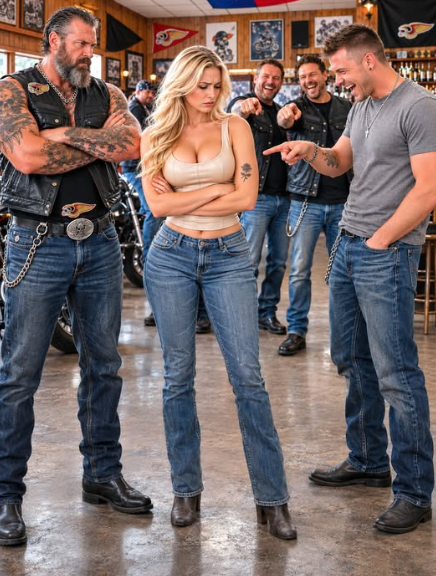
Thirty-two men watched me walk into a Montana motorcycle clubhouse with a battered mechanic’s bag and a black helmet. Before I could introduce myself, one of them pointed at the wolf tattoo covering my arm and asked if I was lost.
“Did you know a man named Daniel Reeves?” I stopped packing. For a few seconds, the clubhouse seemed to lose every sound it had ever made. The refrigerator hummed behind the bar. Somewhere outside, a truck passed along the highway. But inside that room, thirty-two men waited for my answer. I looked at Logan. “Why are you asking?” He glanced at the wolf tattoo on my arm, then back at my face. “Because I served with him.” My fingers tightened around the wrench. “Where?” “Army Special Operations. Search and rescue attachment.
About fifteen years ago.” I swallowed. “Daniel was my commander.” Logan closed his eyes. For the first time since I’d walked through the door, the old man’s face changed completely. The hard lines around his mouth softened, and something that looked painfully close to grief settled into his expression. “Then you’re the one he always talked about.” I shook my head. “I doubt that.” “You’d be surprised.” Derek laughed from his chair. “Come on, Logan. You’re telling me this girl is some kind of war hero now?” Logan turned. “Sit down, Derek.” The words weren’t loud, but they carried enough weight to make Derek’s smile disappear. I had seen men twice his size respond to that tone. Logan pulled a chair from beneath the workbench and sat across from me. “What was his call sign?” “Northstar.” Logan stared at me. Then he slowly reached beneath his leather vest and pulled out a small, weathered photograph. It showed six men standing beside a helicopter. They were younger, thinner, and smiling in the careless way people do before life teaches them how quickly things can change. Daniel stood in the middle. Logan was beside him. And on the far left was a woman with a wolf tattoo on her arm. Me. I hadn’t seen that photograph in eleven years. “Where did you get that?” I whispered. “Daniel sent it to me after our last joint operation. Told me to keep it somewhere safe.” He turned it over. There was handwriting on the back. For the ones who bring people home. No matter how long it takes. I looked away. The room had become too small. “Daniel told me you survived the cave collapse,” Logan said. “He said you were the strongest person on his team.” “He was wrong.” Logan shook his head. “No. I think you just haven’t forgiven yourself for coming home.” That sentence hit harder than I expected. I pushed my chair back and walked toward the open garage door. Cold Montana air swept across my face. For eleven years, I had avoided conversations about the past. I had changed towns, changed jobs, and learned how to answer questions without giving people anything they could use to find the parts of me I’d buried. But now a man I’d never met was holding a photograph of people I had spent years trying not to miss. Behind me, Logan followed. “Can I tell you something?” he asked. I nodded without turning around. “Daniel saved my life.” I looked at him. “During the collapse?” “No. Three months before it.” Logan leaned against the doorframe. “I was trapped under a vehicle after a mountain road gave way during a recovery operation. Everyone thought the slope was too unstable to reach me. Daniel went back anyway. He stayed with me until the extraction team got there.” He paused. “Afterward, I asked him why he risked his life for somebody he’d barely known.” “What did he say?” Logan smiled faintly. “He said, ‘Nobody should have to wonder whether someone is coming back for them.’” I looked down at the tattoo on my forearm. That was Daniel. He had a way of making ordinary words sound like promises. “I was there when he died,” I said. Logan’s expression tightened. “I know.” I turned sharply. “What?” “Daniel’s final report mentioned seven team members. He said they were accounted for before the secondary collapse.” I stared at him. “He couldn’t have known.” “Known what?” I took a breath. “He was the one who stayed behind.” The memories came back in fragments. A narrow cave passage. Dust filling the air. A radio crackling against my shoulder. Daniel’s voice telling us to keep moving. We had gone into the mountain looking for two missing climbers after a sudden storm triggered a rockslide. The first collapse trapped several people inside. Daniel organized the evacuation, assigning each of us a section of the route. Then the second collapse came. It happened so quickly that there was no time to think. A wall of stone dropped between Daniel and the exit. I remember screaming his name. I remember trying to turn back. And I remember his last instruction. “Get them out.” We had three injured people with us. One couldn’t walk. Another was barely conscious. I had wanted to go back. I had wanted to ignore every order and dig until my hands were nothing but blood. But Daniel had looked directly at me through the dust and said something I would never forget. “Your job isn’t to die with me. Your job is to make sure this wasn’t for nothing.” So I left. Seven people made it out. Daniel didn’t. I had carried the guilt like a stone in my chest ever since. Logan listened without interrupting. When I finished, he rubbed a hand over his gray beard. “There’s something else you should know.” He reached into his vest again and pulled out a folded envelope. The paper was yellowed, and the handwriting was unmistakable. Daniel’s. My knees felt weak. “What’s that?” “A letter he left with me. He told me to give it to you if I ever found you.” I didn’t reach for it. “Why didn’t you send it?” “I tried. Your last known address was empty. Then I heard you’d left the service. I didn’t know where you went.” He held the envelope between us. “I’ve carried it for eleven years.” I finally took it. My name was written across the front. Not my rank. Not my call sign. Just my name. I opened it carefully. If you’re reading this, there’s a good chance I’ve managed to get myself into trouble again. I almost laughed. That sounded exactly like Daniel. Listen carefully. I know you carry more responsibility than you should. You think being the person everyone depends on means you aren’t allowed to fall apart. That’s nonsense. My vision blurred. You have a habit of counting the people you couldn’t save and forgetting the ones who are alive because you refused to give up. I pressed my lips together. If something happens to me, don’t turn my absence into the purpose of your life. Remember me, certainly. Miss me when you need to. But keep living. The next paragraph was shorter. There is a young rescue volunteer named Marcus who reminds me of you. He thinks courage means never being afraid. I’ve told him otherwise. If you ever meet him, remind him that the best rescuers know when to ask for help. I stopped reading. Daniel had written that letter before the cave collapse. Before any of us knew what was coming. At the bottom, he had added one final sentence. Seven people carry pieces of this story. Don’t let the eighth be the person who forgets how to live. I folded the letter against my chest. For eleven years, I had believed that leaving Daniel behind was the one unforgivable thing I’d ever done. Now, standing in a motorcycle clubhouse in Montana, I was beginning to understand that he had never asked me to carry that guilt. He had asked me to carry something else. His lessons. His kindness. His belief that people were worth going back for. Logan put a hand on my shoulder. “There’s another reason I wanted to meet you.” I looked up. He pointed toward the old Harley. “Earl Dawson knew Daniel, too.” I blinked. “What?” “Earl served in the same rescue unit before he left the military. He was one of the people who helped build the training program Daniel eventually joined.” I looked at the motorcycle. The polished chrome. The leather gloves. The faded photograph tucked into the frame near the handlebars. Logan nodded toward it. “Earl kept that bike because Daniel once rode it during a training exercise. He used to say it was the only motorcycle Daniel ever managed to start without flooding the engine.” A few men chuckled softly. I looked at the old Harley again. “So that’s why nobody wanted to give up on it.” “Exactly.” Logan smiled. “Earl said it deserved to run again.” I looked at the engine I’d repaired. For the first time, the motorcycle seemed less like an old machine and more like a message someone had been waiting years to deliver. Behind us, Derek cleared his throat. “Okay. That’s a touching story. But what does any of this have to do with her fixing a motorcycle?” Nobody answered. Derek stood and walked toward the garage. “I mean, we’re all supposed to believe she just walked in here, fixed something four mechanics couldn’t fix, and suddenly she’s family?” Logan looked at him. “That’s not what anyone said.” “Then what are we doing?” The older man sighed. “Remember the winter rescue three years ago?” Derek’s expression changed. “What’s that got to do with anything?” “Your younger brother.” The room went still. I noticed Derek’s jaw tighten. Logan continued. “Your brother was stranded on the east ridge after his truck slid off the road. Snow was coming in hard. The search team couldn’t get a helicopter up. We had people walking the trail until midnight.” Derek looked toward the floor. “Yeah. I remember.” “Earl was the one who organized the volunteers. He was already sick, but he insisted on going out.” “I know.” “He kept saying nobody should have to wonder whether someone was coming back for them.” Logan looked at me. Then back at Derek. “Those were Daniel’s words. Earl had learned them from him.” I glanced at the photograph in Logan’s hand. The same words. The same promise. Logan continued. “Your brother was found alive because people he had never met refused to quit looking. Earl was one of them.” Derek rubbed his forehead. “He told me that.” “Did you ever thank him?” Derek didn’t answer. “Earl didn’t do it because he expected gratitude,” Logan said. “He did it because someone needed help.” The younger man looked toward the Harley. For a moment, he seemed smaller than he had when I’d first entered the clubhouse. “I didn’t know all that,” he muttered. “That’s the problem,” Logan replied. “You make decisions about people before you know anything about them.” Derek glanced at me. His eyes dropped to the wolf tattoo. Then to the seven symbols. “I was out of line.” It wasn’t a dramatic apology. There were no speeches. But it was the first honest thing he’d said to me. I nodded. “It’s alright.” “No,” he said. “It wasn’t.” He looked at the motorcycle. “Can I ask you something?” “Sure.” “Would you show me how you fixed it?” I glanced at Logan. Then at the group of men watching us. “Why?” Derek shrugged. “My dad was a mechanic. I used to work on bikes with him when I was a kid. Haven’t done much since he passed.” I looked at the old Harley. “Get me a flashlight.” Derek nodded and hurried toward the workbench. For the next hour, I showed him how I’d traced the electrical problem. I explained the corroded connection, the importance of checking the ground path, and how a wire could look perfectly healthy while hiding damage beneath its insulation. He listened carefully. He asked questions. And he didn’t pretend to know more than he did. At one point, he handed me the wrong tool. I smiled. “That’s a wrench, not a screwdriver.” He looked at it, then laughed. “Guess I deserved that.” The tension that had filled the clubhouse slowly dissolved. Men began telling stories about Earl. One remembered him giving away his winter coat to a stranger. Another recalled him driving two hours to repair a neighbor’s broken tractor. Jean brought out an old wooden box filled with photographs and newspaper clippings. In one photograph, Earl stood beside Daniel, both of them covered in mud and smiling. On the back, someone had written: Good men don’t always come home. But what they teach us can. I sat quietly for a long time. Then Jean approached me with a small cardboard box. “We found this when we cleaned out Earl’s office,” he said. “Nobody knew what to do with it.” Inside was a silver dog tag. Daniel’s. I recognized the tiny scratch near the edge. I’d given it to him after he lost his original tag during an operation. It had been a joke between us. He’d called it his lucky charm. I picked it up. “Where did Earl get this?” Jean shrugged. “Logan said Daniel gave it to him years ago. Earl kept it with his papers.” I turned the tag over. There were three words engraved on the back. Bring them home. My throat tightened. Jean watched me. “Would you like to keep it?” I shook my head. “Earl kept it safe. I think it belongs here.” Jean nodded. “Then we’ll find a good place for it.” That evening, the clubhouse began to empty. The Harley sat beneath the overhead lights, its engine cooling with occasional metallic clicks. I packed my tools and placed my helmet under my arm. Logan walked me to the door. “You don’t have to disappear again,” he said. I looked at him. “I wasn’t planning to.” He smiled. “Good.” I hesitated. “Logan, why did you keep looking for me?” He considered the question. “Because Daniel asked me to.” I lowered my eyes. “He never told me about that letter.” “He probably didn’t want you worrying about the future. He was good at taking care of everyone else, even when he should’ve been taking care of himself.” I smiled sadly. “Sounds like him.” Logan looked toward the clubhouse. “Earl used to say this place needed more than motorcycles and beer. He wanted it to be somewhere people could come when they had nowhere else to go.” “Did he succeed?” “Some days.” He paused. “Other days, we forget.” I looked back at the men inside. Derek was standing beside the Harley, explaining something to Jean with a confidence he hadn’t possessed that morning. Maybe the motorcycle had done more than start. Maybe it had reminded them what the clubhouse was supposed to be. I put on my helmet. “Will you tell them I’ll come back?” Logan nodded. “I think they’ll like that.” I started my bike and pulled onto the road. The Montana evening stretched out before me, wide and quiet. For the first time in years, I didn’t feel like I was running away from something. I was simply going somewhere.
Three weeks later, I returned to the clubhouse. I wasn’t carrying a mechanic’s bag this time. I had a box of photographs, Daniel’s letter, and a small wooden frame. The men were gathered around the Harley. Derek was working on the front brake assembly under Jean’s supervision. He looked up when I entered. “Hey. You’re back.” “I said I would be.” He wiped his hands on a rag. “Good. We need somebody around here who actually knows what they’re doing.” I laughed. Logan came out of the office carrying a stack of papers. He placed them on the workbench. “We’ve been talking.” “About what?” “About Earl.” He handed me the top sheet. It was a proposal to turn the unused building behind the clubhouse into a small community repair and rescue center. The idea was simple. Members would volunteer their time repairing motorcycles, cars, and trucks for people who couldn’t afford professional service. A portion of the space would also be used to store emergency supplies for winter roadside rescues. Flashlights. Blankets. First-aid kits. Radios. Fuel containers. Everything needed to help stranded motorists during Montana’s brutal winters. At the top of the proposal was a name. The Earl Dawson and Daniel Reeves Memorial Garage. I stared at it. “You can’t be serious.” Logan nodded. “Earl spent his life helping people. Daniel taught a lot of us how to do it. We figured it was time to make that lesson useful again.” I looked around. Several men nodded. Even Derek. “You want me to help?” I asked. “We want you to teach,” Logan replied. “I don’t know if I’m the right person.” He smiled. “Neither did Daniel, the first time somebody trusted him with a life.” I looked down at the proposal. For years, I had believed that honoring the dead meant preserving every painful detail of how they died. Now I wondered if perhaps it meant preserving the good things they had left behind. I picked up the pen. “Where do I sign?”
The garage opened two months later. It wasn’t fancy. The walls were painted gray, the floor had a few stubborn oil stains, and the old heating system made a noise like a dying tractor. But it was warm. And the doors stayed open. On opening day, people came from all over the county. A single mother brought in an old pickup with a failing battery. A retired farmer needed help repairing a snowblower. A teenager arrived with a motorcycle he’d inherited from his grandfather. Nobody was turned away because they couldn’t pay. Derek became one of our most reliable volunteers. He was still loud, still stubborn, and still convinced he knew more about motorcycles than he actually did. But he had changed. He started greeting newcomers before they could feel unwelcome. One afternoon, a nervous young man walked through the door carrying a battered backpack and wearing a faded military jacket. He stopped just inside. “Sorry. I wasn’t sure if this place was open.” Derek looked up from the engine he was repairing. “Come on in.” The young man glanced at the other volunteers. “I’m looking for someone who might help me with my bike.” Derek smiled. “Then you’ve come to the right place.” He took the young man’s keys and pointed toward the empty workbench. “What’s the problem?” The young man hesitated. “It’s probably something stupid.” Derek shook his head. “There’s no stupid reason to ask for help.” I was standing near the back of the garage when I heard him say that. I looked down at the wolf tattoo. The seven small symbols seemed different now. They no longer felt like seven graves I carried everywhere. They felt like seven promises. A promise to remember. A promise to keep moving. A promise to help someone else find their way home. That evening, after the volunteers had gone, Logan and I stood beside the Harley. It was running beautifully. Jean had placed Earl’s old leather gloves beneath the seat again, exactly where they’d been for years. Above the workbench hung the photograph of Daniel’s team. Beside it was the framed letter. I had chosen not to display every word. Only one sentence. Don’t turn my absence into the purpose of your life. Logan read it quietly. “He’d be proud of you.” I watched the reflection of the overhead lights move across the motorcycle’s chrome. “I wish he could see this.” “He does,” Logan said. I smiled. Neither of us tried to explain how. Sometimes people leave behind things that are difficult to measure. A repaired engine. A remembered promise. A stranger who feels welcome instead of unwanted. A person who finally understands that surviving isn’t a betrayal of the people who didn’t. A year after that first afternoon, the garage held its first winter rescue training day. More than forty volunteers attended. We taught basic roadside safety, emergency communication, first aid, and how to help stranded motorists without putting themselves in unnecessary danger. At the end of the session, I stood in front of the group. Derek was near the back. Logan sat beside Jean. The old Harley stood against the wall, polished and ready. I looked at the people gathered before me. “There’s something I learned a long time ago,” I began. “When I was younger, I thought courage meant being the person who never needed help. I thought strength meant carrying everything alone.” I paused. “I was wrong.” The room was quiet. “Courage is sometimes walking into a place where nobody knows you and offering what you can. Sometimes it’s admitting you don’t know the answer. Sometimes it’s letting somebody else carry part of the weight.” I looked toward the photograph. “And sometimes, the bravest thing you can do is keep living after losing someone who mattered.” Nobody moved. I continued. “We can’t bring everyone home. That’s a truth every rescuer eventually has to face. But we can make sure that the people who are still here don’t have to face their hardest moments alone.” After the training, Derek approached me. He had something in his hand. It was a small metal plaque. He placed it on the workbench. The engraving read: FOR THE SEVEN WHO DIDN’T COME HOME. AND FOR EVERYONE STILL WAITING TO BE FOUND. I looked at him. “You made this?” He nodded. “Figured the wall needed something.” I ran my fingers over the letters. “It’s good.” He looked at my tattoo. “Can I ask you something?” “Sure.” “Do you still think about them every day?” I considered the question. “Not every day in the same way.” “What do you mean?” “Sometimes I remember the bad things. Sometimes I remember the ridiculous things. Sometimes I hear a song or smell something that takes me back to a place I haven’t thought about in years.” I smiled. “But lately, I find myself remembering how they laughed.” Derek nodded slowly. “That’s probably better.” “It is.” He glanced at the plaque. “Do you think they would have liked what we’re doing here?” I looked around the garage. At the tools. The volunteers. The people who had found a place to belong. Then I looked at the old Harley, its engine silent but ready. “I think they’d have wanted us to keep doing it.” Derek smiled. “Then I guess we’d better.”
That night, I rode home beneath a sky crowded with stars. The cold air slipped through the opening in my jacket, and the motorcycle’s engine hummed steadily beneath me. I thought about the day I first walked into that clubhouse. Thirty-two men. A battered mechanic’s bag. A black helmet. And a man named Derek who had decided I didn’t belong before I’d even spoken. I thought about how close I had come to leaving without ever hearing Logan say Daniel’s name. If I had walked away, I would have missed the letter. I would have missed the truth. And I might never have discovered that the people I’d spent years grieving had left behind a living legacy waiting for someone to continue it. I reached the turnoff near my house and slowed down. For eleven years, I had believed that moving forward meant leaving the past behind. Now I understood something different. Moving forward didn’t mean forgetting. It meant carrying the best parts of the people we’d lost into the lives of the people who were still here. Daniel had taught me that nobody should have to wonder whether someone was coming back for them. Earl had lived by that promise. Logan had protected it. And, somehow, even Derek had learned to pass it on. I parked in the driveway and switched off the engine. The silence that followed no longer felt like an empty room. It felt like a moment of peace. I rolled up my sleeve and looked at the wolf winding around my forearm. Seven symbols. Seven names. Seven people who had changed my life. I touched the largest one. “I’m still here, Daniel,” I whispered. “And I’m bringing people home.” Then I went inside. Because the truth is, we don’t honor the people we’ve lost by spending the rest of our lives standing at the place where they left us. We honor them by becoming the reason somebody else has the courage to keep going. And sometimes, all it takes to begin is one person willing to walk through an unfamiliar door, one person willing to listen, and one old motorcycle given another chance to run.