That truck is dead,” the engineer said. “And by Saturday, this clubhouse could be gone.
“Because I helped build it,” I answered.
The laughter stopped.
Garrett stared at me. Owen slowly lowered his laptop. Even Julian’s engineers turned away from their equipment.
“What did you just say?” Garrett asked.
I placed my wrench on the workbench.
“Benny didn’t build this engine alone. There were three of us. Benny, my husband, and me.”
Julian gave an exaggerated sigh.
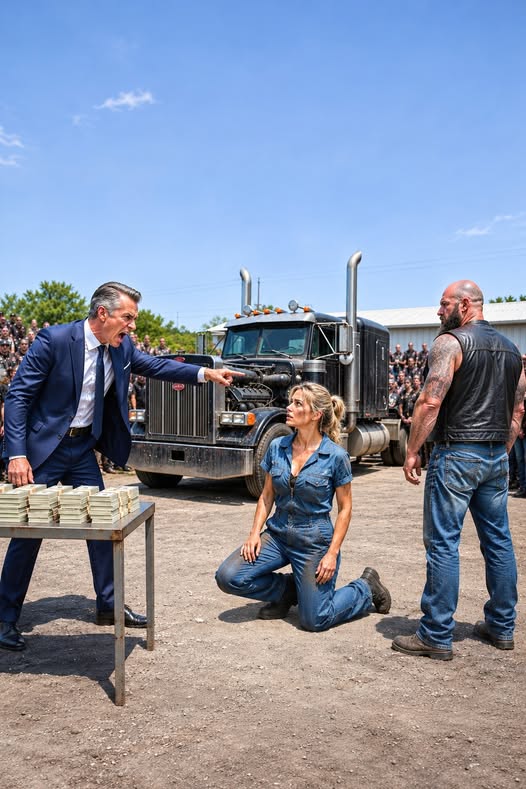
“Wonderful. Now we’re getting a history lesson from the janitor.”
I ignored him and reached beneath the engine’s intake assembly. My fingers found a small metal plate hidden behind a bundle of wires.
“Garrett, bring me a flashlight.”
He did.
I wiped away years of accumulated grease, revealing three sets of initials engraved into the metal.
B.D. — A.M. — E.M.
“Benny Doyle. Aaron Mitchell. Evelyn Mitchell,” I said.
Garrett’s mouth fell open.
Owen leaned closer, examining the engraving.
“Evelyn Mitchell?” he repeated. “The Evelyn Mitchell who worked at Blackridge Performance Engineering?”
I nodded.
He stood upright so quickly that he nearly dropped his flashlight.
“You designed the Mitchell ignition synchronization system.”
“Years ago.”
“I studied your work in college.”
Julian’s smile disappeared.
For the first time in three years, the men in that garage looked at me without seeing a woman holding a mop.
They saw someone they didn’t understand.
And that frightened some of them more than the broken engine.
“Why didn’t you ever tell us?” Garrett asked.
“Because nobody ever asked.”
I pulled a rolling stool toward the truck and sat down.
The truth was more complicated than that, but we didn’t have time for complicated truths.
I had spent twenty-two years designing and rebuilding high-performance engines. Aaron and I had owned a small engineering workshop outside Bozeman. Benny had been our closest friend and our most enthusiastic customer.
Together, we built machines that larger companies said were impossible.
Then Aaron died in a highway accident.
Within eighteen months, medical bills, outstanding business loans, and my inability to walk into our workshop without breaking down had taken everything else.
I sold the equipment.
I stopped answering calls.
Eventually, I took a cleaning job at the clubhouse where Benny’s truck had found its permanent home.
Being near something Aaron had helped create was the closest I could get to being near him.
But I had never touched the engine.
Not until last night.
“Your computer isn’t showing a fault because the computer doesn’t know there’s a fault,” I told Owen.
He frowned.
“How is that possible?”
“This engine has a custom safety circuit. Benny wanted protection against an ignition timing failure. If the circuit detects an inconsistent signal, it prevents the engine from firing.”
“We checked the sensors,” one of Julian’s engineers interrupted.
“I know. I watched you.”
“And they’re working.”
“Yes. That’s why you’ve been looking in the wrong place.”
I removed a small protective cover and pointed toward a connector.
“Something here doesn’t belong.”
Owen bent down.
The connector looked almost identical to the original. But the retaining clip was different, and the protective sleeve was newer than the surrounding wiring.
“Someone replaced it,” he said.
“Recently.”
Garrett crossed his arms.
“Nobody’s worked on that truck since Benny died. Just routine maintenance.”
“Then somebody has been doing more than routine maintenance.”
Julian checked his expensive wristwatch.
“Are we fixing the truck or conducting a criminal investigation?”
I looked at him.
“You offered five minutes, didn’t you?”
“You offered five minutes.”
“Then stop wasting them.”
A few club members chuckled.
Julian stepped back.
I asked Owen for a multimeter and performed several checks. Then I opened a small wooden toolbox I had brought from home.
It had belonged to Aaron.
His initials were burned into the lid, and the handle was worn smooth from decades of use.
Inside was a collection of specialized tools, handwritten notes, and spare components I hadn’t touched in years.
My hands trembled when I opened it.
For a moment, I could almost hear Aaron telling me not to overthink things.
I took out the appropriate replacement component and carefully restored the original connection.
Owen watched every movement.
When I finished, I looked at Garrett.
“Turn the key.”
Nobody spoke.
Garrett climbed into the driver’s seat.
The starter turned.
Once.
Twice.
Then twelve cylinders came alive with a thunderous roar that shook the windows.
The entire garage erupted.
Men shouted, slapped each other’s backs, and raised their fists. Someone dropped a coffee cup. Owen stood beside me, laughing in disbelief.
Garrett climbed out of the cab with tears running down his face.
“That’s Benny’s truck!” he shouted.
I closed my eyes.
I hadn’t heard that engine running from this close in seven years.
For everyone else, it was the sound of a machine coming back to life.
For me, it was the sound of a Saturday afternoon long ago, with Aaron grinning beside me and Benny complaining that we hadn’t made it loud enough.
I pressed my palm against the truck’s fender.
“Still got it, sweetheart,” I whispered.
Then Julian started clapping.
Slowly.
Deliberately.
“Very impressive,” he said. “Unfortunately, starting the engine isn’t enough.”
Garrett turned toward him.
“What?”
Julian pulled the agreement from his leather briefcase.
“The vehicle must complete the charity route under its own power. That’s what you signed.”
The celebration died immediately.
Garrett grabbed the document.
“You said we had to get it running.”
“And the written agreement defines running as fully operational throughout the event.”
Garrett’s face turned red.
“You miserable little—”
I caught his arm before he could move.
Julian smiled.
“Saturday morning. One hundred and forty miles. If that truck fails anywhere along the route, our agreement stands.”
He collected his belongings and motioned for his engineers to follow.
At the doorway, he glanced back at me.
“Enjoy your little victory, Mrs. Mitchell.”
After he left, Garrett slammed the agreement onto the workbench.
“I should’ve read every damn word.”
“Yes,” I said. “You should have.”
He looked at me, surprised by my answer.
“But beating yourself up won’t help us now. We need to inspect this entire truck.”
For the next six hours, Owen and I worked side by side.
The club members brought us tools, coffee, food, and whatever else we needed. Men who had walked past me without saying hello for three years were suddenly asking permission before entering the garage.
Around four that afternoon, I found something that made my stomach tighten.
A mounting bracket near the cooling system had been disturbed.
Then Owen discovered damage to an electrical connection.
Neither problem would necessarily prevent the truck from starting.
But under prolonged operation, either could cause serious trouble.
“This doesn’t make sense,” Owen muttered.
“It does if someone wants the truck to fail tomorrow.”
He looked at me.
“You think Mercer did this?”
“I think we need evidence before accusing anyone.”
We called Garrett into the garage and showed him what we’d discovered.
He went pale.
“There are security cameras outside.”
“Then check them.”
Garrett disappeared into his office.
Twenty minutes later, he returned with a laptop and a face that looked ten years older.
The security recordings showed someone entering the garage late Monday night.
The person had a key.
He wore a dark jacket and a baseball cap, but when he passed beneath the overhead light, his face became visible.
Garrett stopped the recording.
It was his younger brother, Wade.
The club’s treasurer.
The man responsible for organizing the charity run.
Garrett sat down heavily.
“No.”
Nobody answered.
“He wouldn’t.”
I knew that particular kind of denial. It was the desperate hope that reality might change if you refused to accept it.
Garrett called Wade.
His brother arrived thirty minutes later, carrying a bag of hamburgers and smiling like nothing was wrong.
“Figured you guys could use dinner.”
Garrett turned the laptop toward him.
The bag slipped from Wade’s hand.
“Tell me there’s an explanation,” Garrett said.
Wade stared at the screen.
“Garrett—”
“Tell me!”
His voice echoed through the clubhouse.
Wade sat down and covered his face.
For several minutes, all we heard was the hum of the refrigerator.
Finally, he confessed.
He had accumulated nearly forty thousand dollars in gambling debts. He had hidden the problem from his wife, his brother, and everyone at the club.
Julian had discovered his situation.
He offered Wade enough money to clear his debts in exchange for access to the truck and information about the clubhouse’s financial problems.
“He told me nobody would get hurt,” Wade whispered. “He said he’d buy the property, pay everything off, and give the club another place.”
Garrett looked as though someone had punched him.
“You sold us out?”
“I was scared.”
“You let me put our home on the line!”
Wade began crying.
“I didn’t know what else to do.”
“You could’ve come to me!”
Garrett’s voice cracked.
“I’m your brother.”
Wade couldn’t look at him.
I stood beside the workbench, remembering how many nights I had sat alone at my kitchen table, staring at unpaid bills and convincing myself that asking for help would make me a failure.
Desperation could make people do terrible things.
But understanding a mistake didn’t mean excusing it.
“Wade,” I said, “do you have anything connecting Julian to what happened?”
He nodded.
Text messages. Payment records. Instructions.
Everything was still on his phone.
Garrett wanted to call the sheriff immediately.
I agreed, but I also reminded him that tomorrow’s fundraiser still mattered.
Hundreds of people had registered.
Families were counting on the money.
Whatever happened with Julian, we couldn’t abandon them.
By midnight, a deputy had taken Wade’s statement and copies of the evidence. The club’s attorney had also been contacted.
Wade surrendered his keys and agreed to step down as treasurer.
Before leaving, he stopped beside his brother.
“I’m sorry.”
Garrett stared at the floor.
“I don’t know what to do with that yet.”
Wade nodded and walked out.
Nobody tried to stop him.
Owen and I continued working until nearly three in the morning.
When we finally completed our inspections and testing, the truck ran beautifully.
Owen leaned against the workbench.
“Have you considered coming back to engineering?”
“No.”
“Why not?”
I wiped my hands.
“Because the last time I was an engineer, my husband was alive.”
He didn’t offer an empty reassurance.
Instead, he looked at the wooden toolbox.
“Seems to me you’re still an engineer.”
I didn’t know how to answer.
Saturday arrived beneath a gray Montana sky.
Motorcycles filled the clubhouse parking lot. Volunteers arranged donation tables, families gathered beside the road, and the smell of coffee and breakfast sandwiches drifted through the cold morning air.
A banner hung above the entrance.
RIDE FOR THE KIDS — IN MEMORY OF BENNY DOYLE.
Garrett found me standing beside the truck.
He held out the keys.
“You’re driving.”
I shook my head.
“No. This is your club.”
“And that’s your engine.”
“I haven’t driven anything like this in years.”
“Then today’s a good day to remember.”
Before I could argue, a little girl approached us.
She wore a purple winter hat and carried a photograph of a boy sitting in a hospital bed.
“Are you the lady who fixed the truck?” she asked.
“I am.”
“My brother’s at the hospital in Billings. He likes trucks.”
She held up the photograph.
“Can you make it really loud when you get there?”
I smiled.
“I think we can arrange that.”
Her mother explained that the boy, eight-year-old Lucas, was receiving treatment for leukemia. He had been looking forward to seeing the charity convoy from his hospital window.
Suddenly, the wager seemed very small.
I accepted Garrett’s keys.
At eight o’clock, Julian arrived.
He brought an attorney and wore the confident expression of a man who believed the world had already agreed to his plans.
Garrett informed him that the sheriff was investigating allegations of tampering.
For a brief second, Julian looked genuinely alarmed.
Then he recovered.
“Wade is a desperate man,” he said. “Whatever he’s telling you is probably an attempt to save himself.”
“Save it for the investigators,” Garrett replied.
Julian looked toward the truck.
“Are you still participating?”
I climbed into the driver’s seat.
“Wouldn’t miss it.”
The engine roared.
Hundreds of motorcycles answered.
We rolled onto the highway beneath a chorus of cheers.
For the first forty miles, everything went perfectly.
The truck climbed hills effortlessly. Owen sat beside me, monitoring its performance, while Garrett led the motorcycle convoy ahead of us.
For the first time in years, I felt useful in a way that went beyond keeping someone else’s floors clean.
Then, around mile seventy, the weather changed.
Rain swept across the highway.
The temperature dropped, and dark clouds swallowed the mountains.
We slowed the convoy.
A few miles later, a volunteer vehicle pulled alongside us and signaled urgently.
There had been an accident ahead.
A small passenger van had slid off the wet road and become trapped in a muddy drainage ditch.
Several riders stopped.
I pulled the truck onto a safe shoulder and climbed down.
A woman stood beside the van, screaming for help.
“My son’s inside!”
The van had tilted against the embankment. Its rear door was jammed, and water was collecting around the lower side.
Someone had already called emergency services, but the nearest responders were several minutes away.
Garrett organized the riders, keeping traffic clear and checking on the occupants.
I approached the woman.
“Is your son conscious?”
“Yes. He’s scared. He can’t get out.”
A volunteer firefighter riding with the club assessed the situation. With the help of several members, he stabilized the vehicle enough to reach the boy through an accessible window.
I stayed beside the mother until her son was safely lifted out.
He couldn’t have been more than six.
He was cold, frightened, and crying, but he was alive.
His mother wrapped him in her coat and held him so tightly that I had to turn away.
Seven years earlier, strangers had stood beside a wrecked vehicle on another Montana highway.
They had tried to save Aaron.
They hadn’t succeeded.
For years, I had imagined those final moments, wondering whether anyone had held his hand or told him that help was coming.
Now, watching that mother embrace her child, I finally understood something.
Sometimes you couldn’t change the ending of your own story.
But you could still help change someone else’s.
By the time emergency crews arrived, we were nearly forty minutes behind schedule.
Julian, who had been following the convoy, approached me.
“You realize there’s a completion deadline?”
I stared at him.
“There’s a child who could have been seriously injured.”
“That’s unfortunate, but the agreement—”
“Then keep your damn money.”
He blinked.
I had spent years making myself smaller, quieter, and easier to overlook.
I wasn’t doing it anymore.
We resumed the journey.
Twenty miles from Billings, Owen suddenly straightened in his seat.
“Evelyn, temperature’s climbing.”
I checked the gauges.
He was right.
A warning light appeared.
I pulled into a roadside turnout and shut down the engine.
The motorcycles stopped behind us.
Garrett hurried over.
“What’s wrong?”
“Cooling problem.”
Julian’s vehicle pulled in moments later.
He stepped out beneath an umbrella.
“Well,” he said, “that’s disappointing.”
Owen and I inspected the system. One of the aging components had failed under the sustained load.
It wasn’t sabotage.
It was simply an old machine reminding us that even extraordinary engineering had limits.
“We need a replacement,” Owen said.
“Do we have one?”
He shook his head.
Garrett checked the time.
“We’ve got twenty-five minutes.”
The hospital was still twenty miles away.
I searched Aaron’s toolbox, although I already knew the necessary part wasn’t there.
For a moment, defeat settled over me.
Then a club member named Frank stepped forward.
“There’s an agricultural repair shop about two miles back. My nephew works there.”
Owen described what we needed.
Frank made a call.
Within minutes, his nephew confirmed that he had a compatible component.
Two riders volunteered to collect it.
Another member brought additional tools. Others contacted the event organizers to explain the delay.
Nobody stood around waiting for me to perform another miracle.
They worked together.
The replacement arrived twelve minutes later.
Owen and I installed it, completed the necessary checks, and restarted the engine.
It sounded healthy again.
But we had less than ten minutes remaining.
There was no safe way to reach the hospital before the deadline.
Garrett looked at me.
“Don’t even think about speeding.”
“I wasn’t going to.”
Julian smiled from beside his car.
“Then I suppose we’re finished.”
Garrett removed his riding gloves.
“You know what, Mercer? Maybe we are. But I’d rather lose that building than become someone like you.”
We drove the remaining distance at a safe speed.
When we reached the hospital, we were eighteen minutes late.
I expected disappointment.
Instead, hundreds of people were waiting.
Children watched from windows. Nurses waved from the entrance. Families held handmade signs.
And standing near the front was the little girl in the purple hat.
She pointed excitedly toward a third-floor window.
I gave the engine a brief, controlled roar.
Behind the glass, a small boy raised both arms.
I started crying.
I couldn’t help it.
Garrett climbed onto a temporary stage and explained what had happened during the journey.
He thanked the riders who had helped rescue the child.
Then he told the crowd that the clubhouse’s future was uncertain.
What happened next was something none of us could have predicted.
A local reporter who had followed the convoy began interviewing club members. The story spread across social media. People learned about the fundraiser, the truck, the roadside rescue, and the financial pressure threatening the club.
Donations began pouring in.
A retired mechanic contributed five hundred dollars.
A local construction company pledged ten thousand.
Former club members sent money from across the country.
By evening, the hospital’s fundraiser had exceeded its original goal, and a separate community campaign had raised enough to cover the clubhouse’s outstanding loan.
Every dollar intended for the children remained with the hospital.
The clubhouse would survive.
Julian never received the property.
The evidence of his involvement in the tampering led to a formal investigation, and the disputed agreement was eventually canceled through a legal settlement.
Several months later, he pleaded guilty to charges connected to the scheme.
Wade faced consequences for his involvement, too.
Garrett didn’t forgive him overnight.
But he visited his brother, encouraged him to seek treatment for his gambling addiction, and made it clear that rebuilding trust would require more than an apology.
As for me, I returned to the clubhouse the following Monday and reached for my mop.
Garrett took it from my hands.
“Your cleaning days here are over.”
My stomach dropped.
“Am I fired?”
He laughed.
“Come with me.”
He led me into a storage room beside the garage.
The old furniture was gone. Fresh workbenches lined the walls. There were tools, diagnostic equipment, and a large sign above the doorway.
MITCHELL & DOYLE COMMUNITY WORKSHOP.
“We want to teach kids and adults how to work on engines,” he explained. “People who can’t afford trade school. Veterans looking for a fresh start. Anybody willing to learn.”
He handed me a folder containing a proposal and a salary offer.
“We need someone to run it.”
I looked around the room.
On the center workbench sat a framed photograph of Aaron and Benny standing beside the unfinished V12.
I was between them, younger, covered in grease, laughing at something I could no longer remember.
“Where did you find that?”
“Benny’s daughter.”
I picked up the photograph.
For years, I had believed moving forward meant leaving Aaron behind.
Standing in that workshop, I realized I could carry him into whatever came next.
I accepted the job.
A year later, Lucas visited us after completing his treatment. He was wearing a mechanic’s shirt two sizes too big and wanted to know how engines worked.
I gave him a small wrench and showed him where to begin.
He looked up at me.
“Were you always good at fixing things?”
I smiled.
“Not everything.”
Some things couldn’t be repaired with tools. Some wounds required time, courage, and people willing to stay beside you while you healed.
But I had learned that being broken didn’t mean being finished.
That was true of engines, families, friendships, and people who had forgotten their own worth.
Above my workbench, I hung Aaron’s favorite saying, written in his unmistakable handwriting.
“Never throw something away just because you’ve forgotten how to make it work.”
Every morning, I unlocked the workshop and welcomed whoever walked through the door.
I didn’t care what they wore, how much money they had, or what their previous job had been.
I asked their names.
I listened to their stories.
And I gave them a chance.
Because sometimes the person everyone overlooks is the very person who can make the impossible happen.
And sometimes, while you’re busy bringing something else back to life, you discover that you’ve brought yourself back, too.