The injured police officer reached for her gun the moment she saw my Hells Angels vest.
For several seconds, the young officer said nothing. Her fingers hovered near the holster on her hip, and I could see the battle taking place behind her eyes. She was terrified, injured, and trapped in a wrecked cruiser with a man wearing the colors of a motorcycle club she probably associated with everything dangerous.
Finally, her hand dropped.
“Okay,” she whispered. “But don’t touch my gun.”
“Wouldn’t dream of it.”
I slowly lowered my hands and moved closer to the shattered driver’s window.
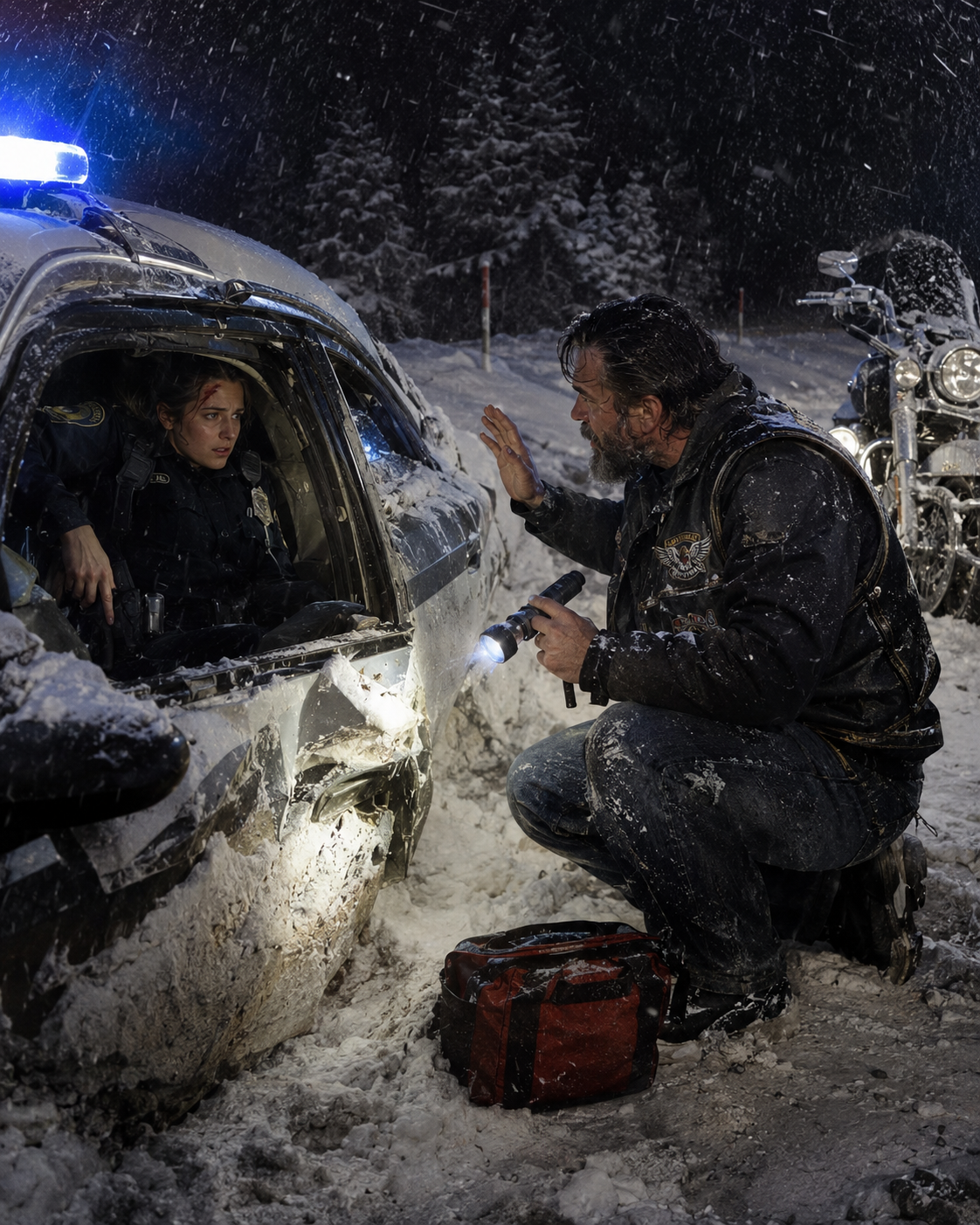
“What’s your name, Officer?”
“Emily. Emily Carter.”
“All right, Emily. I’m going to check your injuries. I’ll tell you everything I’m doing before I do it. Fair enough?”
She nodded weakly.
I pulled on a pair of medical gloves and carefully examined her face. The cut above her eyebrow was bleeding heavily, but it wasn’t my biggest concern. Her breathing was shallow, and when I touched the left side of her rib cage, she nearly screamed.
“Sorry,” I said. “I know that hurts.”
“Feels like somebody parked a truck on my chest.”
“Well, judging by your cruiser, somebody came pretty close.”
She managed the smallest smile.
Then she coughed.
Blood appeared at the corner of her mouth.
My stomach tightened.
That changed everything.
I had seen enough injuries during search-and-rescue missions to recognize the warning signs. She might have broken ribs, possibly a damaged lung, and the cold was making her condition worse by the minute.
I checked my watch.
11:56 p.m.
The temperature had already dropped below zero, and the wind was getting stronger.
“Emily, I need to ask you something. Did you crash because of the weather?”
Her expression changed.
For the first time, I saw something in her eyes that frightened me more than her injuries.
“No,” she whispered.
I leaned closer.
“What happened?”
She looked past my shoulder toward the road above us.
“Someone ran me off.”
I stopped moving.
“What?”
“A black pickup. No plates. It came up behind me with its headlights off.”
She swallowed painfully.
“I was transporting evidence. They knew.”
Before I could ask another question, she grabbed my wrist with surprising strength.
“Weston, listen to me. If somebody comes looking for me, you cannot let them take what’s in my cruiser.”
A cold feeling settled in my chest.
“What kind of evidence?”
She opened her mouth.
Then headlights appeared through the snow.
At first, I thought it was another vehicle struggling along the highway.
But the lights slowed.
Then stopped.
Directly above the ditch.
Emily saw them too.
Her face turned white.
“Oh, God,” she whispered. “They’re back.”
I immediately switched off my flashlight.
The darkness swallowed us.
For three seconds, all I could hear was the wind.
Then a truck door slammed.
A man’s voice carried through the storm.
“Officer Carter!”
Emily gripped my arm.
“Don’t answer.”
The man shouted again.
“We know you’re down there!”
I looked up toward the road. Through the blowing snow, I could barely make out the shape of a large pickup.
Two figures stood beside it.
Neither was wearing a uniform.
One carried a flashlight.
The other appeared to be holding something long and dark.
A rifle.
I felt my heartbeat settle into that strange, steady rhythm it always found when things turned dangerous.
Twenty-three years in the Hells Angels had taught me plenty about bad situations.
But six years pulling injured hikers, stranded families, and crash victims out of the Montana wilderness had taught me something more important.
Panic wastes time.
And right now, time was the one thing Emily didn’t have.
I leaned close to her ear.
“Listen carefully. I’m going to get you out of here.”
She shook her head.
“I can’t walk.”
“Then I’ll carry you.”
“They’ll shoot us.”
“Not if they can’t see us.”
I studied the wreckage. The driver’s door was crushed against a tree stump, but the passenger side faced a narrow drainage channel that disappeared beneath a stand of pine trees.
If I could get her through that door, we might have a chance.
Above us, the man shouted again.
“Emily! We just want the package!”
I looked at her.
“What package?”
She closed her eyes.
“Under the passenger seat. Black waterproof case.”
I reached across the console and found it wedged beneath the seat.
It was about the size of a thick hardcover book.
I pulled it free.
“What is this?”
“Evidence against a trafficking operation. Names, payments, recordings. Enough to put some very powerful people in prison.”
“Then why were you carrying it alone?”
Her voice cracked.
“Because I didn’t know who else I could trust.”
A flashlight beam swept across the windshield.
I ducked.
The men were coming down the embankment.
I slipped the case inside my vest and moved toward the passenger door.
“Emily, can you move your right arm?”
She tried.
“Yes.”
“Good. Keep it close to your chest. I’m going to release your seat belt.”
The buckle clicked.
She gasped as her body shifted.
I caught her before she could fall forward.
“Easy. I’ve got you.”
Above us, boots crunched through the snow.
“She’s still inside!” one man shouted.
I heard the unmistakable metallic sound of a rifle being handled.
There was no more time.
I forced the passenger door open against the packed snow, climbed partly inside, and carefully pulled Emily toward me.
She cried out as I lifted her.
“I’m sorry,” I whispered. “I know.”
Her head dropped against my shoulder.
For one terrible second, I thought she’d lost consciousness.
Then she whispered, “Don’t leave me.”
I tightened my grip.
“Not happening.”
We stumbled into the drainage channel just as a flashlight beam landed on the open passenger door.
“Hey!”
A gunshot cracked through the night.
The sound echoed across the frozen hills.
Snow exploded from a tree trunk beside my head.
I dropped to one knee, shielding Emily with my body.
Another shot followed.
“Keep moving,” she gasped.
I didn’t need encouragement.
I carried her into the trees.
The snow was nearly knee-deep, and every step felt like dragging my boots through wet cement. Emily was smaller than me, but her body armor and duty belt added weight, and the uneven ground made it almost impossible to maintain my balance.
Behind us, the men shouted.
“They went into the woods!”
A third shot rang out.
I kept moving.
After fifty yards, the drainage channel curved sharply behind a rocky outcrop.
I lowered Emily beneath a fallen pine and covered her with my heavy leather jacket.
She was shivering violently.
“Weston,” she whispered. “You’re bleeding.”
I looked down.
A dark stain was spreading across my left sleeve.
One of the bullets had grazed my upper arm.
“Just a scratch.”
“That’s not a scratch.”
“Well, I’ve had worse haircuts.”
She almost laughed, then winced.
I pulled a compression bandage from my medical kit and wrapped my arm as quickly as possible.
Then I took out my phone.
No signal.
Of course.
I looked toward the ridge.
There was an old forestry service tower about two miles east. I’d passed it on summer rides.
If we could reach higher ground, I might be able to get a signal.
But Emily wasn’t going to survive a two-mile hike in these conditions.
I needed another plan.
That’s when I remembered the emergency beacon.
It was a small satellite distress transmitter I carried on every long ride, tucked inside my medical bag. I’d bought it after a rescue mission where a teenage boy nearly died because nobody could reach emergency services.
I pulled it out and activated the SOS.
A tiny indicator began blinking.
I stared at it, waiting for confirmation.
After what felt like an eternity, the device showed that the distress signal had been transmitted.
I exhaled.
“Okay. Somebody knows we’re out here.”
Emily looked up.
“How long?”
“Depends on the storm.”
“Weston…”
“Yeah?”
“They have people inside the department.”
I turned toward her.
“What do you mean?”
She hesitated.
Then she said something that made the blood in my veins feel colder than the snow.
“My sergeant is one of them.”
I stared at her.
“Are you sure?”
“I heard him on a recording. Sergeant Daniel Mercer. He was taking money to make evidence disappear.”
She began coughing again.
I helped her lean slightly forward without twisting her injured side.
When the coughing stopped, her voice was barely audible.
“I was supposed to meet a federal investigator tomorrow morning. Someone outside the county. Nobody knew about it except me and the investigator.”
“Then how did those men find you?”
“I don’t know.”
A branch snapped somewhere behind us.
Both of us went silent.
A flashlight beam moved between the trees.
The men were getting closer.
I looked around desperately.
There was a narrow opening beneath the fallen pine, just large enough for Emily to lie inside.
I pulled my jacket around her shoulders and helped her slide into the shelter.
“Stay here.”
Her eyes widened.
“Where are you going?”
“To make sure they don’t find you.”
“No. Weston, don’t.”
I placed the waterproof evidence case beside her.
“Whatever happens, keep this hidden.”
She grabbed my hand.
“Why are you doing this?”
For a moment, I didn’t understand the question.
Then I realized what she meant.
Why would a Hells Angels biker risk his life for a police officer who had nearly drawn a gun on him?
I thought about giving her a joke.
Something about having nothing better to do on a Friday night.
Instead, I told her the truth.
“Because you’re somebody’s daughter.”
Her eyes filled with tears.
I continued quietly.
“And because somebody once did the same thing for mine.”
Before she could respond, I slipped into the darkness.
The men were less than forty yards away.
I could hear them arguing.
“She’s hurt. She can’t have gone far.”
“Then find her. Mercer wants that case before daylight.”
I crouched behind a tree and picked up a fist-sized rock.
I threw it as far as I could toward the opposite side of the drainage channel.
It struck a frozen branch with a loud crack.
Both flashlights swung toward the sound.
“There!”
The men started running.
I moved in the opposite direction, staying low.
For a few seconds, it worked.
Then my boot broke through a crust of ice.
The sharp crack echoed through the woods.
One of the men stopped.
“Hold it!”
I froze.
His flashlight swept toward me.
“Who’s there?”
I could have stayed hidden.
I might even have escaped.
But if they kept searching, they would eventually find Emily.
So I stood up.
“Evening, boys.”
The flashlight hit my face.
The man holding it was broad-shouldered, wearing a camouflage jacket and a black knit cap.
The second man carried a rifle.
They stared at my vest.
“What the hell are you doing out here?” the first man demanded.
“Same thing you are, apparently. Enjoying the weather.”
“Where’s the cop?”
“What cop?”
The rifleman stepped closer.
“Don’t play games.”
I spread my hands.
“Look, I was riding through when the storm hit. Saw a wreck and came down to check it out. Nobody was inside.”
The first man glanced at his partner.
“He’s lying.”
The rifle rose.
“Last chance.”
I looked directly at the man holding it.
“You really want to shoot a Hells Angels member in the middle of nowhere?”
His expression shifted.
It was subtle, but I saw it.
He knew what my vest meant.
Not because I was threatening him.
Because men like him understood consequences.
“Take off the vest,” he ordered.
I shook my head.
“Not happening.”
He stepped forward.
I could see the anger building behind his eyes.
Then something unexpected happened.
A faint engine noise drifted through the storm.
All three of us turned.
Somewhere on the road above, another vehicle was approaching.
The rifleman cursed.
“Who the hell is that?”
I had no idea.
But I wasn’t about to waste the distraction.
I lunged behind the nearest tree as the rifle fired.
The bullet tore through bark inches from my shoulder.
I hit the ground and rolled down a steep slope, crashing through branches and snow.
Pain exploded through my injured arm.
I kept rolling until I landed hard against a boulder.
For several seconds, I couldn’t breathe.
Above me, the men shouted.
Then I heard a truck engine revving.
They were retreating.
I waited until the voices disappeared before crawling back toward Emily.
When I reached the fallen pine, she wasn’t moving.
My heart stopped.
“Emily?”
Nothing.
I dropped beside her.
“Emily, talk to me.”
Her eyes opened slightly.
“You’re… loud.”
I almost collapsed with relief.
“Yeah, I’ve been told.”
But her skin looked pale, and her breathing had become dangerously shallow.
I checked her pulse.
Fast.
Weak.
She was deteriorating.
The emergency beacon had transmitted, but I had no way of knowing whether rescuers could reach us before morning.
And the men could return at any moment.
I pulled an insulated emergency blanket from my kit and wrapped it around her, placing another layer beneath her to separate her from the frozen ground.
“Emily, I need you to stay awake.”
“I’m trying.”
“Tell me about your family.”
She blinked.
“What?”
“Your family. Anybody waiting for you at home?”
A tear slid down her cheek.
“My dad.”
“What’s his name?”
“Thomas.”
“Good man?”
She nodded.
“The best.”
“Tell me about him.”
Her lips trembled.
“He calls me every Sunday. Even when I tell him I’m busy.”
“Sounds annoying.”
“He is.”
She smiled faintly.
Then her smile disappeared.
“He’s going to be so mad.”
“About what?”
“If I die.”
I felt something twist inside my chest.
“You’re not dying tonight.”
“You can’t promise that.”
She was right.
I couldn’t.
But I could promise something else.
“I can promise you won’t face this alone.”
She looked at me for a long moment.
Then she whispered, “I was wrong about you.”
I shook my head.
“You didn’t know me.”
“I saw your vest and thought…”
“I know what you thought.”
She looked away.
“My brother was killed by a biker.”
The words caught me off guard.
I sat back on my heels.
“How old was he?”
“Nineteen.”
Her voice broke.
“He was working at a gas station. There was a fight outside. A man wearing motorcycle club colors pulled a gun. My brother tried to help somebody, and he got shot.”
I said nothing.
“After that, I hated every one of you.”
I looked down at the patches on my vest.
For twenty-three years, those colors had been part of my identity.
They represented loyalty, brotherhood, and a life most people would never understand.
But I knew they also carried a history that wasn’t always honorable.
Some men had done terrible things while wearing patches.
Pretending otherwise wouldn’t bring Emily’s brother back.
“I’m sorry,” I said.
She shook her head.
“You didn’t do it.”
“No. But I’m still sorry.”
Her eyes met mine.
“Did you ever hurt anybody?”
I considered lying.
It would have been easier.
Instead, I answered honestly.
“I’ve been in fights. I’ve made choices I’m not proud of. There are things I’d change if I could.”
“Then why stay?”
“Because the men I ride with aren’t all the same. Some have made mistakes. Some have done good things nobody ever hears about. And some are still trying to figure out what kind of men they want to be.”
I paused.
“But none of that means you should trust somebody just because they’re wearing my patch. Or distrust somebody just because they are.”
Emily studied me.
“That’s a strange thing for a Hells Angel to say.”
“Maybe.”
I checked my watch.
12:38 a.m.
We had been out in the cold for nearly an hour.
Emily’s trembling had begun to slow.
That worried me more than anything.
I needed to get her somewhere warmer.
Then I heard it.
A distant horn.
Three short blasts.
A pause.
Three more.
I lifted my head.
The sound came from the road.
A few seconds later, a powerful spotlight swept across the treetops.
Someone was searching.
I stood and waved my flashlight.
The beam passed over me.
Then returned.
A voice shouted through a loudspeaker.
“HELLO DOWN THERE! CAN YOU HEAR US?”
I nearly laughed.
“YES! TWO PEOPLE! ONE CRITICALLY INJURED!”
The spotlight held steady.
“STAY WHERE YOU ARE!”
For the first time that night, I allowed myself to believe we might survive.
Then Emily grabbed my wrist.
“Weston.”
“What?”
“Don’t tell them about the case.”
I looked toward the lights.
“Emily, those are rescuers.”
“You don’t know that.”
She was right again.
I couldn’t see who was behind the spotlight.
And if Sergeant Mercer had people looking for her, they might have access to emergency dispatch information.
I crouched beside her.
“Okay. We keep it quiet until we know who’s up there.”
Minutes later, three figures emerged from the trees.
Two wore heavy winter rescue gear.
The third wore a sheriff’s department jacket.
My stomach tightened.
The deputy stepped forward.
“Officer Carter?”
Emily stiffened.
“Who’s asking?”
“Deputy Ryan Holt. County Sheriff’s Office.”
I watched his face carefully.
He looked young, maybe thirty, with snow collecting on his eyelashes.
“How’d you find us?” I asked.
“Satellite distress signal. Search and rescue got the coordinates and called us in.”
“Who’s your supervisor?”
He frowned.
“Sergeant Mercer.”
Emily’s fingers dug into my arm.
I slowly stood.
“That’s interesting.”
Holt looked from me to Emily.
Then back again.
“What’s going on?”
I didn’t answer.
Instead, I asked, “Where’s your ambulance?”
“Waiting at the road. We couldn’t bring it down here.”
“Then let’s get her there.”
The two rescue workers moved toward Emily.
Holt stepped closer to me.
“Sir, I need you to move aside.”
“She’s got serious chest injuries. She needs careful handling.”
“We know what we’re doing.”
“Good. Then do it.”
His eyes dropped to my vest.
Something changed in his expression.
“You’re Hells Angels?”
“Last time I checked.”
“Keep your hands where I can see them.”
I stared at him.
Behind us, Emily made a small sound.
I turned.
She was trying to speak.
“Holt…”
The deputy leaned toward her.
“What is it?”
She swallowed.
“Call… Captain Reynolds.”
Holt’s face went still.
Just for a second.
But it was enough.
“Why?” he asked.
“Tell him… I have what he wanted.”
Holt looked at me.
Then at the rescue workers.
“Everybody hold up.”
My pulse quickened.
He reached for his radio.
“Dispatch, this is Holt. I’ve located Officer Carter.”
Static crackled.
Then a voice answered.
“Copy. What’s her condition?”
“Alive. Injured.”
A pause.
Then another voice came over the radio.
“Ryan, this is Mercer. Secure the scene. I’ll be there in ten.”
Emily closed her eyes.
I looked at Holt.
He looked back.
And suddenly, I understood something.
He was scared too.
Not of me.
Of the voice on that radio.
Holt slowly lowered it.
Then he did something I hadn’t expected.
He turned it off.
“How much does she know?” he whispered.
I didn’t answer.
He looked toward the rescue workers.
“Get her to the ambulance. Now.”
One of them hesitated.
“Deputy?”
“Move!”
They carefully transferred Emily onto a rescue sled.
Holt stepped close enough that only I could hear him.
“Mercer told me Carter stole evidence from an active investigation. Said she was unstable.”
“Do you believe him?”
Holt looked at the blood on my sleeve.
Then at Emily’s battered face.
“No.”
“Then help us.”
He glanced toward the road.
“If Mercer gets here before we leave, we’re all in trouble.”
We started moving.
The rescue workers pulled the sled while Holt and I helped guide it through the trees.
Every few yards, Emily cried out from the pain.
I stayed beside her.
“Almost there, kid.”
She looked up weakly.
“Don’t… call me kid.”
I smiled.
“Then quit acting younger than my boots.”
We were less than a hundred yards from the road when headlights appeared above us.
A vehicle stopped.
A door slammed.
Then a familiar voice shouted.
“Deputy Holt!”
Holt froze.
Sergeant Mercer had arrived.
“Stay with her,” Holt whispered to me.
He climbed toward the road.
I watched him disappear into the blowing snow.
A moment later, I heard Mercer.
“Where’s Carter?”
“Being transported.”
“Where’s the evidence?”
“What evidence?”
A sharp sound cracked through the night.
Not a gunshot.
A punch.
Then Holt grunted.
“You think I’m stupid?” Mercer snarled.
I looked at the two rescue workers.
They were staring at me.
“Get her moving,” I said.
One shook his head.
“That deputy—”
“He’s buying us time.”
Then a gunshot echoed from the road.
Emily screamed.
The rescue workers dropped behind the sled.
I threw myself over her.
Another shot rang out.
A man’s voice shouted.
“DROP IT!”
Then silence.
I lifted my head.
Through the snow, I saw a figure stumbling down the embankment.
It was Holt.
Blood covered one side of his face.
“GO!” he shouted.
Behind him, Mercer appeared with a pistol.
“STOP RIGHT THERE!”
I stood between him and Emily.
Mercer pointed the gun at my chest.
“Move aside.”
“No.”
His eyes narrowed.
“You have no idea what you’re involved in.”
“Funny. I was about to say the same thing.”
He stepped closer.
“That officer stole classified evidence.”
“Then arrest her when she’s out of surgery.”
“Move!”
I didn’t.
Mercer glanced at my vest.
“You think that patch makes you untouchable?”
“No,” I said quietly. “I think the fact that you’re pointing a gun at an injured officer makes you a coward.”
His face twisted with rage.
For one awful second, I thought he was going to shoot.
Then a deep rumble rolled through the darkness.
At first, it sounded like thunder.
But thunder doesn’t grow louder in steady mechanical pulses.
Engines.
Several of them.
Mercer turned toward the road.
Through the storm came the unmistakable sound of motorcycles.
I knew that sound.
I’d heard it thousands of times.
And somehow, despite the snow and the freezing temperatures, it had never sounded sweeter.
My brothers had found me.
Earlier that evening, before the storm became unbearable, I’d sent a message to our chapter’s group chat saying I was taking a back road toward home.
When I failed to answer several calls, my closest friend, Big Mike, had apparently decided something was wrong.
And Big Mike had never been a man who ignored a bad feeling.
The engines stopped above us.
Doors slammed too.
A deep voice shouted through the darkness.
“WESTON!”
I smiled despite everything.
“DOWN HERE, MIKE!”
Mercer’s face drained of color.
A massive figure appeared at the top of the embankment.
Big Mike was six-foot-four, nearly three hundred pounds, and wearing a snow-covered leather vest over a heavy winter coat.
Behind him stood three other club members.
And beside them were two state troopers.
For a moment, nobody moved.
Then one of the troopers raised his weapon.
“SERGEANT MERCER! DROP YOUR GUN!”
Mercer hesitated.
The trooper shouted again.
“NOW!”
Mercer looked at Emily.
Then at me.
Then at the armed officers above.
His pistol fell into the snow.
Big Mike came down the embankment like an avalanche.
He grabbed me by the shoulders.
“Jesus Christ, Weston! You look like hell!”
“Good to see you too.”
He glanced at Emily.
“That the officer?”
“Yeah. She needs a hospital.”
Mike turned toward the rescue workers.
“Then why are we standing around?”
Within minutes, the scene became a whirlwind of movement.
The state troopers secured Mercer.
Holt was helped toward a second emergency vehicle.
The rescue team carried Emily to the waiting ambulance.
I followed until one of the paramedics stopped me.
“Sir, you need treatment too.”
“After her.”
“You’re bleeding through that bandage.”
“I noticed.”
Emily reached out from the stretcher.
“Weston.”
I stepped closer.
Her eyes were barely open.
“Thank you,” she whispered.
I squeezed her hand.
“Save it for when you’re feeling better.”
She shook her head.
“No. I need you to know.”
Her voice cracked.
“I thought you were going to kill me.”
I swallowed.
“I know.”
“And you saved my life.”
For a moment, I couldn’t speak.
Then I said, “Get better, Officer Carter. You’ve got a father waiting for his Sunday phone call.”
She smiled faintly.
The ambulance doors closed.
And she was gone.
I stood in the snow watching the taillights disappear.
Big Mike came up beside me.
“You okay?”
I looked at the blood on my sleeve.
At the wrecked cruiser in the distance.
At the flashing emergency lights illuminating the falling snow.
“Ask me tomorrow.”
He put a heavy hand on my shoulder.
“Come on, brother. Let’s get you patched up.”
I thought the story would end there.
I was wrong.
Three days later, I was sitting in a hospital waiting room with seventeen stitches in my arm when a man in a gray wool coat approached me.
He looked to be in his late sixties.
His hands were rough, and his eyes were red from exhaustion.
“Are you Weston?”
I stood.
“Yes, sir.”
He stared at my vest.
For a moment, I saw the same hesitation I’d seen in Emily’s eyes.
Then he stepped forward.
And hugged me.
Not a polite handshake.
Not an awkward pat on the shoulder.
He wrapped both arms around me and held on like a man who had spent three days trying not to fall apart.
“My name is Thomas Carter,” he whispered.
I closed my eyes.
Emily’s father.
“How is she?”
He pulled back, wiping his face.
“She’s alive.”
The words hit me harder than I expected.
“She had surgery,” he continued. “Collapsed lung, five broken ribs, internal bleeding. The doctors say she’s going to recover.”
I let out a breath I felt like I’d been holding since that night.
“That’s good. That’s real good.”
Thomas nodded.
“She told me everything.”
I looked away.
“She was pretty brave.”
He shook his head.
“She said you carried her through the snow while men were shooting at you.”
“Didn’t have much choice.”
“Yes, you did.”
I looked at him.
His voice trembled.
“You could have walked away. You could have left her in that car. Nobody would’ve blamed you.”
I thought about that.
Maybe he was right.
Maybe nobody would have blamed me.
But I would have known.
And sometimes the hardest person to live with is the one looking back at you in the mirror.
Thomas reached into his coat and pulled out a small photograph.
It showed a teenage girl standing beside a younger boy in a baseball uniform.
Emily and her brother.
“My son Daniel,” he said softly. “He was nineteen when we lost him.”
I nodded.
“Emily told me.”
Thomas looked down at the picture.
“After Daniel died, our family changed. Emily became angry. I became angry. We spent years blaming everyone who looked like the man who killed him.”
He swallowed.
“And then a man wearing a vest just like his saved my daughter.”
I didn’t know what to say.
Thomas placed the photograph back inside his coat.
“I don’t know much about your club, Weston. And I won’t pretend I understand everything it stands for.”
“That’s fair.”
“But I know what you did for my little girl.”
His eyes filled again.
“And I know my son would’ve done the same thing.”
He extended his hand.
This time, I took it.
A week later, federal investigators announced multiple arrests connected to a regional trafficking and corruption investigation.
Sergeant Mercer was among those charged.
The two men who had hunted Emily through the woods were arrested after investigators traced their truck and communications.
Deputy Holt survived his injuries.
The evidence Emily had protected helped expose a network that had operated for years, exploiting vulnerable people and paying officials to look the other way.
The investigation continued for months.
But the part that stayed with me wasn’t the headlines.
It wasn’t the arrests.
It wasn’t even the medal the county eventually offered me, which I politely declined.
It was something that happened six weeks after the crash.
I was working on my Harley in the garage when a patrol car pulled into my driveway.
For a second, I wondered whether I’d forgotten to pay a parking ticket.
Then Emily stepped out.
She was walking slowly, still recovering, but she was smiling.
In her hands was a small cardboard box.
“Officer Carter,” I said. “You finally come to arrest me?”
“Depends. You planning on doing anything stupid?”
“Not before lunch.”
She laughed.
It was the first time I’d heard her laugh without pain.
She walked toward me and handed me the box.
“What’s this?”
“Open it.”
Inside was a new leather medical-kit pouch.
On the front, carefully stitched in silver thread, were four words.
FOR THE ONES WHO STOP.
I stared at it.
Emily shifted nervously.
“I didn’t know what to get you. Dad said you probably didn’t need another motorcycle accessory.”
I ran my thumb over the stitching.
“It’s perfect.”
She smiled.
Then she grew serious.
“I wanted to tell you something.”
I waited.
“After my brother died, I spent years believing I could tell what kind of person somebody was just by looking at them.”
She glanced at my vest.
“I thought a patch told me everything I needed to know.”
I said nothing.
“But that night, when I was bleeding in that cruiser, you asked my permission before you even touched me.”
Her voice softened.
“You treated me with more respect than some people wearing my own uniform.”
I looked down.
“Emily, you don’t owe me anything.”
“I know.”
She stepped closer.
“But I wanted you to understand what you changed.”
She reached into her pocket and pulled out a folded piece of paper.
It was a letter.
She handed it to me.
“I wrote this for the new officers at the academy. My captain asked me to speak to them about the investigation.”
I unfolded it.
At the top was a single sentence.
A uniform can tell you someone’s job. A patch can tell you someone’s club. Neither can tell you the size of their heart.
I read it twice.
Then a third time.
My throat tightened.
“That’s a pretty good lesson.”
She smiled.
“Had a pretty good teacher.”
We stood there for a moment, surrounded by the smell of engine oil and the quiet sounds of a Montana afternoon.
Then Emily surprised me.
“There’s something else.”
“What’s that?”
“My dad wants you to come over for dinner Sunday.”
I raised an eyebrow.
“Your dad knows I’m a Hells Angel, right?”
She laughed.
“Pretty sure he noticed.”
“And he’s okay with that?”
She nodded.
“He said anybody willing to carry his daughter through a blizzard deserves a place at his table.”
I looked at the invitation.
Then at the young woman standing in my driveway.
“Tell him I’ll be there.”
That Sunday, I parked my Harley outside a modest white house with a blue front porch.
Thomas opened the door before I could knock.
The smell of roast beef filled the hallway.
Emily was sitting at the kitchen table, laughing at something her father had said.
There was an empty chair waiting for me.
And beside it, an extra plate.
For the first time in a long while, I felt something I hadn’t realized I’d been missing.
Not pride.
Not gratitude.
Belonging.
Halfway through dinner, Thomas raised his glass.
“To the people who show up when it matters.”
Emily lifted hers.
I lifted mine.
And for a few seconds, nobody spoke.
Because sometimes the most important things don’t need words.
Months later, I still thought about that night whenever I rode through the mountains.
I remembered the freezing wind.
The blood on Emily’s forehead.
The sound of gunshots echoing through the trees.
But most of all, I remembered the moment she first saw my vest.
The fear in her eyes.
The way her hand moved toward her gun.
And how close we came to losing everything because two strangers had been taught to see each other as enemies.
I don’t pretend that one good deed erases a person’s past.
It doesn’t.
And I don’t believe every man wearing a motorcycle patch is a hero, any more than I believe every person wearing a badge is honorable.
I’ve met good people and bad people on both sides.
I’ve seen men with spotless reputations do terrible things.
And I’ve seen men with rough faces, scarred hands, and questionable histories risk their lives for strangers.
What I learned that night was simple.
You don’t really know somebody until you see what they choose to do when doing the right thing costs them something.
A badge didn’t make Mercer a good man.
A leather vest didn’t make me a bad one.
And fear didn’t make Emily weak.
She had every reason to be afraid.
But even while she was injured, freezing, and fighting to stay alive, she found the courage to trust someone she didn’t understand.
That courage helped save her life.
And her willingness to reconsider what she believed changed something in mine.
I still wear my Hells Angels vest.
The patches haven’t changed.
The motorcycle hasn’t changed.
And strangers still look at me differently when I walk into a gas station or pull up beside them at a stoplight.
Some move away.
Some stare.
Some tell their children not to get too close.
I can’t control that.
But I can control what I do next.
I can stop when somebody needs help.
I can offer a hand when somebody falls.
I can choose to be better than the worst thing anyone assumes about me.
And maybe, once in a while, somebody will remember that kindness the next time they see a man who looks like me.
Last February, on the anniversary of the crash, Emily sent me a photograph.
She was standing beside a brand-new patrol cruiser, smiling in her winter uniform.
Her father stood on one side.
Deputy Holt stood on the other.
And hanging from the rearview mirror was a tiny silver motorcycle charm.
Underneath the picture, she’d written:
“Still making my Sunday phone calls. Still remembering the man who stopped.”
I sat in my garage for a long time looking at that photograph.
Then I placed it on the wall above my workbench, right beside pictures of my brothers and the people we’d helped rescue over the years.
Because that was where it belonged.
Not as proof that I was some kind of hero.
But as a reminder of what matters when the road gets dark.
That night, I had been just one tired biker trying to get home through a Montana blizzard.
Emily had been just one frightened officer trying to survive.
We were strangers wearing symbols that told the world we were supposed to stand on opposite sides.
But when the snow started falling harder, and the darkness closed in, none of those symbols mattered.
What mattered was that one human being needed help.
And another human being decided not to walk away.
Sometimes the most powerful thing you can do isn’t to prove someone wrong about you. It’s to give them a reason to see the world differently.
And if there’s one thing I hope people remember from my story, it’s this:
When you come across somebody broken down on the side of life’s road, don’t waste precious time deciding whether they look like someone worth saving.
Stop.
Reach out your hand.
Because someday, when your own world crashes into a ditch and the darkness feels endless, the person who comes through the storm to save you might be the very person you were taught to fear.