I had $4.37 to my name when I found a heavy gold ring buried in the desert dirt.
I shook my head.
Garret Thorne looked down at the gold ring resting in his palm. For a moment, the noise of the motorcycle compound seemed to disappear. The engines, the laughter, the music coming from somewhere behind the clubhouse—all of it faded as the old man stared at something I had almost sold for a few hundred dollars.
“Eleven years,” he said quietly. “That ring’s been missing for eleven years.”
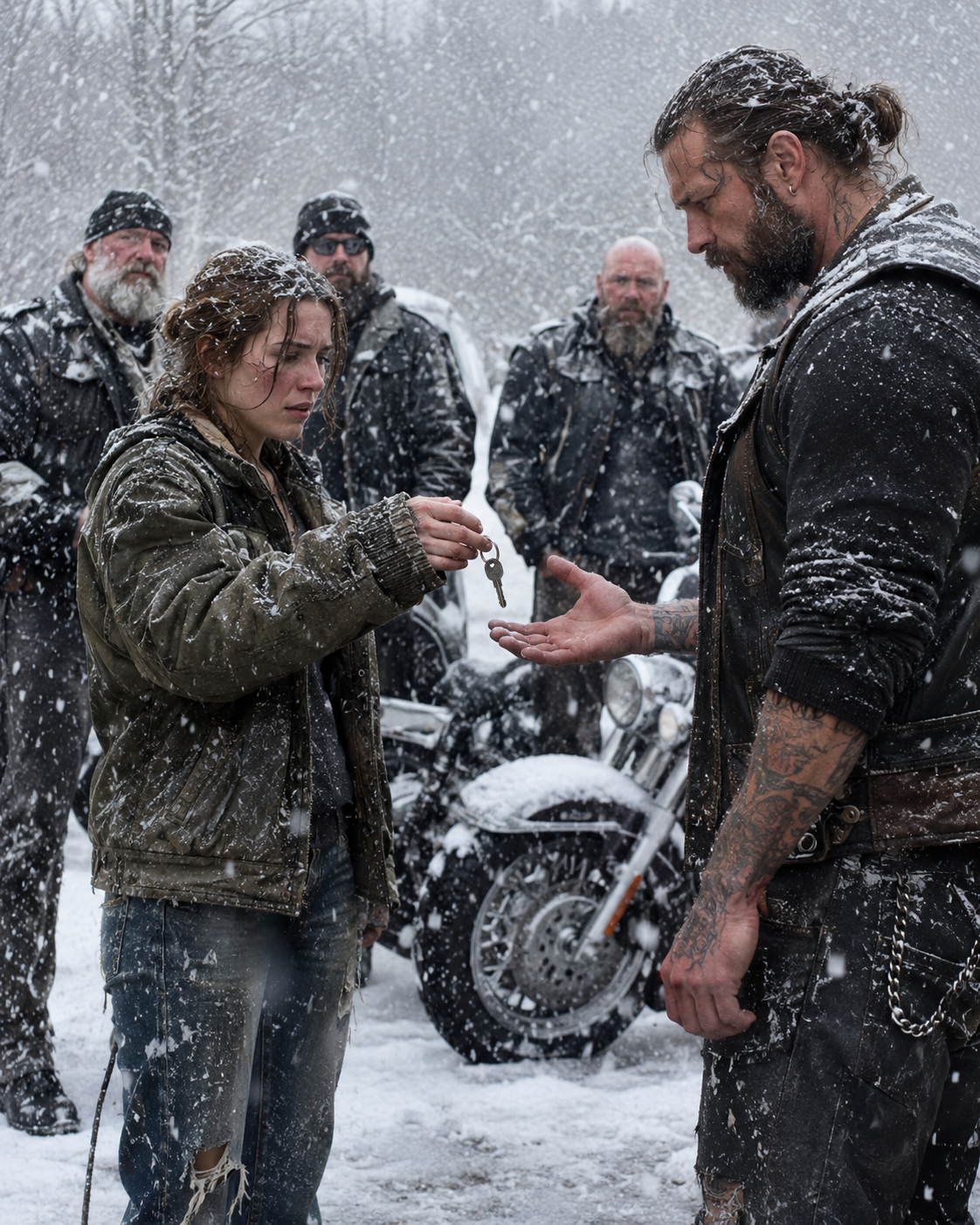
He closed his fingers around it.
“And the last man who wore it died trying to save my life.”
I didn’t know what to say.
The young biker beside me shifted his weight. His name was Cole, and judging by the way he kept glancing between Garret and the ring, he knew something I didn’t.
Garret looked at my face, then at my worn-out backpack.
“What’s your name, son?”
“Ethan. Ethan Miller.”
“Where you from?”
“Used to be from Tucson.”
“Used to be?”
I swallowed. “Don’t really have a place anymore.”
Something changed in his expression.
He nodded toward the clubhouse.
“Come inside, Ethan. You look like you haven’t eaten in a week.”
“Three days,” I admitted.
He didn’t smile.
“Then we’ve already wasted too much time.”
Inside, the clubhouse smelled of coffee, leather, cigarette smoke, and something cooking in the kitchen. A dozen men wearing black vests turned to look at me as I followed Garret through the room.
I could feel every pair of eyes on my torn jacket and dusty boots.
A woman with silver hair and a tattoo of a rose on her wrist appeared behind the counter.
“Rose,” Garret said, “get this young man whatever we’ve got hot.”
She looked me over once.
“Sit down, honey.”
Five minutes later, I had a plate of scrambled eggs, bacon, potatoes, and toast in front of me.
I tried to eat slowly.
I failed.
Rose quietly brought another plate.
Nobody laughed.
That somehow made it harder to keep my eyes dry.
Garret sat across from me, the ring on the table between us.
“Eleven years ago,” he began, “a man named Raymond Walker was riding with us through the desert. We called him Ray.”
He touched the ring.
“Ray wasn’t the biggest man in the club. Wasn’t the loudest, either. But if he gave you his word, you could build a house on it.”
I stopped chewing.
“Walker,” I said. “That’s the name inside.”
Garret nodded.
“We were coming back from a charity ride outside Yuma. A truck had broken down on an empty stretch of road, and Ray pulled over to help. I stayed with him.”
His jaw tightened.
“Turned out the driver wasn’t alone. Two men came out from behind the truck. They wanted our bikes and our money.”
Cole leaned against the wall, listening.
“Things went bad fast,” Garret continued. “One of them pulled a gun. Ray shoved me behind the truck just as the shooting started.”
He looked toward the window.
“Ray took the bullet meant for me.”
The room seemed colder.
“We got him to the hospital, but he never woke up. Somewhere between that highway and the emergency room, his ring disappeared.”
“I’m sorry,” I whispered.
Garret nodded once.
“Ray had a daughter. Little girl named Lily. Eight years old.”
He turned the ring over.
“She gave him this ring after saving up birthday money and helping her grandmother around the house. It wasn’t official club jewelry. Just a custom ring with a skull and the club’s name. Ray wore it every day.”
I looked at the gold.
Suddenly it seemed heavier.
“Did she ever find out what happened to it?”
Garret’s expression darkened.
“She asked me about it at his funeral. Said she wanted something her daddy had worn.”
He paused.
“I promised I’d find it.”
Eleven years.
A promise that had outlived the man it was made for.
“Where is she now?” I asked.
Garret didn’t answer immediately.
“That’s complicated.”
Before I could ask what he meant, a tall man with a gray beard walked into the room.
His vest had a patch that read SERGEANT AT ARMS.
“Garret,” he said, “we’ve got a problem.”
Garret looked up.
“What kind?”
The man glanced at me.
“The kind that started when somebody called from Silver Creek.”
My stomach tightened.
“The gas station?” I asked.
The man’s eyes narrowed.
“You told somebody about the ring?”
“I asked for directions. That’s all.”
Garret stood.
“What’s going on, Briggs?”
Briggs lowered his voice.
“Somebody’s been asking around town about a kid carrying Walker’s ring.”
Nobody moved.
Then Garret slowly turned toward me.
“Ethan,” he said, “tell me exactly where you found it.”
I explained the stretch of Highway 94, the dry wash beside the road, and the patch of dirt where the ring had been half-buried.
Garret listened without interrupting.
When I finished, he asked one question.
“Was there anything else?”
I hesitated.
“Maybe.”
Every face turned toward me.
“There was a piece of metal sticking out of the dirt nearby. Looked like part of an old toolbox. I didn’t think much of it.”
Briggs exchanged a look with Garret.
“What color?” he asked.
“Blue. Rusted around the edges.”
Garret’s face went pale.
He reached for the back of a chair.
“Ray had a blue toolbox strapped to his motorcycle that night.”
The silence that followed was different.
It wasn’t grief anymore.
It was fear.
Garret stared at the ring.
“Ethan, I need you to understand something. The police recovered Ray’s motorcycle after the shooting. They never found his toolbox.”
“Why does that matter?”
“Because Ray had something inside it.”
Briggs stepped closer.
“Something people have been looking for ever since.”
I suddenly wished I’d kept walking.
Garret must have seen it on my face.
“You’re safe here,” he said.
But the way Briggs glanced toward the front gate told me he wasn’t completely sure.
Garret explained that before Ray died, he’d been helping a local mechanic named Daniel Mercer collect evidence against a man who owned several trucking companies across southern Arizona.
The man’s name was Victor Harlan.
On paper, Harlan was a successful businessman who donated to hospitals and sponsored youth sports.
Behind the scenes, according to Ray, he was running a stolen-vehicle operation and using legitimate trucking routes to move the vehicles across state lines.
Daniel had discovered altered identification numbers and falsified shipping records.
When he threatened to report what he’d found, his garage burned down.
He barely escaped.
Ray offered to help him take the evidence to a state investigator.
“He kept copies in that toolbox,” Garret said. “Photographs, paperwork, names. Everything Daniel had collected.”
“Why not just give it to the police?” I asked.
“Ray was supposed to meet the investigator the next morning. He never made it.”
Briggs folded his arms.
“After Ray died, the original evidence disappeared from Daniel’s garage. Daniel left Arizona. The investigation fell apart.”
I stared at the table.
“So the people who shot him…”
“We never proved who sent them,” Garret said. “But Ray believed Harlan knew what he was carrying.”
I looked at the ring again.
“Then why would somebody be looking for it now?”
Garret leaned forward.
“Because you found it near the place where the evidence might still be buried.”
A motorcycle engine roared outside.
Briggs walked to the window.
Then another engine started.
He turned back.
“We need to move.”
Garret shook his head.
“Not yet.”
“Garret—”
“I’m not dragging this kid into something he doesn’t understand.”
I stood up.
“I think I’m already in it.”
Both men looked at me.
I wished my voice hadn’t shaken.
“But if there’s something out there that could explain why Ray died, shouldn’t somebody find it?”
Garret studied me for a long moment.
Then he asked, “How old are you?”
“Twenty-four.”
“You ever been shot at?”
“No.”
“Ever had somebody threaten your life?”
“No.”
“Then don’t mistake courage for knowing what you’re getting into.”
He picked up the ring.
“Ray made that mistake once.”
I didn’t answer.
Because I knew he was trying to protect me.
And because part of me was terrified he was right.
That evening, Garret gave me a clean shirt, a pair of jeans, and a small room behind the clubhouse.
Rose brought me a bowl of soup even though I’d already eaten dinner.
“You’re going to make yourself sick feeding me,” I told her.
She smiled.
“Sweetheart, I’ve been feeding stubborn men for thirty years. You’re an amateur.”
For the first time in months, I laughed.
She noticed the photograph sticking out of my backpack.
“Your family?”
I handed it to her.
My father stood outside Miller’s Hardware, smiling beneath the old red sign.
He had one arm around my shoulders.
The picture had been taken the summer before his diagnosis.
Rose studied it.
“Good-looking man.”
“He was.”
“What happened?”
“Cancer.”
She nodded gently.
“I’m sorry.”
I looked at the photograph.
“He worked every day of his life. Never cheated anybody. Never turned away someone who needed help. And when he got sick, everything he’d built disappeared.”
Rose sat beside me.
“Everything?”
I looked around the little room.
“The store. The house. Our savings.”
She tapped the photograph.
“Not everything.”
I didn’t understand what she meant until much later.
At two in the morning, shouting woke me.
I sat up as footsteps pounded down the hallway.
A door slammed.
Then came the sound of breaking glass.
I rushed into the clubhouse.
Briggs stood near the front entrance, holding a brick wrapped in paper.
The window beside him was shattered.
Garret emerged from his office.
“What happened?”
“Somebody threw this over the fence.”
Briggs unwrapped the paper.
There were six words written in thick black marker.
GIVE BACK WHAT DOESN’T BELONG TO YOU.
My mouth went dry.
Garret read the note.
Then he looked at me.
“Ethan, pack your things.”
“Are you sending me away?”
“I’m getting you somewhere safe.”
“Where?”
“Someplace they won’t find you.”
I thought of the road, the cold nights, and the people who had passed me without stopping.
Then I thought of Ray Walker’s daughter.
A little girl who had spent eleven years without the one thing her father had promised to keep.
“No,” I said.
Garret frowned.
“What?”
“I’m not leaving until we find out what’s buried out there.”
Briggs gave a humorless laugh.
“Kid, you don’t even know these people.”
“That’s true.”
I looked at Garret.
“But you fed me when you didn’t have to. You gave me a bed. And that ring belonged to a man who died helping somebody.”
I took a breath.
“My dad used to say that doing the right thing doesn’t mean much when it’s easy.”
Garret looked away.
For several seconds, nobody spoke.
Then he said, “Your father sounds like a good man.”
“He was.”
Garret folded the note.
“Then let’s make sure his son lives long enough to become one.”
By sunrise, Garret had contacted a retired state investigator named Helen Price.
She had worked on Ray’s case years earlier.
When she arrived, she carried a thick folder and the exhausted expression of someone who had waited too long for answers.
She listened to my story.
Then she spread an old map across the table.
“Show me where you found the ring.”
I pointed to a dry wash near a bend in Highway 94.
Helen stared at the location.
“That’s less than two miles from where Ray’s motorcycle was recovered.”
Briggs leaned closer.
“Could the toolbox still be there?”
“Possibly,” she said. “But if it contains evidence, we need law enforcement involved before anybody starts digging.”
Garret nodded.
Helen made several calls.
By late morning, two county investigators agreed to meet us at the location.
I rode in Garret’s truck.
The desert stretched endlessly around us, brown mountains rising beneath a cloudless sky.
I watched the highway slide past and remembered walking that same road with an empty stomach.
It felt like another lifetime.
When we reached the dry wash, I recognized the twisted mesquite tree and the broken concrete drainage pipe.
“There,” I said.
We parked beside the road.
The investigators photographed the area while I showed them where the ring had been.
One of them used a metal detector.
For nearly an hour, nothing happened.
Then the detector beeped.
The investigator knelt and began carefully removing dirt.
A corner of blue metal appeared.
My heart started pounding.
Within minutes, they uncovered a rusted toolbox wrapped in the remains of a torn canvas bag.
Garret gripped the side of the truck.
Nobody spoke as the investigator opened it.
Inside were a corroded wrench, a broken flashlight, and a sealed metal document case.
Helen stepped forward.
“Don’t touch anything else.”
The investigator photographed the case before opening it.
Inside was a thick plastic pouch.
The documents were yellowed but mostly intact.
There were photographs of trucks, handwritten notes, and copies of shipping manifests.
At the bottom lay a small envelope.
Across the front, in faded blue ink, someone had written:
FOR LILY, IF I DON’T MAKE IT HOME.
Garret turned away.
I saw his shoulders shake.
The investigator carefully placed the envelope in an evidence bag.
Then Helen looked at Garret.
“We need to get this to the proper authorities.”
Garret nodded.
But before anyone could move, a black SUV appeared on the highway.
It slowed.
Then stopped.
Two men stepped out.
One wore sunglasses and a tan jacket.
The other had a phone pressed to his ear.
Briggs moved closer to Garret.
The man in sunglasses approached.
“Afternoon,” he called. “Having car trouble?”
Helen stepped forward.
“This is an active investigation. Please return to your vehicle.”
The man looked past her.
His eyes settled on the toolbox.
Then on me.
For a brief second, his expression changed.
“You’re the kid from the gas station.”
I felt the blood drain from my face.
Garret stepped between us.
“Get back in your vehicle.”
The man smiled.
“Easy, old-timer. Just being friendly.”
The second man lowered his phone.
Then I saw something metallic beneath his jacket.
A gun.
“Garret,” I whispered.
He had already seen it.
One of the investigators reached for his radio.
“Both of you, hands where I can see them.”
The man in sunglasses stopped smiling.
For one terrible moment, nobody moved.
Then the second man bolted toward the SUV.
The investigator shouted for him to stop.
The driver jumped behind the wheel, and the vehicle tore away in a cloud of dust.
The other man tried to follow on foot.
Briggs moved to intercept him, but Helen shouted, “Stay back!”
The man stumbled in the loose gravel.
A deputy who had been securing the roadside caught up and detained him.
The entire confrontation lasted less than thirty seconds.
My hands shook for twenty minutes afterward.
Back at the compound, Helen made another phone call.
Then another.
By evening, the documents were on their way to a state investigative unit.
The detained man’s identification connected him to a private security company that had previously worked for Victor Harlan.
It wasn’t proof of Harlan’s involvement.
But it was enough to make the investigators take the threats seriously.
That night, Garret found me sitting alone outside the clubhouse.
“You did good today,” he said.
“I almost threw up.”
He chuckled.
“Those two things aren’t mutually exclusive.”
He sat beside me.
For a while, we watched the sunset turn the mountains red.
Then he said, “There’s something I haven’t told you about Lily.”
I turned toward him.
“She disappeared three years ago.”
My stomach dropped.
“What do you mean, disappeared?”
“After Ray died, her mother struggled. They moved around. Lily grew up angry, got mixed up with people who didn’t care about her, and eventually stopped answering calls.”
“Did you look for her?”
“Every way I knew how.”
His voice cracked.
“I promised Ray I’d look after his little girl. I couldn’t even find her.”
I stared into the desert.
“Maybe the ring can help.”
Garret shook his head.
“Not every lost thing gets found, Ethan.”
I thought about my father.
About the hardware store.
About everything I’d spent fourteen months believing was gone forever.
“Maybe not,” I said. “But sometimes somebody has to keep looking.”
The next morning, I asked Rose if I could use the clubhouse computer.
She showed me an old desktop in the office.
I searched for Lily Walker.
There were hundreds of results.
None seemed right.
Then I remembered something Garret had mentioned.
Lily’s mother had remarried.
Her new husband’s last name was Bennett.
I searched again.
This time, I found a photograph from a community fundraiser in Flagstaff.
A young woman stood beside a table of donated winter coats.
The caption identified her as Lily Bennett, a volunteer at a shelter called Harbor House.
My heart raced.
I printed the photograph and took it to Garret.
He stared at it.
Then he sat down heavily.
“That’s her.”
His eyes filled.
“That’s Ray’s little girl.”
Garret called the shelter.
The woman who answered wouldn’t give out personal information.
But she agreed to pass along a message.
He told her his name.
Then he said, “Tell Lily I found something her father left behind.”
Three hours later, the phone rang.
Garret answered.
I watched his face change.
“Lily?”
His voice broke.
For a long time, he listened.
Then he whispered, “I’m sorry, sweetheart.”
He covered his eyes with one hand.
“I should’ve found you sooner.”
They spoke for nearly an hour.
When Garret hung up, he looked ten years older.
And somehow ten years younger.
“She wants to come,” he said.
Two days later, a dusty silver sedan pulled through the compound gates.
A young woman stepped out.
She had dark hair, tired eyes, and a small scar above her eyebrow.
Garret stood on the clubhouse steps.
Neither moved at first.
Then Lily crossed the gravel and threw her arms around him.
The old biker held her like he was afraid she’d disappear again.
I stepped back to give them privacy.
But Lily noticed me.
“You’re Ethan?”
I nodded.
She walked over.
For a moment, she just looked at me.
“Garret told me what you did.”
“It wasn’t much.”
Her eyes filled with tears.
“You have no idea how much it was.”
Inside, Garret placed the ring on the table.
Lily picked it up carefully.
Her fingers traced the gold skull.
Then she turned it over.
“R. Walker,” she whispered.
She pressed it against her chest.
“My dad used to let me wear this around the house. It was so big it covered half my hand.”
She laughed through her tears.
“He’d tell me I looked tougher than all his biker friends.”
Garret smiled.
“He wasn’t wrong.”
Lily looked at me.
“Why didn’t you sell it?”
I thought about the four dollars and thirty-seven cents in my pocket.
About the hunger.
About the bus ticket I’d imagined buying.
“Because it wasn’t mine.”
She shook her head.
“Most people would’ve kept it.”
“Maybe.”
I looked at the photograph of my father sticking out of my backpack.
“But I knew what it felt like to lose something you couldn’t replace.”
Lily reached across the table and squeezed my hand.
That afternoon, Helen arrived with news.
The documents found in Ray’s toolbox had helped reopen the investigation into the stolen-vehicle operation.
Several of the names matched people already under investigation.
Authorities were reviewing financial records and preparing additional interviews.
But there was something else.
Helen placed a photocopy of Ray’s letter on the table.
The original had been preserved as evidence, but investigators had allowed Lily to receive a copy.
Lily unfolded it.
Her hands trembled as she began reading.
“My sweet Lily,
If you’re reading this, something has happened that kept me from coming home. I hope I’m wrong about the danger, but I don’t want to leave important words unsaid.
You once asked me what makes a person brave. I told you it was being strong enough to protect people.
That wasn’t the whole answer.
Sometimes bravery means being scared and doing what’s right anyway.
Sometimes it means admitting you’re wrong.
And sometimes it means helping someone who can never repay you.
I don’t know what kind of world you’ll grow up in, sweetheart. But I hope you’ll always remember that the way people treat those who have nothing to offer tells you more about their character than anything they say.
I love you more than all the miles I’ve ever ridden.
Dad.”
By the time Lily finished, nobody in the room had dry eyes.
Garret covered his face.
Rose quietly left the room.
I stared at the letter.
My father could have written those words.
That evening, Lily found me outside.
“Can I ask you something?”
“Sure.”
“What are you going to do now?”
I shrugged.
“Keep moving, I guess.”
“Where?”
“Don’t know.”
She looked at my worn backpack.
“Garret said you used to work in a hardware store.”
“My dad owned one.”
“Were you good at it?”
I smiled faintly.
“I could rebuild a lawn mower before I could drive.”
Lily nodded thoughtfully.
“Interesting.”
“Why?”
She didn’t answer.
The next morning, Garret called me into his office.
Rose was there.
So was Lily.
And a man I’d never met before.
He was broad-shouldered, with grease beneath his fingernails and a faded work shirt that read THORNE MOTOR WORKS.
Garret gestured toward him.
“This is my younger brother, Samuel.”
Samuel shook my hand.
“Heard you know your way around tools.”
“A little.”
“Heard you fixed the generator behind the clubhouse yesterday.”
“It was just a loose connection.”
Samuel grinned.
“That’s what I’ve been telling these idiots for six months.”
Garret leaned back.
“Samuel owns a repair shop outside Flagstaff. He’s been looking for someone reliable.”
I blinked.
“Okay.”
Samuel folded his arms.
“Pay’s eighteen dollars an hour to start. More if you know what you’re doing. There’s a small apartment above the shop. Needs painting, but the plumbing works.”
I stared at him.
“Are you offering me a job?”
“Unless you’ve got somewhere better to be.”
I couldn’t speak.
Garret smiled.
“You returned something that meant more to me than money. I can’t repay that. But I can introduce you to somebody who needs a good mechanic.”
I looked at the floor.
For fourteen months, I’d been trying not to hope for anything.
Hope was dangerous when life kept taking things away.
“What if I mess it up?” I asked.
Samuel shrugged.
“Then we fix it.”
Something inside me broke.
I covered my face.
And I cried.
Not quietly.
Not politely.
I cried the way I’d wanted to cry when the hospital called about my father.
The way I’d wanted to cry when the bank took the hardware store.
The way I’d wanted to cry every night I’d slept outside pretending I wasn’t afraid.
Nobody told me to stop.
Garret simply put a hand on my shoulder.
“You’re allowed to have a second chance, son.”
Three weeks later, I started work at Thorne Motor Works.
The apartment above the shop smelled like fresh paint and old wood.
It had a narrow bed, a kitchen table, and a window overlooking the mountains.
To most people, it wouldn’t have looked like much.
To me, it looked like a palace.
I bought groceries with my first paycheck.
Real groceries.
Eggs, bread, coffee, chicken, vegetables.
I stood in the kitchen staring at the bags for several minutes.
Then I called Rose.
“I bought food,” I told her.
She laughed.
“That’s generally what people do with money, sweetheart.”
“No,” I said, my voice trembling. “I mean I bought enough for the whole week.”
She went quiet.
Then she said, “Your daddy would be proud.”
I hung up and cried again.
Over the following months, life slowly became something I recognized.
I learned the names of regular customers.
I fixed motorcycles, trucks, generators, and anything else Samuel dragged through the garage doors.
Sometimes Garret stopped by with coffee.
Sometimes Lily came over after her shifts at Harbor House.
She’d returned to school to finish her social work degree.
We became friends.
Then something more.
But the story of Ray Walker wasn’t finished.
Seven months after I found the ring, Helen called.
Victor Harlan had been arrested.
The recovered documents had helped investigators connect his company to a wider criminal operation.
Additional witnesses had come forward.
Financial records had revealed payments to people connected to the attack on Ray and Garret.
The man who had thrown the brick through the clubhouse window had agreed to cooperate with prosecutors.
The case would take time.
There would be hearings, lawyers, and testimony.
Nothing could bring Ray back.
But for the first time in eleven years, his family had a real chance at answers.
When Garret heard the news, he sat silently for a long time.
Then he said, “Ray would’ve hated all this attention.”
I smiled.
“Sounds like him.”
Garret looked at me.
“You never even met him.”
“No,” I said. “But I think I know what kind of man he was.”
A year after I walked into that compound, Lily and I drove back to the stretch of Highway 94 where everything had begun.
We parked beside the dry wash.
The desert was quiet.
The wind moved gently through the mesquite branches.
I walked to the spot where I’d found the ring.
Lily stood beside me.
“Hard to believe it was right here,” she said.
I nodded.
“Hard to believe I almost sold it.”
She slipped her hand into mine.
“Do you ever wonder what would’ve happened if you had?”
I looked toward the highway.
I imagined myself walking into a pawnshop.
Handing over the ring.
Buying a bus ticket.
Leaving Arizona.
Maybe I’d have found work somewhere.
Maybe I wouldn’t.
Maybe Lily would never have received her father’s letter.
Maybe Garret would still be carrying eleven years of guilt.
And maybe the evidence in that rusted toolbox would have stayed buried until the desert swallowed it completely.
“Yeah,” I said. “Sometimes.”
She squeezed my hand.
“But you didn’t.”
“No.”
I looked down at the dirt.
“I didn’t.”
That afternoon, we visited my father’s grave in Tucson.
I hadn’t been there since the funeral.
For a long time, I stood in front of the headstone without speaking.
Then I took the photograph from my backpack.
The edges were worn.
The colors had faded.
But Dad was still smiling.
“I think I finally understand,” I whispered.
Lily waited a few steps behind me.
“When you told me that a man’s worth isn’t measured by what he owns, I thought you were just trying to make me feel better when the store was struggling.”
I swallowed.
“But you were trying to teach me something.”
The wind rustled the dry grass.
“I lost the store, Dad. I lost the house. I lost almost everything.”
My voice cracked.
“But I didn’t lose what you taught me.”
I placed a small brass key on the headstone.
It was the last key to Miller’s Hardware.
I’d carried it for fourteen months, even after the locks had been changed.
“I think I’m ready to stop carrying this.”
I stood there until the sun began to set.
Then Lily took my hand.
And we went home.
Two years later, Samuel retired.
He offered to sell me the repair shop through a payment plan I could actually afford.
I renamed it Miller & Thorne Repair.
We kept the old sign hanging inside the office.
Underneath it, I placed a framed photograph of my father.
Beside the photograph was a handwritten note.
IF SOMEONE NEEDS HELP, START THERE.
We began offering free basic repairs once a month for people who couldn’t afford them.
Single parents.
Veterans.
Elderly neighbors.
People living out of their cars.
Sometimes all they needed was a battery.
Sometimes it was a tire.
Sometimes they just needed someone to listen.
One cold February morning, a young man walked into the shop.
He couldn’t have been more than twenty.
His jacket was too thin.
His shoes were falling apart.
And he looked at the floor when he spoke.
“Sir,” he said, “my truck broke down about two miles back. I don’t have much money.”
I set down my wrench.
“How much do you have?”
He reached into his pocket.
“Six dollars and twelve cents.”
For a moment, I couldn’t breathe.
I remembered the desert.
The hunger.
The four dollars and thirty-seven cents.
I remembered standing outside the gates of a motorcycle compound, terrified that the men inside would hurt me.
Instead, they’d fed me.
They’d given me shelter.
They’d given me a chance.
I looked at the young man.
“What’s your name?”
“Caleb.”
“Well, Caleb, let’s go take a look at your truck.”
He hesitated.
“But I can’t pay you.”
I grabbed my keys.
“We’ll worry about that later.”
His eyes filled with relief.
As we walked toward my pickup, I thought about Ray Walker.
About Garret.
About Lily.
About my father.
And about a gold ring that had spent eleven years buried beneath the Arizona sun.
People sometimes ask me whether I believe in miracles.
I used to say no.
I thought miracles were supposed to be lightning bolts from heaven, impossible things that happened to people luckier than me.
But I’ve changed my mind.
Sometimes a miracle is a stranger who gives you a hot meal.
Sometimes it’s a second chance disguised as an ordinary job.
Sometimes it’s a young woman finally receiving a letter from the father she thought she’d lost forever.
And sometimes it’s a hungry man with four dollars and thirty-seven cents choosing not to sell something that doesn’t belong to him.
I never became a member of the Hells Angels.
I never wanted to.
But I learned something from the men who welcomed me through those gates.
You can’t always judge a person’s heart by the clothes they wear, the motorcycle they ride, or the reputation that follows them.
And you can’t measure the value of an honest decision by what it earns you.
The ring I found could have bought me a few nights in a motel and enough food to last a week.
Returning it helped change the direction of my life.
But the most important thing it gave me wasn’t a job, a home, or even the family I eventually found.
It gave me back something I’d lost when my father died.
The belief that goodness still mattered.
That kindness wasn’t weakness.
That doing the right thing was worthwhile even when nobody was watching.
And that sometimes the smallest choice we make on the worst day of our lives can become the beginning of something extraordinary.
I still have that old backpack.
It hangs on a hook in my office, right beside my father’s photograph.
Inside its front pocket, I keep four dollars and thirty-seven cents.
Two crumpled dollar bills, eight quarters, three dimes, a nickel, and two pennies.
Every time I look at it, I remember the person I was when I found that ring.
Hungry.
Homeless.
Afraid.
Convinced that life had nothing left to give me.
Then I remember what my father used to tell me whenever a customer came into our store needing something they couldn’t afford.
“Ethan, you never know how close somebody is to giving up. So if you have a chance to make their day a little easier, take it.”
For years, I thought he was teaching me how to run a hardware store.
Now I know he was teaching me how to live.
Because the greatest treasure I found in that desert wasn’t made of gold.
It was the understanding that even when you have almost nothing, you can still have something valuable to give.
And sometimes, when you choose to give it, life finds a way to give you something back.
Not because the world owes you a reward.
Not because every good deed guarantees a happy ending.
But because one act of kindness can reach people you’ll never meet, heal wounds you’ll never see, and open doors you never knew existed.
That is the legacy my father left me.
That is the lesson Ray Walker died believing.
And that is the promise I intend to keep for the rest of my life.
Never let what you’ve lost convince you that you have nothing left to give.