I thought my father had abandoned us six years ago
I made my choice in less than three seconds.
I trusted the biker.
Not because I knew him. Not because he looked particularly trustworthy. But because the man outside wearing a sheriff’s jacket had my photograph in his hand, and the voice coming through his radio belonged to someone who had hugged me at my mother’s funeral.
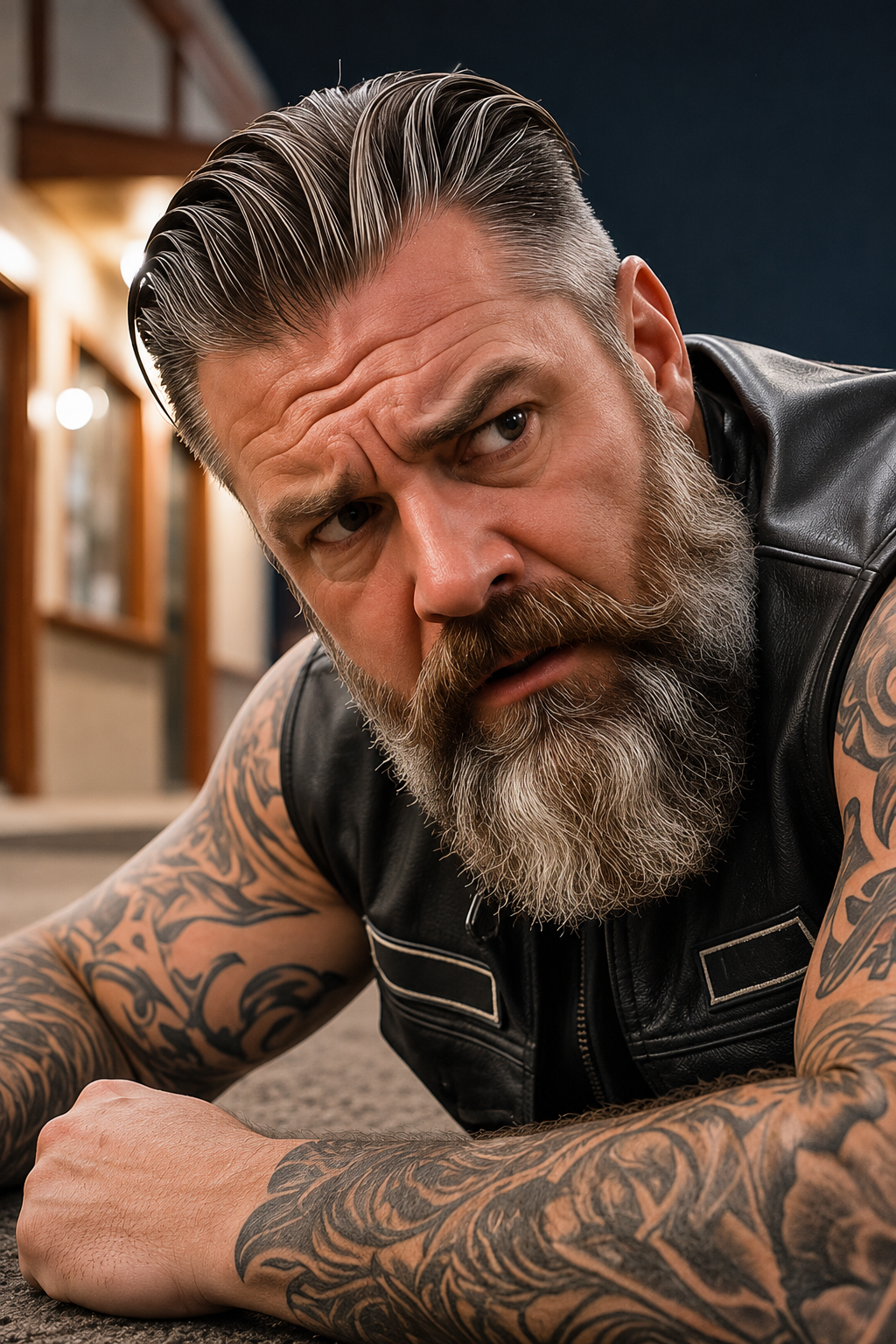
“Kitchen,” Logan whispered. “Now.”
I grabbed the envelope and crawled toward the swinging doors.
A gunshot shattered the front window.
Glass exploded across the counter where my head had been moments earlier.
Logan grabbed my collar and dragged me through the kitchen.
“Stay low!”
Another shot rang out.
I heard the front door crash open, followed by heavy footsteps.
“They’re inside,” I gasped.
“I noticed.”
Logan shoved a stainless-steel prep table against the kitchen entrance. Then he reached beneath his leather vest and pulled out a handgun.
I stopped breathing.
“You’re carrying a gun?”
“Tonight, sweetheart, that’s the least surprising thing you’re gonna see.”
He pushed open the walk-in freezer.
“Get inside.”
“Are you crazy?”
“Probably. But I’m also the only reason you’re still breathing.”
Before I could argue, he stepped into the freezer with me and pulled the door nearly shut.
Through the narrow opening, I watched two men enter the kitchen.
One wore a sheriff’s jacket.
The other carried a pistol fitted with a suppressor.
“Where’d they go?” the second man muttered.
The deputy checked his radio.
“Vance wants the girl. Biker’s expendable.”
My blood turned cold.
Logan leaned toward my ear.
“When I move, you run through the loading door. There’s a red pickup behind the dumpster.”
“What about you?”
He gave me a strange look.
“Your father made me promise something a long time ago.”
Before I could ask what, he kicked the freezer door open.
Everything happened at once.
Logan slammed the heavy door into the gunman’s face. The pistol clattered across the floor.
The deputy reached for his weapon.
Logan fired once.
The shot struck the metal shelving beside him, sending pots crashing down.
“Drop it!”
The deputy ducked behind the stove.
Logan grabbed my wrist.
“RUN!”
We burst through the loading door into the freezing Montana night.
A black SUV screeched around the corner.
Its headlights swept across the alley.
Logan shoved me behind the dumpster just as bullets punched into the brick wall.
“Truck!” he shouted.
I scrambled into the passenger seat of an old red Ford.
Logan jumped behind the wheel, turned the key, and slammed the accelerator.
The pickup roared forward.
The SUV followed.
I twisted around and watched the Bluebird Diner disappear behind us.
It was the only place I’d worked since high school.
My mother had helped me buy it.
Now its front windows were shattered, and armed men were hunting me through the streets of Billings.
“Who are you?” I demanded.
Logan kept his eyes on the road.
“Logan Hayes.”
“I know your name! Who are you to my father?”
His jaw tightened.
“His best friend.”
I stared at him.
“My father didn’t have a best friend named Logan.”
“He did before you were born.”
“Then where have you been for six years?”
“Trying to find him.”
Those five words silenced me.
Logan turned onto a narrow industrial road, killed the headlights, and accelerated toward an abandoned grain elevator.
The SUV overshot the turn.
For a moment, we were alone.
“Open the envelope,” he said.
My hands trembled as I tore the brown paper.
Inside were three things.
A photograph.
A small brass key.
And a folded letter.
The photograph showed my father standing beside Logan and another man in front of a construction site.
My father looked younger. Happier.
The third man wore an expensive suit.
Julian Vance.
I turned the photograph over.
Three words had been written in my father’s handwriting.
TRUST THE IRON.
My throat tightened.
“That’s what he called you?”
Logan nodded.
“Since we were eighteen.”
I unfolded the letter.
The first line nearly broke me.
My beautiful Emma,
If you’re reading this, then the truth has finally found its way to you.
I need you to understand something before anything else.
I did not abandon you.
I pressed my hand against my mouth.
Six years of anger rose inside me so suddenly I thought I might be sick.
I wanted to come home every single day.
But coming home would have put you and your mother in danger.
Julian Vance is not the man this town believes he is.
And the proof of what he’s done is hidden somewhere only you can find.
The next sentence was underlined.
Remember where we buried the bluebird.
I looked up.
“What does that mean?”
Logan frowned.
“I was hoping you’d know.”
I read the final lines.
Don’t trust anyone wearing a badge until you know who they answer to.
And Emma, if you ever hated me for leaving, I understand.
But there wasn’t a single morning I woke up without wishing I could hear you laugh again.
Love, Dad.
I couldn’t speak.
My father used to call me his little bluebird.
When I was seven, he’d built me a wooden birdhouse and painted it bright blue.
We buried our first family dog, Rosie, beneath the old cottonwood tree behind our house.
And when a storm destroyed the birdhouse, Dad buried its broken pieces beside her.
I remembered because he’d made a little wooden marker.
A bluebird carved into the top.
“Logan,” I whispered.
“I know where the key belongs.”
He looked at me.
“Then we’d better get there before Vance figures it out.”
We reached my childhood home shortly after one in the morning.
The house had been empty since my mother died eight months earlier.
I hadn’t had the heart to sell it.
Snow covered the yard.
The old cottonwood stood behind the garage, its branches black against the moonlight.
Logan parked two blocks away.
We approached on foot.
“Stay behind me,” he said.
But something bothered me.
“How did that trucker find me?”
Logan hesitated.
“His name’s Walter Briggs. He drove for your father years ago.”
“Where is he now?”
“I don’t know.”
“You knew he was coming?”
Logan stopped walking.
“Emma, Walter was supposed to meet me outside the diner. When he went inside instead, I knew something had gone wrong.”
“What happened?”
“He called me twenty minutes before he reached you. Said someone had followed him from Wyoming.”
My stomach tightened.
“Do you think he’s alive?”
Logan didn’t answer.
We reached the cottonwood.
I brushed snow away from the old wooden marker.
The bluebird carving was still there.
Dad had made it from cedar, and somehow it had survived sixteen Montana winters.
I knelt beside it.
“Right here.”
Logan handed me a folding shovel from his backpack.
I dug.
Six inches.
A foot.
Then metal struck metal.
I uncovered a small steel box wrapped in thick plastic.
My heart hammered.
The brass key fit perfectly.
Inside lay a flash drive, a leather notebook, and another photograph.
This photograph showed my father holding a newborn baby.
Me.
On the back he’d written:
The only thing I ever did right without making a mistake.
I started crying.
Not quietly.
Not gracefully.
I cried like the little girl who had waited beside the living room window for a father who never came home.
Logan crouched beside me.
“He loved you, Emma.”
“Then why didn’t he tell me?”
“Because he thought silence would keep you safe.”
I wiped my face.
“Safe from what?”
Logan opened the notebook.
His expression changed.
“From this.”
The pages contained dates, truck identification numbers, bank transfers, and names.
Dozens of names.
Some had red lines drawn through them.
Others were marked with a single word.
Missing.
Logan turned to the final page.
There, written in my father’s handwriting, was a sentence that made him go completely still.
If anything happens to me, find the children from Red Creek.
“What children?” I asked.
Before he could answer, headlights appeared at the end of the street.
Three vehicles.
Moving slowly.
Logan snapped the notebook shut.
“Someone knows we’re here.”
We ran.
The first vehicle stopped in front of the house.
Men spilled out.
“Emma Carter!” someone shouted. “This is the sheriff’s department!”
Logan grabbed my arm.
“Don’t stop.”
We reached the pickup just as a spotlight swept across the street.
A voice boomed through a loudspeaker.
“Logan Hayes, you are wanted for kidnapping!”
I froze.
“They’re saying you kidnapped me?”
“That’s the idea.”
He opened my door.
“Get in!”
We tore away as the first patrol car rounded the corner.
For twenty minutes, Logan drove through back roads while I tried to make sense of the notebook.
Finally, he pulled into an abandoned mechanic’s shop outside Laurel.
A woman stood waiting beside the garage.
She was in her late fifties, with silver hair tied into a braid and a shotgun resting against her shoulder.
“You’re late,” she said.
“Traffic,” Logan replied.
She looked at me.
“You must be Arthur’s girl.”
“Who are you?”
“Margaret Ellis. Everybody calls me Maggie.”
She opened the garage door.
“Come inside before the whole county comes looking.”
Inside, the shop smelled of motor oil and coffee.
Three motorcycles stood beneath canvas covers.
A laptop sat on a workbench.
Maggie took the flash drive.
“Let’s see what Arthur died trying to protect.”
The room went silent.
I stared at her.
“What did you just say?”
Maggie looked at Logan.
He closed his eyes.
“Emma…”
“No.”
I backed away.
“No, you said you were trying to find him.”
“We were,” Logan said. “Until last month.”
My legs weakened.
“Last month?”
Maggie stepped forward.
“Arthur’s remains were identified three weeks ago. They were found in an abandoned mine outside Sheridan, Wyoming.”
I couldn’t breathe.
Six years.
Six years of believing my father had walked away.
And for at least part of that time, he’d been lying somewhere in the dark.
“How long?” I whispered.
Logan swallowed.
“The medical examiner estimates he died about five years ago.”
I sank onto a stool.
Five years.
My father had been dead while my mother was still setting an extra plate at Thanksgiving.
While she was checking the mailbox.
While she was whispering his name in her sleep.
And I had spent those years hating him.
“Why didn’t you tell me?”
“Because we didn’t have proof of who killed him,” Logan said. “And because Vance had people watching you.”
I looked at him through tears.
“You don’t get to decide what truth I can handle.”
He lowered his head.
“You’re right.”
Maggie inserted the flash drive into the laptop.
A folder appeared.
Then another.
Hundreds of files.
Photographs.
Financial records.
Recorded conversations.
And a video labeled:
FOR EMMA — IF I DON’T MAKE IT HOME.
My fingers went numb.
“Play it.”
My father’s face appeared on the screen.
He was sitting inside a truck cab.
His beard had grown longer.
There were dark circles beneath his eyes.
But it was him.
My dad.
“Hey, baby girl.”
I broke.
His voice.
I hadn’t heard his voice in six years.
“If you’re watching this, I probably didn’t get the chance to explain things myself.”
He looked away from the camera.
“I made a terrible mistake, Emma. I trusted a man who knew exactly how to use my loyalty against me.”
He explained that he had worked as a transportation manager for Julian Vance’s construction company.
At first, everything looked legitimate.
Then he discovered that several company trucks were transporting undocumented workers, including teenagers, between remote labor camps.
Their passports were confiscated.
Their wages were stolen.
Some were beaten.
Others disappeared.
Red Creek was one of those camps.
My father had secretly photographed records and helped several workers escape.
When Vance discovered what he’d done, he threatened to kill my mother and me.
“I thought I could get enough evidence to bring him down,” Dad said.
His voice cracked.
“But I underestimated how many people he owned.”
He leaned toward the camera.
“Emma, I need you to know I never stopped trying to come home.”
Then he said something that made my heart stop.
“There’s one more thing. Your mother knew.”
I stared at the screen.
“She knew?”
Dad nodded, as though he could hear me.
“I told her the truth before I disappeared. We agreed she’d pretend I abandoned you. It was the only way to convince Vance you didn’t know anything.”
My chest tightened.
All those years, my mother had carried that secret.
Alone.
Dad wiped his eyes.
“Don’t be angry with her, sweetheart. She was protecting you the only way she knew how.”
The video ended.
I sat motionless.
Maggie gently touched my shoulder.
“Your mother was braver than you know.”
I thought about her funeral.
Julian Vance standing beside her casket.
His expensive suit.
His hand resting on my shoulder.
Your mother was a wonderful woman, Emma. If you ever need anything, you come to me.
Suddenly, I understood.
He hadn’t paid for her funeral out of kindness.
He’d been making sure I stayed close.
“Why now?” I asked. “Why is Vance coming after me tonight?”
Maggie opened another file.
“Because Arthur’s remains were found. And because someone leaked the news that his evidence had survived.”
“Who leaked it?”
A voice answered from the doorway.
“I did.”
We turned.
Walter Briggs stood in the entrance.
The trucker from my diner.
Blood stained the sleeve of his jacket.
Logan rushed toward him.
“Jesus, Walter. What happened?”
Walter stumbled against the wall.
“They caught me outside Billings. I got away, but they know about the drive.”
Maggie grabbed a medical kit.
Walter looked at me.
“I’m sorry, kid.”
“For what?”
His eyes filled.
“Your father saved my life. And I waited five years to repay him.”
He reached into his coat.
Logan immediately raised his gun.
“Easy,” Walter whispered.
He pulled out a small black phone.
“Arthur gave me this before he disappeared. Told me to use it only when the evidence was ready.”
“What’s on it?” Maggie asked.
Walter shook his head.
“One number. A federal investigator Arthur trusted.”
Maggie examined the phone.
Then she looked at the laptop.
“We can send everything tonight.”
For the first time, hope flickered inside me.
Until the lights went out.
The garage fell into darkness.
A second later, the front windows exploded.
Walter screamed.
Logan shoved me beneath the workbench.
“DOWN!”
Gunfire thundered through the shop.
Maggie fired her shotgun toward the entrance.
A man shouted outside.
“Give us the girl!”
Logan returned fire.
“Back door!” he yelled.
I crawled toward the rear hallway.
Then a voice came from the darkness.
“Emma.”
I stopped.
Julian Vance stepped through the broken doorway.
He held a pistol in one hand.
His expensive gray coat was dusted with snow.
“Enough of this nonsense,” he said calmly.
Logan aimed at him.
“Drop the gun, Julian.”
Vance smiled.
“Still playing the hero, Hayes?”
Two armed men appeared behind him.
One grabbed Maggie.
The other forced Walter to his knees.
Vance looked at me.
“Come here, Emma.”
I didn’t move.
He sighed.
“I paid for your mother’s funeral. I helped keep your diner open when you were behind on your bills. Is this how you repay me?”
My stomach twisted.
“You killed my father.”
His expression barely changed.
“Your father made unfortunate choices.”
“He tried to save people.”
“He stole from me.”
“He exposed you.”
For the first time, Vance’s smile disappeared.
“Your father was a truck driver who forgot his place.”
Logan lunged.
A gunshot cracked.
He fell against the workbench, clutching his shoulder.
“LOGAN!”
Vance aimed at me.
“Enough. Give me the flash drive.”
I looked toward the laptop.
The screen was black.
The drive was still plugged in.
I slowly stood.
“Okay.”
“Emma, don’t,” Logan groaned.
I pulled the drive free.
Vance held out his hand.
“Good girl.”
I stepped toward him.
Then I remembered something my father used to say whenever we played chess.
When somebody thinks they’ve already won, that’s when they stop paying attention.
I looked at Vance.
“Did you kill my mother too?”
He frowned.
“Your mother died of cancer.”
“You knew she was sick.”
“Of course.”
“And you knew she kept my father’s secret.”
His jaw tightened.
“Your mother was stubborn. Just like Arthur.”
“Did you threaten her?”
“She understood what would happen if she talked.”
My eyes burned.
“You let her spend her last years terrified.”
Vance leaned closer.
“I let her keep her daughter.”
Something inside me hardened.
I wasn’t afraid of him anymore.
I was furious.
“You’re going to prison,” I whispered.
He laughed.
“Who exactly is going to arrest me? Sheriff Dalton? The man standing outside?”
I glanced toward the window.
The sheriff was there.
Smiling.
Vance extended his hand.
“The drive, Emma.”
I placed it in his palm.
He crushed it beneath his boot.
“Now,” he said, “we can all stop pretending.”
Then Maggie laughed.
It was a small, exhausted sound.
Vance turned.
“What’s funny?”
Maggie lifted her chin.
“You really think Arthur left only one copy?”
Vance’s face changed.
She nodded toward the laptop.
“Files were uploading before you cut the power.”
He looked at me.
I smiled through my tears.
“And Walter’s phone was connected.”
Vance raised his pistol.
But before he could fire, Walter slammed his shoulder into the gunman’s knees.
The weapon discharged into the ceiling.
Maggie twisted free.
Logan tackled Vance.
I grabbed the fallen shotgun.
“EVERYBODY STOP!”
My voice echoed through the garage.
For one terrible second, nobody moved.
Then Vance reached toward his coat.
I aimed the shotgun at his chest.
“Don’t.”
He froze.
I had never pointed a gun at another human being.
My hands shook so badly I could barely hold it.
But I kept my finger away from the trigger.
“Emma,” Vance said softly, “you don’t want to do this.”
“You’re right.”
I swallowed.
“I don’t want to become anything like you.”
Outside, sirens began approaching.
Real sirens.
Not just county patrol cars.
Federal vehicles.
Maggie had sent the evidence and the garage’s location to the investigator before the power failed.
Vance heard them too.
His expression collapsed.
For the first time, the most powerful man in Billings looked small.
He tried to run.
Logan caught him before he reached the door.
The two men crashed into a tool cabinet.
Vance grabbed a wrench.
Logan struck him once across the jaw.
Vance dropped.
And that was the end of Julian Vance’s power over my family.
Or so I thought.
Because the truth about my father was still missing one final piece.
Three days later, I sat inside a federal office in Billings.
Logan was recovering from surgery.
Walter had survived his gunshot wound.
Maggie had become something between my bodyguard and an extremely bossy aunt.
And Julian Vance was being held without bail on federal charges.
Investigators had uncovered a trafficking operation stretching across four states.
Several deputies, two business executives, and Sheriff Dalton were arrested.
Survivors from the Red Creek labor camp were being located and offered protection.
But I barely heard any of it.
I kept thinking about my father.
Special Agent Rebecca Cole sat across from me.
She was a quiet woman with tired eyes and a stack of files.
“Emma, there’s something we need to show you.”
She slid a folder across the table.
Inside was a photograph of a little girl.
Maybe eight years old.
Dark hair.
Brown eyes.
She was standing beside my father.
“Who is she?”
“Her name is Sofia Ramirez.”
I looked closer.
My father had his arm around her shoulders.
She was smiling.
“Your father helped Sofia escape from Red Creek,” Agent Cole explained. “She was one of the youngest people held there.”
My throat tightened.
“Where is she now?”
“She’s twenty years old. Living in Denver. She’s studying nursing.”
I stared at the photograph.
Agent Cole continued.
“She contacted us when Arthur’s remains were identified. She wanted you to know something.”
She handed me a letter.
It was written in careful handwriting.
Dear Emma,
You don’t know me, but your father saved my life.
When I was a child, I thought nobody was coming for us.
Then one night, a man named Arthur opened the back of a truck and told us we were going somewhere safe.
I was scared. I wouldn’t move.
He knelt beside me and showed me a photograph of you.
He said, “I have a little girl too. And I hope if she’s ever in trouble, somebody will be brave enough to help her.”
He gave me his jacket because I was cold.
He drove us for six hours.
When we reached safety, he bought us breakfast.
He told me to order anything I wanted.
I chose pancakes.
He laughed and said his daughter loved pancakes too.
Emma, I know you lost your father.
But I want you to know that because of him, I got to grow up.
I got to go to school.
I got to fall in love.
I got to have a future.
I wish he could have come home to you.
But I will spend the rest of my life being grateful that he came for me.
Love, Sofia.
I read the letter three times.
Then I cried until Agent Cole quietly placed a box of tissues beside me.
For six years, I’d measured my father’s love by his absence.
I had counted every birthday he missed.
Every Christmas.
Every empty chair.
And I had never imagined that somewhere out there, other people were counting the birthdays they got to celebrate because of him.
But there was still something I needed to understand.
“Agent Cole,” I whispered, “why did Vance want me alive?”
She opened another file.
“Because your father left instructions with a lawyer. If anything happened to him, ownership of a small piece of land would transfer to you.”
“Land?”
“Forty acres outside Sheridan.”
I frowned.
“My father didn’t own land.”
“He purchased it under a trust before he disappeared.”
She placed a photograph on the table.
It showed an old barn surrounded by empty fields.
“Investigators searched it yesterday.”
My heart began pounding.
“What did they find?”
“A concealed room beneath the floor.”
Inside that room, she explained, were original financial ledgers, identification documents belonging to trafficking victims, and recordings that directly implicated Vance.
My father had created two separate evidence caches.
One for someone he trusted to expose the crimes.
The other for me to inherit, without knowing its significance.
“Vance believed your father had told you how to access the property,” Agent Cole said. “He wanted you alive because he thought you could lead him to the evidence.”
I looked at the photograph.
“And my father?”
Agent Cole hesitated.
“What about him?”
“Did he die there?”
She shook her head.
“No. We believe he was captured after helping another group of workers escape.”
I closed my eyes.
At least now I knew.
He hadn’t died running away from us.
He’d died trying to bring other people home.
The months that followed were the hardest of my life.
The Bluebird Diner reopened in February.
Logan helped replace the shattered windows.
Maggie repaired the kitchen.
Walter installed a new security system and insisted on paying for it himself.
The first morning we opened, a line stretched around the building.
Truckers.
Nurses.
Construction workers.
Families.
People I’d never met.
Some came because they’d heard what happened.
Others came because they’d known my father.
One elderly man approached the counter carrying an old photograph.
“Arthur fixed my truck one winter,” he told me. “Wouldn’t take a dime. Said I should buy my kids Christmas presents instead.”
A woman came in the next day.
“Your dad helped my husband find work after he got hurt.”
Then another.
And another.
Every story gave me back a piece of the man I thought I’d lost.
But the most important visitor came on a rainy Thursday afternoon.
I was wiping down the counter when the bell above the door rang.
A young woman stood in the entrance.
Dark hair.
Brown eyes.
A nervous smile.
I recognized her immediately.
“Sofia?”
She nodded.
For a moment, neither of us moved.
Then she crossed the diner and hugged me.
We held each other for a long time.
Finally, she pulled away.
“I hope it’s okay that I came.”
I laughed through tears.
“Are you kidding? Sit down.”
She slid into a booth.
I brought her coffee.
Then I asked the question I’d been waiting months to ask.
“What was he like?”
Sofia smiled.
“Your dad?”
I nodded.
She thought for a moment.
“He was scared.”
That surprised me.
“He was?”
“Terrified,” she said. “I could see it. His hands shook when he drove.”
I looked down.
“But he kept going.”
Sofia reached across the table.
“That’s what I remember most. He wasn’t fearless, Emma. He was afraid, and he helped us anyway.”
I sat with those words for a long time.
Then I went into the kitchen.
When I returned, I carried a plate of pancakes.
Blueberry.
My father’s favorite.
Sofia stared at them.
I smiled.
“On the house.”
She laughed.
And for one beautiful moment, I could almost hear my father laughing with us.
Six months later, Julian Vance pleaded guilty to multiple federal charges as part of an agreement that required him to identify accomplices and help locate additional victims.
He would spend the rest of his life in prison.
Sheriff Dalton was convicted separately.
Several of the survivors received compensation through seized assets.
The case made national headlines.
Reporters wanted interviews.
Television producers wanted documentaries.
People wanted to call my father a hero.
But I didn’t want him turned into a headline.
I wanted people to know the man who taught me how to ride a bicycle.
The man who burned grilled cheese sandwiches because he always got distracted talking.
The man who sang terribly in the truck and insisted he sounded exactly like Johnny Cash.
So I did something different.
With help from Sofia, Logan, Maggie, and Walter, I established the Arthur Carter Foundation.
We used money recovered from my father’s trust, along with donations, to help trafficking survivors find housing, education, and legal assistance.
The forty acres in Wyoming became a training center.
The old barn was restored.
And above its entrance, we placed a wooden sign.
THE BLUEBIRD HOUSE
The day we opened, I stood beneath that sign with Logan beside me.
His shoulder had healed, though he still complained whenever it rained.
“Your dad would have loved this,” he said.
I smiled.
“Think so?”
“He’d have complained about the paint color.”
I laughed.
Then Logan reached into his vest.
“I’ve been carrying something for you.”
He handed me a small velvet pouch.
Inside was my father’s wedding ring.
My breath caught.
“Where did you get this?”
“It was recovered with his remains. I asked the investigators to hold it until you were ready.”
I turned the ring over.
There was an inscription inside.
Always find your way home.
I remembered my mother tracing those words with her thumb whenever she missed him.
For years, I’d thought home was a place.
A house.
A diner.
A town.
But standing there, surrounded by people whose lives had been changed by my father’s courage, I finally understood something.
Home wasn’t just where someone returned.
Sometimes, it was the safety they created for others.
Sometimes, it was the hope they left behind.
And sometimes, it was the love that survived even when they couldn’t.
That evening, I drove back to Billings.
The diner was quiet.
The last customers had gone.
I turned off the kitchen lights and walked toward the front door.
Then I noticed something on the counter.
An envelope.
For one terrible second, my heart stopped.
It was brown.
Just like the first one.
But this time, there was no stranger waiting outside.
Only a handwritten note.
Emma,
Found this in your father’s old toolbox. Thought you should have it.
—Logan
Inside was a faded drawing.
A bluebird.
I recognized it immediately.
I’d drawn it when I was six.
The wings were crooked.
The beak was too big.
And underneath, in childish handwriting, I’d written:
Daddy, when I grow up, I’m going to be brave like you.
On the back, my father had written a reply.
One I’d never seen.
My sweet Emma,
You don’t have to be brave like me.
Just be kind when it’s difficult.
Tell the truth when it’s dangerous.
And never let fear decide who you become.
That’s all the courage this world needs.
I sat down behind the counter.
The same counter where a stranger had handed me an envelope months earlier.
The same place where my entire life had changed.
And I cried.
Not because I felt abandoned.
Not because I was angry.
But because, after six years, I finally understood my father.
He hadn’t been a perfect man.
He’d made mistakes.
He’d trusted the wrong people.
And his decision to disappear had cost our family more than he could ever have imagined.
I would always wish he’d found another way.
I would always wish my mother had known the truth about his death before she passed.
And I would always wish for one more ordinary Tuesday night when Dad could walk through the diner door, sit at the counter, and complain that I’d made his coffee too strong.
But love doesn’t always give us the ending we wanted.
Sometimes, it gives us a responsibility.
To do something meaningful with what remains.
I framed the drawing and hung it beside the register.
Underneath, I placed a small brass plaque.
ARTHUR CARTER
A FATHER. A FRIEND. A MAN WHO CHOSE TO HELP.
The following morning, a little boy came into the diner with his mother.
He couldn’t have been older than seven.
He pointed at the drawing.
“Who made that bird?”
I smiled.
“I did. When I was little.”
He studied the plaque.
“Who’s Arthur?”
I looked at the photograph hanging beside it.
My father, smiling in the sunlight.
“He’s my dad.”
The boy tilted his head.
“Was he a superhero?”
I thought about that.
About the years I’d hated him.
About the people he’d saved.
About the fear he’d carried.
About the terrible price he’d paid.
Then I knelt beside the little boy.
“No,” I said gently. “He was just a regular person.”
The boy looked disappointed.
I smiled.
“But he taught me something important.”
“What’s that?”
I glanced toward the window, where the morning sun was spilling across the tables.
“That you don’t need to be a superhero to save somebody.”
The boy considered this.
Then he nodded seriously.
“Maybe I can save somebody someday.”
I smiled.
“Maybe you already will, just by being kind to them.”
His mother squeezed my hand before they left.
And as the bell above the door rang, I felt something I hadn’t felt in six years.
Peace.
Not the kind that comes from forgetting.
The kind that comes from finally understanding.
I used to think the worst thing my father ever did was leave us.
Now I know the worst thing Julian Vance ever did was make us believe that love and abandonment looked the same.
My father didn’t get to come home.
My mother didn’t get the answers she deserved.
And I didn’t get those six years back.
But I got the truth.
I got a second family in the people who had loved him.
And I got the chance to make sure his sacrifice meant something beyond our grief.
Sometimes I still look toward the diner’s front door when the bell rings.
A small, foolish part of me expects to see him standing there.
Dirty boots.
Old denim jacket.
That familiar smile.
And when I realize it’s someone else, the ache is still there.
I suspect it always will be.
But I no longer mistake that ache for emptiness.
It’s proof that I was loved.
And that I still have love to give.
Because the people we lose don’t always leave us with answers. Sometimes, they leave us with a choice: let the pain make us bitter, or let their love make us brave.
And every morning, when I unlock the Bluebird Diner, I choose brave.
Just like my father taught me.
THE END.