I thought I was saving a stranger’s life on a deserted Montana road.
I didn’t get home until almost four that morning. A deputy named Ray Dawson took my statement, photographed the scratches on my hands from pushing through the branches, and asked me at least six times whether I’d seen another vehicle near the woods.
I hadn’t.
Before letting me leave, he handed me his business card.
“If anybody contacts you about tonight, call me immediately. Don’t agree to meet anyone. Don’t try to handle anything yourself.”
“Am I in trouble?”
“No,” he said. “But you might have walked into somebody else’s.”
That wasn’t exactly comforting.
I rode home without my jacket, freezing the entire way. My apartment was above a laundromat on the south side of Billings. The heater barely worked, the kitchen faucet leaked, and my refrigerator contained nothing but mustard, leftover pizza, and a carton of expired milk.
I’d never been particularly important to anybody.
By the following afternoon, that had changed.
I woke up to the sound of motorcycles.
Not one or two.
Dozens.
I stumbled toward my bedroom window and pulled back the curtain. Motorcycles lined both sides of the street. Men wearing leather vests stood outside the laundromat, their breath rising in the cold November air.
One of them looked up and spotted me.
A minute later, someone knocked on my apartment door.
I considered calling Deputy Dawson, but before I could grab my phone, a deep voice came from the hallway.
“Name’s Caleb Mercer. I’m Hannah’s husband. I’d like to shake your hand.”
I opened the door.
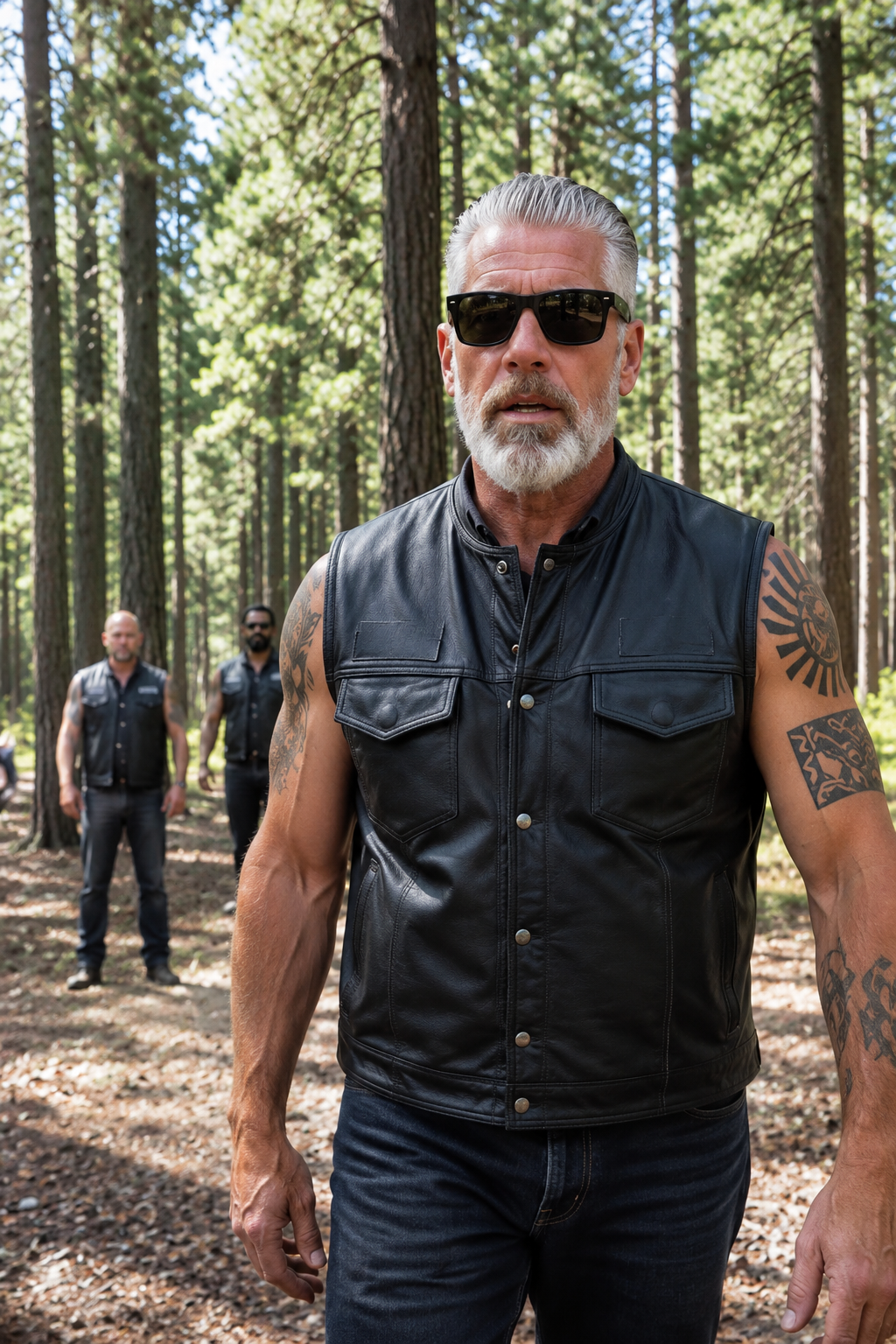
Caleb was probably in his early fifties, with broad shoulders, a gray beard, and a scar running from his left eyebrow toward his temple. He looked like somebody who’d spent his entire life making sure nobody mistook kindness for weakness.
Behind him stood two enormous men.
But Caleb’s eyes were red.
“You the kid who found my wife?”
“Yes, sir.”
He stared at me for several seconds.
Then he stepped forward and wrapped his arms around me.
I wasn’t expecting that.
He held on tightly, and when he finally pulled away, he wiped his face with the back of his hand.
“Doctors said another night out there probably would’ve killed her.”
I didn’t know what to say.
“She’s alive because you stopped,” he continued. “You understand that?”
“Anybody would’ve done the same thing.”
Caleb shook his head.
“No, son. They wouldn’t.”
He handed me a thick envelope. Inside was more cash than I’d probably earned in the previous six months.
I immediately gave it back.
“I appreciate it, but I can’t take that.”
One of the men behind him raised his eyebrows.
Caleb studied my face.
“You sure?”
“I didn’t help her for money.”
For the first time, he smiled.
“Then Hannah was right about you.”
Apparently, she’d been asking about me since waking up in the hospital. Caleb offered to take me there, and despite Dawson’s warning, I agreed. I wanted to know she was okay.
When we arrived, several bikers were standing outside her hospital room. They moved aside without saying a word.
Hannah looked completely different beneath the clean blankets. Her hair had been washed, some color had returned to her cheeks, and both wrists were wrapped in bandages.
When she saw me, she started crying.
“My guardian angel.”
I laughed awkwardly.
“Just a mechanic with bad timing.”
She reached for my hand.
“There’s something I need to tell you.”
Caleb closed the door.
Hannah explained that she’d been driving home from a grocery store when a vehicle blocked her driveway. Two masked men grabbed her before she could reach her house.
They took her somewhere she couldn’t identify.
For the first day, they kept her inside a building. Then they drove her into the woods and chained her to the tree.
But they hadn’t asked her for money.
They wanted Caleb to deliver something.
“What?” I asked.
Caleb looked at his wife.
“A ledger.”
Apparently, one of his oldest friends, a man named Walter Briggs, had discovered that several businessmen were using a regional trucking company to move stolen property and launder money.
Walter had collected records, photographs, and financial documents.
Among the names involved were people with powerful connections throughout Montana.
Six weeks earlier, Walter had died in what authorities ruled a motorcycle accident.
Caleb didn’t believe it was an accident.
Before his death, Walter had given Caleb a package containing copies of everything he’d discovered.
Three days before I found Hannah, Caleb received a photograph of her tied to a chair, along with a demand that he surrender the evidence.
He’d been given seventy-two hours.
“But why leave her in the woods?” I asked.
Hannah swallowed.
“Because they were never planning to let me go.”
The room went silent.
Then she told us something she hadn’t yet told the deputies.
One of her captors had received a phone call shortly before leaving her chained to the tree.
She remembered his exact words.
“Once Mercer hands it over, nobody finds her until spring.”
Caleb lowered his head.
His hands curled into fists.
For a moment, I understood why people were afraid of him.
Then Hannah touched his arm.
“Caleb. Look at me.”
He did.
“I’m still here.”
Those three words seemed to bring him back from somewhere dark.
I left the hospital that evening with more questions than answers.
Unfortunately, the answers started finding me.
Two nights later, I was closing the repair shop when a black pickup pulled into the parking lot.
A man wearing an expensive wool coat stepped out.
He introduced himself as Richard Voss, a representative of a private security company.
He knew my name.
He knew where I lived.
He even knew how much money I owed on my motorcycle.
“We understand you recently assisted Mrs. Mercer,” he said.
“What’s it to you?”
“We’re trying to clarify a few details.”
He placed a photograph on the counter.
It showed my motorcycle parked beside Old Mill Cutoff on the night I’d rescued Hannah.
My stomach tightened.
Someone had been watching me.
“Did Mrs. Mercer give you anything?” he asked.
“No.”
“Did she mention any names?”
“Talk to the sheriff.”
His friendly expression disappeared.
“You’re twenty years old. You’ve got your whole life ahead of you. It would be unfortunate to complicate that life over people you barely know.”
He slid a business card toward me.
Then he left.
I locked the shop and called Dawson.
He told me to stay inside until a patrol car arrived.
While I waited, I called Caleb.
He answered on the first ring.
When I mentioned Richard Voss, he stopped speaking.
“You know him?” I asked.
“He’s the trucking company’s security director.”
Twenty minutes later, Dawson arrived.
He took the photograph and business card, listened to my statement, and promised to investigate.
But as he was leaving, I noticed something strange.
He didn’t seem surprised by the name.
That bothered me more than anything.
The following morning, my boss, Frank, called me into his office.
Frank had hired me when I was seventeen, after my mother died and I’d dropped out of community college. He’d taught me almost everything I knew about engines.
Now he wouldn’t look me in the eye.
“Someone called the shop owner last night,” he said. “They’re threatening to cancel our commercial contracts unless we let you go.”
I stared at him.
“You’re firing me?”
“I’ve got eleven employees with families. I don’t know what else to do.”
He handed me my final paycheck.
“I’m sorry, kid.”
I packed my tools without arguing.
Outside, I sat on my motorcycle and stared at the building where I’d spent the last three years of my life.
I’d stopped to help a dying woman.
Now I’d lost my job.
For the first time, I wondered what would’ve happened if I’d simply kept riding.
That thought made me ashamed.
But it was there.
When Caleb found out, he showed up at my apartment.
“Get your tools,” he said.
“Why?”
“I own a motorcycle repair shop. My head mechanic’s been complaining about needing help for months.”
“I don’t want charity.”
“Good. Because he’s a miserable old bastard who’ll make you earn every dollar.”
Despite everything, I laughed.
That was how I met Earl, a sixty-three-year-old mechanic with missing teeth, terrible coffee, and absolutely no patience for excuses.
Within a week, I was working full-time again.
The bikers treated me like family.
But Caleb was still being hunted.
And whoever wanted that ledger wasn’t finished.
One afternoon, Hannah visited the shop. She was recovering well physically, although loud noises still made her jump.
She brought homemade sandwiches for everyone.
While we ate, she told me about her daughter, Emily, who’d died from leukemia at nineteen.
“She would’ve been about your age now,” Hannah said.
There was something painfully familiar in her expression.
I told her about losing my mother.
About the hospital bills.
About spending my eighteenth birthday alone because I didn’t have anybody left to celebrate with.
Hannah listened without interrupting.
Then she said something I never forgot.
“Sometimes family isn’t something you’re born into. Sometimes it’s something you find when the rest of the world has taken everything away.”
Before leaving, she asked me to come over for Thanksgiving.
I promised I would.
That evening, I received a phone call from an unknown number.
A woman spoke in a trembling voice.
“Are you the boy who found Hannah Mercer?”
“Who is this?”
“My name is Linda Briggs. Walter was my husband.”
She told me she’d seen my photograph in the local newspaper.
She wanted to meet me somewhere public.
I suggested a diner downtown and told Caleb where I was going.
Linda arrived carrying a faded brown purse. She looked exhausted, as though she hadn’t slept properly in months.
“My husband knew they were going to kill him,” she said.
She pulled a small envelope from her purse.
“He told me if anything happened, I should find somebody who wasn’t connected to the club or the police.”
“Why me?”
“Because you stopped for Hannah when you had nothing to gain.”
Inside the envelope was a memory card.
Walter had recorded conversations with several people involved in the trucking operation.
Linda had kept it hidden since his death.
“There’s a sheriff’s captain on those recordings,” she whispered. “His name is Martin Keene.”
Suddenly, Dawson’s reaction to Richard Voss made sense.
Keene was his superior.
Linda grabbed my wrist.
“Please don’t give that to the local sheriff’s office.”
I promised I wouldn’t.
Caleb contacted an attorney that night, who arranged for the evidence to be delivered to federal investigators.
For the first time, it felt like we had a chance to end everything.
Then Linda disappeared.
Her daughter called Caleb the following morning. Linda’s car was still in her driveway, her front door was unlocked, and her purse was lying on the kitchen floor.
I felt sick.
She’d trusted me.
Now she was gone.
Caleb gathered several senior members of his club at the repair shop. Some wanted to confront Voss immediately. Others believed Keene was responsible.
The arguments grew louder until Hannah walked into the room.
“Enough!”
Everybody stopped.
“These people want you angry,” she said. “They want you to do something stupid so they can bury the evidence and call this a biker war.”
She turned toward Caleb.
“You promised me you wouldn’t become the man they expect you to be.”
Caleb looked around the room.
Then he told everyone to stand down.
Nobody liked it.
But nobody challenged him.
Hours later, Dawson called me.
“I need to talk to you. Somewhere safe.”
I told him to come to the shop.
When he arrived, he wasn’t wearing his uniform.
He looked terrified.
He admitted he’d suspected Captain Keene of corruption for months. Several reports had disappeared, witnesses had withdrawn statements, and evidence connected to the trucking company had been mishandled.
He’d been quietly documenting everything.
“I should’ve spoken up sooner,” he said.
“Then why didn’t you?”
“My wife and kids.”
He rubbed his face.
“I convinced myself that staying quiet was protecting them. Then I saw Hannah in those woods.”
He placed a folder on the workbench.
Inside were records connecting Keene to Walter’s death investigation and the kidnapping.
There was also something else.
A photograph of Linda entering an industrial warehouse with two men.
The photograph had been taken that morning.
She was alive.
Dawson had already contacted federal authorities, and they were preparing to intervene.
Before we could celebrate, Caleb’s phone rang.
He put it on speaker.
Richard Voss was on the other end.
“Bring me everything Walter gave you,” Voss said. “Or Mrs. Briggs won’t see tomorrow.”
Caleb looked at Dawson.
“Where?”
Voss named an abandoned freight depot outside town.
“And bring the mechanic. We know he’s involved.”
The call ended.
Caleb immediately turned to me.
“You’re not going.”
I wanted to agree.
Every sensible part of my brain was screaming at me to run.
But I kept thinking about Linda sitting across from me in that diner, trusting me with the last thing her husband had left behind.
Federal investigators were informed of the demand. They took control of the situation and made it clear that rescuing Linda was their priority.
I stayed with Hannah at the repair shop while Caleb cooperated with the authorities.
Those were the longest hours of my life.
Hannah sat beside me, holding a cup of coffee she never drank.
“What if something happens to him?” I asked.
She looked toward the dark windows.
“Then I’ll know he finally understood that protecting people doesn’t always mean fighting.”
Just after midnight, my phone rang.
It was Dawson.
“They’ve got Linda.”
I stood so quickly my chair fell backward.
“Is she alive?”
“She’s alive. They’re taking her to the hospital.”
I closed my eyes.
Then I asked about Caleb.
There was a pause.
“He’s been hurt.”
Hannah grabbed her coat before I could finish repeating the words.
We reached the hospital shortly before one in the morning.
Caleb had suffered a gunshot wound to his shoulder during the confrontation. Doctors said he would recover.
Richard Voss had been arrested.
Captain Keene was taken into custody later that night.
Linda was bruised and badly shaken, but she was going to survive.
When Hannah finally saw Caleb, she stood beside his hospital bed with tears running down her face.
“You stupid, stubborn old man.”
Caleb managed a weak smile.
“Still handsome, though.”
She laughed and cried at the same time.
I stood in the doorway until Caleb noticed me.
“Come here, kid.”
He reached out with his good arm.
“Looks like we’re even.”
I shook my head.
“We were never keeping score.”
His smile faded into something softer.
“No. I guess we weren’t.”
Over the following months, the investigation expanded beyond anything we’d imagined.
Several executives, corrupt officials, and associates of the trucking company were charged with serious crimes.
Walter’s death was reopened as a homicide investigation.
The evidence Linda had preserved became an important part of the case.
Eventually, Voss and Keene were convicted for their roles in the criminal operation.
Dawson testified despite receiving threats against his career.
Frank called me after the arrests and apologized for firing me. He offered me my old job back.
I told him I appreciated it, but I’d found somewhere I belonged.
Thanksgiving came a little late for us that year.
Caleb was recovering, Hannah was still attending counseling, and Linda wasn’t ready to spend a holiday alone.
So we gathered at the Mercers’ house in December.
There were bikers, mechanics, neighbors, children, and enough food to feed a small army.
Nobody talked about revenge.
Nobody discussed the criminal case.
For one evening, we were just people sitting around a table, grateful to be alive.
Before dinner, Hannah placed a photograph of Emily beside an empty chair.
Linda placed one of Walter next to it.
Then Hannah handed me a small picture frame.
Inside was a photograph of my mother that I’d shown her weeks earlier.
“We remember everybody here,” she said.
I had to excuse myself for a minute.
I’d spent years believing grief was something I had to carry alone.
That evening, I learned otherwise.
Five years have passed since the night I found Hannah Mercer chained to that pine tree.
I’m twenty-five now.
Earl retired last summer, and Caleb made me a partner in the repair shop. We expanded the business and started offering free mechanical training to young people who couldn’t afford trade school.
Linda volunteers there twice a week, helping students with paperwork and job applications.
Dawson eventually left the sheriff’s department and became an investigator elsewhere.
As for Hannah, she started a small organization that provides emergency assistance to survivors of violent crime.
She still calls me every Sunday to make sure I’ve eaten something other than gas station food.
And Caleb?
He stepped down as chapter president two years ago.
He told me he’d spent enough of his life trying to be feared.
Now he wanted to spend whatever time he had left being someone his family could depend on.
Last November, on the anniversary of Hannah’s rescue, the three of us rode out to Old Mill Cutoff.
We walked through the pine trees until we reached the place where I’d found her.
The tree was still standing.
Hannah rested her hand against its bark.
For a long time, none of us spoke.
Then she turned to me.
“Do you ever regret stopping?”
I thought about losing my job. The threats. The sleepless nights. The fear I’d felt every time an unfamiliar vehicle pulled up outside my apartment.
I thought about Walter, Linda, Dawson, and all the people whose lives had been changed.
Then I looked at the two people who had become the closest thing I had to parents.
“Not for a second.”
Hannah hugged me.
Caleb stood beside us, quietly wiping his eyes.
Before we left, we attached a small wooden sign to a post near the roadside, with permission from the landowner.
It didn’t mention the Hells Angels.
It didn’t mention the kidnapping, the investigation, or the people responsible.
It simply read:
Never underestimate what one act of kindness can change.
I still think about those twelve minutes I was trying to save that night.
How easily I could’ve turned up the volume on my headphones, ignored that frightened voice, and continued riding home.
Nobody would’ve blamed me.
Nobody would’ve known.
But somewhere in those freezing Montana woods, a woman was waiting for somebody to decide that her life mattered more than their convenience.
And sometimes, that’s what courage really is.
Not being fearless. Not being powerful. Not having a reputation that makes people step aside when you enter a room.
It’s hearing someone cry for help when the rest of the world is silent, feeling afraid, and choosing to care anyway.
I thought I’d rescued a stranger that night.
What I didn’t realize was that, in stopping for her, I’d also begun finding my own way home.