The sheriff was trying to take the money I’d saved for my son’s school clothes, but the biker who stepped in knew something about my brother’s death that would make the sheriff wish he’d never touched my family.
The sheriff’s face had gone pale, but he quickly tried to hide it behind the same arrogant expression he’d worn for three years. “Get that dog under control,” Arthur snapped. The biker didn’t move. “Funny thing about dogs, Sheriff. They remember people. Especially the ones who hurt their families.” Shadow stood perfectly still beside him, his ears pointed forward and his eyes fixed on Arthur. The German Shepherd wasn’t barking or growling anymore. Somehow, that made the situation even more intimidating.
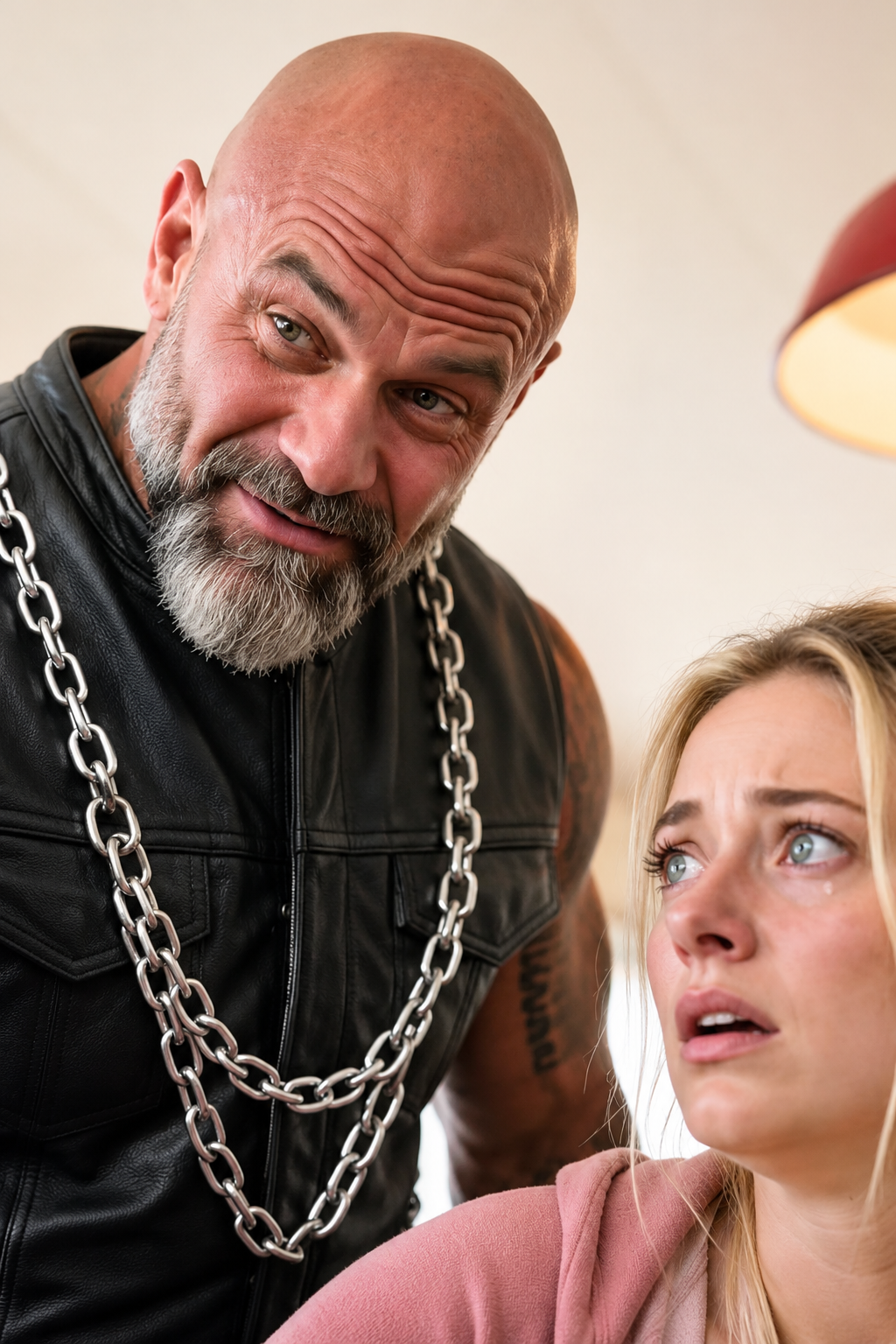
The biker extended one hand toward me. “My name is Cole. I served with your brother. And before you ask, yes, I know exactly what happened to Daniel.” My fingers trembled. “Then tell me.” Arthur stepped forward. “This is ridiculous. This man is interfering with a lawful investigation. Lucas, get him out of here.” But Lucas didn’t move. Instead, the young deputy held his phone tightly and said, “Sheriff, I think you should let him talk.” Arthur’s expression hardened. “That’s an order.” Lucas swallowed. “Maybe it is. But I’ve been following your orders for two years, and I’m starting to think that was the biggest mistake of my life.” A murmur spread through the crowd. Cole glanced at me. “Ma’am, I don’t want to frighten you, but the money in your purse isn’t the reason he’s here today.” “Then what does he want?” Cole looked directly at Arthur. “He wants to know whether Daniel left anything behind.” My breath caught. Three years earlier, Daniel had died on a lonely stretch of highway outside Red Creek. The official report said he’d lost control of his vehicle after a tire blowout. There had been no witnesses, no evidence of another vehicle, and no reason to suspect foul play. I’d buried my brother believing it was a terrible accident. But there had always been one thing that bothered me. Two days before he died, Daniel had called me late at night. His voice had sounded strange, almost frightened. He’d asked whether I still kept the old photograph of us standing beside our father’s red barn. I’d laughed and told him I did. Then he’d said something I’d never forgotten. “If anything happens to me, don’t trust the people who show up first to explain it.” At the time, I’d assumed he was joking. Now I wished I’d asked him what he meant. “Daniel didn’t leave me anything,” I whispered. Cole studied my face. “Are you sure?” “I have his old jacket. Some photographs. A few letters. That’s all.” Arthur suddenly laughed. “Listen to yourselves. You’re all getting worked up over a dead man’s imagination. Daniel was a good deputy, but he had problems. He was under stress.” Cole’s jaw tightened. “Careful, Sheriff. You might want to remember who’s listening.” Arthur pointed at the biker. “You have no idea what you’re talking about.” “I know Daniel found evidence that connected you to a stolen-money operation involving the county evidence room. I know he reported irregularities. And I know the night he died, he was on his way to meet someone who could verify everything.” The crowd fell silent. My knees nearly buckled. “Why didn’t anyone tell me?” Cole lowered his eyes. “Because I didn’t know who I could trust.” He paused. “And because I made a promise to your brother.” I looked at him through tears. “What promise?” “That I’d keep you safe until I knew the truth.” Arthur’s hand moved toward his belt. Lucas immediately stepped between him and Cole. “Don’t, Sheriff.” For a moment, I thought Arthur might actually draw his weapon. Then he noticed the phones. Nearly a dozen people were recording now. He slowly lowered his hand. “This isn’t over,” he muttered. “No,” Cole replied. “It isn’t.” He turned to me. “Would you come somewhere with me? There’s something you need to see.” I looked at my purse, still clutched against my chest. The money inside represented months of saving. I’d cleaned houses, washed dishes, and taken extra shifts at a grocery store to put it together. Every dollar was meant for my son, Ethan. I wasn’t about to let anyone take it. “Where?” “Daniel’s old garage. The one behind the abandoned feed store.” I hesitated. Then I looked at Shadow. The dog approached slowly and pressed his nose against my hand. A sound escaped my throat. I remembered Daniel bringing home a tiny German Shepherd puppy years earlier. He’d named him Shadow because the puppy followed him everywhere. I’d thought the dog had been given away after Daniel died. Instead, apparently, he’d been waiting for this moment. I nodded. “All right.” Arthur stepped forward. “Nobody is going anywhere until I say so.” Lucas finally spoke with a firmness I hadn’t heard from him before. “You’re not in charge of her money, Sheriff. And you’re certainly not in charge of where she goes.” Arthur stared at him. “Think carefully about what you’re doing, Lucas.” The young deputy looked down for a moment. Then he raised his phone. “I am.” That afternoon, something changed in Red Creek. People who had spent years lowering their eyes began looking directly at the sheriff. And for the first time, Arthur seemed to understand that fear was no longer enough to protect him. THE SECRET IN THE OLD GARAGE Cole drove an aging black motorcycle, while I followed in my battered pickup. Shadow rode in the sidecar, his head lifted proudly into the hot New Mexico wind. The abandoned feed store stood on the edge of town, surrounded by dry grass and rusted machinery. Behind it was a small wooden garage. I hadn’t been there since Daniel’s funeral. The sight of it brought back memories so sharply that I had to stop and catch my breath. Daniel used to spend entire Saturdays repairing motorcycles there. He’d let me sit on an overturned bucket while he worked, explaining things I never understood. He’d always said the garage was his favorite place because nobody could tell him what to do. Cole unlocked the door. Inside, dust covered the workbench. An old radio sat beside a collection of rusty tools. A faded photograph of Daniel and me hung crookedly on the wall. I walked toward it. “Why did you bring me here?” Cole reached beneath the workbench and pulled out a small metal toolbox. “Because your brother hid something here.” He placed it on the table. There was a combination lock attached to the front. I stared at the numbers. “Do you know the code?” “No. Daniel told me only you would know it.” My heart began beating faster. I examined the lock. Then I remembered the old red barn photograph. Daniel had asked me about it two days before he died. We’d grown up playing behind that barn, and there was one date we always celebrated. The day our mother brought us home. July 14. I slowly turned the combination.
- The lock clicked. Inside lay a small envelope, a flash drive, and a folded letter bearing my name. My hands shook as I opened it. The handwriting was unmistakably Daniel’s. Little Sis, If you’re reading this, then I probably wasn’t able to explain everything myself. I found out that money and confiscated property have been disappearing from the sheriff’s evidence room. At first, I thought it was careless recordkeeping. Then I noticed that the missing items were connected to cases involving people who couldn’t afford lawyers or didn’t have anyone powerful enough to complain. I started keeping copies of everything. Arthur isn’t working alone. Someone higher up is helping him. I don’t know how far this goes, so I need you to be careful. The most important thing is that you don’t let them convince you that you’re alone. You never have been. I love you, sis. Daniel. I pressed the letter against my chest. For three years, I’d wondered whether my brother had been afraid when he died. Now I knew he had been. But he’d still taken the time to leave me a message. I began crying. Cole stood quietly beside me. After a few moments, I wiped my face. “What’s on the flash drive?” “Records, photographs, and copies of reports. Daniel gave me another copy shortly before he died, but I never opened it because I didn’t know whether it was safe.” “Why didn’t you take this to the police?” Cole looked at me. “Because the police department was part of the problem.” He explained that he and Daniel had served together years earlier. Cole had left law enforcement after an injury and eventually joined a motorcycle club that helped veterans and families in difficult situations. Daniel had occasionally come to him for advice. When the missing evidence investigation began, Daniel had asked Cole to keep a copy of his findings. Then, three days before the accident, Daniel had called him. “He said he’d found proof that Sheriff Arthur had been moving seized cash through fake property transactions. He also said he had a witness.” “Who?” Cole hesitated. “Someone inside the department.” Before he could continue, his phone vibrated. He checked the screen. His expression changed. “What’s wrong?” I asked. “Lucas.” He answered. The young deputy’s voice came through, breathless and panicked. “Where are you? Arthur just ordered everyone to report to the station. He’s saying Cole assaulted him and stole evidence.” Cole looked at me. “Tell him we’re coming.” Lucas lowered his voice. “There’s something else. Arthur knows about the garage.” The call ended. A second later, tires crunched against gravel outside. Shadow immediately stood up. His ears rose. Cole reached for the door. But I saw the fear in his eyes. “How many?” He looked through the dusty window. “Two vehicles.” Then I recognized the first one. The sheriff’s cruiser. THE FIRST BETRAYAL Arthur stepped out of the vehicle with another deputy. He wasn’t smiling anymore. “Open the door, Cole.” Cole positioned himself in front of me. “Do you have a warrant?” “I don’t need one to investigate stolen county property.” “Then explain what county property you’re talking about.” Arthur looked past him. His eyes settled on the toolbox. “That belongs to the department.” I laughed bitterly. “Funny. My brother owned this garage. His name is on the property records.” Arthur ignored me. “Give me the box.” “No,” I said. The word came out before I had time to think. Arthur’s face twisted. “You really don’t understand what’s happening, do you?” “Then explain it.” He took a step forward. “Your brother was unstable. He stole confidential records and became obsessed with people who didn’t exist. I tried to help him.” “Then why did you spend three years taking money from me?” For the first time, Arthur looked genuinely surprised. Cole turned toward me. I realized I had never told him about the payments. Three years earlier, shortly after Daniel died, Arthur had appeared at my house. He’d claimed Daniel had left behind a financial obligation connected to a county investigation. He said the department could make things difficult for me if I didn’t cooperate. I was a single mother with a little boy. I had no lawyer, no savings, and no idea how to fight a sheriff. So every few months, Arthur demanded money. He called it an administrative settlement. Sometimes he threatened to reopen Daniel’s case. Other times he suggested my son might be taken away if I couldn’t provide a stable home. I’d paid because I was terrified. And because I believed that if I just gave him enough, he’d leave us alone. When I finished explaining, Cole’s expression darkened. “How much?” I told him. He shook his head slowly. “That’s not a settlement. That’s extortion.” Arthur stepped forward again. “She doesn’t know what she’s talking about.” Then Lucas appeared behind him. His uniform was wrinkled, and his face was pale. “Actually, Sheriff, she does.” Arthur spun around. “What are you doing here?” Lucas held up his phone. “I recorded your conversation with her outside the diner. And I’ve got three months of audio from the office.” Arthur went completely still. Lucas continued. “I thought you were collecting money to cover department expenses. Then I found the receipts.” He swallowed. “The money wasn’t going into the department.” Arthur’s voice dropped. “Give me that phone.” “No.” “Lucas, don’t make a mistake you can’t take back.” The young deputy looked at the ground. Then he raised his eyes. “You already made enough mistakes for both of us.” Arthur lunged toward him. Shadow barked sharply. The sheriff stopped. In the distance, sirens began to wail. Cole looked toward the road. “Those aren’t local units.” Lucas nodded. “I called the state investigators.” Arthur’s expression changed completely. For the first time, he looked like a man who had run out of excuses. WHAT DANIEL REALLY FOUND The investigators arrived within minutes. Two state police vehicles and an unmarked SUV pulled into the gravel lot. A woman in a dark suit stepped out and introduced herself as Special Agent Marissa Bennett. She was calm, direct, and clearly uninterested in the sheriff’s excuses. Arthur immediately began talking. He accused Cole of theft, Lucas of insubordination, and me of interfering with an investigation. Agent Bennett listened without interrupting. Then she asked one question. “Where is the evidence Daniel collected?” Cole handed her the flash drive. She examined it without plugging it into anything. “We’ll need to process this properly.” Arthur shook his head. “This is ridiculous. That drive could contain anything.” Agent Bennett looked at him. “Then you’ll have no problem explaining why you seem so concerned about it.” Two investigators escorted him toward a vehicle. But just before he got inside, Arthur turned toward me. “You think this makes you safe?” I felt my old fear rising. Then I remembered Daniel’s letter. You never have been alone. I stood straighter. “I think it means you don’t get to scare me anymore.” He glared at me. Then the door closed. The investigators secured the garage and took statements from everyone. Lucas explained how he’d gradually discovered irregularities in the sheriff’s records. He had initially believed the money was being used to cover legitimate expenses. But after seeing my repeated payments listed in a private notebook, he began investigating. He’d found similar entries for several other families. Some had paid hundreds of dollars. Others had paid thousands. People who’d lost loved ones, people with minor criminal records, and people who simply didn’t know their rights. Arthur had made a business out of intimidation. And Daniel had discovered it. But there was one detail nobody understood. Why had Daniel died? Agent Bennett returned the next morning with news. The original accident report had been altered. The tire failure had never been conclusively established. Several photographs from the scene were missing, and a witness statement had disappeared from the file. The witness was a truck driver named Raymond Ellis. He had reported seeing a dark SUV following Daniel’s vehicle shortly before the crash. His statement had been removed from the official report. Investigators found him living in a small town outside Albuquerque. When they interviewed him, he finally told the story he’d been afraid to tell for three years. He had seen Daniel’s truck forced off the road by another vehicle. He’d stopped to help, but another man arrived before he could reach Daniel. The man wore a sheriff’s department jacket. Raymond had recognized the uniform and assumed the person was there to assist. Instead, the man told him to leave. When Raymond asked whether he should call an ambulance, the man threatened to arrest him for interfering with an active investigation. Raymond drove away. He’d spent three years regretting it. The investigators identified the man through additional evidence. He was a former deputy named Travis Moore, who had resigned six months after Daniel’s death. His financial records showed payments from a company connected to the stolen evidence operation. Travis was arrested two weeks later. He initially denied everything. Then investigators showed him the financial records, the missing report copies, and a recording Lucas had preserved. He finally admitted that he had followed Daniel that night on Arthur’s orders. He claimed the plan was only to frighten Daniel into surrendering the evidence. But the confrontation escalated. Daniel’s truck left the road. Travis had panicked and left the scene without calling for help. Arthur later helped cover up what happened. The investigation did not establish that Arthur had personally caused the crash, but it revealed that he had ordered the intimidation, concealed evidence, and threatened witnesses. Daniel hadn’t died because of a simple roadside accident. He had died after getting too close to the truth. When Agent Bennett told me, I couldn’t speak. I sat on the porch of my house, staring at the empty street. For three years, I’d blamed myself for not answering Daniel’s final call. For not insisting that he come home. For not asking more questions. Now I finally understood. None of it had been my fault. THE MONEY IN MY PURSE The investigation lasted several months. Arthur was charged with extortion, evidence tampering, obstruction of justice, and conspiracy. Travis faced charges related to the cover-up and the events surrounding Daniel’s death. Several other officials were investigated, and two county employees eventually admitted helping falsify records. The flash drive proved crucial. Daniel had kept meticulous notes, including dates, transaction records, photographs, and copies of communications. His work helped investigators connect cases that had initially seemed unrelated. But the most important discovery came from a second envelope hidden beneath the toolbox. It contained a small photograph of Daniel holding Shadow as a puppy. On the back, he’d written: For my sister. Make sure she knows she deserves a life without fear. I read those words over and over. Then I did something I hadn’t done in years. I stopped hiding. I contacted a lawyer and reported every payment Arthur had demanded. Investigators recovered much of the money from accounts connected to his operation. The remaining funds couldn’t all be traced, but the county eventually established a compensation program for victims. My payments were among those reviewed. And after months of paperwork, I received most of the money back. The first thing I did was take Ethan shopping. He was eight years old and had grown so much that his old school shoes barely fit. We walked into a clothing store on a Saturday morning. He picked out two pairs of jeans, three shirts, a jacket, and a pair of sneakers with bright blue stripes. “Mom, can I get these?” I looked at the price tag. For years, I would have immediately calculated what I needed to sacrifice to afford them. This time, I smiled. “Yes, sweetheart. You can.” He hugged the sneakers to his chest. “Are you sure?” I knelt in front of him. “Absolutely.” He looked at me carefully. “Are we okay now?” I swallowed the lump in my throat. “We’re going to be.” That afternoon, Cole visited our house. Shadow came running through the yard and nearly knocked Ethan over with excitement. Ethan laughed as the dog covered his face with kisses. “Mom! He’s huge!” Cole smiled. “Your uncle Daniel would have liked you.” Ethan stopped playing. “Did you know Uncle Daniel?” Cole nodded. “He was one of the bravest men I’ve ever known.” “Was he a superhero?” Cole crouched beside him. “No. He was better than that. He was a regular person who knew something was wrong and decided not to look away.” Ethan considered that. Then he looked at Shadow. “Can I keep him?” Cole glanced at me. “That’s something you’ll have to ask your mother.” I smiled through tears. “Shadow already knows where he belongs.” And that was how Daniel’s old dog became part of our family. THE DAY RED CREEK FINALLY SPOKE Six months later, the courthouse was packed. The case against Arthur had drawn attention from across New Mexico. Families who had once been too frightened to speak came forward. Former deputies testified. Financial records were presented. Lucas gave a detailed account of the threats and illegal payments he’d witnessed. I sat in the front row with Cole on one side and Ethan on the other. Shadow waited outside with a volunteer from a local rescue group. When the judge asked whether I wanted to make a victim impact statement, I stood. My hands trembled as I approached the microphone. For a moment, I saw the diner again. I remembered the heat of that July afternoon, Arthur’s finger pointed at me, and the money in my purse. I remembered how thirty people had watched without speaking. Then I looked at the people sitting behind me. Some were crying. Some were holding hands. All of them were listening. “My brother believed the truth mattered,” I began. “He believed that a badge should mean responsibility, not permission to hurt people.” I paused. “For three years, I was afraid. I paid money I couldn’t afford to lose because I thought it was the only way to protect my child. I stayed quiet because I thought nobody would believe me.” My voice cracked. “But I want everyone here to understand something. The people who hurt us depend on our silence. They depend on our fear. And they depend on the idea that ordinary people can’t stand up to powerful people.” I looked toward Arthur. He sat motionless beside his attorney. “My brother didn’t get to come home. No court decision can change that. No prison sentence can give my son the chance to know him. But the truth can stop someone else from suffering the same way.” I took a breath. “So I’m not here because I want revenge. I’m here because I want the next mother who walks into that diner to know that she doesn’t have to hand over her child’s future just because someone wears a badge.” Nobody moved. Then someone began clapping. A moment later, the entire courtroom stood. I returned to my seat and took Ethan’s hand. He squeezed it. “Mom, Uncle Daniel would be proud.” I looked down at him. “Yes, sweetheart. I think he would.” Arthur was eventually convicted on multiple counts and sentenced to prison. Travis was also convicted for his role in the cover-up and received a substantial sentence. The department was reorganized under independent oversight. Lucas, who had cooperated fully with investigators, left the sheriff’s office afterward. He said he wanted to study criminal justice and learn how to make institutions accountable rather than simply powerful. I told him Daniel would have respected that decision. And I meant it. A PROMISE KEPT One year after the diner incident, I returned to the old garage. The wooden door had been repaired, the roof replaced, and the workbench cleaned. Cole had helped me turn the place into a small community workshop. We called it Daniel’s Place. It offered free bicycle repairs, basic mechanical lessons, and after-school activities for children whose families couldn’t afford expensive programs. Some of the money recovered from the investigation went toward supporting the project. On the wall, I hung Daniel’s photograph. Beside it was a framed copy of his final letter. Ethan helped me arrange the chairs. “Mom, why do we keep Uncle Daniel’s letter here?” I knelt beside him. “Because I don’t want anyone who comes through that door to forget that doing the right thing matters.” “Even when it’s scary?” I smiled. “Especially when it’s scary.” Outside, Shadow lay beneath the shade of an old cottonwood tree. His muzzle had begun turning white, and his movements were slower than they had been when I’d first seen him. Cole stood beside him, holding two cups of coffee. “You know,” he said, “Daniel always believed this town could be better.” I looked around the workshop. Children were laughing. A retired mechanic was showing a teenager how to repair a bicycle chain. Two women who had once been afraid to testify against Arthur were organizing a food drive. For the first time in years, Red Creek felt like a community again. “Maybe he was right,” I said. Cole nodded. “He usually was.” That evening, after everyone had gone home, I sat alone at the workbench and opened Daniel’s letter one last time. The paper was worn at the folds. His handwriting was still familiar. I traced the words with my finger. You never have been alone. I finally understood what he had meant. He hadn’t been talking only about Cole. He’d been talking about every person who would eventually choose to stand beside us. The diner crowd. Lucas. Raymond. The families who came forward. The investigators who refused to look away. And even the people who had once remained silent but found the courage to speak later. The next morning, I took Ethan to school. He wore his new blue sneakers and carried his backpack proudly. Before he climbed out of the truck, he turned toward me. “Mom?” “Yes, sweetheart?” “When I grow up, I want to be someone who helps people.” I smiled. “Then promise me one thing.” “What?” “Never confuse being powerful with being right. And never let someone else’s fear make you forget your own courage.” He nodded seriously. Then he ran toward the school doors. I watched until he disappeared inside. On the passenger seat lay the old photograph of Daniel, me, and our mother beside the red barn. For the first time in three years, looking at it didn’t hurt quite as much. I still missed my brother. I always would. But his story hadn’t ended on that lonely highway. It had continued in the people he inspired, the truth he protected, and the little boy who was learning what courage looked like. And as I drove away, I realized something I wished I’d understood much sooner: The sheriff had once believed he could take everything from me because I was poor, alone, and afraid. He’d mistaken my silence for weakness. He’d mistaken my kindness for surrender. And he’d mistaken the money in my purse for the only thing I had worth protecting. But he was wrong. That money had been meant to buy school clothes for my son. Instead, the day he tried to steal it became the day I finally found my voice. Because sometimes justice begins with one frightened person saying no. Sometimes it begins with a stranger refusing to walk away. And sometimes the bravest thing a family can do is make sure the truth survives, even when the people who tried to bury it are still standing right in front of them. Daniel had done his part. Now it was my turn. And I would never be silent again.