**The man who came to take my home had no idea I was prepared to stand in front of my five children and lose everything before I let him throw us out. But what he said when I begged him for seven more days left me speechless.**
“One condition,” Bo repeated. I tightened my arms around my youngest daughter. “What condition?” He looked past me toward the wheat field. “Your children eat supper at my ranch tonight.” I blinked. That wasn’t what I’d expected. “Excuse me?” “You heard me. All five of them. And you.” I stared at him, trying to understand.
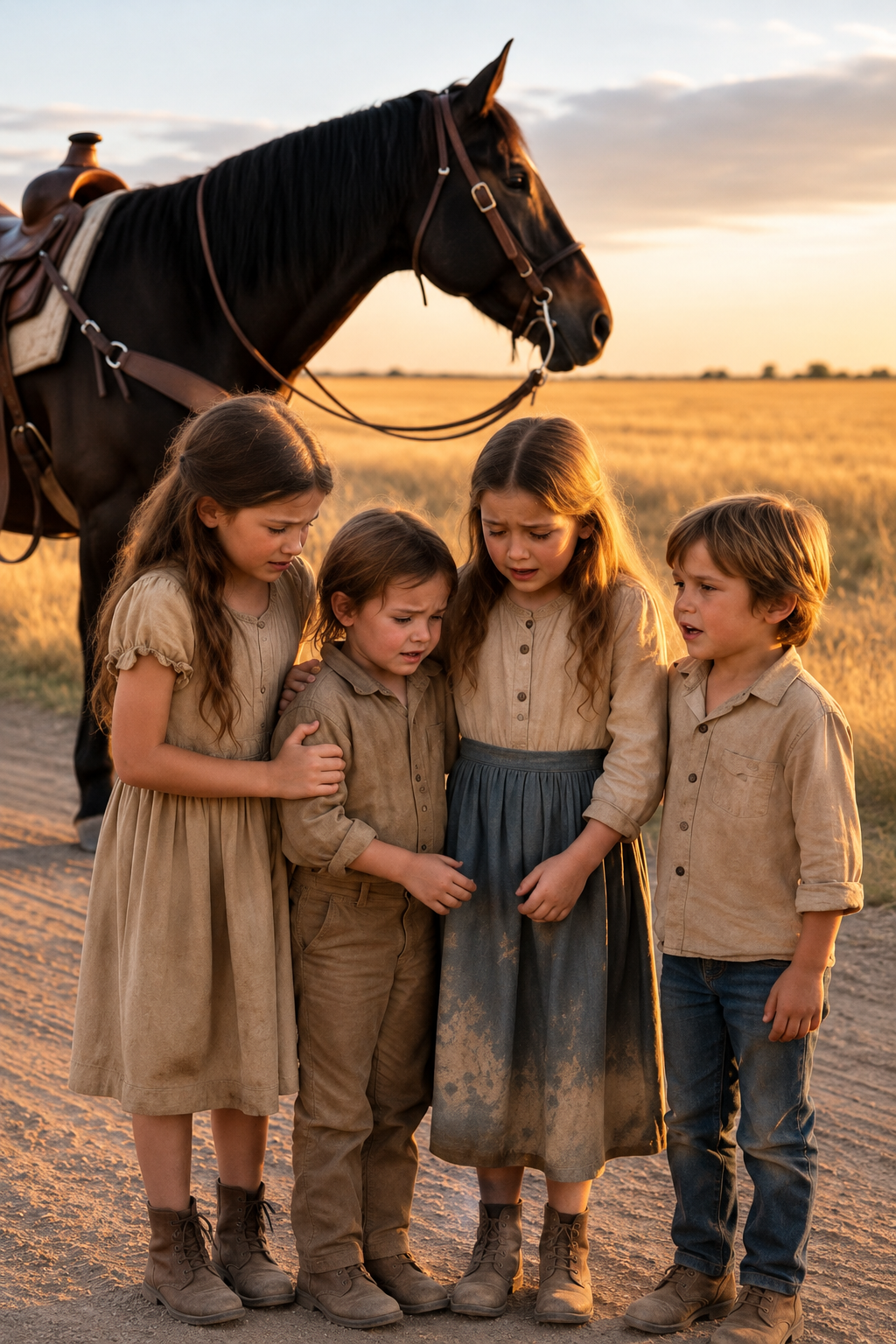
“Why?” “Because I have a cook who prepares enough food for twenty men, and I won’t have five children going hungry while their mother tries to harvest an entire field.” My pride flared. “We don’t need charity, Mr. Callahan.” His expression hardened. “Good. Because I wasn’t offering charity.” He reached into his vest and pulled out another paper. “Your husband and I made an agreement last spring. He was supposed to help me bring in my eastern hay fields in exchange for a portion of the harvest. He never finished the work.” I frowned. “Samuel never told me about that.” “Then he probably didn’t want you worrying.” Bo glanced at my children. “Your husband was a stubborn man. He also happened to be one of the few men in this county who would work until his hands bled rather than leave another man stranded.” My throat tightened. “Samuel wouldn’t have wanted us taking handouts.” “Then don’t take one.” He mounted his horse. “Come to supper. Tomorrow morning, I’ll send two wagons and some men to help with the wheat. You’ll pay me from the harvest. Whatever remains after the debt is settled belongs to you.” I stared at him. “Why would you do that?” Bo paused. “Because seven days isn’t enough time for one woman to harvest twenty acres alone.” Then he rode away. I stood in the road long after the sound of his horse disappeared. Clara finally tugged my sleeve. “Mama, are we going to lose the farm?” I looked down at my oldest daughter. She was twelve years old, but grief had already made her seem much older. “I don’t know, sweetheart.” Then I wiped her tears. “But we’re going to fight for it.” That evening, we went to the Callahan ranch. I almost turned around three times before reaching the front door. The place was enormous. A wide porch stretched across the front, and warm light spilled from every window. Several ranch hands were coming in from the fields, laughing and brushing dust from their clothes. A woman with silver hair opened the door. “You must be Eleanor.” I nodded. “I’m Mrs. Whitaker. I keep the house for Mr. Callahan.” She smiled at the children. “Well, come in before that food gets cold.” The dining room table was already covered with roast chicken, potatoes, fresh bread, and bowls of vegetables. My youngest, Lucy, stared at the food as though she’d never seen so much of it. I felt ashamed. Not because my children were hungry, but because I’d been unable to give them what they needed. Mrs. Whitaker noticed. She quietly placed a plate in front of Lucy. “Eat, darling. There’s plenty.” The children began eating. I sat stiffly, barely touching my food. Bo entered a few minutes later. He had changed into a clean shirt, but his expression remained serious. “How’s the food?” “Very good, sir.” He glanced at my untouched plate. “That wasn’t my question.” I picked up my fork. “Thank you.” He sat at the opposite end of the table. For several minutes, the only sound was the clinking of silverware. Then my seven-year-old son, Thomas, asked the question I had been afraid of. “Are you going to take our house?” The room went silent. Bo put down his fork. “Not tonight.” “How about tomorrow?” “That depends on whether your mama and I can make a fair agreement.” Thomas considered that. “Papa said you were a hard man.” I nearly choked. “Thomas!” But Bo didn’t seem offended. He actually smiled. “Your papa was probably right.” “Then why are you helping us?” Bo looked at the little boy for a long moment. “Because being hard and being cruel aren’t the same thing.” Thomas nodded as if that made perfect sense. After supper, Mrs. Whitaker took the children into the kitchen to help prepare biscuits for the morning. Bo motioned for me to follow him into his office. There, he opened a drawer and removed a small wooden box. “I want to show you something.” Inside was an old pocket watch. The silver cover was scratched, and the glass was cracked. I recognized it immediately. Samuel’s watch. My hand flew to my mouth. “Where did you get that?” “Your husband left it with me last spring.” “Why?” Bo turned the watch over. Engraved on the back were Samuel’s initials. “He came here one evening after we’d finished discussing the hay fields. Said he needed to borrow some money to repair the well.” I frowned. “But our well was working.” “Not then. He told me the pump had started failing. He was worried about the children going without water.” I felt tears gathering. “Why didn’t he tell me?” Bo looked at me. “Because he didn’t want you to know how bad things had become.” He opened another drawer and took out a folded letter. “Your husband wrote this. He asked me to give it to you if something happened to him.” My fingers trembled as I unfolded it. The handwriting was unmistakably Samuel’s. My dearest Eleanor, If you’re reading this, then I wasn’t able to keep every promise I made. I know I’ve been carrying too much by myself. I wanted to fix the roof, pay the debt, repair the well, and make sure the children never had to worry about money. I should have told you how frightened I was. But every time I looked at you and the children, I wanted to be the man who could solve everything. Please don’t mistake my silence for a lack of trust. I was simply afraid of failing the people I love. Whatever happens, remember this: the farm is not the most important thing we built together. You and the children are. Love always, Samuel. I couldn’t finish reading. The letter fell into my lap. For three weeks, I’d been angry with Samuel. Angry that he’d left me with debts. Angry that he’d made promises I hadn’t known about. Angry that he’d died before I could ask him why. Now I understood that he’d been frightened, too. Bo quietly closed the box. “There’s something else.” I wiped my eyes. “What?” “The eight hundred dollars you owe me.” He placed a ledger on the desk. “I don’t believe the amount is right.” I stared at him. “What do you mean?” “Your husband paid me two hundred dollars in July. I have the receipt. The balance should be six hundred, not eight hundred.” My mouth fell open. “Why didn’t you tell me?” “Because I hadn’t checked the ledger when I first came to your house.” He turned the page. “There’s also the matter of the interest.” I looked at him cautiously. “What about it?” “I’m removing it.” I couldn’t believe what I was hearing. “Mr. Callahan, I can’t accept—” “Then don’t accept it. Earn your way out of it.” He tapped the ledger. “Six hundred dollars. That’s what we’ll settle for. I’ll advance the cost of harvesting the wheat, and you can repay me from the sale.” I looked at him. “Why are you doing all this?” For the first time, his face seemed tired rather than intimidating. “Because twenty years ago, I had a wife and a little girl.” He looked toward the window. “My wife died giving birth to our daughter. The little one lived only six days.” I didn’t know what to say. Bo continued. “I had money. Land. More cattle than I could count. But none of it could change what happened.” He turned back toward me. “After that, I spent years believing that if I made enough money, nobody would ever be able to hurt me again.” He gave a bitter laugh. “All it did was make me a lonely man with a large ranch.” I understood something then. The coldness wasn’t cruelty. It was armor. And he’d been wearing it for a very long time. The next morning, I woke before sunrise. I expected to find the children still sleeping. Instead, Clara was already dressed. She stood beside the kitchen table, tying her hair back. “Where are you going?” “To help with the wheat.” I shook my head. “No, sweetheart. You need to go to school.” She lowered her eyes. “We might not have a farm to come home to if we don’t finish.” I knelt in front of her. “Listen to me. You’re twelve. You are allowed to be a child.” “But Mama—” “Your job is to learn, to play, and to grow up. The grown-up problems belong to me.” She looked unconvinced. I kissed her forehead. “That’s a promise.” When I stepped outside, two wagons were already coming up the road. Six ranch hands climbed down. Bo was among them. He carried a toolbox and wore an old brown hat. “Morning, Eleanor.” “You’re here early.” “So are you.” He looked toward the field. “Let’s see what we’ve got.” The men began working. They repaired the broken section of the harvesting equipment, checked the wagons, and organized the work into sections. Bo had brought enough people to finish in a fraction of the time it would have taken me alone. I spent the morning preparing food and helping wherever I could. For the first time since Samuel’s funeral, the farm was full of voices. Men laughing. Wagons rattling. Horses moving through the yard. It almost felt like the old days. By sunset, a large portion of the wheat had been harvested. Bo stood beside me, wiping sweat from his forehead. “Not bad for one day.” I looked at the golden stacks. “Better than I expected.” He nodded. “Your husband knew what he was doing.” I smiled sadly. “Yes, he did.” The second day went even better. The third day, however, brought trouble. A storm rolled in from the west. Dark clouds gathered over the mountains, and the wind began pushing through the wheat like an invisible hand. One of the ranch hands shouted from the field. “Mr. Callahan! We’ve got weather coming!” Bo looked toward the horizon. “How long?” “Maybe two hours. Could be less.” The remaining wheat was still standing. If the storm hit before we finished, much of it could be ruined. I looked at the field. “We can’t stop now.” Bo shook his head. “Nobody’s stopping. But we need to work smart.” He divided the men into teams. One group continued harvesting. Another moved the finished grain into storage. I helped prepare the barn. Clara stayed with the younger children inside the house, watching the sky turn black. By late afternoon, the wind was howling. Rain began falling in heavy drops. Then I heard a shout. One of the wagons had become stuck in the muddy field. The load was beginning to shift. Without thinking, I ran toward it. “Eleanor!” Bo shouted. I grabbed the side rail as the wagon tilted. The driver was struggling with the horses. “Get back!” he yelled. But I could see the grain spilling into the mud. That harvest represented our home. Our food. Our future. I wasn’t going to watch it disappear. Bo rushed over with two men. Together, they steadied the wagon and guided the horses onto firmer ground. By the time we reached the barn, I was soaked to the bone. Bo looked at me angrily. “What were you thinking?” “That we needed the grain!” “And what good would it do if you got crushed?” I opened my mouth. Then closed it. He shook his head. “Your children need their mother more than they need one wagonload of wheat.” The words struck me harder than I expected. I looked toward the house. Through the kitchen window, I could see Clara holding Lucy. They were watching us. I realized Bo was right. I couldn’t save our future by risking the only person my children had left. I stepped back. “You’re right.” He nodded. “Now go inside. Get dry.” The storm lasted through the night. In the morning, we discovered that most of the wheat had been saved. A few sections had been damaged, but the majority of the harvest was safely stored. I stood in the field, looking at the rows of golden grain. We had done it. Four days remained, and the harvest was nearly complete. But our troubles weren’t over. On the fifth morning, a man arrived in a dusty carriage. His name was Harold Pike. He was the county’s land agent and had been handling the paperwork for Samuel’s debt. He carried a leather folder and wore an expression that made my stomach tighten. “Mrs. Eleanor.” “Mr. Pike.” He looked toward the men working near the barn. “I see Mr. Callahan has taken an interest in your property.” I didn’t answer. He opened his folder. “There’s a complication with the foreclosure.” “What complication?” “Your husband signed a separate agreement last year. The land was pledged as security for a second loan.” I felt the blood drain from my face. “How much?” “Another four hundred dollars.” My knees nearly gave way. “That’s impossible.” Pike showed me the document. The signature looked like Samuel’s. But something was wrong. I had seen my husband’s handwriting thousands of times. This signature looked hurried. The letter S was too sharp. The final stroke of the name was missing. “I don’t believe he signed this.” Pike shrugged. “That’s for the court to decide.” Bo walked over. “What seems to be the problem?” Pike turned toward him. “Nothing that concerns you, Mr. Callahan.” Bo took the document and examined it. “Who witnessed this?” “That’s not your concern.” “Who?” Pike hesitated. Then pointed to a name. Elias Mercer. Bo’s expression changed. “Mercer died two years ago.” Pike quickly retrieved the paper. “Then perhaps the records are mistaken.” “Perhaps,” Bo replied. “But I don’t think so.” Pike climbed into his carriage. “You have until the end of the week to settle the additional balance. Otherwise, the entire property will be subject to legal proceedings.” Then he drove away. I stood frozen. Another four hundred dollars. Even if we sold every bushel of wheat, we might not have enough. Bo looked at me. “Don’t panic.” “How can I not panic?” “Because something about that document isn’t right.” He folded his arms. “Samuel wouldn’t have pledged the same land twice without telling me. And he certainly wouldn’t have used a dead man as a witness.” “What are you saying?” “I’m saying somebody may have used your husband’s death to create a debt that never existed.” That afternoon, Bo rode into town. He visited the county clerk and asked to examine the original loan records. I stayed home with the children, trying to keep my fear hidden. When he returned after dark, he carried a large envelope. “You’re right,” he said. “About what?” “The signature.” He laid out two documents. One was the original agreement between Samuel and Bo. The other was the supposed second loan. The signatures were nearly identical. But the second had been copied from the first. Bo had found a record of the original agreement in the county office. He also discovered that Harold Pike had recently filed several questionable claims involving widows and families whose husbands had died. “He’s been using old debt records to pressure people into paying money they don’t owe,” Bo explained. I stared at the documents. “Can he do that?” “Not legally.” “Then why is he doing it?” “Because most people are too frightened to challenge him.” Bo placed the papers into his coat. “Tomorrow, we’re going to see the sheriff.” The following morning, we went to town. The sheriff, a broad-shouldered man named William Turner, listened carefully as Bo explained what we’d found. He examined the documents. Then he sent a deputy to retrieve the county’s original records. By noon, they had enough evidence to begin an investigation. Harold Pike was summoned to the sheriff’s office. At first, he denied everything. Then the sheriff placed the copied signature in front of him. Pike’s face turned pale. He claimed it was a clerical error. But when the sheriff asked why the supposed witness had signed a document two years after his death, Pike had no answer. The investigation uncovered several similar cases. Pike had been using false loan agreements to collect money from struggling families. Some had paid. Others had lost their land. He was arrested before the end of the week. When I heard the news, I sat down on the porch and cried. Not because everything was suddenly easy. But because, for the first time, someone had stood beside me and helped me fight instead of telling me to accept what I couldn’t change. Bo sat on the steps a few feet away. “Your husband would be proud of you.” I shook my head. “I don’t feel brave.” “That’s usually how bravery works.” I looked at him. “What do you mean?” “People think courage means not being afraid. It doesn’t. It means doing what needs doing even when your knees are shaking.” I smiled through my tears. The seventh day arrived. The wheat was harvested. The wagons were loaded. And the accounts had been checked by the county clerk. After paying the legitimate harvesting expenses, we had enough to cover the six hundred dollars owed to Bo. I placed the money on his desk. “Every penny.” He counted it once, then pushed the stack back toward me. I stared at him. “What are you doing?” “I’m refusing it.” My heart sank. “You said I could pay you from the harvest.” “I did.” “Then why—” “Because I’ve changed the agreement.” I stood up. “Mr. Callahan, I don’t understand.” He opened his desk drawer and removed a folded document. “Your husband helped me when I needed it. Last spring, I had a serious problem with my northern pasture. A fire had damaged the fencing, and I couldn’t get the cattle moved safely.” He paused. “Samuel worked for three weeks helping me rebuild it. I owed him more than I ever paid.” I looked at him. “What does that have to do with this?” “Everything.” He unfolded the document. It was a receipt showing that Samuel’s labor had been credited against the debt. The amount was exactly six hundred dollars. Bo looked at me. “Your husband paid me in full before he died.” I couldn’t speak. He continued. “I only discovered the final accounting after reviewing the old records. I should have checked before I came to your house with those foreclosure papers.” My eyes filled. “Then why did you let me work for seven days?” “Because I wanted you to see what your farm could produce. And because I needed to make sure you had enough grain stored to get through winter.” He pushed the money back toward me. “The land is yours, Eleanor. There is no debt.” I stared at the document. For a moment, I couldn’t breathe. All those nights I’d spent calculating what I could sell. All the hours I’d worried about where my children would sleep. All the fear. And Samuel had already settled the debt. I began crying. Bo stood up. “I’m sorry.” I shook my head. “You don’t have to apologize.” “Yes, I do. I should have known.” He looked at the money. “And I should have asked more questions before threatening to take your home.” I wiped my cheeks. “You gave us seven days.” “That doesn’t erase how I handled the first day.” He was right. And I respected him for admitting it. I reached across the desk and shook his hand. “Thank you for helping us.” He held my hand for a moment. “Your husband was a good man.” “He was.” “And you’re doing a fine job raising his children.” I looked toward the window. Outside, Clara was helping Thomas stack firewood. Lucy was chasing a chicken across the yard. For the first time in weeks, their laughter sounded like laughter again. I went home that evening and placed Samuel’s letter beside his photograph. Then I gathered the children around the kitchen table. “There’s something I want you to know.” Clara looked up. “Are we keeping the farm?” I smiled. “Yes, sweetheart. We’re keeping the farm.” Thomas jumped out of his chair. “Does that mean we can have pancakes?” I laughed. “Yes. It means we can have pancakes.” Lucy clapped her hands. Even little James, who was too young to understand what had happened, started laughing because everyone else was happy. That night, I made the biggest supper we’d had since Samuel died. We ate fresh bread, potatoes, and the last of the chicken Mrs. Whitaker had sent home with us. Afterward, Clara helped me wash the dishes. “Mama?” “Yes?” “Are you still scared?” I thought about it. “Sometimes.” “Even now?” “Especially now.” She looked confused. I dried a plate. “Being safe doesn’t mean you’ll never be afraid again. It means you know you can face difficult things when they come.” She considered that. Then she smiled. “I think Papa would be proud.” I kissed her forehead. “I think so, too.” The months that followed weren’t easy. Winter came early, and the wheat harvest wasn’t as large as we’d hoped. We had to sell two cows to pay for supplies. I took in sewing from families in town and began selling bread at the Saturday market. Bo never offered to pay our bills. Instead, he offered work whenever we needed it. I learned to keep accounts, manage supplies, and negotiate prices. Clara returned to school full-time. Thomas joined the younger boys who helped gather eggs and feed the chickens. The children began smiling more. And slowly, our little homestead became a home again. One afternoon in early spring, Bo arrived carrying a wooden box. “Something for the family.” I opened it. Inside was Samuel’s old pocket watch. The glass had been repaired. The silver had been polished. And the hands were moving again. I looked up at him. “Where did you get this?” “Your husband left it with me. I thought it belonged with his family.” I held it carefully. For months, I had thought of that watch as one more thing Samuel had left behind. Now it felt like a piece of him had come home. “Thank you.” Bo nodded. Then he glanced toward the children playing in the yard. “How are things?” “Better.” “Good.” He hesitated. “I’ve been thinking about something.” I raised an eyebrow. “That sounds dangerous.” He laughed. “Probably.” He explained that several small farms in the county were struggling. Some had lost workers. Others had been targeted by dishonest lenders. He wanted to organize a cooperative. Farmers could share equipment, labor, and storage space instead of each family trying to survive alone. “I can’t promise it’ll solve every problem,” he said. “But it might give people a fair chance.” I looked at him. “And you want me involved?” “You understand what it’s like to be one bad harvest away from losing everything.” I thought about Samuel. About the seven days. About the men who had come to help. And about the children who had nearly lost their home. “I’ll help.” That summer, the cooperative began. Bo provided equipment. Several farmers contributed land for shared storage. I managed the records and organized the schedules. Within a year, more than twenty families had joined. We helped one another repair fences, harvest crops, and transport goods to market. Nobody became rich. But fewer families went hungry. And when another widow in the county received a foreclosure notice, the cooperative came together to help her understand her options and challenge the unfair charges. I visited her one evening. She was standing in front of her house, holding a letter with trembling hands. I recognized the expression immediately. It was the same look I’d worn when Bo first arrived. She whispered, “I don’t know what I’m going to do.” I took her hand. “First, we’ll read the papers. Then we’ll figure out what is actually owed. You don’t have to face this alone.” She began crying. I hugged her. And suddenly I understood something I hadn’t understood during those seven terrible days. The greatest gift Bo had given us wasn’t the money he returned. It wasn’t the men who helped harvest our wheat. It wasn’t even the extra time. It was the reminder that asking for help wasn’t the same as surrendering. A year after Samuel died, I stood beside his grave with the children. The grass was green, and the morning sun stretched across the hills. Clara placed a small bouquet of wildflowers against the stone. Thomas stood beside me holding Samuel’s repaired watch. “Mama, do you think Papa knows we’re okay?” I looked at my children. They were growing. They were laughing again. And they were learning that hard times didn’t have to break a family. “I think your father knew we were stronger than we believed.” I looked down at the grave. “Samuel, we kept the farm.” The wind moved softly through the grass. I imagined him smiling. Not because everything had turned out perfectly. But because we had kept going. On our way home, we passed Bo’s ranch. He was standing by the gate, speaking with one of his ranch hands. When he saw us, he lifted his hat. I waved. He walked over. “How’s the family?” “Good. Better than good.” He smiled at the children. “Who’s ready for some fresh apple pie?” All five children shouted at once. I laughed. “You’re going to spoil them.” “Somebody ought to.” As we followed him toward the ranch house, I thought about the man who had ridden up our road with foreclosure papers. I remembered the fear in my chest. I remembered standing between him and my children, convinced I was about to lose everything. And I remembered his condition. One supper. One opportunity to see the truth behind a debt. One chance for two stubborn people to discover that neither had to fight alone. Bo had entered our lives as the man who could take our home. He became one of the people who helped us keep it. But I never forgot that the farm had been saved because we questioned the papers, checked the accounts, and refused to let fear make our decisions. Kindness matters. So does courage. And so does knowing when something isn’t right. I had learned that being a strong mother didn’t mean carrying every burden without help. It meant protecting my children while teaching them that compassion was not weakness, and pride should never stand in the way of doing what was right. That evening, as the children ran through the Callahan ranch yard, I took Samuel’s watch from my pocket. Its hands moved steadily. Tick. Tick. Tick. Time kept going. So did we. And I finally understood the lesson my husband had left behind. A home isn’t simply a piece of land, a roof, or a field of wheat. A home is the people who stand beside you when the harvest fails. It’s the hands that help you lift what you cannot carry alone. It’s the courage to ask for another seven days when the world tells you that you’ve run out of time. And sometimes, the greatest wealth a person can possess isn’t the land beneath their feet or the money in their pocket. It’s the kindness they leave behind in the lives of others. Samuel had left us a small farm, five children, and a letter. Bo had given us seven days. But together, they had given me something far more valuable. The strength to believe that even after losing the person you love most, life can still grow something beautiful. And as long as we keep helping one another, no family has to face the storm alone.