My father gave my bedroom to my stepsister, dumped my belongings beside the garbage, and told me to learn my place
The driver’s door opened slowly.
A woman stepped out into the cold April evening, wearing a faded green coat and carrying a worn leather purse.
She had shoulder-length brown hair, tired eyes, and a face that seemed strangely familiar.
For a moment, I couldn’t breathe.
I’d seen that face before.
Not in person.
In the photographs my father had thrown away years earlier.
“Mom?” I whispered.
The woman stopped beside the car.
Her eyes found mine through the open garage.
And then she started crying.
“Tessa.”
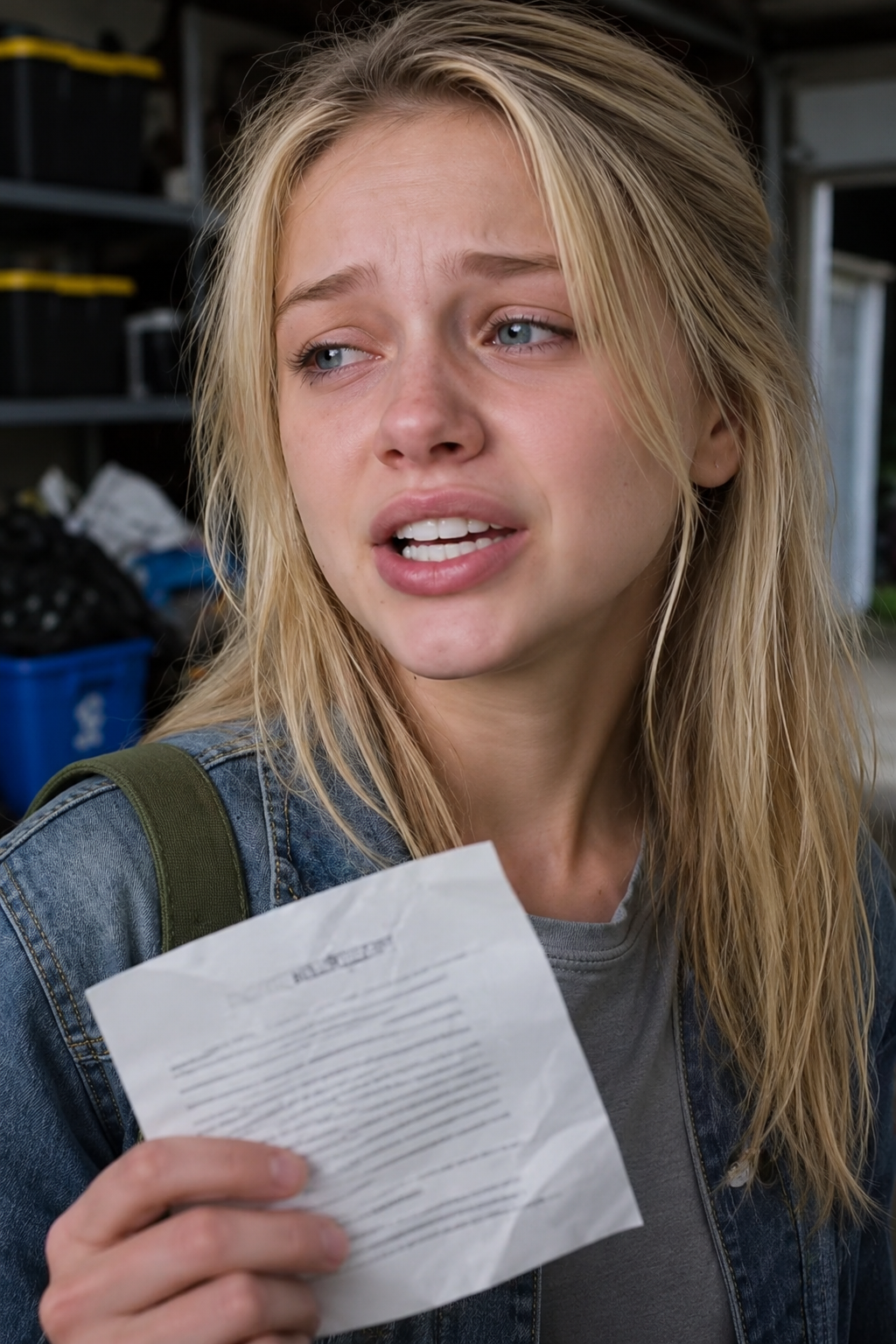
My name sounded different coming from her.
Not irritated. Not impatient.
Like it was something precious she’d been afraid she’d never get to say again.
Behind me, the front door slammed.
Dad came down the driveway so fast he nearly slipped.
“Get off my property, Rebecca!”
The woman didn’t move.
“I came for my daughter, Mark.”
“You don’t have a daughter here.”
I felt those words hit me harder than anything he’d said that afternoon.
My mother looked at him.
“Don’t you dare say that.”
Dad stepped between us.
“You need to leave before I call the police.”
“Please do,” she answered. “I’ve been trying to get someone to listen for six years.”
I stood beside the garbage bags, clutching my mother’s denim jacket.
Six years.
That was exactly how long Dad had been telling me she didn’t want me.
I looked at her.
“Why are you here?”
Her expression crumpled.
“Because I saw the video, sweetheart.”
Kendra appeared behind Dad, holding her phone.
For the first time all day, she wasn’t smiling.
Nadia came outside too.
“What is going on?”
My mother looked past them toward the garage.
She saw the mattress on the concrete floor.
The duffel bag.
My clothes stacked beside the recycling bins.
Then she looked at Dad.
“Is that where you’ve been making her sleep?”
Dad folded his arms.
“It’s temporary.”
“She’s fourteen.”
“Don’t tell me how to raise my child.”
My mother took one step forward.
“She is our child.”
I wanted to run to her.
I wanted to scream.
But six years of believing someone had abandoned you doesn’t disappear just because they show up in your driveway.
Instead, I asked the question that had lived inside me since I was eight.
“Why did you leave me?”
My mother went completely still.
Dad turned toward me.
“Tessa, get inside.”
I didn’t move.
“Why did you leave?”
My mother’s eyes filled again.
“I didn’t.”
Dad laughed sharply.
“Here we go.”
She ignored him.
“I never stopped trying to see you.”
Something inside my chest twisted.
“Dad said you moved away.”
“I moved twenty minutes from here.”
“He said you didn’t want custody.”
“I fought for it.”
Dad stepped forward.
“That’s enough.”
But my mother reached into her purse and pulled out a thick envelope.
“I brought proof.”
Dad’s face changed.
Not anger this time.
Fear.
And suddenly I understood that whatever was inside that envelope was something he never wanted me to see.
My mother didn’t hand me the envelope immediately.
Instead, she looked at the garage again.
“Tessa, are you hurt?”
I shook my head.
“Has anyone hit you?”
“No.”
“Have you eaten dinner?”
I hesitated.
That was enough.
Her mouth tightened.
Dad threw up his hands.
“Oh, come on. She’s being dramatic. We were rearranging bedrooms.”
“You threw her belongings beside the trash.”
“Kendra needed more space.”
My mother stared at him.
“And where was Tessa supposed to sleep?”
Dad didn’t answer.
Nadia stepped forward.
“We were going to make the garage comfortable.”
My mother looked at the concrete floor.
“In April? With no heat?”
Nadia’s cheeks reddened.
“It wasn’t finished.”
“Then why did you move her out before it was ready?”
For once, Nadia had nothing to say.
A car slowed in front of our house.
Then another.
I recognized Mrs. Patterson from across the street standing on her porch.
She’d probably heard the shouting.
Dad noticed too.
“Everybody inside,” he snapped.
My mother shook her head.
“Not until Tessa knows the truth.”
He pointed at her.
“You’re violating our agreement.”
“What agreement, Mark?”
“The custody order.”
She opened the envelope.
“I’m glad you mentioned that.”
She removed several papers and held one toward him.
“Because the court issued a new order six weeks ago.”
I looked between them.
“What order?”
Dad’s eyes darted toward the house.
My mother spoke carefully.
“The court ordered your father to cooperate with a custody review and allow supervised contact while the case was being reconsidered.”
I stared at her.
“Contact with me?”
She nodded.
“He was notified.”
Dad’s voice rose.
“That order is being challenged.”
“Then explain why you told Tessa I didn’t want her.”
He said nothing.
My mother turned toward me.
“I need you to understand something. When we divorced, your father was awarded primary custody. I was supposed to have regular visitation.”
I remembered being eight.
Waiting by the living room window on Saturdays.
Dad telling me Mom had canceled again.
Sometimes he’d say she was busy.
Sometimes he’d say she’d forgotten.
Eventually, I stopped waiting.
“I came for those visits,” Mom said. “Many times. Sometimes nobody answered. Sometimes your father said you were sick or away.”
Dad shook his head.
“That’s not what happened.”
She continued.
“I went back to court. I sent letters. I tried calling. Then your father changed his number and moved without giving me the new address.”
My stomach dropped.
We had moved when I was ten.
Dad told me it was because our old neighborhood was getting dangerous.
Mom looked directly at me.
“I never knew where you were until recently.”
I stared at Dad.
“You said she knew.”
He looked away.
“You don’t understand adult problems.”
“Then explain them.”
“Tessa—”
“No. Explain.”
My voice cracked.
“You told me she didn’t love me.”
He rubbed his forehead.
“Your mother wasn’t stable back then.”
Mom’s expression hardened.
“I was working two jobs and fighting to see my daughter.”
“You had problems.”
“I had depression after the divorce. I got treatment. That didn’t make me an unfit mother.”
I looked at her.
“Is that true?”
She nodded.
“I wasn’t perfect, sweetheart. I made mistakes. But I never stopped loving you.”
Dad reached for my arm.
“Come inside.”
I stepped away.
It was the first time I’d ever done that.
He looked genuinely shocked.
Then a police cruiser turned onto our street.
Dad stared at it.
“Did you call them?”
My mother nodded.
“Before I came here.”
The cruiser stopped at the curb.
Two officers stepped out.
One was a woman with dark hair pulled into a bun.
She approached us calmly.
“I’m Officer Martinez. We received a request for a welfare check involving a minor.”
Dad immediately changed his tone.
“Officer, this is a family misunderstanding.”
Mom gestured toward the garage.
“My daughter has been displaced from her bedroom. Her belongings were placed beside the garbage, and she’s been told to sleep out here.”
Officer Martinez looked inside.
Then she looked at me.
“Are you Tessa?”
I nodded.
“Can we talk somewhere private?”
Dad stepped forward.
“I’m her father. I’ll answer your questions.”
The officer held up a hand.
“I’d like to hear from Tessa.”
Dad’s jaw tightened.
I followed the officer toward her cruiser.
She didn’t rush me.
She didn’t tell me what to say.
She just asked what had happened.
So I told her.
About my bedroom.
About Kendra’s new furniture.
About the garage.
About the twelve dollars in my bag.
About Dad telling me to learn my place.
And then, quietly, I told her about the last six years.
How I’d been told my mother didn’t want me.
How I’d stopped asking questions because every question seemed to make Dad angry.
How I’d learned that keeping quiet was easier than being disappointed.
Officer Martinez listened without interrupting.
When I finished, she asked, “Do you feel safe staying here tonight?”
I looked toward the house.
Kendra stood near the front window.
Nadia was talking rapidly to Dad.
My mother waited beside her old car.
For the first time, I realized I had a choice about how to answer.
“No,” I whispered.
The officer nodded.
“Thank you for telling me.”
She explained that she would contact the appropriate child welfare authorities and review the information available about the custody situation.
She didn’t promise that everything would be fixed immediately.
But she did promise that my concerns would be taken seriously.
That was more than anyone in that house had done all day.
While the officers spoke with Dad, my mother came toward me.
She stopped a few feet away.
“Can I hug you?”
Such a simple question.
But it nearly broke me.
Nobody in that house had asked permission before taking my things, entering my room, or deciding where I belonged.
I nodded.
She wrapped her arms around me.
And I remembered her smell.
Lavender soap.
Coffee.
Something warm and familiar that had survived somewhere deep inside my memory.
I started crying.
Not because Kendra had taken my bedroom.
Not because Dad had yelled.
But because the person I’d spent six years believing didn’t want me was holding me like she’d been waiting every second to get me back.
“I’m sorry,” Mom whispered.
I shook my head against her shoulder.
“I thought you forgot me.”
“Never.”
“I thought I did something wrong.”
She held me tighter.
“Oh, sweetheart. You were a little girl. None of this was your fault.”
I wanted to believe her.
But believing something good after years of hearing something terrible takes time.
That night, I didn’t sleep in the garage.
After the officers consulted the relevant authorities and confirmed arrangements with my mother’s attorney, I was allowed to stay temporarily with my aunt Linda, Dad’s older sister, while the custody matter was reviewed.
I hadn’t seen Aunt Linda in almost three years.
Dad said she’d turned against our family.
When she arrived, she looked at me standing beside my duffel bag and burst into tears.
“Oh, Tessa.”
She hugged me so hard I could barely breathe.
Then she looked at Dad.
“What have you done?”
He crossed his arms.
“Stay out of this, Linda.”
She shook her head.
“I tried to stay out of it. That’s what I regret.”
Dad looked furious.
“You don’t know the whole story.”
“I know enough.”
Aunt Linda took my bag.
Then she turned toward me.
“Come on, sweetheart. I’ve got a warm bed waiting.”
As we walked toward her car, Kendra came outside.
She wasn’t recording anymore.
“Tessa?”
I stopped.
She looked uncomfortable.
“I didn’t think the video would get that much attention.”
I stared at her.
“You posted it to embarrass me.”
She looked down.
“I know.”
“Then why are you surprised people saw it?”
She didn’t answer.
For once, I didn’t try to make her feel better.
I got into Aunt Linda’s car.
As we drove away, I looked back at the house.
The upstairs window that had once belonged to my bedroom was glowing with pink lights.
Kendra’s lights.
And for the first time, I didn’t wish I was inside.
I wished I’d known sooner that I deserved better.
The next morning, I woke up beneath a thick blue quilt in Aunt Linda’s guest room.
For a few seconds, I forgot where I was.
Then I heard someone moving in the kitchen.
Pancakes.
The smell reminded me of childhood Sundays before everything changed.
I walked downstairs.
Aunt Linda stood at the stove.
My mother sat at the kitchen table.
When she saw me, she stood so quickly her chair scraped the floor.
“Good morning.”
I stopped in the doorway.
“You’re still here.”
Her expression softened.
“Of course.”
I didn’t know what to say.
Some part of me had expected her to disappear overnight.
Like Dad always said she would.
Mom seemed to understand.
“I’m not going anywhere without telling you, Tessa.”
I sat across from her.
Aunt Linda placed pancakes in front of me.
For a while, nobody mentioned the night before.
Then Mom reached into her purse.
“I brought something.”
She placed a small cardboard box on the table.
Inside were letters.
Dozens of them.
Some were in colorful envelopes.
Others were folded notebook paper.
Every one had my name on it.
I picked up the first.
It was dated six years earlier.
My sweet Tessa,
Today I saw a little girl wearing purple rain boots, and I thought of you. Remember how you used to jump in every puddle?
I hope you’re still finding reasons to laugh.
I love you more than all the stars.
Mom.
I opened another.
Then another.
Birthday letters.
Christmas letters.
Notes about books she’d read and places she wanted to take me.
Some contained photographs.
One had a pressed flower taped inside.
I looked at her.
“You wrote all these?”
She nodded.
“I mailed many letters to the addresses I had. Some came back. Others disappeared. Eventually, I started keeping copies because I wanted you to know I hadn’t stopped trying.”
I stared at the box.
Six years of love I’d never been allowed to see.
“Why didn’t Dad give them to me?”
Mom looked down.
“I can’t tell you what he was thinking.”
Aunt Linda sat beside me.
“But I can tell you something I should’ve said a long time ago.”
I looked at her.
“Your father told the family that Rebecca had abandoned you. When I questioned him, he stopped letting me visit.”
She swallowed.
“I should’ve pushed harder.”
I didn’t know how to respond.
Part of me wanted to be angry.
Another part was simply tired.
Mom reached across the table.
“You don’t have to forgive anyone today.”
I looked at the letters.
“Can I keep these?”
Her eyes filled.
“They’re yours.”
Later that afternoon, something happened that changed the case.
Aunt Linda received a phone call from my cousin Rachel.
Rachel had seen Kendra’s video before it was deleted.
She’d saved a copy because she recognized the house.
But that wasn’t all.
Kendra had accidentally recorded more than she realized.
Near the end of the video, Dad could be heard speaking to Nadia.
His voice was clear.
“Rebecca’s lawyer keeps sending notices. I told you we should’ve handled this before anyone found out where Tessa was.”
Nadia answered, “Then stop letting her use that old school account. Someone could trace her.”
The recording continued for several seconds before Kendra stopped filming.
I watched it three times.
My stomach twisted.
Dad hadn’t simply forgotten to tell Mom where we lived.
He’d been actively trying to keep her from finding me.
And Nadia knew.
Aunt Linda immediately contacted Mom’s attorney.
The video was preserved and provided to the people handling the custody case.
That evening, my mother sat beside me on the couch.
“Tessa, there’s something I need to explain.”
I turned toward her.
“When your father and I divorced, the court made decisions based on what it knew at the time. Some of those decisions were painful, but they were legal.”
I nodded.
“But if someone deliberately prevents court-ordered contact or hides important information, the court needs to know.”
“Will Dad go to jail?”
“I don’t know. That’s not something I can promise or predict.”
I stared at my hands.
“Do you want him to?”
Mom was quiet for a moment.
“No,” she said finally. “I want you safe. I want the truth heard. And I want you to have the chance to grow up without being made to feel unwanted.”
I looked at her.
“What if I still love him?”
She took my hand.
“Then you still love him.”
I started crying.
“Even after everything?”
“Love doesn’t always disappear when someone hurts us. But loving someone doesn’t mean we have to accept being hurt.”
That was the first time anyone had explained it to me that way.
Over the following weeks, my life changed in ways I couldn’t have imagined.
I met with a counselor.
I spoke with a court-appointed professional who wanted to understand my experiences and preferences.
My school helped me catch up on assignments I’d missed.
And Mom kept showing up.
Every appointment.
Every meeting.
Every afternoon she said she’d be there.
Sometimes we went for walks.
Sometimes we baked cookies.
Sometimes we sat in silence because I didn’t know what to say.
She never demanded that I call her Mom.
She never asked me to choose between her and Dad.
She simply made room for me.
One Saturday, she took me to a small house on the edge of town.
It had yellow siding, a narrow porch, and a garden filled with tulips.
“This is where I live,” she said.
I looked around.
There were two bedrooms.
One had a small desk, a bookshelf, and pale green curtains.
The bed was covered with a quilt patterned with tiny stars.
I stood in the doorway.
“Whose room is this?”
Mom smiled nervously.
“I’ve kept it ready in case you ever came home.”
My throat tightened.
“For six years?”
“Not all the furniture,” she admitted. “I changed things as you got older. I didn’t know what you’d like anymore.”
I walked inside.
On the bookshelf sat a framed photograph.
Me at seven years old.
Missing my front tooth.
Holding a birthday cake.
I picked it up.
“You kept this?”
She nodded.
“It’s one of my favorites.”
I turned toward her.
“Can I put my own things here?”
She covered her mouth.
Then nodded.
“Of course.”
It was such a small question.
But after everything that had happened, being allowed to choose where my belongings went felt enormous.
The custody hearing took place in June.
I didn’t have to stand in a courtroom and argue with my father.
The adults handling the case had already gathered statements, records, and evidence.
The video Kendra posted was included.
So were the letters Mom had sent.
The school records.
The history of missed visits.
And the reports about my living conditions.
Dad’s attorney argued that the bedroom situation had been temporary and that the custody dispute was more complicated than it appeared.
The judge listened.
But the evidence showed a troubling pattern.
The court changed the custody arrangement, placing me primarily with my mother and establishing conditions for future contact with Dad.
I remember sitting outside the courtroom afterward.
My hands were shaking.
Mom sat beside me.
Aunt Linda stood nearby.
When our attorney explained the decision, I didn’t cheer.
I didn’t smile.
I just felt tired.
Because winning the right to live somewhere safe didn’t erase the fact that my own father had made me feel disposable.
That evening, Dad called.
Mom asked if I wanted to speak with him.
I thought about it for a long time.
Then I nodded.
She handed me the phone and stepped into the kitchen.
“Tessa.”
His voice sounded smaller than I remembered.
“Hi, Dad.”
There was a pause.
“I suppose you’re happy now.”
I stared at the wall.
“What?”
“You got what you wanted.”
I felt something familiar rising in my chest.
The old instinct to apologize.
To make him feel better.
To accept blame so the conversation would end.
But my counselor had taught me something important.
I could answer without taking responsibility for his feelings.
“I wanted my bedroom,” I said quietly. “And I wanted you to care that I was hurt.”
He didn’t answer.
“I didn’t ask for any of this.”
He sighed.
“Your mother has turned you against me.”
I closed my eyes.
“No, Dad.”
My voice shook, but I kept going.
“You did that when you told me she didn’t love me.”
Silence.
Then he said, “I was trying to protect you.”
“From what?”
He didn’t answer.
I waited.
Finally, he said, “Things were complicated.”
I looked toward the kitchen, where Mom was quietly washing dishes.
“Maybe they were. But I was eight. I needed the truth, not a story that made me hate myself.”
For a long moment, neither of us spoke.
Then Dad said, almost too quietly to hear, “I didn’t know how to handle losing your mother.”
I swallowed.
“So you made me lose her too?”
He began crying.
I’d never heard my father cry before.
Part of me wanted to comfort him.
But another part understood that I couldn’t fix what he’d done.
“Dad,” I said, “I hope you get help.”
He sniffed.
“Will you come home?”
I looked around Mom’s living room.
At the books.
At the flowers on the windowsill.
At the little framed picture of me on the shelf.
“I am home.”
Then I ended the call.
I sat there for several minutes, shaking.
Mom came back into the room.
She didn’t ask what he’d said.
She just sat beside me.
And when I leaned against her shoulder, she held me.
By August, I’d started feeling like a normal fourteen-year-old again.
I made friends at a summer art program.
I joined the school newspaper.
I learned how to ride a bike on the trail near Mom’s house.
And slowly, I stopped checking my phone every few minutes, expecting someone to tell me I’d done something wrong.
One afternoon, I received a message from Kendra.
I almost deleted it.
But curiosity won.
Tessa, I know you probably hate me. I just wanted to say I’m sorry about the video.
I stared at the screen.
A second message appeared.
I thought everyone would laugh. I didn’t know people would recognize what was happening.
Then another.
Things at home have been awful since you left.
I didn’t reply immediately.
Kendra had spent years treating me like an inconvenience.
She’d taken my room.
Mocked my clothes.
Recorded my humiliation.
But I also remembered that she was fifteen.
Old enough to know better.
Young enough to learn.
Eventually, I typed:
You didn’t accidentally hurt me, Kendra. You chose to embarrass me.
She replied a few minutes later.
I know.
I stared at those two words.
Then I wrote:
I hope you understand why it was wrong. But I’m not ready to be friends.
She answered:
That’s fair.
I put my phone down.
For the first time, I didn’t feel guilty about setting a boundary.
A few weeks later, I started helping at a community center that offered after-school programs for younger kids.
One afternoon, a little girl named Lily refused to join an art activity.
She sat alone near the window, clutching a backpack.
I sat beside her.
“Hey. You okay?”
She shrugged.
“I’m not good at drawing.”
“Neither was I when I started.”
She looked at me suspiciously.
“Really?”
“Really.”
She hesitated.
Then whispered, “My brother says everything I make is stupid.”
I felt something ache inside my chest.
I knew that feeling.
The way someone’s words could become your own thoughts if you heard them enough.
I handed her a blue marker.
“Can I tell you something?”
She nodded.
“Just because someone says something about you doesn’t make it true.”
She looked at the marker.
“What if they say it a lot?”
“Then you might need someone else to remind you.”
She thought about that.
Then she began drawing.
By the end of the afternoon, she’d filled an entire page with colorful butterflies.
When she showed me, I smiled.
“That’s beautiful.”
Her face lit up.
And in that moment, I understood something.
I couldn’t change what had happened to me.
But I could decide what I passed on.
I could pass on the cruelty.
The silence.
The belief that love had to be earned by staying small.
Or I could pass on something better.
Kindness.
Truth.
The courage to speak.
That Christmas, Mom and I decorated our tree together.
She let me choose the ornaments.
We played old holiday songs and made cookies that came out slightly burned.
At one point, she pulled a small box from the closet.
Inside was a silver star.
“I bought this the first Christmas we were apart,” she said.
I held it carefully.
“Why?”
“I told myself that someday we’d put it on a tree together.”
My eyes filled.
I climbed onto a small step stool and placed the star at the top.
Mom stood beside me, holding the stool steady.
When I stepped down, we looked at the tree.
It wasn’t perfect.
Some branches were uneven.
The lights were tangled.
And one side had far too many ornaments.
But it was ours.
Later that night, I opened my closet.
My clothes hung neatly inside.
My books were stacked on shelves.
My mother’s old denim jacket rested on a hook beside the door.
I touched the sleeve.
That jacket had been the only thing I’d taken from my old life that still made me feel connected to her.
Now I didn’t need it to remind me she loved me.
I heard Mom calling from downstairs.
“Tessa? Hot chocolate’s ready!”
“Coming!”
I turned off the bedroom light.
Then I stopped.
For six years, I’d believed I was the child someone had walked away from.
I’d believed love could disappear without explanation.
I’d believed being quiet and useful was the only way to keep a place in a family.
But the truth was different.
My mother hadn’t abandoned me.
My father had hidden the truth.
And the video meant to humiliate me had accidentally opened the door to everything he’d tried to keep buried.
I still had difficult days.
I still missed the father I wished I’d had.
I still sometimes worried that people would leave if I disappointed them.
Healing wasn’t a straight line.
But now, when those fears came, I had people who listened.
People who showed up.
People who didn’t make me earn the right to belong.
I walked downstairs.
Mom was waiting with two mugs of hot chocolate.
She smiled.
“Everything okay?”
I nodded.
“Yeah.”
Then I hugged her.
Not because I was afraid she’d disappear.
But because I knew she was there.
And that was the greatest difference of all.
A home isn’t defined by whose name is on the deed, who gets the biggest bedroom, or who makes the rules. A real home is where you are treated with dignity, where your voice matters, and where love doesn’t require you to disappear to make room for someone else.
I was fourteen when my father told me to learn my place.
It took losing that bedroom to discover something he never wanted me to know.
My place had never been beside the garbage.
My place was wherever I was loved, respected, and allowed to be myself.