**Six bikers walked into a restaurant on New Year’s Eve, and the hostess treated us like criminals. But what a woman in torn clothes did next left the entire room speechless.**
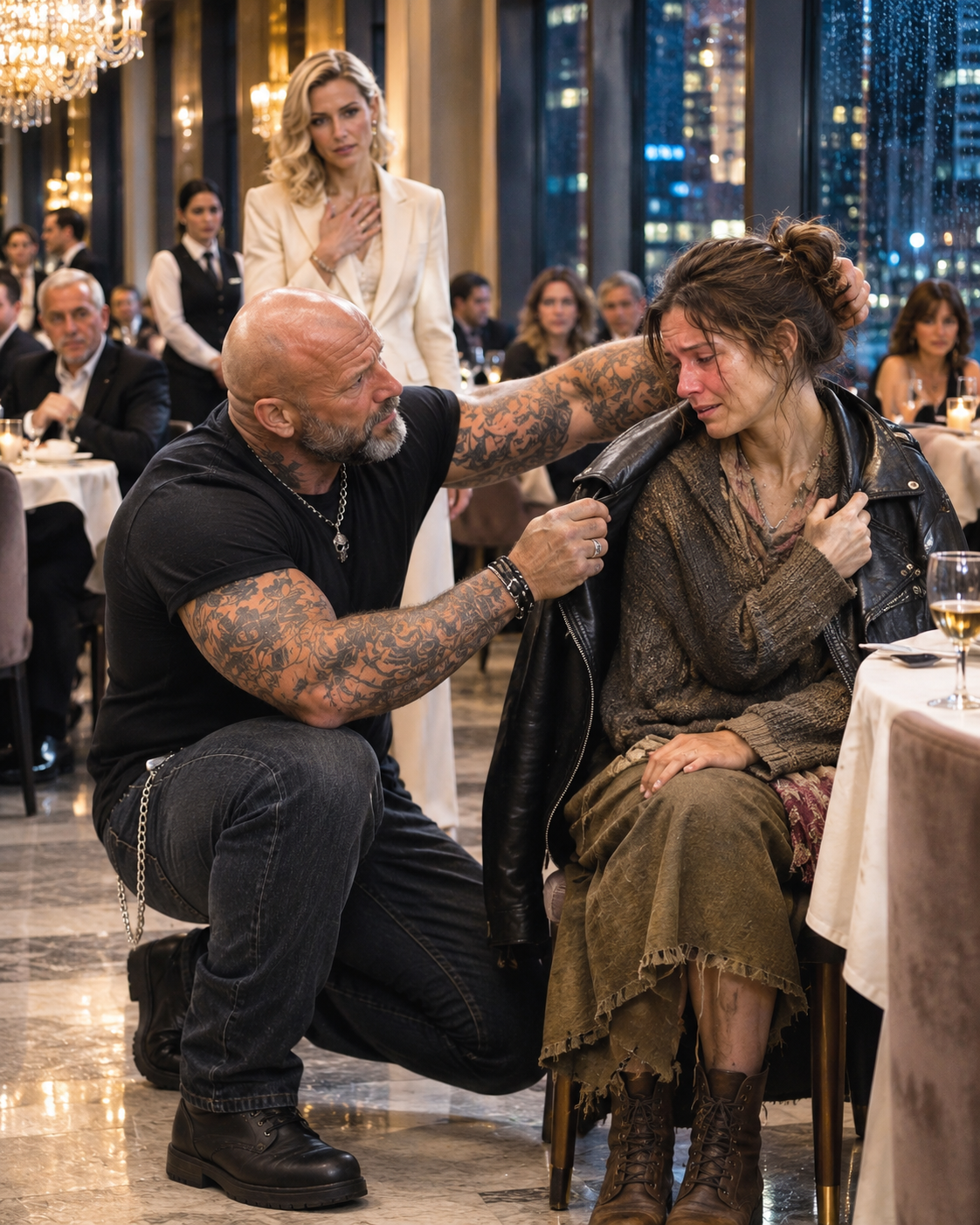
I thought I made that perfectly clear.” Emily lowered her eyes. “I’m not asking for anything. I just wanted to finish my meal.” “Your meal?” He looked at the plate in front of her. “You haven’t paid your last bill. You think you can just walk in here and pretend nothing happened?” I glanced at Emily. She looked like someone who’d been slapped. “How much does she owe you?” I asked. The manager turned toward me. “That’s none of your business.” “Maybe not. But you seem awfully interested in making it everybody’s business.” He stepped closer. “Listen, buddy. I don’t know who you think you are, but I run this restaurant.” I looked around. Three empty tables. A dozen customers staring. Six men who had just ridden nearly three hundred miles through freezing weather. And one young woman who looked ready to disappear beneath the table. I took a breath. “Then maybe you should start acting like someone who understands hospitality.” The manager’s face reddened. But before he could answer, Emily whispered something that changed the entire situation. “Please don’t. I can’t afford another problem.” I turned toward her. “Sweetheart, what happened?” She looked at the manager. Then she looked at me. And finally, she told us.
“My husband used to work here,” she said quietly. “His name was Daniel. He was the assistant kitchen manager.” The manager rolled his eyes. “Here we go again.” Emily continued. “Three months ago, there was a fire in the kitchen. Daniel was working the closing shift. He noticed smoke coming from the storage room and got everyone out.” She paused. “Everyone except himself.” The restaurant became silent. “He went back inside because one of the cooks was still trapped near the rear exit. He got the man out, but the ceiling collapsed before he could escape.” I felt my chest tighten. “Your husband died?” She nodded. “He was thirty-four.” Nobody moved. “After the funeral, I discovered I was pregnant. I was already struggling, but I thought we could manage. Daniel had life insurance through the restaurant.” She looked down at her hands. “Except the insurance company rejected the claim.” “Why?” Duke asked. Emily gave a bitter little smile. “According to the company, Daniel had violated safety procedures. They said he entered a restricted storage area without authorization.” The manager crossed his arms. “That’s what the investigation found.” Emily turned toward him. “You know that’s not what happened.” “That’s enough, Emily.” “No. It’s not.” Her voice shook. “Daniel told you about the faulty wiring. He told you about the blocked emergency exit. He submitted three maintenance requests. You ignored every one.” The manager leaned toward her. “Watch what you’re saying.” I looked at him. “Maybe you should watch what you’re doing.” Emily wiped her eyes. “After Daniel died, I came here to ask for his final paycheck. Mr. Collins told me the company couldn’t pay it because of the investigation. Then he accused me of trying to exploit my husband’s death.” The manager interrupted. “She was making accusations against this business!” “Because you refused to tell the truth!” Her voice broke. “I lost my husband. I lost our apartment. I sold my car. And three days ago, I had to leave the room I’d been renting because I couldn’t afford another week.” She glanced toward the window. “I came here tonight because Daniel and I used to celebrate New Year’s Eve at this restaurant. It was our place.” She touched the edge of her coat. “I didn’t know where else to go.” For several seconds, nobody spoke. Then the manager said something that made my blood run cold. “Your husband made his own choices. His death isn’t my responsibility.” I slowly stood. “I’m going to give you one chance to take that back.” He laughed. “Or what?” I looked him directly in the eyes. “Or you’re going to have to explain to a room full of witnesses why you’re humiliating a pregnant widow instead of helping her.” Emily’s eyes widened. “I’m not pregnant,” she whispered. “I had the baby last month.” I turned toward her. “Where’s the little one?” “With a woman from the church. She’s watching him tonight.” Her voice became almost inaudible. “His name is Noah.” I sat back down. Then I did something I hadn’t planned. I pulled out my wallet and placed several hundred dollars on the table. “Bring her something warm to eat. And bring enough for six more.” The manager stared at the money. “I don’t take orders from customers like you.” A voice came from behind the counter. “Then you’ll take them from me.” Everyone turned. An older man in a gray suit had stood up from a booth near the kitchen. He was probably in his seventies, with silver hair and a cane. The manager went completely still. “Mr. Whitaker?” The old man approached slowly. “I’ve been listening for the last ten minutes, Collins.” He looked at Emily. “Are you Daniel’s wife?” Emily nodded. “Yes, sir.” The old man removed his hat. “Then I’m sorry. Very sorry.” He turned toward the manager. “And I believe we have some things to discuss.”
His name was Harold Whitaker. He owned the restaurant. And, as we would soon discover, he had no idea what had been happening under his own roof. He pulled out a chair and sat beside Emily. “Tell me everything from the beginning.” Emily hesitated. The manager stepped forward. “Harold, this is an internal employment matter.” Whitaker raised one hand. “I didn’t ask you.” Collins backed away. Emily took a deep breath. She explained the fire, the insurance denial, the missing paycheck, and the maintenance requests. Then she reached into her worn coat and pulled out a small envelope. “I brought these because I didn’t know if anyone would believe me.” Inside were copies of three maintenance requests signed by Daniel. The first reported exposed wiring near the storage room. The second described an emergency exit blocked by stacked deliveries. The third warned that the kitchen’s fire suppression system had not passed its latest inspection. Harold studied each page. His expression changed. “These were never sent to my office.” Emily shook her head. “Daniel said he gave them directly to Mr. Collins.” The manager’s face turned red. “Those documents don’t prove anything.” Harold looked at him. “Did you receive these?” Collins hesitated. “I receive dozens of reports every week.” “That’s not what I asked.” He looked down. “I don’t remember.” Harold placed the papers on the table. “Then perhaps you can explain why the maintenance budget was approved but the repairs were never completed.” Collins opened his mouth. Nothing came out. Harold turned to Emily. “Mrs. Carter, I want you to know something. My father started this restaurant in 1968. He believed that a business was only as good as the way it treated people.” He glanced at the empty tables. “I have spent forty years trying to preserve that belief.” His voice became quieter. “If what you’re telling me is true, someone has betrayed everything this place was supposed to stand for.” Emily began crying again. “I don’t want trouble. I just want people to know Daniel wasn’t careless. He was a good man.” Harold nodded. “Then that’s where we’ll begin.”
Dinner arrived twenty minutes later. Emily received a bowl of chicken soup, a roast chicken dinner, and a slice of apple pie. The six of us ordered steaks and coffee. For the first time that evening, Emily smiled. It was a small smile. But it was real. Duke asked her about Daniel. She told us he loved old motorcycles, terrible country music, and fixing things nobody else wanted to touch. “He wanted to buy a Harley someday,” she said. I laughed. “Sounds like he had good taste.” She smiled. “He used to say that if he ever got enough money, he’d take me and Noah across the country.” I looked at the photograph she had placed on the table. It showed a young man holding a newborn baby. He had a tired smile and a hand resting gently against the child’s head. I recognized that expression. It was the look of a man who understood that his whole world had suddenly become smaller and more important. I had seen it in my own mirror twenty-nine years earlier. My daughter had been born when I was twenty-nine. I had spent years believing I knew what it meant to be a father. Then she died in a car accident at seventeen. I had ridden for days afterward, trying to escape a grief that followed me everywhere. The only thing that had kept me going was my brothers. And Franklin Mercer. Bear. The man we had buried three weeks earlier. I looked at Emily and thought about how easily one person’s tragedy could become another person’s forgotten inconvenience. I wasn’t going to let that happen tonight.
After dinner, Harold asked Emily to come into his office. I went with them. Duke followed. The others stayed in the dining room. Harold opened a filing cabinet and pulled out a thick folder. “This is the restaurant’s maintenance and insurance file.” He flipped through several pages. Then he stopped. “Collins, come in here.” The manager entered reluctantly. Harold pointed to a document. “This is the inspection report submitted two weeks before the fire.” Collins nodded. “Yes.” “Who signed it?” “Daniel.” Emily shook her head. “No, he didn’t.” Harold examined the signature. “That’s strange. Daniel’s signature looks nothing like this.” Collins folded his arms. “He signed it electronically.” “Then where’s the original?” “I don’t know.” Harold looked toward me. “Grant, would you mind taking a look at this?” I stepped closer. I wasn’t an investigator, but I had spent twenty years running a construction company before retiring. I knew paperwork. I knew what legitimate inspection records looked like. And I knew what happened when someone wanted to make a problem disappear. I noticed something at the bottom of the report. A reference number. “Harold, this document lists an inspection contractor. Have you contacted them?” He checked the file. “Not recently.” “Maybe you should.” He picked up his phone. Collins shifted uncomfortably. “There’s no need to make this bigger than it is.” Harold looked at him. “That’s exactly what someone says when they know it’s already bigger than they can control.” The call went to voicemail. Harold left a message requesting confirmation of the inspection date and the person who had authorized the report. Then he turned toward Collins. “Until we establish what happened, you’re suspended.” Collins stared at him. “You can’t be serious.” “I’ve never been more serious.” “You’ll ruin this business!” Harold’s face hardened. “No, Richard. Someone already tried.” Collins stormed out. Emily sat very still. “Am I going to lose the money he owes me?” Harold looked at her. “You’re going to get every dollar you’re legally entitled to. And I’m going to personally make sure we find out what happened to your husband.” I looked at Emily. For the first time that night, her shoulders relaxed.
At midnight, the restaurant changed. Harold ordered champagne for the customers. Someone turned up the music. A family near the entrance began counting down the final seconds of the year. Ten. Nine. Eight. I looked at my brothers. Six men who had ridden through a blizzard to remember a friend who would never celebrate another New Year’s Eve. Seven. Six. Five. I looked at Emily. She was holding a photograph of Daniel and Noah. Four. Three. Two. One. “Happy New Year!” The room erupted. People hugged. Glasses clinked. A little girl dropped her party hat and laughed. Emily sat quietly for a moment. Then she looked at us. “Thank you.” I raised my coffee cup. “To Daniel.” Duke raised his. “To the men who don’t leave people behind.” Harold raised his glass. “To doing what’s right, even when it’s difficult.” Everyone followed. And for a moment, the restaurant felt like a family.
The next morning, Harold called. The inspection contractor had responded. There had been no authorized inspection of the kitchen fire suppression system before the accident. The report submitted by Collins was fraudulent. Even worse, the company had sent a technician to examine the equipment six days before the fire. The technician had recommended shutting down the kitchen until the system was repaired. Collins had refused. Harold immediately contacted his attorneys and the local authorities. An independent review was opened. Over the next few weeks, more evidence emerged. The maintenance requests had been received. The kitchen staff had complained repeatedly. Collins had ignored them. He had also submitted false safety records to the insurance company. When the fire occurred, the restaurant’s emergency response system failed to operate properly. Daniel had recognized the danger and evacuated the other employees. Then he’d returned for a dishwasher who was trapped behind a collapsed storage shelf. That dishwasher had survived. His name was Luis. He agreed to provide a statement. He remembered Daniel shouting at him to crawl toward the rear door. He remembered Daniel pushing him through the opening. And he remembered the last thing Daniel had said. “Get home to your family, Luis.” Daniel never made it home.
Three months later, I returned to the restaurant. The weather was warmer. The snow had melted along the roadside. Emily was standing behind the counter. She wore a clean blue sweater and had her hair tied back. When she saw me, she smiled. “Grant!” I walked toward her. “Well, look at you.” She laughed. “Harold hired me.” I raised my eyebrows. “As what?” “Office manager. Part-time at first. I’m helping organize the records and employee paperwork.” “That’s wonderful.” She nodded. “And Noah’s doing well. He’s sleeping through most nights now.” I grinned. “That’s a bigger achievement than anything we’ve done.” She laughed again. Then her expression became serious. “There’s something I want to show you.” She led me into the office. On the wall was a framed photograph of Daniel. Beside it was a small brass plaque. It read: DANIEL CARTER A HUSBAND, FATHER, AND COWORKER WHO RISKED HIS LIFE TO SAVE ANOTHER. HIS COURAGE WILL NEVER BE FORGOTTEN. I stood there for a long moment. “Harold put that up?” Emily nodded. “He said the restaurant owed Daniel more than an apology.” I looked at her. “What about the investigation?” “Collins was charged with falsifying safety records and insurance documents. The authorities are still reviewing the circumstances of the fire.” “Good.” Emily smiled. “And the insurance company reopened Daniel’s claim.” I looked at her. “Did they approve it?” She nodded. “They paid the full benefit.” I felt my shoulders relax. “That’s good news, sweetheart.” She reached into a drawer and pulled out a small photograph. It showed Daniel standing beside an old motorcycle. He was laughing. “Do you know what he always said about bikers?” I smiled. “Should I be worried?” “He said they looked intimidating, but most of them had better hearts than people in expensive suits.” I laughed loudly. “Your husband was a smart man.”
That summer, our club organized a charity ride. We called it the Daniel Carter Memorial Ride. The goal was to raise money for families who had lost loved ones in workplace accidents. We expected maybe fifty riders. More than two hundred showed up. They came from Montana, Wyoming, Idaho, and the Dakotas. Some were veterans. Some were mechanics. Some were teachers and business owners. All had heard Daniel’s story. Emily arrived with Noah. He was almost six months old. She carried him in a small blue blanket. When she approached me, I knelt so I could see his face. “Well, little man. You’re getting big.” He grabbed my finger. I smiled. “Strong grip. Definitely his father’s son.” Emily laughed. Then she looked at the motorcycles. “Daniel would have loved this.” I nodded. “I think he knows.” Before the ride began, I stood on a small platform. The riders gathered around. I held up a photograph of Bear. My friend Franklin Mercer. For a moment, I couldn’t speak. Bear had been the kind of man who never needed recognition. He’d helped strangers without telling anyone. He’d stayed beside his friends through sickness, divorce, and grief. And when he died, we’d promised each other we’d never let his kindness disappear. Now I understood something. The best way to honor Bear wasn’t simply to remember him. It was to become the kind of people he would have respected. I looked at the crowd. “Three months ago, six old bikers walked into a restaurant looking for coffee. We thought we were just trying to get warm.” A few people laughed. “But that night, we met a woman who had almost given up believing that good people still existed.” I pointed toward Emily. “She invited strangers to sit with her when she had almost nothing herself.” The crowd turned toward her. “She didn’t know our names. She didn’t know our stories. She just saw six cold men who needed somewhere to sit.” I paused. “That simple act changed our lives. Because sometimes kindness doesn’t come from people who have everything. Sometimes it comes from people who have almost nothing left and still find room in their hearts for someone else.” I looked at Noah. “And sometimes, one small act of kindness gives somebody a reason to keep going.” The crowd applauded. Emily wiped her eyes.
The ride raised more than $180,000. Harold donated the restaurant’s proceeds from an entire weekend. Local businesses contributed. The surviving kitchen workers helped organize the event. The money established an emergency assistance fund for families affected by workplace accidents. Emily joined the board. She insisted that the fund help with practical things first. Rent. Groceries. Medical bills. Childcare. The things families needed immediately after losing someone. “People don’t need speeches when their electricity is about to be shut off,” she told us during our first meeting. “They need someone to help.” Nobody argued. Within six months, the fund had helped twenty-three families. One of them was a young father who had lost his hand in a construction accident. Another was a widow with three children. Another was a mechanic whose employer had refused to cover his medical expenses. Every time we approved assistance, I thought about that New Year’s Eve. About the empty tables. About Emily’s trembling hand. About the manager who had mistaken poverty for guilt. And about how close we had come to walking out without knowing what was happening.
A year later, I received a package in the mail. It was from Emily. Inside was a small leather photograph album. The first page showed the six of us sitting around her table on New Year’s Eve. Duke was laughing. Frank had his eyes closed. I was holding a coffee cup. Emily was smiling. And in the corner, barely visible, was a photograph of Daniel that she had placed beside her plate. The second page showed Noah at the memorial ride. The third showed the restaurant’s new plaque. At the end was a handwritten letter. “Grant, I used to think the worst night of my life was the night Daniel died. Then I thought it was the night I lost our apartment. Then I thought it was the night I walked into that restaurant and was told I didn’t belong. But now I realize that night was also the beginning of something I never expected. I met six men who treated me like a person when I felt invisible. I met a restaurant owner who chose to listen instead of look away. And I found out that my husband had left behind more than memories. He had left behind people who cared. Thank you for reminding me that the world still has good in it. I hope one day Noah grows up to be the kind of man his father was. Emily.” I read the letter twice. Then I placed it beside the photograph of Bear that I kept on my desk. I thought about both men. One had died saving a coworker. The other had spent his life showing up for people who needed him. Neither had been famous. Neither had been wealthy. But their actions had changed more lives than they would ever know.
On the second anniversary of that New Year’s Eve, our club returned to the restaurant. This time, we didn’t arrive as strangers. Harold had reserved the entire back room. The staff greeted us by name. Emily was there with Noah, who was now running around the dining room with a toy motorcycle in his hand. He stopped in front of me. “Mr. Grant!” I bent down. “What’s going on, little man?” “Look! My motorcycle!” I examined the toy. “That’s a fine machine.” He grinned. “When I’m big, I’m going to ride a real one.” Emily laughed from behind him. “Let’s get you through kindergarten first.” I chuckled. Then Noah looked at the photograph on the wall. “That’s my daddy.” I followed his gaze. “Yes, buddy. That’s your daddy.” “Was he brave?” I looked at Emily. She smiled gently. I knelt beside Noah. “Yes, he was. But do you know what made him brave?” The boy shook his head. “He cared about people. Even when he was scared, he wanted to make sure everyone else was safe.” Noah thought about that. Then he held up his toy motorcycle. “I’m going to help people too.” I felt something catch in my throat. “I believe you will.” That evening, we raised our glasses again. Not because life had become perfect. It hadn’t. Emily still missed Daniel. Noah would grow up with questions nobody could fully answer. The investigation had brought accountability, but it couldn’t undo the tragedy. And we still missed Bear. But something good had grown from the pain. A restaurant had become a place where struggling families could ask for help. A widow had become a leader in a community support program. A group of bikers had found a new purpose. And a little boy was growing up knowing that his father had been a good man.
Before leaving, I stepped outside. The night was cold, but not nearly as cold as that first New Year’s Eve. I looked across the parking lot at the row of motorcycles. For years, I’d thought brotherhood meant riding together, standing together, and protecting the people who wore the same colors. I still believed those things mattered. But I’d learned something else. Brotherhood could begin at a restaurant table with a stranger. It could begin with a woman who had every reason to turn away from the world but chose to make room for six men. It could begin when someone with power finally listened to someone without it. And sometimes, it could begin with a simple question: “Are you sure you have room for us?” I looked through the restaurant window. Emily was helping Noah put on his little coat. Harold was laughing with Duke. The staff were carrying plates to the tables. Everyone belonged. I pulled out my phone and looked at the photograph of Bear. He was smiling in it, wearing his old leather vest, one arm around my shoulder. I could almost hear his voice. Don’t make life harder than it needs to be, Grant. If somebody needs a hand, give them one. I smiled. “Happy New Year, brother.” Then I climbed onto my motorcycle. The engine roared to life. Behind me, five more engines started. We rode into the Montana night, carrying the memory of two good men and a promise to keep doing what they had taught us. Because that was the real lesson of that night. You never know what someone is carrying when they walk through a door. The person who looks like they need your help might be the one who reminds you what kindness really means. And sometimes, the greatest thing you can give another human being isn’t money, advice, or a grand gesture. It’s simply a place at your table. A warm meal. And the feeling that, for one more night, they don’t have to face the world alone.