Ninety-seven bikers surrounded me on a deserted Arizona highway, and their leader asked why I was riding a dead man’s motorcycle.
The name Walter Brennan hit the highway like a gunshot. For several seconds, nobody moved. Then a biker near the back spat onto the pavement and muttered, “That lying son of a bitch.” Garrison slowly stood up. His eyes remained fixed on me, but something in his expression had changed. The anger I’d feared wasn’t directed at me anymore. It was something older. Something deeper. “How long have you known Walter?” he asked. “About six months.” “Six months?” I nodded. “He told me he owned a motorcycle repair shop outside Tucson.
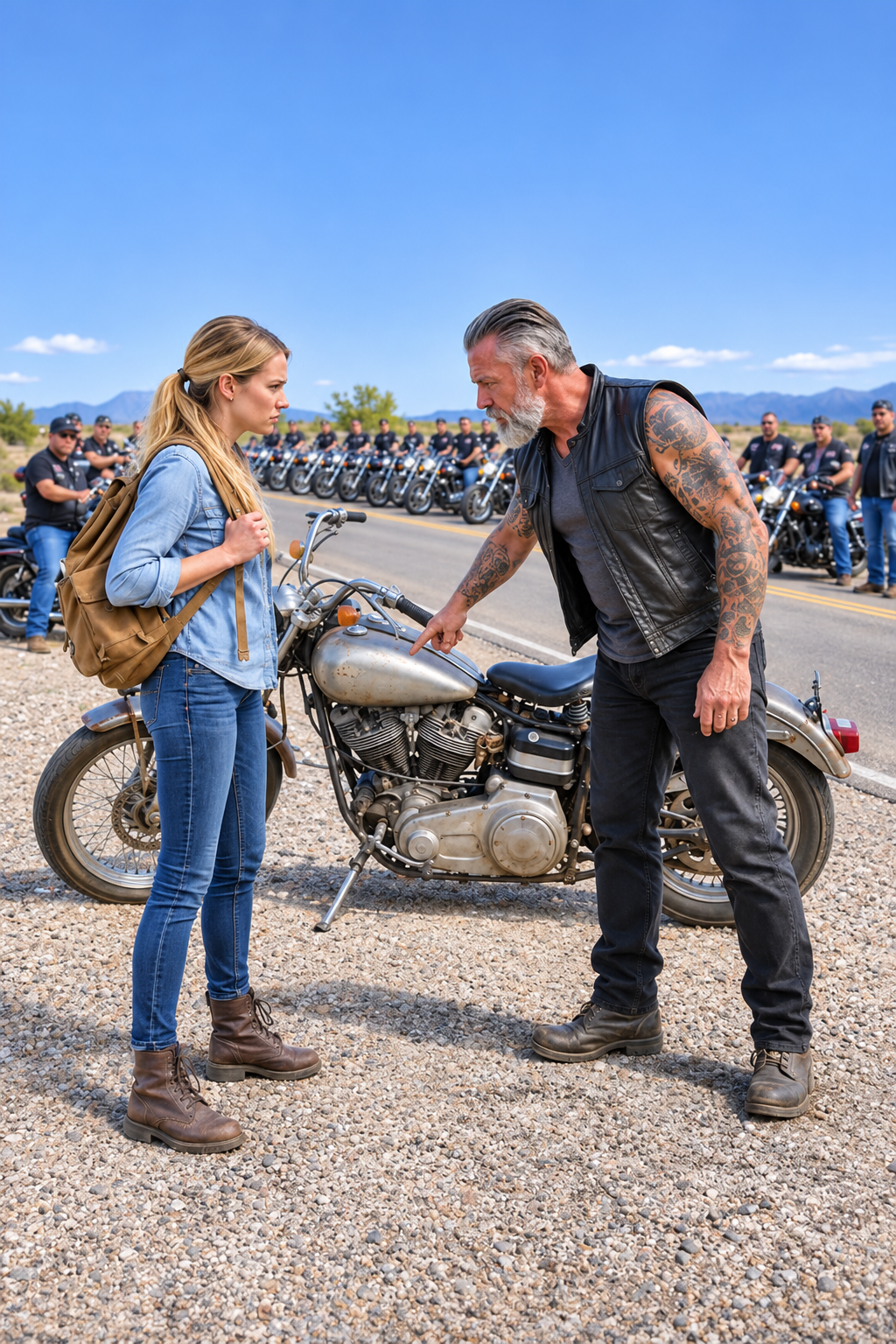 Said he’d collected old Harleys for years. I met him when I was looking for work. He offered me a place to stay, and eventually he sold me the bike.” Garrison glanced at the motorcycle. “How much?” “Two thousand dollars.” A few men exchanged looks. “Did he give you a title?” I shook my head. “He said the paperwork was complicated because the bike had been sitting in storage. He promised he’d mail everything once the registration was sorted out.” Garrison closed his eyes. “Of course he did.” I tightened my grip on my backpack. “Look, I know this sounds bad, but I didn’t know it belonged to anyone. I paid him what I had. I worked for months to save that money.” “Nobody’s accusing you of stealing it, sweetheart.” A woman stepped forward from the crowd. She was perhaps in her late fifties, with silver hair braided down her back and a faded leather vest covered in patches. She looked at my bruised wrist. “What’s your name?” “Emily.” “I’m June. Come stand over here. You’re shaking.” Only then did I realize how badly my hands were trembling. June guided me toward a parked motorcycle and helped me sit on a low roadside barrier. Garrison turned toward his people. “Get the old photographs.” A younger biker immediately pulled out his phone. “Already on it.” Within seconds, a photograph appeared on the screen. It showed a broad-shouldered man with a thick mustache sitting on a black Harley-Davidson. The motorcycle looked exactly like mine. Except for one thing. A small silver anchor had been welded onto the left side of the frame. I stared at it. My motorcycle had the same anchor. I’d always assumed it was a decorative piece the previous owner had added. “That’s Raymond,” Garrison said. “Our president. And that’s the bike he built with his own hands.” June sat beside me. “Raymond wasn’t just our president. He was the person who kept this club together. When somebody lost their job, he found them work. When someone’s kid needed help, he showed up. He was the kind of man who remembered everyone’s birthday.” Her voice faltered. “Then one night, he disappeared.” “Did you look for him?” Garrison gave a humorless laugh. “For four years, we looked everywhere. Hospitals, police stations, abandoned properties, every highway between Arizona and New Mexico. We spent thousands of dollars following rumors.” He looked down at my motorcycle. “And all that time, his bike was sitting with Walter Brennan.” I swallowed. “Why would Walter have it?” Nobody answered immediately. Then an older biker stepped forward. His name was Hank, and he wore a small patch that read ORIGINAL MEMBER. “Because Walter was the last person who saw Raymond alive.” I turned toward him. “What?” Hank nodded slowly. “Walter used to handle bookkeeping for our club. He wasn’t a member, but Raymond trusted him. They were friends for years. The night Raymond vanished, Walter told us he’d left town after an argument.” “An argument about what?” “Money,” Garrison answered. “How much money?” “Almost half a million dollars.” My stomach dropped. I looked at the Harley again. Suddenly, the motorcycle didn’t feel like a machine I’d bought with my savings. It felt like a piece of evidence from a life I knew nothing about. Garrison crouched in front of me. “Emily, I need to ask you something. Did Walter ever tell you why he was selling the bike?” “He said it belonged to his uncle. He claimed his uncle had died and left him a storage unit full of old motorcycles.” Garrison’s jaw tightened. “Raymond never had a brother.” I looked at the ground. “I should have checked.” “Maybe. But you’re not responsible for Walter’s lies.” A motorcycle engine started somewhere behind us. Garrison turned. “Nobody moves until we know what’s happening. Hank, call the sheriff. Tell him we may have located Raymond’s missing motorcycle. And tell him Walter Brennan’s name is involved.” Then he looked at me again. “One more thing. You said you met Walter six months ago. Where is he now?” I hesitated. Then I told him. “He’s probably at his house in Mesa.” June’s expression changed. “Probably?” I pulled my sleeve down over my wrist. “He doesn’t know I left.” Garrison studied my face. “Did you run away from him?” I nodded. Nobody spoke. I hadn’t intended to tell strangers about my life. I barely understood how I’d ended up there myself. But something about June’s gentle expression made the words come out. “Walter wasn’t the man who hurt me.” I looked at my hands. “It was his son, Travis.” Garrison’s face hardened. “His son lives with him?” “Yes. Walter always said Travis was going through a difficult time. That I should be patient with him. At first, he was just rude. Then he started taking my money. When I complained, he’d shove me or grab my arm.” I swallowed. “Last night, he hit me. Walter watched. He told me I was making things worse by upsetting his son.” June reached for my hand. I pulled away instinctively. She didn’t take it personally. “You’re safe right now,” she said. I wanted to believe her. More than anything, I wanted to believe her. But people had said that before. And every time I’d believed them, I’d ended up paying for it. Garrison stood. “June, take her to the diner in the next town. Get her something hot to eat. Hank, stay with them. The rest of us are going to wait here for the sheriff.” He looked at me. “Nobody’s taking that motorcycle from you tonight. And nobody’s sending you back to that house.” I started crying. Not loudly. Not dramatically. Just a quiet, helpless stream of tears that seemed to come from somewhere deep inside my chest. For the first time in six months, someone had told me I didn’t have to go back. And they sounded like they meant it. An hour later, I was sitting in a roadside diner with a bowl of chicken soup in front of me. June had bought me a sandwich, coffee, and a piece of apple pie. I hadn’t eaten a proper meal in two days. Hank sat across from me, quietly scrolling through his phone. Every few minutes, he glanced toward the entrance. “Are you expecting someone?” I asked. “Not exactly. Just making sure nobody followed us.” I looked through the window. Outside, several motorcycles were parked beneath the diner lights. I counted twelve. “Where are the others?” “Back at the highway.” “All ninety-seven?” Hank chuckled. “Most of them. Word travels fast in this family.” I stared at him. “You’re all family?” He nodded. “Not by blood. By choice.” I lowered my spoon. “I don’t have anyone.” Hank put his phone down. “Then tonight, you have people who give a damn whether you make it home.” I looked away before he could see my eyes filling again. At 10:43 p.m., Garrison called. Hank answered. “Yeah?” He listened for a moment, then stood. “What do you mean the address is empty?” A long silence followed. “Any sign of Brennan?” Another pause. “All right. We’re coming.” He hung up. June looked up from her coffee. “What happened?” “Walter’s house is empty. The sheriff found the front door unlocked. There’s broken glass in the kitchen and blood on the floor.” My stomach turned. “Blood?” “Not enough to tell what happened yet.” I felt cold all over. “Did Travis do something?” Hank shook his head. “We don’t know.” Then his phone rang again. This time, the number was unfamiliar. He answered cautiously. “Hello?” A man’s voice came through the speaker. I recognized it immediately. Walter. “Tell Emily I know where she is.” My entire body froze. Hank put the call on speaker. “Who is this?” “Don’t play games with me. I know she’s with you people.” Hank looked at June. She reached across the table and squeezed my hand. Walter continued. “That girl has something that belongs to me. I want it back.” Garrison’s voice suddenly came through the phone. “What exactly belongs to you, Brennan?” Silence. Then Walter laughed. “You should have stayed out of this, Garrison.” Garrison’s reply was ice cold. “You’ve had four years to explain what happened to Raymond. You’re running out of time.” Walter hung up. I stared at the phone. My voice barely worked. “He knows about the motorcycle.” Garrison called back seconds later. “Emily, listen carefully. The sheriff is investigating the house. You’re staying where you are. Don’t answer any calls from Walter or Travis.” “Okay.” “One more thing. Did Walter ever give you anything with the motorcycle? A box, a folder, an old tool kit? Anything that didn’t belong to you?” I thought for a moment. Then I remembered. “There was a small metal toolbox under the seat. Walter said it came with the bike. I never opened it.” Garrison went quiet. “Is it still there?” “Yes.” “Don’t touch it. Don’t open it. Let the sheriff handle it.” I nodded, although he couldn’t see me. When the call ended, June leaned closer. “What’s in that toolbox?” “I don’t know.” Hank stared out the window. “Maybe it’s the reason Walter sold the bike.” The next morning, two sheriff’s deputies arrived at the diner. They took my statement, photographed my bruises with my permission, and asked about the motorcycle. I told them everything. I also told them where I had last seen Walter and Travis. One deputy, a woman named Deputy Morales, listened carefully. “Emily, I want you to understand something. You’re not in trouble. We’ll need to verify the ownership history, but purchasing something from someone who misrepresented its ownership doesn’t automatically make you a thief.” I nodded. She gave me a card with her number. “If either of those men contacts you, call us. Don’t meet them alone.” The motorcycle was still at the highway, guarded by several club members. A recovery team and a mechanic arrived later that morning to inspect it. When the toolbox was opened under the deputies’ supervision, everyone went silent. Inside was a thick envelope wrapped in an old oil-stained cloth. There were photographs, several handwritten letters, and a small digital voice recorder. On top of everything lay a folded piece of paper. Garrison read it first. His face turned pale. “What is it?” June asked. He handed her the paper. It contained just one sentence. IF SOMETHING HAPPENS TO ME, FIND THE ORIGINAL LEDGER. WALTER KNOWS WHERE IT IS. Below the sentence was a signature. Raymond Cole. Garrison sat down on the roadside barrier. For four years, he’d imagined hundreds of possibilities about what happened to his friend. He’d never imagined that Raymond had left them a message. The recorder was old, but the mechanic managed to get it working. Deputy Morales arranged for the recording to be preserved as evidence. Then they played it. A man’s voice filled the small roadside office. “October seventeenth. This is Raymond Cole.” Garrison closed his eyes. The voice continued. “If you’re hearing this, something went wrong. Walter has been moving money out of the club’s community fund. I found the records. Almost half a million dollars is missing.” A pause. “I confronted him tonight. He claims he was borrowing it. He says he’ll replace it before anyone notices. But I don’t believe him.” The recording crackled. “There’s something else. He threatened my family. I don’t know how far he’ll go.” Garrison gripped the edge of the table. “Where are you, brother?” he whispered. The recording continued. “I’ve hidden the original ledger somewhere Walter won’t think to look. The person who finds this needs to understand that the money was never mine. It belonged to the families who trusted us.” Then Raymond said something that made Garrison sit upright. “If Walter gets away with this, he won’t stop.” The recording ended. Nobody spoke for several seconds. Finally, Hank asked, “Where’s the ledger?” Garrison looked at the photographs. One showed Raymond standing in front of a small building with a wooden sign. Another showed him beside a red pickup truck. The final photograph was a close-up of a stone monument beside a highway. On the back, Raymond had written: THE PLACE WHERE WE STARTED. Garrison studied it. “That’s the old Route 66 garage.” June frowned. “The one near Kingman?” He nodded. “Raymond and I started riding together there. It was the first place our club ever met.” Deputy Morales took the photographs. “We’ll need to follow up through the proper channels. If there’s evidence at that location, we’ll document it.” Garrison nodded. Then he turned to me. “Emily, you said Walter told you the motorcycle belonged to his uncle. Did he ever mention the old Route 66 garage?” I thought. “Once. He said he’d found some old boxes there years ago. He told Travis the place was full of junk.” Garrison looked at the deputy. “Then we need to tell the sheriff.” By noon, the investigation had grown considerably. Authorities discovered that Walter had been living under financial pressure for years. There were outstanding debts, suspicious transfers, and documents connecting him to the missing community funds. But the most important discovery came from the old garage. Behind a false panel in a storage room, investigators found a metal lockbox. Inside was the original ledger. It contained detailed records of every withdrawal, transfer, and payment Walter had made. There were also letters from Raymond. One was addressed to Garrison. It read: Brother, If you’re reading this, I probably didn’t make it back. I trusted Walter longer than I should have. That’s my mistake, not yours. Don’t waste your life blaming yourself for not seeing what I saw too late. Take care of the people who depended on us. That’s what matters. And if you ever find my bike, remember that it was never just mine. It was built with the hands of friends, paid for with money from our first jobs, and repaired by people who believed we could build something worth keeping. Don’t let anyone turn it into a symbol of hate. Ride it forward. Garrison folded the letter carefully. His eyes were wet. For a moment, the road captain looked like a man who had finally found permission to grieve. But Raymond was still missing. And the investigation had only just begun. Three days later, Deputy Morales received a call from a hospital in New Mexico. A patient had been admitted under a different name four years earlier. He had suffered a head injury, lost much of his memory, and had remained in long-term care before eventually being transferred to a rehabilitation facility. The hospital had recently updated its records after a routine identity review. A fingerprint comparison had produced a possible match. Raymond Cole. Garrison received the call while we were sitting outside a small garage in Kingman. He didn’t speak for nearly a minute. Then he stood so quickly his chair fell backward. “Where?” The deputy gave him the information. Garrison closed his eyes. “He’s alive.” Those two words traveled through the club faster than any rumor ever had. By the following morning, twenty-three motorcycles were heading east. I went with June in her truck. I wasn’t ready to ride the Harley yet. Part of me still felt that I hadn’t earned the right to sit on it. But June told me something I’ll never forget. “That bike doesn’t belong to Walter’s lies, sweetheart. And it doesn’t belong to your guilt either.” The rehabilitation facility was a quiet building surrounded by cottonwood trees. When we entered the common room, an older man sat near the window. His hair was mostly gray. His shoulders were thinner than those in the photographs. But the hands were unmistakable. Garrison stopped walking. “Anchor?” The man looked up. For a moment, his expression was blank. Then his eyes moved to Garrison’s face. Something flickered. “Gar…” Garrison covered his mouth. “Yeah, brother. It’s me.” The man slowly stood. He looked confused, frightened, and exhausted. “I know you,” he whispered. Garrison took one step forward. “Four years, Raymond. Four damn years.” Raymond stared at him. Then he began to cry. Garrison crossed the room and wrapped his arms around his friend. Neither man said anything for a long time. I stood near the doorway, watching ninety-seven bikers become quiet children again. The doctors explained that Raymond had been found injured near an isolated stretch of road in New Mexico. He had no identification and couldn’t remember his name. A passing truck driver had brought him to a hospital. He’d spent months recovering from his injuries. When he regained enough strength to speak clearly, he still couldn’t remember his past. His medical records showed that he had asked repeatedly whether anyone had come looking for him. But no one had been able to tell him who he was. When the hospital transferred him to rehabilitation, his original identity remained unresolved. Now, with the fingerprint match and the old photographs, the missing pieces were finally coming together. There was still an investigation into the circumstances of his disappearance. Walter’s actions, the missing money, and the evidence found in the toolbox were being examined by law enforcement. Nobody had enough information to say exactly how Raymond had ended up injured on that highway. But Raymond remembered one thing when Garrison showed him the old photograph of his motorcycle. He touched the screen with trembling fingers. “Anchor,” he whispered. Garrison smiled through his tears. “That’s what we called you.” Raymond looked at him. “Where’s my bike?” Garrison laughed and cried at the same time. “Safe, brother. It’s safe.” Then Raymond noticed me standing beside June. He studied my face. “Who is she?” Garrison turned. “This is Emily. She’s the reason we found your motorcycle.” Raymond looked at me for a long moment. “Thank you.” I shook my head. “I didn’t do anything.” “You rode it,” he replied. “And you brought it back to us.” I didn’t know what to say. Then he noticed the bruising on my wrist. His expression changed. “Someone hurt you?” I looked down. “Yes.” He nodded slowly. “Then I hope they never get the chance again.” Two weeks later, Walter Brennan was arrested after investigators gathered enough evidence connecting him to the financial crimes and the false sale of the motorcycle. Travis was also taken into custody after Deputy Morales documented the assault allegations and obtained additional witness statements. The legal process would take time. There were court dates, interviews, paperwork, and questions that nobody could answer immediately. But Walter’s phone call had been his last attempt to intimidate me. He couldn’t reach me anymore. And I no longer had to spend every night listening for footsteps outside my bedroom door. Raymond’s recovery was slower. He had lost four years of memories, and some of them might never return. But the doctors were optimistic. The club helped arrange additional rehabilitation and transportation to Arizona when he was medically cleared. They also began restoring the old Harley. I visited the garage every afternoon. At first, I mostly watched. Then one day, Garrison handed me a wrench. “Want to help?” I looked at him. “I don’t know much about motorcycles.” “Neither did Raymond when he started.” He smiled. “We’ll teach you.” So I learned. I learned how to clean a carburetor, inspect a chain, identify worn cables, and listen for the difference between a healthy engine and one begging for attention. The men and women who had frightened me on that deserted highway became familiar faces. Hank taught me how to change oil. June taught me how to cook for a crowd. And Garrison taught me that leadership wasn’t about being the loudest person in the room. It was about making sure the quietest person had somewhere to stand. One afternoon, Raymond came into the garage using a cane. He moved slowly, but his eyes were brighter. He stopped beside the Harley. For a long time, he simply stared at it. Then he ran his fingers over the silver anchor welded to the frame. “I made that,” he said. Garrison nodded. “You did.” Raymond looked at me. “How much did you pay?” “Two thousand dollars.” He laughed softly. “That was a terrible deal.” I smiled for the first time in what felt like forever. “I know.” He looked at Garrison. “Give her the money back.” Garrison nodded. “We’re already working on it.” But Raymond wasn’t finished. “And the bike?” He looked at me again. “Do you want to keep riding it?” I hesitated. “Isn’t it yours?” “It was. But I don’t know if I’ll ever ride like I used to.” He rested a hand on the seat. “That machine helped bring me home. I think it deserves to keep moving.” I shook my head. “I can’t accept something that valuable.” Raymond smiled. “Emily, I spent four years not knowing where I belonged. If I’ve learned anything, it’s that some things are worth passing on.” He paused. “But I won’t give it to you because you need saving. I’ll give it to you because you’ve earned the right to decide what happens next.” For the first time, I understood the difference between someone giving me something out of pity and someone trusting me with something meaningful. I accepted. Not immediately. Not without tears. But I accepted. The club helped me find a small apartment in Kingman. It wasn’t fancy. The kitchen cabinets needed repainting, the bathroom faucet leaked, and the bedroom window rattled whenever the wind picked up. But the keys were mine. Nobody could take them away. I found work at a local repair shop, where I spent my days learning more about engines and my evenings rebuilding the Harley. I also started taking community college classes. For years, I’d believed my life had ended because I’d trusted the wrong person. Now I was beginning to understand that a bad chapter didn’t have to become the whole story. Six months after that night on the highway, the club organized a memorial ride. Not for Raymond. He was alive, recovering, and sitting at the front of the gathering in a leather jacket that had been carefully repaired. The ride was for the people who had suffered because of the stolen community fund. Raymond had insisted that every recovered dollar go toward helping the families who had originally contributed to it. They established a small emergency fund for people facing sudden medical bills, housing problems, and unexpected hardship. The first person to receive help was a single mother who had lost her apartment after a workplace injury. She cried when the club handed her the keys to a temporary rental. I recognized that kind of crying. It was the sound of someone realizing they might survive another day. Before the ride began, Raymond asked me to stand beside him. He handed me a small silver pin shaped like an anchor. “This belonged to my wife,” he said. “She gave it to me the day we started the club.” I looked at it. “I can’t take that.” “You can borrow it,” he replied. “Until you understand what it means.” I pinned it to my jacket. Garrison approached with a helmet in his hand. “Ready?” I looked at the Harley. Its black paint gleamed beneath the Arizona sun. The engine had been rebuilt, the brakes were new, and the silver anchor on the frame shone like a promise. For a second, I remembered that deserted highway. The ninety-seven motorcycles. The gray-bearded man asking why I was riding a dead man’s bike. And the terrible fear that had filled my chest when everyone went silent at Walter’s name. I swung my leg over the seat. The engine started with a deep, familiar rumble. Raymond smiled. “Sounds good.” I looked at him. “Thank you.” He shook his head. “Don’t thank me. Just remember what happened here.” “What?” He pointed toward the gathering. “People can lose their money, their memories, their homes, even years of their lives. But when good people decide to stand together, they can still find a way forward.” Then he leaned closer. “And never confuse kindness with weakness. The world needs more of the first and less of the second.” The ride began. Ninety-seven motorcycles rolled onto the Arizona highway, followed by the people who had joined them along the way. I rode near the front, with Raymond beside me in Garrison’s sidecar. The desert stretched endlessly ahead. For the first time in my life, I wasn’t riding away from someone. I was riding toward something. A home. A future. A life that belonged to me. And as the sun disappeared behind the mountains, I finally understood something I wished I’d learned years earlier: Sometimes the people who save your life aren’t the ones who promise to protect you forever. They’re the ones who remind you that your life is still yours to reclaim. That night, ninety-seven strangers had surrounded me. I thought they were going to take everything I had left. Instead, they helped me find everything I’d lost. And the old Harley that had once carried a missing man into the darkness became the motorcycle that carried two broken lives back into the light. The road ahead wasn’t going to be easy. But I wasn’t afraid of it anymore. Because this time, I wasn’t riding alone.