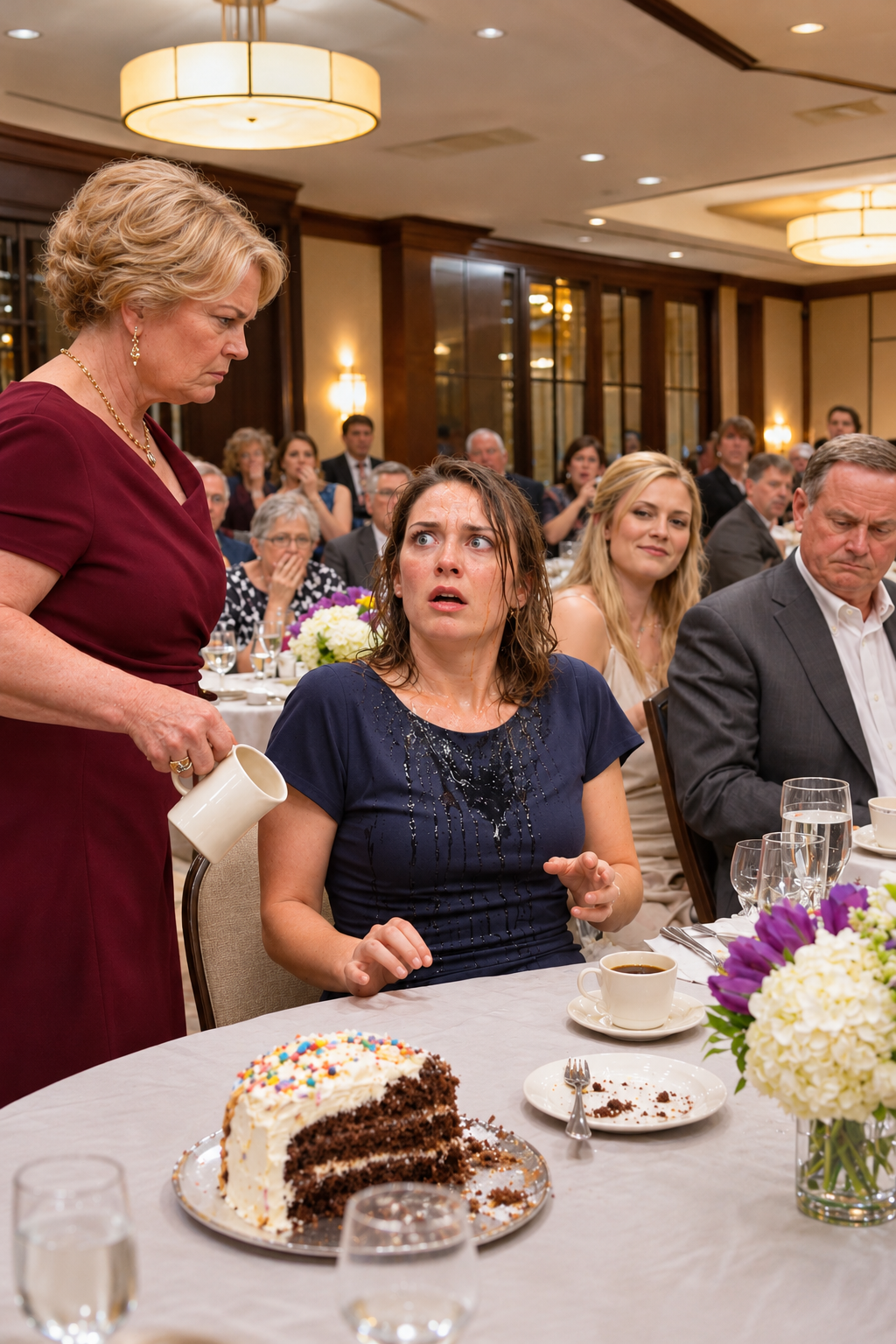
My mother poured an entire cup of hot coffee over my face in front of sixty guests at her 60th birthday party. Then she picked up the microphone and said, “You should be grateful anyone even wants to marry you.”
The first paragraph made my stomach drop. “Dear Maya, If Liam has given you this letter, then I finally found a way to get the truth to you without your mother interfering. I am sorry it took me so long. I am even sorrier that you have been sending money to help me while believing I was living comfortably. I need you to know that I have never been disappointed in you. Not once. I have been waiting for you to come see me, sweetheart. Your mother told me you didn’t want to.” I stopped reading.
The banquet room was suddenly very quiet. I looked down at the payment records. For three years, I had transferred $800 every month to my mother. She told me that was what Grandma needed for her nursing home expenses. The records in my hands told a different story. Grandma’s actual facility had received only three payments during those three years. Three. The most recent payment was dated twenty-seven months earlier. I counted the numbers twice, hoping I had misunderstood something. I hadn’t. The facility had charged Grandma a monthly amount that was considerably higher than what I had been told. She had been moved from her original private room into a small shared room because her account had fallen behind. There were notices about unpaid bills. There were letters warning of possible discharge to a lower-cost facility. And there were copies of bank transfers showing that my mother had received every payment I had sent. My hands began to shake. I looked at Liam. He quietly placed another envelope on the table. “There is more,” he said. My mother lunged toward it. “That’s enough. This is private family business.” Liam stepped between her and the table. “No,” he replied calmly. “It stopped being private when you decided to make Maya’s life a public spectacle.” My mother turned toward the guests. “She has no idea what she’s talking about. Your grandmother is confused. She’s old. She doesn’t understand money anymore.” I looked at her. “Then why are there bank transfers into your personal account?” For the first time that evening, my mother had no immediate answer. I pulled the remaining papers from the envelope. There were copies of checks, account statements, and a handwritten list of dates and amounts. At the bottom of the list, Grandma had written something that made my chest tighten. $28,800 received from Maya. $2,400 paid to facility. Remaining amount unaccounted for. I did the calculation in my head. Twenty-eight thousand eight hundred dollars. That was what I had sent over three years. My grandmother had received less than ten percent of it. I felt sick. “Where did the rest go?” I asked. My mother folded her arms. “I had expenses. I was managing everything. You don’t understand how expensive things are.” “Then show me the receipts.” “I don’t have to explain every dollar to you.” “You were taking money meant for Grandma.” “I was helping this family!” The words came out so loudly that several guests shifted in their seats. I looked toward my sister. Brooke was no longer smiling. She was staring at the papers as if she were seeing something she had never imagined. “Mom,” she said quietly. “What is she talking about?” My mother ignored her. Instead, she pointed at me. “You have always been selfish. You have a good job. You have a man who loves you. You have everything. Your sister needed help, and you couldn’t even do that much.” I glanced at the records again. Then I noticed something. One of the transfers was dated six months earlier. The description read: BROOKE WEDDING DEPOSIT. I stared at it. “Did you use Grandma’s money for Brooke’s wedding?” My sister’s face went white. “What?” I turned the paper around so she could see it. The amount was $6,500. The date matched the week Brooke had announced that she had secured her wedding venue. My mother snatched at the paper. “That’s not what happened.” Brooke stood up. “Mom, tell me that’s not true.” My mother looked at her, then at me. “You both need to calm down.” But nobody was listening to her anymore. I felt something inside me change. For years, I had been the daughter who stayed quiet. The one who apologized first. The one who worked extra shifts, sent money, remembered birthdays, and swallowed insults because I thought being a good daughter meant never making things harder for my parents. That night, I finally understood something. My silence had not kept my family together. It had simply made it easier for someone else to hurt me. I took a deep breath. “Liam, can you tell everyone how you got these documents?” He nodded. “Your grandmother contacted me three weeks ago. She asked me to help her reach you. She said your mother had been intercepting her letters and telling her you refused to visit.” My stomach twisted. “She contacted you?” “Through the nursing home social worker. Your grandmother had been asking for help for months. The social worker eventually helped her arrange a phone call.” I looked at him. “Why didn’t she call me directly?” “Your mother had changed the contact number on her file. Grandma thought you had blocked her.” I covered my mouth. Three years. Three years of believing that my grandmother didn’t want to see me. Three years of her believing I had abandoned her. My mother had taken more than money. She had stolen time. I turned to the final page of the letter. There was another paragraph. “Your mother told me that you were too busy with your own life to care about me. She said you had refused to help when I needed money. I believed her for a while, Maya. I am ashamed of that. But I kept your birthday cards. I kept the little notes you sent with the payments. I knew something wasn’t right because I remembered the girl who used to sit beside my bed and read to me when I was sick. That girl would never simply disappear without saying goodbye.” My eyes filled with tears. I could barely make out the final lines. “I have one more thing to tell you. Your grandfather and I left something for you. It was never intended to replace love or make you feel obligated to us. We wanted you to have a little security of your own. Your mother knows about it. Please ask an attorney to review the documents before signing anything. Do not let anyone pressure you. I love you, sweetheart. I always have.” I lowered the letter. “What did Grandma leave me?” My mother suddenly became very still. Liam looked at me. “There’s a copy of the trust document in the envelope.” I pulled it out. It was a trust established by my grandparents years earlier. It named me as the beneficiary of a small investment account and a property they had owned before my grandfather died. The property was a modest two-bedroom house on the outskirts of Columbus. It wasn’t a mansion. It wasn’t worth millions. But it was fully paid off, and the account held a substantial amount of money that had been invested over the years. The document also named my mother as the person responsible for administering certain portions of the trust until Grandma’s death. A clause near the bottom stated that the beneficiary had to be informed of any distributions or withdrawals. I had never received a single notice. I looked at my mother. “Did you know about this?” She swallowed. “I was handling the paperwork.” “Did you withdraw money from the account?” “Those funds were for family expenses.” “Did you withdraw money?” She looked away. That was enough. My father finally lifted his head. “Evelyn told me to make sure everything was handled properly,” he said. My mother whipped around. “Richard, don’t.” He looked at me. “I knew she had been using some of the money. I didn’t know how much. I thought she was borrowing it and would replace it.” I felt as if the room had tilted. “You knew?” He rubbed his forehead. “I thought it was temporary.” “How long have you known?” He didn’t answer. I laughed once, but there was no humor in it. “So everybody knew something except me.” Nobody spoke. My mother grabbed her purse. “This party is over. Everyone needs to leave.” But the guests were already looking at her differently. Some looked shocked. Others looked uncomfortable. A few looked angry. One older woman who had been sitting near the cake stood up. “I think Maya deserves an apology,” she said. My mother stared at her. “This is none of your business.” The woman shook her head. “You poured coffee on your own daughter in front of all of us. You made it everyone’s business.” A few guests nodded. My mother looked around the room, searching for someone who would defend her. Nobody did. Brooke slowly removed the engagement ring from her finger. I noticed because it was the same ring she had shown me in photographs for months. She placed it on the table. “I’m not accepting money for my wedding,” she said. My mother turned toward her. “Don’t be ridiculous.” “I didn’t know where the money came from.” “You didn’t ask!” “Because I trusted you!” That sentence seemed to hit my mother harder than anything I had said. Brooke looked at me. “Maya, I am sorry.” I couldn’t answer immediately. She stepped closer. “I knew Mom was pressuring you. I knew she always expected you to pay for things. But I never imagined she was doing this to Grandma. And I laughed when she poured the coffee on you.” Her voice cracked. “I laughed because I wanted Mom to be happy with me. I am so sorry.” I looked at my sister. For years, Brooke had been the favorite. She got the new clothes, the attention, the encouragement. I got told to be understanding because I was older. I could have listed a hundred things she had done that hurt me. But that night, for the first time, she looked genuinely ashamed. “I appreciate the apology,” I said. “But I need time.” She nodded. “I understand.” Then she looked at our mother. “You need to give Grandma her money back.” My mother laughed bitterly. “With what?” Brooke’s expression changed. “You mean you spent it all?” “Don’t start.” “Mom!” My mother finally exploded. “I did what I had to do! Your father was barely contributing. The house needed repairs. You needed things. Maya had more than enough. I was keeping everyone afloat!” I stared at her. “You had no right to decide that my savings belonged to you. And you had no right to take money from a woman who depended on it to live.” “She was my mother!” “And I was her granddaughter.” For a moment, I thought my mother might throw something else. Instead, she leaned toward me and lowered her voice. “You are going to regret humiliating me like this.” I looked at the coffee dripping from my blouse. Then I looked at the sixty people who had watched her do it. “Mom, you humiliated yourself.” I picked up my purse. Liam placed his jacket around my shoulders. We walked out together. I didn’t look back. The cold November air hit my face as we reached the parking lot. Only then did I begin to cry. Not because of the coffee. Not because of the money. Because I had spent thirty-two years trying to earn love from someone who treated it like a reward I had to purchase. Liam held me while I cried. “You don’t have to figure everything out tonight,” he whispered. I nodded against his shoulder. But I knew one thing. I was going to see my grandmother. And nothing was going to stop me. The next morning, we drove two hours to the nursing home. I had barely slept. My mother called seventeen times between midnight and six in the morning. She sent messages accusing me of ruining her birthday, threatening to sue me for defamation, and insisting that Grandma was mentally incapable of making financial decisions. I didn’t respond. Instead, I called the nursing home’s administrator. The woman who answered was kind but cautious. She confirmed that Grandma was still a resident and that she had repeatedly asked to speak with me. When I asked whether she had received my monthly payments, the administrator paused. “I’m afraid we can only discuss her account with authorized individuals. However, I can tell you that she has been having financial difficulties.” That was all I needed. We arrived shortly before noon. A social worker named Patricia met us near the reception desk. She led us down a quiet hallway to a small room with pale yellow walls and a window overlooking the courtyard. Grandma was sitting in a wheelchair beside the window. She looked smaller than I remembered. Her silver hair was thinner, her hands trembled slightly, and a soft blanket covered her knees. But when she looked up and saw me, her entire face changed. “Maya?” I dropped my purse. “Hi, Grandma.” She covered her mouth. Then she started crying. I crossed the room and wrapped my arms around her carefully. “Oh, sweetheart,” she whispered. “I thought you didn’t want to see me.” I held her tighter. “I thought you didn’t want to see me either.” We stayed like that for several minutes. Neither of us had the right words. Eventually, I sat beside her and took her hand. “I read your letter.” She nodded. “I’m sorry I couldn’t get it to you sooner.” “You don’t have to apologize.” She looked toward Patricia. The social worker gently explained that Grandma had recently requested an independent review of her financial arrangements. She had also asked the facility to update her emergency contacts and remove my mother from any authority she no longer wished her to have. The process was underway. I asked Grandma whether she wanted me involved. She squeezed my hand. “Only if you want to be. I don’t want you to feel responsible for fixing everything.” That sentence nearly broke me. Even after everything, she was still worried about putting a burden on me. I told her I wanted to help, but that we would do things properly. I would speak to an attorney. I would review the trust. I would make sure her care was paid directly to the facility. And I would visit. Not because she owed me anything. Because I loved her. She smiled. “Your grandfather would have liked that.” I laughed through my tears. “He would probably have told me to eat more.” “He would have told you to stop working so many shifts.” “He’d be right about that.” For the first time in years, the room felt like home. Over the following weeks, the situation became much more complicated. I hired an attorney who specialized in elder financial exploitation and trust administration. Her name was Claire Bennett. She was direct, organized, and not easily impressed by emotional explanations. After reviewing the documents, she advised me not to confront my mother privately or sign anything she provided. We requested a complete accounting of the trust. We also contacted the appropriate authorities to report the suspected misuse of Grandma’s funds. The investigation took time. Bank statements had to be obtained. Transfers had to be traced. Nursing home records had to be compared against deposits and withdrawals. My mother initially refused to cooperate. Then she hired an attorney. Suddenly, the woman who had insisted that family matters should remain private was sending formal letters demanding that I stop discussing the situation with anyone. Claire handled those communications. I focused on Grandma. Every Sunday, Liam and I drove to see her. Sometimes we brought lunch. Sometimes we sat in the courtyard. Sometimes she fell asleep halfway through a conversation, and I simply held her hand until she woke up. I learned that she had been lonely. Not just because she missed me, but because she had spent years believing that everyone she loved had moved on without her. She told me about the little things she remembered. The birthday cake I once baked when I was twelve. The time I fell asleep on her couch during a thunderstorm. The first time I told her I wanted to become a nurse. “You always wanted to take care of people,” she said. “I suppose I did.” “You just forgot that you were one of those people.” I thought about that sentence for a long time. Meanwhile, the investigation revealed that the missing money was not a misunderstanding. My mother had transferred funds into her personal account, used some to cover household expenses, paid for portions of Brooke’s wedding preparations, and made several withdrawals from the trust without the required authorization. The records also showed that the trust property had been used as collateral for a personal loan without the proper consent. The attorney explained that there were several possible legal consequences, depending on what the investigation established and what could be recovered. My mother claimed she had intended to repay everything. But there was no repayment plan. There were no records showing that she had set money aside. And there were no credible explanations for the false statements she had made to Grandma and me. The worst discovery came from a folder of intercepted mail. Inside were copies of letters Grandma had sent me over the years. Some were birthday cards. Others were simple notes asking whether I was happy, whether Liam treated me well, and whether I might visit when I had time. None had reached me. In one letter, Grandma had written: “I hope Maya knows she never has to send money to earn a place in my heart.” I read that sentence three times. Then I put the letter down and cried. My mother had convinced two people who loved each other that they had been abandoned by the other. It wasn’t just financial betrayal. It was deliberate isolation. About a month later, Brooke called me. I almost let it go to voicemail. But something made me answer. “Hey,” I said. She sounded exhausted. “Can we talk?” I agreed to meet her at a coffee shop near my apartment. She arrived without makeup, wearing jeans and an old sweater. She looked nothing like the polished bride who had spent months planning an extravagant wedding. She sat across from me and wrapped both hands around her cup. “I canceled the country club.” I nodded. “I figured.” “I lost the deposit.” “I’m sorry.” She shook her head. “Don’t be. It was money I shouldn’t have been spending.” For a while, neither of us spoke. Then she looked at me. “I need to tell you something, and I don’t expect you to forgive me.” I waited. “When Mom asked you for the money, I knew she was going to pressure you. She told me she had already talked to you and that you were being difficult.” I stared at her. “She told me you had agreed to help, but you were trying to negotiate how much. I believed her.” I felt a familiar ache in my chest. “So you laughed because you thought I was breaking a promise?” Brooke nodded. “Partly. But that doesn’t excuse it. I should have asked you. I should have stood up when she poured the coffee on you.” She looked down at her hands. “I’ve spent my whole life being protected from consequences. You spent yours being expected to absorb them.” That was the first time my sister had ever said anything like that. “I don’t know how to fix what happened,” she continued. “But I want to try.” I studied her face. “Then start by not asking me to make you feel better about it.” She nodded. “I won’t.” We talked for another hour. Not about our mother. Not about the wedding. About us. About the resentment we had carried since childhood. About the way our parents had assigned us roles and expected us to stay in them forever. I told her I wasn’t ready to trust her again. She said she understood. When we left, she hugged me. I hugged her back, but I didn’t promise anything. Sometimes rebuilding a relationship begins with honesty, not forgiveness. And sometimes honesty is the first thing a family has avoided for decades. Three months after the birthday party, my mother requested a meeting. She wanted to meet at my parents’ house. Claire advised against it, so I suggested a neutral conference room at her office. My mother arrived with my father. She wore a dark blue dress and carried a folder. She looked older than I remembered. There were shadows beneath her eyes. But she still walked into the room as if she expected everyone to accommodate her. She sat down. “I want this whole thing finished,” she said. Claire opened her notebook. “Then let’s discuss the accounting and the proposed repayment arrangements.” My mother ignored her. She looked directly at me. “Maya, I made mistakes. But you have to understand the pressure I was under.” I waited. “Your father wasn’t earning enough. The house needed repairs. Brooke’s wedding was important. I thought you could spare some money.” “Why didn’t you ask me honestly?” She frowned. “Because you would have said no.” “Yes.” The answer seemed to surprise her. I continued. “And Grandma would have said no if you had asked to use her money. That’s why you lied to her.” My mother pressed her lips together. “I never intended for anyone to get hurt.” I looked at her. “Grandma lived in a smaller room because she couldn’t pay her bills. I believed she hated me. I missed three years of her life. You poured coffee on me in front of sixty people because I wouldn’t give you my wedding savings. How much more hurt did you think was acceptable?” She looked down. For the first time, she seemed unable to find a version of the story in which she was the victim. My father cleared his throat. “I should have stopped it.” I turned toward him. “Yes, you should have.” He nodded. “I know.” “I needed you to stand up for me when I was a child. I needed you to stand up for Grandma. And I needed you to stand up that night.” He rubbed his eyes. “I was afraid of your mother.” I believed him. But understanding his fear didn’t erase the damage. “I hope you work through that,” I said. “But I’m not going to pretend it didn’t happen.” Claire then explained the proposed resolution. The trust funds would be independently accounted for. Any remaining unauthorized assets would be recovered where possible. The house would be protected from further encumbrances, and Grandma’s care expenses would be paid directly from the appropriate accounts. My mother would no longer manage Grandma’s finances. She would also have to cooperate with the investigation. There would be no private handshake, no vague promise, and no agreement requiring me to remain silent. My mother signed the initial documents. Not because she suddenly understood what she had done. But because the evidence left her with very few alternatives. Before leaving, she stopped beside my chair. “I hope someday you can forgive me.” I looked at her. “I hope someday you understand why I can’t pretend this never happened.” She stared at me for a moment. Then she walked out. I didn’t feel victorious. I felt tired. But it was a different kind of tired. It was the exhaustion that comes after finally putting down something you’ve carried for far too long. Six months later, the legal process was still ongoing. Some money had been recovered. Some had not. The exact amount remained subject to the final accounting and the legal proceedings. My grandmother’s care was stable, and her financial affairs were now being handled independently. She had moved into a brighter room with a small balcony overlooking the garden. The first time I visited her there, she pointed to a little table beside the window. “I want you to put your wedding photographs there when you get married.” I smiled. “We haven’t picked a date yet.” “You will.” She gave me a mischievous look. “And this time, nobody gets to spend your wedding money except you and Liam.” I laughed. “Deal.” Brooke eventually found a smaller venue for her wedding. She paid for it herself, took a second job for a while, and postponed the date until she could afford it. She and I began talking more regularly. Some conversations were awkward. Some ended with apologies. But gradually, we learned to speak without using our mother as the center of every discussion. My father also began therapy. He sent me a letter acknowledging that his silence had protected the wrong person. I kept it. I didn’t immediately return to the relationship we once had, but I allowed him to show me whether his actions could change. As for my mother, I established boundaries. She was not allowed to contact Grandma about financial matters. She was not allowed to access my accounts. And she was not welcome in my home without an invitation. She sent several messages saying I was tearing the family apart. I eventually sent one response. “You didn’t lose your family because I told the truth. You lost my trust because of what you chose to do.” Then I stopped arguing. Liam and I postponed our wedding by several months. Not because we had lost our savings, but because we needed time to breathe. We eventually chose a small outdoor ceremony at a garden venue. There were thirty-two guests. No extravagant flowers. No designer dress. No pressure to impress anyone. Grandma attended in a beautiful pale blue outfit, with Patricia helping her into the front row. When I walked down the aisle, she was already crying. After the ceremony, she took my hands. “Your grandfather would have loved this.” I smiled. “He would have complained about the food.” She laughed. “He absolutely would have.” Later that evening, Brooke came over while Liam and I were cutting the cake. She hugged me. “You look happy,” she said. “I am.” She glanced at Grandma, who was laughing with one of the nurses. Then Brooke lowered her voice. “I used to think being loved meant being the person Mom chose first.” I looked at her. “And now?” “Now I think it means being able to tell the truth, even when it’s uncomfortable.” I smiled. “That sounds like a good place to start.” She hugged me again. We didn’t suddenly become the perfect sisters. There were still things to work through. But for the first time, we were trying to build a relationship that belonged to us, rather than one controlled by our mother’s expectations. A year after the birthday party, Grandma gave me one final gift. It wasn’t money. It wasn’t the house. It was a small wooden box that had belonged to my grandfather. Inside were photographs, old birthday cards, and a stack of letters I had written when I was a little girl. At the very bottom was a note in his handwriting. “Maya, never confuse being needed with being loved. People who truly love you won’t make you prove your worth by sacrificing your peace. Be kind, but remember that kindness without boundaries can become an invitation for others to use you.” I sat at Grandma’s bedside and read it twice. Then I held the note against my chest. For years, I had thought that being a good daughter meant giving until there was nothing left. I thought saying no made me selfish. I thought keeping quiet was the same as keeping peace. I was wrong. Love should not require you to empty your bank account, ignore your pain, or accept humiliation. Family can be complicated. Forgiveness can take time. And sometimes the healthiest thing you can do is step away from someone who keeps hurting you, even when that person shares your last name. I still remember the sound of that coffee cup hitting the table. I remember the burning on my face. I remember sixty people watching my mother tell me I should be grateful anyone wanted to marry me. But that is no longer the part of the story that defines me. What I remember most is the envelope Liam placed in my hands. A letter from a grandmother who never stopped loving me. A stack of records that finally exposed the truth. And a reminder that I was never obligated to purchase my place in anyone’s life. On the day of our first wedding anniversary, Liam and I visited Grandma. We brought her flowers and a slice of the same cake we had served at our wedding. She looked at us, smiled, and asked whether married life was treating us well. “Better than I deserve,” Liam joked. Grandma shook her head. “Nobody deserves to be treated badly, especially not by the people who claim to love them.” I squeezed her hand. Then I looked out the window at the garden. For the first time in a very long time, I felt no need to explain myself, defend my choices, or earn anyone’s approval. I had my husband. I had my grandmother. I had a sister who was learning to be honest. And I had finally learned to stand up for the person I had spent so many years abandoning. My family didn’t become perfect. But my life became peaceful. And that, I realized, was worth far more than the fifty thousand dollars my mother had demanded. Because the greatest inheritance my grandmother gave me wasn’t money or property. It was the understanding that love is not something you have to pay for. And no matter how long it takes, you are allowed to choose yourself.