My fiancé dumped me at the altar in front of 300 guests because he thought my family was too poor for him. Then he invited another woman to take my place, without realizing the elderly man in the faded gray suit was my grandfather.
Grandfather opened his jacket. Beneath the faded gray fabric was a dark navy ceremonial uniform, decorated with a row of medals and a golden insignia shaped like a crowned eagle. It was the uniform of the Emperor of the Aurelian Empire. For three seconds, nobody moved. Then the elderly woman sitting behind him stood abruptly. “Your Majesty,” she whispered.
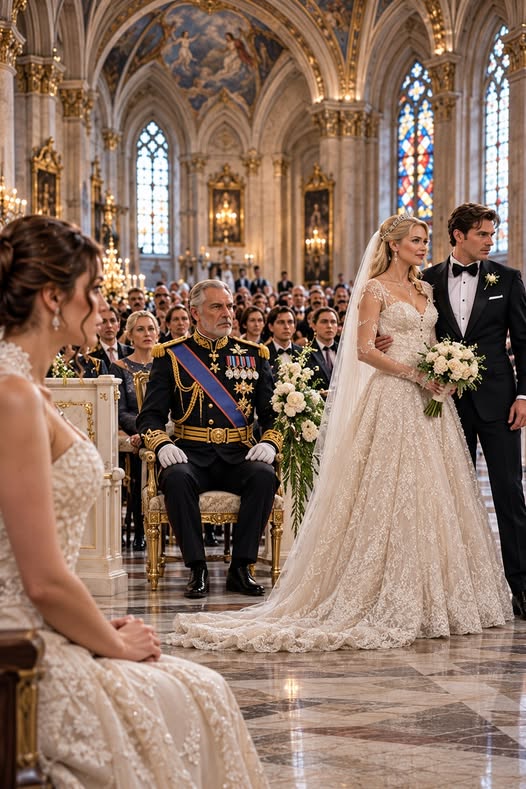
She was the former ambassador to the Ashford family, a woman whose photograph had appeared in newspapers alongside world leaders for decades. She bowed her head. And then, almost as if a signal had passed through the cathedral, several other guests rose. One by one, they bowed. Vane’s smile disappeared. Beatrix released his hand. “Who is that?” she whispered. Vane looked toward his mother, who was sitting in the second row. His mother had already gone white. She knew exactly who my grandfather was. Everyone in the Ashford family knew. They had spent the previous two years trying to secure a commercial partnership with the Aurelian Imperial Development Council. They had submitted proposals, arranged private dinners, and requested introductions through three different diplomatic channels. They had never succeeded. And now the emperor they had been trying to meet was standing in their family cathedral wearing a suit they had mistaken for something borrowed from a charity shop. Grandfather buttoned his jacket. He didn’t raise his voice. He didn’t need to. “I believe,” he said, looking directly at Vane, “that you have just insulted my granddaughter.” Vane swallowed. “Your Majesty, I…” Grandfather lifted one hand. “Do not address me with a title you would have ignored five minutes ago.” The words traveled through the cathedral. Vane looked at me. “Elara?” I stood beneath the stained-glass windows, still holding my bouquet. He seemed to be searching my face for an explanation. “Why didn’t you tell me?” I almost laughed. “You never asked who my grandfather was.” “I knew you had family.” “You knew I had an elderly relative. You never asked his name.” “That isn’t fair.” I looked at the man who had just called my family beggars. “Neither was what you said.” Beatrix took a step away from him. “Vane, what is happening?” He turned toward her. “It’s complicated.” “No,” she replied. “It really isn’t.” Grandfather walked slowly toward the altar. His security director, Colonel Marcus Vale, followed several steps behind. The colonel carried a slim black leather case. Grandfather stopped in front of Vane. “My name is Aethelgard. I am the sovereign of the Aurelian Empire, and this young woman is my only granddaughter.” He paused. “She is also the person who has spent the last three years restoring historical manuscripts in an archive while refusing to use her family name to obtain special treatment.” His eyes moved briefly toward the guests. “She has never asked anyone to bow to her. She has never demanded a place at a table because of her inheritance. And she has never measured another human being by the balance of their bank account.” Then he looked back at Vane. “Apparently, you have.” Vane’s mother, Margaret Ashford, stood up. “Your Majesty, I sincerely apologize for this unfortunate misunderstanding.” Grandfather turned toward her. “Was it a misunderstanding?” Margaret hesitated. “My son has been under considerable pressure.” “Pressure does not force a man to humiliate a woman at the altar.” Nobody spoke. Vane straightened his jacket. “Your Majesty, I think we should discuss this privately. There are business matters between our families that could be affected by today’s events.” That was when Grandfather smiled. It wasn’t a warm smile. “Ah. There it is.” He glanced at Colonel Vale. “Please bring the documents.” The colonel opened the leather case. Inside were several folders, each marked with the imperial seal. Vane’s expression changed. “What documents?” Grandfather took the first folder. “For the past fourteen months, the Ashford Group has been seeking approval for a major maritime infrastructure partnership with the Aurelian Empire.” Vane nodded quickly. “Yes. We’ve been working on that proposal.” “I know.” Grandfather handed the folder to Colonel Vale. “Our investment council reviewed your proposal. The initial assessment identified several concerns regarding the company’s debt structure, projected revenue, and undisclosed liabilities.” Vane frowned. “Those matters have already been addressed.” “Have they?” Grandfather opened the second folder. “Your company has been presenting projected contracts as secured agreements. Several of those contracts were still under negotiation. In addition, your financial reports contain discrepancies that require independent examination.” Vane’s face tightened. “These are commercial matters. They have nothing to do with my personal life.” “Correct,” Grandfather said. “And that is precisely why I have kept them separate.” He handed the folder to Marcus. “The investment council has independently decided to suspend its review until the necessary financial information is verified. No final agreement was ever promised.” Vane stared at the documents. “But the financing…” “Was never guaranteed.” I watched the realization settle over him. For months, Vane had been telling his board that the Ashford Group was close to securing a historic international partnership. He had even mentioned the possibility of an imperial-backed investment during private meetings. I had never known the details. Now I understood why he had become increasingly interested in my family’s background during the last few weeks of our engagement. He hadn’t been asking about my grandfather because he wanted to know him. He had been looking for an opportunity. And perhaps he had suspected more than he admitted. Grandfather turned toward me. “Elara, my dear, would you like to say anything?” I looked at Vane. My hands were trembling, but my voice was steady. “I want to ask you one question.” Vane nodded eagerly. “Anything.” “If my grandfather had remained in that gray suit, if nobody had recognized him, and if you had still believed my family was poor, would you have married me?” He opened his mouth. Then closed it. “I was making a difficult decision.” “That wasn’t my question.” He looked toward Beatrix. She was watching him with an expression I couldn’t read. Finally, he said, “You don’t understand the responsibilities I have.” I nodded slowly. “That’s an answer.” I removed my engagement ring. For six months, I had worn it every day. I had touched it whenever I was nervous. I had imagined passing it down one day. Now it felt like a piece of metal that had belonged to someone else’s life. I placed it on the altar beside the wedding vows. “I understand your responsibilities perfectly, Vane. You just don’t understand mine.” He stared at the ring. “Don’t do this.” “You already did.” Then I turned toward Beatrix. She looked startled. “I don’t know what he promised you,” I said, “but I hope you know that you deserve someone who chooses you without calculating what your family can provide.” Her eyes softened. For a moment, she looked less like a billionaire heiress and more like a woman who had just discovered she was standing in the middle of someone else’s deception. “I think I understand,” she whispered. She removed the small diamond brooch Vane had given her and placed it beside my ring. “I won’t be marrying him either.” Vane turned sharply. “Beatrix!” She shook her head. “You told me Elara had agreed to end the engagement weeks ago. You said the wedding was only being held because of family expectations.” I stared at him. He had told her that? Beatrix continued. “You said she was aware of our arrangement and that the two families had already agreed.” “That was a misunderstanding.” “No, Vane. You lied.” She looked toward the guests. “And I won’t become part of a marriage built on lies.” She walked away from the altar. The sound of her heels against the marble floor was almost painfully clear. Vane remained standing alone. His mother tried to approach him, but he waved her away. For the first time, he seemed to realize that the room was no longer his to control. Grandfather offered me his arm. “Shall we go home?” I nodded. But before we could leave, Vane called after me. “Elara, please.” I stopped. He looked desperate. “I love you.” I turned around. “You loved the life you thought I could give you.” “That isn’t true.” “Then why did you wait until the altar to tell me I wasn’t good enough?” He had no answer. I walked out of St. Bellamy Cathedral beside my grandfather. Behind us, three hundred guests watched the wedding that would never happen. And I didn’t look back.
The first thing I did when we reached Grandfather’s residence was take off my wedding dress. I didn’t throw it away. I folded it carefully and placed it inside its garment bag. Somehow, I couldn’t bring myself to destroy it. It had been chosen by a woman who believed she was about to marry the love of her life. That woman deserved some kindness. Grandfather was waiting in the adjoining sitting room. He had changed out of his ceremonial uniform and was wearing a simple cream sweater. He looked tired. At eighty-three, he had traveled through the night to attend my wedding. I sat beside him. “I’m sorry you had to see that.” He turned toward me. “Why are you apologizing?” “Because I invited you into something that ended like this.” He shook his head. “Elara, I have attended state funerals, diplomatic crises, and meetings where entire governments were on the verge of collapse. I have never considered sitting beside my granddaughter at her wedding an inconvenience.” I smiled weakly. Then I began to cry. He took my hand. “Did you love him?” “Yes.” “Then allow yourself to grieve. His behavior does not make your feelings foolish.” I lowered my head. “I thought he loved me.” Grandfather was quiet for a moment. “Perhaps he did love something about you. But love that disappears when a person discovers you cannot provide a financial advantage is not the kind of love on which a marriage can stand.” I leaned against his shoulder. For the first time that day, I stopped trying to be composed. I cried until there was nothing left to say.
The next morning, the story was everywhere. The abandoned bride. The emperor in the faded gray suit. The shipping heiress who walked away. And the Ashford heir who had rejected an imperial princess because he believed her family was poor. Photographs of Grandfather standing beneath the cathedral’s stained-glass windows appeared on the front pages of newspapers. One headline read: ASHFORD HEIR REJECTS PRINCESS, LOSES IMPERIAL PARTNERSHIP. Another called it the most expensive wedding cancellation in modern society. I hated every headline. They made it sound as though the tragedy was that Vane had lost a business opportunity. That wasn’t the tragedy. The tragedy was that I had trusted someone who believed my worth could be measured by my family’s wealth. For several days, I refused interviews. I turned off my social media accounts and returned to the small apartment I had rented near the Rothmir Archive. Grandfather offered me a room in the palace. I declined. “I need my own space.” He understood. “You may have an empire waiting for you, but you are still allowed to have a small apartment and a quiet morning.” I smiled. “That’s exactly what I want.” On my first morning back at work, my colleague Nora nearly knocked over a stack of manuscripts when she saw me. “Oh, Elara.” She crossed the room and hugged me. “I am so sorry.” I held her tightly. “Thank you.” She stepped back and studied my face. “Are you going to be all right?” “I think so.” She nodded toward my workbench. “I saved your restoration project. Nobody has touched it.” I looked down at the ancient manuscript. It was a damaged collection of letters from a woman who had lived nearly six hundred years earlier. The ink had faded. Several pages had been torn. But the words were still there. I put on my gloves. “Then I suppose I should finish what I started.” Nora smiled. “That sounds like you.” For the next several weeks, I returned to my ordinary routine. I took the bus. I bought coffee from the little shop across the street. I worked with fragile paper and old bindings. And slowly, the humiliation stopped feeling like something that had happened to me yesterday. But the story wasn’t over. Not even close.
Three weeks after the wedding, Margaret Ashford requested a private meeting. She sent a handwritten invitation to the palace. Grandfather asked whether I wanted him present. I declined. “If I meet her, I want to hear what she has to say without anyone speaking for me.” We arranged the meeting at a quiet hotel. Margaret arrived wearing a tailored gray suit and carrying a leather handbag. She looked different from the confident woman who had sat in the front row of the cathedral. She sat opposite me. “Elara, I hope you understand that I never intended for things to go this far.” I waited. “Vane was under tremendous pressure. The company has been struggling, and he believed marrying Beatrix would stabilize our position.” I looked at her. “Did you know he planned to abandon me at the altar?” She hesitated. “I knew he had doubts.” “Did you know Beatrix would be there?” “Yes.” I felt my stomach tighten. “So you knew.” Margaret looked down. “I thought he would find a way to end things privately.” “But he didn’t.” “No.” I took a breath. “Why did you think I deserved that?” She looked uncomfortable. “I never thought you deserved humiliation.” “Then what did you think I deserved?” She didn’t answer. I continued. “You judged my clothes, my apartment, my job, and my family before you knew anything about me. You treated me as though I was an inconvenience to your son’s future.” Margaret’s eyes filled with tears. “I was trying to protect my family.” “From what?” “Financial collapse.” There it was. The real reason. The Ashford Group had been facing serious problems for nearly a year. Its shipping operations had become less profitable. Several loans were approaching maturity, and a major expansion project had gone over budget. Vane believed a marriage to Beatrix would bring financial support and open access to her family’s shipping network. Margaret had encouraged him. She had even helped arrange the private meetings between the two families. I sat quietly. “Did you ever consider that I might have loved your son regardless of his money?” Margaret nodded. “I know that now.” “No,” I said gently. “You know my grandfather’s name now.” She looked up. I continued. “You don’t know what I would have offered your son. You never gave me the chance to show you.” For a long moment, she stared at the table. Then she whispered, “I’m sorry.” I believed she was sorry. But I wasn’t sure what she was sorry for. And I wasn’t ready to forgive her. “I appreciate you saying that,” I replied. “But I don’t think we need to see each other again.” She nodded. Before leaving, she asked one final question. “Will your grandfather still consider the Ashford proposal?” I looked at her. “The investment council will make its decision based on the company’s financial position. My personal life has nothing to do with that process.” She seemed disappointed. I almost felt sorry for her. Almost.
Two months later, a financial investigation into the Ashford Group became public. The investigation had begun before the wedding. Independent auditors had identified inconsistencies in several subsidiary accounts and questioned whether certain projected revenues had been presented too optimistically. The imperial investment council had requested clarification. The Ashford board had delayed providing complete records. After the wedding, the matter received renewed attention. The council confirmed that it would not proceed with the proposed partnership until the concerns were resolved. That announcement was enough to trigger a crisis. Several lenders demanded updated financial disclosures. The company’s share price fell. Two major suppliers suspended credit arrangements. Vane released a statement blaming the collapse of negotiations on political interference and personal revenge. He claimed my grandfather had used the wedding incident as an excuse to destroy his family’s business. Grandfather was furious. Not because Vane had insulted him. Because he had accused an independent financial institution of acting dishonestly. He summoned the council’s legal director. “Publish the full review,” he instructed. “Every finding that can legally be disclosed. Let the facts speak for themselves.” The report eventually revealed that the Ashford Group had overstated the value of several pending contracts and failed to disclose significant liabilities to certain prospective investors. The findings were serious enough to trigger regulatory reviews. But the report also made one thing clear. The investigation had begun before the wedding. The emperor had not ordered the company to collapse. He had simply refused to rescue it without proper evidence. That distinction mattered. And it mattered even more to the hundreds of employees whose livelihoods depended on the company. Grandfather instructed his advisers to explore whether essential shipping operations could be protected through a transparent restructuring process. He refused to make the company’s owners a special offer. Instead, any proposal would have to protect workers, honor legitimate creditors, and meet the same standards applied to every other investment. When I asked him why he was helping at all, he replied: “Because the employees did not abandon you at the altar.” I never forgot that.
Six months after the wedding, Beatrix contacted me. She asked whether we could meet. I agreed. We chose a small restaurant in the city. She arrived alone, without an entourage or expensive jewelry. “I owe you an apology,” she said. I waited. “I knew Vane was engaged. He told me the relationship had ended, but that your family was insisting on the wedding for appearances.” She looked embarrassed. “I should have verified that. Instead, I believed what was convenient for me.” I appreciated her honesty. “Why did you go along with it?” She thought for a moment. “Because I wanted to win.” I raised my eyebrows. She gave a small, humorless smile. “My family has spent years competing with the Ashfords. Vane made me feel like choosing me would prove something. I liked that.” I understood more than I wanted to. “Did you love him?” “No. I loved the idea of being the person he chose.” She looked down. “When he abandoned you, I realized I was about to become part of the same arrangement. He wasn’t choosing me. He was choosing what he thought I could provide.” We sat quietly. Then she said something I hadn’t expected. “I hope you find someone who loves the person you are when nobody is watching.” I smiled. “I hope you do too.” We didn’t become close friends. But we left the restaurant with a mutual understanding. Sometimes two people can be placed in competition by someone who benefits from their rivalry. And sometimes the best thing they can do is refuse to play.
A year after the wedding, Grandfather invited me to a meeting at the imperial palace. He had been preparing for a constitutional transition, and he wanted me to begin taking a more active role in the family institutions. I had known the day would come. Still, seeing the documents laid out on the long oak table made my chest tighten. The first folder contained my formal designation as Crown Princess and heir to the imperial house. The second contained an appointment to the board overseeing the Aurelian Historical Preservation Trust. The third contained a proposal for a new public archive initiative. Grandfather watched me read. “Which one interests you most?” I smiled. “The archive.” He laughed. “I thought you might say that.” I pointed to the proposal. “I want to establish a restoration center where young conservators can train without having to come from wealthy families.” “Why?” “Because talent shouldn’t depend on who can afford an education.” He nodded. “Then make it happen.” Over the next year, the center became one of my most important projects. We offered scholarships, paid apprenticeships, and access to restoration laboratories. Students from small towns worked alongside experienced conservators. People who had never imagined entering a royal institution found themselves preserving manuscripts that had survived wars, fires, and centuries of neglect. I loved every minute of it. The work reminded me why I had chosen my ordinary life in the first place. I didn’t need to be admired. I wanted to do something meaningful. And for the first time, I was building a future that belonged entirely to me.
Two years after the wedding, I received a letter from Vane. It was short. He wrote that the Ashford Group had undergone restructuring and that he was no longer its chief executive. He had taken a position with a smaller shipping company. He said he had spent a great deal of time thinking about the wedding. He admitted that he had treated love like a business transaction and that he had mistaken social status for personal worth. At the end, he asked whether I would consider meeting him. I read the letter twice. Then I placed it in a drawer. I didn’t feel anger anymore. I didn’t feel the desire to prove anything. But I didn’t want to reopen a door simply because the person on the other side had finally understood why it had closed. I wrote a brief reply. “Vane, I hope you have learned from what happened. I wish you well, but I have no interest in rebuilding our relationship. The person I was before the wedding deserved honesty and respect. I will not ask her to accept less now. Elara.” I mailed it the following morning. Then I went to work.
Three years after the wedding, Grandfather’s health began to decline. He was still sharp, still stubborn, and still capable of making an entire council reconsider a proposal with a single question. But he tired more easily. One afternoon, I found him sitting in the palace garden, looking through an old photograph album. He pointed to a photograph of my parents. My mother had died when I was young, and my father had passed away several years later. Grandfather had raised me with the help of a small household staff. “I remember your mother wearing that dress,” he said. I sat beside him. “She would have loved the restoration center.” “She would have loved you working there.” He closed the album. “Do you remember why I agreed to let you live under a different name?” I nodded. “I wanted to know whether someone could love me without knowing about the empire.” “And did you learn?” I looked at the garden. “Yes.” He waited. “I learned that some people see money as a reason to love you, and others see its absence as a reason not to. But neither group is really looking at you.” He smiled. “That is a difficult lesson.” “It was.” He reached into his pocket and removed a small folded piece of paper. It was an old note in my mother’s handwriting. She had written it shortly before she died. Grandfather handed it to me. The note said: “My little Elara, never let anyone convince you that your worth is determined by the size of the room you enter. The most important thing about you will always be the kindness you carry into it.” I read it slowly. Then I looked at him. “Why didn’t you give this to me before?” “Because I wanted you to understand it for yourself.” I folded the paper carefully. “I think I finally do.” He took my hand. “Then I have done my job.”
Several months later, Grandfather passed away peacefully in his sleep. The empire mourned him for days. Leaders from across the world attended his funeral. The streets were filled with people who had come to pay their respects. But I remembered him differently. Not as the emperor who arrived at a cathedral with an entire security convoy. Not as the man whose signature could move markets. I remembered the elderly man in the faded gray suit. The man who had sat quietly in the front row because his granddaughter had asked him to. The man who had never judged me for wanting an ordinary life. At the funeral, I wore a simple black dress and carried the old note from my mother in my pocket. When the ceremony ended, I stood alone beside his coffin for several minutes. “Thank you,” I whispered. “For coming that day. For letting me be myself. And for teaching me that power means nothing if it isn’t used to protect people.” Then I walked out. The following month, the constitutional council formally confirmed my succession as Empress of the Aurelian Empire. I accepted the responsibility with humility. My first public initiative was to expand the historical preservation center and establish scholarships for students from disadvantaged communities. My second was to create an independent oversight body for major imperial investments. My grandfather had taught me that influence should never be used to bypass fairness. I intended to remember that.
Four years after the wedding, I returned to St. Bellamy Cathedral. This time, I wasn’t wearing an ivory gown. I was attending the opening of a historical conservation exhibition. The cathedral had recently agreed to host a collection of restored manuscripts, including several documents that had been damaged during an old fire. I stood beneath the same stained-glass windows where Vane had once told me my family was too poor for him. The sunlight passed through the colored glass and fell across the stone floor. For a moment, I remembered the girl I had been. She had believed that the worst thing that could happen to her was being rejected in front of three hundred people. She had believed that losing the wedding meant losing her future. She had been wrong. A young conservator approached me. “Your Majesty?” I turned. “Yes?” She hesitated. “May I ask you something personal?” “Of course.” “I heard about your wedding. People always tell the story as though the important part was discovering you were an imperial heir.” I smiled. “That’s what the newspapers preferred.” She looked down. “But what if you hadn’t been? What if your grandfather had just been an ordinary old man in a gray suit?” I considered her question. Then I answered honestly. “Then I would still have deserved respect.” She looked at me. I continued. “I would still have deserved a husband who didn’t humiliate me. I would still have deserved honesty. And I would still have had every right to walk away.” She nodded slowly. “People sometimes think money makes someone valuable.” “Money can make life easier,” I said. “It can create opportunities and provide security. But it cannot create character. And it certainly cannot replace love.” The young woman smiled. “Thank you.” After she left, I remained beneath the stained glass for a few moments longer. I thought about the engagement ring on the altar. The bouquet in my hands. The elderly man who had stood up when everyone else was too shocked to move. And the question people still asked me: Would I have given Vane another chance if he had discovered my identity before abandoning me? My answer was no. Not because he was poor. Not because he was ambitious. Not because he wanted a successful life. But because he had shown me who he was when he believed I had nothing to offer. I could forgive him someday. I could wish him well. But I would never again confuse forgiveness with permission to return. As I walked toward the cathedral doors, sunlight followed me across the marble floor. I no longer needed an emperor to stand beside me. I no longer needed a title to make people listen. And I no longer needed to prove that I belonged anywhere. I had learned that the greatest inheritance my grandfather left me was not an empire, a palace, or a fortune. It was the freedom to recognize my own worth before anyone else had the chance to measure it. Vane had believed he was choosing a woman worthy of his family name. He never realized that the woman he rejected was already carrying a name that belonged to history. But that was no longer what mattered. Because the day he abandoned me at the altar, I didn’t lose my future. I lost someone who had never truly understood it. And in doing so, I finally found the courage to build a future on my own terms. Never let someone convince you that you are worth less because of what you own, where you come from, or what your family can provide. The right people won’t need to discover your wealth before they recognize your worth. And the right kind of love will never ask you to become someone else just to deserve it.